Charities That Help With Car Repairs in New York (2026): Your County DSS Can Pay, and the State Manual Says So

If you search for car repair help in New York, you get the same national list every other state gets: Good News Garage, Vehicles for Change, Wheels of Success, Working Wheels. None of them serves New York. Good News Garage works “across New England.” Vehicles for Change says its program is “currently limited to individuals and families who live in Maryland.” Wheels of Success is in Tampa. Working Wheels is in Asheville.
The money that fixes cars in New York comes from somewhere else. Your county Department of Social Services can pay for a car repair outright, and the state’s own employment manual says so in plain words. On top of that, a handful of upstate community action agencies run state-funded “Wheels for Work” grants, and New York’s inspection rules have a $450 waiver that can keep a failing car legal. Almost none of this appears in the national guides.
Every program, dollar figure, eligibility rule and phone number on this page was read off the administering agency’s or organization’s own website on 22 September 2026. Where a county’s published limit comes from an older plan, this page gives the plan year so you know how old it is. Where we could not verify something, we say so instead of guessing.
The short version: where the money actually is
New York has one route that exists in every county, your local DSS, and five nonprofit or county programs we could verify as running today. All five are upstate. We found no verified car repair charity taking public applications in New York City, on Long Island, or in the Buffalo or Rochester metros. In those places, DSS is the realistic route.
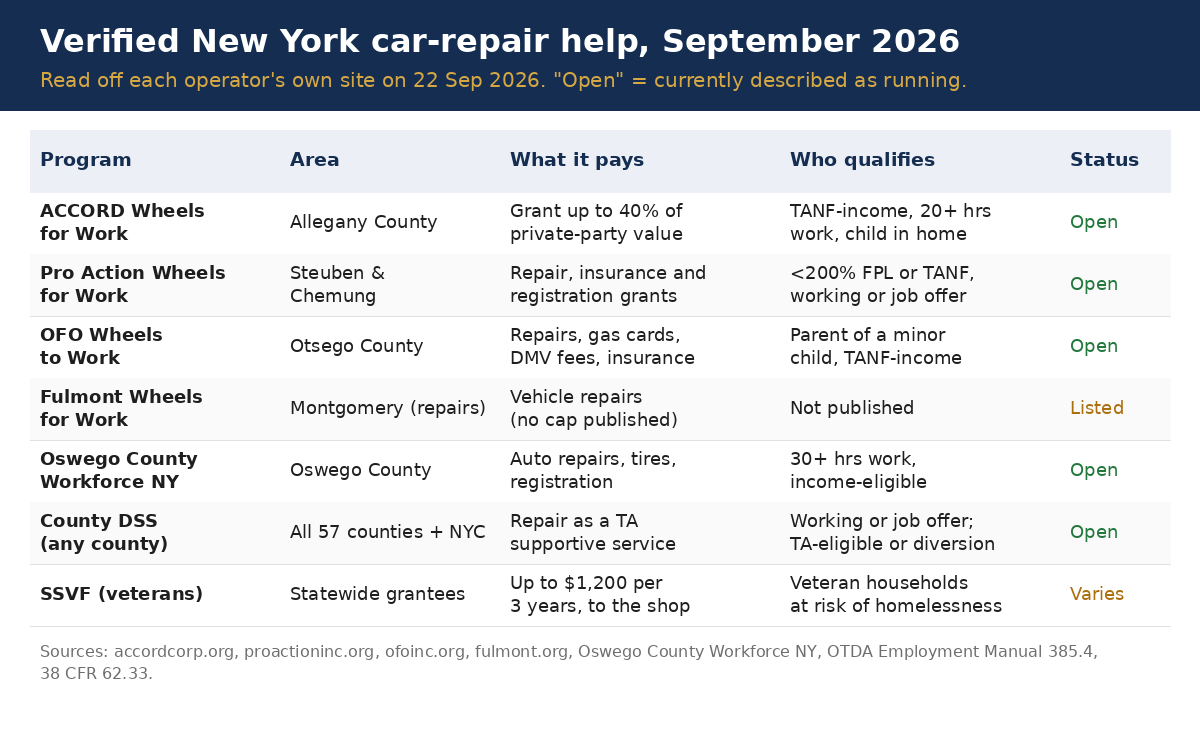
Work through it in this order. If you live in Allegany, Steuben, Chemung, Otsego, Montgomery or Oswego County, start with the local program in the table, because it is usually faster and less paperwork than DSS. Everyone else starts at DSS. Veterans at risk of losing housing should also call an SSVF provider, covered below.
Start here: your county DSS can pay for the repair
New York’s Office of Temporary and Disability Assistance (OTDA) writes the rules every county Department of Social Services follows. Its Employment Policy Manual, section 385.4 (revised March 2022), answers the question directly:
“Q.1 Can the district pay to repair an applicant’s car in order to enable the TA applicant to continue working?
A.1 Yes. Supportive services can be used as a diversion in a front door program.”
The manual goes on to say the district can decide “that repairing the car enables the applicant to continue in his/her employment and prevents the applicant from needing public assistance.” In other words, you do not have to be on welfare already. If fixing your car is what keeps you working and off Temporary Assistance, the county is allowed to pay for the fix instead.
The same section lists vehicle repair by name in the upstate payment category for transportation, called R7-Transportation: “bus tokens/passes, gas card, mileage reimbursement, vehicle insurance, vehicle repair, driver’s license fees and vehicle registration.” It is available to Family Assistance and Safety Net Assistance applicants and recipients.
If you just left Temporary Assistance for a job
There is a second window many people miss. Payment type T2 covers “transportation employment related expenses for FA, SNA MOE, and SNA non-MOE recipients whose case closed due to employment for up to 90 days.” If your TA case closed because you started working, and your car breaks down within the first 90 days, tell DSS that your case closed due to employment and ask about T2 transportation help.
How much your county will pay
There is no statewide cap. Each county sets its own limit in a TA/SNAP Employment Plan it files with OTDA. That is why the answer in Dutchess is different from the answer in Genesee. Here is what the plans we could read actually say:
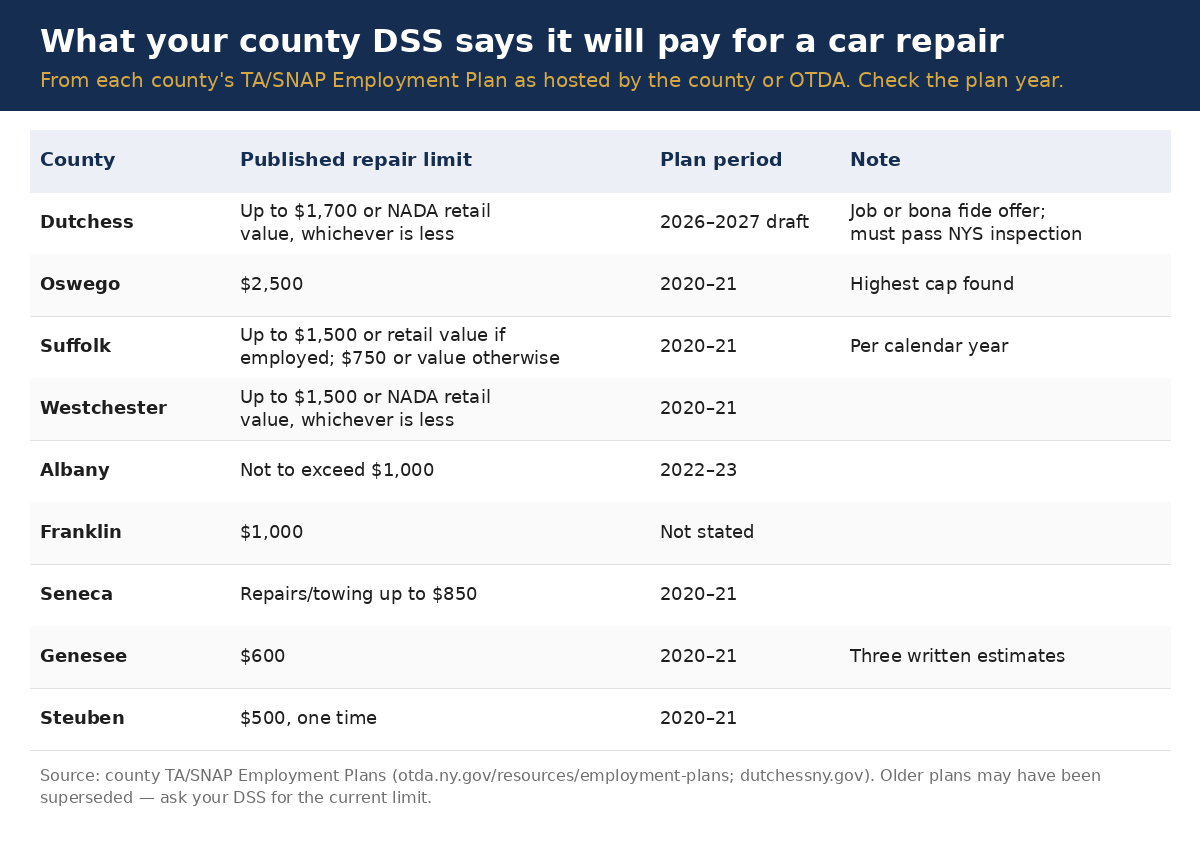
Read the plan period column before you rely on a number. Only Dutchess has a current plan, a draft covering January 2026 through December 2027. For most other counties, the copy OTDA hosts today is the 2020–21 plan. Those limits may have changed since. They are still useful because they tell you the county does pay for repairs and roughly how much. When you call, ask what the current limit is.
Some details from the plans are worth knowing before you apply:
- Dutchess (2026–2027 draft) pays “Up to $1,700, or the average retail value as listed in the NADA Appraisal Guide whichever is less for repairs.” You need a job or a bona fide job offer, and the car must pass New York State inspection after the repair.
- Suffolk (2020–21) pays “Up to a maximum of $1,500 for auto repairs, or the retail value of the automobile, whichever is less, during any calendar year” for people who are employed, and up to $750 for other participants.
- Westchester (2020–21) allows up to $1,500 or the NADA retail value, whichever is less.
- Oswego (2020–21) lists “Automobile Repairs $2500.00,” the highest limit we found.
- Genesee (2020–21) caps repairs at $600 and requires three separate written estimates.
- Monroe (2020–21) lists one-time payments for “rent, energy, transportation, car insurance or repairs” but publishes no dollar limit.
- Chautauqua runs a named Diversion Services program that helps “with motor vehicle insurance, vehicle registration and/or necessary vehicle repairs to ensure transportation to and from employment.” It is for people who are “low-income and without sufficient resources” and “at risk of needing ongoing Temporary Assistance.” Call the Jamestown office at 716-661-8200 or the Dunkirk office at 716-363-3500, Monday to Friday, 8:30 a.m. to 4:30 p.m.
The NADA rule shows up in several plans, and it matters. If the repair would cost more than the car is worth, DSS will pay only up to the car’s value, or not at all. If your repair estimate is higher than your car’s value, skip to the section on replacement below.
How to ask DSS for a car repair
- Get written estimates first. Get at least two, and three if you live in Genesee. Use a shop registered with the New York DMV.
- Get proof of work. Pay stubs, a schedule, or a letter from your employer. If you have a job offer, get it in writing with a start date.
- Find out what the car is worth. Look up its NADA or private-party value and bring a printout.
- Call or visit your county DSS and ask for Temporary Assistance with an employment-related supportive service or diversion payment for a car repair. Use those words. “Can you help with my car?” can get you routed to the wrong desk.
- If you are told no, ask which section of the county’s TA/SNAP Employment Plan covers transportation and what its limit is. Then quote OTDA Employment Policy Manual section 385.4, Q.1. Caseworkers do not always know this rule exists.
New York City is the one place we could not confirm. HRA’s employment plan would not load when we checked, and its One-Shot Deal page returned an error. The OTDA manual still covers NYC. But we cannot tell you HRA’s limit or which office handles it, so we have not guessed. In the five boroughs, call 311 and ask for HRA employment-related transportation or car repair assistance.
Wheels for Work: the state money that reaches upstate counties
On top of ordinary DSS payments, OTDA funds a separate transportation program for low-income working families. It is still widely called Wheels for Work. OTDA’s own summary of the 2023–24 round says “Eleven (11) local departments of social services were awarded,” and that “Services may include driver education, modified public transportation services, van pool programs, transit passes, gas cards, car repairs, license and registration fees, auto insurance and auto loan programs.”
OTDA does not list the eleven counties on that page. Its 2010–2023 funding matrix lists Albany, Allegany, Delaware, Dutchess, Franklin, Fulton, Genesee, Jefferson, Montgomery, Oswego, Otsego, Seneca and Steuben. The counties usually hand the money to a local community action agency to run. Here are the ones we could verify as running today.
ACCORD Corporation, Wheels for Work (Allegany County)
What it pays: “Repair grants cover up to 40% (2026 Program) of the private party value of the vehicle.” These are grants, not loans. You collect the estimates yourself: “A minimum of two written estimates are required; it is the participant’s responsibility to collect them.”
Who qualifies: You must live in Allegany County, work at least 20 hours a week at minimum wage or more, and meet TANF income eligibility. ACCORD says that means being eligible for Family Assistance or Safety Net, Medicaid, SNAP, HEAP, or reduced or free school lunch. The household must include a child under 18 or a pregnant woman, or you must be a non-custodial parent. Your license must be free of any DUI, DWI or DWAI for 7 years.
How to apply: Download the application from ACCORD’s Wheels for Work page and mail or email it. ACCORD says that after your application arrives, the program coordinator will call you to schedule an interview. Phone (585) 268-7605, ext. 1711. Address: 84 Schuyler Street, Belmont, NY 14813. Email: business@accordcorp.org.
One discrepancy: The 211 Helpline database still describes the grant as “not exceeding 25% of the private value.” ACCORD’s own page, which is the more recent source, says 40% for the 2026 program.
Pro Action of Steuben and Yates, Wheels for Work (Steuben and Chemung counties)
What it pays: “Auto repair grants, Insurance payment grants, Registration grants.” There are no fees. Pro Action does not publish a dollar cap.
Who qualifies: In both counties, household income must be below 200% of the federal poverty level, or you must receive TANF. You need a valid New York driver’s license.
- Steuben: You need “custodial or non-custodial children under age 18” and must be “working a minimum of 20 hours per week or have the promise of employment.”
- Chemung: There is no child requirement, but you must be working or have a promise of employment, and you “Must be the primary owner of the vehicle.”
How to apply: Contact the program coordinator, Samantha Smalt, at 607-776-2125 x4113 or smalts@proactioninc.org. The 211 Helpline listing gives Pro ActionPro Action’s main office is at 117 E. Steuben Street, Bath, NY 14810.rsquo;s address as 117 E. Steuben Street, Bath, NY 14810, with a second number, 607-776-2723.
Opportunities for Otsego, Wheels to Work (Otsego County)
What it pays: “financial assistance to eligible adults so they may make necessary vehicle repairs, obtain gas cards, and pay select DMV fees and car insurance premiums.” OFO does not publish a dollar amount, and another OFO page says services are first-accepted, first-served. Apply early in the funding year.
Who qualifies: You must live in Otsego County and be the parent or non-custodial parent of a minor child. OFO’s service page adds that relative caregivers may qualify and that you must meet TANF services income eligibility.
How to apply: Call OFO’s main line at 607-433-8000, Monday to Friday, 8 a.m. to 5 p.m. OFO lists its address as 3 West Broadway, Oneonta, NY 13820. OFO’s two program pages give different phone numbers; the other one lists 607-433-8335. If one does not get you to Wheels to Work, try the other.
Fulmont Community Action Agency, Wheels for Work (Montgomery County)
Fulmont lists “Wheels for Work providing vehicles and vehicle repairs (Montgomery County only).” Fulmont serves Fulton County too, but its page limits repairs to Montgomery residents. It publishes no amounts or eligibility rules, so this is a program to call, not one you can plan around. Phone (518) 853-3011. Mailing address: PO Box 835, Fonda, NY 12068.
Oswego County Workforce New York, Transportation Assistance Program
This is a public workforce agency, not a charity. Its program covers “Auto Repairs,” tires, registration fees, gas cards and bus passes. To qualify, you must “Be employed a minimum of 30 hours per week or verify you’ve accepted new employment for 30 hr. per week,” live in Oswego County, hold a valid license, and be income eligible. The office is at 200 North Second Street, Fulton, NY 13069, phone (315) 591-9000.
Oswego County DSS separately posts an “E&T Vehicle Repair Program” document dated August 2026. We could not read its text, so we are not reporting its terms. If you live in Oswego, ask both offices.
Dutchess County: Way to Work is mostly cars, not repairs
Dutchess runs a county Wheels to Work program with its Workforce Investment Board. A 2018 county release credited it with 869 vehicle repairs. The June 2025 release describes it as a program for getting a car, not fixing one. Treat Dutchess repair help as coming through DSS and its $1,700 limit above. The Way to Work contact in the 2025 release is Taylor O’Donnell, (845) 249-4642.
New York’s $450 emissions waiver: the rule that keeps a failing car legal
New York is one of the states where an emissions failure can stop you from driving legally. Unlike California, New York has no state program that pays for emissions repairs. What it has is a waiver.
The DMV’s waiver form, VS-71.2 (revised January 2026), explains that a vehicle that fails an emissions inspection can still get an inspection certificate “if they have passed the safety inspection and a minimum of $450 has been spent on qualifying repairs.” The Department of Environmental Conservation adds two conditions: “Documented costs must exceed $450,” and the vehicle must fail at least twice in the inspection cycle.
Three things to know before you spend the money:
- Only repairs made after the first failed inspection count. The form says: “Only confirmed emissions failure(s) and documented repairs that occur after the initial inspection count towards the waiver.” Receipts from last month do not count.
- Get itemized receipts from a shop. Parts, labor and related sales tax count toward the $450.
- Check your warranty first. DEC notes that federal law covers emissions parts “for the first 2 years or 24,000 miles,” and catalytic converters “up to 8 years or 80,000 miles.” On a newer car, the repair may be free.
The waiver does not pay for anything. It caps what you have to spend to keep the car legal for one inspection cycle. For a family facing a $1,500 catalytic converter bill, that can decide whether the car stays on the road.
Veterans: SSVF can pay a repair shop directly
The Supportive Services for Veteran Families program (SSVF) is funded by the VA and run in New York by local nonprofit grantees. Federal regulation 38 CFR 62.33 allows grantees to pay for car repairs: “Payments for car repairs or maintenance on behalf of the participant may not exceed $1,200 during a 3-year period.” The money goes to the shop, not to you.
SSVF is not a general repair fund. It is for very low-income veteran households (at or below 80% of area median income) that are homeless or at risk of homelessness. The car repair has to be part of keeping the household housed, for example by keeping the job that pays the rent. None of the New York grantee pages we read mention car repair by name. They list “transportation.” Ask specifically about the vehicle repair payment the regulation allows.
- Suffolk County: Economic Opportunity Council of Suffolk, 631-289-2601 ext. 128.
- New York City (providers listed on the city’s October 2022 SSVF overview): HELP USA 855-457-7783; Jericho Project 646-970-7170; Services for the UnderServed 646-790-2449; Volunteers of America 718-993-3564. That list is several years old, so confirm with the provider when you call.
The NYS Department of Veterans’ Services runs a Veterans Emergency Housing Program with a $2,000 maximum. It covers housing only, not vehicles. We found no county Veterans Service Agency in New York that publishes a car repair fund.
The claims about New York car repair that do not hold up
Here is what we checked and what the organizations’ own pages say.
- Good News Garage does not serve New York. It works “across New England,” and it gives away donated cars. It does not repair cars people already own.
- Vehicles for Change is Maryland only. Its own words: “currently limited to individuals and families who live in Maryland.”
- Wheels of Success is in Tampa, Florida (Hillsborough, Pinellas and Pasco). Working Wheels is in Asheville, North Carolina. Chariots4Hope serves Nebraska and Wisconsin. United Way of Greater Stark’s auto repair program requires you to “Be a Stark County resident” — Stark County, Ohio.
- “Catholic Charities Tompkins/Tioga Wheels for Work, up to $750” is repeated on aggregator sites. Catholic Charities of Tompkins/Tioga’s own emergency assistance page lists “Transportation Assistance” but no car repair program and no $750 figure.
- Catholic Charities of Livingston County’s Wheels for Work traces to a Catholic Courier article from December 2006. We could not find a Catholic Charities car repair program running today in any New York diocese: Rochester, Buffalo, Albany, Syracuse, Ogdensburg, Rockville Centre, Brooklyn or the Archdiocese of New York.
- “Wheels for Workers 716” in Buffalo gives away bicycles, not cars. It is a good program, but it will not fix your car.
- “Ways to Work” car repair loans show up on many lists. The national Ways to Work website did not load when we checked, and we could not verify any active New York affiliate.
- County caps quoted as current on many sites come from 2020–21 plans. We give each figure’s plan year above for that reason.
Where to call when nothing above covers your county
For most of New York the honest answer is DSS first, then 2-1-1. New York’s 211 system is run by regional centers, and each keeps its own database. Call the one for your county:
- 211 Western New York (Cattaraugus, Chautauqua, Erie, Genesee, Niagara, Orleans, Wyoming): 888-696-9211, 211wny.org
- 211/Life Line (Cayuga, Livingston, Monroe, Ontario, Seneca, Wayne): 877-356-9211, 211lifeline.org
- 211 Helpline (Allegany, Chemung, Schuyler, Steuben, Yates): 800-346-2211, 211helpline.org
- 211 Tompkins/Cortland: 877-211-8667, 211tompkins.org
- 211 CNY (Jefferson, Lewis, Onondaga, Oswego, St. Lawrence): 844-245-1922, 211cny.org
- 211 Susquehanna River Region (Broome, Chenango, Delaware, Otsego, Tioga): 800-901-2180, helpme211.org
- 211 Mid-York (Herkimer, Madison, Oneida): 844-342-5211, 211midyork.org
- 211 ADK (Clinton, Essex, Franklin): 888-774-0289
- 211 Northeast (Albany, Columbia, Fulton, Greene, Hamilton, Montgomery, Rensselaer, Saratoga, Schenectady, Schoharie, Warren, Washington): 888-366-3211, 211neny.org
- 211 Hudson Valley (Dutchess, Orange, Putnam, Rockland, Sullivan, Ulster, Westchester): 800-899-1479, 211hudsonvalley.org
- 211 Long Island (Nassau, Suffolk): 888-774-7633, 211li.org
- New York City: dial 311 (212-639-9675 from outside the city)
Ask 211 for vehicle repair assistance by name. Ask for your county’s community action agency too. In New York, community action agencies hold the state Wheels for Work money, even when their websites do not mention it.
When replacement, not repair, is the realistic answer
Several county plans cap repairs at the car’s NADA value. So if your estimate is higher than what the car is worth, the county will not pay the full repair. Two New York options point toward replacement instead:
- Dutchess County DSS can put up to $12,000 toward buying a vehicle when there is no other way to get to work. You must work your scheduled hours for six full weeks before the county buys the car.
- Wheels for Work programs such as Fulmont’s list vehicles as well as repairs, and OTDA’s program description includes “auto loan programs.”
Our guide to free cars for low-income families covers the national vehicle-award programs and which of them actually reach New York.
Before you pay: your rights at a New York repair shop
Every program above requires estimates, and most pay a shop directly. That makes the rules for New York repair shops worth knowing. The DMV sets them out on its “Know your rights in auto repair” page:
- “If you request it, the repair shop must give you a written estimate of the parts and labor necessary.”
- “A shop may not perform any services unless you give your permission.”
- “You are entitled to the return of all replaced parts, except warranty and exchange parts.”
- The shop should display the green and white “Registered State of New York Motor Vehicle Repair Shop” sign. Use a registered shop, because most assistance programs require one.
If a shop overcharges you or does work you did not authorize, you can complain to the DMV with form VS-35. Send it to the Complaint Unit, Bureau of Consumer & Facility Services, NYS DMV, P.O. Box 2700-ESP, Albany, NY 12220-0700, or call 518-474-8943 on weekdays, 8:30 a.m. to 4:15 p.m. There is a “90-day limit on reporting incidents related to a New York State Repair Shop,” so act quickly. The DMV cannot force a refund, and it says costs such as rental cars “cannot be recovered.”
How to actually get a yes in New York
- Start with the right office. Upstate in a Wheels for Work county, that is your community action agency. Everywhere else, it is DSS.
- Tie the repair to your job. Every program on this page is an employment program. Bring pay stubs, a schedule or a written job offer.
- Bring two or three estimates and the car’s value. Programs that pay part of the car’s value (ACCORD) or cap payments at NADA value (Dutchess, Westchester, Suffolk) will ask for both.
- Use the rule’s own words. Ask DSS for “an employment-related supportive service” or “a diversion payment” for car repair, under OTDA Employment Policy Manual section 385.4.
- If the car failed emissions, keep every receipt from after the first failure. The $450 waiver only counts documented repairs made after that inspection.
- If the repair costs more than the car is worth, stop. Switch to a replacement program rather than spending assistance money on a car that will not pass the value test.
Frequently asked questions
Are there charities that help with car repairs in New York?
Fewer than the national lists suggest, and they are all upstate. The verified ones are community action agencies running state-funded Wheels for Work programs: ACCORD in Allegany County (grants up to 40% of the car’s private-party value in 2026), Pro Action in Steuben and Chemung counties, Opportunities for Otsego in Otsego County, and Fulmont in Montgomery County. Oswego County Workforce New York also pays for repairs. In New York City, Long Island, Buffalo and Rochester we found no verified charity taking public applications, so the route there is your county Department of Social Services.
Will New York DSS pay for car repairs?
Yes. The OTDA Employment Policy Manual, section 385.4, answers the question directly: a district can pay to repair an applicant’s car so the applicant can keep working, and it can do so as a diversion payment for someone who is not yet on Temporary Assistance. Vehicle repair is listed by name in the R7-Transportation payment type. Each county sets its own limit in its TA/SNAP Employment Plan. Dutchess County’s 2026-2027 draft plan allows up to $1,700 or the car’s NADA retail value, whichever is less.
How much will my county pay for a car repair in New York?
It depends on the county, because each one sets its own limit. The published limits we found are Dutchess up to $1,700 (2026-2027 draft plan), Oswego $2,500, Suffolk up to $1,500 for employed people and $750 for others, Westchester up to $1,500, Albany and Franklin $1,000, Seneca $850, Genesee $600 and Steuben $500. Apart from Dutchess, those figures come from 2020-21 or 2022-23 plans, so ask your DSS for its current limit. Several counties also cap payments at the car’s NADA value.
Does New York have an emissions repair assistance program?
No. New York has no state program that pays for emissions repairs, unlike California. It has a waiver instead. Under DMV form VS-71.2, a car that fails emissions but passes the safety inspection can still get an inspection certificate once at least $450 has been spent on qualifying emissions repairs, documented and made after the first failed inspection. The Department of Environmental Conservation adds that the vehicle must fail at least twice in the inspection cycle.
Does Catholic Charities help with car repairs in New York?
Not as a published program that we could find. We checked the dioceses of Rochester, Buffalo, Albany, Syracuse, Ogdensburg, Rockville Centre and Brooklyn and the Archdiocese of New York, and none lists a car repair program. The Tompkins/Tioga Catholic Charities program often quoted at up to $750 does not appear on that charity’s own site, which lists general transportation assistance instead. The Livingston County Wheels for Work program traces to a 2006 newspaper article.
Does Good News Garage or Vehicles for Change help in New York?
No. Good News Garage works across New England and gives away donated cars rather than repairing cars people own. Vehicles for Change says its program is limited to people who live in Maryland. Both appear on national lists of car repair charities, but neither serves New York residents.
Can veterans in New York get help with car repairs?
Sometimes, through Supportive Services for Veteran Families (SSVF). Federal rules let SSVF grantees pay up to $1,200 for car repairs or maintenance over a three-year period, paid directly to the shop. SSVF is limited to very low-income veteran households that are homeless or at risk of homelessness. The NYS Department of Veterans’ Services emergency program covers housing only, not vehicles.
I just got a job and my Temporary Assistance case closed. Can I still get help with my car?
Possibly. OTDA payment type T2 covers transportation employment-related expenses for Family Assistance and Safety Net Assistance recipients whose case closed due to employment, for up to 90 days. If your car breaks down within 90 days of your case closing because you started work, contact your DSS and ask about T2 transportation help.
What if the repair costs more than my car is worth?
Several New York counties cap repair payments at the car’s NADA retail value, so a repair that costs more than the car is worth usually will not be approved in full. In that case look at vehicle replacement instead. Dutchess County DSS can put up to $12,000 toward a vehicle purchase after six full weeks of work, and some Wheels for Work programs provide vehicles as well as repairs.
What are my rights at a New York car repair shop?
If you ask, a New York repair shop must give you a written estimate of parts and labor, and it may not do any work you have not authorized. You are entitled to get back the parts it replaced, except warranty and exchange parts. Registered shops display a green and white Registered State of New York Motor Vehicle Repair Shop sign. Complaints go to the DMV on form VS-35 within 90 days of the incident.
Related help
If this page did not solve it, these will help next.
- Charities that help with car repairs — the national picture, and what actually crosses state lines
- Car repairs in California, Texas , Florida and Georgia — the other large-state guides
- Charities that help with rent in New York — the same DSS offices, for housing
- Charities that help with car insurance — several Wheels for Work programs pay premiums too
- Charities that help with car payments — if the loan, not the repair, is the problem
- Free cars for low-income families — when the repair costs more than the car is worth
- Charities that help with transportation — rides, passes and gas cards
How we verified this guide. Every program, dollar figure, eligibility rule, phone number and open-or-closed status on this page was read off the administering agency’s or organization’s own website on 22 September 2026. State material comes from the OTDA Employment Policy Manual section 385.4 (revised March 2022), OTDA administrative directive 22-ADM-06 and local commissioners memorandum 12-LCM-11, OTDA’s Wheels for Work and Transportation Initiative accountability pages, and county TA/SNAP Employment Plans published by Dutchess County and by OTDA. Plan years are stated wherever a figure appears. Inspection material comes from DMV form VS-71.2, 15 NYCRR 79.25 and the Department of Environmental Conservation. Repair-shop rules come from the DMV and 15 NYCRR 82.5. Veterans material comes from 38 CFR 62.33, the NYS Department of Veterans’ Services and the grantees named. 211 regions come from 211 New York and the Office of Children and Family Services. Nonprofit material comes from each organization’s own site. Where something could not be verified, including New York City’s HRA repair limit and the Oswego DSS vehicle repair document, this page says so instead of guessing. Written and verified by Alex Shabani for Nonprofit Point.