Charities That Help With Car Repairs in California (2026): Every Program That Actually Pays

If you have been reading “charities that help with car repairs” lists and coming up empty in California, there is a reason. The organisations those lists name — the garages, the ministries, the vehicle programmes — are in Minnesota, Georgia, Texas, Arizona and Washington. California barely appears on them, and the entries that do appear are frequently suspended, closed or misdescribed.
What California has instead is different, larger, and almost entirely missing from those pages: state and air-district money for emissions repairs, a statutory right to have your county pay for repairs if you are on CalWORKs that was written into law this year, a one-time waiver that lets you register a car you cannot yet afford to fix, and a small number of genuine interest-free lenders. Between them these routes will put more money on a Californian’s repair bill than every national car-repair charity combined.
This guide covers all of it. Every figure, threshold, deadline and status line below was read off the administering agency’s or organisation’s own page on 16 September 2026. Where a programme is closed, this page says it is closed. Where a number is not published, this page says it is not published rather than repeating the figure circulating elsewhere.
The four routes that actually pay a California repair bill
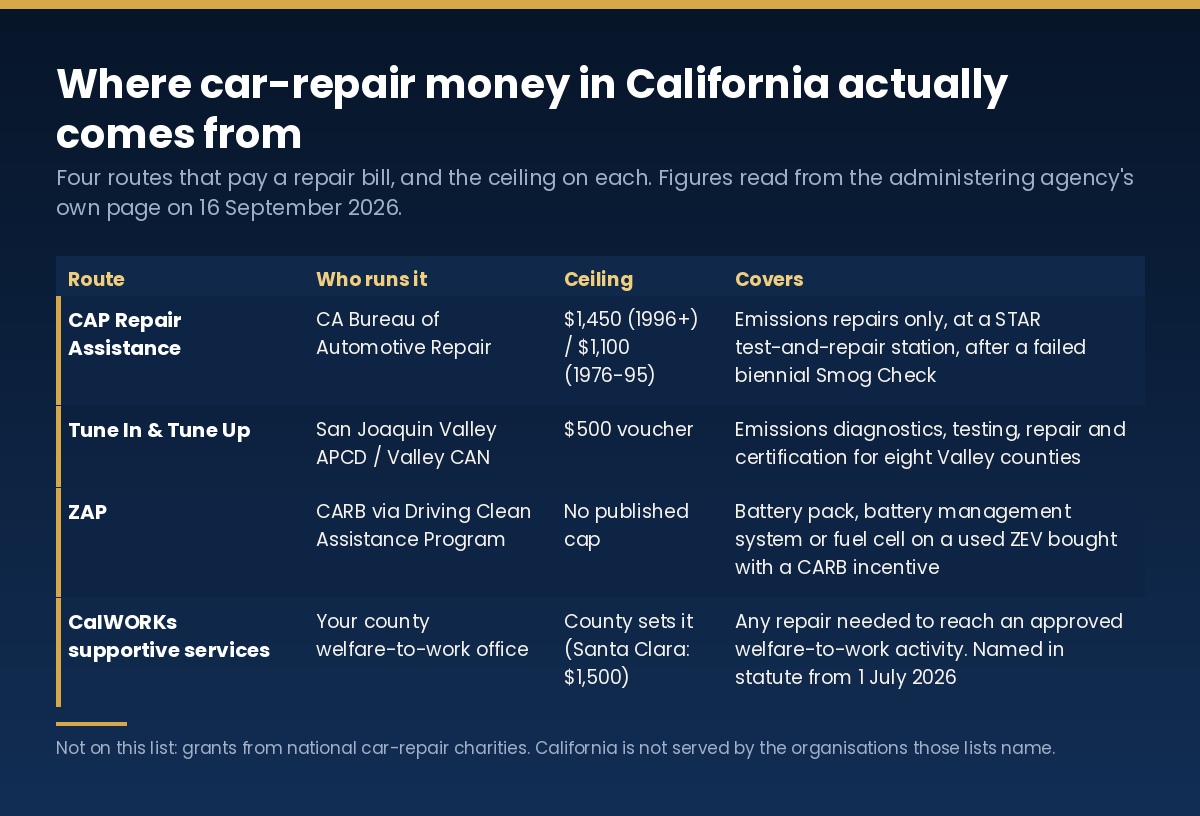
Three of those four are emissions programmes. That is not an accident of how this article is organised — it is the shape of the actual money. California has spent decades building an apparatus to get dirty cars repaired or off the road, and that apparatus is funded at a scale no charity approaches. The Bureau of Automotive Repair reported roughly $33.7 million in Consumer Assistance Program expenditure for fiscal year 2024–25 in its February 2026 supplemental report to the Legislature.
The fourth route, CalWORKs, is the one that covers a transmission, a set of brakes or a timing belt — anything, in principle, if you need the car to get to an approved welfare-to-work activity. It is also the one almost nobody asks for.
1. CAP Repair Assistance: up to $1,450 from the state
The Consumer Assistance Program is run by the California Bureau of Automotive Repair, part of the Department of Consumer Affairs. It is a state programme, not a charity, and it is the single largest source of car-repair money available to an individual Californian.
The amounts, and the figure almost every other page is printing
BAR’s own repair assistance page states the caps plainly:
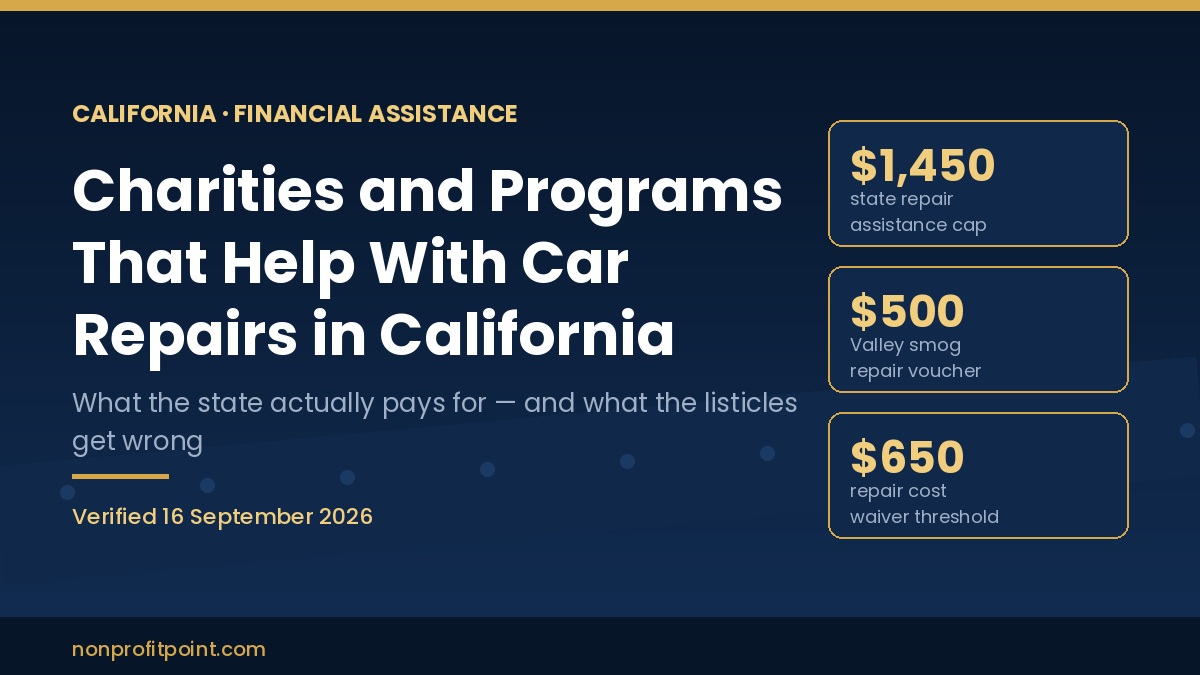
“Model year 1996 or newer vehicles may qualify for up to $1,450 for emissions-related repairs.”
“Model year 1976-1995 may qualify for up to $1,100 for emissions-related repairs.”
If you have read that CAP pays $1,200, that figure is out of date. It is not a small-website problem either: the San Joaquin Valley Air Pollution Control District — a government agency that partners with BAR on smog repair — was still publishing “up to $1,200 in financial assistance toward emissions-related repairs” on its own vehicle repair page when this guide was written. Where two official California sources disagree about a CAP figure, the Bureau of Automotive Repair is the administering agency and its number is the one that governs. Use $1,450 and $1,100.
What you pay
CAP is not a blank cheque. There is a co-payment, and it is structured so that you always pay something. BAR publishes it as two tables:
Model year 1976–1995. If the total cost of diagnosis and emissions-related repairs is $1,375 or less, your co-payment is 20% of the total cost — on a $500 bill you pay $100. If the total is more than $1,375, your co-payment is the total minus $1,100 — on a $1,500 bill you pay $400.
Model year 1996 or newer. If the total is $1,812.50 or less, your co-payment is 20% of the total — on a $1,000 bill you pay $200. If the total is more than $1,812.50, your co-payment is the total minus $1,450 — on a $2,000 bill you pay $550.
The practical reading: CAP covers 80% of a moderate emissions repair and everything above your share up to the cap. It does not cover a repair that vastly exceeds the cap — on a $4,000 job you would still owe $2,550.
Who qualifies
- Income. “Your gross household income must be less than or equal to 225% of the Federal poverty level.” BAR publishes a calculator rather than a dollar table on its repair assistance page, so run your household size through the calculator rather than trusting a figure you find elsewhere.
- The failure has to be the right kind. Your vehicle must have failed its biennial Smog Check inspection. BAR states that “aborted, manual mode, and training mode inspections do not qualify.”
- Registration. Current and unexpired, or all DMV fees paid with registration not expired more than 365 days.
- Not in transition. The vehicle cannot be mid-ownership-transfer or undergoing initial California registration.
- Not a company car. Vehicles registered to businesses, government agencies or non-profits are excluded. So are vehicles with a tampered emissions control system.
- Model year 1976 or newer.
What CAP will not pay for
This is where readers get caught. CAP is an emissions programme. BAR’s published exclusion list is long and specific: “Body repairs, Brakes, Completing OBD II drive cycles, Fuel, Glass repairs, Heating ventilation and air conditioning repairs, Mufflers, Oil and fluid top-offs, Oil treatments, Radiators, Repairs performed after the vehicle is certified, Repairs performed without the consumer’s authorization, Safety-related equipment (e.g., air bags, seat belts), Suspension, Tailpipes, Tires, Transmission flushes, Water pumps, 2004 and older Nissan product knock sensor.”
If your problem is brakes, tyres or a transmission, CAP is not your programme. Skip to the CalWORKs section.
How to apply, and the two mistakes that void it
Apply online through BAR’s CAP portal, or call (866) 272-9642, Monday to Friday 8:30 a.m. to 4:30 p.m., to have a paper application mailed to you.
Two rules will cost you the money if you get them wrong. First: “Do not take your vehicle for repairs until you receive your letter of eligibility.” Repairs you have already paid for are not reimbursed. Second: the repairs must be done at a STAR test-and-repair station. BAR states that “CAP repairs are performed by STAR test-and-repair stations throughout the state.” An ordinary smog shop, however good, cannot perform a state-subsidised repair.
Apply early in the fiscal year
BAR attaches the same caveat to every CAP page: “Participation is based on meeting eligibility requirements and the availability of funds each fiscal year (July 1–June 30).” That is standing language rather than a current closure notice — as of 16 September 2026 there is no BAR notice saying CAP funds are exhausted. But the fiscal year restarts on 1 July, and a programme that runs on a fixed annual appropriation is easier to get into in September than in May.
2. Vehicle retirement: $1,350 to $2,000 to give the car up
The other half of CAP pays you to scrap the vehicle instead of fixing it. BAR states that if you meet the income requirements “you may receive $1,500 or $2,000 to retire your vehicle”, and if you do not meet them, “you may receive $1,350 to retire your vehicle.” The income test is the same 225% of the federal poverty level. BAR does not publish, on that page, which condition moves an income-eligible applicant from $1,500 to $2,000 — so ask when you apply rather than assuming the higher figure.
The vehicle has to be genuinely a vehicle, not a shell. BAR requires it to be a passenger vehicle, truck, SUV or van at 10,000 pounds GVWR or less; registered with DMV with no lapse beyond 120 days; continuously registered for two years without a lapse over 120 days; not mid-transfer; not registered to a business, government agency or non-profit; and not previously junked or salvaged. It must “drive forward a minimum of 10 yards under its own power” and have a working engine start, pedals, doors, hood, dashboard, windshield, seats, bumpers, exhaust and lights.
Once approved you contact a BAR-contracted dismantler to schedule the appointment. This is worth weighing honestly against repair: if the car needs $3,000 of work and is worth $1,200, retirement plus the money you were going to spend may buy something better.
3. The repair cost waiver: $650, and it still exists
This is the most commonly mis-reported item in California car repair, and the correction matters because it is the route that gets you legally back on the road when you cannot afford the fix.
California’s Smog Check repair cost waiver was not eliminated. It is live. BAR’s own Smog Check Reference Guide, dated 21 November 2025, states it:
“California law limits the amount of money required to be spent on repairs needed to pass a biennial Smog Check inspection to $650. In general, a customer may qualify for a repair cost waiver if their vehicle fails to meet the biennial Smog Check standards after the customer has spent a minimum of $650 on repairs at a Smog Check station.”
How it works in practice, from BAR’s Referee programme:
- Fail a Smog Check at a licensed station and keep the paperwork.
- Spend at least $650 on emissions-related repairs and diagnostics at a licensed smog check test-and-repair station.
- Have the vehicle retested. If it still fails, you may qualify.
- Schedule a virtual appointment with a BAR Referee to submit your documentation. If approved, you are scheduled for a face-to-face inspection.
Three things to understand before you rely on it. Only a Referee can issue it — your smog shop cannot, and Referee stations “do not perform emissions repairs or diagnostics on any vehicle.” It is one-time. BAR describes it as “a one-time, one-use waiver” and excludes vehicles that “received a cost waiver for any previous biennial inspection.” And it defers, it does not forgive: the waiver “postpones the Smog Check certificate requirement for up to two years” and “a vehicle that receives a waiver must be fully repaired by the next biennial Smog Check inspection requirement or title transfer.”
Waivers are not available for tampered emissions equipment, vehicles mid-ownership-transfer, most initial registrations of out-of-state, grey-market, salvaged, engine-change or alternate-fuel vehicles, or government and private fleet vehicles. For a Visible Smoke Test failure the waiver is income-restricted — low income at the CAP standard, or moderate income up to 225% of the federal poverty guidelines with no public assistance.
Do not chase the “economic hardship extension”
You will find pages telling Californians to ask the DMV or BAR for an economic hardship extension with a $250 repair cost limit. The statute is real — Health and Safety Code section 44017.1, defining a low-income owner as one at or below 185% of the federal poverty level. But read the operative sentence:
“Until such time as a repair assistance program becomes effective pursuant to Section 44062.1, an economic hardship extension shall be issued upon request to a qualified low-income motor vehicle owner…”
A repair assistance programme is effective — that is CAP. Consistent with that, the phrase “economic hardship” appears nowhere in BAR’s 2025 Smog Check Reference Guide, and BAR publishes no consumer page or process for it. We could not verify that any Californian can obtain this extension today, and we are not going to tell you to spend a morning asking for it. Ask for the repair cost waiver and CAP instead.
4. Tune In & Tune Up: a $500 voucher in eight Valley counties
If you live in the San Joaquin Valley, this is the most concrete help on this page, because it comes with dates.
Tune In & Tune Up is run by Valley Clean Air Now (Valley CAN) with San Joaquin Valley Air Pollution Control District funding. You drive to a free Saturday event, get an emissions test on the spot, and if the vehicle is repairable you leave with a $500 voucher for emissions-related diagnostics, testing, repair and certification, redeemable at a participating STAR test-and-repair station.
Counties covered: San Joaquin, Stanislaus, Merced, Madera, Fresno, Kings, Tulare, and parts of Kern.
Published event schedule, all 7:45 a.m. to 11:45 a.m.:
- 26 September 2026 — Visalia Adult School, 3110 E Houston Ave, Visalia (Tulare County)
- 10 October 2026 — Koinonia Church, 12536 Hanford-Armona Rd, Hanford (Kings County)
- 31 October 2026 — Kern County Fairgrounds South Gate, 1142 S P St, Bakersfield (Kern County)
- 5 December 2026 — San Joaquin County Fairgrounds Gate 3, 1658 S Airport Way, Stockton (San Joaquin County)
- 16 January 2027 — Madera District Fairgrounds, 1850 W Cleveland Ave, Madera (Madera County)
- 6 February 2027 — Stanislaus County Fairgrounds Gate 9, 1325 N Soderquist Rd, Turlock (Stanislaus County)
Events are first come, first served, and Valley CAN warns to expect at least a two-hour wait. Eligibility: Valley resident, vehicle currently registered or on planned non-operation with DMV, gasoline light- or medium-duty, operational, not under manufacturer warranty or an open emissions recall, and no voucher used in the past twelve months. Diesels, full electric vehicles and anything over 14,000 pounds GVWR are excluded.
The version with no queue
You do not have to wait for an event. Valley CAN runs a year-round virtual Tune In & Tune Up for non-diesel vehicles. Call 707-866-3004 — Monday to Saturday, 7:00 a.m. to 8:00 p.m. — to schedule a free emissions test at a participating STAR shop. If the vehicle fails you get the same $500 electronic voucher; if it passes you get a free smog certificate. This is the single most useful phone number on this page for a Valley reader.
One caution on the figure: a June 2023 Air District news release described a voucher “worth up to $850.” Valley CAN’s current pages say $500, and the operator’s current page is the one to trust. Budget for $500.
5. ZAP: the one programme that repairs an electric car
The Zero-Emission Assurance Project sits inside California’s Driving Clean Assistance Program and is easy to miss because everything around it is about buying cars. ZAP is described by its administrator as designed “to assist Californians who have purchased a used zero-emission vehicle (ZEV) or near-zero emission vehicle (NZEV) through a California Air Resources Board (CARB) incentive program and suspect that their vehicle’s critical battery or fuel cell components are in need of major repair.”
Covered components are the battery pack, the battery management system and the fuel cell. Coverage runs for 15 years from the date of manufacture or up to 200,000 miles, with a battery capacity test at below 70% of original capacity. The vehicle must be diagnosed at a ZAP-approved diagnostic location only. The programme is listed as open in South Coast, San Joaquin Valley, Bay Area and Sacramento Metro, and statewide from 30 March 2026.
If you bought a used EV through a state incentive and the battery is failing, this is the programme, and nobody else is telling you about it.
6. CalWORKs: the route for brakes, transmissions and everything CAP excludes
If you are on CalWORKs and in a welfare-to-work activity, your county can pay to repair your car. This is not a discretionary kindness — as of this year it is named in the statute.
What changed on 1 July 2026
Senate Bill 119, chaptered in 2025 and operative 1 July 2026, rewrote Welfare and Institutions Code section 11323.2(a)(3). For the first time the phrase car repairs appears by name in the CalWORKs supportive services statute:
“Transportation services may include, but not be limited to, bus passes, mileage reimbursement, van pools, car repairs, car ownership programs, rideshare, parking, and tolls. Counties shall inform participants of the various transportation services available in the county and have the participant identify which transportation services they need in order to participate in welfare-to-work activities.”
Two further sentences in the same section are worth more than they look. The statute says counties “may opt to provide separate payments for specific necessary costs related to use of a private vehicle, including… normal wear and tear, and maintenance, parking, tolls, car repairs, and other costs directly related to transportation and the activity.” And then: “All payments for transportation shall be advanced to participants.”
The California Department of Social Services implemented this in All-County Letter 26-31, dated 1 May 2026, which spells out what the advance rule changed:
“Effective July 1, 2026, county HHSAs are required to advance all transportation supportive service payments to participants who need them to participate in their assigned WTW activity(ies). Previously, county HHSAs were only required to advance payments for supportive services to the participant upon request.”
That is the difference between being told to pay the mechanic and claim it back, and being given the money first. If you are being asked to front a repair bill you cannot front, that sentence is the one to quote.
How much? Your county decides
There is no statewide dollar cap on CalWORKs vehicle repair. The statute contains no figure. The governing regulation, MPP section 42-750, contains no figure. CDSS explicitly leaves it to counties: “County HHSAs continue to have discretion to determine which services are offered and available in their county, as set forth in their written transportation supportive service policies.”
What counties publish varies enormously, which is why a national figure is meaningless here. Published examples:
- Santa Clara County runs the most documented programme, the Jump Start Vehicle Repair Program. Its handbook states: “The total repair costs, including fees for diagnostic estimates, cannot exceed the KBB retail value of the vehicle OR the maximum allowable amount of $1,500, whichever is less. There is a maximum of $150 for each diagnostic estimate. Two estimates are required and cannot exceed $300.” It is one repair payment per participant; in a two-parent household where both are in an approved activity, each parent is entitled to one. The shop must be licensed by the Bureau of Automotive Repair and give a written parts-and-labour warranty. Allowable work includes brakes, tyres with alignment and balancing, minor related repairs, and smog inspections and related repairs; tune-ups, air conditioning and body work are not. The form is SCD 1787, requests must be processed within five working days, and post-aid recipients without an assigned counsellor can call (408) 758-3777.
- Kings County screens on value: “When the cost of repairs does not exceed 50% of the blue book value of the vehicle and is needed to allow participation, the request for repairs is usually approved.”
- Madera County requires “a minimum of three estimates for the repair from licensed vehicle repair businesses” and treats it as a one-time-only request.
- Placer and Tuolumne counties publish only that repairs are “approved by the WTW supervisor on a case by case basis.”
- San Diego County folds routine repair costs into its mileage rate, but lists “Transportation Emergency Assistance (essential vehicle repair)” separately under Family Stabilization. Request it through your employment case manager, a Family Resource Center, the Access call centre on 1-866-262-9881, or 211.
- Los Angeles County is the exception that matters most, because it is the largest. Its Vehicle Diagnosis and Repair Program is defined in DPSS policy and then immediately disabled: “Effective with the release of Call-Out 17-30, dated August 10, 2017, VDRP was suspended due to the reduction of the budget.” It has been suspended for nine years. LA’s current transportation support is bus passes, EZ transit passes, mileage, parking and non-traditional transport — not repairs. Anyone telling Angelenos that the county fixes cars is working from a page that was already stale in 2018.
How to ask — and what to say if you are refused
Ask your welfare-to-work case worker, not the eligibility worker who handles your grant. The title changes by county: Employment Counselor in Santa Clara, GAIN Services Worker or Contracted Case Manager in Los Angeles, Employment and Training Specialist in Santa Cruz, Employment and Training Worker in Madera, Employment Case Manager in San Diego. Most counties have a specific form — SCD 1787 in Santa Clara, WEL 3269 “Participant Request for CalWORKs Car Repairs” in Santa Cruz, GN 6151 in Los Angeles, MAD WTW 363 in Madera.
Bring what every county asks for: current registration in your name, a valid California driver’s licence, current proof of insurance, and written estimates from a licensed shop. Counties routinely want two; Madera wants three.
Three pieces of leverage most participants do not know they have:
- The county has to tell you what it offers. The statute requires counties to “inform participants of the various transportation services available in the county.”
- The county’s rule has to be in writing and public. MPP section 11-501.3 requires counties to develop written standards where they have discretion over supportive services, and CDSS states those standards “must be made available to the public upon request.” If you are told “we don’t do car repairs,” ask for the written policy that says so. A 2003 CDSS state hearings decision turned on exactly this point: “the county had no written policy against paying for car repairs… In the absence of such a written policy, the county is not permitted to limit car repairs.”
- A denial is appealable, and the lack of a needed supportive service is good cause for not participating — so a refusal should not, by itself, put you in sanction.
What about General Assistance or General Relief?
Short answer: no California county we checked publishes car repair as a General Assistance benefit, and we checked Los Angeles, Orange, Santa Clara, San Francisco and Tuolumne. LA’s General Relief emergency aid covers eviction, utilities and transportation, where transportation means bus passes or, in remote areas, a mileage allowance. Santa Clara’s General Assistance special-needs list runs to stoves, refrigerators, bedding and clothing, and its transportation item is limited to “the actual cost of transportation when transportation is needed for medical treatment.” Orange County’s manual makes special needs entirely discretionary with no appeal right.
The structural reason is that General Assistance is county-funded and county-defined with no state statute requiring supportive services at all. It is worth asking your county, because policies change and are not always published — but do not plan around it.
Clean Cars 4 All and DCAP: these replace a car, they do not repair one
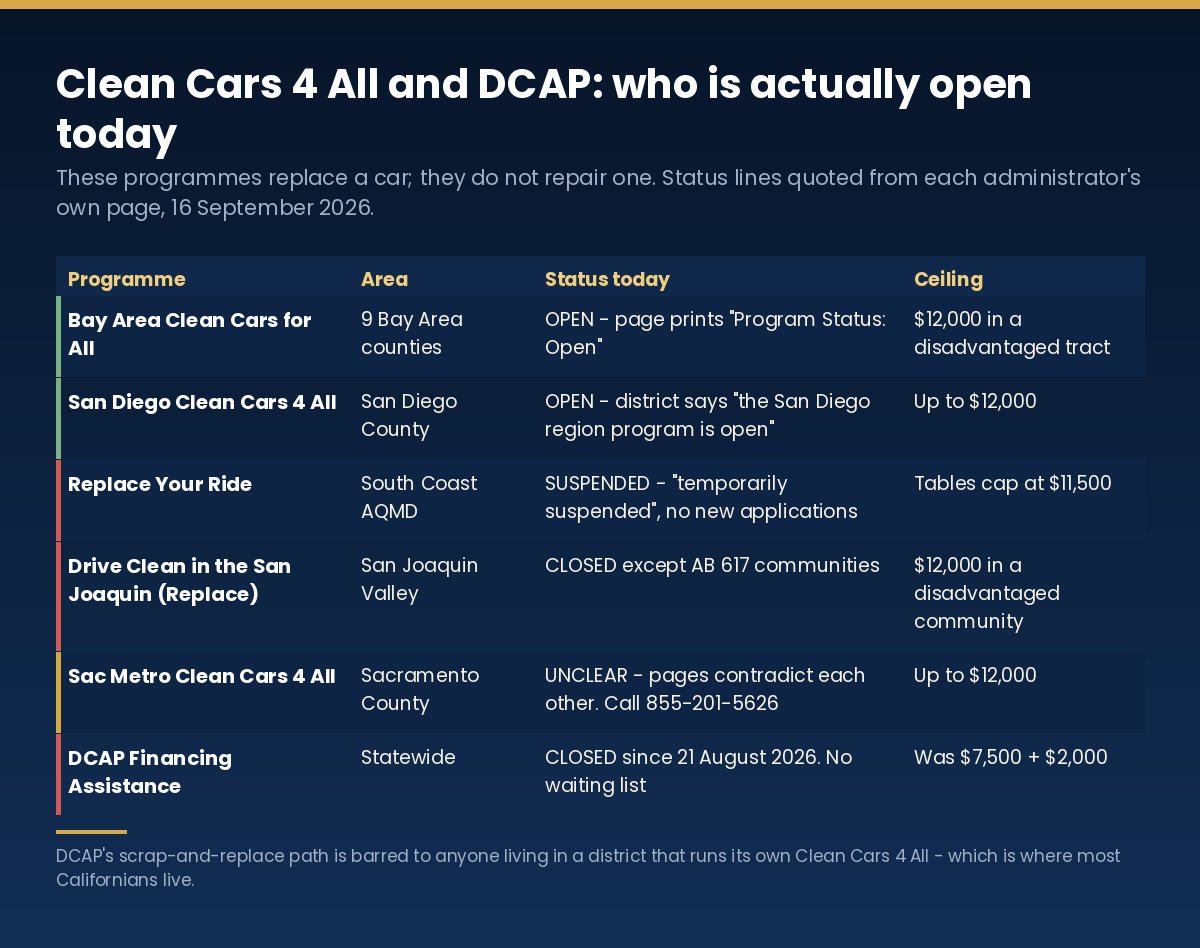
These come up constantly in searches for car repair help, and they are genuinely large — up to $12,000 — so it is worth being precise about what they are. They are scrap-and-replace programmes. You give up an old car and get money toward a cleaner one. None of them pays to repair the car you have. The exception is ZAP, covered above.
The Air Resources Board runs Clean Cars 4 All through the five largest air districts: South Coast, San Joaquin Valley, Bay Area, Sacramento Metro and San Diego. Household income must be at or below 300% of the federal poverty level. As of 16 September 2026 the picture is uneven:
- Bay Area Clean Cars for All prints a literal status field reading “Program Status: Open”, and relaunched on 19 August 2025. Grants run $9,500 for a plug-in hybrid and $10,000 for a battery or fuel cell electric vehicle, rising to $11,500 and $12,000 in a disadvantaged census tract, with up to $2,000 for a charger. Administered by GRID Alternatives on 855-256-3656.
- San Diego: the district states plainly, “the San Diego region program is open.” Up to $12,000. Call (855) 651-2242. Note that San Diego’s separate SCRAP programme, which paid $1,000 per retired 1997-or-older vehicle, is listed by the district as “currently CLOSED.”
- South Coast “Replace Your Ride” is suspended: “Due to the high volume of applications, Replace Your Ride will be temporarily suspended. During this time, you can still log in but you will not be able to initiate or submit a new application.” Worth noting for anyone budgeting: the site banner advertises up to $12,000, but every published table on that site caps at $9,500 plus $2,000 for charging equipment. We are not asserting $12,000 for South Coast.
- San Joaquin Valley’s replace programme is closed with a carve-out: “the District has stopped accepting applications until additional funding is received… Specific funding for AB 617 residents is still available for applicants residing in the following communities: Arvin-Lamont/Shafter/Stockton/South Central Fresno.”
- Sacramento Metro is genuinely ambiguous. Its eligibility page carries a pause banner dated 7 June 2024 while the same page runs a current-cycle eligibility quiz and the application page describes a live process. We are not going to guess. Call 855-201-5626 before doing anything. One thing on that site is unambiguous and current: the EVgo prepaid charging option is on hold.
The statewide Driving Clean Assistance Program is the fallback for everyone outside those five districts, and its news is bad. A notice posted 21 August 2026 states: “Due to an extraordinary response and high demand, DCAP’s Financing Assistance pathway is closed and is not accepting new applications.” There is no waiting list — DCAP says so directly: “Due to limited funding, there will not be a reservation list.”
Here is the trap. DCAP’s remaining open pathway is scrap-and-replace, and DCAP states that “participants residing in an air district with a CC4A program will not be eligible to scrap and replace with DCAP but can still go through the financing assistance pathway.” The financing pathway is closed. So if you live in South Coast, San Joaquin Valley, Bay Area, Sacramento Metro or San Diego — which is most of California’s population — DCAP is currently unavailable to you in either direction, and you are back to whatever your own district is doing.
One further detail worth flagging because DCAP has not updated it: its eligibility page still says the retired vehicle must be “model year 2010 or older for applications submitted during calendar year 2025” on a page carrying an August 2026 notice. The 2026 cutoff is not published. Ask on 1-833-202-3227.
Interest-free loans: the realistic non-emissions option
Californians looking for a grant to fix a car will mostly find loans instead. That is a genuine disappointment, but a 0% loan with no fees is not nothing — on a $3,000 repair it is the difference between paying $3,000 and paying $4,200 on a subprime instalment plan.
Jewish Free Loan Association covers Los Angeles, Ventura, Orange and Santa Barbara counties and names car repairs and maintenance explicitly among the uses of its transportation loans. Amounts run up to $7,500 with one guarantor and $15,000 with two, at 0% interest with no fees, repayable within 36 months. You must be 18 or older with current California ID, resident in one of those four counties, employed and able to repay, without an active JFLA loan, and able to produce at least one qualified guarantor. JFLA states it “helps people of all races & religions” — there is no religious requirement. Applications are online with a Zoom interview; repayment begins 30 to 45 days after funding. 1-844-535-2674.
Hebrew Free Loan San Francisco serves Northern California with interest-free loans including an Emergency category of up to $3,000 for urgent needs, car repair among them. It primarily serves Jewish individuals; non-Jewish applicants qualify in defined circumstances including students referred through partner programmes and employees of Jewish organisations. (415) 546-9902 x110.
Hebrew Free Loan of San Diego offers interest-free Emergency loans up to $2,000 and Personal Needs loans up to $10,000 to Jewish residents of San Diego County. Read this one carefully: the Personal Needs category covers used car purchase, not repairs; the Emergency loan is the general-purpose category. Guarantors must be 25 or older, California residents, with a credit score of 670 or above. (858) 345-8018.
If you have served
VFW Unmet Needs pays grants of up to $2,500 directly to creditors — never cash to the applicant. Vehicle repairs are an eligible expense, and CalVet’s own financial assistance page names Unmet Needs as helping with “home and auto repairs.” But there is a restriction that essentially no listicle carries, and it will decide most cases: the programme’s own application material states that for vehicle expenses, “major repairs for vehicles over ten years old will not be considered.” If your car is a 2015 or older, expect a no on a major repair. Eligibility is active-duty service members including activated Guard and Reserve and their families, with service on active duty within the three years before applying, and applications are limited to one every eighteen months. 1-866-789-6333.
Semper Fi & America’s Fund, headquartered in Oceanside, runs transportation assistance that its own page describes as covering adaptive vehicles, vehicle modifications, car repairs and fuel support, so that veterans and their families can travel to medical appointments. It publishes no amounts and no branch, disability or income criteria — this is case-managed help, and you should expect a conversation with a case manager rather than a form with a number on it. 760-725-3680.
Operation Homefront appears on almost every car-repair list and should not. Its Critical Financial Assistance categories are auto insurance, auto payments, critical baby items, essential home items, food assistance, home repairs, medical, rent and mortgage, travel and transportation, utilities and vision care. Auto repairs are not a category. Auto payments and insurance are — which may still be useful, but is not what you came for.
Your county Veteran Service Office is the underused route here. Every California county has one, they are free, and they hold discretionary emergency funds and referral relationships that do not appear in any search result.
Local, faith-based and the honest truth about scale
Genuine free-labour auto ministries exist in California. They are small, they are local, and they will not show up in a national list because they do not have the reach to rank.
The clearest example we could verify is Green Valley Community Church’s Auto Ministry in Placerville, El Dorado County. Its own site states the arrangement twice, identically: “You pay for the parts and they provide the free labor.” Skilled mechanics work on vehicles twice a week, for “single moms and others who cannot do it on their own,” and you must first meet with a pastoral or care partner to see whether you qualify. Call the church office on 530.622.3231.
That is the shape of this category: one church, one county, twice a week, parts-only. Multiply it across California and it is real help for hundreds of households a year, not thousands — and the only way to find your local version is to ask.
How to actually find one near you
Call 211, or use your county’s 211 site. Be clear about what 211 is: a referral database, not a funder. It does not pay for repairs, and pages implying otherwise are wrong. But its category structure is genuinely useful — 211 Orange County maintains an “Automotive Repair and Maintenance” category under Transportation ((888) 600-4357, or text your zip to 898211), and 211 Sacramento maintains a “Vehicle Consumer Assistance – Automotive Repair” category. 211 LA runs 24/7 on 800-339-6993.
Beyond 211, call the St. Vincent de Paul conference and the Catholic Charities office for your own parish or diocese, not the diocesan switchboard for a region you found online. Neither publishes a car repair programme anywhere in California that we could find — SVdP San Diego, SVdP Sacramento, SVdP Santa Clara County, Catholic Charities Orange County and Catholic Charities San Bernardino & Riverside all publish programme lists with no vehicle assistance on them. But conference-level discretionary help is by definition not published, and a phone call costs nothing.
Modest Needs: real, national, and not what the aggregators say
Modest Needs Foundation runs Self-Sufficiency Grants that pay a vendor or creditor directly — their own policies “prohibit our sending cash directly to an applicant” — and auto repairs appear among their examples of the emergency expenses they exist for. Californians are eligible; it is a national programme.
Two corrections. First, at least one adult in the household “must be documentably employed”, with primary household income from employment, child support, veteran’s benefits or retirement income; this is a programme for people working just above the poverty line, not for the unemployed. Second: the $1,000 figure attached to Modest Needs across dozens of grant-aggregator sites does not appear anywhere on Modest Needs’ own website. We looked. Do not plan around it, and confirm the application window directly before you assemble documentation.
What is on every list and does not exist
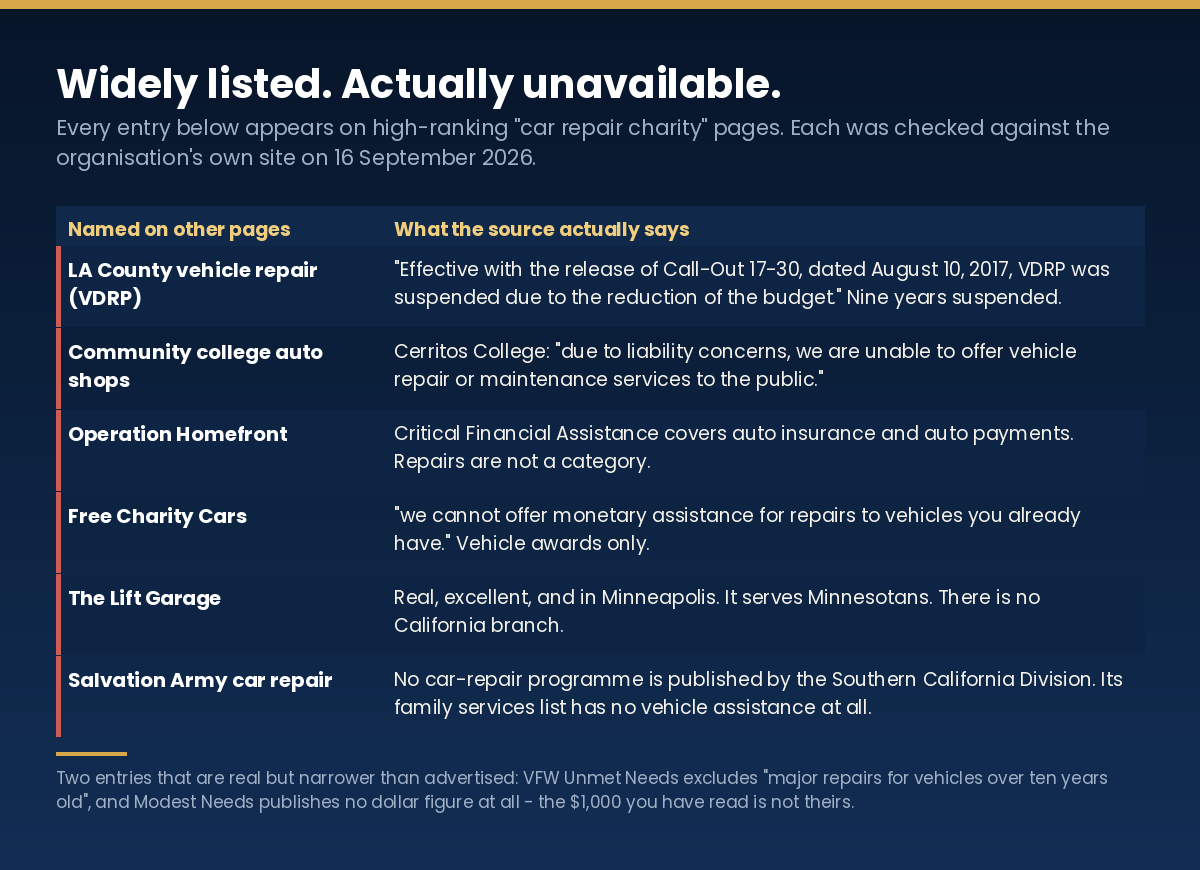
Six entries above, each checked against the organisation’s own words. Two deserve expansion because they waste the most reader time.
Community college auto shops. The advice to take your car to a community college automotive programme for cheap repairs is close to universally false in California. Cerritos College states it directly: “due to liability concerns, we are unable to offer vehicle repair or maintenance services to the public.” Its facilities are reserved for instruction and its training vehicles come through manufacturer partnerships. We checked Rio Hondo, Chaffey, Mt. SAC, Fresno City, Sacramento City, Modesto Junior College and Chabot as well; none publishes a public customer-vehicle repair service.
One-off corporate events. You will find coverage of free repair days — CarParts.com held one in Los Angeles in March 2025 at the Petersen Automotive Museum. Read the detail: it served 38 pre-selected families identified through Safe Parking LA, and there was no public application process. These are real and admirable and you cannot apply to them.
The order to do this in
- Is it an emissions failure? If your car failed a biennial Smog Check and your household is at or below 225% of the federal poverty level, apply to CAP before you touch the car. Up to $1,450. (866) 272-9642.
- Are you in the San Joaquin Valley? Call Valley CAN on 707-866-3004 for the virtual Tune In & Tune Up, or go to the next Saturday event. $500 voucher, no income paperwork of the CAP kind.
- Are you on CalWORKs? Ask your welfare-to-work case worker for vehicle repair as a transportation supportive service, in writing, and ask for it to be advanced. If told no, ask for the county’s written policy.
- Already spent $650 on emissions repairs and still failing? Book a BAR Referee virtual appointment for a repair cost waiver so you can register the car while you finish the work.
- Is it a used EV bought with a state incentive? ZAP, through the Driving Clean Assistance Program.
- Veteran or active duty? Your county Veteran Service Office first, then VFW Unmet Needs — unless the car is more than ten years old and the repair is major.
- None of the above? Call 211, call your parish, and price an interest-free loan before a subprime one.
- Is the repair worth more than the car? Take CAP vehicle retirement’s $1,350 to $2,000, or check whether your air district’s Clean Cars 4 All is open.
Frequently asked questions
Are there charities that help with car repairs in California?
Very few, and none at scale. The organisations that dominate national “car repair charity” lists either serve other states, do not fund repairs, or are suspended. The genuine California charitable options are small and local — a church auto ministry such as Green Valley Community Church in Placerville, which provides free labour if you buy the parts — plus national programmes like Modest Needs that pay a vendor directly. The larger money in California is not charitable at all: it is state and air-district emissions funding, and county CalWORKs supportive services.
How much does California’s Consumer Assistance Program pay toward repairs?
Up to $1,450 for model year 1996 or newer vehicles and up to $1,100 for model years 1976 to 1995, according to the Bureau of Automotive Repair’s own page. There is a co-payment: 20% of the total cost below a threshold ($1,812.50 for 1996-and-newer, $1,375 for older vehicles), and above that threshold you pay the total minus the cap. The widely circulated $1,200 figure is out of date.
Does the Consumer Assistance Program cover brakes or a transmission?
No. CAP is strictly an emissions programme. Its published exclusion list includes brakes, tyres, suspension, radiators, water pumps, mufflers, tailpipes, transmission flushes, glass, body work, heating and air conditioning, and safety equipment such as airbags and seat belts. For non-emissions repairs the route in California is CalWORKs supportive services if you are eligible, or a 0% loan if you are not.
Does California still have a repair cost waiver for Smog Check?
Yes. It was not eliminated. California law caps the amount you must spend on repairs to pass a biennial Smog Check at $650; if you spend at least $650 on emissions-related repairs at a licensed smog check test-and-repair station and the vehicle still fails, you may qualify. Only a BAR Referee can issue it, it is a one-time, one-use waiver per vehicle and owner, and it postpones the certificate requirement for up to two years rather than forgiving the repair.
Can CalWORKs pay for my car repair in California?
Yes, if you need the vehicle for an assigned welfare-to-work activity. Senate Bill 119 wrote “car repairs” into Welfare and Institutions Code section 11323.2 effective 1 July 2026, and from that date counties are required to advance transportation supportive service payments rather than reimburse them. There is no statewide dollar cap — counties set their own. Santa Clara County publishes a $1,500 maximum; Kings County screens at 50% of blue book value; several counties publish no cap at all.
Does Los Angeles County still pay for car repairs?
No. LA County DPSS defines a Vehicle Diagnosis and Repair Program in its GAIN policy, but the same page states that “effective with the release of Call-Out 17-30, dated August 10, 2017, VDRP was suspended due to the reduction of the budget.” It has been suspended for nine years. LA’s current transportation supportive services are bus passes, EZ transit passes, mileage reimbursement, parking and non-traditional transport.
What is Tune In & Tune Up and who can use it?
It is a free emissions testing and repair programme run by Valley Clean Air Now with San Joaquin Valley Air Pollution Control District funding, for residents of San Joaquin, Stanislaus, Merced, Madera, Fresno, Kings, Tulare and parts of Kern counties. You get a free emissions test at a Saturday event and, if the vehicle is repairable, a $500 voucher for emissions diagnostics, testing, repair and certification at a participating STAR station. There is also a year-round virtual version with no queue — call 707-866-3004.
Can Clean Cars 4 All pay to fix my car?
No. Clean Cars 4 All and the Driving Clean Assistance Program are scrap-and-replace programmes — you retire an old vehicle and get money toward a cleaner one, up to $12,000 in a disadvantaged community. They do not fund repairs. The one exception inside that family is ZAP, the Zero-Emission Assurance Project, which covers battery pack, battery management system or fuel cell repair on a used zero-emission vehicle bought through a CARB incentive programme.
Do California community colleges repair cars for the public?
Generally no, despite the advice appearing constantly. Cerritos College states that “due to liability concerns, we are unable to offer vehicle repair or maintenance services to the public” and reserves its facilities for instruction. We found no published public customer-vehicle repair service at Rio Hondo, Chaffey, Mt. SAC, Fresno City, Sacramento City, Modesto Junior College or Chabot either.
What if I do not qualify for any of these programmes?
Price an interest-free loan before a subprime one. Jewish Free Loan Association lends up to $7,500 with one guarantor and $15,000 with two, at 0% with no fees, across Los Angeles, Ventura, Orange and Santa Barbara counties, to applicants of any faith. Hebrew Free Loan San Francisco and Hebrew Free Loan of San Diego serve their own communities. Then call 211 for local referrals, call your own parish rather than a regional office, and if the repair costs more than the car is worth, consider CAP vehicle retirement, which pays $1,350 to $2,000 to scrap it.
How we verified this guide. Every programme, dollar figure, income threshold, phone number, event date and open-or-closed status on this page was read off the administering agency’s or organisation’s own website on 16 September 2026. State material comes from the Bureau of Automotive Repair’s Consumer Assistance Program pages and its Smog Check Reference Guide dated 21 November 2025; CalWORKs material comes from the chaptered text of Senate Bill 119, CDSS All-County Letter 26-31 of 1 May 2026, the CDSS Manual of Policies and Procedures section 42-750, and the published handbooks of Santa Clara, Santa Cruz, Los Angeles, Madera, Kings, Imperial, Placer and Tuolumne counties; air-district figures come from each district’s own programme pages. Four corrections are printed here rather than quietly absorbed: the Consumer Assistance Program cap is $1,450, not the $1,200 still published by at least one California government partner site; the Smog Check repair cost waiver still exists and is widely reported as abolished; Los Angeles County’s vehicle repair programme has been suspended since August 2017; and Operation Homefront does not fund auto repairs. Where a figure is not published — the Tune In & Tune Up voucher cap on the Air District’s own page, Modest Needs’ grant amount, Semper Fi & America’s Fund’s award sizes, Sacramento Metro’s current application status, the condition that moves CAP retirement from $1,500 to $2,000 — we say it is not published rather than filling the gap. Programme funding is appropriated annually and application windows close without notice; confirm status by phone before you spend money on a repair.
Moved from California to Texas, or comparing the two?
Texas has no programme resembling California’s Bureau of Automotive Repair assistance. What it has instead is a $4,000 veterans’ repair allowance and a Workforce Solutions route with a locally set cap, and its old emissions voucher — AirCheckTexas — is closed, though an orphaned legacy page still publishes the dead figures. See charities that help with car repairs in Texas.
Other large-state guides
Florida has no emissions test at all, so its help runs through two state statutes and CareerSource instead — see charities that help with car repairs in Florida. New York has an emissions test but no repair voucher; it has a $450 waiver, and county DSS offices that can pay for the repair itself — see charities that help with car repairs in New York.