Free Cars for Low-Income Families: Who Actually Gives Cars Away in 2026

Editor’s Note — Verified September 2026. Every organisation and every dollar figure on this page was checked in September 2026 against a primary source: the charity’s own eligibility page, the state agency’s own policy manual, the Code of Federal Regulations, or IRS Form 990 filings. Where a figure is not published, we say “not published” rather than repeating a number we found on another blog. We also name the programs that do not give cars away, and the ones whose websites have gone dark, because the most expensive thing on this topic is a family spending three weeks applying to something that no longer exists. Found something stale or a broken link? Email team@nonprofitpoint.com and we will correct it.
Search “free cars for low-income families” and you will find dozens of pages listing twenty or thirty charities that supposedly hand over vehicles. We checked them. Most of those organisations do not give cars to anybody. They are car-donation fundraisers: you give them your old sedan, they sell it at auction, and the cash funds something else entirely. A handful of real programs do exist, they are much smaller than the internet suggests, several are limited to a single state, and the biggest name in the field is not free at all — it charges recipients roughly a thousand dollars.
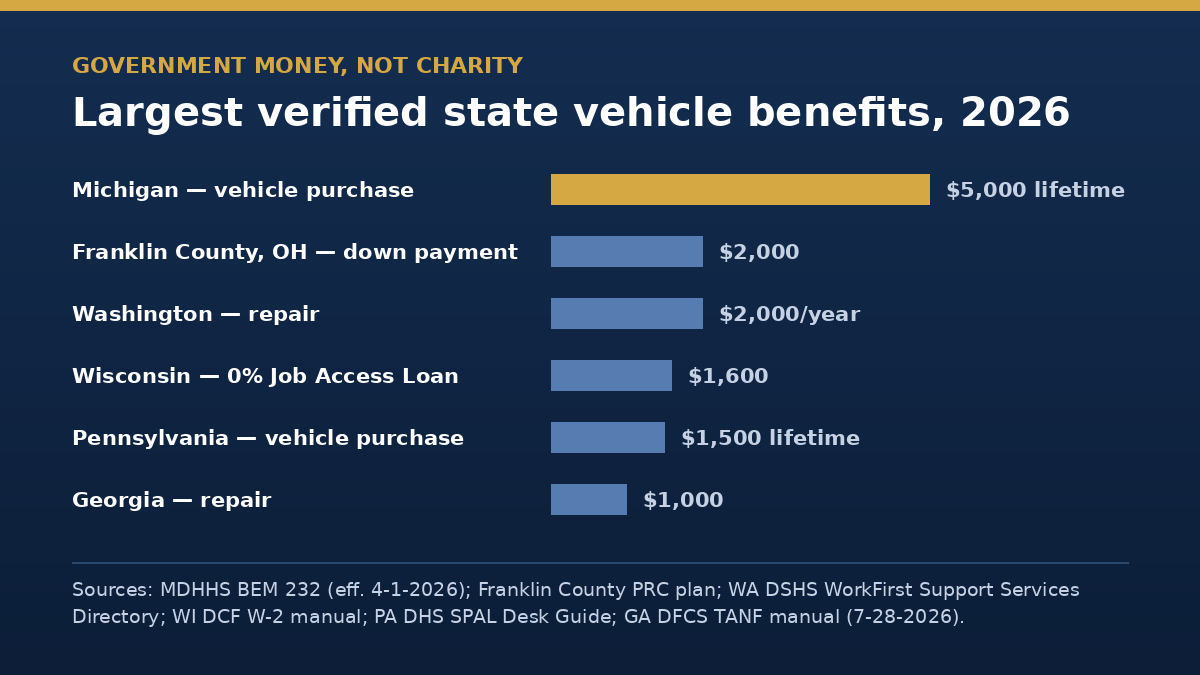
That is the bad news, and it is worth getting out of the way first, because the useful news follows from it. The largest pot of vehicle money in the United States is not charitable at all. It sits inside state welfare-to-work budgets, where a caseworker can authorise up to $5,000 for a car purchase in Michigan or $1,500 in Pennsylvania or $2,000 for a down payment in Franklin County, Ohio — and where most eligible families never ask, because nobody tells them the money is there. This guide covers both routes: the charities that genuinely award vehicles, and the government and community-lending programs that are usually a faster path to a car than a donated-vehicle waitlist.
The short answer
Only two organisations award vehicles to individuals across most of the country, and only one of those takes applications from the general public. Everything else is regional, referral-only, or both.
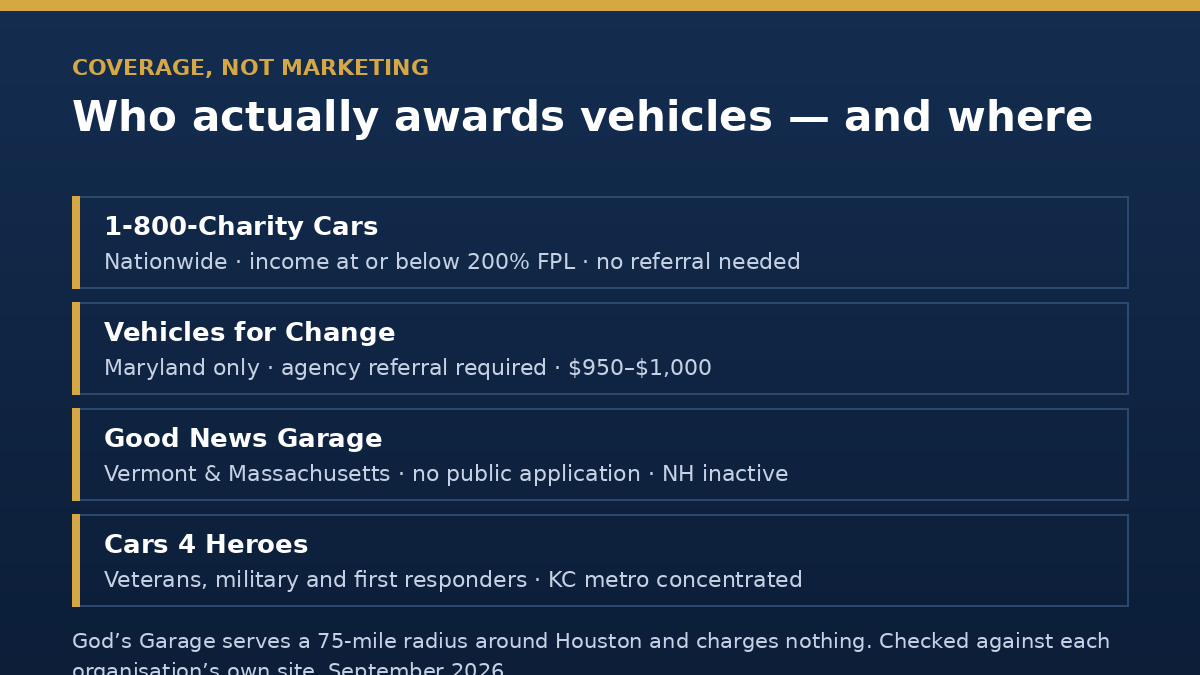
| Program | Where it operates | What you pay | How you apply |
|---|---|---|---|
| 1-800-Charity Cars | All 50 states, including Alaska and Hawaii | Free to apply; free vehicle; you pay tags, title, registration and insurance | Directly, online |
| Cars 4 Heroes | No published state list; concentrated in the Kansas City metro | Free vehicle; fee responsibility not published | Directly, online |
| Vehicles for Change | Maryland only | $950–$1,000 plus title, tags and registration | Only through a sponsoring agency |
| Good News Garage | Vermont and Massachusetts (New Hampshire inactive) | Not published | Only through a caseworker; no public application exists |
| God’s Garage | 75-mile radius around Houston, Texas | Nothing — “no charge for labor or parts” | Directly, online |
If you live outside Maryland, Vermont, Massachusetts and the Houston area, your realistic charity option is a single national program with an unpredictable waitlist. That is why the government section further down matters more than most people expect.
1-800-Charity Cars: the one genuinely national program
Charity Cars, Inc. has operated out of Altamonte Springs, Florida since 1996 and is the only vehicle-award charity we could verify as operating in every state. Its most recent Form 990 on file covers the fiscal year ending August 2025 and reports revenue of $3,674,642 against expenses of $3,949,786 — a working charity of real but modest size, not the national vehicle-distribution network the search results imply.
Who qualifies
You must be a United States resident, at least 18 years old, hold a valid driver’s licence, have income at or below 200% of the federal poverty level, lack sustainable transportation, have internet access, and be able to demonstrate genuine need. There is no requirement to be referred by an agency, which is what separates this program from every other one on the list. The charity names the groups it prioritises as military veterans, struggling families, the working poor, victims of domestic violence, the medically needy and victims of natural disasters.
How recipients are actually chosen — read this part carefully
This is where expectations usually break. Awards are not first-come, first-served and they are not ranked purely by need. When a donated vehicle becomes available in a particular area, the charity reviews applications from members in that area, and its own FAQ says the team generally begins with the most recent applications and looks for stories that are, in its words, “truly inspirational and compelling.” The organisation also states that promoting the charity on social media improves an applicant’s chances.
Two practical consequences follow. First, applications are purged after roughly three months, and the application page itself tells people to reapply frequently — so a single application submitted and forgotten is close to worthless. Second, the written narrative you submit is doing more work than your income figure. The charity is candid about the odds: its FAQ warns there is “NO guarantee of a vehicle and there may be an extensive waiting period,” and explains that timing “depends on so many variables” because the supply is entirely dependent on what the public donates that month in your area.
What it costs and how to apply
Applying is free, and the charity states plainly that it never asks for card details for any fee — a useful benchmark, because impostor sites in this niche do exactly that. If you are awarded a vehicle, you are responsible for all fees plus insurance and ongoing maintenance: tags, title, registration, emissions where your state requires it, and the first insurance payment. Budget for that before you apply, because an award you cannot insure is an award you cannot take.
The application is at freecharitycars.org/vehicle-request-form. Read the FAQ first — the form requires you to confirm you have — then complete it with your household income, employment, children’s dates of birth, military status and your account details for any social platform you use. Set a calendar reminder to resubmit every ten weeks.
Cars 4 Heroes: veterans, military families and first responders
Cars 4 Heroes, based in Olathe, Kansas, provides what it calls “free basic transportation” to veterans, active-duty military, first responders and their families who cannot obtain a vehicle on their own. Its founder is known locally as Car Santa, and the organisation says he gives away more than 300 cars a year in the Kansas City metro alone.
Two honest caveats. The organisation does not publish a service-area list; its leadership page names directors of operations in Kansas, Missouri, Florida and Indiana, which is the closest thing to a coverage map that exists. And its public filings are thin — ProPublica shows a ruling date of September 2024 and the most recent Form 990 on file is for fiscal 2018. That does not mean anything is wrong; it does mean you cannot check its finances the way you can check the others here. Whether recipients pay title, tags or registration is not published, so ask before you accept.
There are two application tracks, both at cars4heroes.org/apply-for-a-car — one for military applicants, which asks for service dates, branch, rank, deployments and a copy of your military ID, and one for civilians and first responders. The organisation says plainly that it is unable to reply to every applicant and will contact you only if you are selected for an interview, so treat silence as normal rather than as a rejection.
Vehicles for Change: the biggest name, and it is not free
Vehicles for Change has awarded more than 8,200 vehicles since 1999 and is the organisation most often cited in articles about free cars. Two things about it are almost always reported wrongly.
It is not free. Its eligibility page states that recipients “must be able to pay between $950–$1000 for the vehicle,” plus applicable title, registration and tag fees, and that it partners with area banks to finance that amount where needed. Federal technical-assistance material describing the program has referenced a twelve-month arrangement of around $85 a month. This is a deeply subsidised sale of an inspected, road-ready car — genuinely good value, and not a giveaway.
It is Maryland-only in 2026. The organisation historically operated in Michigan and Virginia, and third-party directories still list those states. Its own site now says the Keys to Independence program “is currently limited to individuals and families who live in Maryland.” If you are reading a page that tells you to apply to Vehicles for Change in Detroit, that page is out of date.
Eligibility, as published: work a minimum of 30 hours a week or hold a verifiable job offer letter; be a Maryland resident with a Maryland driver’s licence and no DUI or DWI in the last three years; supply a certified three-year MVA driving record and, if employed, 30 days of recent pay stubs; meet household income requirements (the dollar threshold is not published); have no vehicle currently in your name; and be able to secure insurance.
Critically, you cannot apply directly. The organisation does not accept or hold applications in-house; every referral must come through a participating sponsoring agency, which in practice is often a TANF caseworker, a domestic-violence shelter or a workforce training program. The list of sponsoring agencies is on the charity’s own site, and finding the one nearest you is the first step, not the last. After approval you enter a queue and are matched as donated inventory allows; the organisation says wait times vary with inventory and demand and does not publish a typical figure.
Good News Garage: Vermont and Massachusetts, through a caseworker only
Good News Garage is a program of Ascentria Community Services and has provided close to 6,000 vehicles across New England since 1996. It has no public application form and says so explicitly: all recipients are referred by partner agencies.
In Vermont, the gateway is Reach Up, the state’s TANF program. Reach Up determines who is eligible and notifies Good News Garage; if you are eligible, your Reach Up case manager gives you the application and you return it to them. In Massachusetts, referrals come through partners including MassAbility. The New Hampshire program is inactive — the organisation still accepts donated vehicles from New Hampshire residents but currently awards those cars to Vermonters instead.
What a recipient pays is not published anywhere on the organisation’s site, so ask your caseworker. Demand comfortably exceeds supply: reporting on a Vermont Public partnership with the charity described a waiting list of more than 200 Vermont families. If you are on Reach Up and have not raised transportation with your case manager, that conversation is the entire application process.
God’s Garage: the one program that is genuinely free, if you live near Houston
God’s Garage in Conroe, Texas serves single mothers, widows and the wives of deployed military personnel within a 75-mile radius of Greater Houston. Its policy is unusually clear: “We do not charge for labor or parts. Vehicles are gifted free of charge to qualifying applicants.” It repairs cars as well as gifting them, and its 2024 filing shows just over a million dollars in revenue, so it is a real operating charity rather than a website.
You need a valid driver’s licence or state ID, proof of income, proof of residence, registration if you are asking for a repair, and insurance documentation. You must also be willing to attend the required Restore U life-skills seminar — that is not optional, and it is the second of three stages: you apply online, you are invited to the seminar if shortlisted, and a final determination follows. Income thresholds are not published. Neither is the number of vehicles gifted per year.
What “free” still costs you
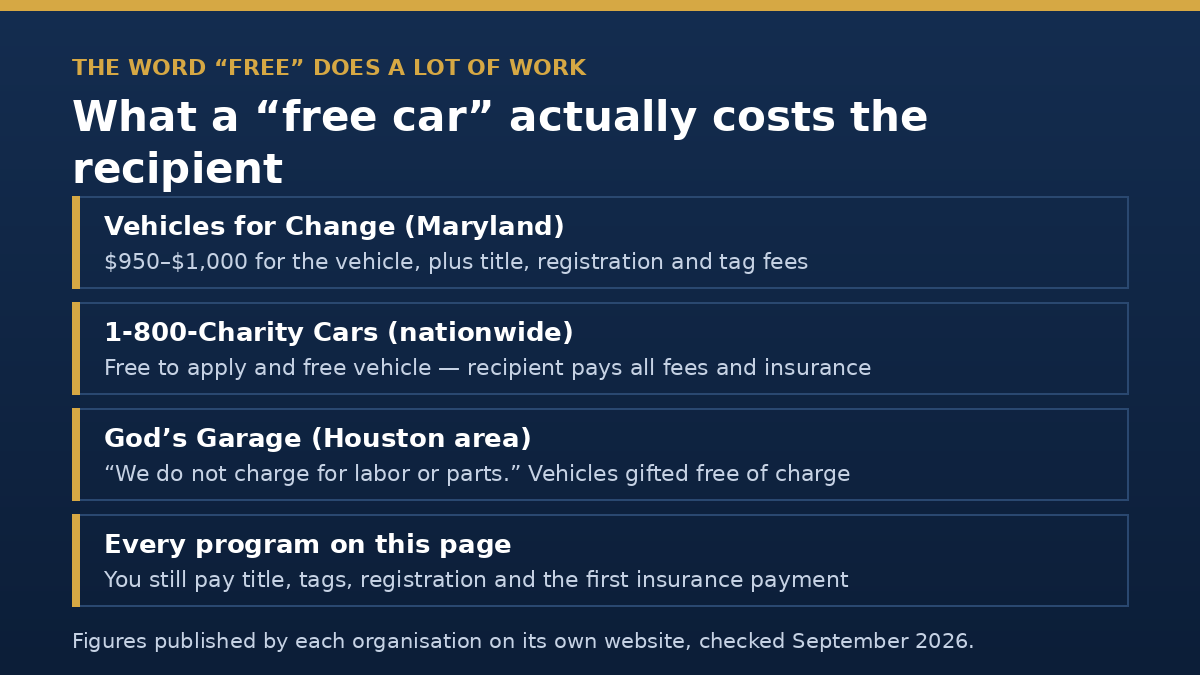
Every program on this page, including the ones that charge nothing for the vehicle, leaves the recipient paying to put it on the road. Title transfer, tags and registration are state fees that no charity can waive. Insurance is required by every program before the keys change hands, and a first payment on a policy for a driver with a thin insurance history is rarely small. Several programs also require the car to be registered and insured in the recipient’s own name, which rules out putting it on a relative’s policy.
Assume several hundred dollars of unavoidable cost even on a genuinely gifted car, and roughly $1,300 to $1,500 all-in on a Vehicles for Change award. If that number is the obstacle, deal with it before you apply: charities that help with car insurance covers the programs that specifically subsidise premiums, and several of the state benefits below will pay registration and licence fees directly.
The bigger money is at the welfare office, not the charity
Most families searching for a free car are already eligible for, or receiving, some form of cash assistance. That is where the largest verified vehicle benefits in the country sit. TANF is a block grant, so each state writes its own rules, and the variation is enormous — from a $5,000 lifetime purchase authorisation in one state to nothing at all in another. Nobody is going to volunteer this money. You have to name it.
Michigan — up to $5,000 to buy a car, once in a lifetime
Michigan’s Department of Health and Human Services runs the most generous vehicle benefit we could verify. Under the Direct Support Services item of its Bridges Eligibility Manual, a caseworker may “authorize up to $5000 to purchase, not lease, a vehicle,” and vehicle purchase “is limited to once in a client’s lifetime.” Repairs are separate and capped: total program cost of repairs may not exceed $2,000, counting any repairs done in the previous twelve months.
The conditions are strict. You need prior approval through the Bridges system, a valid Michigan driver’s licence, and a finding that public transportation is not available. A mechanic’s inspection is required, and the vehicle must be registered and insured to an eligible member of your group. Repairs cannot be authorised on a vehicle purchased within the previous 60 days. The benefit runs through FIP, the Child Development and Care program, MA Family and FAP Family; the governing bulletin is BPB 2026-009, effective 1 April 2026. Ask your caseworker for “BEM 232 direct support services, vehicle purchase” by name.
Pennsylvania — $1,500 lifetime for a vehicle, plus repairs and fees
Pennsylvania calls them Special Allowances, or SPALs, and the vehicle purchase allowance is “one vehicle up to $1,500 in a lifetime.” That one is TANF-only and explicitly not available to SNAP-only households. Motor vehicle repair is available to both TANF and SNAP participants as required for work or approved activities. Motor vehicle expenses — driver’s licence, inspection, registration — are TANF-only with no published cap. Transportation and bus allowances run to $1,500 annually on a July-to-June year, and mileage is reimbursed at $0.20 per mile for TANF participants.
The gate is participation: you must be enrolled in an approved employment and training activity recorded on a PA 1661 for TANF or a PA 1531 for SNAP, and the item must not be available to you from another source. The county has 15 days to decide, and you have 14 days after receiving the money to produce a receipt — miss that and it is processed as an overpayment.
Ohio — the money is real, but it is county by county
Ohio’s Prevention, Retention and Contingency program is its flexible TANF fund, and each of the 88 counties writes its own plan. That means the benefit in the next county may be double yours, and the only way to know is to read your county’s current PRC plan, which is published on the state’s site.
Two live examples show the range. Franklin County offers auto down-payment assistance of up to $2,000 per family household at 175% of the federal poverty level, plus auto repairs capped at the vehicle’s Kelley Blue Book retail value, driver’s licence reinstatement where you can show employment or a job offer, gas cards, rideshare fees and up to four months of bus passes. Hancock County runs a program called Wheels to Work at 200% of poverty: down-payment assistance up to $1,000 on a 100% match basis, once per lifetime, plus loan or lease payments of up to $1,500 across four months specifically to stop a repossession. Hancock requires 90 days in the same job at 32 hours a week, a valid licence and participation in financial literacy; its repair benefit is $1,000 per twelve months and must go through an ASE-certified mechanic.
Ask your county job and family services office for “the PRC plan” and for the transportation and vehicle items in it specifically. Plans are re-filed regularly, so confirm the effective date of whatever you are quoted.
Wisconsin — a $1,600 loan at zero interest, no credit check
Wisconsin’s Job Access Loan is the most unusual benefit on this list. It is a no-interest loan of between $25 and $1,600 with no credit check and no bank involved, and it can be used for car repairs, car loan payments, car insurance, driver’s licence fees, work clothing and tools. Repayment runs over twelve months and can be extended to 24, and here is the part that matters: up to 75% of it can be repaid through community service, with a minimum of 25% repaid in cash.
To qualify you must be a parent with a minor child, at least 18, a Wisconsin resident, working or looking for work, cooperating with child support, with income at or below 115% of the federal poverty level and assets of $2,500 or less. Apply through your local W-2 agency.
Washington, Georgia, Virginia and Minnesota — repair money, not purchase money
Several states will keep a car you already own on the road but will not help you buy one. Washington’s WorkFirst support services pay up to $2,000 per program year for car repair with two written estimates required, $500 a year for licensing and title fees, gasoline up to $100 per request and $150 a month for public transport — inside an overall $5,000 per-participant annual cap shared across three state agencies. Georgia reimburses vehicle repairs up to $1,000 per period of participation, but only against an actual invoice after the work is done, plus $300 of insurance in any twelve months and $50 for licence and emissions costs; the vehicle must be your sole source of transportation and registered in your name, and car rental is explicitly not covered.
Virginia has two routes and one trap. VIEW supportive services can pay for vehicle repair where public transport is unavailable, no other resource exists and the condition of the car justifies the cost; no dollar cap is published. Separately, TANF Diversionary Assistance offers a lump sum of up to four times your monthly TANF grant — the manual’s own worked example gives a three-person household a $1,836 maximum — which can be spent on a car repair. Taking it makes you ineligible for TANF for up to 180 days. For a family whose only barrier to a job is a transmission, that can be the right trade. For a family that needs ongoing cash assistance, it is a bad one. Ask for the number in writing before you accept.
Minnesota’s MFIP Consolidated Fund explicitly allows gas cards, bus cards, van rides and car repairs, but the dollar amounts are set by county and tribal employment services providers rather than published statewide. In Colorado, the state regulation governing Colorado Works contains no vehicle provision at all; anything you get will be a county decision, so ask your county office directly rather than assuming a program exists. For Texas, support-service limits under the Choices program are set by 28 local workforce boards and we could not retrieve the state guide to verify a figure — ask your local board rather than trusting a number you read online, including ours.
The asset-limit trap: the car that costs you your benefits
Before you accept a vehicle, check what owning it does to the rest of your case. There is no federal TANF asset limit and no federal vehicle rule — the regulations at 45 CFR Part 260 set purposes and definitions and leave financial eligibility to the states. The result is a patchwork in which the same car is invisible in one state and disqualifying in another.
| State | How a vehicle counts | Overall asset limit |
|---|---|---|
| Michigan | Vehicles are not a counted asset type at all | $15,000 in cash, investments and retirement plans |
| Pennsylvania | One vehicle fully exempt if its equity is under $40,000 | — |
| Washington | One vehicle used for transportation fully excluded | $12,000 equity |
| Wisconsin | First $10,000 of combined vehicle equity disregarded | $2,500 |
| Texas | Only the first $4,650 of fair market value is excluded; the excess counts | $1,000 |
Read the Texas row again. With a $1,000 resource limit and a $4,650 vehicle exclusion, a car with a fair market value above roughly $5,650 can put a Texas family over the TANF resource limit on its own. If you are in Texas and someone offers you a nicer car than you expected, that is a question for your caseworker before it is a celebration. One warning specific to Texas: the widely circulated $22,500 and $8,700 vehicle figures come from the SNAP rules in the same handbook, not the TANF rules. Do not let anyone — including a well-meaning volunteer — apply the SNAP number to a TANF case.
Two vehicle categories are commonly exempt regardless: a vehicle that produces income, and a vehicle used to transport a household member with a disability. If either applies to you, say so explicitly at your interview, because it is not always asked.
Nonprofit car loans: 0% to 8%, and a real alternative to waiting
A donated-car waitlist is a lottery with no published odds. A nonprofit car loan is a decision with a date on it. Several community lenders make small vehicle loans at rates a subprime dealer would never offer, and they are the fastest route to a car for a working family with damaged credit.
Central Wisconsin Community Action Council’s Wheels 2 Work is the strongest terms we found anywhere: $3,000 to $8,000 at 0% interest over 24 to 48 months, in Adams, Columbia, Dodge, Jefferson, Juneau and Sauk counties. You need income at or below 150% of poverty, a valid licence, nine months of residency, four consecutive months in your current job at a minimum of 30 hours a week, six months of banking history and no OWI or DUI in three years. The costs to know about are a $250 administrative fee at signing, a 2.2% monthly processing fee plus $0.30 per transaction, and a requirement to carry full-coverage insurance with deductibles no higher than $500. Notably it is funded through the Federal Transit Administration under 49 U.S.C. § 5311, not through TANF — which is why programs like it turn up in rural transit budgets rather than welfare offices.
Community Growth Fund’s Ways to Work loan covers nine south-western Pennsylvania counties — Allegheny, Armstrong, Beaver, Butler, Fayette, Greene, Indiana, Lawrence and Westmoreland — and lends up to $10,000 at 8% over 48 months for a used vehicle. You need a valid Pennsylvania licence, three consecutive months of employment at 20 or more hours a week, and no current auto or personal loan; the car must come from a licensed dealership, so private sales do not qualify. Three limits are worth knowing in advance: it stopped making auto repair loans on 1 December 2023, it will not fund 1099 delivery driving such as DoorDash or Instacart, and the process takes 90 days or more because of the required financial classes. Intake is by email only.
HumanKind runs a Ways to Work program across Greater Richmond, Roanoke, Warrenton and Lynchburg in Virginia, and On the Road Lending does character-based auto lending and refinancing in Georgia, Kentucky, North Carolina, Mississippi and Texas. Neither publishes loan amounts or rates, so both require a call. Be aware that the national Ways to Work network no longer exists as a single organisation — what survives are independent local lenders that kept the name or the model, so there is no national application to fill in.
Where a loan will not close the gap on its own, stack it: a Franklin County down-payment grant or a Wisconsin Job Access Loan on top of a community loan is a far more realistic path to a $6,000 car than any single program on this page.
If a disability is part of the picture
State vocational rehabilitation agencies are frequently listed on “free car” pages, and the listing is wrong in an important way. VR agencies pay for vehicle modifications, not vehicles. New York’s ACCES-VR states it outright: the agency “does not purchase, rent or lease vehicles.” What it will do is modify a vehicle you already own or have the use of, where the modification is needed to reach an employment outcome, after a driver evaluation, once in a five-year period or when the vehicle accumulates another 70,000 miles, whichever comes first — subject to a financial need review and to using any comparable benefit, such as Veterans Administration help, first.
Arizona’s rules, last revised in February 2026, run the same way: modifications only, on a vehicle owned and registered by the client or a family member, restricted to the least expensive equipment that lets the client operate the vehicle safely, tied to employment rather than general independent living, with a used vehicle needing to be under 50,000 miles for full modification and over 75,000 miles eligible only for mobility equipment, and a maximum of one modification per client. Arizona does not apply an economic need assessment to these services but does require a credible plan for insurance, maintenance and repairs.
The practical read: VR can turn a car you can get into a car you can drive, and that is a large benefit. It cannot be the source of the car.
What to do while you wait, or if no program fits
Two entitlements sit underneath all of this and are far more reliable than any car program.
Medicaid non-emergency medical transportation is mandatory in every state. Federal regulation requires state Medicaid programs to assure necessary transportation to and from providers, and Section 209 of the Consolidated Appropriations Act, 2021 wrote the requirement into the Medicaid statute itself. It covers rides to covered services — routine appointments, specialists, dialysis, behavioural health, and pharmacy pickups where those are covered — and children entitled under EPSDT must receive transportation assistance. Request it through your state’s NEMT broker, your managed care plan’s member services line, or your state Medicaid agency; the number is on the back of your card, and most states require booking several days ahead. It is the single most dependable transportation benefit in the country, and it is useless for work, school, childcare or errands. Know both halves of that.
211 is a referral service, not a funder. It will not give you a car or car-repair money, but the local centre knows which fund in your county has money this month, which is information you cannot get any other way. Dial 211 from any phone or find your local centre through 211.org. Ask by program name rather than by outcome — say “TANF or PRC transportation assistance,” “car repair assistance,” and “Community Action Agency vehicle programs,” because the database is indexed by service category, not by “free car.” One direct benefit does run through the network: Ride United, a United Way partnership with Lyft, schedules free or discounted rides to food, employment, education, veteran, housing and financial or medical services when local transportation is unavailable. It reports more than 125,000 riders and 500,000 completed rides; geographic coverage is not published and depends on your local 211.
If the barrier is a repair rather than a purchase, Modest Needs makes emergency grants averaging between $750 and $1,250 to employed low-income households, and names the cost of a deductible to repair your car among its qualifying circumstances. It does not fund vehicle purchase; that is not a published eligible expense. At least one adult in the household must be documentably employed at the time of application, and the organisation says its strongest applications are usually fully funded within 10 to 14 days of entering donor review, though some take as long as two months.
The organisations that will not give you a car, whatever the search result says
These names appear on nearly every “free cars” list. None of them awards vehicles to individuals. They are car-donation fundraisers: they collect donated vehicles, sell them, and spend the proceeds on unrelated charitable programs. That is a legitimate model and there is nothing wrong with donating to them — but applying to them for a car is time you will not get back.
| Organisation | What it actually does |
|---|---|
| Wheels For Wishes | Sells donated cars; proceeds fund local Make-A-Wish chapters |
| Kars4Kids | May resell or otherwise dispose of the vehicle; proceeds fund its own youth and education programs |
| Vehicles For Veterans | Sends donated cars to auction; proceeds fund veterans’ services — cash to charities, not cars to veterans |
| Online Car Donation | Donation intake only; publishes no recipient program, legal name or EIN |
| Working Cars for Working Families | An advocacy coalition that never awarded cars, and has published nothing since 2014 — its program directory is a decade stale |
| Cars 4 Christmas | Domain is a parked placeholder with no organisation details, application or contact information |
If you want to give a car away rather than receive one, our guide to reputable car donation charities covers which of these return the most value to the cause.
The honest odds, and the order to work in
Here is the number nobody publishes: not one organisation on this page discloses how many vehicles it awards per year against how many applications it receives, and not one publishes a typical wait time. That silence is itself the answer. Vermont’s 200-family waitlist against a program that has placed roughly 6,000 cars in thirty years is the clearest ratio available, and it is not encouraging.
So work the list in the order of what actually decides quickly, not in the order of what sounds best:
- Ask your caseworker about the vehicle benefit by name — BEM 232 in Michigan, a SPAL in Pennsylvania, your county PRC plan in Ohio, a Job Access Loan in Wisconsin, WorkFirst support services in Washington. This is the only money on this page with a decision deadline attached.
- Apply to 1-800-Charity Cars the same week, because it costs nothing and the queue only runs if you are in it — then diarise a resubmission every ten weeks.
- Call 211 and ask by program name for local transportation and vehicle funds, and ask specifically whether Ride United operates in your county.
- Check whether a nonprofit lender covers your counties. A 0% or 8% loan you can get in 90 days beats a donated car you might get in a year.
- If you already have a car, protect it. Repair, insurance and payment assistance are far easier to obtain than a vehicle, and every state above funds repairs more readily than purchases.
Already have a car? Keeping it is easier than replacing it.
Each of these covers eligibility, dollar amounts and application steps in more depth than a section here can: charities that help with car repairs, charities that help with car payments, charities that help with car insurance, charities offering gas vouchers and charities that help with transportation.
Pennsylvania readers: before you apply for a donated car, check whether the one you have can be fixed instead. Pennsylvania will fund a repair on a car worth less than the repair — its cash assistance handbook says the Kelley Blue Book value has no bearing on approval — and there is a Harrisburg garage that repairs vehicles to inspection standard at no cost. See charities that help with car repairs in Pennsylvania.
Illinois readers: before you apply for a donated car, check the repair routes first. Illinois public aid pays up to $900 in any 12-month period toward automobile repairs for people in an approved work activity, several townships fund car repair through Emergency Assistance, and a South Barrington garage does the labour for free if you pay for parts. See charities that help with car repairs in Illinois.
Related help
- Get help paying for … — the full index of assistance guides on this site, grouped by what you need
- Grants for single mothers and charities that help single mothers — several of the vehicle programs above prioritise single parents
- Housing assistance for disabled veterans — the veteran-specific benefits that sit alongside Cars 4 Heroes
- Charities that give money to individuals and emergency financial assistance — where to go when the need is cash rather than a car
- Charities that help with rent — the same caseworker conversation usually covers both
Frequently asked questions
Is there really such a thing as a free car for a low-income family?
Yes, but from far fewer places than the internet suggests, and never entirely free. 1-800-Charity Cars awards donated vehicles nationwide at no cost to the recipient, God’s Garage gifts vehicles free of charge within 75 miles of Houston, and Cars 4 Heroes gives vehicles to veterans, military families and first responders. In every case you still pay title, tags, registration and insurance. The most cited program, Vehicles for Change, is a subsidised sale at $950 to $1,000 rather than a giveaway, and it operates only in Maryland.
How long is the wait for a donated car?
No organisation publishes a typical wait time, and you should be suspicious of any page that quotes one. Supply depends entirely on what the public donates in your area that month. 1-800-Charity Cars warns there is no guarantee and that the wait may be extensive, and Vehicles for Change says only that wait times vary with inventory and demand. One usable data point: reporting on Good News Garage in Vermont described a waiting list of more than 200 families.
Can I get help buying a car through welfare or TANF?
In some states, yes, and it is usually more money than a charity will give you. Michigan authorises up to $5,000 once in a lifetime to purchase a vehicle. Pennsylvania allows one vehicle purchase up to $1,500 in a lifetime. Franklin County, Ohio funds auto down payments up to $2,000, and Hancock County up to $1,000. Wisconsin offers a no-interest Job Access Loan of up to $1,600. Washington and Georgia fund repairs but not purchases. Ask your caseworker for the benefit by name; it is rarely offered unprompted.
Will owning a car make me ineligible for benefits?
It depends entirely on your state, because there is no federal TANF vehicle rule. Michigan does not count vehicles as an asset at all. Pennsylvania exempts one vehicle with equity under $40,000, Washington excludes one vehicle outright, and Wisconsin disregards the first $10,000 of combined vehicle equity. Texas is the outlier: only the first $4,650 of fair market value is excluded against a $1,000 resource limit, so a car worth much above $5,650 can disqualify a family on its own. Ask before you accept a vehicle, and note that income-producing vehicles and vehicles used to transport a disabled household member are commonly exempt.
Do Kars4Kids or Wheels For Wishes give cars to families in need?
No. Both are car-donation fundraisers. They collect donated vehicles, sell them and spend the proceeds on other programs — Make-A-Wish chapters in the case of Wheels For Wishes, and its own youth and education programs in the case of Kars4Kids. The same is true of Vehicles For Veterans, which sends donated cars to auction and funds veterans’ services with the cash rather than giving vehicles to veterans.
Can a single mother get a free car?
Some programs prioritise single parents explicitly. God’s Garage serves single mothers, widows and the wives of deployed military personnel within 75 miles of Houston and charges nothing. 1-800-Charity Cars lists struggling families and the working poor among its priority groups nationwide. Wisconsin’s Job Access Loan requires the applicant to be a parent with a minor child. Beyond that, the vehicle money in state TANF programs is available to single-parent households on the same terms as anyone else, and is usually the larger amount.
What if I need transport now and cannot wait for any of this?
If the trips you need are medical, Medicaid non-emergency medical transportation is a mandatory benefit in every state and covers rides to covered services; request it through your managed care plan or your state’s NEMT broker using the number on the back of your card. For other trips, call 211 and ask whether Ride United, the United Way partnership with Lyft, operates in your county — it schedules free or discounted rides to food, work, education, housing and financial or medical services where local transportation is unavailable.
Will vocational rehabilitation buy me a car if I have a disability?
No. State vocational rehabilitation agencies pay for vehicle modifications, not vehicles. New York’s ACCES-VR states that it does not purchase, rent or lease vehicles, and Arizona’s policy is the same. What they will fund is adapting a vehicle you already own or have use of, where the modification is needed to reach an employment goal, following a driver evaluation and a financial need review. Modifications are typically limited to once every five years or another 70,000 miles, and comparable benefits such as Veterans Administration help must be used first.
Program rules, dollar caps and service areas on this page were verified in September 2026 against each organisation’s own website and each state’s own policy manual. Caps change with state budget cycles and county plans are re-filed regularly, so confirm the current figure with the agency before you rely on it.
In Florida, check the repair route before you wait for a car.
Vehicle awards are slow and heavily oversubscribed. Florida has two statutory routes that pay for repairs instead, both through your local CareerSource board, plus a county programme paying up to $1,500 — and the state’s best-known vehicle charity has been closed to applications since November 2025. See charities that help with car repairs in Florida.