Best Text-to-Give Platforms for Nonprofits in 2026: What They Actually Cost

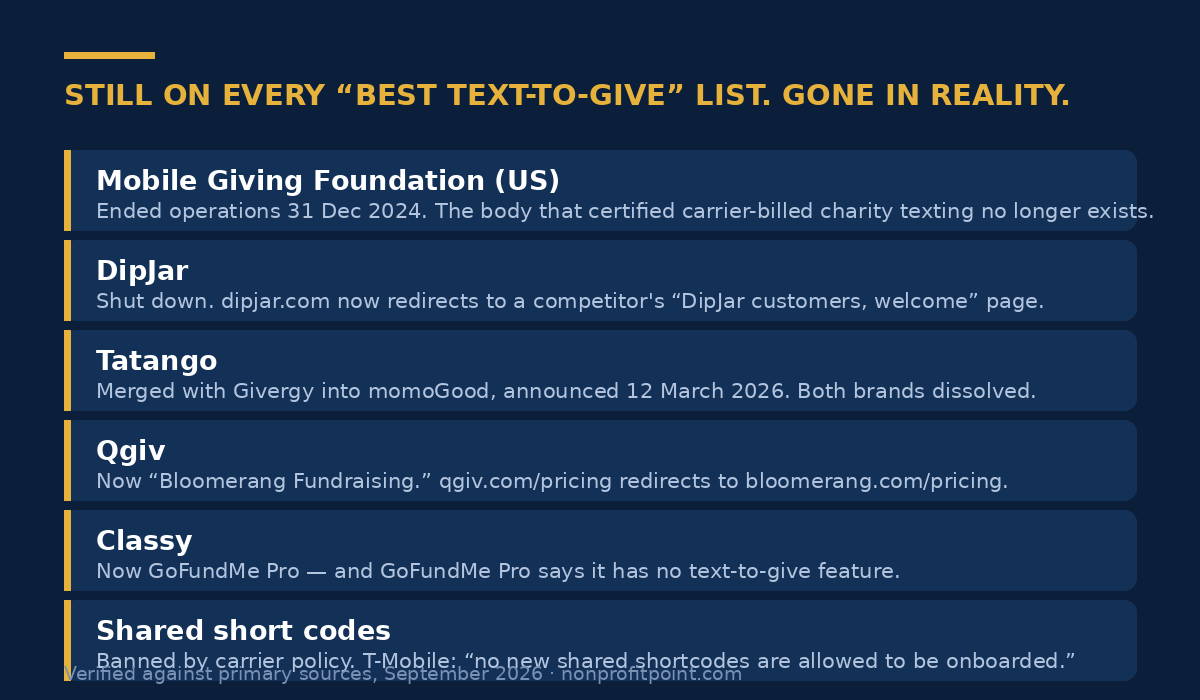
The short version: the thing most nonprofits picture when they hear “text-to-give” — text a word to a five-digit number, ten dollars lands on the donor’s phone bill — no longer exists in the United States. The Mobile Giving Foundation, the body that certified and cleared those carrier-billed charitable texts for seventeen years, ended operations on 31 December 2024. What every vendor sells today is text-to-donate: the donor texts a keyword, gets a link back, and pays by card, ACH or digital wallet on an ordinary web page.
That distinction is not pedantry. It changes what you are buying, what it costs, and which rules you are standing under. And it is the first of several places where the buyer’s guides currently ranking for this topic are describing a market that has moved on. Since 2024, Tatango has ceased to exist as a company, Qgiv has been folded into Bloomerang, Classy has become GoFundMe Pro and dropped text giving entirely, DipJar has shut down, and shared short codes have been banned by carrier policy.
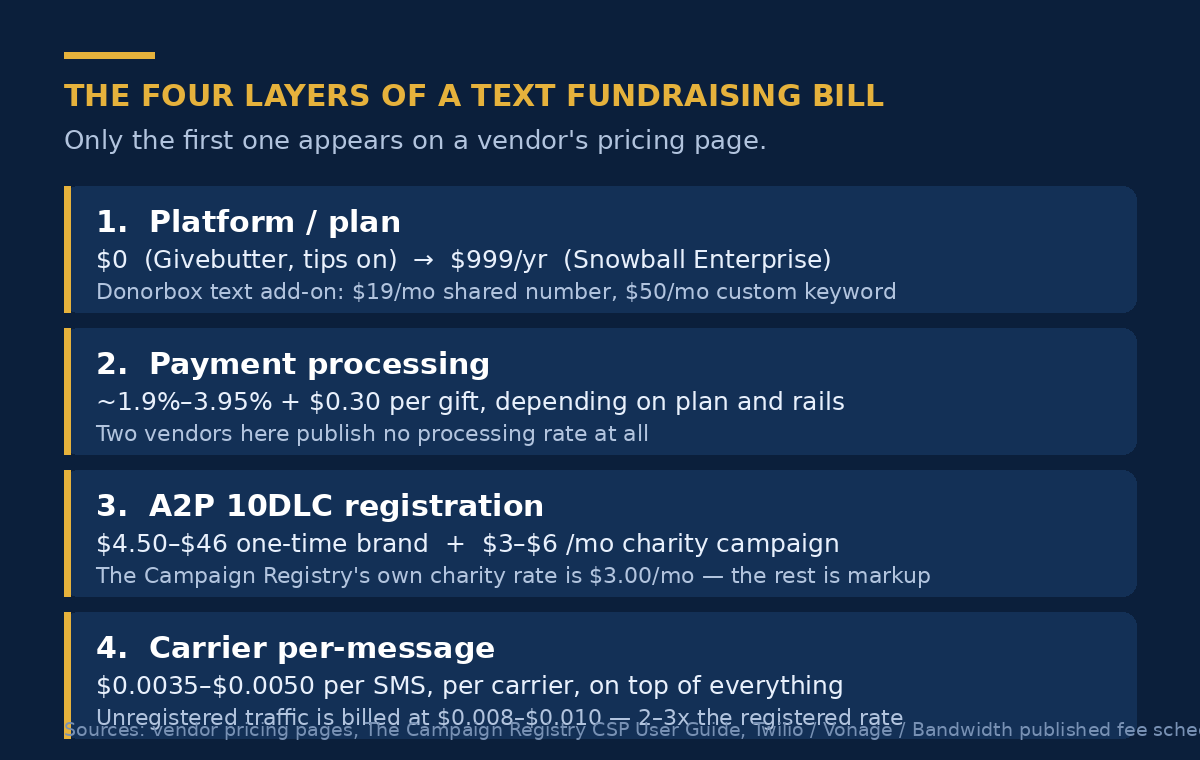
This guide does two things no other page on this subject currently does. It gives you the pricing each vendor actually publishes — and names, without hedging, the ones that publish none. And it prices the three cost layers that sit underneath the platform fee and never appear on a pricing page: A2P 10DLC registration, per-message carrier fees, and short codes. Every figure below was read on the vendor’s or regulator’s own page in September 2026, with the URL noted. Where we could not confirm something, the guide says so instead of filling the gap.
Text-to-give platforms compared: what each one publishes
The single most useful sorting criterion in this category is not features. It is whether the vendor will tell you the price without a sales call. Of the seven platforms that genuinely sell text giving to US nonprofits, two publish complete pricing, one publishes a starting figure and withholds the processing rate, and four publish nothing at all.
| Platform | Text product | Cost of the text feature | Platform fee | Processing |
|---|---|---|---|---|
| Givebutter | Text-to-Donate (short code 53-555) | Free on every account, 5 keywords max | 0% with donor tips on; 3% flat with tips off | 0% with tips on; 2.9% + 30¢ card / 1.9% + 30¢ ACH with tips off |
| Donorbox | Text-to-Give (toll-free, or keyword on 801801) | $19/mo shared number; $50/mo custom keyword; included on Premium | 2.95–3.95% (free plan) · 1.75–2% (Pro, $150/mo) · 1.6–2% (Premium) | Stripe 2.2% + 30¢, PayPal 1.99% + 49¢ (“typically”, per Donorbox) |
| Bloomerang (formerly Qgiv) | Text Fundraising / Text-to-Donate | Bundled. Bloomerang Fundraising from $40/mo annually, must be bought with Bloomerang CRM (from $125/mo) | Not published | Not published |
| Snowball | Text-to-Give | Local numbers = Professional plan; toll-free and short code = Enterprise, from $999/yr | None claimed | Not published on any live page |
| GiveSmart (absorbed MobileCause) | Text-to-Donate | Included in both plans; no figures published | Annual subscription (no per-transaction fee) or pay-as-you-go | Not published |
| OneCause | Text2Give® | Sold as its own package; no figures published | Not published | Not published |
| momoGood (formerly Tatango + Givergy) | SMS fundraising | No figures published; “pricing scales with what you actually run” | Not published | Not published |
Givebutter — the only genuinely free option, with one hard limit
Givebutter’s help centre is unusually direct: “Text-to-Donate is free for all Givebutter accounts,” and “like the rest of Givebutter, Text-to-Donate and using our shortcode is free.” The short code is 53-555, dedicated to Givebutter, and it works only with US phone numbers on US carrier networks.
The revenue model changed and is worth stating precisely, because older guides describe it wrongly. Givebutter charges 0% platform fee when donor tipping is enabled. If you disable tips, a flat 3% platform fee applies, plus standard processing of 2.9% + 30¢ on cards and 1.9% + 30¢ on ACH. You can require donors to cover those fees, offer it as optional, or absorb them.
Two limits to plan around. First, each account may hold only five keywords at a time — you delete one to add another, so a campaign calendar with a dozen keywords needs sequencing. Second, inbound Text-to-Donate is free but outbound texting is a Givebutter Plus feature. Plus runs $29/month for up to 250 contacts, $79/month at 1,000 and $129/month at 2,500. If your plan is to text your existing donor list rather than to put a keyword on a screen at an event, you are buying Plus.
Donorbox — cheap, transparent, and the keyword is the upsell
Donorbox publishes everything, which in this category counts for a lot. Its Text-to-Give add-on is $19/month for the basic version — donors text your campaign ID to a shared toll-free number, 1-855-575-7888 — and $50/month if you want a custom keyword donors can text to short code 801801. It is included at no charge on the Premium plan. There is no per-message cost (“no limit to the number of texts that can be sent and received”) and Donorbox states there are no setup or cancellation fees.
Watch the naming collision: the add-on’s own tiers are called “Standard” and “Custom Keyword,” and they have nothing to do with your account being on Donorbox’s Standard plan. The platform fee that sits underneath is what actually moves the total — 2.95–3.95% on the free plan, dropping to 1.75–2% on Pro at $150/month. For most small organisations the free plan plus the $19 add-on is the right shape; Pro only pays for itself once the fee saving beats $150 a month, which takes roughly $7,500 in monthly online giving. There is also a $195 flat fee to migrate recurring donors on the Standard and Pro plans.
Bloomerang, formerly Qgiv — good product, missing number
Qgiv no longer exists as a brand you can buy. Bloomerang announced the acquisition on 10 January 2024, and qgiv.com now carries a site-wide banner reading “Qgiv is now Bloomerang Fundraising.” The old qgiv.com/pricing page redirects to Bloomerang’s. The text product, once marketed as Text2Give, is now simply Text Fundraising, and it is native rather than an add-on — gifts sync straight to donor profiles.
Bloomerang publishes starting anchors: the Giving Platform from $242/month billed annually, Bloomerang Fundraising from $40/month billed annually, CRM from $125/month, Volunteer from $119/month. Pricing scales with the number of contacts you track, and users are unlimited. But Bloomerang publishes no payment processing rate anywhere, and the $40 figure carries an asterisk whose footnote we could not locate in the page source. Bloomerang Fundraising must also be purchased bundled with the CRM, so $40 is not a real entry point — $165/month is closer. If you shortlist Bloomerang, get the processing rate in writing before you compare it to anything.
Snowball — the short code is the expensive tier
Snowball’s pricing page opens with “Let’s Talk Results—Not Just Prices” and then, unusually, contradicts itself: its own body copy refers readers to “pricing cards above” that are not present anywhere in the page. Prices do exist on Snowball’s live plan-signup pages — an Essential plan at $0/year and an Enterprise plan starting at $999/year — with the two middle tiers, Premium and Professional, unpriced publicly.
The important detail is which plan carries which phone number. Snowball’s own text-to-give page tiers them explicitly: local numbers require Professional; toll-free numbers and short codes require Enterprise. So the marquee “text GIVE to 55555” experience is an Enterprise feature, which starts at $999/year. Snowball claims no platform fees at all — “you only pay for your annual plan and per-transaction credit card processing fees” — but its current live site publishes no processing rate. Outbound messaging is metered: Professional and Enterprise plans buy 3,000 additional SMS for $150, and unused messages roll over. Inbound texts are unlimited.
GiveSmart, OneCause and momoGood — demo-gated
GiveSmart absorbed MobileCause, which it acquired in July 2021; mobilecause.com now redirects to GiveSmart, though a legacy MobileCause login still runs for existing customers. GiveSmart is part of Momentive Software, the entity formed when Community Brands’ nonprofit and events divisions were sold to TA Associates in a deal reported in July 2024. It offers two named plans — an annual fee subscription with no per-transaction fees, and a pay-as-you-go option that costs nothing to start and applies “a clearly disclosed transaction rate” — and publishes no figure for either.
OneCause sells Text2Give® as a discrete package with sixteen listed features including recurring giving and wallet payments, and publishes no monthly fee, no setup fee and no transaction rate. momoGood, formed by the March 2026 Tatango–Givergy merger, states only that “pricing scales with what you actually run (list size, guest count, message volume) not a flat license.”
None of that makes them bad products. It does mean you cannot compare them on this page, and it means the first hour of your evaluation goes to a sales call rather than a spreadsheet. Budget accordingly, and ask all three the same four questions: monthly platform cost, transaction rate, who pays the 10DLC fees, and whether outbound messages are metered.
Two platforms you will see listed that do not do this
Zeffy appears in most text-to-give roundups. It should not. Zeffy’s own words: “While we don’t provide text-to-give services directly, our platform can be used alongside such campaigns to offer donors additional giving options without incurring extra costs.” Zeffy is a genuinely free platform funded by optional donor tips, and it is a strong choice for donation forms — but it has no text product.
GoFundMe Pro, which is what Classy became, is the second. Its own help centre states: “GoFundMe Pro does not currently have a text to give feature,” and points customers instead to Give By Cell, SimpleTexting, Rally Corp, Trumpia, TextMagic and Betwext. The Classy brand retired through mid-2025 — the bank payee name changed from Classy, Inc. to GoFundMe, Inc. on 23 June 2025, and 22 June 2025 was the last day Classy’s EIN was used. Pricing is custom: “an annual upfront subscription with a transaction fee per donation.”
The costs that are not on any pricing page
A2P 10DLC registration — and the markup on a $3 fee
Before a US nonprofit can send fundraising texts from an ordinary ten-digit number, it must complete two registrations through a messaging provider: a brand registration and a campaign registration with The Campaign Registry. Nonprofits cannot register directly; it goes through your platform or its carrier partner.
There is good news buried in the mechanics. Charity / 501(c)(3) is a recognised special use case, restricted to 501(c)(3) organisations, and it requires no external vetting. The Campaign Registry verifies tax-exempt status automatically against IRS records and can display 501(c)(3), (4), (5) or (6) status; if the automated check fails, the fallback evidence is an IRS determination letter or a filed and accepted Form 990. Registration itself needs your legal name, country, EIN, address, vertical and contact details.
Note the scope restriction, because it catches organisations out. The charity use case covers messaging “aimed at providing help and raising money for those in need” and, in Bandwidth’s wording, “is not to be used for messaging that is outside of that nature (ie, appointment reminders, scheduling notifications, 2FA, account updates, etc).” A food bank that wants to text both donation appeals and volunteer shift reminders is looking at two campaigns, not one.
Now the money. The Campaign Registry’s own published charity campaign fee is $3.00 per month. What providers charge for that same pass-through varies: Twilio passes it through at $3/month, Vonage charges $5/month, Bandwidth $6/month. One-time brand registration ranges from $4.50 (Vonage, and Twilio’s low-volume tier) to $9 (Bandwidth) to $46 (Twilio standard, including secondary vetting). Campaign vetting runs $15, and a standard vetting attempt $41.50. Bandwidth also imposes a three-month minimum commitment on all campaigns except political ones.
These are small numbers individually. The reason to know them is that when a platform quotes you a bundled “compliance fee,” you can ask which of these it is marking up, and by how much.
Per-message carrier fees
Every carrier charges a surcharge per message, on top of whatever your platform charges. From Bandwidth’s published schedule, with its own effective dates: AT&T $0.0035 (effective 1 April 2026), T-Mobile $0.0045 outbound and $0.0025 inbound (19 January 2026), Verizon $0.0050 outbound (new rate effective 1 October 2026), and U.S. Cellular $0.0050 outbound. Twilio’s published US figures sit in the same range. Short code and toll-free traffic carries broadly the same per-carrier rates as 10DLC.
Send unregistered and the penalty is steep: Vonage publishes unregistered-traffic rates of $0.008 on T-Mobile and $0.010 on AT&T and Verizon — two to three times the registered rate, assuming the message is delivered at all.
There is one more question worth putting to your vendor in writing. Twilio’s special-use-case documentation shows the Charity / 501(c)(3) case at $0.0000 for AT&T and T-Mobile SMS and MMS — a full waiver of those carriers’ per-message fees, originating in a T-Mobile fee-reduction programme for 501(c)(3), K-12 and emergency campaigns. We could not confirm that waiver is still in force in 2026. The page carrying it sits on a Twilio support site marked end-of-life since February 2024 and still references a 2022 fee; neither Twilio’s current pricing page nor Bandwidth’s 2026 surcharge schedule mentions a charity exemption, and Bandwidth describes reduced T-Mobile pricing as case-by-case, requiring a “Pricing Special Business Review.” Ask your provider directly whether the charity waiver applies to your account and whether it is passed through to you. On a list of 50,000 recipients it is the difference between roughly $200 a send and nothing.
Short codes: $18,000 and ten weeks
If you want your own five-digit code rather than your platform’s shared one, Twilio’s published rates are $1,000/month for a random short code and $1,500/month for a vanity code, billed quarterly, plus a one-time $1,000 US setup fee and $500 more to enable MMS. Leasing a code you already own through Twilio is $500/month. Annual prepayment earns a discount equal to one month.
Year one on a vanity code is therefore roughly $18,000 before a single message is sent. And it is slow: Twilio budgets “between 6 – 10 weeks from the time that you make your initial payment to when the short code is live on major carriers.” A campaign built around a memorable code for Giving Tuesday has to start provisioning in September. For almost every organisation under a few million dollars in revenue, the right answer is to use the platform’s own code — Givebutter’s 53-555 or Donorbox’s 801801 — with your own keyword on it.
Shared short codes, where several unrelated organisations sent independently branded content from one code, are gone. T-Mobile’s Code of Conduct: “Effective immediately no new shared shortcodes are allowed to be onboarded. All existing shared shortcodes will be required to migrate at a future date to a dedicated application address.” AT&T is reported to have closed new shared codes in 2019, though we could not locate an AT&T-published policy document to confirm the dates. Note that CTIA’s Short Code Monitoring Handbook does not itself contain a general ban — the prohibition is carrier policy, and its only blanket dedicated-code mandate applies to political actors.
The compliance rules that actually changed
Nonprofits do not need written consent — federally
This is the single most commonly overstated requirement in nonprofit texting advice. Texts are treated as calls under the TCPA, and 47 CFR § 64.1200(a)(2) requires prior express written consent for autodialed telemarketing — “other than a call made with the prior express written consent of the called party or the prior express consent of the called party when the call is made by or on behalf of a tax-exempt nonprofit organization.” The definition of “telephone solicitation” in the same rule separately excludes calls made “by or on behalf of a tax-exempt nonprofit organization.”
So a 501(c)(3) sending fundraising texts needs prior express consent, not prior express written consent. Three qualifications, all of which matter more than the headline:
- Federal only. State mini-TCPAs — Florida, Oklahoma, Washington, Maryland and others — do not uniformly replicate the nonprofit carve-out. If you text into those states, get state-specific advice.
- It evaporates around advertising. The exemption covers charitable solicitation. A message that “includes or introduces an advertisement” — gala tickets, merchandise, a corporate sponsor’s offer — is a different animal.
- Carriers do not care. CTIA and carrier campaign-vetting rules require a documented opt-in regardless of the statute. You will collect and log consent either way; the TCPA point only changes what happens if you are sued.
The “one-to-one consent” rule is dead
A great deal of 2024-vintage guidance warns nonprofits to prepare for the FCC’s one-to-one consent rule. It never took effect. The Eleventh Circuit vacated it on 24 January 2025 in Insurance Marketing Coalition Ltd. v. FCC, No. 24-10277, holding that the Commission had exceeded its statutory authority and that a consumer “need only ‘clearly and unmistakably’ state, before receiving the robocall, that he is willing to receive the robocall. One-to-one consent is not required.” The FCC then formally repealed the rule by order DA 25-621 on 14 July 2025, published in the Federal Register on 29 August 2025. It is no longer in the CFR. Ignore any checklist that still lists it.
Revocation: ten business days, fixed keywords, and one deadline still ahead
The rules that did take effect are the revocation rules from FCC order 24-24, in force since 11 April 2025 and codified at 47 CFR § 64.1200(a)(10). A donor may revoke consent “by using any reasonable method,” and every request “made in any reasonable manner must be honored within a reasonable time not to exceed ten business days from receipt.”
Practically, that means: the keywords stop, quit, end, revoke, opt out, cancel and unsubscribe must be processed automatically; a donor may opt out in the language your message was written in; a voicemail or email to your published contact details creates a rebuttable presumption of valid revocation, with the burden on you; and if you send a confirmatory opt-out text and the donor does not reply, you must treat that as revoking consent for all your robocalls and robotexts.
One piece is still pending, and it is the one to diary. The requirement that revocation on one campaign apply to all of your unrelated robotexts was waived to April 2026 by order DA 25-312, then extended again by DA 26-12, released 6 January 2026, to 31 January 2027. Until then, a STOP on your event reminders does not automatically kill your appeal texts. After then, it does — and organisations running separate program, event and fundraising lists should be building for that now rather than in January.
What must appear in the messages themselves
CTIA’s Messaging Principles and Best Practices (May 2023) require that standardised STOP wording be used for opt-out instructions, while normal-language opt-outs “should also be read and acted upon,” and that you “acknowledge and honor all Consumer opt-out requests by sending one final opt-out confirmation message per campaign.” Opt-in confirmation messages must carry customer care contact information or HELP instructions, and must disclose that messages are recurring along with their frequency.
A sourcing correction worth having: the familiar “Message and data rates may apply” disclosure is routinely attributed to the Messaging Principles. It is not there. The explicit requirement sits in CTIA’s Short Code Monitoring Handbook v1.9, effective 2 August 2023, in the table of required opt-in confirmation elements — alongside program name, opt-out information, customer care contact and message frequency — with an exception for free-to-end-user programs. If you are writing your compliance documentation, cite the handbook.
Receipting a text donation properly
Under IRC § 170(f)(8), a donor cannot deduct any single contribution of $250 or more without a contemporaneous written acknowledgment. “Contemporaneous” means the donor receives it by the earlier of the date they file their return or the return’s due date including extensions. The acknowledgment must carry your organisation’s name, the amount, a statement of whether you provided any goods or services in return, and if you did, a description and good faith estimate of their fair market value.
The provision that matters most for text giving is this one, from IRS Publication 1771: “Separate contributions of less than $250 will not be aggregated.” A donor giving $25 a month by text for a year triggers no acknowledgment obligation on any individual gift — though every monetary gift of any size still requires a record showing your name, the date and the amount, so per-gift receipting has to work regardless.
Two questions to put to any vendor. First, does an SMS confirmation satisfy the written requirement? Publication 1771 does not address SMS — its examples are a letter, a postcard or a computer-generated form — so a platform that sends only a text and no email receipt leaves a gap you should close yourself. Second, does the automated receipt include the goods-and-services statement? That is the element most commonly missing from automated receipts, and it is the one that matters if you are texting about a gala, an auction or anything with a premium attached.
How to choose, in about ten minutes
- Budget under $100/month, and you mostly need inbound giving. Givebutter. Text-to-Donate is free, the short code is real, and you accept the five-keyword cap. Keep donor tips on unless you have a specific reason not to — turning them off costs 3%.
- You already run Donorbox forms. Add Text-to-Give at $19/month, or $50/month if a memorable custom keyword is worth $31 to you. It usually is for event signage; it usually is not for an email footer.
- You want outbound texting to your donor list, not just inbound keywords. This is a different purchase. Givebutter Plus starts at $29/month; Snowball meters outbound at $150 per 3,000 messages; Bloomerang, GiveSmart and OneCause bundle it into quoted plans. Price the send volume, not the platform.
- You need text giving inside a CRM you already own. Bloomerang if you are already there — but get the processing rate in writing first, because it is not published.
- You are running a large gala or a multi-channel campaign. This is where the demo-gated vendors earn their keep. Ask OneCause, GiveSmart and momoGood the same four questions and compare the answers, not the feature grids.
- Whatever you choose: confirm who registers your 10DLC campaign, whether the charity carrier-fee waiver applies to your account, whether outbound messages are metered, and whether receipts include the goods-and-services statement. Those four answers move the total cost more than the sticker price does.
What we could not verify
Stating this plainly is more useful than filling the gaps. DipJar’s exact shutdown date — the shutdown itself is clear from its domain now redirecting to a competitor’s “DipJar customers, welcome” page, but every source naming 11 February 2025 is a competitor, and DipJar itself never speaks; treat the date as reported, not confirmed. Whether the AT&T and T-Mobile charity carrier-fee waiver is still in force in 2026 — see above; this is the highest-value question to ask your own provider. Bloomerang’s and Snowball’s payment processing rates — neither publishes one, and a rate we found for Snowball came from a help page that now returns a 404, so we have not printed it. Whether momoGood still honours Tatango’s $199/month Fast Start tier. Whether a US carrier or aggregator will onboard a new nonprofit to carrier-billed giving at all — we found no successor to the Mobile Giving Foundation and no 2026 enrollment path. And whether an SMS-only receipt satisfies the IRS written-acknowledgment requirement, on which Publication 1771 is silent.
Frequently asked questions
Is text-to-give still charged to the donor’s phone bill?
No. That model — text a keyword to a five-digit code and a $10 charge lands on your wireless bill — ran through the Mobile Giving Foundation, which ended operations on 31 December 2024. Every US product sold as “text-to-give” in 2026 is technically text-to-donate: the text sends back a link, and the donor pays by card, ACH or wallet on a web page. Donorbox and Givebutter both say so on their own feature pages. If a vendor’s marketing still shows a donation appearing on a phone bill, that page has not been updated in two years.
What is the cheapest text-to-give platform in 2026?
Givebutter, and it is not close. Text-to-Donate is free on every Givebutter account, including unpaid ones, and uses Givebutter’s own dedicated short code 53-555. Givebutter charges 0% platform fee when donor tipping is enabled; turn tips off and a flat 3% platform fee applies plus 2.9% + 30¢ card processing. The catch is a cap of five keywords per account at a time. Donorbox is next: $19/month for a shared toll-free number, or $50/month for a custom keyword on short code 801801, with no per-message charge and no setup fee.
Do nonprofits need written consent before sending fundraising texts?
Under the federal TCPA, no — prior express consent is enough. 47 CFR § 64.1200(a)(2) requires prior express written consent for autodialed marketing calls and texts “other than a call made with the prior express written consent of the called party or the prior express consent of the called party when the call is made by or on behalf of a tax-exempt nonprofit organization.” Three caveats matter. The carve-out is federal only, and state mini-TCPAs do not all copy it. It disappears the moment a message “includes or introduces an advertisement” — gala tickets, merchandise, a sponsor’s offer. And carrier and CTIA rules require a documented opt-in regardless of what the statute says, so you will be collecting consent either way.
How much does a dedicated short code cost?
At Twilio’s published rates, a random short code is $1,000 per month and a vanity code $1,500 per month, both billed quarterly, plus a one-time $1,000 US setup fee and $500 more to enable MMS. A vanity code therefore costs roughly $18,000 in year one before a single message is sent. It also cannot go live quickly: Twilio budgets six to ten weeks from first payment to carrier approval. A short-code campaign tied to Giving Tuesday has to be provisioned a full quarter ahead.
Can we still get a shared short code to keep the cost down?
No. T-Mobile’s Code of Conduct states plainly that “effective immediately no new shared shortcodes are allowed to be onboarded,” and requires existing ones to migrate to a dedicated address, 10DLC or toll-free. AT&T is reported to have closed shared codes earlier still. A vendor offering a nonprofit a “shared short code” in 2026 is either describing its own dedicated code that many customers use with different keywords — which is what Givebutter’s 53-555 and Donorbox’s 801801 actually are — or offering shared 10DLC or toll-free numbers, which is a different product with different throughput.
Does Zeffy offer text-to-give?
No, and Zeffy says so itself: “While we don’t provide text-to-give services directly, our platform can be used alongside such campaigns.” Zeffy is genuinely free to the nonprofit and monetises through optional donor tips, but it is regularly listed in text-to-give roundups it does not belong in. GoFundMe Pro, formerly Classy, is the other common misplacement — its own help centre states that “GoFundMe Pro does not currently have a text to give feature” and refers customers to six third-party SMS tools.
What happened to Tatango?
Tatango and the event-fundraising platform Givergy merged to form momoGood, announced 12 March 2026, with Edison Partners taking the majority stake and both prior CEOs departing. Both brand names were dissolved into the new entity. A legacy Tatango page still advertises a $199/month “Fast Start” package with 2,000 messaging credits; sibling URLs on that domain already redirect to momoGood, and momoGood itself publishes no figures, so treat the $199 as historical until momoGood confirms it.
How quickly must we honour a STOP?
Within a reasonable time not to exceed ten business days from receipt, under 47 CFR § 64.1200(a)(10), in force since 11 April 2025. The rule also fixes the keywords that must be processed automatically — stop, quit, end, revoke, opt out, cancel and unsubscribe — and lets a donor revoke by any reasonable method, including a reply to the wrong number or an email to your published address. One piece is still delayed: the requirement to treat a STOP on one campaign as a STOP on all of your unrelated robotexts was pushed to 31 January 2027 by FCC order DA 26-12, released 6 January 2026.
Do text donations need a tax receipt?
A single contribution of $250 or more requires a contemporaneous written acknowledgment before the donor can deduct it, under IRC § 170(f)(8). IRS Publication 1771 is explicit that “separate contributions of less than $250 will not be aggregated,” so a donor giving $25 a month by text never crosses the threshold on any single gift. Every monetary gift, however small, still needs a record showing your organisation’s name, the date and the amount. Publication 1771 does not say whether an SMS confirmation satisfies the written requirement — its examples are a letter, a postcard or a computer-generated form — so ask any vendor whether it also sends an emailed receipt, and whether that receipt carries the goods-and-services statement, which is the element automated receipts most often omit.
Related guides
Keep comparing before you commit:
- Best donation platforms for nonprofits — the same first-party fee treatment applied to online donation forms.
- Best peer-to-peer fundraising software — for campaigns where supporters fundraise on your behalf.
- Best CRM for nonprofits — where the donor record lives once the text gift lands.
- Donorbox review — a closer look at the platform behind the $19 text add-on.
- Charitable tax deduction rules for 2026 — the donor side of the receipting question.
- How to ask for donations — the copy that decides whether the keyword gets texted at all.
- Fundraising ideas for nonprofits — campaigns a text keyword actually fits.