Charities That Help After a House Fire: What Actually Pays in the First 72 Hours (2026)

US fire departments respond to about 344,600 residential building fires a year. Those fires cause an estimated 2,890 deaths, 10,400 injuries and $11.27 billion in direct property loss, according to the US Fire Administration’s national estimates for 2023.
Almost none of those are disasters in the legal sense. And that distinction, which sounds like paperwork, decides which doors open for you.
Most advice written for people who have just lost a home to fire is quietly recycled from wildfire and hurricane guidance. It tells you to register with FEMA, to claim the casualty loss on your taxes, to get your passport replaced for free. After an ordinary single-home fire, all three of those are wrong. FEMA will not open a case. The passport fee waiver does not apply. The casualty loss deduction almost certainly produces nothing.
What does work is a different and much more local list, and it works fastest if you call it in the right order. This guide gives you that order, the programs that actually pay, the eligibility rules in full rather than in summary, and the three federal doors to stop knocking on so you can spend the hours where the money is.
The first 24 hours, in order
1. Get the fire report number before you leave the scene
Every program below will ask you to prove the fire happened. The fire department’s incident or report number is that proof, and it is far easier to write it down while a crew is still on your street than to chase it in a week.
Ask the officer in charge for the incident number and the name of the department’s records division. The full written report usually takes several days to be finalised and released, and many departments charge a small copying fee. You do not need the finished report to start a Red Cross or insurance claim. You do need it for most charitable assistance applications, and you will need it again if there is any dispute about cause.
2. Call 1-800-RED-CROSS
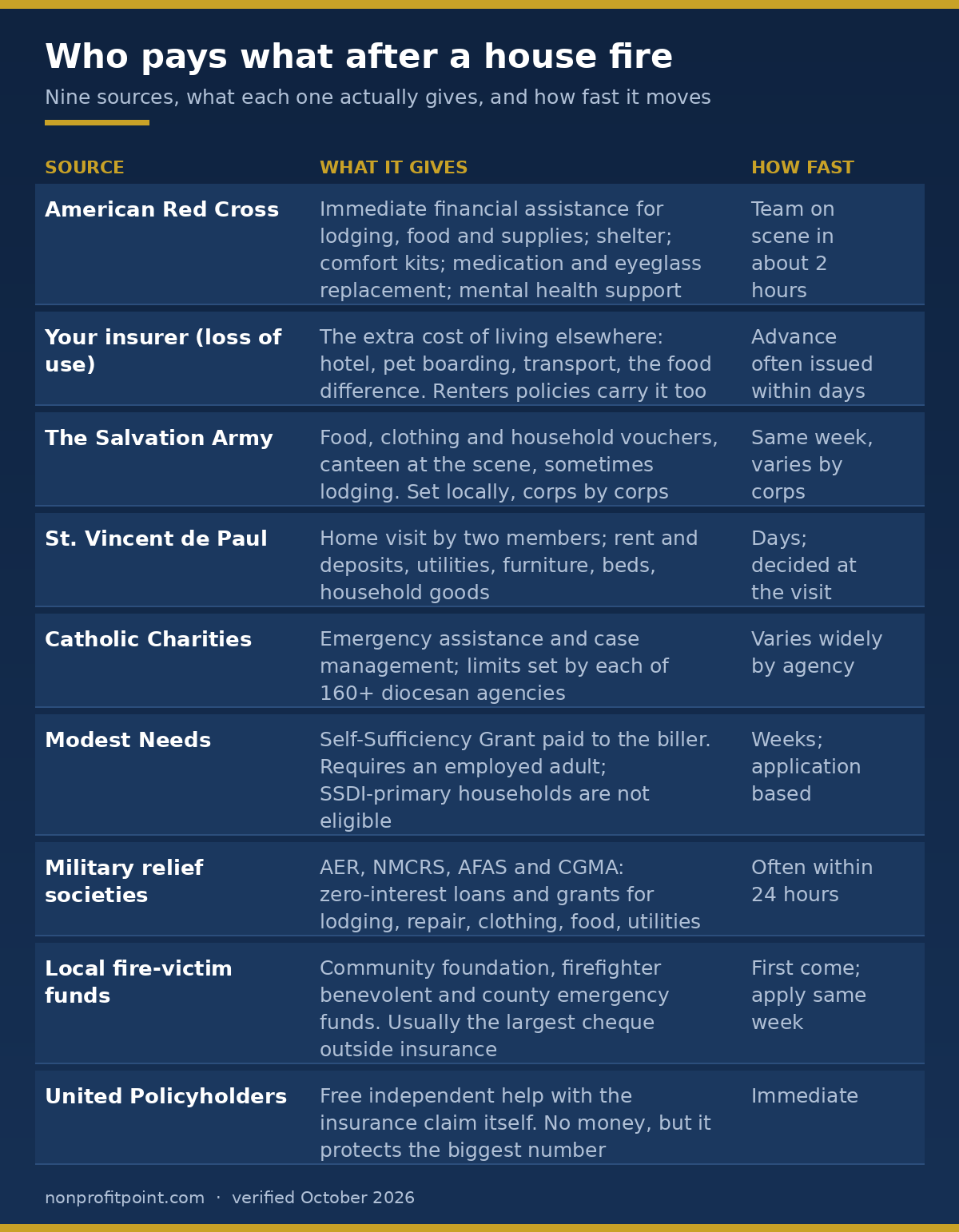
The American Red Cross is the only national organisation that responds to individual home fires as a matter of routine. It says the vast majority of the disasters it responds to are home fires, and that it responds to an emergency somewhere in the country every eight minutes.
What arrives is a Disaster Action Team, typically within about two hours of being notified. What they are authorised to provide, in the immediate aftermath, is:
- Immediate financial assistance for urgent expenses such as lodging, food and essential supplies
- Temporary shelter, arranged with community partners, if the home cannot be stayed in
- Emergency supplies, including comfort kits with basic toiletries
- Health and mental health support, including help replacing medications and eyeglasses lost in the fire
- Recovery casework in the days that follow, which is the part most people never ask for
Be clear about what this is not. The Red Cross is not a rebuilding fund and it does not replace your insurance. Its job is to get your household through the first few nights. The sum involved is measured in hundreds of dollars and a handful of nights, not thousands. Treat it as the bridge, not the recovery.
You can request help through the Red Cross get help page or by calling 1-800-RED-CROSS. In most cases the fire department notifies them for you while they are still on scene, but do not assume it happened.
3. Call your insurer the same day, and ask for loss of use by name
If you have homeowners or renters insurance, the largest cheque in your recovery is already yours and the clock on it has started. Two parts of the policy matter immediately.
Loss of use, also written as additional living expenses, ALE or Coverage D, pays the extra cost of living somewhere else while your home is uninhabitable. Travelers gives the standard worked example: if your household normally spends $300 a week on groceries and spends $400 a week eating out while in a hotel with no kitchen, the $100 difference is what the coverage pays. It also covers temporary lodging, public transport, boarding a pet, and lost fair rental value if you rented out part of the home. It does not pay expenses you are no longer incurring, such as utilities at the burned property.
Renters have this too. A renters policy carries loss of use alongside personal property cover, and a large share of renters who have a policy never claim the lodging half of it because nobody tells them it exists. Your landlord’s insurance covers the building. It does not cover your possessions or your hotel.
Two asks for that first call: open the claim and get a claim number, and request an advance on both additional living expenses and contents. Most insurers will issue one within days, and that advance is usually the first real money a household sees.
4. Call 211
Dialling 211 reaches a free, 24-hour referral service run through United Way, which maintains the local database of who is actually funded and open in your county this month. It covers crisis and disaster recovery, housing and utility costs, food programs, healthcare and bill assistance, and you can search online instead of calling.
Tell the operator three things: that you have had a house fire, the date, and whether you are insured. The answer to the third question changes which programs they route you to, because many local emergency funds exist specifically for uninsured households.
Why FEMA will almost certainly not help
This is the single most common wasted day after a house fire, so it is worth being blunt.
FEMA’s Individuals and Households Program is the mechanism people mean when they say “apply to FEMA”. Its own fact sheet sets out the conditions: you must have necessary expenses or serious needs directly caused by a declared disaster, and for housing assistance the damaged home must be in a declared disaster area. Assistance is limited to 18 months after the presidentially declared disaster.
An isolated house fire is not a declared disaster. It does not become one because the loss was total, because you were uninsured, or because the household has children. If your county is not named in a current declaration, there is no FEMA case to open, and the hours spent looking for one are hours not spent on the list in the next section.
The exception is a fire that was part of a declared event, which in practice means a wildfire complex or a fire following a storm or earthquake. If that is your situation, the program is substantial and you should apply. Its categories include Serious Needs assistance for essentials such as water, food, first aid, infant supplies and fuel; Displacement assistance for immediate housing when you cannot return home; Rental Assistance; Lodging Expense Reimbursement; Home Repair or Replacement for owner-occupied primary residences; and Other Needs Assistance covering personal property, medical and dental costs, funeral costs, child care, transportation, moving and storage, and cleaning.
Two details worth knowing. The maximum grant for Home Repair or Replacement and for Other Needs Assistance changes every fiscal year and is adjusted to the Consumer Price Index, so any dollar figure you read on a blog is probably stale. And Rental Assistance, Lodging Expense Reimbursement and Direct Temporary Housing carry no financial maximum at all, which is the part of the program most households underclaim.
Nine programs that actually pay after a home fire
1. American Red Cross
Covered above, and first for a reason: it is the only one of these that comes to you. Ask specifically about recovery casework after the first night, not just the immediate assistance card. A caseworker is the person who knows which local funds exist.
2. The Salvation Army
The Salvation Army runs Emergency Disaster Services at local corps level, and single-structure fires are a standing part of that work. Typical help is a canteen at the scene for responders and displaced residents, food, vouchers for clothing and household goods at its family stores, and in some corps short-term lodging.
What matters is that everything is decided locally. There is no national amount, no national application and no national waiting list, and the corps in the next county may operate differently from yours. Use the Salvation Army location finder to get the nearest corps and ask for the emergency assistance caseworker by name.
3. The Society of St. Vincent de Paul
St. Vincent de Paul works through parish-based conferences of volunteers, and its distinguishing feature is the home visit: two members come to you, assess the situation in person, and are often able to authorise help on the spot. Common assistance after a fire is rent or deposit help, utility reconnection, furniture, beds and household goods.
It helps people of any faith or none. Find your local conference through the national society’s site. Note that the national domain changed, so older directories pointing at svdpusa.org will bounce you.
4. Catholic Charities
Catholic Charities operates through diocesan agencies, more than 160 of them, each setting its own emergency assistance rules and budget. Some run substantial direct financial assistance; others concentrate on case management and referral. There is no way to know which yours is without calling, so find your local agency and ask directly what the emergency assistance limit is this quarter.
5. Modest Needs
Modest Needs makes Self-Sufficiency Grants to working households facing a one-off emergency. It is genuinely useful and its eligibility rules are stricter than almost any other program on this list, so read them before you spend an hour applying.
- At least one adult in the household must be documentably employed at the time of application.
- The household’s largest single source of income must be employment, child support, veterans’ benefits, or retirement income including Social Security retirement.
- Households whose primary income is Social Security Disability Income are not eligible, and are referred to 211 instead. This excludes a large share of fire-affected households and is the reason most Modest Needs applications fail.
- Special consideration goes to people living alone with no dependent children, to public school teachers, and to first responders.
Eligible costs include uninsured medical care, major appliance repair or replacement, required work tools or uniforms, and funeral expenses, plus a one-time payment of a monthly bill where a documented extenuating circumstance occurred in the past year. It will not cover taxes, groceries, fuel, rent paid to a family member, utility or rental deposits, credit card balances, payday loans, overdrafts, fines or legal fees. Modest Needs does not send cash or gift cards; it pays bills on the household’s behalf.
6. Military families: the four relief societies
If anyone in the household serves or has served, this is usually the fastest money available, and it is routinely missed.
Army Emergency Relief provides zero-interest loans and grants, assessed case by case, across categories that map directly onto a house fire: temporary lodging, home repair, clothing, food, utilities, rent or mortgage deposits, and vehicle costs. Eligibility covers active-duty soldiers and eligible dependents, soldiers retired for longevity, medical reasons or at age 60 for the reserve component, Reserve and National Guard soldiers on Title 10 orders of more than 30 days, unremarried surviving spouses, and children of soldiers who died on active duty or after reaching retirement eligibility.
The equivalents are the Navy-Marine Corps Relief Society, the Air Force Aid Society and Coast Guard Mutual Assistance. All four can act within a day because they are internal to the service community rather than a public grant process.
7. Operation Homefront
Critical Financial Assistance from Operation Homefront serves post-9/11 wounded, ill or injured service members and veterans and their families, and pays vendors directly rather than issuing cash. It is a supplement to the relief societies rather than a substitute, and worth applying to in parallel.
8. Your local fire-victim fund
This is the money nobody writes about and it is often the largest single cheque a household receives outside insurance. Depending on where you live, some combination of these exists:
- A community foundation emergency or neighbour-in-need fund
- A firefighters’ association or benevolent fund attached to the department that answered your call
- A county or municipal emergency assistance program, often administered through social services
- A local ministerial alliance or church fund that pools across congregations
None of these advertise. Two questions find them: ask the fire department for its community risk reduction officer, and ask the 211 operator, in those words, which local fire-victim funds are currently taking applications. Apply the same week; most are small and first-come.
9. United Policyholders
United Policyholders is a nonprofit that gives free, independent help with the insurance claim itself, including how to build a contents inventory, how to read your own policy and what to do when an adjuster’s figure looks wrong. It gives no money. It protects the biggest number in your entire recovery, which usually makes it the highest-value call on this page.
Replacing what burned: documents, agency by agency
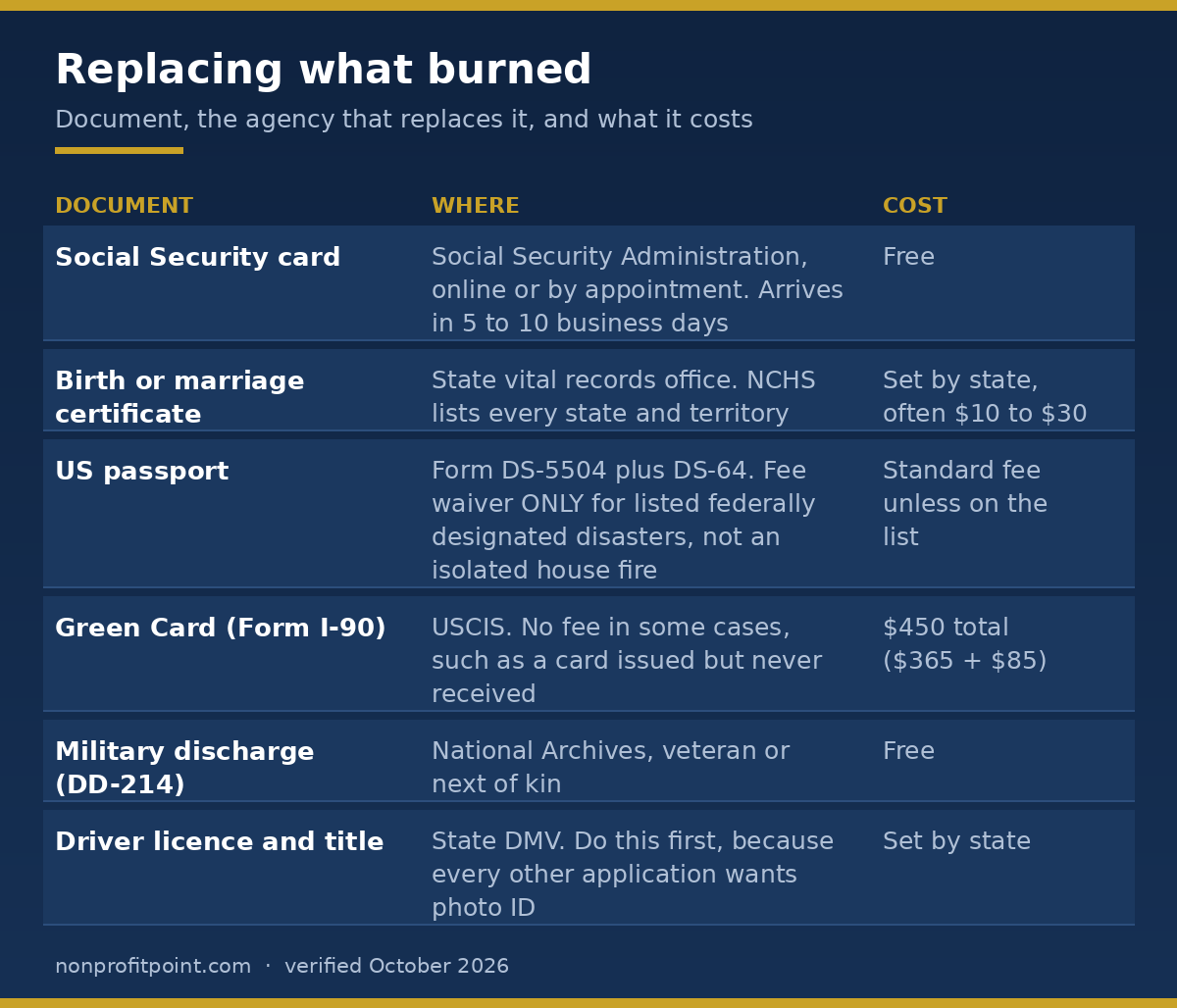
Social Security card. Free. Apply online through the Social Security Administration if your situation qualifies, otherwise by appointment at a local office. The replacement card arrives by post in five to ten business days. If you already know the number, you often do not need the physical card at all.
Birth, marriage and death certificates. These are held by the state where the event occurred, not by the federal government. The National Center for Health Statistics maintains a directory of where to write for vital records covering every state and territory. Fees are set by each state and typically run from around ten to thirty dollars per copy. Some states waive them after a declared disaster; most do not waive them for an individual fire, though it is worth asking.
Passport. Read this one carefully. The State Department can waive the passport application and file search fees after a disaster, and a great deal of fire-recovery advice quotes that as though it were general. It is not. The waiver applies only to people impacted by federally designated disasters that appear on the department’s published list. You are also ineligible if you never held a passport, or if the one lost was already expired. For those who do qualify, the process is Form DS-5504 plus Form DS-64 and a new photo; the application fee waiver runs for three years after the disaster and the file search fee waiver for eighteen months. After an ordinary house fire you pay the standard fee.
Green Card. Form I-90, with a total fee of $450, made up of a $365 form fee and an $85 biometric services fee. There is no fee in certain situations, including a card that was issued but never received or one carrying incorrect data because of a DHS error. If you are requesting a fee waiver you cannot file online and must file by post.
Military discharge papers (DD-214). Free to the veteran or next of kin from the National Archives. Worth requesting early, because several of the veteran programs above want to see it.
Driver’s licence and vehicle title. Your state DMV, with fees and replacement rules set state by state. Do this before the document scramble, not after, because almost every other application on this page asks for photo ID first.
The tax question most pages get wrong
Since 2018, a personal casualty loss has generally been deductible only if it was caused by a federally declared disaster. The IRS states plainly that outside that case, a deduction is generally not available for net personal casualty losses. Where a loss does qualify, you subtract $100 per event and then 10% of your adjusted gross income from the total, and you claim it as an itemised deduction on Schedule A. A qualified disaster loss is treated more generously: $500 per event instead of $100, no 10% threshold, and you may elect to claim it without itemising.
What changed for 2026. The One Big Beautiful Bill Act, P.L. 119-21, made the deduction permanent, and beginning in 2026 the scope of eligible losses is no longer limited solely to federally declared disasters. State-declared disasters can now qualify, provided all other requirements of Internal Revenue Code section 165 are met. That is a real and under-reported expansion, and it will matter to households caught in events a governor declares but a president does not.
It still does not reach an ordinary house fire. If your fire is not attributable to a declared disaster of either kind, the loss generally produces no deduction, and any insurance reimbursement reduces the loss in the calculation regardless. This is a summary of published IRS guidance and not tax advice. A fire year is a good year to pay for an hour with a tax professional rather than guess.
Week two and beyond
Photograph everything before you throw it away. The Red Cross is explicit that items such as plastics, canned and boxed food, medicines and hygiene products exposed to heat and smoke should be discarded, and that you should photograph what you discard. Those photographs are claim evidence.
Build the contents inventory yourself, room by room. It is slow, miserable and the highest-value unpaid work of the whole recovery, because the number you do not list is the number you do not get paid for. Receipts help; so do old phone photographs of rooms, which almost everyone has and almost nobody thinks to mine.
Do not sign anything at the scene. Public adjusters and restoration contractors often arrive before the smoke clears. Some are excellent. A contract signed in the first hours, in shock, on a street, is not how to find out which.
Stay out until the fire authorities clear the structure, and have pets checked by a vet for smoke inhalation and hidden burns even when they look unhurt.
Ask for the mental health support. It is part of what the Red Cross provides and it is the thing households decline first and need longest, particularly where children were in the house.
Frequently asked questions
Does the Red Cross give you money after a house fire?
Yes, but as a bridge rather than a recovery. A Red Cross Disaster Action Team usually reaches a home fire within about two hours of being notified and provides immediate financial assistance for urgent costs such as lodging, food and essential supplies, plus comfort kits, help replacing medications and eyeglasses, and mental health support. The amounts are measured in hundreds of dollars and a few nights of lodging. The Red Cross is not a rebuilding fund and does not replace insurance.
Will FEMA pay for a house fire?
Almost never. FEMA assistance through the Individuals and Households Program requires needs directly caused by a declared disaster, and housing assistance requires that the damaged home sits inside a declared disaster area. A single house fire is not a declared disaster, however total the loss. The exception is a fire that forms part of a declared event such as a wildfire complex, in which case the program is substantial and you should apply.
How long does insurance pay for a hotel after a fire?
Loss of use coverage, also called additional living expenses, pays while the home is uninhabitable, subject to the policy limit and any time limit written into the policy. Limits are commonly expressed as a percentage of the dwelling amount or as a fixed sum, and many policies also cap the period at twelve or twenty four months. Read your own declarations page, because the two caps are separate and whichever runs out first ends the payments.
What should I do first after a house fire?
Get the fire department incident number before you leave the scene, then make three calls the same day: 1-800-RED-CROSS for immediate assistance, your insurer to open a claim and request an advance on living expenses and contents, and 211 for local programs. Stay out of the structure until the fire authorities say it is safe.
Can I get help after a house fire if I have no insurance?
Yes, and several local programs exist specifically for uninsured households. The Red Cross responds regardless of insurance status. Say plainly that you are uninsured when you call 211, because it changes which funds they route you to. County emergency assistance, community foundation funds and firefighter benevolent funds are the most likely sources, and the fire department itself is often the fastest way to find them.
How do I get a copy of the fire report?
Ask the officer in charge for the incident number at the scene, then request the written report from the fire department records division. It usually takes several days to be finalised and released and many departments charge a small copying fee. You do not need the finished report to start a Red Cross or insurance claim, but most charitable assistance applications will ask for it.
Is a house fire tax deductible?
Usually not. Since 2018 a personal casualty loss has generally been deductible only when caused by a federally declared disaster, and beginning in 2026 state declared disasters can also qualify after the One Big Beautiful Bill Act made the deduction permanent and widened its scope. An ordinary house fire tied to no declaration of either kind generally produces no deduction, and insurance reimbursement reduces the loss in any case. Speak to a tax professional about your own return.
How do I replace a Social Security card lost in a fire?
A replacement Social Security card is free. Apply online through the Social Security Administration if your situation qualifies, or make an appointment at a local office. The card arrives by post within five to ten business days. If you already know your number you may not need the physical card at all.
Does renters insurance pay for a hotel after a fire?
Yes. A renters policy carries loss of use alongside personal property coverage, and it pays the extra cost of living elsewhere while the unit is uninhabitable. Many renters never claim it because they assume the landlord policy covers them. It does not: the landlord insures the building, not your possessions and not your lodging.
Who helps with furniture and beds after a house fire?
The Society of St. Vincent de Paul is usually the best first call, because its local conferences do home visits and commonly provide furniture, beds and household goods. Salvation Army family stores issue vouchers for furniture and household items through local corps. Habitat for Humanity ReStores, local furniture banks and church thrift programs fill the rest, and a 211 operator can name the ones operating in your county.
Related help
If the fire has left you needing a bed, a room or the basics, these cover the next steps:
- Charities That Help With Emergency Shelter – how to get a bed tonight, and how coordinated entry actually works.
- Charities That Help With Hotel Vouchers – the ten programs that issue them and what to have ready when you call.
- Charities That Help With Furniture – furniture banks, beds and household goods once you have somewhere to put them.
- Charities That Help With Winter Coats – clothing programs, which matter most when a fire happens in the cold months.
- Free Financial Assistance Organizations – the wider list of funds that pay bills in an emergency.
- Get Help Paying For… – our full directory of assistance guides by need.
Every program, eligibility rule, fee and deadline in this article was verified on the organisation’s own website or on the responsible federal or state agency’s published guidance in October 2026. Where a rule is set locally rather than nationally, we say so rather than quote a figure that will not hold in your county. Program terms and fees change without notice; confirm before you rely on a number here. This article explains how to find help and is not legal, insurance or tax advice.