Hospital Bill Forgiveness in 2026: How Charity Care Works and How to Apply

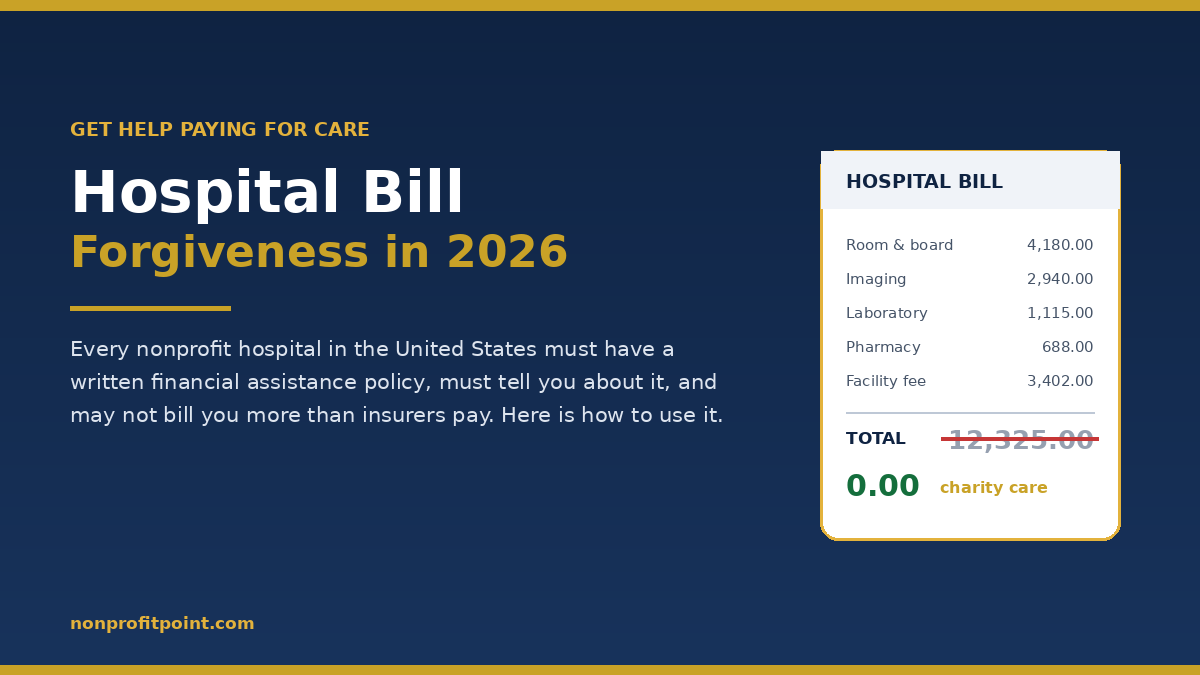
If you are holding a hospital bill you cannot pay, the most valuable thing available to you is almost never a charity grant. It is the hospital itself.
Every hospital in the United States that is organised as a 501(c)(3) charity has to run a financial assistance programme. Not as goodwill, and not as a courtesy it can withdraw. It is a condition of the hospital keeping its tax exemption, written into the tax code at Section 501(r) and spelled out in regulations the IRS finalised on 29 December 2014. The hospital must publish a policy, must tell you it exists, must give you months to apply, and once you qualify it may not bill you more than it bills insured patients for the same care.
That programme is usually called charity care or financial assistance. It routinely erases a bill in full. And most of the people entitled to it never ask, because nobody on the hospital’s side has any particular reason to bring it up while a payment plan is on the table.
The scale of the miss is measurable. Washington State’s Department of Health, which collects the numbers because state law makes it, reported in January 2026 that Washington hospitals wrote off about $1.6 billion in billed charges as charity care during 2024 and estimated that roughly half of all patients treated in the state’s hospitals, about 3.9 million people, were eligible for it. Eligible is not the same as approved. The gap between those two words is where this article lives.
What charity care actually is, and what it is not
Charity care is the hospital reducing or cancelling its own bill, under its own written policy, because of your financial circumstances. It is not any of the following, and the distinction matters because each of the alternatives is worse for you:
- It is not a payment plan. A payment plan means you still owe the full amount. Agreeing to one before you have applied for financial assistance is the single most common way people give up a write-off they qualified for.
- It is not a self-pay or prompt-pay discount. Those are commercial discounts off an inflated list price. The IRS is explicit that discounts offered outside the financial assistance policy do not count as financial assistance at all.
- It is not a grant from an outside charity. Outside grants exist and are worth pursuing, but they are usually a few hundred to a few thousand dollars. Charity care can be the whole bill.
- It is not bankruptcy, debt settlement or a medical credit card. Every one of those costs you something. Charity care costs you paperwork.
The formal name you will see on the hospital’s website is the Financial Assistance Policy, almost always abbreviated FAP. If you remember one phrase from this page, make it that one. Asking the billing department for “the FAP and the plain language summary” gets a different response from asking whether they can “do anything about the bill.”
The four things every nonprofit hospital owes you under Section 501(r)
The requirements apply facility by facility. A health system with eleven hospitals has to satisfy them at all eleven, and a failure at one facility can put the whole organisation’s exempt status at risk. The IRS sets out the four requirements for 501(c)(3) hospitals as follows.
1. A written policy it has to push in front of you
Under 501(r)(4) the hospital must have a FAP that covers all emergency and other medically necessary care, states the eligibility criteria for every level of help it offers, says whether that help is free or discounted, explains how to apply, and lists what documents an applicant may be asked for.
Two parts of that are quietly powerful. First, the IRS guidance on the policy requirement says assistance cannot be denied for failing to provide information the policy or the application form did not specifically ask for. If a billing clerk demands two years of tax returns and the published form does not list them, that demand is not a basis for denial. Second, the hospital may approve you on an attestation or other evidence rather than documents, which is the opening you use when you genuinely cannot produce paperwork.
The hospital must also widely publicise the policy, and the regulation is specific about what that means: the full FAP, the application form and a plain language summary posted on the website so anyone can view, download and print them without an account, without handing over personal information and without paying; free paper copies on request by mail; copies offered in the emergency room and admissions areas; a conspicuous notice on billing statements carrying a phone number and a web address; public displays in the emergency room and admissions areas; and translations for every language group in the community that is the lesser of 1,000 people or 5 percent of the population served.
If none of that happened to you, that is itself a compliance failure worth naming in writing.
2. A hard cap on what you can be charged
Section 501(r)(5) is the provision almost nobody knows. Once you are determined eligible under the FAP, the hospital may not charge you more than amounts generally billed, or AGB, for emergency and other medically necessary care. AGB is, in plain terms, what the hospital actually collects from insured patients for the same service.
The IRS rules on the limitation on charges allow two ways to work it out. The look back method takes claims the hospital was allowed over a prior twelve month period, divides allowed amounts by the associated gross charges, and applies the resulting percentage. The claims can come from Medicare fee for service alone, Medicare plus private insurers, or Medicaid alone or combined. The prospective method instead prices your care as though you were a Medicare or Medicaid beneficiary, counting both the programme payment and the patient cost sharing.
Either way, the number is typically a fraction of the list price on the statement in your hand. And the cap applies to insured patients too, not just the uninsured, provided they are FAP eligible. For any care covered by the policy, the hospital must in all cases charge an eligible patient less than gross charges.
3. A 120 day pause and a 240 day window
Section 501(r)(6) governs billing and collections, and it runs on a clock you should write down. The IRS billing and collections rules require a hospital to make reasonable efforts to determine whether you are FAP eligible before it takes any extraordinary collection action against you. Reasonable efforts means, at minimum:
- 120 days. The hospital must notify you about the FAP and must refrain from extraordinary collection actions for at least 120 days after the first post discharge billing statement.
- 240 days. The application period runs 240 days from that same first post discharge statement. Submit inside it and the hospital has to process your application.
- 30 days of notice. Before the first extraordinary collection action the hospital must give written notice with a deadline no earlier than 30 days out, and must also give oral notice at least 30 days ahead. In practice this means the window can run past 240 days.
- Everything stops when you apply. Once a complete application is received the hospital must suspend collection actions, make a timely determination, and tell you the result and its basis in writing. Collections cannot resume until that determination is made.
- Incomplete is not denied. If your application is incomplete the hospital must tell you how to complete it and give you a reasonable opportunity to do so.
Extraordinary collection actions are defined, not left to interpretation. They include selling your debt to a third party, reporting adverse information to credit bureaus, deferring or denying medically necessary care because of unpaid previous bills, placing a lien on your property, foreclosing on real property, seizing a bank account, commencing a civil action, causing an arrest or a writ of body attachment, and garnishing wages.
Three things are specifically not extraordinary collection actions: filing a claim in a bankruptcy proceeding, placing a lien on the proceeds of a personal injury settlement paid by a third party, and selling the debt under a written agreement that bars the buyer from collection actions, caps interest at the federal underpayment rate, makes the debt recallable if you turn out to be eligible, and ensures you never pay more than an eligible person would.
4. An emergency care policy that does not ask about money first
The fourth requirement is a written emergency medical care policy obliging the hospital to provide care for emergency medical conditions without discrimination and regardless of FAP eligibility. This sits alongside, and does not replace, the federal duty to screen and stabilise anyone who turns up at an emergency department.
Who qualifies in 2026
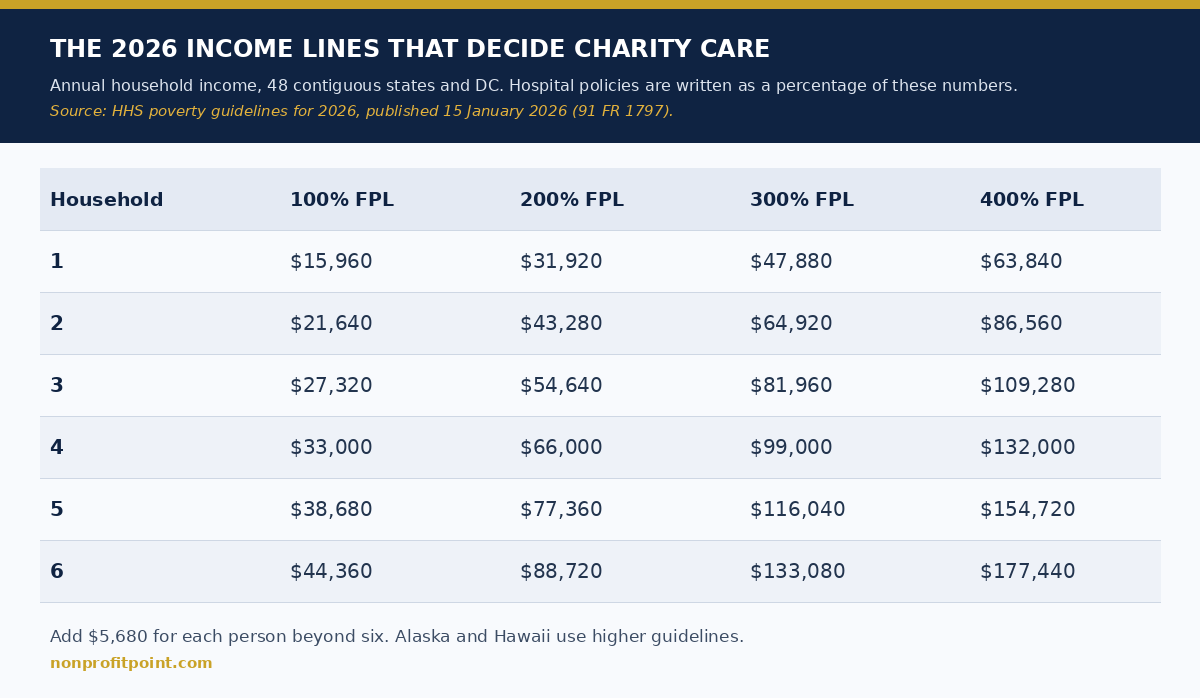
Hospital policies are written as a multiple of the federal poverty guidelines, so the guidelines are where eligibility starts. The 2026 figures were published on 15 January 2026 at 91 FR 1797 and took effect 13 January 2026. For the 48 contiguous states and the District of Columbia, the poverty guideline is $15,960 for one person and rises by $5,680 for each additional person, reaching $33,000 for a household of four. Alaska and Hawaii use higher figures: $41,250 and $37,950 respectively for a household of four. The current tables are maintained on the HHS poverty guidelines page.
There is no federal income cutoff, and this is the most misunderstood fact on the subject
Section 501(r) requires a hospital to have a policy. It does not tell the hospital where to draw the line. A hospital that gives free care only below 100 percent of the poverty guideline satisfies the statute exactly as well as one that gives free care below 400 percent. That is why advice telling you that charity care stops at 200 percent of poverty, or at any other single number, is wrong everywhere except by coincidence.
The practical consequences are two. First, the only threshold that governs your bill is the one in that hospital’s own FAP, which is published and which you can read before you apply. Second, two hospitals ten miles apart can reach opposite decisions on identical finances, so being turned down by one tells you nothing about the next.
The variation is wide in the aggregate as well. KFF’s analysis of hospital cost report data found that half of all hospitals reported charity care at 1.4 percent or less of operating expenses, with an average of 2.6 percent pulled upward by a small number of large spenders. About 8 percent of hospitals reported 0.1 percent or less. A hospital at the bottom of that distribution still has a policy. It simply has a thin one.
Being insured does not disqualify you
This is the second common misreading. The AGB cap in 501(r)(5) applies to all FAP eligible individuals, insured or uninsured. Many hospital policies cover the portion a patient owes after insurance, which is exactly the problem facing someone with a high deductible plan and a $9,000 out of pocket maximum. Some states write the point into law: New York defines an underinsured patient as one whose out of pocket costs exceed 10 percent of pre tax household income and requires hospitals to help them.
Presumptive eligibility, and why you should ask about it by name
A hospital may determine you eligible without a completed application, using information it already has or buys, such as enrolment in a means tested public programme, homelessness, or a credit based scoring model. This is called presumptive eligibility and it counts as reasonable efforts under the billing rules. A presumptive finding of ineligibility does not count and does not release the hospital from doing the rest.
If you are on Medicaid, SNAP, WIC, SSI or a similar programme, say so in the first sentence of your application. In many policies that enrolment alone triggers approval.
Where state law sets a floor above the federal rule
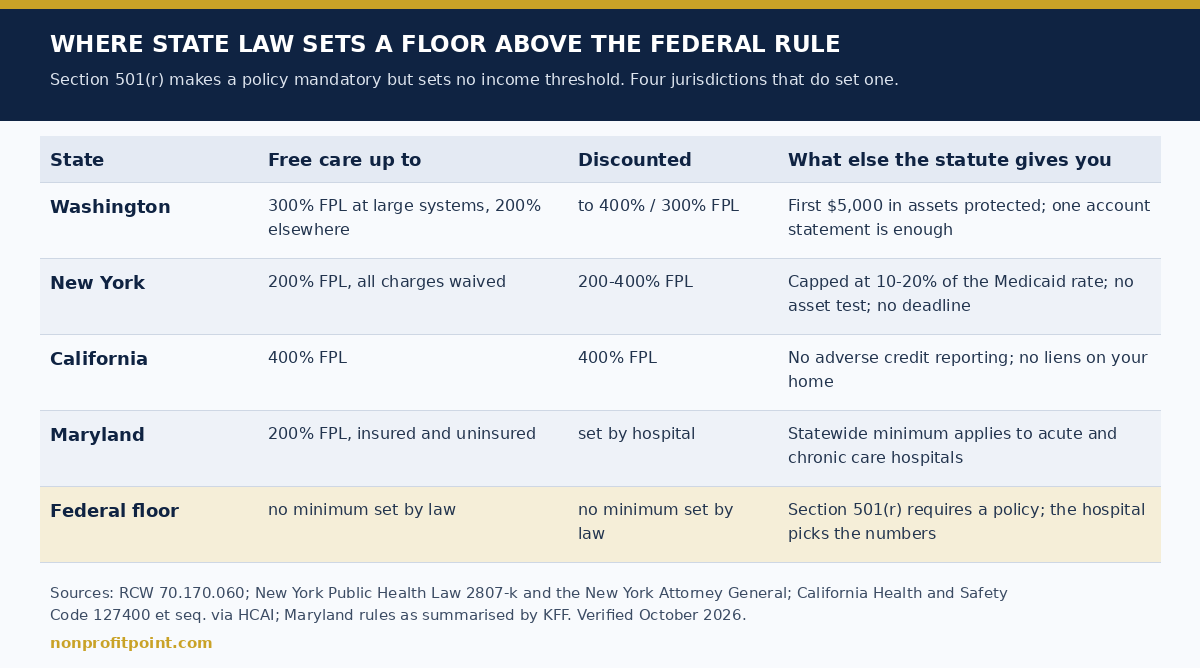
Because the federal rule sets no number, some states set their own. Research summarised by KFF counted 26 states and the District of Columbia requiring all or some hospitals to extend eligibility to certain patients, with 11 states applying minimum standards to for profit, nonprofit and government hospitals alike. Thirteen states require eligibility screening, sixteen require patient notification and eight regulate appeals. Three of the strongest regimes are worth knowing in detail because they show what a real floor looks like.
Washington
RCW 70.170.060 splits hospitals in two. At large systems, defined to include systems operating three or more acute hospitals and specified large single hospitals, full charity care runs to 300 percent of the federal poverty level, a 75 percent discount covers 301 to 350 percent and a 50 percent discount covers 351 to 400 percent. At every other hospital the ladder is 200 percent for free care, 75 percent off to 250 percent and 50 percent off to 300 percent.
The statute also protects assets, which most do not. If a hospital counts assets at all it must publish its asset policy, and it must exclude the first $5,000 in monetary assets for an individual, $8,000 for a family of two plus $1,500 for each additional member, equity in a primary residence, most retirement plans other than 401(k)s, one vehicle plus a second where needed for work or medical reasons, prepaid burial arrangements and life insurance with a face value of $10,000 or less. One current account statement is sufficient to verify monetary assets, a signed written statement must be accepted where no documentation exists, and asset information may not be used for collection activity. Income can be measured at the time of application rather than the time of service if you apply within two years and have been making good faith payments.
New York
New York requires hospitals to offer assistance to households at or below 400 percent of the federal poverty level, and caps what an eligible patient can be charged rather than leaving it to the hospital. As the New York Attorney General sets out: below 200 percent of poverty all charges are waived; between 200 and 300 percent an uninsured patient can be charged no more than 10 percent of what Medicaid would have paid, on a sliding scale; between 301 and 400 percent the cap is 20 percent.
Eligible patients must be offered an instalment plan whose payments cannot exceed 5 percent of pre tax monthly income, with interest capped at 2 percent a year. Hospitals may not ask about assets such as a home or a car and may not deny assistance because you lack bank statements or tax returns. There is no application deadline at all, decisions are due within 30 days of a complete application and must be explained in writing, and even if you never apply a hospital cannot send the bill to a collector until at least six months after the first bill. The programme rules for patients are published by the New York State Department of Health.
California
California’s Hospital Fair Pricing Act, at Health and Safety Code section 127400 and following, sets eligibility at 400 percent of the federal poverty level, raised from 350 percent by AB 1020 in 2021. That law also restricted the sale of patient debt, pushed the earliest date for adverse credit reporting or a civil action out to 180 days from the initial bill, and required debt collectors to certify that a patient was screened for public coverage and financial assistance before filing suit. Two 2024 laws went further: adverse credit reporting on hospital debt is prohibited outright, as are liens on and sales of a patient’s real property. A 2025 law, AB 1312, will require screening and presumptive eligibility determinations from 1 July 2027. Enforcement sits with the state’s Department of Health Care Access and Information, which runs a hospital bill complaint programme you can use directly. The underlying rules are collected on the programme’s laws and regulations page.
If you live somewhere else
Most states do not set a floor, and in those states the hospital’s own FAP is the whole of the law that applies to your bill, on top of the federal 501(r) requirements. That is not a reason to skip applying. It is a reason to read the policy first, because the number you need is written in it.
How to apply, step by step
The order matters more than the paperwork. Doing step two before step one is how people lose the write-off.
- Do not agree to anything yet. No payment plan, no card on file, no settlement, no medical credit card. A payment plan converts a disputable bill into a debt you have acknowledged.
- Find the policy before you phone anyone. Search the hospital’s website for “financial assistance policy” or “charity care.” The full policy, the application form and the plain language summary all have to be free to download. Read the eligibility section and find the income multiple it uses.
- Write down the date of your first post discharge bill. That date starts both clocks: 120 days before collections may begin, 240 days to get an application in.
- Ask for an itemised bill in writing. You are entitled to see what you are being charged for, and billing errors are common enough that it is worth the week it takes. Apply for assistance at the same time rather than waiting for the itemisation.
- Apply for Medicaid in parallel if there is any chance you qualify. Many policies require it, retroactive coverage can reach back three months in most states, and an approval removes the bill entirely.
- Complete the application and attach only what the form asks for. Usually proof of income for the last one to three months, household size and identity. If the form does not ask for something, you do not have to supply it, and assistance cannot be denied for not supplying it.
- State any public programme enrolment on the first page. Medicaid, SNAP, WIC, SSI, LIHEAP, free school meals. This is what triggers presumptive eligibility.
- Submit it so you can prove you submitted it. Email with a read receipt, a portal upload with a screenshot, or certified mail. Note the date, the name of the person you dealt with and the reference number.
- Tell collections in writing that an application is pending. A complete application obliges the hospital to suspend extraordinary collection actions until it decides. Say that in those words.
- Get the decision in writing. The hospital must notify you of the determination and its basis. If you are approved, confirm that the balance has been adjusted, then check your statement again 30 days later.
Five mistakes that cost people the write-off
- Paying something to show good faith. It does not improve your application and, depending on the policy, a paid balance may no longer be eligible. Ask about refunds of amounts already paid, which some policies and some state laws allow.
- Assuming a high income rules you out. Policies at 400 percent of poverty cover a household of four earning $132,000 in 2026. Catastrophic or medically indigent provisions in many policies go higher still where the bill is enormous relative to income.
- Applying only to the hospital. The surgeon, the anaesthetist, the radiologist and the pathologist often bill separately and are not covered by the hospital’s policy. Each of those practices needs its own ask. The hospital policy does cover care from a substantially related entity, so ask which physicians are included before assuming they are not.
- Letting the 240 days run. Applications are routinely accepted after the window, but inside it the hospital has to process yours. Outside it, that is discretionary.
- Treating a denial as final. Denials are frequently about a missing document or an income figure read wrong, and eight states regulate how appeals of denials must work.
What to do if you are turned down
Ask for the denial in writing with the specific reason and the policy provision it rests on. Then work through, in order: whether the reason is a document the published form never requested; whether household size or income was calculated on the wrong basis, such as gross rather than net or a month that included a bonus; whether a catastrophic or medically indigent provision in the same policy applies; and whether the hospital identified the office with final authority to determine that reasonable efforts were made, which the policy has to name.
If that fails, escalate outside the billing department. Your state attorney general’s health care bureau takes hospital billing complaints, and in California the state’s hospital bill complaint programme exists for exactly this. Where the hospital appears to have ignored the publicity, notice or collection rules, those failures are reportable to the IRS, and a hospital organisation that fails 501(r) at any facility risks its exemption.
The free help that is genuinely free
- Dollar For is a national nonprofit whose whole purpose is getting hospital bills cleared under charity care. It screens you against the specific hospital’s policy and files the application with you. There is no charge.
- Undue Medical Debt, formerly RIP Medical Debt, buys portfolios of medical debt and abolishes it. Worth understanding correctly: you cannot apply. If your debt is bought, you get a letter telling you it is gone. Treat it as a windfall, never as a plan.
- Patient Advocate Foundation provides free case management for people in active treatment for serious illness, including help with insurance denials and negotiating balances.
- Your state attorney general and 211. The AG handles billing complaints; 211 routes to local funds that can cover what charity care leaves behind.
If charity care covers the hospital and you still owe the physicians, or you are managing a longer run of costs, the wider map of charities that help with medical bills and of emergency financial assistance is the next place to look.
What actually happened to medical debt and your credit report
A great deal of advice written in 2025 is now wrong on this, so it is worth being precise.
The Consumer Financial Protection Bureau finalised a rule in January 2025 that would have barred credit reporting agencies from including medical debt in reports used for credit decisions, and barred creditors from considering it. That rule was vacated in its entirety, nationwide, on 11 July 2025 by the United States District Court for the Eastern District of Texas in Cornerstone Credit Union League v. CFPB, which held it exceeded the agency’s statutory authority. There is no federal rule keeping medical debt off credit reports. The National Consumer Law Center maintains a running account of the litigation.
Three things still protect you, and they are not the vacated rule:
- The voluntary bureau changes from 2022 and 2023 stand. Equifax, Experian and TransUnion agreed to exclude medical debt less than one year delinquent, to remove paid medical debt, and from spring 2023 to omit medical debts under $500.
- Fifteen states and the District of Columbia limit medical debt reporting, including California, Colorado, Connecticut, Delaware, Illinois, Maine, Maryland, Minnesota, New Jersey, New York, Oregon, Rhode Island, Vermont, Virginia and Washington. Whether the federal Fair Credit Reporting Act preempts those laws is being litigated and the courts have not settled it.
- Section 501(r) itself. Reporting you to a credit bureau is an extraordinary collection action. A nonprofit hospital cannot do it before it has made reasonable efforts to determine whether you are FAP eligible, and it must stop while your application is pending.
How to read a hospital before you owe it anything
Nonprofit hospitals report their charity care annually to the IRS on Schedule H of Form 990, which is a public document. You can pull any hospital’s filing free on ProPublica’s Nonprofit Explorer and read what it spent on financial assistance against its total expenses. A hospital reporting a fraction of a percent is telling you something about how its policy is administered, whatever the policy says.
Two caveats on using that number. It is a year or two old by the time you see it, and charity care reported at cost will always look smaller than the same care measured in billed charges. Washington’s 2024 figures are the clearest illustration available: $1.608 billion in billed charges converts to roughly $544 million at the state’s cost to charge ratio, which is 1.5 percent of total patient services revenue. Same care, two very different headline numbers.
Related help
- Charities that help with medical bills
- Charities that help with prescription costs
- Charities that help cancer patients
- Charities that help seniors with bills
- Charities that help with assisted living costs
- Charities that help after a house fire
Frequently asked questions
What is hospital charity care?
Charity care is free or discounted care a hospital provides under its own written financial assistance policy. Every hospital organised as a 501(c)(3) charity must have such a policy as a condition of its tax exemption under Section 501(r) of the tax code. It is the hospital cancelling or reducing its own bill, not a grant from an outside charity.
Do I have to be uninsured to get charity care?
No. The cap on charges under Section 501(r)(5) applies to every patient found eligible under the policy, insured or not. Many hospital policies cover the balance left after insurance, and some states require it. New York treats a patient as underinsured when out of pocket costs exceed 10 percent of pre tax household income.
What income qualifies for hospital charity care in 2026?
There is no federal income cutoff. Federal law requires a hospital to have a policy but does not set the threshold, so the number that governs your bill is the one written in that hospital policy. Most policies are expressed as a multiple of the 2026 federal poverty guidelines, which are 15,960 dollars for one person and 33,000 dollars for a household of four in the 48 contiguous states.
How long do I have to apply for charity care after treatment?
Under the federal rules the application period runs 240 days from the first billing statement you receive after discharge. The hospital must also refrain from extraordinary collection actions for at least 120 days from that same statement. Some states are more generous. New York sets no deadline, and Washington lets income be measured at the time of application up to two years after service in some circumstances.
Can a hospital send my bill to collections while my application is pending?
No. Once a hospital receives a complete financial assistance application it must suspend extraordinary collection actions, make a timely determination of eligibility, and notify you in writing of the result and the basis for it. Collection actions cannot resume until that determination has been made.
Does charity care cover a bill that already went to a collection agency?
Often yes. Apply anyway and say in writing that an application is pending. Hospitals that sell debt must usually do so under an agreement that makes the debt recallable if the patient turns out to be eligible, and hospitals remain responsible for actions taken by collectors acting on their behalf.
What is the most a hospital can charge me if I am approved?
No more than amounts generally billed, which is what the hospital typically collects from insured patients for the same emergency or medically necessary care. For any other care covered by the policy the charge must be less than gross charges. Some states cap it far lower. New York limits an eligible patient between 200 and 300 percent of poverty to 10 percent of the Medicaid rate.
Do for-profit hospitals have to offer charity care?
Not under Section 501(r), which is a condition of charitable tax exemption and therefore applies only to nonprofit hospitals. State law can still reach them. Research summarised by KFF counted 11 states applying minimum charity care standards to for-profit, nonprofit and government hospitals alike.
Does medical debt still show up on my credit report in 2026?
It can. The federal rule that would have removed medical debt from credit reports was vacated nationwide on 11 July 2025 and is not in force. What remains is the voluntary agreement of the three nationwide bureaus to exclude paid medical debt, debt under 500 dollars and debt less than a year delinquent, plus bans in 15 states and the District of Columbia whose survival is being litigated.
What should I do if the hospital denies my charity care application?
Ask for the denial in writing with the specific reason and the policy provision behind it. Check whether the reason is a document the published application never asked for, since assistance cannot be denied on that basis, and whether income or household size was calculated incorrectly. Then appeal in writing and escalate to your state attorney general if the hospital will not reconsider.




![Get Debt-Free: Discover 9 Charities That Help with Debt Today [Full List]](https://nonprofitpoint.com/wp-content/uploads/2023/03/Charities-that-help-with-Debt-min-768x432.png)