Charities That Help With Assisted Living Costs

If you are searching for a charity that will pay your mother’s assisted living bill, here is the honest answer before anything else: there is no national charity that writes that check. We looked hard for one. We checked the relief societies, the fraternal orders, the disease foundations and the grant databases. The pages promising “senior grants” are, with very few exceptions, lead-generation properties that sell your enquiry to a placement service.
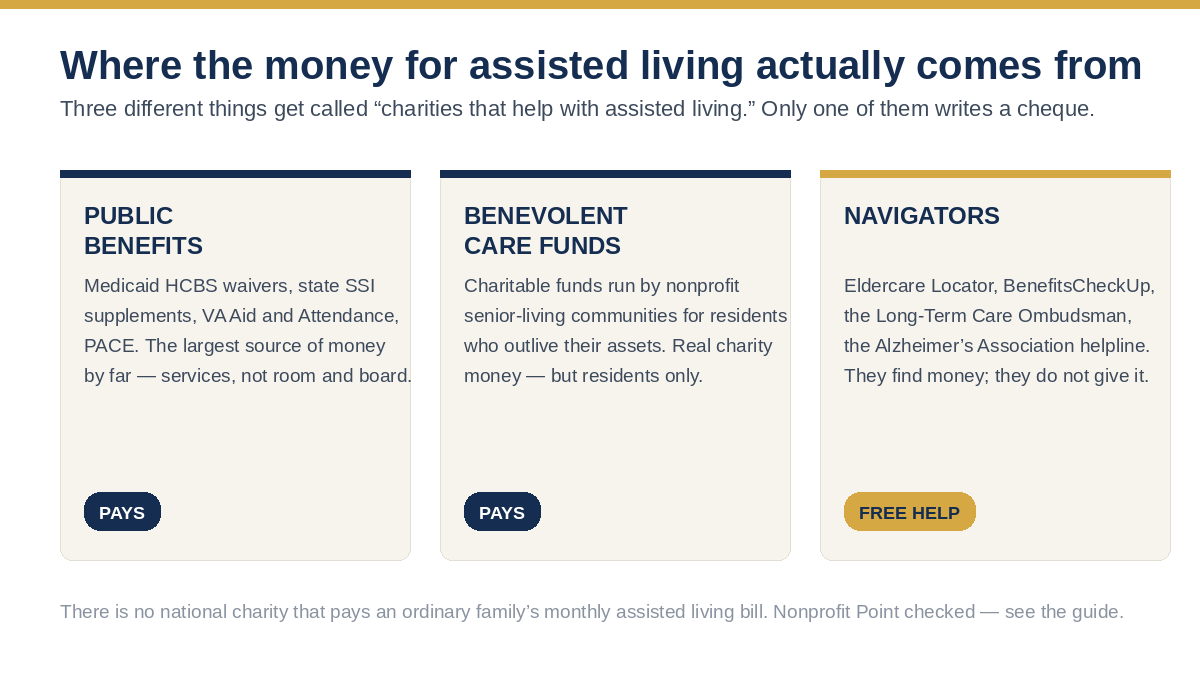
That is not the end of the story, though. Real money does move, in large amounts, toward exactly this problem — it just does not arrive through the door marked charity. It arrives through Medicaid home and community-based waivers, through state supplements to SSI that exist specifically for residential care, through a VA pension benefit that most eligible families never claim, through nonprofit PACE programs, and through charitable funds that nonprofit senior-living communities hold for residents who outlive their savings.
This guide walks each of those in turn, with the 2026 figures, the eligibility rules as the agencies themselves state them, and the phone numbers as the organizations themselves publish them. Everything here was read off a government or organization source on 23 September 2026. Where we could not verify something, we say so rather than fill the gap.
The short version
- Medicare does not pay. Medicare.gov is blunt about it: “Medicare doesn’t pay for long-term care.”
- Medicaid is the largest payer of help, but it pays for services in an assisted living community, not the rent and food. As of KFF’s most recent survey, 41 of 47 responding states cover assisted living services through at least one Medicaid home care program.
- A handful of states add a cash supplement for residential care. New York pays a combined SSI/SSP of $1,429 a month for Congregate Care Level 2 in the New York City area; California pays $1,626.07 for a person in a licensed residential facility.
- VA Aid and Attendance is the biggest single benefit most families miss. A veteran with no dependents can have a maximum annual pension rate of $29,093 with Aid and Attendance — roughly $2,424 a month — effective 1 December 2025.
- The actual charity money lives inside nonprofit communities. Asbury’s foundation distributed $2,711,180 in benevolent care across six communities in 2025. But you generally have to already live there.
- Start with the free navigators. The Eldercare Locator (1-800-677-1116) and NCOA’s BenefitsCheckUp cost nothing and are the fastest route to whatever your state actually offers.
What assisted living costs in 2026, and why charity is the wrong first call
CareScout — the successor to the Genworth Cost of Care Survey — fielded its most recent survey between July and November 2025 and published results in March 2026. Its finding: “The national median monthly cost increased 5% to $6,200, or $74,400 annually.” That figure is for a one-bedroom unit in an assisted living community, at private-pay rates.
Set that against what an older adult actually has coming in. The Social Security Administration’s 2026 cost-of-living fact sheet puts the average retired-worker benefit at $2,071 a month after the 2.8 percent increase. The maximum federal SSI payment for an individual in 2026 is $994 a month. Medicare Part B takes $202.90 of that back every month in 2026, up from $185.00.
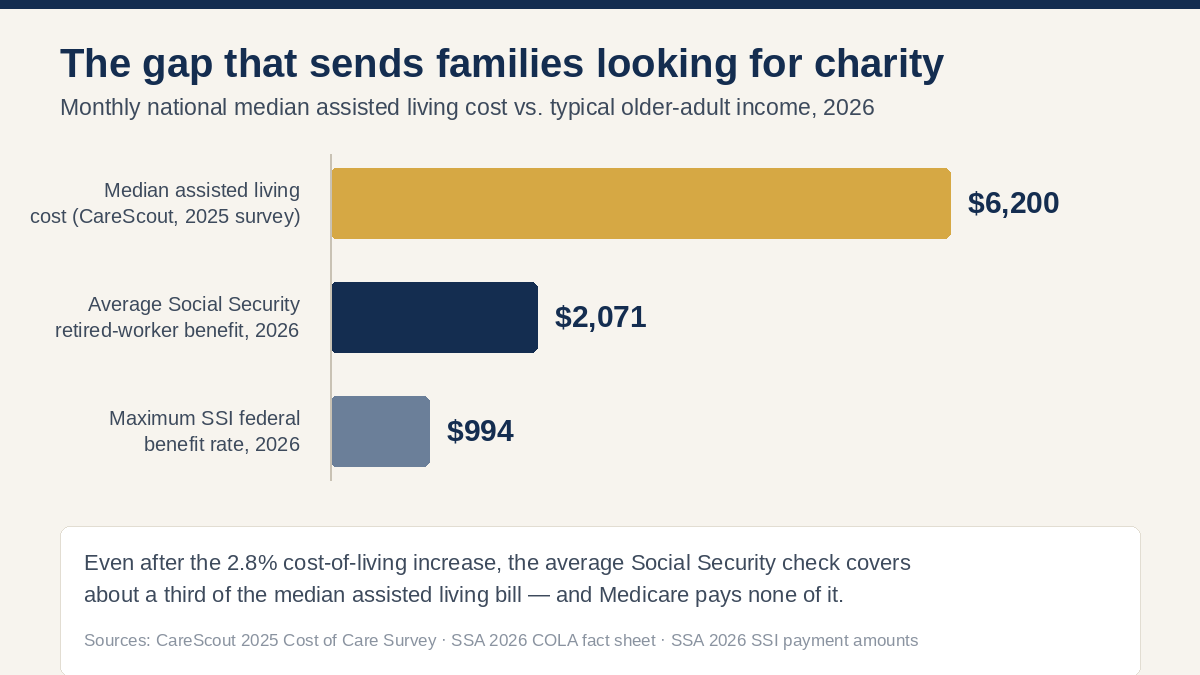
So the average Social Security check covers roughly a third of the median bill, and about 30 percent once the Part B premium is deducted. That arithmetic is ours, on the verified figures above. It is also the reason the phrase “charities that help with assisted living costs” gets typed into search engines several thousand times a month: the gap is enormous and recurring, and a one-off $500 grant does not close it.
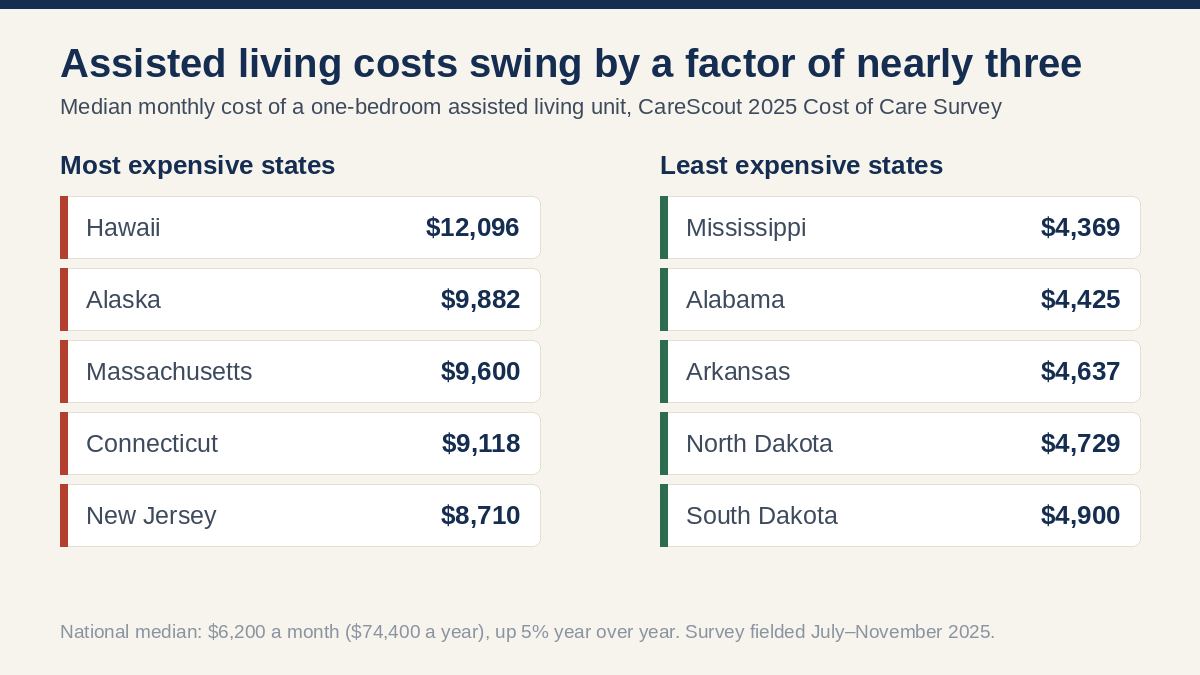
Where you live changes the number dramatically. CareScout’s state tables for the 2025 survey put Hawaii at $12,096 a month and Mississippi at $4,369 — a spread of nearly three to one.
One more piece of context that explains why so little charitable money exists here: this is not a niche problem. The CDC’s National Center for Health Statistics counted 32,200 residential care communities with 1,313,600 licensed beds in 2022, housing roughly a million people, and 81.5 percent of those communities are for-profit businesses. No foundation is large enough to subsidize a million private-pay residents. Public programs are the only mechanism at that scale — which is why the rest of this guide is mostly about them.
Medicaid is the biggest source of help — and it pays for services, not rent
This is the single most important distinction on this page, and the one that content farms consistently blur.
Medicaid can pay for the care you receive in an assisted living community — personal care, medication management, nursing oversight, adult day health services. It generally cannot pay for your room and board. That is not a policy preference; it is written into the statute. Section 1915(c) of the Social Security Act authorizes Medicaid payment for “home or community-based services (other than room and board).” The federal regulation at 42 CFR 441.310 repeats the exclusion, allowing only two narrow exceptions (facility-based respite care, and a portion of rent and food attributable to a live-in unrelated caregiver).
KFF summarises the practical result: “Although Medicaid law prohibits states from covering assisted living room and board expenses, states’ home care programs may offer some coverage.”
How many states actually do it
From KFF’s survey of state Medicaid home care programs — fielded April to October 2024 and published 14 March 2025 — “41 of the 47 responding states cover services provided in assisted living facilities through at least one Medicaid home care program.” The most common route is a 1915(c) waiver, used by 32 states. State plan personal care accounts for eight, Section 1115 waivers for six, and Community First Choice for three.
KFF also reports, citing the National Center for Assisted Living, that Medicaid pays for daily services for about 200,000 assisted living residents — roughly one in five. A separate NCHS analysis of 2022 data found about 17 percent of residential care community residents were Medicaid beneficiaries. The two are measuring slightly different things, so the safe statement is: somewhere between one in six and one in five residents has Medicaid paying for part of their care, and the large majority pay privately.
The 2026 income and asset tests
Medicaid long-term care eligibility is state-administered and genuinely varies, but three federal anchors set the shape of it:
- The special income level is 300 percent of the SSI federal benefit rate. With the 2026 FBR at $994, that ceiling is $2,982 a month for an individual. This is a ceiling states may use, not a floor — some states set their limit lower, and some use a medically needy “spend-down” instead.
- The countable asset limit is $2,000 for an individual and $3,000 for a couple in most states. CMS’s 2026 standards bulletin lists exactly those SSI resource standards. Note that this figure is not indexed to inflation — it has sat at $2,000 since 1989 — and that states may adopt more liberal methodologies, so a handful allow considerably more.
- Your home, one vehicle and certain other assets are usually excluded from the count, subject to equity limits and estate recovery rules that differ by state.
If your income is over the limit, do not stop there. Miller trusts (qualified income trusts) are available in income-cap states, and medically needy pathways exist in others. This is the point at which a free consultation with your Area Agency on Aging, or a paid hour with an elder law attorney, is worth more than another evening of searching.
If one spouse needs care and the other stays home
The spousal impoverishment rules exist precisely so that a community spouse is not stripped of everything. CMS publishes the figures annually. For 2026:
- Minimum community spouse resource standard: $32,532.00
- Maximum community spouse resource standard: $162,660.00
- Maximum monthly maintenance needs allowance: $4,066.50
- Minimum monthly maintenance needs allowance: $2,705.00 for all states except Alaska ($3,381.25) and Hawaii ($3,111.25), effective 1 July 2026
One warning about this section: the minimum monthly maintenance needs allowance runs on a July–June cycle rather than the calendar year, so it changed mid-2026 from $2,643.75 to $2,705.00. If you are reading a chart that still says $2,643.75, it is out of date. Also be aware that Medicaid’s spousal protections are written for institutional care, and states apply them to HCBS waivers with some variation — ask your state agency directly rather than assuming.
Four state programs worth knowing by name
Every state calls this something different, which is one reason families give up. These four cover a large share of the US population and show the range of designs.
California — the Assisted Living Waiver (ALW). Run by the Department of Health Care Services. Its own page states the waiver “is available in 15 counties and the current five-year waiver term is approved for March 1, 2024 – February 28, 2029.” The counties are Alameda, Contra Costa, Fresno, Kern, Los Angeles, Orange, Riverside, Sacramento, San Bernardino, San Diego, San Francisco, San Joaquin, San Mateo, Santa Clara and Sonoma. To qualify you must be “Age 21 or older,” have “full-scope Medi-Cal eligibility with zero share of cost,” and have “care needs equal to those of Medi-Cal-funded residents living and receiving care in nursing facilities.” Two things to plan around: DHCS warns that “the number of available slots is limited and there is a waitlist,” and it states plainly that “ALW participants must have sufficient funds to pay for their room and board, with some funds remaining to meet personal and incidental needs.”
New York — the Assisted Living Program (ALP). The state health department describes it as serving “persons who are medically eligible for nursing home placement but serves them in a less medically intensive, lower cost setting,” bundling personal care, room, board, housekeeping, supervision, home health aides, therapies, equipment and case management. Medicaid recipients “must have their ALP services approved in advance by the Local Social Services District.” The residential half is paid at an SSI congregate care rate rather than by the Medicaid services rate — which is what makes ALP unusual and useful. A caution: the health department’s ALP page carries a last-updated stamp of August 2014 and the provider manual dates from 2006. Treat the structure as current and confirm the numbers with the Local Social Services District before relying on them.
Florida — Statewide Medicaid Managed Care Long-Term Care, plus OSS. Florida’s Agency for Health Care Administration lists “Assisted Living” among the covered services in its SMMC Long-Term Care program, alongside assistive care, personal care, medication administration and adult day health care. The Department of Elder Affairs states the limit directly: “Florida Medicaid cannot pay room and board for residents in assisted living facilities.” For that gap Florida runs the Optional State Supplementation program, which the same page describes as providing “limited financial assistance to low-income seniors who cannot live independently and require residential care.” An ALF must be eligible to accept OSS residents, so ask before you move in. We could not retrieve the current OSS payment amount from Florida’s administrative rule 65A-2.036, so we are not publishing a figure — call DCF and ask.
Texas — STAR+PLUS assisted living services. The STAR+PLUS Handbook defines assisted living as “a 24-hour living arrangement for persons who, because of physical or mental limitation, are unable to continue independent functioning in their own homes,” and requires that “the personal care facility must provide each individual a separate living unit to guarantee their privacy, dignity and independence.” As everywhere else: “STAR+PLUS HCBS program members are responsible for their room and board costs and, if applicable, copayment for AL.” The handbook section carries a revision date of June 2019, so confirm current copayment rules with your managed care organization.
State SSI supplements: the part that helps with room and board
Because Medicaid is blocked from paying rent and food, some states solve the problem from the other direction: they top up SSI for people living in licensed residential care, so the resident has enough income to pay the facility themselves. This is quiet, unglamorous and frequently missed.
New York publishes a chart of 2026 SSI/SSP maximum monthly benefit levels, revised 27 October 2025. A single person living alone gets $994 federal plus $87 state, a total of $1,081. The same person in Congregate Care Level 2 (Residential Care) gets $994 plus $435 in the New York City area — $1,429 a month — or $994 plus $405 in the rest of the state, $1,399. Congregate Care Level 3 (Enhanced Residential Care) pays $994 plus $694, a total of $1,688 a month.
California does the same through its Non-Medical Out-of-Home Care rate. Under the SSI/SSP payment standards effective 1 January 2026, an aged or disabled individual in independent living receives $1,233.94 ($994.00 federal plus $239.94 state). The same person in a licensed facility, without in-kind room and board, receives $1,626.07 — $994.00 federal plus $632.07 state.
Florida’s OSS, described above, is the same idea under a different name.
Two practical notes. First, these supplements are paid to the resident, and in most states the facility must be licensed and willing to accept the rate — many private-pay communities are not. Second, the amounts are nowhere near the $6,200 median; they are designed for the lower-cost end of the licensed residential market, including adult care homes and board-and-care settings. That is a real option, not a consolation prize, but it is a different tier of housing from a marketed assisted living community.
VA Aid and Attendance: the biggest single benefit most families miss
If the person needing care is a wartime veteran or the surviving spouse of one, this is the first phone call to make. VA pension with Aid and Attendance is cash, it is monthly, and it can be spent on assisted living.
The VA’s published maximum annual pension rates, effective 1 December 2025 with a 2.8 percent increase and running through 30 November 2026:
| Claimant | Maximum annual pension rate with Aid and Attendance | Approximate monthly |
|---|---|---|
| Veteran, no dependents | $29,093 | about $2,424 |
| Veteran with one dependent | $34,488 | about $2,874 |
| Surviving spouse, no dependents | $18,697 | about $1,558 |
| Two veterans married to each other, both with A&A | $46,143 | about $3,845 |
The monthly figures are our arithmetic on the VA’s annual rates; the VA publishes the annual MAPR only, and rounds actual monthly payments down to the whole dollar.
Understand what MAPR means, because this is where families get the number wrong. The MAPR is not a check. VA pays the difference between the MAPR and your countable income for VA purposes. If a single veteran has $1,400 a month in countable income, the pension fills the gap up to roughly $2,424, not on top of it. The saving grace is that unreimbursed medical expenses — including the care portion of an assisted living bill — can be deducted from countable income, which is exactly why the benefit works so well for people in residential care. Get the facility to itemize the care component.
Apply through VA.gov, a county veterans service officer, or an accredited veterans service organization representative. All three are free. Anyone charging a percentage of the retroactive award to “help you qualify” is not someone to work with. Our guide to housing assistance for disabled veterans covers the adjacent VA housing grants.
PACE: the nonprofit program that can keep you out of assisted living altogether
The Program of All-Inclusive Care for the Elderly is the most under-used thing in this entire guide. Medicare describes it as “a Medicare and/or Medicaid comprehensive medical and social services program available in some states.” To join you must be at least 55, live in a PACE organization’s service area, need a nursing-home level of care as certified by your state, and be able to live safely in the community with PACE’s help.
What PACE covers is unusually broad: adult day primary care, dentistry, emergency services, home care, hospital care, prescription drugs, physical therapy and transportation to and from the PACE center and medical appointments. For a dual-eligible participant, there is typically no monthly premium and no deductible for care approved by the PACE team.
The National PACE Association’s April 2026 figures: “There are 202 PACE Programs operating in 33 states and the District of Columbia,” with 93,615 participants as of 1 April 2026. The count has been climbing steadily — it was 180 programs in February 2025 — so check for a new one in your area even if there was none last year.
PACE is also, by statutory default, a charitable enterprise: Section 1894 of the Social Security Act defines a PACE provider as a public entity or “a private, nonprofit entity organized for charitable purposes under section 501(c)(3),” though for-profit PACE organizations are now permitted and do exist. If you want a genuinely nonprofit answer to a care crisis, this is the closest thing in the system.
Benevolent care funds: the real charity money in assisted living
Here is where actual charitable dollars go. Many nonprofit senior-living organizations hold endowed funds whose purpose is to keep residents in place when their own money runs out. The sector calls it benevolent care, charitable care or a resident assistance fund. It is real, it is substantial, and it is almost entirely invisible from outside.
The catch is structural: these funds are for people who already live in that organization’s community. You cannot apply from the outside for a grant toward a placement elsewhere. Which means the decision point is at move-in — choosing a nonprofit community with a funded benevolent care program is itself a financial strategy.
Asbury Communities publishes the clearest account we found. Its foundation states that “All residents of independent living and assisted living or personal care at participating communities are eligible to apply for benevolent care based on the terms set forth in their resident agreement,” and that the fund covers “a range of expenses including medical, dental, housing, and more.” In 2025 it distributed $1,321,999 at Asbury Methodist Village, $771,113 at Bethany Village, $279,483 at Asbury Solomons, $153,616 at Normandie Ridge, $95,504 at Springhill and $89,465 at RiverWoods — $2,711,180 in total. Contact: 301-216-4050, 5285 Westview Drive, Suite 200, Frederick, MD 21703, or through the community’s executive director.
Read Asbury’s exclusion carefully, because it is the industry norm and it catches people out: “Residents who have depleted their assets in order to qualify for assistance, including those who have transferred assets to family or others, are not eligible.” Benevolent care is for people who genuinely outlived their money, not for people who arranged to.
Covenant Living Communities puts the principle in one sentence: its Benevolent Care Fund “helps our community members who have been good financial stewards, yet have outlived their resources and can no longer afford the services or care they need.” Covenant Living operates communities across the country. Apply through your local community’s administrator — the number on the giving page is a front desk, not an application line.
Masonic Villages in Pennsylvania runs three named funds. The Masonic Tree of Life Fund will “partially or fully subsidize retirement living residents’ monthly service fees” at Elizabethtown. The Compassionate Care Fund helps “in covering nursing or personal care costs for residents living in Elizabethtown, Lafayette Hill, Sewickley and Warminster when their assets have depleted” — and note that “personal care” is Pennsylvania’s regulatory term for assisted living, so this is the relevant one. The Village Green Residents Fraternal Care Fund covers the Village Green area. Phone: 1-800-599-6454. One important caveat: Masonic homes are separately incorporated state by state. Pennsylvania’s program tells you nothing about California’s or Connecticut’s; each must be checked on its own.
Presbyterian Senior Living operates a Resident Assistance Fund and makes a strong claim about it: “PSL, as an organization, has never asked an older adult to leave their home because of an inability to pay due to financial hardship.” PSL runs communities in Pennsylvania, Maryland, Ohio and Delaware. It does not publish eligibility criteria or amounts, so treat the claim as a reason to ask, not as a guarantee.
St. Andrew’s Charitable Foundation in the St. Louis area states that its Benevolent Care Fund “allows our elders to continue receiving the highest quality care at Brooking Park or Tower Grove Manor.” No application phone number is published, so route through the communities.
Two organizations that circulate widely on lists like this one did not hold up. Good Samaritan Society is frequently named as having a benevolent care fund; we read its own foundation and about pages and found no benevolent-care, charitable-care or “outlive your resources” language — only that gifts support “enhancements to care.” We are marking that unverified rather than repeating it. Volunteers of America does operate assisted living, memory care and “Affordable Living for Older Adults,” but that is HUD-subsidized housing, which is a different mechanism from a charity paying a care bill; we found no benevolent care language on its page.
How to ask for benevolent care, in practice. Do it early, in writing, through the community’s executive director or the affiliated foundation. Bring the full financial picture: income, remaining assets, the care assessment, and what changed. Ask specifically whether the community holds a benevolent fund, what the application looks like, whether there is a residency-length requirement, and whether Medicaid enrollment is a precondition. And ask the question before you need it — at the tour, before signing the residency agreement. The answer belongs in your comparison spreadsheet alongside the monthly rate.
If you want to find nonprofit providers in the first place, LeadingAge describes itself as “a community of over 5,300 nonprofit aging services providers.” It is an association, not a funder — it gives no money to individuals — but its member directory is a reasonable way to identify which communities near you are nonprofits and therefore plausibly have a fund at all.
Free help finding the money
None of these organizations give grants. All of them are free, and each will save you weeks.
Eldercare Locator — 1-800-677-1116, Monday to Friday, 8am–9pm ET. It is “a public service of the Administration on Aging (AoA), an agency of the U.S. Administration for Community Living,” and “a nationwide service that connects older Americans and their caregivers with trustworthy local support resources.” One call routes you to your Area Agency on Aging, which is the body that actually knows your state’s waiver names, waiting lists and local subsidies.
NCOA BenefitsCheckUp — benefitscheckup.org. NCOA describes it as “a free, confidential online tool that helps older adults and people with disabilities find benefits programs they might be eligible for depending on their location,” connecting people with “nearly 2,000 benefits programs.” Be realistic about what it finds: NCOA frames the tool around food, medicine, utilities and daily expenses. It will not hand you an assisted living grant. What it will do is surface the Medicare Savings Programs, Extra Help, SNAP and state pharmaceutical assistance that free up several hundred dollars of income a month — which is the same thing as help with the bill.
Long-Term Care Ombudsman — and this one genuinely covers assisted living. The program “advocates for residents of nursing homes, residential care communities (e.g., board and care homes, assisted living facilities), and other similar adult care facilities,” it is “the only federal program mandated to advocate with, and for, residents of long-term care facilities,” and “All services provided by the LTCOP are free and confidential.” There is no national hotline; find your state program through the directory at theconsumervoice.org. Call them if a community is threatening discharge over non-payment — state discharge rules are stricter than most families realize.
Alzheimer’s Association Helpline — 800.272.3900, staffed around the clock, 365 days a year, with the option to speak to “a Care Consultant who is a master’s-level dementia expert.” Their topics explicitly include “care planning, including finding care providers” and “respite care and funding options.” Worth noting honestly: the Association’s own paying-for-care guidance names no charitable grant source for residential or memory care. When the largest dementia charity in the country cannot point to one on its own page, that is strong evidence the thing does not exist.
2-1-1 — dial 211, or use 211.org. Local, uneven, and occasionally the only place a small church-run subsidy is listed.
What does not pay, no matter what the search results say
A large share of the disappointment in this area comes from lists that name organizations without checking their scope. We checked. These do not pay for assisted living:
- VFW Unmet Needs serves “active-duty service members (to include activated Guard/Reserve members) and their families” facing difficulty “because of deployment or other military-related activity or injury.” An 84-year-old veteran in assisted living is outside the program by design.
- Army Emergency Relief does serve retired soldiers, but its published assistance categories — emergency travel, rent and deposits, food, medical co-pays, vehicle costs, utilities, funeral expenses, furniture — contain no long-term care or assisted living line.
- Air Force Aid Society offers emergency loans and grants, education support and community programs. No elder care.
- Navy-Marine Corps Relief Society serves retirees and runs a Visiting Nurse Program described as “trusted advice from registered nurses—perfect for new moms and aging retirees.” That is free nursing advice, which is genuinely useful, and it is not payment for care.
- Elks National Veterans Service Commission gives one-time help to veterans “at risk of homelessness” for “rent, security deposit, or utilities,” in 13 cities only, and only on referral from a VA social worker. Its own page says “Contacting the Elks office directly will not result in obtaining emergency assistance.”
- Catholic Charities USA states that “the Catholic Charities USA national membership office in Alexandria, Virginia, does not provide direct services to clients.” The 170 local agencies vary enormously and none we found advertises paying assisted living fees. Still worth a call for adjacent help.
- Modest Needs makes “small, emergency grants to low-income workers.” A recurring $6,200 monthly bill is neither small nor an emergency in that sense.
- Lutheran Services in America and LeadingAge are networks and associations. They fund nothing directly.
And a general rule: if a site offers a “senior grant finder” and asks for your phone number and your loved one’s care needs before showing you anything, it is a placement lead broker. Placement services are not inherently bad — they are free to you because communities pay them a commission — but they are a sales channel, not a charity, and the commission is embedded in the rate you will be quoted.
A realistic plan for the next 30 days
- Call 1-800-677-1116 and ask for your Area Agency on Aging. Ask by name: what is our state’s Medicaid waiver that covers assisted living services, is there a waiting list, and how long is it?
- Run BenefitsCheckUp the same week. Medicare Savings Programs and Extra Help alone can return $200–$400 a month of income, and that is money that goes straight to the care bill.
- If there is any wartime military service in the family, start the VA pension claim now. Use a county veterans service officer. Aid and Attendance is the single largest recurring benefit on this page and claims take months.
- Check whether a PACE program serves your county. With 202 programs across 33 states and DC, and new ones opening, it is worth five minutes even if the answer was no last year.
- Shortlist nonprofit communities and ask each one, in writing, about benevolent care. Ask what it paid out last year, what the eligibility rules are, and whether there is a minimum residency period. Get the answer before you sign anything.
- Price the lower-cost licensed tier too. Adult family homes, board-and-care homes and personal care homes are licensed, often accept the state SSI supplement, and cost a fraction of a marketed assisted living community. Your ombudsman can tell you which local ones have clean inspection histories.
- If money is about to run out where your relative already lives, call the Long-Term Care Ombudsman before the community calls you. Discharge for non-payment is regulated, and an ombudsman knows the rules better than the business office does.
If the immediate problem is broader than care — a pension that no longer stretches, medical debt, a utility shut-off notice — our guides to charities that help seniors with bills, charities that help with medical bills and charities that help with prescriptions cover the neighboring ground.
Frequently asked questions
Are there charities that pay for assisted living?
Not in the way people hope. We could not find a single national charity that accepts applications from the public and pays an ongoing assisted living bill, and the Alzheimer’s Association’s own paying-for-care guidance names none either. What does exist is benevolent care: charitable funds held by nonprofit senior-living organizations for their own residents who outlive their savings. Asbury’s foundation alone distributed $2,711,180 across six communities in 2025. You generally have to already live there to apply, which is why the choice of a nonprofit community matters financially.
Does Medicare pay for assisted living?
No. Medicare.gov states it directly: “Medicare doesn’t pay for long-term care,” and it lists an assisted living facility as one of the places where non-medical long-term care is delivered. Medicare will still pay for your doctor visits, hospital care and prescriptions while you live in assisted living, and it covers short-term skilled nursing after a qualifying hospital stay. It does not pay the monthly fee.
Does Medicaid pay for assisted living?
Medicaid pays for the services, not the room and board. Section 1915(c) of the Social Security Act authorizes home and community-based services “other than room and board,” and 42 CFR 441.310 repeats the exclusion. According to KFF’s survey published in March 2025, 41 of 47 responding states cover assisted living services through at least one Medicaid home care program, most often a 1915(c) waiver. Programs are named differently in every state: California’s Assisted Living Waiver, New York’s Assisted Living Program, Florida’s SMMC Long-Term Care, Texas STAR+PLUS.
What is the Medicaid income limit for assisted living help in 2026?
Most states use a special income level set at 300 percent of the SSI federal benefit rate. With the 2026 rate at $994 a month, that ceiling is $2,982 a month for an individual. It is a ceiling, not a national standard, and some states set theirs lower or use a medically needy spend-down instead. The countable asset limit is $2,000 for an individual and $3,000 for a couple in most states, and states may adopt more generous rules. Check your own state agency before assuming you are over the line.
How much is VA Aid and Attendance in 2026?
Effective 1 December 2025 and running through 30 November 2026, the maximum annual pension rate with Aid and Attendance is $29,093 for a veteran with no dependents, $34,488 for a veteran with one dependent, and $18,697 for a surviving spouse with no dependents. Those work out to roughly $2,424, $2,874 and $1,558 a month. The VA pays the difference between that maximum and your countable income, not the full amount on top of it — but unreimbursed medical expenses, including the care portion of an assisted living bill, reduce countable income, which is what makes the benefit so valuable in residential care.
What happens if my parent runs out of money in assisted living?
Three things to do at once. Apply for Medicaid, because a waiver may cover the care portion even though it cannot cover rent; check whether the community is a nonprofit with a benevolent care fund and apply in writing to the executive director; and call your Long-Term Care Ombudsman, which is free, confidential, and covers assisted living as well as nursing homes. Discharge for non-payment is regulated by state law, and the ombudsman will know those rules better than the business office. Do not wait until an eviction notice arrives.
How much does assisted living cost in 2026?
The CareScout 2025 Cost of Care Survey, fielded July to November 2025, puts the national median at $6,200 a month, or $74,400 a year, up 5 percent year over year. State medians range from $12,096 a month in Hawaii to $4,369 in Mississippi. For comparison, the national median nursing home rate is $315 a day for a semi-private room and $355 a day for a private room.
Is there a state program that helps with assisted living room and board?
In some states, yes, through a supplement to SSI rather than through Medicaid. New York’s 2026 SSI/SSP chart pays a combined $1,429 a month for Congregate Care Level 2 in the New York City area and $1,688 for Congregate Care Level 3. California pays a combined $1,626.07 for an aged or disabled person in a licensed facility. Florida runs an Optional State Supplementation program for people who need residential care. These rates work at the lower-cost licensed end of the market — adult care and board-and-care homes — not at a marketed assisted living community.
Can a church help pay for assisted living?
Occasionally, and usually as a one-off rather than an ongoing subsidy. The faith-based money that reliably reaches residential care is structural rather than discretionary: Masonic, Presbyterian, Lutheran, Methodist, Catholic and Episcopal organizations run nonprofit senior-living communities with benevolent care funds for their residents. Catholic Charities USA states that its national office “does not provide direct services to clients,” so call the local diocesan agency rather than the national one. Ask your own congregation about a benevolence fund, and expect the answer to be modest and one-time.
What is PACE and could it help instead?
PACE is the Program of All-Inclusive Care for the Elderly. If you are 55 or older, need a nursing-home level of care as certified by your state, live in a PACE service area and can live safely at home with support, PACE provides comprehensive medical and social care — primary care, home care, hospital care, prescription drugs, therapies and transport — often with no premium for dual-eligible participants. As of 1 April 2026 there were 202 PACE programs in 33 states and the District of Columbia, serving 93,615 people. Because PACE is designed to keep you out of residential care, it can remove the assisted living bill entirely rather than help you pay it.
Related help
If this page did not solve it, these will help next.
- Charities that help seniors with bills — the wider picture for an older adult whose income no longer stretches
- Best charities that help the elderly — the organizations worth knowing and supporting
- Charities that help with medical bills and help with prescriptions — the costs that usually arrive alongside care
- Charities that help with medical equipment — wheelchairs, walkers, hospital beds and lifts
- Best dementia charities — if memory care is the reason for the move
- Housing assistance for disabled veterans — the VA grants that sit alongside Aid and Attendance
- Charities that help with home repairs — if staying at home longer is the better answer
- Charities that help with rent — for a spouse or family member left paying a household on one income
How we verified this guide. Every program, dollar figure, eligibility rule and phone number on this page was read off a government agency’s or organization’s own website on 23 September 2026. Cost data comes from the CareScout 2025 Cost of Care Survey, fielded July–November 2025. Benefit rates come from the Social Security Administration’s 2026 SSI payment amounts and 2026 COLA fact sheet, the CMS 2026 Medicare Part B fact sheet, the CMS 2026 SSI and Spousal Impoverishment Standards bulletin of April 2026, and the VA’s veterans pension and survivors pension rate tables effective 1 December 2025. The room-and-board exclusion comes from Section 1915(c) of the Social Security Act and 42 CFR 441.310. State coverage counts come from KFF’s analysis of its 2024 state survey, published 14 March 2025. Facility counts come from CDC/NCHS FastStats for 2022. PACE figures come from the National PACE Association’s April 2026 “PACE in the States.” State program detail comes from California DHCS, the New York State Department of Health and OTDA, Florida AHCA and the Department of Elder Affairs, and the Texas STAR+PLUS Handbook. Benevolent care detail comes from each organization’s own site. Where we could not verify something — Florida’s current OSS payment amount, a benevolent care fund at Good Samaritan Society, current New York ALP figures on a page last updated in 2014 — this guide says so rather than guessing. This page is general information, not legal, financial or benefits advice; eligibility is decided by your state agency. Written and verified by Alex Shabani for Nonprofit Point.