Qualified Charitable Distributions in 2026: The $111,000 Limit and How to Report a QCD

A qualified charitable distribution is the most tax-efficient gift most retirees can make, and it is also the gift most likely to be reported wrong. The reason is a piece of paperwork. When your IRA custodian sends money straight to a charity on your instruction, the Form 1099-R that arrives in January has historically looked identical to a 1099-R for money you took out and spent on a kitchen. Same gross distribution. Same box. Nothing anywhere on the form says the word charity. If you or your preparer treat that number as taxable income because the form appears to say it is, you have paid tax on a gift that was never supposed to be taxed, and the IRS will not write to tell you.
That changed slightly for tax year 2026. The IRS added a new distribution code to Form 1099-R specifically to flag these gifts — and then made it optional. So the form might identify your QCD, or it might not, and the burden of getting it onto your return correctly is still entirely yours.
This guide is the mechanics: who qualifies, which accounts work, the 2026 dollar limits, the three rules that disqualify an otherwise perfect gift, and exactly how to report it. If what you need is the comparison with claiming an ordinary charitable deduction under the rules that changed on 1 January 2026, that is in our guide to the 2026 charitable tax deduction. If you need the calendar — when your custodian has to have the request in hand to land the gift in this tax year — that is in our year-end giving deadlines guide. This page assumes you have decided to make a QCD and want to do it correctly.
What a QCD actually is, in one paragraph of law
The authority is Internal Revenue Code § 408(d)(8). It allows a distribution from an individual retirement plan to be excluded from your gross income if it is “made directly by the trustee to an organization described in section 170(b)(1)(A)” and you have “attained age 70½.” Two words in that sentence carry almost all the weight. Directly means custodian to charity, with the money never touching your account or your hands. Excluded means it is not income — not income you then deduct, but income you never had.
That distinction is why a QCD beats a deduction rather than merely matching one. A deduction reduces your taxable income. An exclusion reduces your adjusted gross income, which is the number that drives Medicare premiums, the taxable share of your Social Security benefit, and a long list of phase-outs. Section 408(d)(8)(E) closes the obvious loophole: amounts excluded as a QCD “shall not be taken into account in determining the deduction under section 170.” You get one or the other, never both.
The 2026 numbers, and the IRS publication that will give you the wrong one
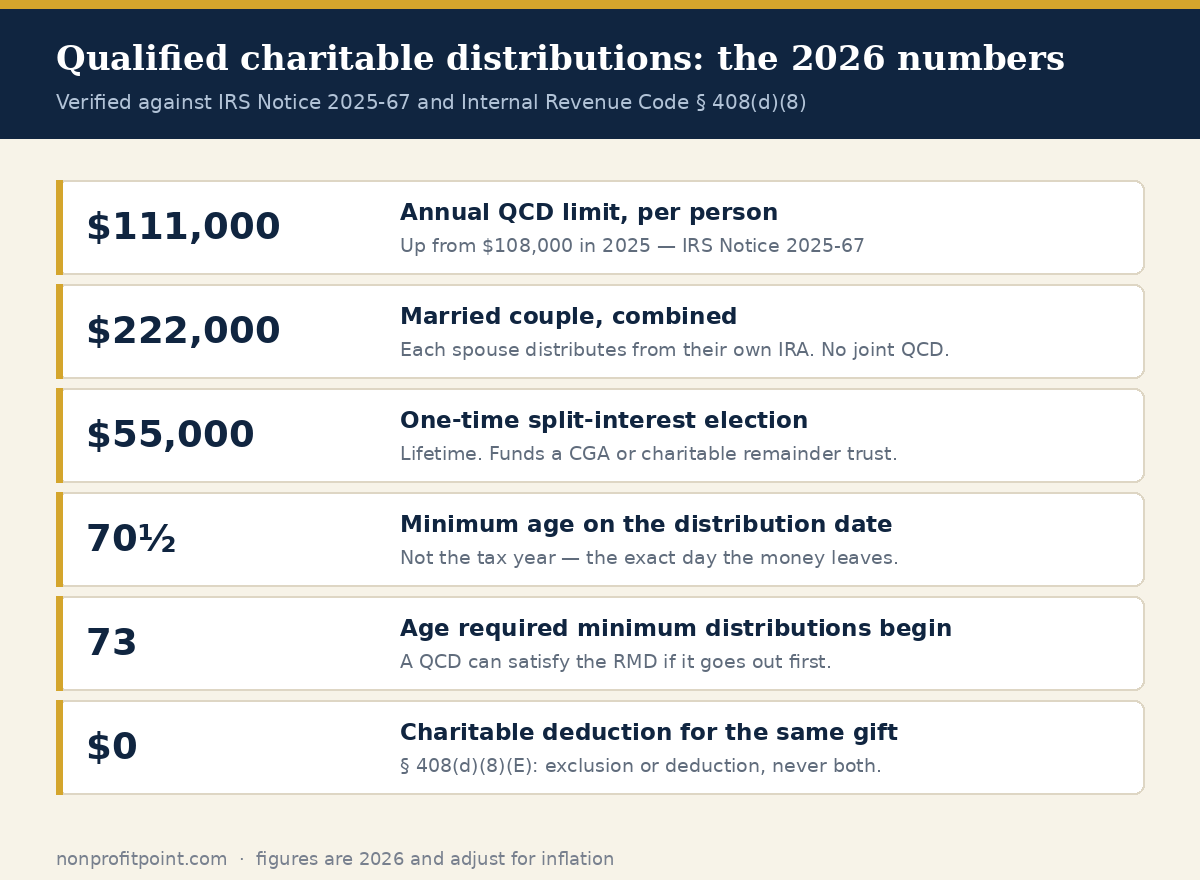
The statute sets a $100,000 annual cap, indexed for inflation since 2024. The 2026 figures come from IRS Notice 2025-67, which states that “the aggregate amount of qualified charitable distributions that are not includible in gross income under section 408(d)(8)(A) is increased from $108,000 to $111,000.” The same notice raises the one-time split-interest election “from $54,000 to $55,000.”
- $111,000 per person, per calendar year, in 2026.
- $222,000 for a married couple — but only because each spouse has their own $111,000 allowance and each must distribute from their own IRA. There is no joint QCD. One spouse cannot use the other spouse’s unused room.
- $55,000 for the one-time lifetime election to fund a charitable gift annuity or charitable remainder trust, which counts against the $111,000 rather than sitting on top of it.
Here is the trap. If you go looking for the limit in IRS Publication 590-B, which is the publication that actually explains QCDs to individuals, the version online states that “the maximum annual exclusion for QCDs is $108,000.” That is not an error. It is the 2025 edition, published for the 2025 filing season, and the 2026 edition will not appear until the 2026 return is due. Anyone citing Publication 590-B in the middle of 2026 will quote a figure that is a year stale and $3,000 low. The inflation notice is the current authority until the publication catches up.
The age rule is a date, not a tax year
You must be 70½ on the day the distribution leaves the IRA. Not 70½ at some point during the year, not turning 70½ in December. If your half-birthday falls on 14 August 2026, a distribution on 13 August is an ordinary taxable withdrawal and a distribution on 14 August is a QCD, and nothing about the paperwork will distinguish them. This is the most common disqualifier among first-time QCD donors, and it is unfixable after the fact.
Note that 70½ is not the age at which required minimum distributions begin. The IRS puts that at 73: you must start taking withdrawals “when you reach age 73,” with a required beginning date of “April 1 of the year following the calendar year in which you reach age 73.” SECURE 2.0 steps it to 75 for people born in 1960 or later, which first bites in 2033. The gap between 70½ and 73 is a two-and-a-half-year window in which you can make QCDs but have no RMD to offset — still worth doing if you intend to give, because the money leaves your IRA permanently without ever being taxed, but the headline benefit of satisfying an RMD does not apply yet.
Once you are 73, the interaction matters a great deal, and so does the order of your withdrawals. The IRS confirms that “your qualified charitable distributions can satisfy all or part the amount of your required minimum distribution from your IRA.” But distributions count toward the RMD in the order they come out. If you take your full RMD in February and make a QCD in October, the October gift is excluded from income and the February money is still taxable — you have not offset anything. If you want the QCD to cover your RMD, it has to be among the first dollars out of the account that year.
Which accounts qualify, and which look like they should but do not
The statute permits distributions from an individual retirement plan “other than a plan described in subsection (k) or (p)” — subsection (k) is a SEP IRA and subsection (p) is a SIMPLE IRA. The practical sorting:
- Traditional IRA and rollover IRA — yes. This is the overwhelming majority of QCDs.
- Inherited IRA — yes, if the beneficiary is personally 70½ or older. The deceased owner’s age is irrelevant; yours is what counts.
- SEP or SIMPLE IRA — only if the plan is inactive, meaning no employer contribution has been made for the plan year in question. An ongoing SEP or SIMPLE is excluded by the statute.
- Roth IRA — technically permitted, and almost always a mistake. Qualified Roth withdrawals are already tax-free, so routing one through a QCD converts a tax-free dollar into a tax-free dollar and burns $111,000 of allowance that could have sheltered pre-tax money.
- 401(k), 403(b), 457, Thrift Savings Plan — no. These are not IRAs and no QCD provision reaches them. If a workplace plan holds the money you intend to give, it has to be rolled into a traditional IRA first, and the rollover has to settle before the distribution goes out.
Where the money can and cannot go
The recipient must be a public charity described in § 170(b)(1)(A). The statute then carves out two specific exclusions: a QCD cannot go to “any organization described in section 509(a)(3) or any fund or account described in section 4966(d)(2)” — supporting organizations and donor-advised funds. Private foundations are excluded by a different route: they are not § 170(b)(1)(A) organizations in the first place.
So the three ineligible destinations are donor-advised funds, private foundations and supporting organizations. Donor-advised funds catch the most people, because a DAF is a perfectly good vehicle for every other kind of charitable gift and many donors have one sitting ready. It cannot receive a QCD. (Our explainer on the different types of charities covers how these classifications work and where a given organisation sits.)
There is one further condition that is easy to miss and does real damage. The flush language of § 408(d)(8)(B) requires that “a deduction for the entire distribution would be allowable under section 170.” The entire distribution. If you receive anything of value in return — a gala ticket, a membership with benefits, a tote bag over the de minimis threshold — then part of your payment would not have been deductible, and the whole distribution fails. Buying a seat at a charity dinner with a QCD does not produce a partial QCD. It produces a taxable IRA distribution.
Because of this, it is worth checking the organisation’s standing and its finances before the money moves rather than after. A QCD is irreversible: there is no mechanism to recall a distribution and no relief if the recipient turns out not to qualify. Our review of the best charities to donate to and the companion piece on the worst veteran charities both work through what the filings actually show.
The rule almost nobody mentions: still working, still contributing, smaller QCD
This one is buried in Publication 590-B and it is the most under-reported QCD rule in circulation. If you are over 70½ and still earning income, you are allowed to keep making deductible traditional IRA contributions — the old prohibition was repealed. But those contributions reduce what you can exclude as a QCD. The publication states that “the amount of QCDs that you can exclude from income is reduced by the excess of the aggregate amount of IRA contributions you deducted for the taxable year and any prior year that you were age 70½ or older.”
It is cumulative and it does not reset. Every deductible IRA contribution you make from 70½ onward goes into a running total, and your QCD exclusion is reduced by that total until the offset has been used up. A donor who has deducted $7,500 a year for three years after 70½ carries a $22,500 drag into the next QCD they attempt, and nothing in the custodian’s paperwork will warn them. If you are working past 70, contributing to an IRA and also giving from it, run this before you instruct the distribution.
How to actually do one
The procedure is unglamorous and the failure points are all in the first step.
- Confirm the recipient is eligible — a public charity, not a DAF, private foundation or supporting organisation — and confirm you are receiving nothing in return.
- Instruct your custodian, not yourself. Every major custodian has a specific path for this. Vanguard requires you to select “Send me a check payable to a charity,” and states plainly that if “the distribution is paid to you first, it may be treated as a taxable IRA withdrawal.” The check must be payable to the charity. A check payable to you that you then endorse over is a taxable distribution followed by an ordinary gift, which is a materially worse outcome and cannot be undone.
- Allow for float. The gift counts on the date the money leaves the IRA. If the custodian mails a paper check to the charity, that date is not the date you clicked the button, and most custodians stop accepting QCD requests in the first half of December for exactly this reason. Our deadlines guide has the per-custodian cut-offs.
- Tell the charity the gift is coming, and that it is a QCD. A check arriving from a brokerage with no accompanying letter frequently gets receipted to the custodian rather than to you, which leaves you without the acknowledgment you need. One email before the check arrives prevents this.
- Get the written acknowledgment. Publication 590-B requires “the same type of acknowledgment of your contribution that you would need to claim a deduction for a charitable contribution” — the charity’s letter, naming the amount and stating that no goods or services were provided. Keep it with your tax records. You do not file it, but you cannot defend the exclusion without it.
Reporting it: the new code Y and the checkbox on line 4c
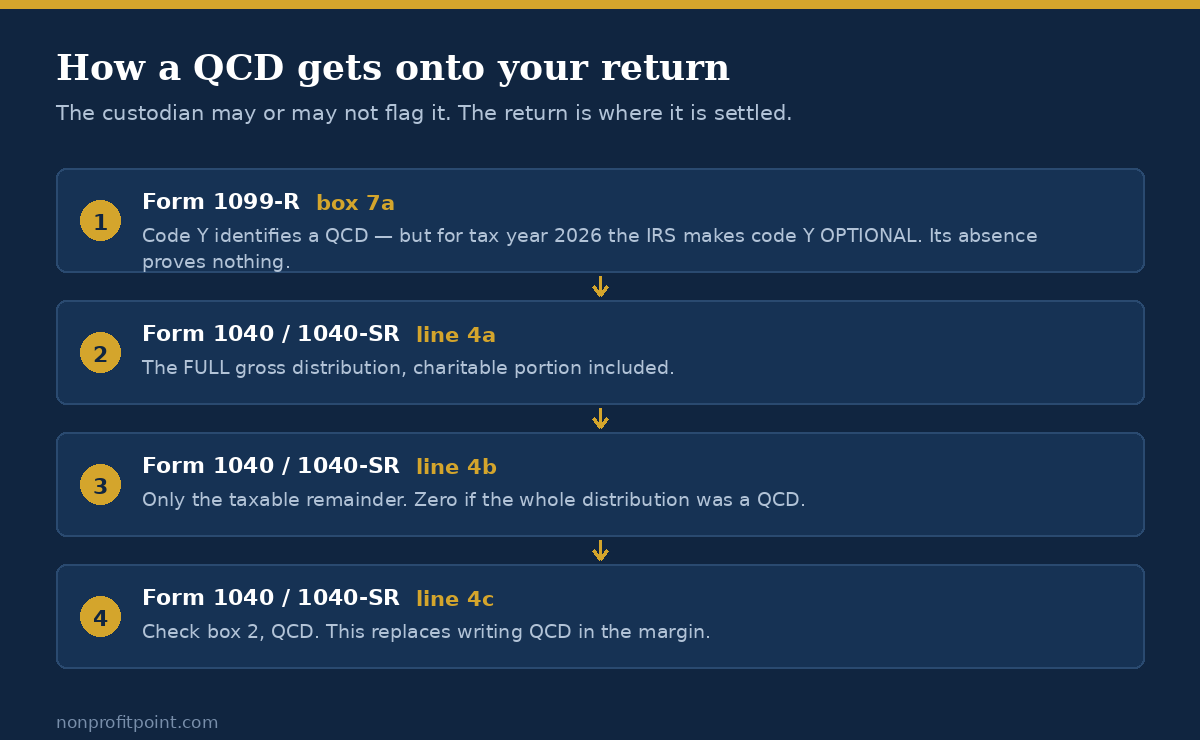
Start with the form you receive. For tax year 2026 the IRS added a distribution code to Form 1099-R for precisely this purpose: “We added code ‘Y’ to the list of codes for box 7a to identify a qualified charitable distribution (QCD).” Then it softened it. The instructions continue: “For tax year 2026, the use of code Y to report a QCD is optional. If you are completing and filing a 2026 Form 1099-R, you may choose, but are not required, to enter code Y in box 7a.”
Read that carefully, because it sets your expectations correctly. Some custodians will use code Y. Some will not, and will report your gift with an ordinary distribution code exactly as they always have. The absence of code Y on your 1099-R is not evidence that your gift failed to qualify. It is evidence that your custodian declined an optional reporting step. The custodian has never had a duty to verify or track QCD status, and in 2026 it still does not.
Now the return. The gross distribution goes on the income line in full, and the excluded portion simply is not carried to the taxable line. Publication 590-B’s worked example puts it plainly: the taxpayer “reports the total distribution ($25,000) on line 4a of Form 1040-SR,” enters “-0-” on line 4b, and “checks box 2 for QCD on line 4c.”
That checkbox is the part people miss, and it is new enough that a great deal of published guidance is out of date. The old instruction — still repeated across the internet — was to hand-write the letters “QCD” in the margin beside line 4b. Current Form 1040 and Form 1040-SR both carry a line 4c reading “Check if (see instructions): 1 Rollover 2 QCD 3,” and box 2 on line 4c is now how you tell the IRS. So the reporting is three mechanical acts:
- Line 4a: the full gross distribution from the 1099-R, including the charitable portion.
- Line 4b: only the taxable remainder. If the entire distribution was a QCD, this is zero.
- Line 4c: check box 2, QCD.
If you have already filed a return in a prior year that put a QCD on line 4b as taxable income, that is an amended return and a refund, not a lost cause. The exclusion is a statutory right, not an election you forfeit by missing it.
What a QCD does to your AGI, and why that is the whole point
Because a QCD never enters income, it never enters adjusted gross income, and AGI is a gatekeeper for things that have nothing to do with charity. The clearest example is Medicare. For 2026 the standard Part B premium is $202.90 a month with a $283 annual deductible. Above a modified AGI of $109,000 for a single filer or $218,000 for a couple filing jointly, the income-related monthly adjustment begins and the first tier takes the total premium to $284.10 a month. Social Security generally uses the return from two years earlier to set this, so a 2026 distribution is tested against your 2026 income for the 2028 premium year.
A $40,000 RMD taken as cash raises your AGI by $40,000 and can push a couple sitting at $200,000 straight through the first IRMAA threshold — an extra $81.20 a month each, for twelve months, on top of the income tax. The same $40,000 taken as a QCD raises AGI by nothing. The charitable deduction, even when it works perfectly, cannot do that: it comes off taxable income, below the AGI line, and arrives too late to matter.
The same logic reaches the taxable share of your Social Security benefit and the 2026 floor on itemised charitable deductions. Our guide to the 2026 charitable tax deduction works through why three rule changes this year made the itemised route worse and the QCD route relatively better. For donors already helping relatives with living costs, the companion piece on charities that help seniors with bills covers the other side of that ledger.
The one-time $55,000 election
SECURE 2.0 added a narrow option at § 408(d)(8)(F): once in your life, you may direct a QCD to a split-interest vehicle — a charitable remainder annuity trust, a charitable remainder unitrust, or a charitable gift annuity — up to $55,000 in 2026. The conditions are strict. The vehicle must be “funded exclusively by qualified charitable distributions,” so an existing trust that holds any other money cannot receive one. The income interest must go only to you and your spouse, and the payments are ordinary income when you receive them.
In practice this is almost always a charitable gift annuity rather than a trust, because a trust funded with $55,000 and nothing else rarely justifies its administration costs. It suits a donor who wants lifetime income from a gift, and it is the wrong tool for a donor who simply wants to give money away.
When a QCD is the wrong move
Three situations where the answer is no.
You were not going to give anyway. A QCD reduces your tax by removing the money from your estate entirely. It is efficient charity, not a tax strategy with charity attached.
Your IRA holds after-tax basis. QCDs are treated as coming from the pre-tax portion first, which is normally favourable, but if a large share of your IRA is nondeductible contributions the arithmetic changes and is worth modelling before you act.
You are giving appreciated stock instead. For a donor holding long-held securities with a large unrealised gain, transferring the shares directly can beat a QCD: you avoid the capital gains tax and preserve your QCD allowance for another year. The two are not mutually exclusive, and the sequencing is worth a conversation with whoever prepares your return.
The figures above are 2026 figures and will move with inflation. A QCD is simple enough to execute yourself and consequential enough to be worth one phone call before you do.
Frequently asked questions
What is the QCD limit for 2026?
$111,000 per person, per calendar year. IRS Notice 2025-67 raised it from $108,000 for 2025. A married couple can move up to $222,000 in total, but only because each spouse has a separate $111,000 allowance and each must distribute from their own IRA. A separate one-time lifetime election allows up to $55,000 of that amount to fund a charitable gift annuity or charitable remainder trust.
How old do I have to be to make a QCD?
You must be 70½ or older on the exact date the distribution leaves your IRA, not merely at some point during the calendar year. That is a different and earlier age than the required minimum distribution age, which the IRS puts at 73. Between 70½ and 73 you can make QCDs but have no RMD for them to offset.
Does a QCD count toward my required minimum distribution?
Yes, and the order matters. The IRS confirms a QCD can satisfy all or part of your RMD, but distributions are applied to the RMD in the order they leave the account. If you take your full RMD in cash in February and make a QCD in October, the February money stays taxable. To have the QCD cover the RMD, make it before you take any other distribution that year.
Can I make a QCD to a donor-advised fund?
No. Section 408(d)(8)(B) specifically excludes donor-advised funds and supporting organizations, and private foundations are excluded because they are not section 170(b)(1)(A) organizations. The money must go to a public charity. This is the single most common disqualifying mistake, because a donor-advised fund works perfectly well for every other kind of charitable gift.
Why does my 1099-R not say anything about charity?
Because your custodian is not required to say so. For tax year 2026 the IRS added code Y to box 7a of Form 1099-R to identify a QCD, but explicitly made it optional, so some custodians use it and some do not. A 1099-R without code Y is not evidence that your gift failed to qualify. Reporting the exclusion correctly on your return is your responsibility either way.
How do I report a QCD on my tax return?
Put the full gross distribution on line 4a of Form 1040 or 1040-SR, put only the taxable remainder on line 4b, and check box 2 for QCD on line 4c. If the whole distribution was a QCD, line 4b is zero. The older advice to hand-write the letters QCD beside line 4b has been superseded by the line 4c checkbox.
Can I make a QCD from my 401(k)?
No. The provision reaches individual retirement accounts only. A 401(k), 403(b), 457 plan or Thrift Savings Plan cannot make a QCD. Money in a workplace plan has to be rolled into a traditional IRA first, and the rollover needs to settle before the distribution goes out, which is a reason to start the process well before December.
Do deductible IRA contributions after 70 and a half affect my QCD?
Yes, and this is widely overlooked. Publication 590-B reduces the amount you can exclude as a QCD by the total of all IRA contributions you have deducted in the current year and any prior year in which you were 70½ or older. The offset is cumulative and persists until it is used up, so a donor who has been working and contributing past 70½ may be able to exclude considerably less than the headline limit.
Can I claim a charitable deduction for the same gift?
No. Section 408(d)(8)(E) provides that amounts excluded as a QCD are not taken into account in determining the section 170 deduction. You choose the exclusion or the deduction. For most people over 70½ the exclusion is worth more, because it reduces adjusted gross income rather than taxable income and so reaches Medicare premiums and other income-tested thresholds that a deduction cannot touch.
What happens if I buy a gala ticket with a QCD?
The whole distribution fails, not just the part representing the ticket. The statute requires that a deduction for the entire distribution would be allowable under section 170, so receiving anything of more than token value in return disqualifies the full amount. Pay for benefit events from a taxable account and keep the QCD for gifts where you receive nothing back.