Charitable Tax Deduction 2026: What Changed and How to Claim It

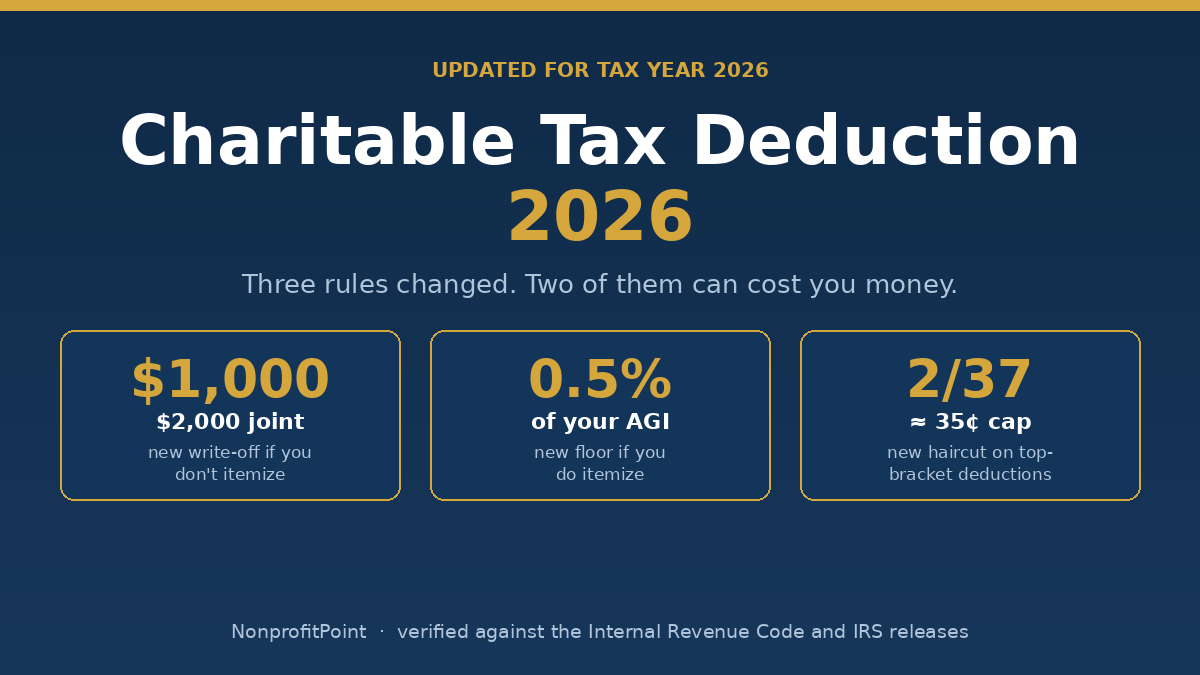
Three separate rules about charitable giving changed on 1 January 2026, and only one of them is good news. If you take the standard deduction, you can now write off up to $1,000 of cash gifts — $2,000 on a joint return — for the first time since 2021. If you itemize, the first 0.5% of your adjusted gross income in gifts no longer counts at all. And if your income puts you in the top bracket, every itemized deduction you claim, charitable ones included, is now trimmed by a fraction that caps its value at roughly 35 cents on the dollar.
All three come from the same law, the budget reconciliation act signed on 4 July 2025 and published as Public Law 119-21, and all three first apply to tax year 2026 — the return you will file in early 2027. This guide covers what each rule does, what it does to your situation, and the paperwork that decides whether the deduction survives a question from the IRS.
It also corrects the most common error in the coverage of this change. The new deduction for non-itemizers is not an above-the-line deduction, and it does not reduce your adjusted gross income. A great many articles say it does, and several go on to tell readers it will lower income-driven thresholds such as Medicare premium brackets. It will not. The statute puts it below AGI. For some households that difference is worth real money, and it is covered in detail further down.
📝 The short version, for tax year 2026. (1) If you take the standard deduction, give cash — up to $1,000, or $2,000 filing jointly — directly to a public charity, and keep a bank record. Gifts to a donor-advised fund do not count for this one. (2) If you itemize, your first 0.5% of AGI in gifts is disallowed, and in most cases that money is gone rather than carried forward, which makes bunching two years of giving into one year worth more than it used to be. (3) If you are 70½ or older, a qualified charitable distribution from your IRA — up to $111,000 in 2026 — sidesteps every one of these new limits, because it is an exclusion from income rather than a deduction. (4) Whatever you give, get the acknowledgment before you file. The record, not the gift, is what gets checked.
What actually changed for tax year 2026
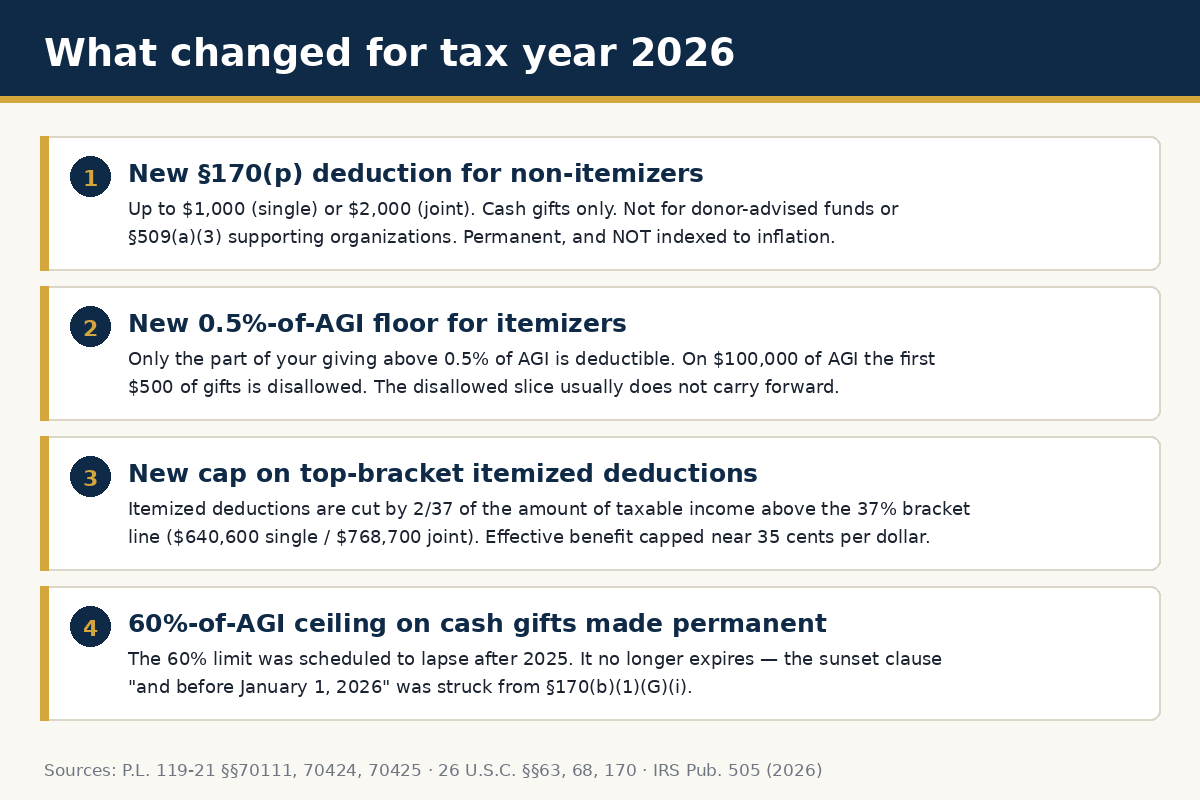
Four provisions touch individual and corporate giving, and each carries the same effective date in the statute: “taxable years beginning after December 31, 2025.” None of it applies to a 2025 return.
- A new deduction for people who do not itemize. Section 70424 of the act rewrote Internal Revenue Code § 170(p), replacing the old pandemic-era “$300 ($600” with “$1,000 ($2,000” and deleting the words “beginning in 2021” that had confined it to a single year.
- A new 0.5%-of-AGI floor for people who do itemize. Section 70425 added § 170(b)(1)(I). Gifts below the floor are not deductible at all.
- A new limit on the value of itemized deductions in the top bracket. Section 70111 rewrote § 68 from scratch. Itemized deductions are reduced by two thirty-sevenths of the lesser of your total itemized deductions or the amount by which taxable income, with those deductions added back, passes the 37% bracket threshold.
- The 60%-of-AGI ceiling on cash gifts became permanent, and was restated. Section 70425(b) replaced § 170(b)(1)(G)(i) in full. The old clause contained the words “and before January 1, 2026” and the ceiling was due to lapse after 2025; the replacement drops the sunset. It also changes the computation: the 60% allowance is now expressly 60% of your contribution base reduced by the contributions already taken into account under § 170(b)(1)(A), rather than a free-standing 60% cap.
A fifth change applies to companies rather than individuals, and it matters if you run a small business that gives. Corporations now face a 1%-of-taxable-income floor alongside the long-standing 10% ceiling, under § 170(b)(2)(A). A corporation that donates less than 1% of its taxable income gets no deduction for any of it, and under § 170(d)(2)(C) generally no carryforward either.
The $1,000 and $2,000 deduction if you don’t itemize
This is the provision most people mean when they ask about the “new charity deduction.” Roughly nine in ten filers take the standard deduction, and since 2022 those filers have gotten nothing at all for their giving. From 2026 they get something. The IRS states it plainly in Tax Topic 506, updated 21 August 2026: “Beginning with tax year 2026, if you do not itemize, you may deduct up to $1,000 ($2,000 if filing jointly) of your cash contributions to certain qualified organizations.”
The word doing the most work in that sentence is certain. Here is the full fence, straight from the statute.
What qualifies
- Cash only. The statute counts only “contributions made in cash.” The IRS reads cash broadly to include check, electronic transfer, debit and credit card, online payment service and payroll deduction — but a bag of clothes to a thrift store, a car, or shares of stock earn you nothing under this provision.
- Public charities only. The recipient must be an organization described in § 170(b)(1)(A) — churches, schools, hospitals, and the ordinary run of publicly supported 501(c)(3) charities. Private non-operating foundations are outside that description and so outside this deduction.
- No donor-advised funds. The statute excludes any contribution “for the establishment of a new, or maintenance of an existing, donor advised fund.” If you write a $2,000 check to a sponsoring organization’s DAF this December, you get nothing from this provision.
- No supporting organizations. Gifts to a § 509(a)(3) supporting organization are excluded by name.
- $1,000 single, $2,000 joint, and the cap is per return. Two single filers each get $1,000. A married couple filing jointly gets $2,000, not $2,000 each.
Three details almost nobody publishes
The amounts are not indexed to inflation. Section 170(p) contains no inflation-adjustment provision, and the IRS revenue procedure setting the 2026 inflation adjustments does not list it among the adjusted items. $1,000 and $2,000 are what they will be in 2027, 2030 and beyond unless Congress acts. Guidance in circulation that describes these figures as rising with inflation over time is wrong on the point.
The 0.5% floor does not apply to it. Section 170(p) is computed “without regard to” § 170(b)(1)(I). If you take the standard deduction and give $600 in cash, you deduct $600 — the floor that hits itemizers does not touch you.
An unused cap does not carry forward. Section 170(p) is also computed without regard to § 170(d)(1), the carryover rule. Give $400 in 2026 and you deduct $400; you do not bank $600 of headroom for 2027.
Why calling this “above-the-line” is wrong, and what believing it costs
An above-the-line deduction reduces adjusted gross income. AGI is the number that drives dozens of other thresholds: the medical-expense floor, education credit phase-outs, the taxable portion of Social Security, Medicare’s income-related premium brackets, and the starting point for most state income taxes. A deduction that lowers AGI is therefore worth more than the same deduction taken further down the form.
The new charitable deduction does not lower AGI. Section 63(b) defines taxable income for a non-itemizer as “adjusted gross income, minus (1) the standard deduction, (2) the deduction for personal exemptions…, (3) any deduction provided in section 199A, (4) the deduction provided in section 170(p)…” — that is, it is subtracted from AGI, after AGI has already been computed. And it appears nowhere in § 62(a), which is the exhaustive list of deductions that do reduce AGI.
The practical consequence: this deduction cuts your taxable income, and therefore your tax, and that is all it does. It will not move you into a lower Medicare premium bracket. It will not expand a credit that phases out on AGI. It will not reduce your state taxable income in a state that starts from federal AGI. If a source has told you otherwise, that source is wrong on the point, and the cost of acting on it falls on retirees near an IRMAA threshold, who may make a gift expecting a premium reduction that will never arrive.
The 0.5%-of-AGI floor if you do itemize
If you itemize on Schedule A, 2026 takes something away. The new § 170(b)(1)(I) says that charitable contributions “shall be allowed only to the extent that the aggregate of such contributions exceeds 0.5 percent of the taxpayer’s contribution base for the taxable year.” Your contribution base is your AGI, computed without any net operating loss carryback — for nearly everyone, simply AGI.
The arithmetic is not complicated. Multiply your AGI by 0.005. That much of your giving is disallowed. Everything above it is deductible, subject to the percentage ceilings that already existed.
| Your AGI | The 0.5% floor | If you give $3,000 | If you give $12,000 |
|---|---|---|---|
| $60,000 | $300 | $2,700 deductible | $11,700 deductible |
| $100,000 | $500 | $2,500 deductible | $11,500 deductible |
| $150,000 | $750 | $2,250 deductible | $11,250 deductible |
| $250,000 | $1,250 | $1,750 deductible | $10,750 deductible |
| $400,000 | $2,000 | $1,000 deductible | $10,000 deductible |
The IRS confirms the rule in Publication 505 for 2026, last reviewed 30 April 2026: “Beginning in 2026, if you itemize, you can only deduct charitable contributions that are more than 0.5% of your adjusted gross income.”
What happens to the money the floor eats — and why two IRS documents disagree
This is the question most coverage raises and then abandons, and it is the one with money attached. A great deal of the material circulating on this change states the floor and then says nothing at all about what happens to the money it removes; some of it asserts, without qualification, that the blocked amount carries over to future years. For most donors that assertion is not correct, and the statute is the reason.
The two IRS documents that address it in plain language do not agree with each other. Publication 505 for 2026 says: “Any amount that falls under the 0.5% floor can’t be deducted in 2026.” The 2026 Form 1040-ES repeats that the floored amount is not deductible and then adds a sentence Publication 505 does not contain: “Any amount that you can’t claim as a deduction will be added to any charitable contribution carryover amount and you may be able to claim those amounts in a future year.” Read on its own, that sentence describes an unconditional carryforward.
The statute is narrower than either. Section 170(d)(1)(C) is headed “Contributions disallowed by 0.5-percent floor carried forward only from years in which limitation is exceeded,” and it operates by increasing an excess that is already being carried forward under one of the percentage-ceiling carryover rules. In other words:
- If, in the same year, your giving also exceeded one of the AGI percentage ceilings — 60% for cash to public charities, 30% or 20% for other categories — so that you already had a carryover, then the amount the floor took is added to that carryover and rides forward with it, for up to five years, within the matching category.
- If you were comfortably under every ceiling, which describes the overwhelming majority of donors, there is no carryover to add it to, and the floored amount is simply lost.
A household with $150,000 of AGI giving $9,000 a year is nowhere near the 60% ceiling of $90,000. Its $750 of floored giving does not come back in 2027. Over ten years that is $7,500 of giving that produces no deduction at all.
Which of your gifts the floor eats first
If all your giving is cash to public charities this does not matter. If you give a mix — some cash, some appreciated stock, a conservation easement, a gift to a private foundation — it matters a great deal, because the statute prescribes a mandatory order and it is not the order a taxpayer would choose. Section 170(b)(1)(I) applies the haircut first to the 20% category, then the 30% capital-gain category, then other 30% gifts, then qualified conservation contributions, then the 50% category, and last to 60% cash. The floor consumes your least favourably treated dollars before it touches your best ones. That ordering is the one genuinely taxpayer-friendly detail in the provision, and almost nobody mentions it.
What the floor does to the case for bunching
Bunching — making two or three years of gifts in a single tax year so the total clears the standard deduction — was already the standard answer for mid-income donors. The floor strengthens it, because the floor is charged once per year rather than once per dollar. Give $6,000 a year for three years on $120,000 of AGI and you lose $600 to the floor each time, $1,800 in total. Give $18,000 once and skip two years, and you lose $600 once. Same giving, $1,200 more deducted — before you even count the benefit of clearing the standard deduction in the bunching year.
The 35-cent cap, if your income is high enough to meet it
The rewritten § 68 is short and does something new. It reduces itemized deductions “by 2/37 of the lesser of— (1) such amount of itemized deductions, or (2) so much of the taxable income of the taxpayer for the taxable year (determined without regard to this section and increased by such amount of itemized deductions) as exceeds the dollar amount at which the 37 percent rate bracket under section 1 begins with respect to the taxpayer.” It applies, by its own terms, “after the application of any other limitation on the allowance of any itemized deduction” — including after the 0.5% charitable floor.
Two thirty-sevenths is about 5.41%; the IRS worksheets round it to 5.4%. The logic behind the fraction: a deduction in the 37% bracket is worth 37 cents, and removing two of those cents leaves 35. That is the whole point of the provision — an effective ceiling of roughly 35 cents of benefit per dollar of itemized deduction for the highest earners.
The 37% bracket thresholds for 2026 are $640,600 for single filers and heads of household, $768,700 for joint filers and $384,350 for married filing separately. Read the parenthetical carefully, because it is the part that catches people: the test is not your taxable income as filed, but your taxable income with your itemized deductions added back. A single filer with $700,000 of AGI and $80,000 of itemized deductions has taxable income of $620,000 — below the $640,600 line, and apparently safe. Add the deductions back and the figure is $700,000, which exceeds the threshold by $59,400. The reduction is 2/37 of the lesser of $80,000 and $59,400, so $59,400 × 2/37 = $3,210.81 of itemized deductions disallowed. Any guide that tells you § 68 applies only when your taxable income exceeds the threshold is understating its reach. Because the reduction is capped at the lesser of the two figures, someone barely over the line still loses very little. The deduction for qualified business income is expressly carved out and is computed as if § 68 did not exist.
For a top-bracket donor, the two new charitable rules stack: the 0.5% floor removes a slice of the gift, and then the 2/37 haircut trims what survives. It is worth running that combination with a preparer before committing to a very large year-end gift.
Should you itemize in 2026?
The threshold question, and one a surprising amount of coverage discusses without ever printing the numbers. From Revenue Procedure 2025-32, confirmed in the IRS’s 2026 inflation-adjustment release, the 2026 standard deduction is:
| Filing status | 2026 standard deduction |
|---|---|
| Single | $16,100 |
| Married filing jointly / surviving spouse | $32,200 |
| Head of household | $24,150 |
| Married filing separately | $16,100 |
Add $1,650 for each of age 65 or over and blindness — $2,050 instead if you are unmarried and not a surviving spouse. A single 70-year-old therefore starts at $18,150 — $16,100 plus $2,050.
Separate provisions of the same 2025 law created other deductions for particular groups, including taxpayers aged 65 and over, which sit outside this page’s subject and outside the itemize-or-not comparison; check whether any apply to you before you file. Itemizing itself only pays if your state and local taxes, mortgage interest, qualifying medical expenses and charitable gifts together beat the standard-deduction figure. If they do not, you take the standard deduction — and now you also take up to $1,000 or $2,000 for cash giving on top of it. That combination is new in 2026 and it is the reason the “should I itemize” calculation is worth redoing this year even if the answer was settled before.
If you are 70½ or older, the best move in 2026 is not a deduction at all
A qualified charitable distribution goes directly from your IRA trustee to a charity. It never enters your income, and § 408(d)(8)(E) provides that a QCD “shall not be taken into account in determining the deduction under section 170.” It is an exclusion, not a deduction — which means the 0.5% floor does not touch it, the § 68 haircut does not touch it, and you do not need to itemize to benefit.
Because it keeps money out of AGI altogether, a QCD does the thing the new non-itemizer deduction cannot: it genuinely lowers AGI, and therefore can affect the taxable share of Social Security, the medical-expense floor and Medicare premium brackets.
The 2026 numbers, from IRS Notice 2025-67:
- $111,000 per person for the year, up from $108,000 in 2025. A married couple who each own an IRA can each give up to that amount from their own account.
- $55,000 for the one-time election to fund a split-interest entity such as a charitable gift annuity or charitable remainder trust, up from $54,000.
- Minimum age 70½, measured from the actual half-birthday, not from the start of the year.
- The distribution must go directly from the trustee to the charity. If the money passes through your hands first, it is not a QCD.
- Donor-advised funds and § 509(a)(3) supporting organizations are excluded, exactly as they are from the new non-itemizer deduction.
The 2026 figure is worth checking against whatever you read elsewhere. A good deal of current material still carries $108,000, which was the 2025 limit, and some still carries $100,000, which has been out of date for several years.
That is the case for a QCD. Doing one correctly is a separate question, and the reporting step is where most of them go wrong: our guide to qualified charitable distributions in 2026 covers the $111,000 limit, which IRAs qualify, the three rules that disqualify an otherwise valid gift, and the Form 1040 line 4c checkbox that replaced the old margin notation.
Three worked examples
1. A couple who takes the standard deduction
AGI $85,000, married filing jointly. During 2026 they give $1,500 in cash to a local food bank and drop off about $300 of used clothing at a thrift shop. They take the $32,200 standard deduction.
Under 2025 rules their giving produced nothing. In 2026 they deduct $1,500 — the cash, in full, because it is under the $2,000 cap and the 0.5% floor does not apply to non-itemizers. The clothing produces nothing, because § 170(p) counts cash only. Their taxable income falls to $51,300, which sits in the 12% bracket, so the gift is worth about $180 in tax. Modest, but it is $180 more than the same giving was worth in 2025 — and if they had known the clothing was excluded, they might have sold it and given the proceeds in cash instead.
2. A single itemizer
AGI $180,000, itemizes, gives $9,000 to charity during the year. The floor is 0.5% of $180,000, or $900. Deductible charitable contribution: $8,100. With a marginal rate of 24%, the floor costs about $216 of tax relative to the same gift in 2025 — and because this donor is nowhere near the 60% ceiling, that $900 does not carry forward. It is gone.
3. The same donor, bunching
Suppose that donor plans to give $9,000 a year for three years. Spread evenly, the floor takes $900 in each of the three years: $2,700 lost, $24,300 deducted.
Now bunch. Give $27,000 in 2026 and nothing in 2027 or 2028. The floor takes $900 once. Deducted: $26,100 — $1,800 more, worth roughly $432 at a 24% rate, and that is before counting the benefit of a much larger itemized total in the bunching year.
There is a further step almost nobody has put in print yet, and it only works from 2026. In the two “off” years, when this donor takes the standard deduction, they can still give up to $1,000 in cash and deduct it under the new § 170(p) provision on top of the standard deduction. Bunch the large gifts into the itemizing year; keep giving small cash amounts in the standard-deduction years. Before 2026 the off-year giving was worth nothing at all.
What counts as a deductible gift — and what does not
The list of things people believe are deductible and are not has been stable for decades. From IRS Publication 526:
- The value of your time or services is never deductible. Publication 526 is explicit, and names two cases people get wrong: “Blood donations to the American Red Cross or to blood banks, and the value of income lost while you work as an unpaid volunteer for a qualified organization.” A consultant who donates forty hours of work worth $8,000 deducts nothing.
- Raffle, bingo and lottery tickets are not gifts. “You can’t deduct as a charitable contribution amounts you pay to buy raffle or lottery tickets or to play bingo or other games of chance,” even when the whole event benefits a charity.
- Gifts to a specific individual are not deductible, and that includes money routed through a charity but earmarked for a named person or family. Disaster relief given to the organisation is deductible; disaster relief earmarked for the Smiths is not.
- Political parties, candidates and political organisations — not deductible. Nor are chambers of commerce, civic leagues, social and country clubs, homeowners’ associations or labour unions.
- Most foreign organisations are excluded, with narrow treaty exceptions for certain Canadian, Israeli and Mexican charities. A gift to a US charity that is earmarked to go abroad to a specific foreign organisation is also excluded.
Out-of-pocket volunteer costs, though, are deductible — unreimbursed, directly connected to the service, and not personal. That covers ingredients you bought for a shelter kitchen, a uniform not suitable for everyday wear, and mileage. The charitable mileage rate is 14 cents a mile for 2026, confirmed in IRS Notice 2026-10. It is set by statute rather than by inflation, which is why it has not moved in decades while the business rate climbed to 72.5 cents. Parking and tolls are deductible on top of it.
If you got something back, subtract it. Buy a $250 gala ticket that includes a $90 dinner and you deduct $160. A charity must give you a written statement whenever a payment of more than $75 is partly a gift and partly for goods or services. Small tokens can be ignored: for 2026, Revenue Procedure 2025-32 sets the low-cost article limit at $13.90, and the insubstantial-benefit thresholds at $13.90, $69.50 and $139.
The records that decide whether the deduction survives
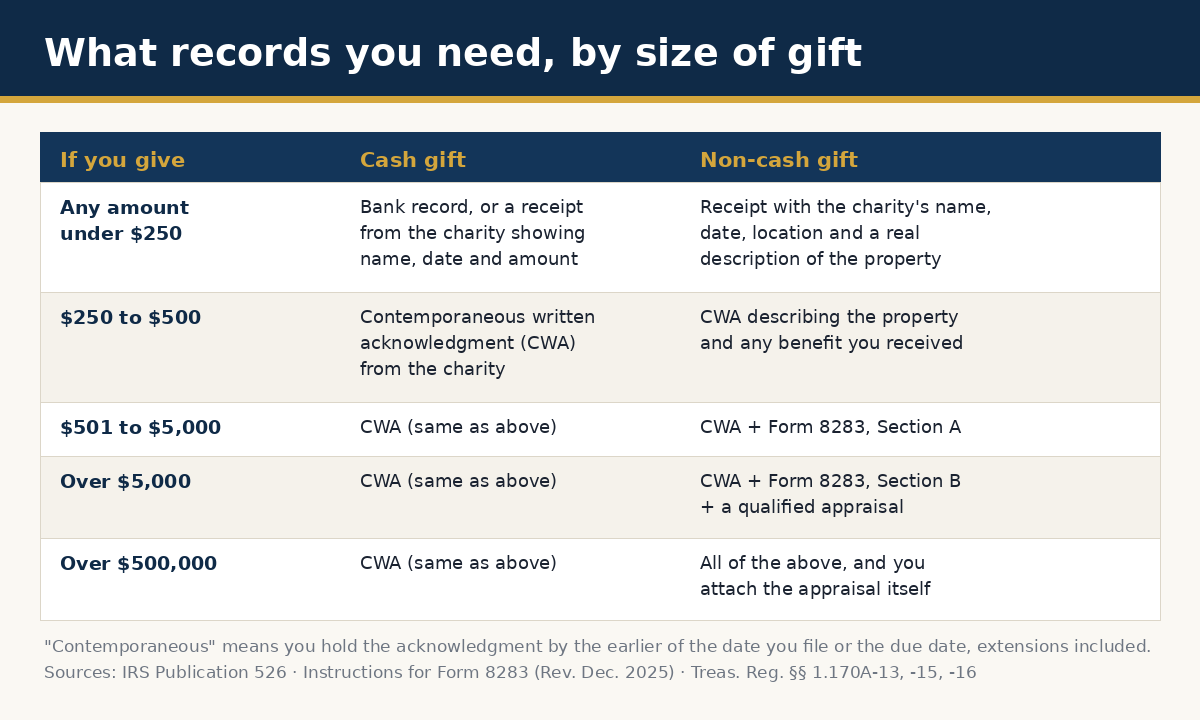
Deductions are lost far more often on paperwork than on arithmetic. The rules by size of gift:
- Any cash gift, however small. Publication 526 is categorical: “You can’t deduct a cash contribution, regardless of the amount, unless you keep one of the following.” That means either a bank record showing the charity’s name, the date and the amount, or a receipt or written communication — email counts — from the charity showing the same three things. A cash note in a collection plate with no record is not deductible.
- $250 or more. You need a contemporaneous written acknowledgment. It must state the amount, whether you received any goods or services in return, and a good-faith estimate of their value; if the only benefit was an intangible religious benefit, it must say so. Separate gifts are not combined: $25 a week to your church is fifty-two separate contributions, not one $1,300 gift.
- “Contemporaneous” has a hard deadline. Under Treasury Regulation § 1.170A-13(f)(3) you must hold the acknowledgment by the earlier of the date you file or the due date including extensions. Getting it afterwards does not fix the problem, and this is a common and entirely avoidable way to lose a large deduction.
- Non-cash over $500. Form 8283 goes with your return. The instructions are blunt: the IRS may disallow the deduction if the form is missing.
- Non-cash over $5,000 per item or group of similar items: Form 8283 Section B, a qualified appraisal, and the charity’s signature in Part V. Over $500,000, you attach the appraisal itself to the return.
- Clothing and household goods must be in “good used condition or better.” That is the statutory phrase and there is one way around it: an item in worse condition is deductible only if you claim more than $500 for it and attach a qualified appraisal and Form 8283 Section B.
- Volunteer expenses of $250 or more need their own acknowledgment from the charity, describing the services you provided and whether you were reimbursed. Unlike an ordinary acknowledgment, it does not state a dollar figure — your own records supply that.
The December 31 rules that decide which tax year your gift lands in
This section covers the principle. For the operational cut-off dates for the 2026 tax year — including the USPS postmark change, broker and custodian lead times, and the November deadlines for gifts of stock and mutual funds — see our guide to year-end charitable giving deadlines for 2026.
A contribution counts in the year it is delivered, and delivery is defined differently for each payment method. These are the rules that matter in the last week of December:
- A mailed check is delivered on the day you mail it. Treasury Regulation § 1.170A-1(b): “The unconditional delivery or mailing of a check which subsequently clears in due course will constitute an effective contribution on the date of delivery or mailing.” A cheque postmarked 31 December 2026 that clears in January is a 2026 gift.
- A credit card gift counts in the year it is charged, even if you pay the bill the following year.
- A text-message gift counts when it is charged to your phone account.
- A pay-by-phone bank payment counts when the bank pays, not when you authorise it — the one asymmetry in the list, and the one that catches people who set up a payment on 30 December.
- Stock: a properly endorsed certificate delivered or mailed to the charity or its agent counts on that date. But Treasury Regulation § 1.170A-1(b) also provides that if the donor delivers the certificate “to his bank or broker as the donor’s agent, or to the issuing corporation or its agent, for transfer into the name of the donee, the gift is completed on the date the stock is transferred on the books of the corporation.” That covers how almost every retail donor actually gives shares — so handing stock to your broker on 29 December does not, on its own, make it a 2026 gift. Start well before Christmas.
The 2026 tax year for an individual closes on Thursday, 31 December 2026. Under § 6072(a) the return is statutorily due 15 April 2027, though as of this writing the IRS has not yet issued its filing-season announcement for that year.
Check the charity before you give
Two free IRS tools settle the question, and both take under a minute.
Tax Exempt Organization Search (apps.irs.gov/app/eos) tells you whether an organisation is currently eligible to receive tax-deductible contributions. Search the Pub 78 Data set for the deductibility question specifically. The Auto-Revocation List, searchable in the same tool and published here, lists organisations that lost exempt status automatically for failing to file a Form 990 for three consecutive years. The IRS states the donor consequence directly: “Donors can deduct contributions made before an organization’s name appears on the Automatic Revocation List.” Give after that date and there is generally no deduction, however genuine the organisation looks. The one way it comes back is retroactive reinstatement: the IRS lists four reinstatement routes, three of which can restore exempt status effective from the revocation date, and where that happens gifts made in the interim are deductible after all. You cannot count on it, and you should not give into a revoked organisation expecting it.
On fraud, the IRS named fake charities in its 2026 Dirty Dozen list published 5 March 2026: “Fraudsters often exploit tragedies and disasters by creating fake charities to collect donations and personal information.” Its practical advice, repeated in a tip page the IRS reviewed on 25 August 2026, is worth memorising: “Legitimate charities do not ask for gift cards, cash, or wire transfers.” Scammers can and do spoof caller ID to appear to be a real charity, so verify the organisation independently and give through its own website rather than a link you were sent.
What is not yet known
Three things are genuinely unsettled as of late August 2026, and pages that pretend otherwise are guessing.
There is no 2026 edition of Publication 526. The current edition, dated 5 February 2026, is for preparing 2025 returns, and says nothing about § 170(p) or the 0.5% floor. Any article citing “the 2026 Publication 526” is citing a document that does not exist. The 2026-specific guidance so far lives in Tax Topic 506, Publication 505 and the 2026 Form 1040-ES.
No line number exists yet for the non-itemizer deduction. The IRS draft forms page still shows a 2025-revision Form 1040; a 2026 draft Schedule A has been posted, but it is for itemizers and contains no line for this. In the meantime the 2026 Form 1040-ES simply folds the deduction into its standard-deduction worksheet line. Be sceptical of any guide that names a specific 1040 line.
Donor-advised funds sit in an awkward middle. A DAF gift is excluded from the non-itemizer deduction by name, but it remains fully deductible for an itemizer in the year of contribution, provided you obtain the acknowledgment § 170(f)(18) requires — a statement from the sponsoring organisation that it has exclusive legal control over the assets. The IRS is explicit about what that means: “Once the donor makes the contribution, the organization has legal control over it.” You keep advisory privileges, not ownership. No DAF carve-out appears in the 60% cash ceiling, so cash to a DAF is governed by the same ceiling as other cash gifts to public charities; gifts of appreciated property to a DAF fall under different and lower ceilings, which is a question for your preparer rather than an article.
Related reading on giving well
- 15 best charities to donate to in 2026 — vetted, rated, and with the financial ratios shown
- The worst charities to avoid in 2026 — the ones whose ratings do not survive a look
- Charities that accept stock donations — the route that avoids capital gains entirely
- Best charities to donate clothes to — and the “good used condition” rule that applies
- Reputable car donation charities — where the Form 1098-C rules bite
- Best charities for Giving Tuesday 2026 — if you are timing a year-end gift
- Get help paying for… — our directory for readers who need assistance rather than a deduction
Frequently asked questions
Can I deduct charitable donations in 2026 without itemizing?
Yes, for the first time since 2021. Beginning with tax year 2026, Internal Revenue Code section 170(p) allows a taxpayer who takes the standard deduction to deduct up to 1,000 dollars of cash contributions, or 2,000 dollars on a joint return. The deduction is permanent, it is not adjusted for inflation, and it applies only to cash gifts made to public charities described in section 170(b)(1)(A). Contributions to a donor-advised fund or to a section 509(a)(3) supporting organization are excluded by name, and non-cash gifts such as clothing, household goods, cars or stock do not count toward it. The 0.5 percent of adjusted gross income floor that applies to itemizers does not apply to this deduction, and an unused portion of the 1,000 or 2,000 dollar cap does not carry forward to the next year.
Is the new $1,000 charitable deduction an above-the-line deduction?
No, and this is the most common error in coverage of the change. An above-the-line deduction reduces adjusted gross income. Section 63(b) of the Internal Revenue Code defines taxable income for a taxpayer who does not itemize as adjusted gross income minus the standard deduction, the deduction for personal exemptions, any section 199A deduction, and the deduction provided in section 170(p). It is subtracted from adjusted gross income after that figure has already been computed, and it does not appear in section 62(a), which is the list of deductions that do reduce adjusted gross income. The practical consequence is that this deduction lowers your taxable income and your tax, but it will not lower your Medicare income-related premium bracket, will not expand a tax credit that phases out on adjusted gross income, and will not reduce your state taxable income in a state that starts from federal adjusted gross income.
What is the 0.5% charitable deduction floor for 2026?
Beginning in tax year 2026, a taxpayer who itemizes may deduct charitable contributions only to the extent they exceed 0.5 percent of the taxpayer’s contribution base, which for almost everyone is adjusted gross income. On 100,000 dollars of adjusted gross income the first 500 dollars of giving is disallowed; on 250,000 dollars the first 1,250 dollars is disallowed. The floor is charged once per year rather than once per gift, which is why bunching several years of giving into a single tax year is worth more than it used to be. Where a donor gives in more than one category, the statute applies the floor first to the 20 percent category, then to 30 percent capital gain gifts, then to other 30 percent gifts, then to qualified conservation contributions, then to the 50 percent category, and last to 60 percent cash, so the least favourably treated dollars are consumed first.
Does the amount blocked by the 0.5% floor carry forward to a future year?
Usually not. Internal Revenue Code section 170(d)(1)(C) permits the floored amount to be carried forward only from a year in which the taxpayer’s giving also exceeded one of the percentage of adjusted gross income ceilings, so that a carryover already existed for the floored amount to be added to. A donor who is comfortably below every ceiling, which describes the great majority of donors, has no carryover to attach it to and simply loses the money. Two IRS documents describe this differently: Publication 505 for 2026 says only that the amount under the floor cannot be deducted in 2026, while the 2026 Form 1040-ES adds a sentence saying it will be added to any charitable contribution carryover and may be claimable in a future year. The statute is narrower than that Form 1040-ES sentence, and a donor planning around a carryforward should confirm the position with a tax preparer.
What is the standard deduction for 2026?
For tax year 2026 the standard deduction is 16,100 dollars for a single filer, 32,200 dollars for a married couple filing jointly or a surviving spouse, 24,150 dollars for a head of household, and 16,100 dollars for married filing separately. These figures come from Revenue Procedure 2025-32. An additional 1,650 dollars is allowed for each of age 65 or over and blindness, increased to 2,050 dollars if the taxpayer is unmarried and not a surviving spouse. Itemizing is worth doing only if state and local taxes, mortgage interest, qualifying medical expenses and charitable gifts together exceed the applicable figure. A taxpayer who takes the standard deduction in 2026 may now also claim the separate charitable deduction of up to 1,000 or 2,000 dollars on top of it.
How much can I give from my IRA to charity in 2026?
The qualified charitable distribution limit for 2026 is 111,000 dollars per person, up from 108,000 dollars in 2025, and the one-time election to fund a split-interest entity such as a charitable gift annuity or charitable remainder trust is 55,000 dollars. Both figures are set by IRS Notice 2025-67. You must be at least 70 and a half years old on the date of the distribution, and the money must pass directly from the IRA trustee to the charity rather than through your hands. A qualified charitable distribution is an exclusion from income rather than a deduction, so the new 0.5 percent floor and the new limit on itemized deductions do not apply to it, and because it keeps the money out of adjusted gross income entirely it can affect the taxable share of Social Security and Medicare premium brackets. Donor-advised funds and section 509(a)(3) supporting organizations are not eligible recipients.
Does giving to a donor-advised fund count for the new non-itemizer deduction?
No. Section 170(p) expressly excludes any contribution made for the establishment of a new, or the maintenance of an existing, donor-advised fund, as well as any contribution to a section 509(a)(3) supporting organization. A donor who takes the standard deduction and gives 2,000 dollars to a donor-advised fund receives nothing under this provision. A donor-advised fund contribution does remain deductible for a taxpayer who itemizes, in the year the contribution is made, provided the donor obtains the acknowledgment required by section 170(f)(18) confirming that the sponsoring organization has exclusive legal control over the assets. The IRS states that once the donor makes the contribution, the organization has legal control over it, and the donor retains advisory privileges only.
What receipt do I need for a charitable donation?
For a cash gift of any amount, including a small one, you need either a bank record showing the charity’s name, the date and the amount, or a receipt or written communication from the charity showing the same three things. Email counts. For a gift of 250 dollars or more you need a contemporaneous written acknowledgment stating the amount, whether you received any goods or services in return, and a good faith estimate of their value. Contemporaneous has a hard meaning under Treasury Regulation section 1.170A-13(f)(3): you must hold the acknowledgment by the earlier of the date you file your return or the due date including extensions, and obtaining it later does not cure the problem. Non-cash gifts over 500 dollars require Form 8283, gifts over 5,000 dollars require Form 8283 Section B and a qualified appraisal, and for gifts over 500,000 dollars the appraisal itself must be attached to the return.
Corrections, 28 August 2026. This page was published and then handed to an independent adversarial check whose instructions were to find errors rather than confirm them. Nine were found and all nine were corrected the same day, before this note went up. The most serious: our summary of the § 68 limitation quoted the statute with an ellipsis that removed the words “and increased by such amount of itemized deductions,” and we then told readers the provision applies only above the 37% bracket threshold. Because itemized deductions are added back for the test, it can apply to a filer whose taxable income is below that threshold, and our text would have told exactly the wrong reader they were safe. Both the quotation and the explanation have been rewritten and a worked counterexample added. Also corrected: a summary bullet that stated the § 68 reduction without the statutory “lesser of,” overstating it; an arithmetic error that gave a single filer aged 65 or over a 2026 starting figure of $17,750 rather than $18,150; a description of the 60% ceiling as a struck sunset, when the clause was replaced in full and the computation changed with it; an over-absolute statement that a gift to an auto-revoked organisation is never deductible, which omits retroactive reinstatement; a stock-delivery rule that omitted delivery to your own bank or broker, the route most donors actually use; a characterisation of Publication 505 and Form 1040-ES as saying opposite things, when the Form 1040-ES says both; a Publication 526 quotation truncated without an ellipsis; and four claims about competing articles that carried counts and quotations we had not published sources for, which have been removed rather than left unsourced.
How this page was verified — 28 August 2026. Every figure, quotation and statutory citation on this page was checked against a primary source retrieved on the day of publication: the enrolled text of Public Law 119-21 on govinfo.gov; the current text of Internal Revenue Code sections 62, 63, 68, 170, 408 and 6072 on uscode.house.gov; Treasury Regulations §§ 1.170A-1, 1.170A-13, 1.170A-15 and 1.170A-16 on eCFR; IRS Revenue Procedure 2025-32, Notice 2025-67 and Notice 2026-10; IRS Publications 505 and 526; IRS Tax Topic 506; the 2026 Form 1040-ES; and the Instructions for Form 8283. Where two IRS documents state the rule differently — as Publication 505 and Form 1040-ES do on the 0.5% floor carryforward — we show both and identify which one the statute supports, rather than picking the tidier answer. Where a figure could not be confirmed on a primary source, we say so on the page instead of publishing it.
What we deliberately did not publish. No Form 1040 line number for the new non-itemizer deduction, because no 2026 Form 1040 or its instructions have been released. No citation to a “2026 Publication 526,” because the current edition is dated 5 February 2026 and covers 2025 returns. No percentage ceiling for gifts of appreciated property to a donor-advised fund, because we could not verify a current figure from a primary source. No estimate of how many taxpayers the new deduction will reach, because no such figure has been published by the IRS or Treasury.
Written and verified by the Nonprofit Point editorial team. This page explains published federal tax rules for general information; it is not tax advice, and it cannot account for your particular circumstances. For a decision involving a large gift, a gift of property, a private foundation, a trust, or a state that does not follow federal rules, use a qualified tax professional. Nonprofit Point is an independent resource and is not affiliated with the Internal Revenue Service or with any organisation named on this page.