Charities That Help With Rent in Virginia: 40+ Real Programs (2026)

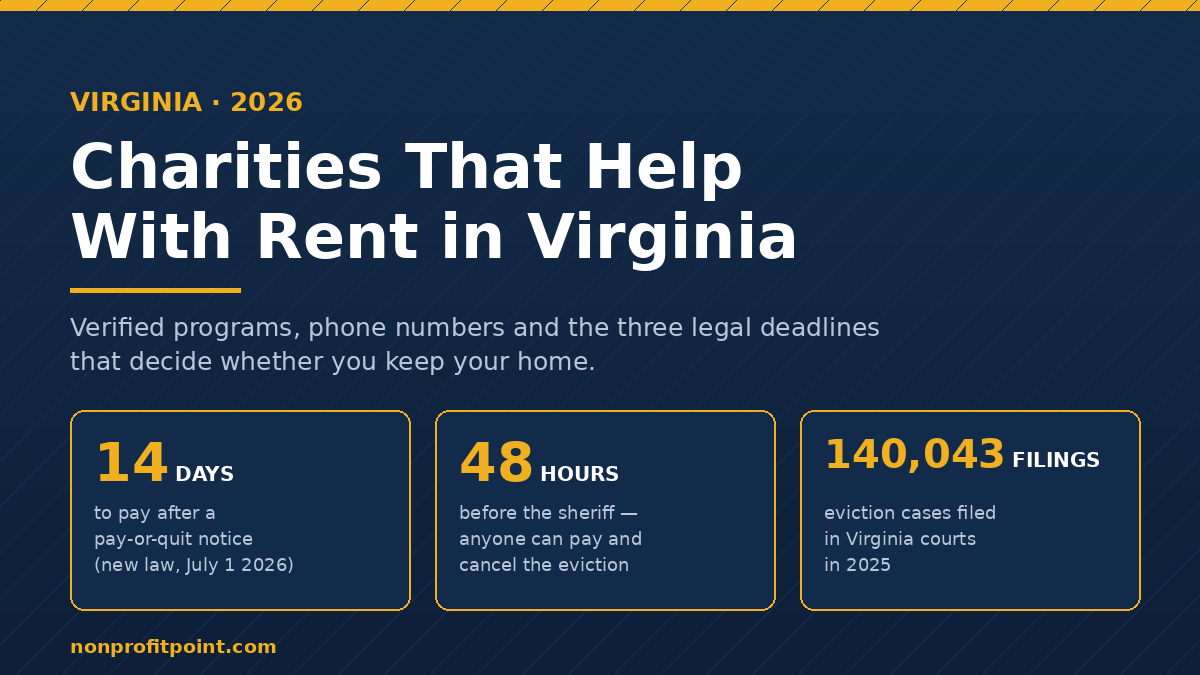
Start with the sentence that makes almost every other Virginia rent guide on the internet wrong. As of July 1, 2026, a Virginia landlord must give you 14 days to pay overdue rent, not five. The change is in the Code of Virginia at § 55.1-1245(F), put there by HB 15 (Chapter 353) and SB 48 (Chapter 354) in the 2026 session, and it reads plainly: if the tenant “fails to pay rent within 14 days after written notice is served on him,” the landlord may then terminate and move for possession. We checked all three published versions of that statute, including the ones that take effect in 2027 and later. Every one of them says 14 days. Virginia does not revert. A further protection is already on the books but not yet in force: from 1 July 2027, § 55.1-1245(G) will require any landlord with more than four rental units to offer a tenant who owes a month’s rent or less a written payment plan of up to six equal monthly instalments. Any page still telling you that you have a “five-day pay-or-quit” window is describing a law that no longer exists, and it is stealing nine days from you.
The second thing worth knowing before you dial anyone: the Virginia Rent Relief Program is dead, and has been since 11:59 p.m. on May 15, 2022. That is not a technicality. On August 27, 2026 we loaded the Department of Housing and Community Development’s own pages for it — dhcd.virginia.gov/rrp and dhcd.virginia.gov/rmrp — and both returned HTTP 403, “You are not authorized to access this page.” DHCD’s one surviving RRP page, the April 2022 press release announcing the closure, still closes by telling readers that “additional information on RRP are available at dhcd.virginia.gov/RRP.” That link is one of the dead ones. A live Virginia state agency page is pointing renters at its own 403. Meanwhile Prince William County still publishes an entire page describing the program in the present tense, and Fairfax County’s eviction-prevention resources still carry a link to it. There is no statewide successor. Stop looking for one.
The third thing is not a correction. It is the single most useful rule in Virginia landlord-tenant law, and most guides bury it in a footnote if they mention it at all. Under § 55.1-1250(D), a tenant “or any third party on behalf of the tenant” may pay all amounts claimed on the summons — current rent, damages, late charges, court costs, any civil recovery, attorney fees and sheriff’s fees, including the sheriff’s fee for serving the writ if you pay after it issued — “no less than 48 hours before the date and time scheduled by the officer” to execute the writ, and the eviction is cancelled. One condition matters and most summaries drop it: this works where the case is about unpaid rent. The statute’s own mandatory warning language says full payment “made at least 48 hours before the scheduled eviction will cause the eviction to be canceled, unless there are bases for the entry of an order of possession other than nonpayment of rent stated in the unlawful detainer action filed by the landlord.” If your landlord also pleaded a lease violation, paying does not automatically stop it. That is the deadline every church, charity, relative and employer needs to hear, because it means help that arrives on the morning of the eviction is too late, and help that arrives three days before is not.
This guide is the list of who actually pays rent in Virginia in 2026 — four statewide doors, the regional coordinated-entry line for each part of the state, verified local nonprofits with their real intake rules, and a plainly labelled list of the programs that are closed, renamed, or that never paid rent in the first place. Every phone number, dollar figure and status below was read on the organization’s own website or on an official Virginia state, city or county page on August 27, 2026. Where an organization does not publish an amount or an income limit, we say so instead of guessing.
📞 Start here: three calls, in this order. First, call your region’s housing crisis line from the table below — in Virginia that single number is the gate to most nonprofit rent money, and calling the charity directly will usually get you sent back to it. Second, if there is a child under 18 in your household, apply for TANF Emergency Assistance at commonhelp.virginia.gov or 855-635-4370; it pays up to $1,500 and it must be decided within five working days. Third, open fightmyeviction.org (Spanish: nodesalojo.org) and call legal aid on 866-LEGLAID (866-534-5243) — Virginia has no right to counsel, so nobody will offer you a lawyer unless you ask. If you already have a sheriff’s eviction date, the number that matters is 48 hours before it. Say that out loud on every call.
Virginia has no statewide rent fund. Here is what it has instead.
There is no single program a Virginia renter can apply to for back rent. What replaced the COVID-era fund is a patchwork: one narrow cash benefit through social services, two DHCD grant streams that flow to local nonprofits rather than to you, and a regional crisis line in every corner of the state that decides which charity, if any, gets your case.
The scale mismatch will shape how you behave. Virginia courts saw 140,043 eviction filings in 2025, a filing rate of 12.78% of renter households. That figure comes from the RVA Eviction Lab’s calendar-year 2025 evaluation of the Virginia Eviction Reduction Program, published by DHCD itself, and in that report’s ten-state comparison Virginia had both the highest number of filings and the highest filing rate. In the same year, the state’s flagship eviction-reduction program served 1,835 households. That is roughly 1.3% of the filings.
Apply to everything at once anyway — but treat the legal deadlines below as the real safety net, because they are free, statewide, and cannot run out of funding.
The three deadlines that decide your case
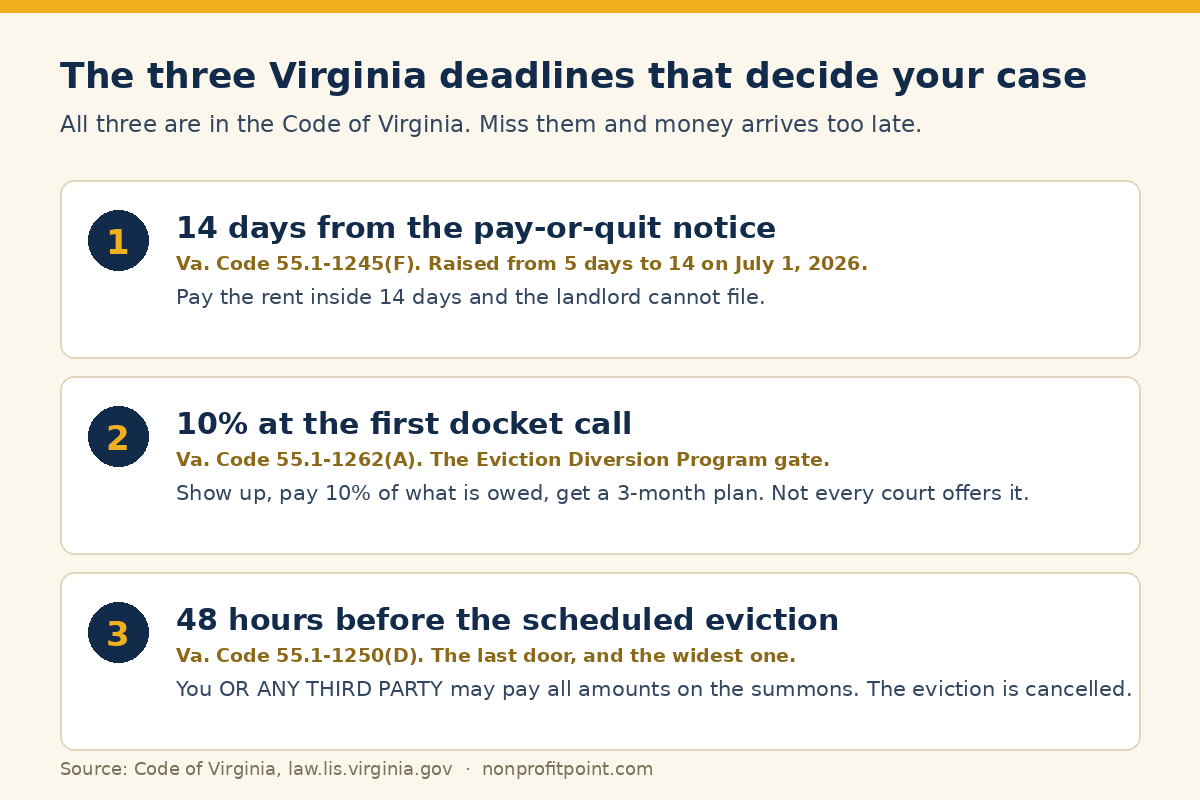
1. Fourteen days from the pay-or-quit notice — § 55.1-1245(F)
Since July 1, 2026, the written notice a landlord serves for unpaid rent gives you 14 days, not five, to pay before the rental agreement can be terminated. The Legal Aid Justice Center’s summary of the 2026 session describes HB 15 and SB 48 as allowing tenants “a fourteen-day grace period (instead of five under current law).” DHCD’s own VERP guidelines, dated August 26, 2026, put it the same way: the notice period was “extended from 5 to 14 days, a change that expands the window for tenants to stabilize and for interventions, including rental assistance, legal support, and landlord engagement, to occur.”
So you have nine more days of runway than the old guides assume. And bring whatever written notice you actually received to every appointment: Virginia’s own TANF manual still instructs caseworkers to require a “Five-Day Notice to Pay Rent or Quit,” a document no landlord will issue again. If a worker asks for one, the paper in your hand is the right paper.
2. Ten percent at the first docket call — § 55.1-1262(A)
Virginia’s Eviction Diversion Program lets you convert a nonpayment case into a court-supervised payment plan. The statute’s conditions are exact: you must appear “on the first docket call of the case,” pay “at least 10 percent of the amount due” that day, and you must not owe outstanding rent under, or have defaulted on, any payment plan executed in the last 12 months, or have used the diversion program in the last 12 months. The plan then runs 30% by the fifth of the next month, 30% the month after, and a final 30% in the third month. Complete it and “the judge shall dismiss the unlawful detainer as being satisfied.”
The catch DHCD prints itself: “Not all courts offer EDP, so you must contact your local court to determine availability and local requirements.” Call your general district court clerk before your date and ask whether they run one.
3. Forty-eight hours before the scheduled eviction — § 55.1-1250(D)
This is the widest door in Virginia law and the least advertised. After judgment, you or anyone acting on your behalf can pay everything claimed on the summons up to 48 hours before the sheriff’s scheduled time, and the eviction is cancelled — provided the unlawful detainer rests on nonpayment of rent and nothing else. Section 55.1-1250(A) says so in the warning it requires landlords to give: payment cancels the eviction “unless there are bases for the entry of an order of possession other than nonpayment of rent stated in the unlawful detainer action filed by the landlord.” Read your summons and check what it actually alleges. Payment must be by cashier’s check, certified check, or money order (§ 55.1-1250(E)), and you are entitled to demand a written statement from the landlord of the exact amount owed so you can pay it to the penny.
Two limits to know. There is no once-per-12-months cap on redemption — that rule belongs to the Eviction Diversion Program and is constantly confused with this one. The only frequency limit is that a landlord “with four or fewer rental dwelling units” may restrict redemption to once per lease period, and only if they gave you written notice of that limit.
What happens if you miss all three
The timeline is faster than most people expect, and one widely repeated claim about it is wrong. Under § 8.01-129(B), if the landlord asks, “the judge shall further order that the writ of eviction issue immediately upon entry of judgment for possession.” The writ can be issued the same day. What waits is the physical eviction: the sheriff may not remove you before your 10-day appeal period expires, and must serve notice of the date and time at least 72 hours beforehand (§ 8.01-470). A writ not executed within 30 days of issuance “shall be vacated as a matter of law.” An order of possession stays valid 180 days.
And on belongings: § 55.1-1255 gives you 24 hours, not ten days. The sheriff oversees removal of your property to the public way, and “the tenant shall have the right to remove his personal property from the public way during the 24-hour period after eviction.” After that the landlord may dispose of it. If you are close to this point, arrange a truck and somewhere to put things before the date, not after.
One more: no indigent defendant is required to post an appeal bond under § 8.01-129(B). If you cannot pay a bond, say so and ask the court to find you indigent.
The four statewide doors
Work all four in the same week. They do not talk to each other, and applying to more than one is not double-dipping — it is the correct strategy, because three of the four will probably say no.
1. TANF Emergency Assistance — the only cash benefit you can apply for directly
This is Virginia’s closest thing to an entitlement, and it is administered by your local department of social services. VDSS describes it as “cash support provided to families who are eligible whether they are currently receiving TANF,” available “to prevent eviction.”
- Maximum: the TANF manual is exact — the total “shall not exceed $1,500 during any one period of thirty (30) consecutive days in any twelve (12) consecutive months.” A 365-day period of ineligibility then applies, starting 30 days after the first issuance.
- The hard gate: the family must include at least one child under 18 (or 18–19 and still in secondary or vocational school). No child, no Emergency Assistance.
- What you must bring: a valid lease agreement, and either the written pay-or-quit notice or a Summons for Unlawful Detainer with a court date.
- Speed: “EA must be approved as soon as administratively possible, but no later than five working days after receipt of the final verification.” This is the fastest formal decision available to a Virginia renter.
- It does not burn your TANF clock: “Receipt of emergency assistance will not count toward either the 24 or 60-month limit.”
- Apply: commonhelp.virginia.gov, or the Enterprise Customer Service Center on 855-635-4370 (Mon–Fri 7 a.m.–6 p.m.), or in person at your local DSS.
Two cautions: you cannot hold Diversionary Assistance and Emergency Assistance at once, and the income screen uses the TANF Standard of Assistance for your locality, which is low. Apply regardless — the screen tests unmet need, and a denial costs an afternoon.
2. The Virginia Homeless Solutions Program — deep help, narrow gate
VHSP prevention money pays rent arrears, and it is real: DHCD reports roughly $3.9 million distributed for prevention in the 2024–2025 program year, aiding 1,813 individuals in 781 households. Arrears payment is “a one-time payment for up to six months in arrears, including any late fees on those arrears,” and no participant may receive more than 24 months of assistance in any three-year period.
The gate is narrow. Prevention assistance “is limited to those households who will imminently lose their primary nighttime residence within 14 days” and whose income is below 30 percent of AMI. DHCD is blunt about its own program: “Prevention financial assistance is not intended to operate as an eviction prevention program… Financial assistance (e.g., rent assistance) should be provided as a last resort to prevent homelessness.” If you are 14 days out and under 30% AMI, this is your best-funded option; two months out, it is not yet open to you.
There is no statewide VHSP hotline. Access runs through your region’s crisis line — the table below.
3. The Virginia Eviction Reduction Program — permanent, and probably not in your county
Good news first: VERP stopped being a pilot this year. DHCD states it “was made a permanent program through Chapter 164 of the 2026 Acts of Assembly (HB527),” and its 2027–2028 guidelines — a PDF created on August 26, 2026 — commit up to $17.5 million across the cycle, with the biennial budget directing DHCD “to expand the program to underserved regions, including Northern Virginia.” Applications from would-be grantees close October 9, 2026, with awards in early December.
Now the part no listicle prints. VERP currently has four grantees, and none of them serves Northern Virginia or the Richmond metro. DHCD’s own grantee list:
- Family Crisis Support Services — (276) 679-7240 — Buchanan, Dickenson, Lee, Russell, Wise and Tazewell counties, the City of Norton and the associated towns
- ForKids — (757) 587-4202 — cities of Chesapeake and Portsmouth
- United Way Virginia Peninsula — (757) 229-2222 — Gloucester, Hampton, James City, Mathews, Newport News, New Kent, Poquoson, Williamsburg and York
- United Way of Henry County–Martinsville — (276) 638-3946 — Henry County and Martinsville
Where VERP does operate it is worth chasing: assistance is capped at six months per household per year with no fixed dollar ceiling “because the cost of housing varies too widely across Virginia,” eligibility runs to 80% of AMI, and 92% of the 121 participants who answered DHCD’s CY2025 experience survey were still housed afterwards — a real result, but on a 10.6% response rate, so read it as encouraging rather than definitive. Note also that VERP is explicitly not first-come, first-served, and that households in a hotel or motel when they first make contact are not eligible.
4. 2-1-1 Virginia — refers, does not pay
211 Virginia is “a contracted service of the Commonwealth of Virginia, administered by the Virginia Department of Social Services” in partnership with the Council of Community Services in Roanoke. Dial 2-1-1, or 1-800-230-6977; for hearing-impaired service dial 7-1-1 then the toll-free number. Text chat is available 24/7 by texting CONNECT to 247211. The searchable directory is at search.211virginia.org.
Its searchable directory at search.211virginia.org is the right way to find the Salvation Army corps or church conference nearest you — and note that as of today the main 211virginia.org site carries a notice that “the public search directory and find resources search options are temporarily unavailable” while it is being upgraded, so use the search. subdomain directly. It does not disburse money. Treat its listings with mild suspicion too: 211 entries carry no last-verified date, and we found one advertising a rent program the charity itself says it no longer runs.
Free legal help, and the helpline you should stop calling
Virginia has no right to counsel in eviction cases. We checked the National Coalition for a Civil Right to Counsel’s register of enacted eviction right-to-counsel and eviction-defense programs, last modified August 2026: the word “Virginia” does not appear in it once. A judge will not appoint you a lawyer. You have to go and get one.
- fightmyeviction.org — the Virginia Poverty Law Center’s Eviction Defense Center, and the tool DHCD itself points tenants to. Spanish: nodesalojo.org. It gives general legal information, not advice, and no money.
- 866-LEGLAID (866-534-5243) — the number VirginiaLawHelp.org publishes to “find and connect with your local legal aid office.” Know what it is before you call: it is operated as the LawLine of Virginia Legal Aid Society, whose own stated service area is the 20 counties and six cities around Lynchburg, Farmville, Martinsville, Danville and Suffolk. Its hours are Monday, Tuesday, Thursday and Friday 9 a.m.–3:30 p.m. — it is closed Wednesdays.
- Legal Aid Justice Center — Charlottesville (434) 977-0553, Northern Virginia (Falls Church) (703) 778-3450, Richmond (804) 643-1086, Petersburg (804) 862-2205, toll-free 1-800-269-4717. It handles landlord-tenant disputes and takes phone intakes through the Richmond office Monday to Friday.
- Legal Services of Northern Virginia (703) 778-6800 · Central Virginia Legal Aid Society (804) 648-1012 or 1-800-868-1012 · Virginia Poverty Law Center (804) 782-9430.
Do not call “1-833-NOEvict” or the “Eviction Legal Helpline.” That number is printed on DHCD’s own materials, on Prince William County’s pages, on People Incorporated’s site and across dozens of listicles. As of August 27, 2026, VPLC’s page for it returns 404, evictionhelpline.org redirects to fightmyeviction.org — which publishes no helpline number at all — and eviction does not appear anywhere on VPLC’s current list of its five live helplines. The only VPLC page still describing the service is dated August 2019. We cannot tell you whether the 833 number still rings; we can tell you the organisation that ran it has stopped promoting it everywhere it once did.
Your region’s crisis line — the number that actually opens doors
In most of Virginia the nonprofit holding rent money will not take your call directly — it takes referrals from a regional coordinated-entry line, and calling the charity’s switchboard instead is the commonest way to waste a week. These come from DHCD’s crisis-assistance directory and the operators’ own pages.
| Region | Line | Number |
|---|---|---|
| Greater Richmond (city, Henrico, Chesterfield, Hanover, Ashland, Powhatan, Goochland, New Kent, Charles City) | Homeless Connection Line (Homeward) | 804-972-0813 |
| Greater Richmond — referral only, pays nothing | Housing Resource Line | 804-422-5061 |
| Southeastern Virginia & the Peninsula (Norfolk, Chesapeake, Suffolk, Franklin, Isle of Wight, Southampton, Hampton, Newport News, Williamsburg, York…) | Regional Housing Crisis Hotline (ForKids) | 757-587-4202 or 1-866-750-4431 |
| Virginia Beach | Regional Housing Crisis Hotline | 757-227-5932 |
| Portsmouth | Regional Housing Crisis Hotline | 757-966-2107 |
| Fairfax County | Coordinated Services Planning | 703-222-0880 |
| Arlington County | Centralized Access Center | 703-228-1300 |
| Alexandria | Homeless Services Assessment Center | 703-746-5700, text 703-346-5599 |
| Prince William County | Coordinated Entry System | 703-792-3366 |
| Loudoun County | Department of Family Services | 703-777-0420 (after 5 p.m./weekends 571-258-3033) |
| Roanoke City & County, Salem | City of Roanoke Central Intake | 540-853-1163 |
| Charlottesville | Community Resource Line (The Haven) | 434-207-2328 |
| Lynchburg & Central Virginia | Coordinated Homeless Intake and Access | 434-427-2442 |
| Fredericksburg, Spotsylvania, Stafford | Homelessness Helpline | 540-358-5801 |
| Harrisonburg, Winchester, Shenandoah, Warren, Page, Clarke, Front Royal | Mercy House centralized intake | 540-271-1701 |
| Culpeper, Fauquier, Madison, Orange, Rappahannock | Foothills Housing Network | 540-724-6630 |
| Southwest Virginia (Bristol, Buchanan, Dickenson, Russell, Tazewell, Washington) | People Incorporated Coordinated Intake | 833-429-7754 |
| Far Southwest (Lenowisco) | Family Crisis Support Services | 800-572-2278 |
| New River Valley | Causeway Community Action | 540-639-3159 |
| Danville / West Piedmont | Danville Redevelopment & Housing Authority | 434-792-5544 |
| Petersburg & the Crater region | St. Joseph’s Villa | 804-722-1181 |
| Northern Neck & Middle Peninsula | Bay Aging | 804-286-9563 |
| Eastern Shore | Accomack-Northampton PDC | 757-787-2936 |
Northern Virginia
Fairfax County — everything runs through one number
Coordinated Services Planning, 703-222-0880 (TTY 711), Mon–Fri 8 a.m.–4:30 p.m., is the only consumer intake route into Fairfax’s rent-assistance network. Britepaths, FACETS, Northern Virginia Family Service and Cornerstones all take referrals through it.
The county’s own money is the Emergency Rental Assistance Bridge Program (ERA-BP 4.0), launched May 18, 2026 and, unusually for 2026, open: “At this time, funds are available to provide financial assistance to all anticipated eligible applicants.” It pays up to four months — arrears, the current month, and a maximum of two months forward — with a gross household income limit at 80% of AMI ($74,800 for one person, $106,800 for four) and rent at or below 150% of Fair Market Rent. Payments go to the landlord, never to you. Previous recipients may apply again. Apply through CSP or the Community Member Portal at fairfacsportal.fairfaxcounty.gov; landlords have a separate portal and a line on 703-324-5580.
Britepaths (703.273.8829) has a timing rule nothing else publishes: “Funds are available from the 15th through the end of each month,” and recipients attend a free coaching session. Referral-only through CSP, and Britepaths warns that contacting CSP “does not guarantee a referral.” FACETS (703-352-5090) funds security deposits, rent arrears and utility arrears, also via CSP, and staffs an eviction-prevention team at the courthouse every Friday; it has moved to 10700 Page Avenue, Suite 160, Fairfax. Cornerstones (571-323-9555) offers eviction-prevention assistance but publishes no criteria or caps. Two ZIP-restricted agencies: Lorton Community Action Center (703-339-5161), 22079 and 22060 only, appointment required; and Western Fairfax Christian Ministries (703-988-9656), serving Centreville, Clifton, Chantilly, Fairfax Station, Fairfax, Oak Hill, Herndon and Fair Oaks.
Arlington — and the 24-hour window nobody tells you about
Arlington Thrive is the county’s emergency fund and it does not work like a normal charity. Its application form carried this text on August 27, 2026: “Funds have been exhausted for the month, we will reopen the fund to applications on September 1st at 9am. The application will remain open for 24 hours.” Assistance is one-time, paid directly to landlords and utilities, and reserved for “Arlington County residents who have been under 50% AMI for three months or longer.” Thrive’s general office line is 703-558-0035 (it sits in the footer of every page), but the rent and utility fund is not applied for by phone — it is the JotForm, and questions go to assistance@arlingtonthrive.org. Calling the office will not get you into the fund.
Arlington County Housing Grants is the state’s most unusual local program: a 100% locally funded ongoing rent subsidy, not a voucher and not a one-off. You must be 65+, totally and permanently disabled, a client of a county-supported mental health program, or a working family with a child under 18. Income limits run $48,790 (one person) to $91,970 (eight), assets may not exceed $35,000, and benefits “normally begin… within 90 days.” Apply at DHS, 2100 Washington Blvd, 3rd floor, or 703-228-1350. Note: old housing.arlingtonva.us URLs for this program — which used to serve income limits “effective 07/01/12”, showing $32,003 for one person — still surface in search results, but as of 27 August 2026 they 301-redirect to the county’s current housing page, so you land on current figures. Use www.arlingtonva.us.
Arlington DHS Emergency Financial Assistance caps at $3,000 per calendar year, requires a current eviction or pay-or-quit notice, a lease at least six months old and income at or below 50% AMI. But its live page still carries an all-caps banner saying funds ran out and applications resume January 2, 2026 — a date eight months past. Neither “open” nor “closed” is a defensible reading. Call 703-228-1300 and ask.
Alexandria
Alexandria runs a genuinely distinctive program: Rent Relief for Older and Disabled Adults, up to $6,000 a year paid directly to the tenant in monthly allotments, usable for any household need. (The city publishes the annual cap and says payment is monthly; it does not publish a per-month maximum, so treat any “$500 a month” figure as arithmetic rather than policy.) You must be 65+ or permanently and totally disabled, an Alexandria resident for at least 12 months (waived if you are coming out of a shelter or receiving homelessness services), at or below 30% AMI, with combined financial worth under $75,000, and not receiving Section 8 or another housing subsidy. Applications are accepted year-round with a waiting list, and take up to seven business days once complete. Program line 703-746-6085; Office of Community Services, 4850 Mark Center Dr., 5th Floor.
Everyone else goes through the DCHS Customer Call Center on 703.746.5700. ALIVE! pays rent, utilities and medical bills for Alexandria residents, but its rule is absolute: “Family Assistance volunteers work with caseworkers and not directly with any individual clients.” You must be referred by DCHS, an ALIVE! member congregation, or another agency. Family Assistance line 703-549-3692.
Catholic Charities Diocese of Arlington — the largest NoVA rent charity, and it reopens September 1
CCDA covers the 28 counties and cities of the Diocese of Arlington, from Arlington and Fairfax through Prince William, Loudoun, Stafford, Fredericksburg, Winchester and the Northern Neck. On August 27, 2026 its page read: “Catholic Charities Financial Assistance Program is currently At-Capacity. We will begin accepting new applications on Tuesday, September 1st, at 9am.” It is first-come, first-served, so the hour matters.
Read the exclusions first — they eliminate more people than the income test does. CCDA cannot help if you live in Section 8, public housing, or subsidized housing of any type; if you receive a county housing grant or voucher; if you are subleasing or renting from a relative; if you are self-employed; or if you work in your building’s leasing office or for your landlord. Frequency: “once in a 12-month period and up to two times in a 10-year period.” Catholic Charities is “the last payer on the bill,” so bring pledge letters from other organisations for any balance they will not cover. Forms must be returned within 24 hours or you wait 60 days; documents within three days or you reapply after 30. Intake is a Zoom video appointment. You will need a photo ID for each leaseholder, the signed lease, a landlord rental ledger, the landlord’s signed W-9 dated within a year, and your notice. Phone 703-841-3830. Notably, CCDA has already updated its own document checklist to say “14-day pay or quit” — independent confirmation that the law changed.
Prince William and Loudoun
Prince William has no county rent-arrears program. Everything routes through the Coordinated Entry System on 703-792-3366, operated by ACTS. NVFS states the rule flatly: “All intake must go through the CES. We cannot accept walk-ins or direct intake requests.” ACTS (703-441-8606, EAinfo@actspwc.org) does fund rent and mortgage help to avoid eviction, but qualified in its own words as “offered as funding permits,” by appointment only, and its utility assistance is limited to once every six months.
Loudoun likewise runs no rent program of its own; its “Rent & Mortgage Assistance” page is a referral list. Call Information & Referral on 703-777-0420 for the Community Support Program, or 703-777-0353 for eviction assistance. Loudoun Cares still runs a Rent Assistance Program with the highest income ceilings in the state ($93,050 for one person, $132,900 for four) and requires landlord participation plus a mandatory pre-screen — but note two things: its Eviction Prevention Program is “currently closed to new clients” even though the homepage still advertises it, and the rent program still requires that “all households must have been impacted by at least one COVID-19 economic factor.” That bar is still in force in August 2026.
Richmond, Henrico and Chesterfield
Richmond’s Eviction Diversion Program is alive but has changed hands: the city states it “is now administered and run by Southside Community Development & Housing Corp.” (1624 Hull Street; edpteam@scdhc.com). It pays past-due rent to bring the balance to zero within three months. You need city residency, a written nonpayment notice or unlawful detainer, income at or below 80% AMI, a participating landlord, and nonpayment as the only issue — plus two rules most guides miss: you must attend an EDP workshop before applying, and you must not have taken rental assistance from another city-funded source in the last 12 months.
The strongest currently-open rent payer we found in the city is Capital Area Partnership Uplifting People (CAPUP), the local community action agency — 710 Dawn St, 804-788-0050 — serving Richmond, Petersburg, Hopewell, Dinwiddie and Prince George. Its rules are unusual and you must read them the right way round: “Your balance cannot exceed $800 (for households without minors) and $1500 (for households with minors)” is a ceiling on your arrears for eligibility, not a grant cap. Owe more, and you are out. You also need a pay-or-quit or eviction notice, income at or below 200% of the federal poverty level, no assistance from another organisation in the last year, and CAPUP will assist a household only once every three years. Intake is by appointment on a handful of specific published dates — at the time of writing, August 28 at 20916 Old School Rd, McKenney and September 11 at 710 Dawn Street, Richmond, both 11 a.m.–3 p.m. — so call before assuming you can walk in. If you are approved, attending a financial coaching workshop is mandatory, not optional.
Richmond DSS Emergency Assistance caps at $500 in any 12-month period, is limited to families with children facing a disaster or a housing emergency they did not control, and must be applied for in person at 300 E. Franklin Street or 4100 Hull Street Road.
Henrico and Chesterfield renters have no local government rent program at all. Both counties route to the same two regional lines — 804-972-0813 and 804-422-5061 — plus legal aid, and Virginia’s own locality resource sheet confirms that is all there is. St. Joseph’s Villa (Flagler Housing) provides short-term financial assistance in the Richmond region but you cannot walk in: assessment comes through 804-972-0813, or 804-722-1181 for the Tri-Cities.
Hampton Roads
One number governs the region: 757-587-4202, the Regional Housing Crisis Hotline operated by ForKids, Mon–Fri 8 a.m.–5:30 p.m. Virginia Beach residents call 757-227-5932; James City, Williamsburg and out-of-area callers use 1-866-750-4431. The hotline pays nothing itself — it triages into partner funds. The Planning Council does not run a second hotline; its page is headed “Housing Crisis Hotline (Managed by ForKids, Inc.)” with the same number.
Norfolk Eviction Prevention Center is the most concrete municipal rent program in Hampton Roads and the most time-sensitive item in this guide. Its banner on August 27, 2026: “Next Application Opening Tuesday, September 15, 2026, at 10:00 A.M. Maximum of 25 applications will be accepted.” Requirements: a Norfolk rental property; a past-due balance of at least $100 and no more than $2,500; a willing landlord; no assistance from the Center in the last 12 months (measured from when payment was made, not when you asked); gross income within 80% AMI. Phone 757-664-6363 — not the “757-664-RENT” that circulates in cached copies, which does not appear in the live page. Take the city at its word on what this is and is not: “Emergency financial assistance is not available from the Norfolk Eviction Prevention Center.” It is a scheduled application window, not same-week money, and you must also “meet minimum risk factors.”
The Salvation Army Hampton Roads Area Command publishes the clearest rent rules of any Salvation Army unit in the state: up to two months of rent, Norfolk, Virginia Beach and Chesapeake only, once every 24 months, and if you owe more than two months you must clear the overage first. It is honest about capacity in a way charities rarely are: “Funding and scheduling availability limit this program to 10-15 households per month.” Referral only, through 757-587-4202 — the corps says it is “required to funnel all utility and rent requests through that office and cannot accept any requests made directly to our office.”
Catholic Charities of Eastern Virginia (1132 Pickett Rd, Norfolk, 757-456-2366) assists with rent, mortgage and utilities across 20 offices from the Eastern Shore to Southside Hampton Roads. Its bars are strict and specific: the bill must be in the occupant’s name, “not delinquent more than 30 days,” and “the program cannot serve clients who have been served within the last 18 months.” Referral through 757-587-4202 is required — “walk-ins without referrals are not accepted” — and CCEVA states plainly that “funding is very limited.”
On the Peninsula, THRIVE Peninsula (12749 Nettles Drive, Newport News, 757-877-6211) runs Critical Bill Assistance for rent, utilities, childcare, transport and car repairs; it publishes no caps or income limits, and its /financial-assistance URL 404s — use /help. Newport News Project North Star covers security deposits in full plus first month’s rent and ongoing help in 90-day declining increments, for households with children under 18 who are homeless or within 14 days of it — via 757-587-4202, or walk in at the Four Oaks Day Service Center, 7401 Warwick Blvd, open seven days a week, 7 a.m.–5 p.m., 757-975-5201. The Denbigh satellite office at 368 Deshazor Drive closes permanently on August 31, 2026.
In Hampton, the rent-relevant program is TAPT at the Department of Human Services (400 Butler Farm Road, 757-727-1800) — but it is work-program-gated: “eligible individuals must attend an initial assessment and complete a minimum of 2 weeks of approved courses and workshops.” It is not an emergency fund. In Virginia Beach, the door is the Housing Resource Center, 104 N. Witchduck Road, 757-385-5167, walk-in screening Monday, Tuesday, Thursday and Friday 8 a.m.–noon and closed to walk-ins on Wednesdays. JCOC (757-491-2846) funds rental subsidies, security deposits, utilities and moving costs through rapid rehousing, with case management up to two years.
Be aware of the $500 traps. Suffolk DSS Emergency Assistance ($500 max) is for “families with children when a fire or natural disaster has destroyed essential items” — not rent. Norfolk DHS Emergency Assistance ($500 per 12 months) covers natural disaster, fire, energy-shortage layoffs, or total loss of winter income — also not general arrears. Both are routinely listed as rent help. They are not.
Central, western and southern Virginia
Charlottesville has the clearest city rent money in this half of the state: the Community Resource Hotline (Pathways), 833-524-2904 (Spanish 434-373-0930), Mon–Fri 9 a.m.–5 p.m., for “past due rent, mortgage, and/or utility bills.” City residents only, and leave one message — the city says multiple messages slow returns. The Haven takes housing cases through the Homeless Information Line, 434-207-2328, callback “within three business days,” for people literally homeless or facing eviction within 14 days. Albemarle residents have their own door: ACERP, 434-972-4010. Almost nobody covers Charlottesville’s Rental Relief for the Elderly and Disabled, a Commissioner of the Revenue grant “not to exceed $2,000” for elderly or disabled renters with 2025 income under $65,000 and net worth under $125,000: (434) 970-3160.
Lynchburg’s best-documented door is Interfaith Outreach Association, 701 Clay Street, (434) 846-6098, covering Amherst, Appomattox, Bedford and Campbell counties plus the city. Intake is phone only, 9 a.m.–noon Monday to Friday; clients are eligible “once every 365 days”; and documents must be in at least five business days before the eviction or termination date. Miriam’s House (434.847.1101) works through a Coordinated Entry Specialist and publishes the community line as 434.427.2442.
Roanoke. Roanoke Area Ministries publishes the region’s most exact rules, and they are small: rent help where the “total amount due for pay or quit notice / intent to rent is for $300 or less,” utilities at $200 or less, NW and SW Roanoke City residents only, one service in a 12-month period, and “no hotels, motels or rooming houses.” RAM publishes no intake phone number or office hours at present, and its building is currently inaccessible — “due to ongoing construction issues at our new location (410 Elm Ave. SW)… no clients will be seen on-site” — so the only route in is the contact form on its Emergency Financial Assistance page, which triggers an email with instructions. RAM is explicit that submitting the form “is NOT ‘applying’ for assistance.” RAM refers NE, SE and Vinton residents to the Presbyterian Center, 540-982-2911, and Roanoke County and Salem to DSS on 540-387-6087. Note Total Action for Progress’s housing offering is a loan — SEED, “up to $500… with a three or four month repayment period” — not a rent grant.
Southwest Virginia. People Incorporated of Virginia is widely miscategorised: its page labelled “Rental Assistance” is the Housing Choice Voucher program in Washington County only. The emergency door is Homeless Solutions, coordinated intake (833) 429-7754, covering Bristol VA, Buchanan, Dickenson, Russell, Tazewell and Washington counties — with its own honest caveat, “funds are limited and not always available.” In the far southwest, Family Crisis Support Services (276) 679-7240 is the VERP grantee and the strongest option in the region. Harrisonburg and the Valley route through Mercy House centralized intake, 540-271-1701 — which People Incorporated also lists as the coordinated intake for Shenandoah, Warren, Winchester, Page, Clarke and Front Royal. Fredericksburg runs on the Homelessness Helpline, 540-358-5801.
The graveyard: Virginia rent doors that are closed
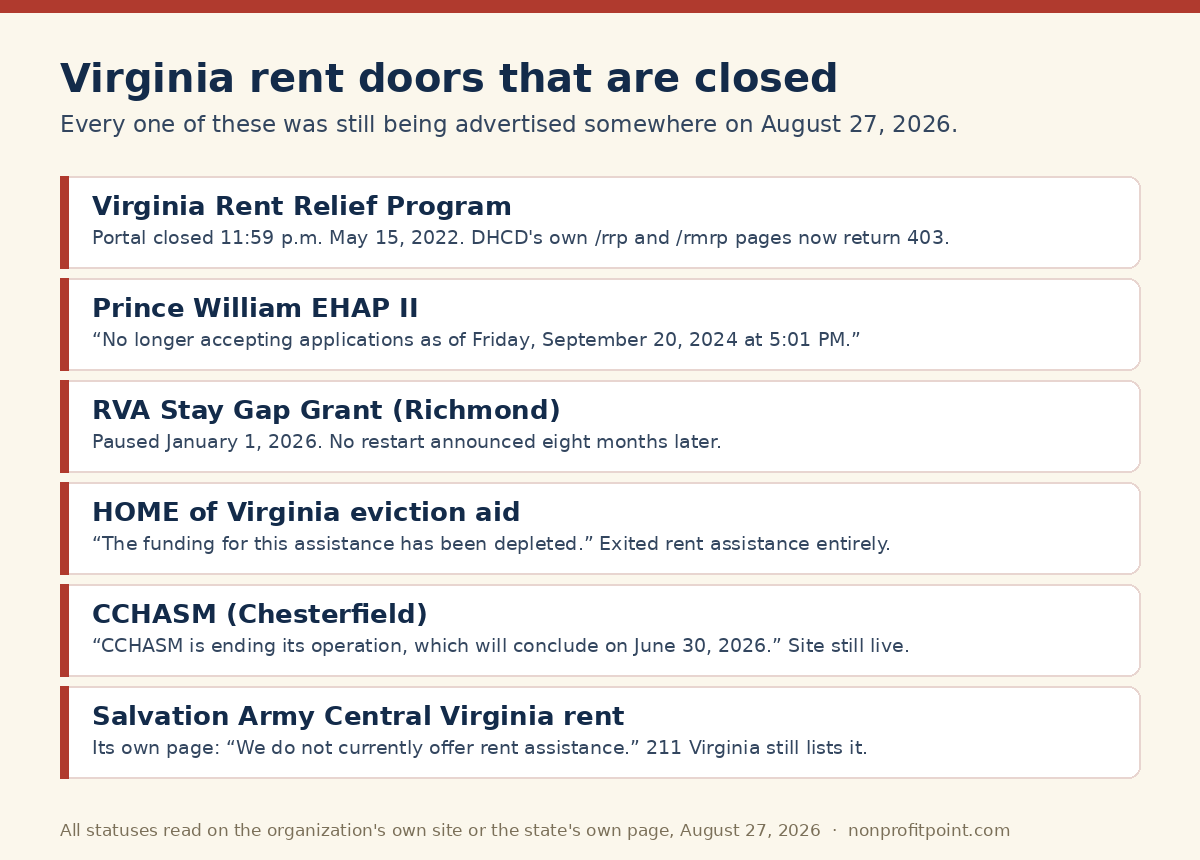
These are not obscure. Several are the first result for their obvious search, and two are still promoted by Virginia governments themselves.
- Virginia Rent Relief Program — portal closed 11:59 p.m., May 15, 2022. DHCD’s /rrp and /rmrp pages now return 403; rentrelief.virginia.gov does not resolve. Still described in the present tense on Prince William County’s own website and still linked from Fairfax County’s eviction resources.
- Prince William EHAP II — the county’s page, in capitals: “OHCD HAS LIMITED FUNDING AND WE ARE NO LONGER ACCEPTING APPLICATIONS AS OF FRIDAY, SEPTEMBER 20, 2024 AT 5:01 PM.” Closed nearly two years, still the top result for Prince William emergency rental assistance.
- RVA Stay Gap Grant — Richmond’s $1,200 one-time housing grant, “temporarily paused” effective January 1, 2026. Its status page was last updated January 14, 2026 and no restart has been announced. The city’s own figures explain why: of 3,879 applications received, 286 were approved and $343,200 disbursed against a $3.9 million appropriation.
- HOME of Virginia — one of the most-cited Richmond rent organisations, now explicit: “the funding for this assistance has been depleted, and HOME will no longer accept new intake clients for direct financial assistance… HOME does not offer rental assistance or homelessness services.”
- CCHASM (Chesterfield Colonial Heights Alliance for Social Ministry) — “As of June 30, CCHASM has officially concluded operations. The Thanksgiving Program will continue through the Chesterfield Food Bank Outreach Center.” The site now auto-redirects visitors to Chesterfield Food Bank, and separately still states “CCHASM is no longer able to offer utility assistance.” It never paid rent in any case — it was food and utilities.
- Salvation Army of Central Virginia rent assistance — on a page still slugged utility-rent-assistance, the charity states: “Please note: We do not currently offer rent assistance.” Utility help is still offered, on two separate tracks — one for Henrico County, Mechanicsville and the City of Richmond, and a second for Petersburg and Hopewell. 211 Virginia still publishes an active “Rent Assistance – Richmond” listing for it. When a directory and the charity disagree, the charity wins.
- Loudoun Cares Eviction Prevention Program — “currently closed to new clients,” while the same organisation’s homepage advertises it in two places.
- Norfolk’s Housing Choice Voucher waiting list — opened 9 a.m. July 6, 2026 and closed 4 p.m. July 7, 2026. It is shut. So is Virginia Housing’s statewide HCV list: “The waiting list is currently closed.”
Real organisations that do not pay rent
Each is a real charity doing real work. None will pay your arrears, and all appear on Virginia rent lists.
- Virginia Housing (formerly VHDA) — a bond-financing authority. It administers Housing Choice Vouchers; it has no emergency tenant fund, and its waiting list is closed. This is the highest-volume wasted-time error in the category.
- Piedmont Housing Alliance (Charlottesville) — “We do not offer financial assistance at this time.” Counselling and court navigation only.
- Commonwealth Catholic Charities (Richmond) — 18 published programs, none of them a rent or utility fund. Do not confuse it with Catholic Charities Diocese of Arlington, which is a separate corporation and does pay rent.
- CARITAS (Richmond) — shelter, recovery housing, employment and a furniture bank. No arrears programme.
- Affordable Homes & Communities — the former AHC Inc., an affordable-housing developer, not a rent fund.
- Society of St. Andrew — a food-gleaning organisation headquartered in Virginia. Not housing at all.
- Loudoun Hunger Relief (formerly Loudoun Interfaith Relief) — a food pantry. Its old domain, interfaithrelief.org, is now a parked page.
- Also food or shelter only, not rent: Food for Others (Fairfax), Oasis Social Ministry (Portsmouth), God’s Storehouse (Danville), Peninsula Rescue Mission, LINK of Hampton Roads, Union Mission Ministries (whose day centres are “currently on hiatus”), and the Thurman Brisben Center.
- Greater Peninsula NOW — every one of its domains returns NXDOMAIN. Charity Navigator lists it as “Not Rated” for missing filings. Treat as defunct.
- Modest Needs Foundation — a national grant-maker that appears on nearly every Virginia rent list. Its 501(c)(3) status was automatically revoked effective May 15, 2026 (IRS Automatic Revocation list, published August 11, 2026, EIN 47-0863430, no reinstatement recorded), and its founder pleaded guilty in August 2025 to embezzling over $2.5 million from it. Its application portal is still open and carries no notice of either fact.
Utility money frees up rent money
If rent help falls through, covering the power bill has the same effect on your balance — and Virginia’s utility programmes are better funded than its rent ones.
Dominion Energy EnergyShare is the most under-used, because of one fact almost every guide gets wrong: there is no income limit. Dominion’s own page lists “No income restrictions for bill payment assistance recipients” — you need a demonstrated hardship and a disconnection notice, a need for restoration, or help with a payment plan. Benefits are up to $600 for heating (Oct. 1–May 31) and up to $300 for cooling (June 1–Sep. 30), with an additional $500 for military veterans and people with disabilities in the relevant state voucher programmes. Find your local agency by calling 2-1-1. In its 2025–2026 year EnergyShare connected “more than 14,600 customers” to bill-payment assistance.
The Virginia Energy Assistance Program through VDSS runs on fixed windows: Fuel from the second Tuesday in October to the second Friday in November; Crisis from November 1 to March 15 for deposits and equipment, and from the first workday in January to March 15 for fuel and heating bills; Cooling from June 15 (VDSS’s page and its own official form disagree on whether it closes August 15 or 17 — assume the earlier date). Income must be at or below 150% of the federal poverty level. Apply at commonhelp.virginia.gov or 855-635-4370. If you are outside a window, EnergyShare is year-round.
Appalachian Power customers have Neighbor to Neighbor, administered by Dollar Energy Fund: maximum grant $300, requires at least $100 paid on the account in the previous three months ($75 if you are 62 or over) and an outstanding balance of at least $100, income at or below 150% FPL. Old Dominion Power’s WinterShare caps at $250, Columbia Gas of Virginia’s HeatShare and Virginia American Water’s H2O-Help to Others at $500 each; one grant per utility per programme year, and none of them can be used for security deposits or reconnection fees. Contact centre 1-888-282-6816.
One scam warning, from a charity that is watching it happen
This is not a generic caution. Catholic Charities Diocese of Arlington publishes it on its own emergency assistance page, about its own applicants:
“Catholic Charities Emergency Assistance is seeing scams targeting clients via email, text, and phone. Watch for unexpected messages, urgent or threatening language, or requests for payment through Venmo, gift cards, wire transfers, or cryptocurrency. Catholic Charities Emergency Assistance will never contact you by text. Official emails come only from @ccda.net.”
Generalise the rule, not the brand: no legitimate Virginia rent programme asks you to pay anything to apply, and none pays you personally except Alexandria’s senior and disabled Rent Relief, a city programme you apply to in writing. Everything else here pays the landlord or utility directly. A request for a gift card, wire or crypto to “release” rent assistance is a scam, full stop.
And know what the federal warnings actually say. The FTC’s December 2025 analysis — nearly 65,000 reports, about $65 million lost since 2020 — is about fake rental listings, not rent-relief fraud, and is routinely miscited as the latter. The CFPB’s guidance on spotting rental assistance scams is on point but sits in the agency’s archive under a banner warning it may be outdated; it was published in August 2021 and nobody has replaced it.
Related help while you work the list
If rent money does not land in time, these are the adjacent doors: charities that help with security deposits if you are moving rather than staying, emergency hotel vouchers for the gap nights, emergency shelter, help with utility bills, and grants for single mothers if there are children in the household. Renters in neighbouring states can use our directories for North Carolina, Georgia and New Jersey. Everything we have on financial assistance is indexed on the Get Help Paying For… hub.
Frequently asked questions
How many days do I have to pay rent in Virginia before eviction?
Fourteen days, since July 1, 2026. Virginia Code section 55.1-1245(F) requires the landlord to give written notice and wait 14 days for payment before terminating the rental agreement, a change from the old five-day rule made by HB 15 and SB 48 in the 2026 session. All three published versions of the statute, including the ones effective in 2027 and later, say 14 days, so Virginia does not revert to five. If a page or a caseworker refers to a five-day pay-or-quit notice, they are working from the old law. Bring whatever written notice you actually received.
Is there still emergency rental assistance in Virginia in 2026?
Not as a single statewide fund. The Virginia Rent Relief Program closed at 11:59 p.m. on May 15, 2022, and DHCD’s own pages for it now return an access-denied error while its application portal no longer resolves. What exists instead is TANF Emergency Assistance through your local social services office, worth up to 1,500 dollars for households with a child under 18; Virginia Homeless Solutions Program prevention funds for households below 30 percent of area median income who will lose housing within 14 days; the Virginia Eviction Reduction Program, which has only four grantees covering a minority of localities; and local city or county programs that vary enormously. You reach almost all of it through your regional housing crisis line rather than by applying to the state.
Can anyone else pay my back rent to stop a Virginia eviction?
Yes, and this is the most useful rule in Virginia landlord-tenant law. Under Virginia Code section 55.1-1250(D), the tenant or any third party acting on the tenant’s behalf may pay all amounts claimed on the summons for unlawful detainer, including rent, damages, late charges, court costs, attorney fees and sheriff’s fees, no less than 48 hours before the date and time the sheriff has scheduled to execute the writ. The statute’s own required warning language states that full payment made at least 48 hours before the scheduled eviction will cause the eviction to be canceled, unless there are bases for the entry of an order of possession other than nonpayment of rent stated in the unlawful detainer action filed by the landlord. That exception matters: if your landlord also pleaded a lease violation, paying the money does not by itself stop the eviction. Payment must be by cashier’s check, certified check or money order, and you can demand a written statement from the landlord of the exact amount owed.
What is TANF Emergency Assistance and who qualifies?
It is the only cash benefit a Virginia renter can apply for directly, administered by your local department of social services. The total cannot exceed 1,500 dollars during any 30 consecutive days in any 12 consecutive months, and a 365-day period of ineligibility follows. The household must include at least one child under 18, or 18 to 19 and still in secondary or vocational school. You need a valid lease plus either the written pay-or-quit notice or a summons for unlawful detainer with a court date. A decision is required no later than five working days after the final verification is received, which makes it the fastest formal decision available. Receiving it does not count against the 24-month or 60-month TANF limits. Apply at commonhelp.virginia.gov or call 855-635-4370.
Which Virginia organizations should I not bother calling for rent?
Several that appear on most lists. Virginia Housing, formerly VHDA, is a bond-financing authority with no emergency tenant fund and a closed voucher waiting list. The Salvation Army of Central Virginia states on its own page that it does not currently offer rent assistance, even though 211 Virginia still lists a Richmond rent program for it. HOME of Virginia has publicly exited rent assistance because its funding was depleted. CCHASM in Chesterfield concluded operations on June 30, 2026. Piedmont Housing Alliance says it does not offer financial assistance. Commonwealth Catholic Charities lists no rent or utility fund among its 18 programs. And Modest Needs Foundation lost its federal tax-exempt status effective May 15, 2026, though its application portal is still open.
Do I have to call a hotline, or can I call the charity directly?
In most of Virginia you have to call the hotline. In Fairfax, Britepaths, FACETS, Northern Virginia Family Service and Cornerstones all take referrals through Coordinated Services Planning on 703-222-0880 and do not run direct financial intake. In Alexandria, ALIVE! states that its volunteers work with caseworkers and not directly with individual clients. In Prince William, Northern Virginia Family Service says all intake must go through the Coordinated Entry System and it cannot accept walk-ins. In Hampton Roads, both the Salvation Army and Catholic Charities of Eastern Virginia require a referral through the Regional Housing Crisis Hotline on 757-587-4202, and the Salvation Army states that direct requests to its office are not accepted.
How long do I have after an eviction judgment in Virginia?
Less time than most people expect. Under Virginia Code section 8.01-129(B), if the landlord requests it the judge shall order the writ of eviction to issue immediately upon entry of judgment, so the writ can exist the same day. The sheriff may not remove you before your 10-day appeal period expires, and must serve notice of the date and time at least 72 hours beforehand. A writ not executed within 30 days of issuance is vacated as a matter of law, and an order of possession stays valid 180 days. If you cannot afford an appeal bond, note that no indigent defendant is required to post one. After eviction, section 55.1-1255 gives you 24 hours, not ten days, to remove your belongings from the public way.
Can I get help with utilities if I cannot get help with rent?
Often yes, and it is worth doing because the effect on your budget is the same. Dominion Energy’s EnergyShare has no income restrictions at all for bill payment assistance; you need a demonstrated financial hardship and either a disconnection notice, a need for restoration, or help with a payment plan. It pays up to 600 dollars for heating between October 1 and May 31 and up to 300 dollars for cooling between June 1 and September 30, with an extra 500 dollars available to some veterans and people with disabilities. Find your local EnergyShare agency by dialing 2-1-1. The Virginia Energy Assistance Program through social services requires income at or below 150 percent of the federal poverty level and only accepts applications in fixed seasonal windows.
Corrections, 27 August 2026. A same-day adversarial re-check of this page found and fixed the following: the 48-hour redemption rule was stated without the statutory exception for unlawful detainers pleading grounds other than nonpayment (now stated in both places it appears); the indigent appeal-bond rule was cited to § 8.01-129(A) rather than (B); two statutory quotations were tightened to the exact wording; we said Arlington Thrive publishes no phone number, and it does (703-558-0035, though the fund is still applied for by form); we said the Salvation Army of Central Virginia’s utility help was limited to Petersburg and Hopewell, when it also runs a Henrico/Mechanicsville/Richmond track; CCDA covers 28 localities, not 27; the stale Arlington income-limits page now redirects rather than serving 2012 figures; a Salvation Army Hampton Roads paraphrase was inside quotation marks; the CCHASM and VHSP quotations were updated to the current and complete wording; Roanoke Area Ministries publishes no intake phone number or hours; Alexandria’s “$500 a month” was our arithmetic, not the city’s policy; an unsourced 211 program count was removed; the VERP 92% figure now carries its sample size and response rate; Norfolk’s own caveat that it does not provide emergency financial assistance was added; and source links to the Code of Virginia and the underlying state reports were added throughout.
About this guide. Compiled and fact-checked by the Nonprofit Point editorial team, which researches financial-assistance and charity-vetting resources for U.S. households. Every program status, dollar figure, statutory citation and phone number above — including the 14-day notice change at Va. Code § 55.1-1245(F), the 48-hour redemption rule at § 55.1-1250(D), the writ-of-eviction timing at §§ 8.01-129 and 8.01-470, DHCD’s VERP guidelines dated August 26, 2026 and its four-grantee list, the VDSS TANF manual’s $1,500 Emergency Assistance cap, the RVA Eviction Lab’s CY2025 filing figures published by DHCD, and every regional crisis line and local program listed — was verified against official Virginia state, city, county or organizational sources on August 27, 2026. Where an organization does not publish a dollar amount, income limit or frequency rule, we say so rather than estimating. Funds open and close quickly, several of the programs above have hard monthly application windows, and one of the largest reopens on September 1. Confirm availability by phone before travelling to an office. This page is general information about programs and published law, not legal advice; for advice about your own case contact legal aid. Nonprofit Point is an independent resource and is not affiliated with any agency listed.