Charities That Help With Car Repairs in Georgia (2026): The Short, Honest List

Georgia is a hard state to get a car fixed for free. Most of metro Atlanta has little transit outside MARTA’s reach, so a broken car often means a lost job. Yet the state’s cash assistance program does not name car repair anywhere in its plan. The national repair charities that turn up in search results — Good News Garage, Vehicles for Change, Wheels of Success — do not operate here.
What Georgia does have is narrower, and worth knowing precisely. A workforce board in metro Atlanta has a written policy that pays for car repairs, within a $2,500 total cap on support services. St. Vincent de Paul lists car repair help statewide. A small nonprofit garage in Augusta does low-cost and sometimes free repairs. And if you live in one of the 13 metro Atlanta emissions counties, there is a waiver that can keep a failing car registered.
Everything on this page was read off the administering agency’s or organization’s own website, or current local reporting, on 22 September 2026. Where a program is paused, we say so. Where something could not be verified, we say that too, rather than filling the gap.
The short version
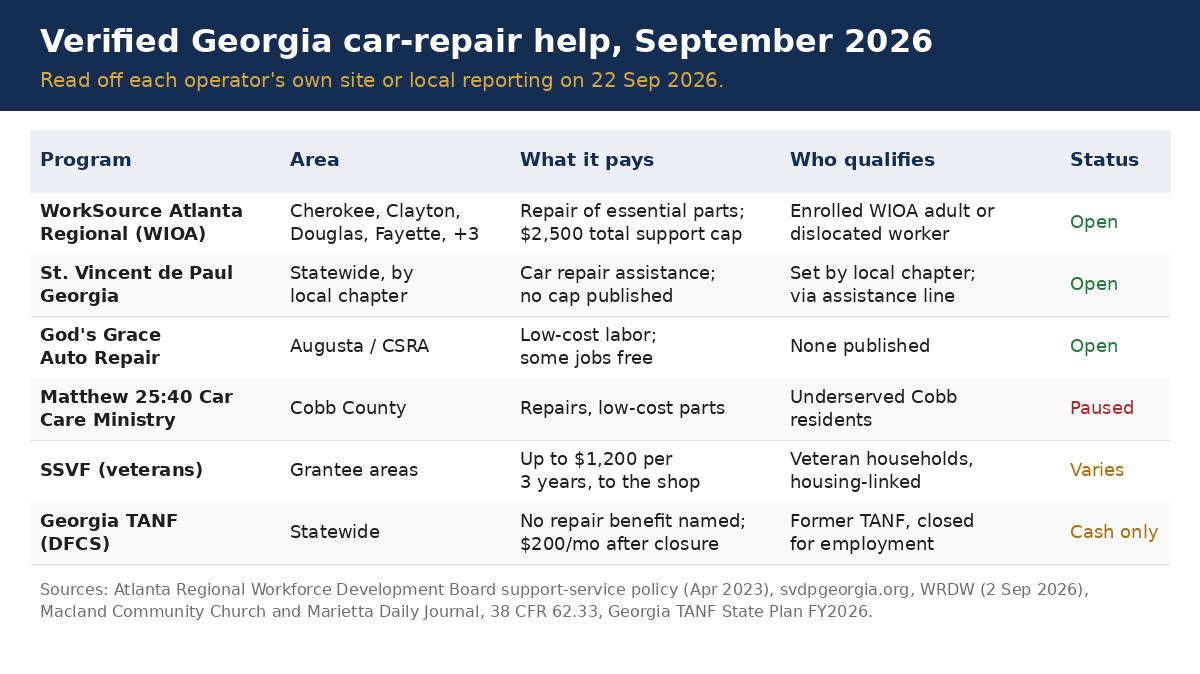
Georgia’s verified options are short, and we have not padded the list. If you are working or training and live in the Atlanta Regional workforce area, WorkSource is the strongest route. Anyone in Georgia can call St. Vincent de Paul’s assistance line. Augusta residents should call God’s Grace. Veterans at risk of losing housing should call an SSVF provider. Everyone else should call 2-1-1 and ask by name for vehicle repair assistance.
Start here: WorkSource can pay for repairs if you are in its program
Georgia’s federally funded job training system, known as WorkSource Georgia, runs through local workforce boards. The boards can pay “supportive services” so that participants can get to training or work. We found one board whose written policy names car repair: the Atlanta Regional Workforce Development Board, run by the Atlanta Regional Commission. It serves Cherokee, Clayton, Douglas, Fayette, Gwinnett, Henry and Rockdale counties.
Its support-service policy, effective 5 April 2023, says:
“WIOA funds may pay for repair and replacement of essential parts and safety equipment to an automobile only if it can be verified there is no other reasonable way for the participant to transport himself/herself to a training or work site.”
The conditions are specific:
- The car must be yours and legal. “The vehicle must be titled and registered in the participant’s name, be properly insured and it must be verified by a reputable mechanic that the repairs are needed.” The policy makes an exception when the car belongs to another family member and is your only means of transportation, as long as that is documented in your file.
- It pays against real invoices, not quotes. “Original invoices/receipts are required for car repair payments. Quotes or work orders are not accepted for payment receipts.”
- It is one payment. “This is a one-time payment only not to exceed maximum support allowed.”
- The overall cap is $2,500. “A maximum of up to $2,500* total supportive services assistance with WIOA formula funding may be awarded for the entire participation period.” That cap covers all your support services together, not just the car.
The catch: you have to be enrolled. This money goes to participants in WIOA Adult or Dislocated Worker services, which means job search help, training or a training voucher. It is not a walk-in repair fund. If you are already job hunting or want training, enrolling can bring the car repair with it.
Career center numbers in the Atlanta Regional area: Clayton 678-271-3554, Douglas 770-920-4104, Gwinnett 678-268-6610, Rockdale 470-249-4633 and Fayette 678-271-3541. Cherokee and Henry residents use 678-271-3554 until their offices are listed.
Outside those seven counties, WorkSource Georgia operates through other local boards, including separate ones for Atlanta, Fulton, DeKalb and Cobb. We could not verify their support-service policies. Ask your local WorkSource office whether its supportive services include vehicle repair, and what its cap is.
Georgia TANF does not name car repair
This is where many Georgians look first, so it is worth being plain. Georgia’s TANF State Plan for fiscal year 2026 lists support services for working recipients: “transportation reimbursement,” “purchase of Marta cards,” and “transportation provided through a DHS contract, referral service,” plus work clothing, tools and licensing fees. The word “repair” does not appear anywhere in the plan. Its only mention of a vehicle is an asset rule: “The equity value up to $4,650 of one vehicle that is used to look for work or used to travel to work or education and training is excluded.”
There is one indirect route. Families whose TANF case closes because they start work can get Work Support Payments of “$200 per month for the 12 months following case closure,” and the plan says “Regular TANF support services will be available as needed” during those 12 months. That is cash, so you can spend it on a repair. But it is not a repair program, and DFCS is unlikely to pay a shop for you. We could not read the relevant DFCS policy manual sections, so we are not claiming DFCS will or will not pay for a repair.
Georgia charities that will actually help with a car
St. Vincent de Paul Georgia (statewide)
The Society of St. Vincent de Paul Georgia says it provides “a variety of transportation assistance for neighbors in need, including MARTA cards, gas cards, car repair assistance, car payment assistance, insurance payment assistance and more.” It is the only organization we found that lists car repair help across the state.
How it works: Help is given by local volunteer chapters, called conferences, usually attached to a Catholic parish. Call the Assistance Line at 678-892-6163, Monday to Friday, 8:30 a.m. to 4:00 p.m., and you will be routed to the chapter for your ZIP code.
What to expect: No statewide dollar cap is published, and each chapter sets its own rules. One Cobb County chapter, for example, serves four ZIP codes only, helps “once per year per household,” and pays the vendor directly. Plan on partial help toward a repair rather than the full bill.
God’s Grace Auto Repair (Augusta)
God’s Grace Auto Repair is a nonprofit garage at 3313 Perkins Rd., Suite C4, Augusta, phone (706) 526-1504. Founder Gary Johnson opened the shop in June 2026, and WRDW reported on 2 September 2026 that it had helped about 90 people. Donations keep the repairs affordable, and some jobs are done completely free. As Johnson put it, “we can’t do that without the donations.”
It publishes no eligibility rules or application form. Call, describe the repair and ask what it would cost you. The shop also trains volunteers with no experience, if you want to give back.
Matthew 25:40 Car Care Ministry (Cobb County) — paused
Macland Community Church in Powder Springs runs a car care ministry offering “Repair services, low-cost parts, and educational resources” to “Underserved communities of Cobb County and its surrounding areas.” It is the successor to the “God’s Garage” ministry that local TV covered in 2017. It is not taking cars right now. The Marietta Daily Journal reported in April 2026 that it had been forced to “temporarily shut down while seeking a new facility,” and a later article said it will resume “once the facility is built.” If you are in west Cobb, the church’s number is 770-863-8622; ask for the reopening date.
Listed elsewhere, but not verified
Two Georgia nonprofits appear in giving directories as offering vehicle repairs, but we could not reach their websites or confirm that they are active. Cars, Insurance and Repairs for Single Mothers lists an Atlanta address and describes help with repairs, insurance and cars. Family Car Foundation in Marietta is listed as offering car donations and vehicle repairs to low-income families and veterans. Call before you plan around either one.
Organizations that give cars, not repairs
The We Care Car Program (A Pathway to Hope and Home) and Together with Families in Acworth both award refurbished cars; neither is a repair program. Salvation Army Metro Atlanta’s emergency assistance covers rent, utilities and similar bills, and does not mention car repair. If your car is not worth fixing, see free cars for low-income families.
Georgia’s emissions waiver: $1,176, and only in 13 counties
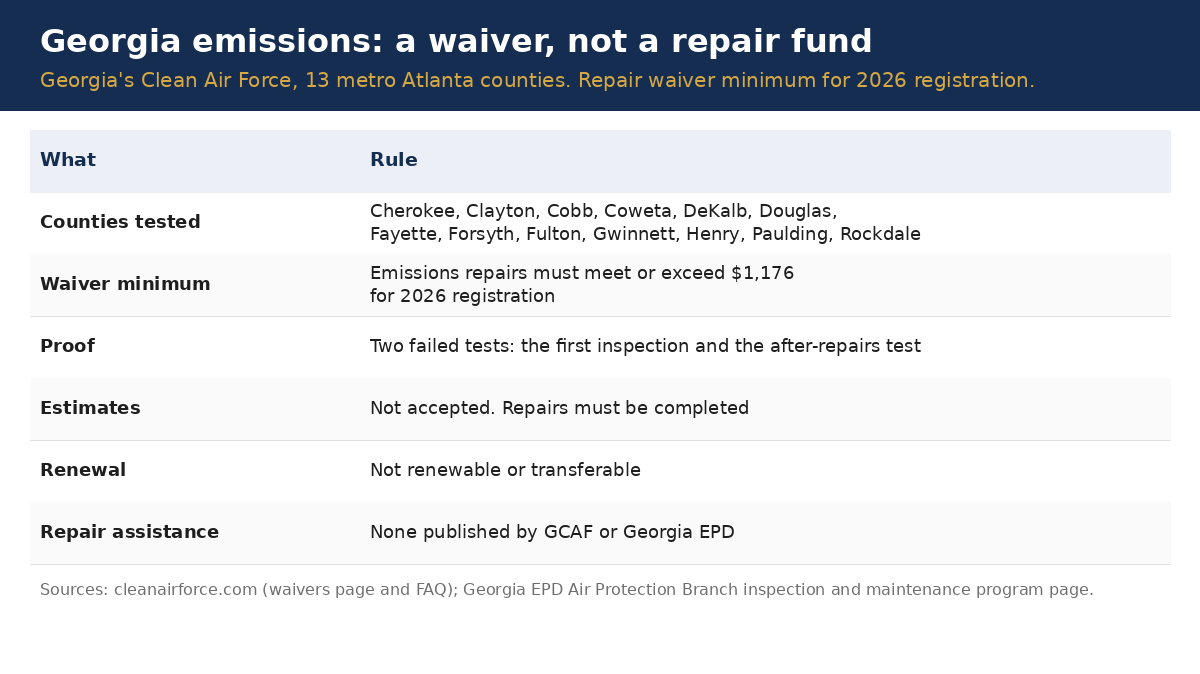
Georgia tests emissions only in 13 metro Atlanta counties: Cherokee, Clayton, Cobb, Coweta, DeKalb, Douglas, Fayette, Forsyth, Fulton, Gwinnett, Henry, Paulding and Rockdale. There is no Georgia program that pays for emissions repairs. We found none on any Georgia’s Clean Air Force or Georgia EPD page.
What exists is a repair waiver. If your car fails, you pay for emissions repairs, and it still fails, you can get a waiver for that registration year, provided that:
- “The cost of emissions-related repairs must meet or exceed the Repair Waiver minimum amount of $1,176 for 2026 registration.”
- You show “two failed emissions tests” — the first inspection and the after-repairs inspection.
- “Repairs must be completed. Estimates are not acceptable.”
- “Repair Waivers are not renewable or transferable,” so you face the problem again next year.
You apply online or at a Clean Air Force Customer Service Center; mailed applications are not accepted, and the car must be presented for a visual inspection before final approval. $1,176 is a high bar compared with New York’s $450. For an older car, it can be cheaper to replace the car than to reach the waiver.
Veterans: SSVF can pay a repair shop directly
The VA’s Supportive Services for Veteran Families program (SSVF) is run in Georgia by local nonprofit grantees. The federal rule, 38 CFR 62.33, allows them to pay for car repairs: “Payments for car repairs or maintenance on behalf of the participant may not exceed $1,200 during a 3-year period.” Payment goes to the shop, and only when the repair helps the veteran get or keep permanent housing.
SSVF is for very low-income veteran households (at or below 80% of area median income) who are homeless or at risk of homelessness. Grantee pages list “transportation” rather than car repair, so ask about it specifically. Georgia grantees on the VA’s September 2026 award list with published contact details include:
- CSRA Economic Opportunity Authority (Augusta region, a wide area reaching toward Athens and Statesboro): 706-364-6548
- Volunteers of America Southeast: Columbus (762) 207-6390, Warner Robins (478) 919-2377, SSVF@voase.org
- Project Community Connections (City of Atlanta and Fulton, DeKalb, Clayton, Henry, Rockdale, Gwinnett and Douglas counties): (404) 215-9991. Its page lists eligibility for veterans currently in shelter, transitional housing or a place not meant for habitation.
The Georgia Department of Veterans Service does not list a car repair or emergency grant program.
The claims about Georgia car repair that do not hold up
- Good News Garage serves New England and gives away donated cars; it does not repair cars for the public.
- Vehicles for Change says its program “is only available in the state of Maryland.”
- Wheels of Success requires you to “Live and work in Hillsborough, Pinellas, or Pasco counties” in Florida.
- Working Wheels is in Asheville and serves western North Carolina by referral.
- The Catholic Charities car repair program that circulates online belongs to the Diocese of Arlington, Virginia, and serves Northern Virginia only. Catholic Charities Atlanta has a car donation page, but no repair program that we could find. Catholic Charities of South Georgia mentions no car help.
- 1-800-Charity Cars gives away cars; it does not pay for repairs.
- “Metro Auto Ministry,” which some national blogs attach to Georgia, is in the Dallas–Fort Worth area of Texas. “CARS Ministry” is in Minnesota.
- The 2017 “God’s Garage” story about a Cobb County church is out of date; that ministry is the paused Matthew 25:40 program above.
Where to call when nothing above fits
Georgia’s 211 service is run by regional United Ways, including Greater Atlanta, the Coastal Empire (Savannah), CSRA (Augusta), Central Georgia (Macon), Northeast Georgia (Athens), Southwest Georgia (Albany), the Chattahoochee Valley (Columbus) and Northwest Georgia. Dial 2-1-1 from anywhere in the state and you will reach the one for your area.
- United Way of Greater Atlanta 211: dial 2-1-1 or (404) 614-1000, live agents 8 a.m. to 7 p.m. on weekdays. It covers Butts, Cherokee, Clayton, Cobb, Coweta, DeKalb, Douglas, Fayette, Fulton, Gwinnett, Henry, Paulding and Rockdale counties.
- United Way of the Coastal Empire 211: 912-651-7730, covering Bryan, Chatham, Effingham, Liberty and Long counties.
Ask for “vehicle repair assistance” by name. Ask for your local St. Vincent de Paul conference and your county’s community action agency too. We could not confirm that any Georgia community action agency funds car repairs, but they sometimes run discretionary emergency funds.
Before you pay: your rights at a Georgia repair shop
Georgia gives you fewer protections here than many states. The Attorney General’s consumer education site says plainly: “While some states have statutes regulating auto repairs, there is no statute in Georgia that requires dealers to publicly post their hourly repair rates.” We found no Georgia law that requires a written estimate.
That makes your own paperwork the protection. The same site advises: “Get a written estimate before work begins,” and says a mechanic “should not charge you for different repairs to your vehicle that are unrelated to the repairs that were discussed and agreed to by you ahead of time.” Misleading conduct can still fall under Georgia’s Fair Business Practices Act. Complaints go to the Attorney General’s Consumer Protection Division at 404-651-8600, or (800) 869-1123 toll-free inside Georgia outside metro Atlanta, at consumer.georgia.gov.
Written paperwork matters for assistance too. WorkSource Atlanta Regional pays only against original invoices, and the emissions waiver counts only completed, documented repairs.
How to actually get a yes in Georgia
- If you are job hunting or want training in the Atlanta Regional counties, enroll with WorkSource first. It is the only written Georgia policy we found that pays for a car repair, and its cap is up to $2,500 across all support services.
- Call St. Vincent de Paul’s Assistance Line early in the week. Chapters run on donations and volunteers, and some help a household only once a year.
- Get a written estimate, then keep the original invoice. Programs differ on which one they need; WorkSource and the emissions waiver both need proof of completed work.
- Tie the repair to your job or your housing. WIOA pays for getting to work or training; SSVF pays only when the repair helps keep a veteran housed.
- In an emissions county, compare the repair to $1,176. If you cannot reach the waiver and the car keeps failing, replacement may be the realistic answer.
Frequently asked questions
Are there charities that help with car repairs in Georgia?
A few, and fewer than national lists suggest. St. Vincent de Paul Georgia lists car repair assistance statewide through its local chapters; call its Assistance Line at 678-892-6163. God’s Grace Auto Repair in Augusta does low-cost and sometimes free repairs. The Matthew 25:40 Car Care Ministry in Cobb County is paused while it builds a new facility. The strongest written program is not a charity: the Atlanta Regional workforce board can pay for car repairs for people enrolled in its WIOA services.
Does Georgia TANF pay for car repairs?
Not as a named benefit. Georgia’s TANF State Plan for fiscal year 2026 lists transportation reimbursement, MARTA cards and contracted transportation as support services, and the word repair does not appear in it. Families whose case closes because they start work can receive Work Support Payments of $200 a month for 12 months, which is cash they can put toward a repair, but that is not a repair program.
Can WorkSource Georgia pay for my car repair?
It can in the Atlanta Regional area. The Atlanta Regional Workforce Development Board’s support-service policy, effective April 2023, allows WIOA funds to pay for repair and replacement of essential parts and safety equipment when there is no other reasonable way to get to training or work. The car must be titled, registered and insured in your name, the repair must be verified by a mechanic, it pays against original invoices only, and total support services are capped at $2,500. You must be enrolled in WIOA Adult or Dislocated Worker services.
Is there help with emissions repairs in Georgia?
No program pays for them. Georgia tests emissions in 13 metro Atlanta counties, and Georgia’s Clean Air Force offers a repair waiver instead: if completed emissions-related repairs cost at least $1,176 for 2026 registration and the car still fails, you can apply for a waiver. You need two failed tests, estimates are not accepted, and the waiver is not renewable or transferable.
Which Georgia counties require an emissions test?
Thirteen metro Atlanta counties: Cherokee, Clayton, Cobb, Coweta, DeKalb, Douglas, Fayette, Forsyth, Fulton, Gwinnett, Henry, Paulding and Rockdale. Cars registered elsewhere in Georgia are not emissions tested, so the repair waiver does not apply to them.
Does Catholic Charities help with car repairs in Georgia?
Not that we could find. Catholic Charities Atlanta has a car donation page but no repair program, and Catholic Charities of South Georgia mentions no car help. The Catholic Charities repair program that circulates online belongs to the Diocese of Arlington, Virginia, and serves Northern Virginia only. The Catholic organization that does list car repair help in Georgia is St. Vincent de Paul Georgia.
Can veterans get help with car repairs in Georgia?
Sometimes, through Supportive Services for Veteran Families. Federal rules let SSVF grantees pay up to $1,200 for car repairs or maintenance over three years, paid directly to the shop, when the repair helps a very low-income veteran household get or keep housing. Georgia grantees include CSRA Economic Opportunity Authority, Volunteers of America Southeast and Project Community Connections. The Georgia Department of Veterans Service does not list a car repair grant.
Does Georgia require repair shops to give a written estimate?
We found no Georgia law requiring one. The Attorney General’s consumer education site says Georgia has no statute requiring shops to post hourly repair rates, and advises you to get a written estimate before work begins. A mechanic should not charge for repairs unrelated to what you agreed to. Complaints go to the Attorney General’s Consumer Protection Division at 404-651-8600.
Related help
If this page did not solve it, these will help next.
- Charities that help with car repairs — the national picture
- Car repairs in Florida and car repairs in New York — neighboring and large-state guides
- Charities that help with rent in Georgia — if the car trouble is putting rent at risk
- Charities that help with car insurance — St. Vincent de Paul Georgia lists insurance help too
- Charities that help with car payments — if the loan is the problem
- Free cars for low-income families — when the repair costs more than the car is worth
- Charities that help with transportation — rides, passes and gas cards
How we verified this guide. Every program, dollar figure, eligibility rule, phone number and open-or-paused status on this page was read off the administering agency’s or organization’s own website, or current local reporting, on 22 September 2026. Workforce material comes from the Atlanta Regional Workforce Development Board’s support-service policy effective 5 April 2023 and the Atlanta Regional Commission. TANF material comes from Georgia’s TANF State Plan for fiscal year 2026. Emissions material comes from Georgia’s Clean Air Force and Georgia EPD. Veterans material comes from 38 CFR 62.33, the VA’s SSVF award list of September 2026 and each grantee’s own page. Consumer material comes from the Georgia Attorney General’s consumer education site. Nonprofit material comes from each organization’s site, WRDW and the Marietta Daily Journal. Where we could not verify something — DFCS policy manual text, other workforce boards’ caps and two directory-listed nonprofits — this page says so. Written and verified by Alex Shabani for Nonprofit Point.