Giving Tuesday 2026: How to Give on December 1 Without Getting It Wrong

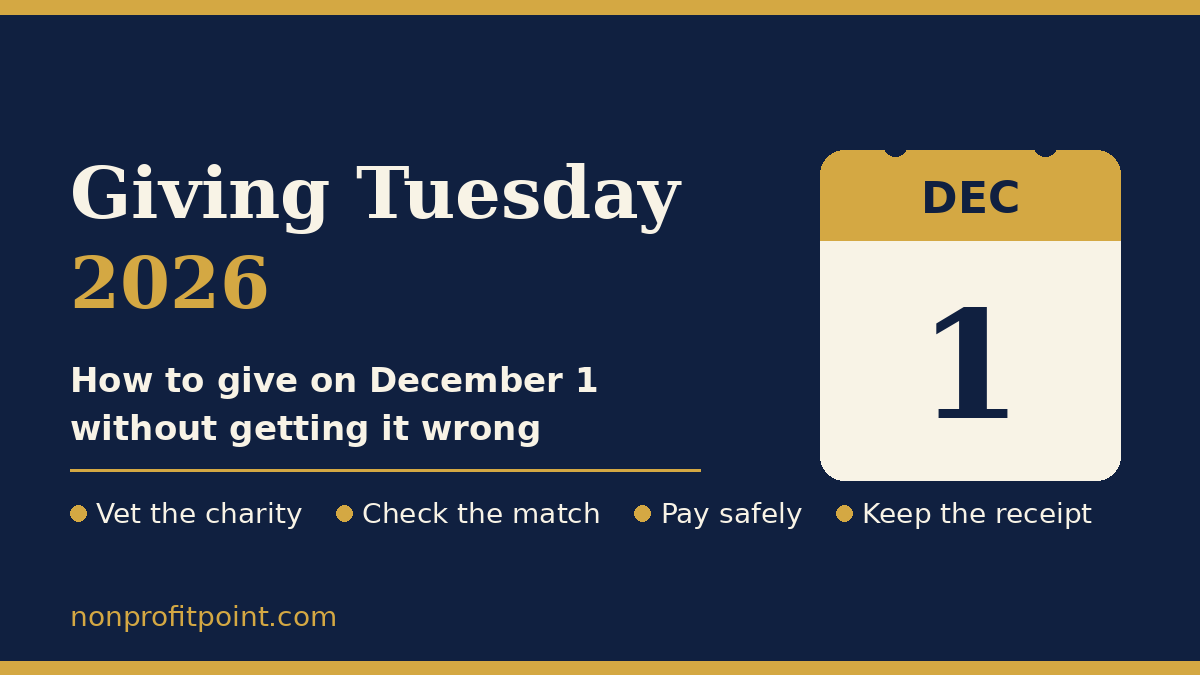
GivingTuesday 2026 falls on Tuesday, December 1, the Tuesday after U.S. Thanksgiving. It is the biggest single day of charitable giving in the American calendar, and that is exactly why it is worth slowing down for. On GivingTuesday 2025 (December 2, 2025), the GivingTuesday Data Commons estimates that 38.1 million Americans took part and $4.0 billion was donated in the US alone, up 13% on 2024. Every inbox, feed and text thread fills up with asks that day, and most of them are honest. Some are not, and plenty of honest ones are worded to make you give faster than you would otherwise.
This guide is for the person giving, not the organisation asking. It covers what to settle before December 1, how to check a charity in about ten minutes, what a “double your donation” match actually means, which way of paying sends the most money to the cause, the scam patterns that cluster around giving days, and the paperwork to keep afterwards. If you run a nonprofit and want campaign ideas instead, see our Giving Tuesday strategies for nonprofits.
What GivingTuesday is, and what the numbers say
GivingTuesday was created in 2012 at the 92nd Street Y and its Belfer Center for Innovation and Social Impact in New York City. It is now an independent nonprofit and a global movement, with national campaigns in more than 110 countries. It is not a single charity and it does not collect your money: when you give “on GivingTuesday”, your gift goes to whatever organisation, platform or person you choose. The GivingTuesday organisation itself runs the brand, the data work and the network of local campaigns.
The figures it publishes for the US are useful because they show that money is only part of the day:
- $4.0 billion donated in the US on GivingTuesday 2025, up 13% from $3.6 billion in 2024.
- 38.1 million participants, up 6%.
- 19.1 million people gave money, 13.5 million gave goods, and 11.1 million volunteered, which was the fastest-growing kind of participation, up 20%.
- 20.9 million people spoke out about a cause, up 26%.
- $22.5 billion donated on GivingTuesday in total since 2012.
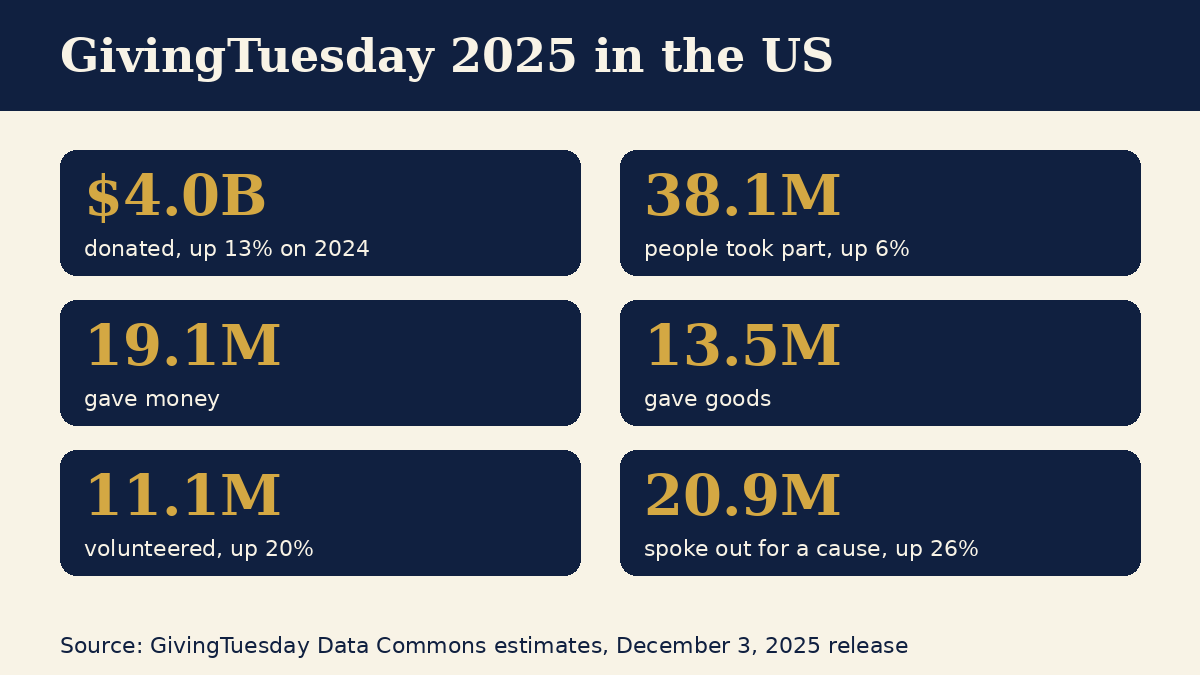
Those estimates come from the GivingTuesday Data Commons, which pools data from payment processors, donor-advised fund sponsors and donation platforms. Read them as a measure of how much attention the day gets, not as proof that any one ask you receive is worth answering.
Settle three things before December 1
Most giving-day regret comes from deciding on the day, under a countdown timer. Three decisions are easier to make in November.
1. How much, in total
Pick a single number for the whole day and stick to it. A giving day is designed around urgency: matches that “expire at midnight”, progress bars, a fresh email every few hours. A fixed total means a well-written ask moves money between causes you already care about instead of moving your budget. If a December gift is part of a larger year-end plan, our year-end charitable giving deadlines for 2026 lay out every cut-off by gift type, from checks and cards to stock, IRA distributions and donor-advised funds.
2. Which one to three causes
Name the causes first, then find the organisations. “Food insecurity in my county” or “veterans who need housing” gives you a filter. A charity you have never heard of that emails you on December 1 is easier to judge against that filter than against a moving story. If you need a starting list, our best charities to donate to in 2026 is vetted and rated, and the worst charities guide covers the patterns to avoid.
3. Money, goods or time
The 2025 numbers show that more than 11 million Americans volunteered on GivingTuesday and 13.5 million gave goods. If your budget is tight this year, a few hours at a food bank, a coat drive or a shift answering phones for a local nonprofit counts in exactly the same way. Call ahead: many organisations need volunteers to register and sometimes pass a background check before they can take a shift, so the week before is the time to sign up, not the morning of.
How to check a charity in about ten minutes
You do not need a forensic accountant. Four checks catch nearly every fake charity and most badly run ones. Our longer guide to researching a charity before donating goes deeper on financial efficiency and governance; this is the version that fits in a coffee break.
Step 1: Confirm it is a real tax-exempt organisation
Search the organisation by name or EIN in the IRS Tax Exempt Organization Search. If donations are tax deductible, the organisation will be listed there. The FTC points donors to this same tool. If the name does not appear, check for a slightly different spelling, then check whether the “charity” is actually a political action committee: PAC donations are not tax deductible and the FTC warns that some calls that sound like charities are PACs.
Step 2: Check your state charity regulator
Most states require charities and the paid fundraisers who solicit for them to register with a state regulator, usually the attorney general or secretary of state. The FTC recommends checking that both the charity and anyone calling on its behalf are registered in your state. Search “[your state] charity registration lookup” and use the result on the .gov site.
Step 3: Look at how the money is spent
The BBB Wise Giving Alliance publishes 20 Standards for Charity Accountability at Give.org. Two of them are the quickest reality check: a charity should spend at least 65% of its total expenses on program activities, and no more than 35% of related contributions on fundraising. Those are not perfect measures. Newer organisations and small ones often have higher costs for good reasons, and Give.org says it considers evidence that spending is reasonable. But a charity that spends most of what it raises on raising more deserves a hard look. Give.org, Charity Navigator and CharityWatch all publish ratings you can check in under a minute.
Step 4: Search the name with “complaint” and “scam”
The FTC suggests searching the charity’s name plus words like “complaint”, “review”, “rating”, “fraud” or “scam”. If there is a pattern of bad reviews or an enforcement action, pick another organisation working on the same cause. There is almost always one.
What a “double your donation” match actually means
Matching gifts are the engine of most GivingTuesday campaigns, and they are real. A donor, foundation or company pledges to match gifts up to a set amount. They are also the most misunderstood part of the day, so ask four questions before a match changes your mind.
- Who is the matcher, and is the pool capped? A legitimate match names the person, foundation or company putting up the money and the total they have pledged. “All gifts doubled” with no named matcher and no cap is a marketing line, not a match.
- Has the cap already been reached? Many campaigns keep promoting the match after it has been met. Your gift still counts, but it is no longer doubled. A good campaign page shows how much of the pool is left.
- Would the money be given anyway? Some matching pledges are paid in full whether or not the target is reached. That is not a deception, but it means your gift is unlocking less new money than the banner suggests. If it matters to you, ask the charity.
- Does your employer match too? An employer match is separate from a campaign match and often the bigger lever. Most programmes require you to submit the gift through the company portal, usually within a deadline. Our guide to employer matching gift programs covers how they work and the deadline trap that costs donors the match.
Where your money goes depends on how you give
The same $50 can arrive at a charity as $50, as $50 minus fees, or not at all, depending on the route.
The charity’s own donation page
Typing the charity’s web address yourself and giving on its own site is the most direct route, and it is what the FTC recommends when an ask arrives by text, email or a social post. It keeps you away from look-alike links and usually means the smallest share is lost to third parties. Many donation forms offer a box to “cover the processing fee”; ticking it means the charity receives the full amount you meant to give.
Donation platforms and social fundraisers
Fundraisers on social media and giving platforms can be completely legitimate, but the FTC tells donors to check who is asking and where the money goes, and not to assume a link is accurate just because a friend shared it. Before you give, look for the name of the actual charity receiving the funds, then read the platform’s own fee page and how long it takes to pass the money on. Fee terms differ from platform to platform and change, so check the current page rather than relying on what was true last year.
Crowdfunding for a person
Crowdfunding a family after a house fire or a neighbour with medical bills is generous and often the fastest help available. Go in knowing what the FTC spells out: the money goes to the campaign organiser, who controls how it is spent and may not be closely connected to the person it is for. Donations to individuals are not tax deductible, even if the organiser plans to pass the funds to a charity. The safest crowdfunding gifts are to campaigns organised by people you know and trust. For anything else, the FTC suggests a reverse image search of the campaign photos: stolen photos and copied stories are a common sign of a fake campaign.
The scams that cluster around giving days
Scammers like GivingTuesday for the same reason charities do: people expect to be asked. These are the warning signs the FTC lists, and they apply with extra force on December 1.
- Payment by gift card, wire transfer, cryptocurrency or a payment app only. If that is the only way a “charity” will take your gift, the FTC says it is likely a scam. Real charities take credit cards and checks.
- Pressure to give right now. A real match deadline is fine. A caller who will not let you hang up and look them up is not.
- “Thank you for your pledge” when you never made one. A fake invoice or a call claiming you pledged last year is a known trick.
- A name that is almost a famous charity. Write the name down and search it before you give.
- Sentimental claims with no details. Lots of emotion about families or veterans, but nothing about what the money will actually pay for. Our guide to the worst veteran charities shows how often this pattern turns up in that cause in particular.
- A guaranteed prize for donating. That is always a scam.
- An unexpected text with a donation link. Do not tap it. Go to the charity’s website yourself.
- A trusted local caller ID. Caller ID is easy to fake, so a local area code or an organisation’s name on the screen proves nothing.
Fundraising calls are allowed even if your number is on the National Do Not Call Registry, but the FTC rules still apply to them. Callers cannot ring before 8 a.m. or after 9 p.m., must say which charity they represent, cannot lie about how much of your gift reaches its programmes, and cannot use a robocall unless you are already a member or past donor. If you want the calls to stop, ask to be put on that charity’s own do-not-call list.
If something feels wrong after you have given, report it at ReportFraud.ftc.gov and to your state charity regulator, and call your card issuer.
How to pay, and the recurring-gift trap
The FTC calls a credit card or a check the safest way to donate. A card also gives you a dispute route if something goes wrong. When you give online, make sure the payment page address starts with “https”, but remember that encryption only means the connection is private. It does not mean the site is honest.
One thing catches careful donors every year: the monthly box. Many donation forms default to a recurring gift, or make the monthly option the visually dominant one. Monthly giving is the best thing you can do for a charity you trust, but only if you meant to choose it. Check the confirmation page and email, and check your card statement in the weeks after December 1. The FTC specifically tells donors to make sure they were only charged what they agreed and were not signed up for a recurring donation by accident.
After you give: the paperwork worth keeping
Keep a record of every gift: the confirmation email, a bank or card statement line, or a receipt. The FTC recommends it, and the IRS requires it if you plan to claim a deduction.
For any single contribution of $250 or more, the IRS requires a written acknowledgment from the charity. It must show the organisation’s name, the amount of a cash gift (or a description, not a value, of a non-cash gift), and a statement of whether you received any goods or services in return, with a good-faith estimate of their value if you did. Most charities send this automatically by email. If one does not arrive by January, ask for it.
Whether a GivingTuesday gift lowers your tax bill depends on your own return, and the rules changed for 2026. This guide does not give tax advice. Our charitable tax deduction 2026 guide explains what changed and how a deduction is claimed, and a tax professional can tell you how it applies to you.
If you need help this season rather than want to give
GivingTuesday sits in the middle of the hardest weeks of the year for a lot of households. If you are reading this because you are on the other side of the ask, the same charities raising money on December 1 are often the ones handing out help. Start with our list of charities that give money to individuals, or call 211 to reach your local United Way referral line.
Frequently asked questions
When is Giving Tuesday 2026?
Giving Tuesday 2026 is Tuesday, December 1, 2026. It always falls on the Tuesday after U.S. Thanksgiving, which in 2026 is Thursday, November 26.
How much did Americans give on Giving Tuesday 2025?
The GivingTuesday Data Commons estimates that Americans donated $4.0 billion on GivingTuesday 2025, a 13% increase on 2024, with 38.1 million people taking part.
How can I tell if a Giving Tuesday charity is real?
Look it up in the IRS Tax Exempt Organization Search, check that it is registered with your state charity regulator, check its rating with Give.org, Charity Navigator or CharityWatch, and search its name with the words complaint and scam. Give on its own website rather than through a link in a text or email.
Are Giving Tuesday matching gifts real?
Most are. A genuine match names who is putting up the money and how much has been pledged. Check whether the cap has already been reached, because campaigns often keep promoting a match after it is used up. An employer matching gift is separate and has to be submitted through your employer.
Is a GoFundMe donation tax deductible?
Not if it goes to an individual. The FTC notes that donations to individuals are not tax deductible, even when the organiser plans to pass the money to a charity. Gifts made through a platform to a registered charity can be deductible; check that the charity is listed in the IRS Tax Exempt Organization Search.
What receipt do I need for a donation of 250 dollars or more?
The IRS requires a written acknowledgment from the charity for any single contribution of $250 or more. It must show the charity name, the amount of a cash gift or a description of a non-cash gift, and whether you received any goods or services in return.
Sources: GivingTuesday, “Generosity Sweeps the Globe” 2025 results release (December 3, 2025) and About page; Federal Trade Commission, “Before Giving to a Charity” and “Donating Through Crowdfunding and Fundraising Platforms”; IRS, “Charitable contributions: Written acknowledgments” and Publication 1771; BBB Wise Giving Alliance, Standards for Charity Accountability. Figures checked October 23, 2026.