Charities That Help With Car Insurance: Real Programs and How to Save (2026)

If your car insurance bill has outgrown your budget, you are not alone — premiums have climbed hard over the past two years, and for a household living paycheck to paycheck, one renewal notice can mean choosing between coverage and groceries. The honest truth is that very few charities will cut a check straight to your auto insurer. But that does not mean you are out of options. There are three real paths to affordable coverage when money is tight: state-run low-cost auto insurance programs built specifically for low-income drivers, emergency-assistance charities that can cover a bill during a genuine crisis, and a short list of proven moves that lower your premium without dropping the coverage you legally need.
This guide walks through all three, with real eligibility rules, real dollar amounts, and the exact phone numbers and websites to start with — every figure verified in July 2026. Where a program has closed or an organization can no longer be trusted, we say so plainly. Driving uninsured is the one thing you should never do to save money, and by the end of this guide you will have several better ways to stay legal and covered.
The Honest Truth About “Car Insurance Charities”
Search the web for “charities that help with car insurance” and you will find long lists that quietly recycle the same handful of names — many of them general emergency-aid groups that can help with a bill but do not run a dedicated car-insurance program. We think that is misleading, so here is the framework we actually recommend, in the order you should work it:
- Check whether your state runs a low-cost auto insurance program first. A few states subsidize coverage for low-income drivers. If you live in one, this is almost always your cheapest legal option — often a fraction of what a private policy costs.
- If you are in a short-term crisis, ask an emergency-assistance charity to help with a single bill. Groups like St. Vincent de Paul, the Salvation Army, and Catholic Charities can sometimes pay a premium to keep you covered while you get back on your feet.
- Lower the premium itself. The biggest permanent savings usually come from changing how you buy insurance — pay-per-mile policies, low-mileage discounts, non-owner coverage, and simply comparing quotes.
Work all three in that order and most drivers find a combination that fits their budget. Let’s go program by program.
1. State Low-Cost Auto Insurance Programs
A small number of states run insurance programs designed for people with low incomes. These are the closest thing to “free or cheap car insurance” that exists, and because they are state-sponsored they are legitimate and safe. The catch is that only a few states offer them, and each has strict eligibility rules.
California — Low Cost Automobile Insurance Program (CLCA)
California’s CLCA is the largest and best-known program of its kind. It provides liability coverage to income-eligible drivers at rates far below the private market.
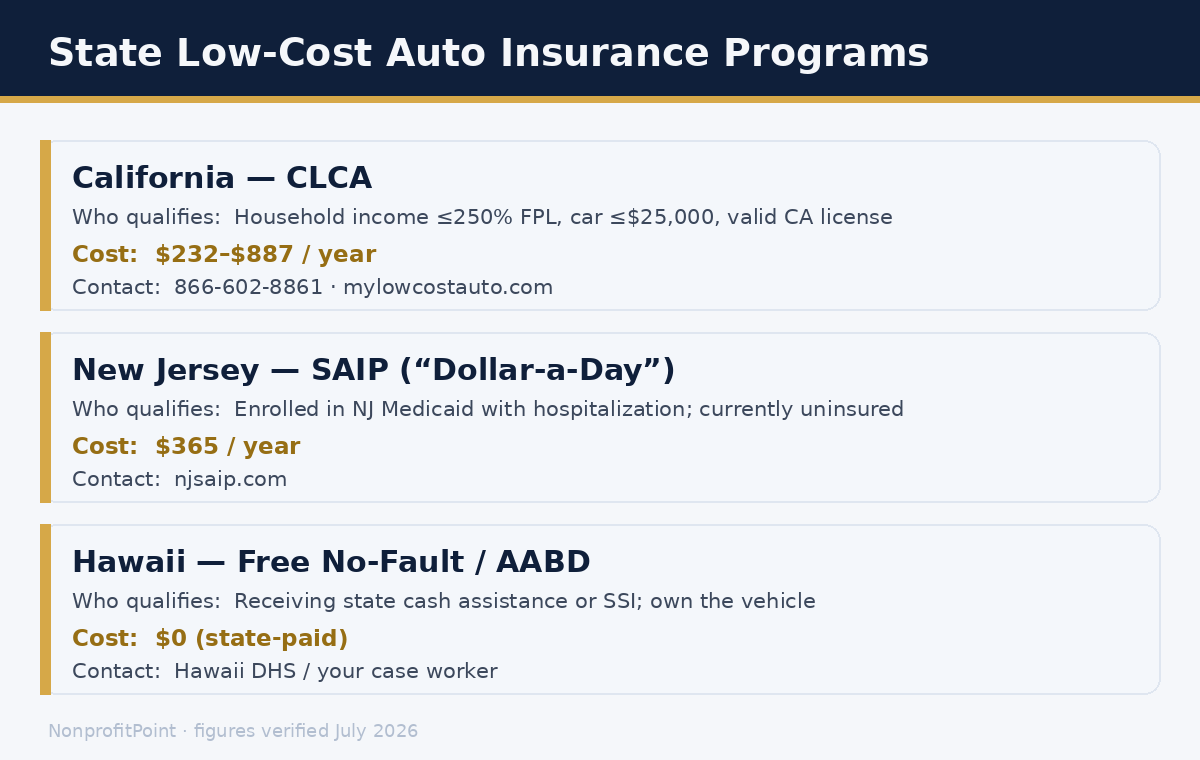
- Who qualifies: A valid California driver’s license, a vehicle worth $25,000 or less, at least one year of driving experience, a household income at or below 250% of the federal poverty level (roughly $96,700 for a five-person household under the 2026 guidelines), and a clean-enough record — no more than one at-fault property-damage accident or one point-carrying violation in the past three years, no at-fault accident involving injury, and no DUI in the past seven years.
- What it costs: Annual premiums in 2026 run from about $232 in low-cost rural counties to roughly $887 in Los Angeles County. Single male drivers aged 19–24 pay a 25% surcharge on top of the base rate.
- What it covers: Liability up to $30,000 per person and $60,000 per accident for bodily injury, plus $15,000 for property damage. Optional uninsured-motorist and medical-payments add-ons run an extra $37–$107 per year.
- How to apply: Apply online at mylowcostauto.com or call 866-602-8861. The program is administered under the California Department of Insurance.
New Jersey — Special Automobile Insurance Policy (SAIP, the “Dollar-a-Day” policy)
New Jersey’s SAIP is unusual: it is a bare-bones policy costing about $365 a year — roughly a dollar a day — aimed at residents who are enrolled in Medicaid.
- Who qualifies: You must be enrolled in a New Jersey Medicaid program that includes hospitalization benefits, and you must currently be uninsured. Not every Medicaid enrollee qualifies — the plan has to include hospitalization.
- What it covers: This is not a full policy. SAIP provides emergency and catastrophic medical care after an accident — treatment of serious brain and spinal-cord injuries up to $250,000, plus a $10,000 death benefit. It does not include liability, collision, or comprehensive coverage, and it does not meet New Jersey’s standard minimum-insurance requirement.
- How to apply: Apply through njsaip.com. You must show a current Medicaid ID card at each renewal; if you lose Medicaid eligibility mid-term your coverage is not cut short, but you will not be able to renew.
Because SAIP is so limited, treat it as a stopgap for the medically vulnerable rather than a substitute for a standard policy if you can afford one.
Hawaii — Free No-Fault Coverage for Public-Assistance Recipients
Hawaii offers free no-fault auto insurance to residents who receive state financial assistance or Supplemental Security Income (SSI).
- Who qualifies: You must be receiving state financial-assistance payments or SSI, hold a valid Hawaii driver’s license, and own the vehicle being insured (with an exception for people who are permanently disabled and cannot drive). Coverage is for one vehicle; a second vehicle may qualify if it is used to get to work or medical appointments.
- What it covers: No-fault personal injury protection up to Hawaii’s state minimum — medical and hospital costs from accidents up to $10,000 per person. Additional coverage is available through the state’s Aid to the Aged, Blind, and Disabled (AABD) program for residents who have a qualifying long-term disability or care for someone who receives AABD benefits.
- How to apply: Ask your Hawaii Department of Human Services case worker, or inquire when you apply for or renew your public-assistance benefits.
What About Every Other State?
Most states do not run an income-based auto insurance program. What many states do have is an “insurer of last resort” — for example, the Maryland Automobile Insurance Fund (MAIF) or the Massachusetts Automobile Insurance Plan (MAIP). These exist to guarantee coverage for drivers who have been turned down by private insurers, but they are important to understand correctly: they are high-risk pools, and their rates are typically higher than the standard market, not lower. They are a safety net for the un-insurable, not a discount program. If you live outside California, New Jersey, or Hawaii, your best savings will come from the emergency-aid and premium-cutting strategies below.
2. Emergency-Assistance Charities That Can Help Pay a Bill
If you are facing a one-time crisis — a lost paycheck, a medical emergency, an unexpected deductible — several established charities provide emergency financial assistance that can, in the right circumstances, cover an insurance premium. None of these run a dedicated car-insurance fund, and help is never guaranteed, but they are real, reputable, and worth a call.
Start With 211
Before anything else, dial 2-1-1 or visit 211.org. Operated through United Way, 211 is a free, confidential referral service that works a little like 911: your call is routed to the local organizations best able to help with your specific need in your area. A 211 specialist can point you to the emergency-assistance funds, community-action agencies, and faith-based charities near you that are currently accepting requests — which changes month to month as funding cycles open and close.
Society of St. Vincent de Paul
Among the major emergency-aid charities, St. Vincent de Paul is the one most explicitly willing to help with transportation and insurance costs. Local conferences — the volunteer groups attached to Catholic parishes — provide direct financial help to struggling households, and their assistance can include medical bills, insurance, and transportation costs alongside the more common rent and utility help. Because it is run conference by conference, availability and rules are local. Find your nearest conference through svdpusa.org or by asking a local parish.
The Salvation Army
The Salvation Army provides a wide range of emergency services, including help with bills, through its local corps community centers. What is available depends heavily on the location and on current funding, so contact the corps nearest you to ask what emergency financial assistance is open. They are a reliable first stop for households in acute need.
Catholic Charities
Many Catholic Charities agencies run an Emergency Assistance program built specifically to help people through a one-time financial crisis. Assistance and eligibility vary by diocese, and you do not need to be Catholic to receive help. Search for your regional Catholic Charities agency to find out what emergency aid it currently offers.
Community Action Agencies
Every state is covered by a network of local Community Action Agencies funded through the federal Community Services Block Grant. They administer emergency-assistance and self-sufficiency programs, and in some areas they can help with transportation-related costs that keep you employed. A 211 specialist can connect you to the agency serving your county.
A Word of Caution: Vet Before You Trust
Because this is money-in-crisis territory, be careful who you rely on. As an example of why that matters: Modest Needs, a self-sufficiency-grant charity that appeared for years on lists like this one, is not included in our recommendations. Its founder pleaded guilty in 2025 to embezzling more than $2.5 million in donor funds and fabricating a board of directors, and was scheduled for federal sentencing that December. We mention it not to pile on, but to make a point we take seriously: verify that any organization asking for your personal and financial details is legitimate — check its current standing on Charity Navigator or the IRS Tax Exempt Organization Search — before you hand anything over. The established charities above and your local 211 network are safe places to start.
3. Cut Your Premium Yourself — Moves That Work on a Tight Budget
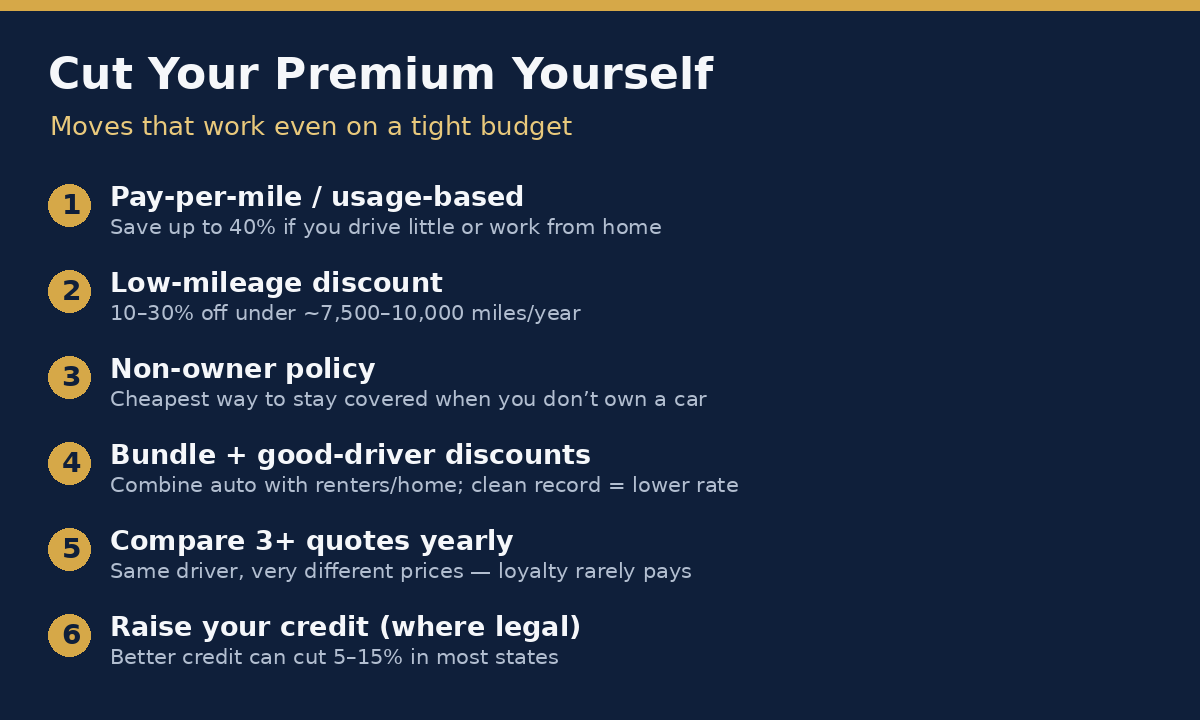
The most durable savings do not come from a one-time grant — they come from changing how you buy coverage. These strategies are especially powerful for low-income and low-mileage drivers, and several can be stacked together.
Pay-Per-Mile and Usage-Based Insurance
If you drive very little — you work from home, take transit most days, or keep a car mainly for errands and appointments — a pay-per-mile policy can be transformative. You pay a low fixed base rate each month plus a few cents per mile driven, tracked by a phone app or a small plug-in device. For genuine low-mileage drivers, pay-per-mile can save more than 40% versus a traditional policy. Broader usage-based insurance programs track your driving habits and reward safe, low-mileage driving with discounts.
Low-Mileage Discounts
Even on a standard policy, driving under roughly 7,500–10,000 miles a year (thresholds vary by insurer) often qualifies you for a low-mileage discount worth 10% to 30% — commonly $100 to $400 a year. If your annual mileage has dropped, tell your insurer; they will not always adjust it on their own.
Non-Owner Car Insurance
If you do not own a car but occasionally borrow or rent one — or you need to keep continuous coverage on record to avoid a rate penalty later — a non-owner policy is usually the cheapest way to stay insured. It provides liability coverage when you drive a vehicle you do not own.
Bundle, Ask for Every Discount, and Keep a Clean Record
Bundling auto insurance with renters or homeowners insurance from the same company is one of the most common ways to cut the bill. On top of that, ask specifically about good-driver discounts (a clean record), good-student discounts for young drivers, and any low-income, defensive-driving, or paperless/autopay discounts your insurer offers. Insurers rarely volunteer these — you have to ask.
Compare at Least Three Quotes Every Year
The single most reliable way to lower your premium is to shop it. The same driver can be quoted wildly different prices by different insurers, and loyalty is rarely rewarded — renewal rates often creep up year over year. Get at least three quotes at each renewal, and do not be afraid to switch.
Improve Your Credit Where It Is Allowed
In most states, insurers use a credit-based insurance score when setting your rate, and better credit can reduce a premium by 5% to 15% — roughly $50 to $200 a year. (A few states, including California, Hawaii, Massachusetts, and Michigan, restrict or ban this practice, which can actually benefit lower-income drivers.) Paying down balances and correcting credit-report errors can pay off at renewal.
Adjust Coverage Carefully — Never Just Drop It
If your car is older and paid off, dropping collision and comprehensive coverage may make sense once the annual cost approaches what the car is worth. Raising your deductible lowers the premium too — but only do this if you could actually cover that deductible in an emergency. What you should never do is drop below your state’s minimum required liability coverage or let your insurance lapse entirely.
What If You Truly Cannot Afford Any Insurance Right Now?
Driving uninsured is a trap that gets more expensive, not less. Getting caught can mean fines, license suspension, and a mandatory SR-22 filing that raises your rates for years — and if you cause an accident with no coverage, you can be sued personally for every dollar of damage. If you have hit a wall, work this sequence:
- Call 211 today and explain exactly what you need — help with one month’s premium to stay covered. Framing it as a specific, one-time bill makes it easier for a charity to say yes.
- Ask your insurer about a payment plan or a lower-cost minimum-liability policy before you cancel anything. Many will restructure a policy rather than lose you.
- Switch to a non-owner or pay-per-mile policy if your situation fits — it may be affordable even when a standard policy is not.
- If you genuinely cannot drive right now, park the car and cancel coverage deliberately rather than letting it lapse, and lean on transportation charities and transit until you are back on your feet. Our guide to charities that help with transportation covers free-ride programs, gas cards, and vehicle-donation programs.
How to Apply: A Simple Step-by-Step
- Gather your documents. Most programs and charities will want photo ID, proof of income (a recent pay stub, tax return, or benefits letter), proof of residency, and your vehicle registration. Emergency-aid charities often want to see the actual bill or renewal notice.
- Check your state program first. If you are in California, New Jersey, or Hawaii, apply to CLCA, SAIP, or the state no-fault program — these are your cheapest legal options.
- Call 211 to map local help. Ask specifically which nearby charities are currently funding emergency bill assistance.
- Contact charities directly and be specific. Explain that you need help with one insurance premium to stay legally covered, and how much. A clear, one-time ask is far more likely to be funded than a vague request.
- Lower the bill in parallel. While you wait on aid, get three fresh quotes and ask your current insurer about pay-per-mile, low-mileage, and every available discount.
Frequently Asked Questions
Are there really charities that pay your car insurance directly?
Very few charities run a dedicated program that pays an auto-insurance premium. What is realistic is that general emergency-assistance charities — St. Vincent de Paul, the Salvation Army, Catholic Charities, and local community-action agencies — can sometimes cover a single premium during a documented crisis. Start by dialing 211 to find which organizations near you are currently funding that kind of help.
Which states offer low-income car insurance programs?
As of 2026, California (the Low Cost Automobile Insurance Program), New Jersey (the Special Automobile Insurance Policy, or “dollar-a-day” plan for Medicaid recipients), and Hawaii (free no-fault coverage for people receiving state assistance or SSI) run programs specifically for low-income drivers. Most other states do not, though they may have an “insurer of last resort” for high-risk drivers — which is not the same as a discount program.
What is the cheapest way to legally stay insured on a low income?
If you qualify for a state program like California’s CLCA, that is almost always cheapest. Otherwise, the biggest savings usually come from a pay-per-mile or usage-based policy if you drive little, a non-owner policy if you do not own a car, and comparing at least three quotes at every renewal. Stacking a low-mileage discount with bundling and a clean-record discount can cut a standard premium substantially.
How much can a low-mileage or pay-per-mile policy save me?
Low-mileage discounts typically save 10% to 30% — often $100 to $400 a year — for drivers under roughly 7,500 to 10,000 miles annually. For genuine low-mileage drivers, a pay-per-mile policy can save more than 40% compared with a traditional policy, because you pay a low base rate plus only a few cents per mile driven.
Is it worth calling 211 for help with car insurance?
Yes. 211 is a free, confidential United Way service that routes you to the local charities and government programs best able to help with your specific need. Because emergency-assistance funding opens and closes throughout the year, a 211 specialist will know which organizations near you are currently accepting requests — information that is hard to find on your own.
What happens if I just drive without insurance?
It is the most expensive “savings” you can choose. Penalties include fines, license and registration suspension, and a required SR-22 filing that raises your rates for years. If you cause a crash while uninsured, you can be sued personally for all the damages. Every option in this guide — state programs, emergency aid, a non-owner or pay-per-mile policy, or a payment plan — is a safer path than going uninsured.
About This Guide
This guide was researched and written by the NonprofitPoint editorial team, which specializes in financial-assistance and charity-vetting resources for people navigating a tight budget. Every program, eligibility rule, and dollar figure above was verified against primary sources — the California Department of Insurance, NJSAIP, state human-services programs, and each charity’s own materials — in July 2026. Insurance rules and program funding change; confirm the current details with the program or charity before you apply, and verify any organization’s standing on Charity Navigator or the IRS Tax Exempt Organization Search before sharing personal information. NonprofitPoint does not sell insurance and earns no commission from the programs listed here.
Texas readers: insurance is only half the problem if the car will not pass. See charities that help with car repairs in Texas for the four nonprofits that actually do the work, the workforce route that pays the shop directly, and the emissions counties where Bexar joins on 1 November 2026.
Florida and New York readers: Florida statute allows six months of liability insurance as a work support, through CareerSource — see charities that help with car repairs in Florida. In New York, several Wheels for Work programs pay insurance premiums as well as repairs — see charities that help with car repairs in New York.
Related Help From NonprofitPoint
Keeping a car on the road is expensive on every front. These guides cover the bills that most often pile up alongside insurance:
- Charities That Help With Car Repairs
- Charities That Help With Transportation
- Charities That Help Single Mothers
- Charities That Help With Bills
- Free Financial Assistance Organizations
- Get Help Paying For… (all financial assistance guides)