Charities That Help With Prescription Costs: 11 Programs That Pay in 2026

A single specialty prescription can cost more than a month of rent, and the gap between what a drug costs and what a household can pay is now filled almost entirely by charities, manufacturer programs and a handful of federal rules most people never hear about. The money is real. The Patient Access Network (PAN) Foundation, the HealthWell Foundation, Good Days and Patient Advocate Foundation Co-Pay Relief together move hundreds of millions of dollars a year to patients who meet their criteria. Drug manufacturers give away medication outright through their own foundations. Medicare caps what any Part D enrollee can be charged in a year.
The hard part is not that help does not exist. It is that the programs are sorted by a rule almost nobody explains up front, and applying to the wrong category is the fastest way to get denied. This guide walks the programs in the order you should actually try them, with the 2026 income limits, what each one pays for, what it refuses to pay for, and the phone number that reaches a human.
Start here: your insurance status decides which door you knock on
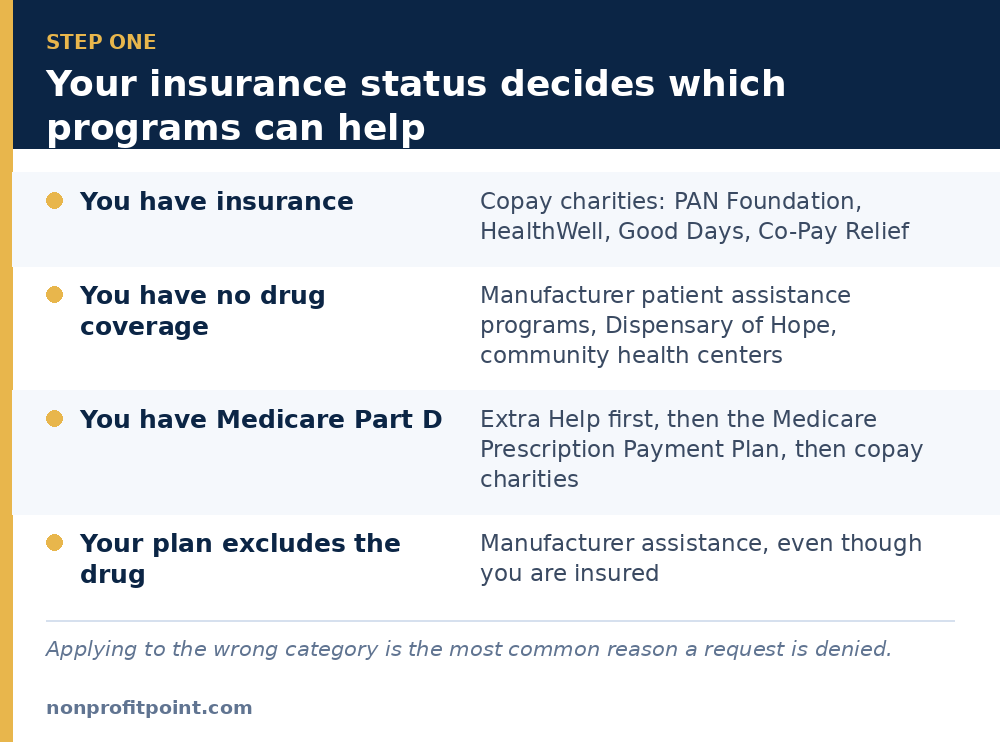
Prescription assistance splits into two families that do not overlap, and the dividing line is whether you have drug coverage.
Copay assistance charities require you to be insured. PAN, HealthWell, Good Days and Co-Pay Relief exist to pay the portion your insurer leaves you: the copay, the coinsurance, the deductible. If you have no coverage there is no copay for them to cover, and they will turn you down. Good Days states the requirement as having insurance with “at least 50% coverage.” Co-Pay Relief requires “active insurance coverage that includes coverage for pharmaceutical products.” PAN requires the health insurance its disease fund specifies.
Manufacturer patient assistance programs generally require that you are not covered. Lilly Cares, for example, excludes anyone on Medicaid, on full Extra Help, or receiving VA benefits. These programs ship the medicine free rather than subsidising a copay.
There is a third case that trips people up constantly: you are insured, but your plan does not cover the drug at all. A copay charity cannot help, because there is no covered cost to offset, and most of them say so explicitly. PAN excludes “medications not covered by insurance.” That is exactly when a manufacturer program becomes the right route even though you hold an insurance card. Lilly Cares says that if insurance does not cover a Group 4 medication, the patient may still qualify.
Work out which family you belong to before you fill in a single form. It will save you weeks.
The 2026 income table every one of these programs runs on
Nearly every program on this page expresses its income limit as a multiple of the federal poverty guideline rather than a dollar figure, which makes the published thresholds useless until you do the arithmetic. Here is the arithmetic.
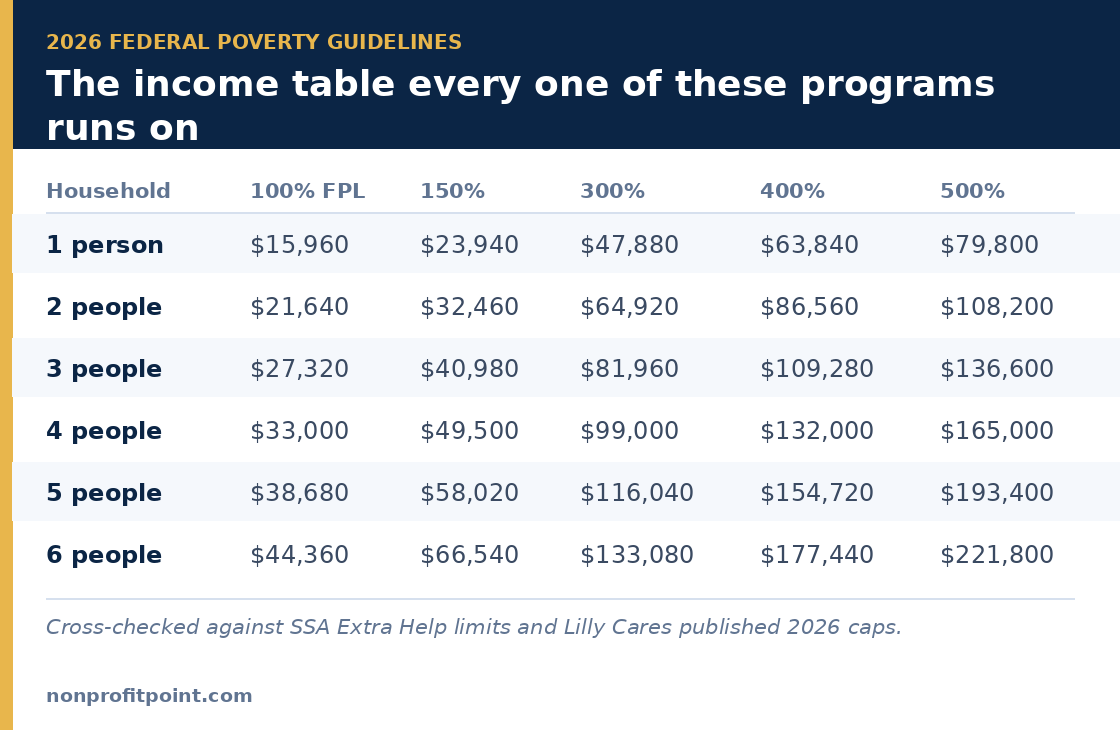
These figures are derived from the 2026 federal poverty guidelines and cross-checked two ways. The Social Security Administration publishes the Extra Help income limit for one person as $23,940, which is exactly 150% of a one-person guideline of $15,960. Lilly Cares publishes its own 2026 caps at 300%, 400% and 500% for household sizes one through six, and every one of them divides cleanly against the same per-person increment of $5,680. Two independent sources, one consistent table.
Three practical notes. Alaska and Hawaii run on higher guidelines, so if you live there the numbers above are too low and you should ask the program directly. Several charities apply a cost-of-living adjustment on top, which is why HealthWell describes “somewhat higher limits in high-cost cities” and Co-Pay Relief says it weighs a Cost of Living Index alongside household size. And household income for these purposes usually means everyone in the home, including income that is not taxable, not just the patient.
Copay assistance charities, if you have insurance
PAN Foundation
PAN runs disease-specific funds rather than one general pot. Each fund has its own medication formulary, its own income threshold and its own insurance requirement, and each opens and closes with funding, so a fund that was closed last month may be open today.
Who qualifies: you must be at or below the federal poverty level specified by the disease fund, hold the insurance that fund requires covering your medication, and live and receive treatment in the United States or its territories. Notably, US citizenship is not required.
What it covers: out-of-pocket costs for medications on the fund formulary, where the drug is FDA-approved, listed in official compendia, or in published clinical guidelines. It does not cover office visits, medical services, or medications your insurance does not cover.
Grant length: 12 months, with additional funding possible depending on availability.
How to apply, and a warning about the phone number. PAN has been folding its programs into a unified platform called TotalAssist. As of this writing its copay grants page carries two different toll-free numbers at once: a banner announcing the TotalAssist transition and a call centre reachable on 866-512-3861, with a new portal at TotalAssist.org, and further down the same page an older line, 1-866-316-7263, listed as Monday to Friday, 9 a.m. to 5:30 p.m. ET. The page does not say which is current, and the older section conflicts with the closure notice in the banner. Start with TotalAssist.org and the 866-512-3861 line; keep the older number as a fallback. Treat any third-party listicle quoting only the old number as out of date.
HealthWell Foundation
HealthWell is the most generous of the four on income and the most specific about its rules, which is useful because its rules are where applications die.
Who qualifies: household income, including non-taxable portions, between 400% and 500% of the federal poverty level depending on the fund, with higher limits in some high-cost cities. You must be insured and that insurance must cover treatment for the disease. People with no insurance can qualify only for premium assistance, and only if they are eligible for a plan that would pay for their treatment. The medication must be dispensed in the United States.
What it covers: coinsurance, copayments, deductibles and health insurance premiums for certain medications and therapies. Two rules catch people out. Premium and copayment assistance cannot both come from the same fund. And there is a floor: no assistance is available if your responsibility is under $5.00 after manufacturer assistance.
The deadlines that close grants. Grants run a rolling 12-month cycle. Your first complete reimbursement request is due within 120 days of the approval letter, and at least every 120 days after that. After 120 days of inactivity the grant closes, even if money remains in it. Re-enrolment opens no more than three to four weeks before your grant end date, and prior approval does not guarantee renewal, because funds are first come, first served.
One detail worth money: a HealthWell grant start date can be backdated up to 30 days before the application date, so costs you have already paid in the past month may be recoverable. Ask.
How to apply: online, with instant approval, or by phone on (800) 675-8416, Monday to Friday, 9:00 a.m. to 5:00 p.m. ET. Staff can take the whole application over the phone.
Good Days
Who qualifies: household income at or below 500% of the federal poverty level for your household size, valid medical insurance with at least 50% coverage, a valid Social Security number, treatment received in the United States, and a prescription for an FDA-approved medication. Medicare-only funds require some form of Medicare coverage, though a supplemental commercial plan alongside Medicare is allowed.
How your income is checked: Good Days verifies income electronically through a third-party credit monitoring service. This is a soft inquiry and does not affect your credit score. If documents are needed, you send one approved proof-of-income document covering the household.
What it covers and when: copay assistance running for the full calendar year or until the fund is exhausted. Critically, Good Days can only begin assistance after funding has been awarded and does not reimburse medication bought before that point. Do not buy first and claim later.
The renewal rule nobody publishes: if you were approved between January and September you must reapply for the following year. If you were approved between October and December you are automatically enrolled for the next year. That single sentence decides whether your coverage lapses on 1 January.
How to apply: at mygooddays.org/apply, or call the Patient Care Navigators on (877) 968-7233. Re-enrolment runs through mygooddays.org/patients/re-enroll or (877) 593-8409.
Patient Advocate Foundation Co-Pay Relief
Who qualifies: household income at or below 300% or 400% of the federal poverty guideline depending on the fund, weighed against a Cost of Living Index and household size. You need active insurance that includes pharmaceutical coverage, or coverage within the past six months.
What it covers: copayments, coinsurance and deductibles for prescribed medications. The program is not drug-specific, but your insurer must cover the medication. Premiums are covered only under the COVID-19, Cystic Fibrosis, and HIV, AIDS and Prevention funds. Medical services such as lab work, office visits, surgeries, radiation therapy and scans are not covered.
Award period: 12 months, forfeited after more than 120 consecutive days with no processed claims. There is a six-month look-back from the approval date for outstanding bills, which is the longest retroactive window of the four charities here.
Waitlists: there are none. Funds are first come, first served while funding lasts, and approval is determined immediately on completing an application.
How to apply: through your provider, your pharmacy, the patient portal, or by phone on 866-512-3861, option 1, to reach an approval specialist. The portals are open 24 hours. The general Patient Advocate Foundation line is 1-800-532-5274.
Manufacturer patient assistance, if you are uninsured or your plan excludes the drug
Every large drug maker runs a foundation or program that gives its own medicines away to people who cannot pay. These are the least publicised and often the most valuable option, because they supply the drug itself rather than a subsidy against it.
Lilly Cares Foundation, as a worked example
Lilly Cares is worth walking through in detail because its structure is typical of the category and its published numbers let you see exactly how the poverty-level tiers work in practice.
Who qualifies: permanent US residents aged 18 and over, including Puerto Rico and the US Virgin Islands, with a prescription for a medication the program offers. You are excluded if you have Medicaid, full Extra Help, or VA benefits, or if your plan requires you to apply to Lilly Cares as a condition of coverage.
The income tiers. Lilly sorts its medicines into groups, each with its own cap against the 2026 federal poverty guidelines:
- Group 1, at or below 300% FPL (one person: $47,880) covers Cialis, Emgality, Forteo, Reyvow and Trulicity.
- Group 2, at or below 400% FPL (one person: $63,840) covers Basaglar, Humalog, Humulin and Lyumjev.
- Groups 3 and 4, at or below 500% FPL (one person: $79,800) cover Ebglyss, Olumiant, Omvoh and Taltz, plus Cyramza, Erbitux, Inluriyo, Jaypirca, Kisunla, Retevmo and Verzenio.
The insurance rules differ by group. Uninsured patients and those on Medicare Part D are eligible for Groups 1 and 2, and for Groups 3 and 4 except for infused medications under Part D. Medicare Part B patients qualify for Groups 3 and 4 only if they hold no supplemental or secondary insurance.
What you get: the medication free, including shipping, in one to four month supplies sent to your home or your prescriber. Automatic refills are available for most medicines. One catch: needles are not always included, and if your medication does not come with them you buy them yourself at a pharmacy.
How long it lasts: approval generally runs 12 months, or to the end of the calendar year for Medicare Part D patients. You can reapply up to 60 days before your end date.
How to apply: the patient completes and signs the patient section and the prescriber completes the prescriber section and submits a prescription, so this is not an application you can finish alone. Submit online, by fax to 1-844-431-6650, or by post to PO Box 501847, San Diego, CA 92150. The helpline is 1-800-545-6962, Monday to Friday, 8 a.m. to 6 p.m. ET.
Finding the program for your specific drug
There is no single registry of manufacturer programs, which is where NeedyMeds earns its place. It is a nonprofit that maintains a database of more than 30,000 programs, searchable by brand or generic medication name. If your medicine appears on neither its brand nor its generic list, NeedyMeds takes that as meaning no patient assistance program currently exists for it, which is a faster answer than ringing six manufacturers.
NeedyMeds also issues a free drug discount card, usable at over 65,000 pharmacies, advertised at up to 80% off prescriptions, over-the-counter medicines, medical supplies and even pet prescriptions. It carries no age, financial or residency restriction, never expires, and does not track personal information. The same card gets 40% off list price on durable medical equipment such as diabetic supplies, braces, mobility devices and compression stockings. Everything NeedyMeds offers is free to use. Its helpline is 800-503-6897.
Medicare: three things worth more than any charity
Extra Help, the Part D Low-Income Subsidy
If you are on Medicare, this is the first thing to apply for and it is worth more than any copay grant. The Social Security Administration estimates Extra Help is worth about $5,700 per year.
2026 limits, from SSA publication 05-10508 dated August 2026:
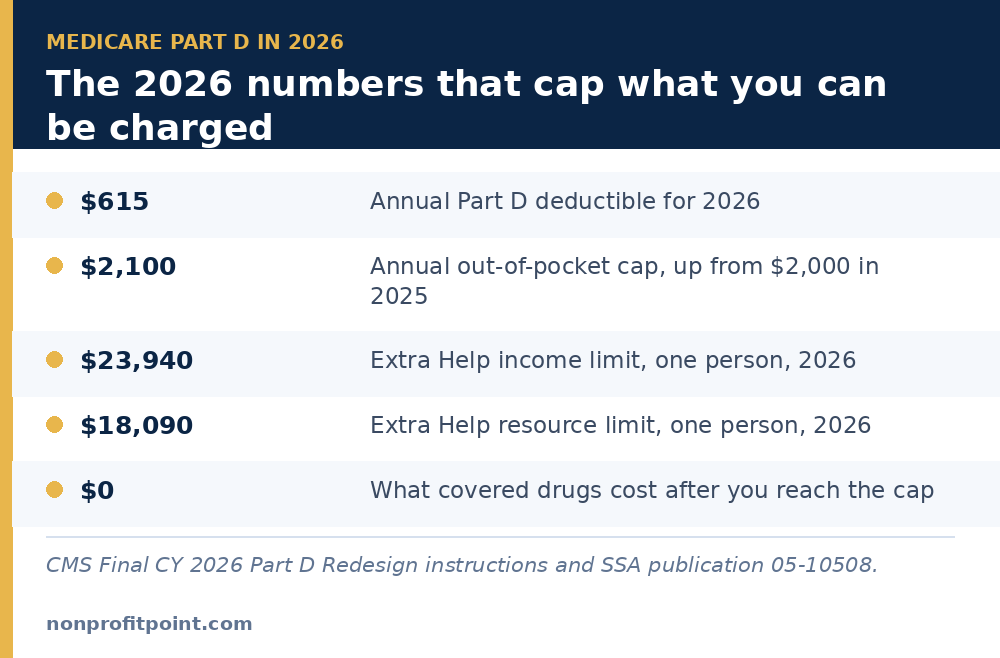
- Income: $23,940 a year for an individual, $32,460 for a married couple living together.
- Resources: $18,090 for an individual, $36,100 for a married couple living together.
You may still qualify above those income limits if you support family members living with you, have earnings from work, or live in Alaska or Hawaii.
What counts as a resource: bank accounts, stocks, bonds including US Savings Bonds, mutual funds, IRAs, cash, and real estate other than your primary home. What does not count: your home, your vehicles, personal possessions, jewellery and furnishings, life insurance policies, burial funds and the interest on them, and property essential to self-support. Retroactive Social Security or SSI payments, housing assistance, certain tax refunds including earned income and child tax credit advances, crime victim compensation and relocation assistance are excluded for nine months.
What it pays: your Part D premium, your annual deductible and your prescription copayments. It also removes the Part D late enrollment penalty while you receive it, even if you had already accrued one. In 2025 the copayments under Extra Help ran up to $4.90 for a generic and $12.15 for a brand-name drug; CMS indexes these annually, so confirm the current figure when you apply. People with full Medicaid who are also in the Qualified Medicare Beneficiary program pay no more than $4.90 per covered drug.
How to apply: Form SSA-1020, online at ssa.gov/medicare/part-d-extra-help, by phone on 1-800-772-1213 (TTY 1-800-325-0778), or at a local Social Security office. Extra Help is not available in Puerto Rico, the US Virgin Islands, Guam, the Northern Mariana Islands or American Samoa.
If you qualify for Extra Help or Medicaid but are not yet enrolled in a drug plan, LI NET provides temporary Part D coverage. Call 1-800-783-1307, 8 a.m. to 7 p.m. ET.
The 2026 cap that applies whether or not you qualify for anything
Under the CMS Final CY 2026 Part D Redesign Program Instructions, the annual out-of-pocket cap is $2,100, up from $2,000 in 2025, and the annual deductible is $615. You pay the full cost of covered drugs until the deductible is met, and once your out-of-pocket spending reaches $2,100 your covered drugs cost $0 for the rest of the year. There is no coverage gap to fall into any more and no application to file. If your total drug bill for the year is heading past $2,100, that is your ceiling.
The Medicare Prescription Payment Plan
This does not reduce what you owe. It spreads your out-of-pocket drug costs across monthly payments over the plan year instead of hitting you with the full amount at the pharmacy counter in January and February, which is when most people with expensive drugs run out of money. It costs nothing to join and there is no interest. If your problem is cash flow rather than total cost, ask your Part D plan to enrol you.
If you have no coverage at all right now
Dispensary of Hope
Dispensary of Hope is a charitable medication distributor that supplies free medicine to uninsured patients through partner hospitals, clinics and pharmacies. Because it operates through local partners, the exact income threshold is set regionally, and the figures below are from one participating health system to show the shape of the test.
Who qualifies at that site: US residents, documented or undocumented, who have no prescription insurance and are not covered by Medicare Part D, Medicaid, TRICARE, VA or Affordable Care Act coverage. If you hold a medical plan with no prescription benefit, you can still qualify. Published household income limits there ran $40,700 for one person, $54,930 for two, $69,090 for three and $83,250 for four.
What you pay: nothing. Medications for chronic illness are dispensed at no out-of-pocket cost from a formulary that is updated weekly.
How it works: you complete the program form, your physician sends the prescription to the participating pharmacy marked as a Dispensary of Hope prescription, and you re-enrol every six months. Ask your hospital or clinic whether it participates, because there is no national sign-up.
Community health centers and 340B pricing
Federally qualified health centers are required to charge on a sliding scale based on income, and many run in-house pharmacies priced through the federal 340B drug pricing program, which can put a prescription well below what you would pay with a discount card. If you are uninsured and need ongoing medication rather than a one-off fill, establishing care at one is usually worth more over a year than any single grant. Find your nearest center through the Health Resources and Services Administration locator.
Discount cards: useful, and carrying a trap
Free discount cards are worth having. The NeedyMeds card costs nothing and is accepted at over 65,000 pharmacies. Government-linked and commercial options including TrumpRx.gov list cash prices and special offers. For a generic drug paid out of pocket, a card frequently beats your insurance copay.
Here is the trap, and it comes straight from Medicare. Discount cards do not count toward your Medicare deductible or your out-of-pocket maximum. Every dollar you spend through a card is a dollar that does not move you toward the $615 deductible or the $2,100 cap. If you are on an expensive drug and will plainly cross $2,100 this year, paying with a card in January can mean paying more across the whole year, not less, because you arrive at the cap later or never. Use cards for cheap generics and for drugs your plan does not cover. Run everything you expect to be expensive through your insurance so the spending counts.
You also cannot stack a discount card with insurance on the same fill. It is one or the other, decided at the counter.
Five mistakes that get prescription assistance applications denied
- Applying to a copay charity with no insurance. This is the single most common wasted application. PAN, HealthWell, Good Days and Co-Pay Relief all require coverage. With no coverage, go to the manufacturer.
- Buying the medication first and claiming afterwards. Good Days states plainly that it cannot reimburse medication bought before funding is awarded. HealthWell will backdate only 30 days; Co-Pay Relief looks back six months. Apply before you pay wherever you can.
- Letting a live grant go quiet. HealthWell closes a grant after 120 days of inactivity. Co-Pay Relief forfeits an award after 120 consecutive days with no processed claims. Money you were awarded can disappear simply because no claim was filed.
- Assuming renewal is automatic. With Good Days it depends entirely on which month you were approved in. With HealthWell, prior approval explicitly does not guarantee renewal because funds are first come, first served.
- Reporting the patient income instead of the household income. These programs assess the household, including income that is not taxable. Understating it gets you denied at verification; overstating it by including excluded income gets you denied for nothing.
One more worth knowing: a closed disease fund is not a permanent no. PAN, HealthWell and Good Days all open and close funds as money arrives, and HealthWell adds new funds through the year. If the fund you need is closed, set a reminder and check monthly.
Where to go next
Prescription costs rarely arrive alone. If the drug bill is part of a larger medical debt problem, start with our guide to charities that help with medical bills, which covers hospital charity care and bill negotiation. Patients in cancer treatment should also read our breakdown of scalp cooling costs and insurance coverage and the programs listed in charities that help with wigs. Older adults juggling drug costs against utilities and rent will find more in charities that help seniors with bills, and families facing fertility treatment costs should see IVF grants. If you are on the giving side of this rather than the receiving side, our guide to the charitable tax deduction in 2026 explains what changed this year.
Frequently asked questions
What charities help pay for prescription costs in 2026?
Four national copay charities help insured patients: the PAN Foundation, the HealthWell Foundation, Good Days and Patient Advocate Foundation Co-Pay Relief. They pay the copay, coinsurance or deductible your insurer leaves you. If you have no drug coverage, the right route is a manufacturer patient assistance program such as Lilly Cares, a charitable distributor such as Dispensary of Hope, or a community health center using 340B pricing. NeedyMeds maintains a free database of more than 30,000 programs searchable by medication name.
Can I get help with prescription costs if I have no insurance?
Yes, but not from the copay charities, which all require active coverage. Uninsured patients should apply directly to the drug manufacturer. Lilly Cares, for example, ships medication free to qualifying patients in one to four month supplies. Dispensary of Hope supplies free medication to uninsured patients through partner hospitals and clinics, including to undocumented residents at participating sites. Federally qualified health centers charge on an income-based sliding scale and often dispense through the federal 340B program.
What is the income limit for prescription assistance programs?
It is usually stated as a multiple of the federal poverty guideline rather than a dollar figure. Good Days uses 500 percent of the federal poverty level. HealthWell runs between 400 and 500 percent depending on the fund. Co-Pay Relief uses 300 or 400 percent weighed against a cost of living index. PAN sets the threshold separately for each disease fund. For 2026 the one-person guideline is 15,960 dollars, so 300 percent is 47,880 dollars, 400 percent is 63,840 dollars and 500 percent is 79,800 dollars.
How much is the Medicare Part D out-of-pocket cap in 2026?
The annual out-of-pocket cap for Medicare Part D in 2026 is 2,100 dollars, up from 2,000 dollars in 2025, and the annual deductible is 615 dollars. Once your out-of-pocket spending reaches the cap, covered drugs cost nothing for the rest of the calendar year. There is no application. These figures come from the CMS Final CY 2026 Part D Redesign Program Instructions.
What are the Extra Help income limits for 2026?
For 2026 the annual income limit is 23,940 dollars for an individual and 32,460 dollars for a married couple living together. The resource limit is 18,090 dollars for an individual and 36,100 dollars for a married couple. Your home, vehicles, personal possessions, life insurance and burial funds do not count as resources. You may still qualify above the income limits if you support family members living with you, have earnings from work, or live in Alaska or Hawaii.
Do drug discount cards count toward my Medicare deductible?
No. Medicare states that discount cards, including TrumpRx and similar offers, do not count toward your Part D deductible or your annual out-of-pocket maximum. Spending through a card does not move you toward the 615 dollar deductible or the 2,100 dollar cap. Use cards for inexpensive generics and for drugs your plan does not cover, and run expensive medications through your insurance so the spending counts toward the cap.
How long does a copay assistance grant last?
Most run 12 months. PAN grants last 12 months with further funding possible. HealthWell runs a rolling 12-month cycle. Co-Pay Relief awards last 12 months. Good Days assistance runs for the calendar year or until the fund is exhausted. Grants can close early through inactivity: HealthWell closes a grant after 120 days without a reimbursement request, and Co-Pay Relief forfeits an award after 120 consecutive days with no processed claims.
Can I use a copay charity and a manufacturer program at the same time?
Sometimes, and the order matters. HealthWell applies manufacturer assistance first and provides nothing if your remaining responsibility is under 5 dollars. Manufacturer programs such as Lilly Cares exclude people on Medicaid, full Extra Help or VA benefits, so a federal benefit can disqualify you from the manufacturer route even while it helps you elsewhere. Tell each program what else you have applied for, because misreporting it is grounds for denial.
Why was my prescription assistance application denied?
The most common reason is applying to the wrong category, usually asking a copay charity for help without insurance. Other frequent causes are buying the medication before funding was awarded, which Good Days will not reimburse, reporting patient income instead of total household income including non-taxable amounts, applying when the disease fund has closed for lack of money, or holding coverage that disqualifies you from a manufacturer program. A closed fund is not permanent, so check again monthly.
How do I find a patient assistance program for my specific drug?
Search the NeedyMeds database, which covers more than 30,000 programs and is searchable by brand or generic name. If your medication appears on neither the brand nor the generic list, NeedyMeds takes that to mean no patient assistance program currently exists for it. You can also call the NeedyMeds helpline on 800-503-6897, or contact the manufacturer directly, since every major drug maker runs its own foundation or program.