Charities That Help With Car Repairs in Illinois (2026): The $900 Rule Nobody Mentions

Illinois is two transport systems wearing one state’s name. Inside the CTA and Metra footprint, a dead car is a bad month. Outside it — in Vermilion County, in Jo Daviess, in the long agricultural middle where the nearest employer is eighteen miles away and there is no bus at all — a dead car is the end of a job, and often the end of the housing that the job was paying for. That is why “charities that help with car repairs in Illinois” is searched so hard, and why the results are so bad.
Here is the honest shape of it. The single biggest source of car-repair money in Illinois is not a charity. It is a line in the Illinois Administrative Code that pays up to $900 every twelve months toward repairs, and almost nobody who qualifies has heard of it. The second biggest source is your township — Illinois is one of the few states that still runs poor relief at township level, and roughly 1,400 of them each write their own rules. Some name car repair explicitly. Some refuse it outright. Two townships that share a border can give you opposite answers, and that is not a bug in this article, it is the actual law.
Beyond those two routes, the state is thin. We could verify exactly one nonprofit garage doing free-labour repairs anywhere in Illinois, and it is in the north-west suburbs. Everything else is county-level, employment-conditioned, or a referral line rather than a cheque.
Every programme, dollar figure, eligibility rule and phone number below was read off the administering agency’s or organization’s own page on 29 September 2026. Where a published figure is stale on its own source, this page says so instead of presenting it as current. Where we could not verify something, we say that rather than printing a number.
The short version
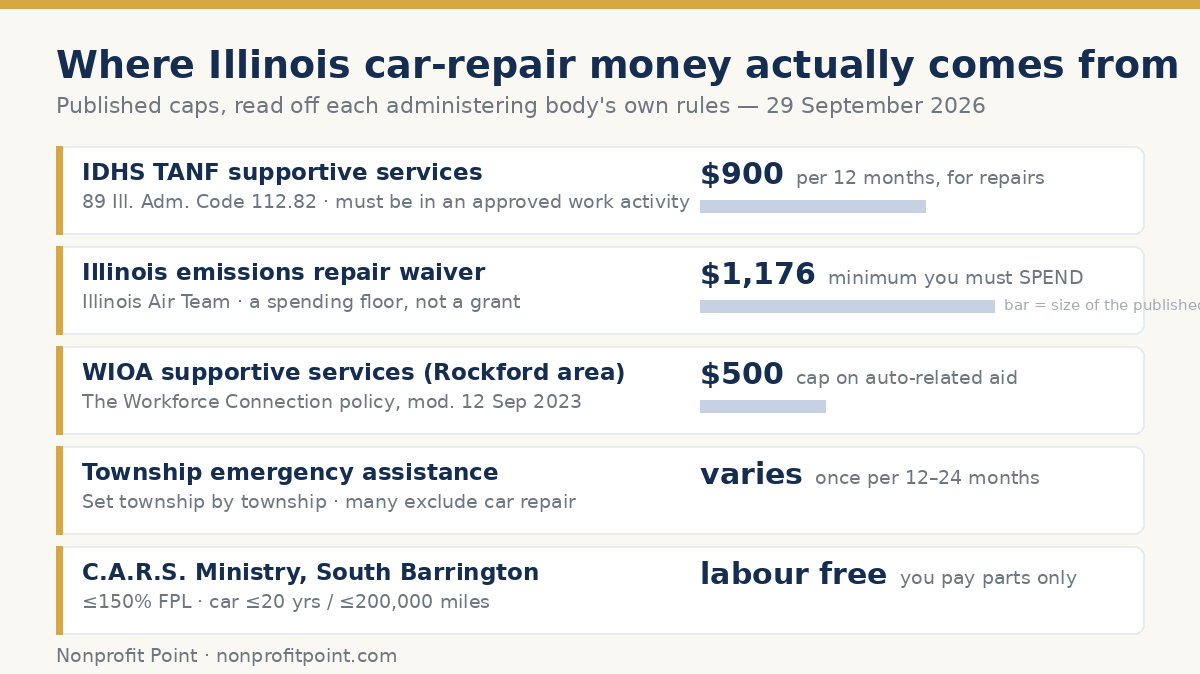
- If you receive TANF cash assistance and are in an approved work activity, ask your IDHS caseworker for a supportive-services payment for automobile repair. The rule allows up to $900 in any 12-month period. This is the strongest route in the state and it is not means-tested beyond the TANF eligibility you already have.
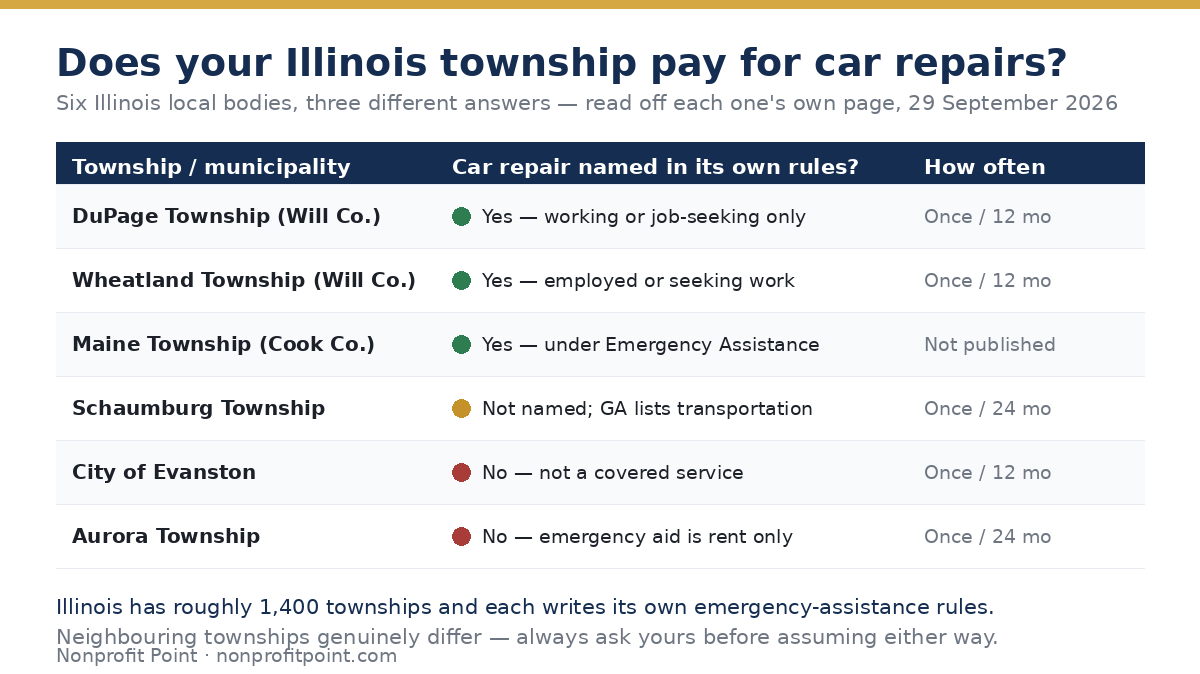
- Whatever else you do, call your township. Illinois township General Assistance and Emergency Assistance are real money, administered locally. DuPage Township, Wheatland Township and Maine Township all name car repair in their own published rules. Aurora Township and Evanston do not.
- If you can get the car to South Barrington, the C.A.R.S. Ministry at the Willow Creek Care Center repairs vehicles with free volunteer labour — you pay only for parts — for households at or below 150% of the federal poverty level.
- If you are enrolled in a WIOA workforce programme, supportive services can pay for repairs. The Rockford-area local workforce board caps auto repairs at $500.
- If you are a veteran, Illinois has something most states do not: county Veterans Assistance Commissions, funded by a dedicated property-tax levy. What they cover varies sharply by county.
- If you failed an emissions retest, the $1,176 figure you keep reading about is a floor on your own spending before you can ask for a waiver. It is not a grant and nobody pays it for you.
Start here: the $900 allowance almost nobody asks for
Illinois pays for car repairs through the Department of Human Services, under the supportive services attached to the TANF work programme. The governing rule is 89 Ill. Adm. Code § 112.82. It is not advertised, it is not called a grant, and it is not on any of the listicles that rank for this search.
The section authorises transportation payments to “permit participation in approved activities or to begin or keep employment,” and inside the automobile category it allows:
“repairs on an automobile (maximum $900 in any 12-month period)”
The five conditions, in the regulation’s own words
The rule attaches five tests, and they are worth reading closely because four of them are easy and one of them stops people:
“The client has no other available and suitable form of transportation to and from work or the approved activity. The client is unable to report to work or the approved activity unless the automobile is repaired. The client has a valid driver’s license and has provided evidence of insurability. The automobile, when repaired, will be suitable for the purpose intended and no other obvious mechanical deficiency has been observed. The title and license of the automobile must be in the name of the client (or the client’s spouse if the spouse lives in the home).”
The one that stops people is the title. If the car is registered to your mother, your boyfriend or an adult child who does not live with you, the allowance does not reach it. That is worth fixing before you apply, not after a denial.
The “no other obvious mechanical deficiency” clause is the second trap. If the transmission is also going, a caseworker can reasonably decide that fixing the alternator does not produce a car that is “suitable for the purpose intended.” Get the shop to write the estimate as a complete return-to-service job rather than a partial one, and have it say plainly that the vehicle is otherwise sound.
What else the same rule pays
The automobile category is not only repairs. The section also covers automobile insurance and licence fees, and separately from the car entirely it authorises a set of supportive services that people in the same situation usually also need: child care; required books, fees and supplies to a maximum of $300 in any 12-month period; physical examinations and medical services where a job requires them; eyeglasses and dental procedures; fees for background checks; and special clothing and tools such as uniforms and hard hats to a maximum of $600 in any 12-month period. There is also a $20 monthly job search and work activity allowance.
If you are not driving, the transportation subsection pays public transit at “the actual public transportation rate per day or the cost of a monthly pass, whichever is less.” If you are driving your own car to an approved activity, the private-vehicle rates are $30 a month for a round trip under 10 miles a day, $45 for 10 to 20 miles, and $60 for over 20 miles. Those are modest, and they are separate from the $900 repair ceiling.
How to actually ask for it
Ask the IDHS caseworker who handles your TANF case, and use the words “supportive services for automobile repair under 112.82.” Bring a written estimate from a licensed shop, your driver’s licence, proof of insurability, and the title or registration in your own name. If you are not currently in an approved work activity — employment, job search, education or training that IDHS has signed off on — you are not eligible, and the first conversation to have is about getting into one.
If you are not on TANF at all, this route is closed and your realistic first call is your township. Which brings us to the part of Illinois law that almost no other state has.
Your township: the Illinois answer nobody outside Illinois understands
Most states abolished township poor relief decades ago. Illinois did not. General Assistance is administered by township supervisors, and Illinois Legal Aid Online describes it plainly as “a program of ‘last resort’” for people who cannot access other public benefits. Crucially: “Different local townships and county governments run GA programs. Each township has its own GA program and its own rules.”
That sentence is the whole reason a national listicle cannot answer this question for you. There is no statewide township answer. There are roughly 1,400 answers.
Most townships run two things. General Assistance is a monthly grant for adults with essentially no income who do not qualify for state or federal programmes. Emergency Assistance is a one-off payment for a crisis — and it is Emergency Assistance, not GA, that is where car repair lives when a township covers it at all.
DuPage Township, Will County — names car repair outright
DuPage Township (which is in Will County, not DuPage County — a genuine source of confusion) publishes one of the clearest car-repair rules in the state. Its Emergency Assistance is available:
“once per twelve-month period for utilities, rent, and/or car repair (only for those working or seeking employment)”
Residency is strict: “All services are for those who live in DuPage Township in Will County.” The township also states the limits of the programme up front — Emergency Assistance “CANNOT be used for 1st month’s rent, security deposit or hotel stays.” Appointments are required, and the township notes that “by law, a determination must be made within 30 days of submitting and completing an application.”
General Assistance Office, 241 Canterbury Lane, Bolingbrook, IL 60440. Phone 630-759-1317. Income and asset limits apply and were last restated on the township’s page as of 1 October 2025.
Wheatland Township, Will County — same answer, published numbers
Wheatland Township’s financial-assistance page says Emergency Assistance covers life-threatening situations including eviction and utility disconnection, and adds that “assistance can be provided for car repair assistance for those employed or seeking employment.” Like DuPage Township, “Emergency Assistance can only be utilized once during a 12 month period.”
Wheatland publishes actual numbers, which is rare and useful — with a caveat. The income limits on the page are dated 1 January 2023: $2,265 for an adult only, $3,052 for two people, $3,838 for three, $4,625 for four, and $590 for each additional household member. Asset limits are $1,500 for an adult only, and $1,500 plus $1,500 per additional member for larger households.
Treat those as indicative, not current. A figure that has sat unrevised since January 2023 has almost certainly moved, and a township is not obliged to update its website before it updates its standards. Ask on the phone what today’s numbers are before you decide you are over the line. The page routes applicants to the General Assistance office at 241 Canterbury Ln., Bolingbrook, IL 60440, 630-759-1317 ext. 203.
Maine Township, Cook County — car repairs listed by name
Maine Township, covering Park Ridge, Des Plaines, Niles and Glenview, states that “Emergency Assistance may include rental assistance with a five-day notice, car repairs, funeral expenses, disaster relief, and other emergency assistance,” and that “all situations must include proof of the hardship.”
Maine Township does not publish a dollar cap or a frequency limit for Emergency Assistance, which means both are set case by case and both are worth asking about directly. Its General Assistance programme is narrower and typical of the state: you must be an adult with no minor children, live within the township, be ineligible for other financial assistance, have “little to no income and depleted assets,” and be “searching for work or pending a disability case.”
1700 Ballard Rd, Park Ridge, IL 60068. Phone (847) 297-2510 ext. 236.
Schaumburg Township — transportation yes, car repair not named
Schaumburg Township’s General Assistance provides “financial support for Schaumburg Township residents to meet basic monthly needs such as shelter, utilities, food, transportation and personal items.” Transportation is in the list; car repair is not called out. Its Emergency Assistance is described narrowly as help “through a crisis circumstance such as an eviction or utility disconnection,” and it “can be issued once in any twenty-four (24) month period” — a tighter window than the Will County townships above.
This is a genuine maybe rather than a no. If you are already a GA recipient there, the word “transportation” in the published list is the thing to ask about. 1 Illinois Boulevard, Hoffman Estates, IL 60169. Phone 847-285-4503.
City of Evanston — a clear no, stated clearly
Evanston runs its own emergency assistance rather than leaving it to a township, and it is worth including precisely because it is a negative result. The covered services are “rental payment assistance, mortgage payment assistance, condominium assessment fee assistance, utility payment assistance, food.” Car repair appears on the page only as an example of the kind of emergency that can put a household in crisis — it is not itself something the programme pays for.
The published caps are worth knowing anyway, because a household that loses a car usually falls behind on something else: utility assistance is capped at “$1,000.00 per year” and delinquent condominium assessment fees at “up to $750.00.” Income tests are “at or below 200% Poverty Guidelines for utility, rent and food assistance” and “at or below HUD 80% Median income for mortgage and condominium assessment fees.” You must live in Evanston, and assistance “can only be issued once in a 12-month period.”
2100 Ridge Avenue, Room 1600, Evanston, IL 60201. Phone (847) 448-8112, Monday to Friday 8:30 a.m. to 5:00 p.m.
Aurora Township — rent only
Aurora Township is the cleanest no in the set. Its General Assistance “provides monthly financial assistance to persons who do not have adequate income or resources to provide for their own basic needs,” and is aimed principally at adults without minor children. But its Emergency Assistance is restricted to rent: applicants must be “30 days or more behind in their rent” and have “received a 5-day notice from their landlord.” It is available once in a 24-month period and is not available to households in subsidised housing. Car repair is not mentioned anywhere.
What to do with all this if your township is not listed
Six townships is not 1,400, and yours is almost certainly not above. The pattern to take away is the question to ask, not the answer. Call your township supervisor’s office and ask this exactly: “Does your Emergency Assistance cover car repair for someone who is working or looking for work, and how often can it be used?” That single sentence gets you a yes or no in under two minutes, and it is phrased in the terms the townships that do cover it actually use.
If the answer is no, ask the second question: “Do you have a discretionary fund or a local partner that does?” Township offices refer constantly and they know the local churches and funds that a directory never captures.
C.A.R.S. Ministry: the one free-labour garage we could verify in Illinois
The Willow Creek Care Center in South Barrington runs a programme called the C.A.R.S. Ministry, and it is the only nonprofit operation in Illinois we could verify that puts a qualifying driver’s car on a lift and does the work without charging for labour. Volunteer mechanics provide the labour free; the client pays for parts.
What it will and will not touch
The ministry offers car inspections and repairs. It explicitly excludes transmissions, engines, head gaskets and body work. That exclusion list matters more than it looks: the repairs that most often kill a car for a low-income household are exactly transmissions and engines, so this is a programme for brakes, suspension, electrical, cooling and the long tail of $400 jobs — not for the $3,000 catastrophe.
Who qualifies
- Age 18 or older
- A valid Illinois driver’s licence
- Household income at 150% or below the federal poverty level
- The vehicle registered in your own name
- The vehicle not over 20 years old and not over 200,000 miles
The age-and-mileage rule is the one to check before you drive out there. A 2004 car, or a car at 214,000 miles, is outside the programme however good the rest of your case is.
How to apply
You start with an appointment with the Care Team rather than with the garage. Bring photo ID, proof of income, proof of address dated within the last 30 days, and the car’s registration. The ministry also facilitates donated-vehicle purchases and accepts car donations, which is a separate route worth asking about if the repair estimate exceeds what the car is worth.
67 Algonquin Rd., Entrance G, South Barrington, IL 60010. Phone (224) 512-2600. Monday to Thursday 7:30 a.m. to 4:30 p.m.; Friday by appointment only.
One practical caution. South Barrington is in the north-west suburbs, and the car has to get there under its own power or on a tow you pay for. For a household in Rockford, Peoria, Champaign or anywhere south of I-80, that alone can make the programme unusable. We say this plainly because several national lists present it as an Illinois-wide resource, and geographically it is not.
Workforce money: the route that pays if you are already enrolled
If you are enrolled in a programme funded under the Workforce Innovation and Opportunity Act — a training course, an adult career service, a youth programme run through an Illinois workNet centre — supportive services can pay for a repair that would otherwise stop you attending.
Local workforce boards write their own supportive-services policies, so the number depends on where you are enrolled. As a concrete example, The Workforce Connection, the local workforce board serving the Rockford region, publishes a Supportive Services policy effective 7 June 2016 and modified 12 September 2023 that sets a line item of:
“Auto Repairs … 500”
with these conditions:
“Car repairs will be provided for a participant only with proof of insurance, copy of registration and a valid driver’s license.” … “The repairs to the vehicle must make it able to provide reliable transportation.”
The vehicle must belong to, or be leased to, the enrolled individual and that has to be documented. The $500 is a cap on auto-related support during enrolment rather than a per-incident allowance, so do not spend it on a $90 job in month one if the tyres are going.
If you are not in the Rockford area, the policy will differ but the structure will not. Find your local workforce innovation area through Illinois workNet, ask your career planner for the supportive-services policy in writing, and read the auto line. The important thing is that this money exists and is routinely under-claimed — career planners are focused on tuition and credentials, and participants frequently do not know a repair is claimable at all.
Veterans: Illinois has a county structure most states do not
Illinois counties run Veterans Assistance Commissions, locally funded bodies that provide emergency financial help to veterans and their dependants. If you are a veteran in Illinois, this is a route that simply does not exist in most of the country, and it is chronically under-used.
What it covers varies by county, and the variation is real rather than cosmetic.
DuPage County: indexed under automotive repair
The Veterans Assistance Commission of DuPage County appears in the county’s own 211 directory under the category Automotive Repair and Maintenance. Its description reads:
“Temporary financial assistance for veterans and their families experiencing a financial emergency. Assistance may be paid towards housing costs, transportation expenses, utilities, and food and fuel certificates. Transportation to VA medical appointments is also available.”
Note carefully what that says and does not say. The listing is filed under automotive repair; the text itself says “transportation expenses,” which is broader and vaguer. We are not going to tell you it pays for a gearbox on the strength of a directory category. Call and ask whether a repair bill is payable under transportation expenses — that is a two-minute answer and it is the honest version of this entry.
Eligibility is DuPage County residency, veteran or dependent of a veteran, honorable discharge, and meeting the income criteria. You call first for a phone screening, then complete an application with a DD214, photo ID, household income documents, marriage licence, birth certificates for children under 18, and proof of residency.
421 North County Farm Road, 2nd Floor, Wheaton, IL 60187. Phone 630-407-5656. Monday to Friday, 8:00 a.m. to 4:00 p.m.
Madison County: a documented no on vehicles
The Madison County Veterans Assistance Commission provides interim and emergency financial assistance described as “payments towards the bare necessities of life and community supports that promote the mental and physical well-being of Veterans.” Its published category list covers utilities, food, rent and transportation tokens — and does not include vehicle or car repair.
Eligibility is Madison County residency and an honorable discharge; veterans released from Active Duty for Training in the Reserve or National Guard are excluded. Applicants must show need and cannot have income exceeding basic living expenses. No dollar caps or frequency limits are published.
157 N. Main St., Suite 115, Edwardsville, IL 62025. Phone (618) 296-4554. Email mcvac@madisoncountyil.gov. Applications can be submitted electronically or by post.
Two counties, two different answers, both official. If you are a veteran anywhere else in Illinois, find your own county’s VAC and ask the direct question rather than assuming either result generalises.
Failed the emissions retest? The $1,176 number is not a grant
This section exists because the figure circulates in Illinois car-help forums as though it were money someone gives you. It is the opposite: it is money you must prove you have already spent.
Illinois runs vehicle emissions testing in the Chicago metropolitan area and in the Metro-East counties across from St. Louis, administered by the Illinois Air Team. If a vehicle fails its retest, a repair waiver can be issued — but only after:
“a minimum expenditure of at least $1,176 in emissions-related repairs”
Three details decide most waiver applications:
- Diagnostic labour does not count. The programme states plainly that “diagnostic labor time does not count towards the minimum expenditure requirement.” If a shop charges you two hours to read the fault and one hour to fix it, only the fix counts toward the threshold.
- The repairs have to match the failure. They must be “consistent with the diagnostic trouble codes (DTCs) present at the time of the initial failure.” Unrelated work, however expensive, does not build the total. Repairs relating to tampering do not count at all.
- Receipts expire. They must be “signed and dated not more than 30 days prior to the test eligibility date.” Keep originals; photocopies of a faded thermal receipt are how people lose waivers.
Applications go in online, or by email to Waivers@IllinoisAirTeam.net, by fax to 312.327.7640, or by post to Illinois Air Team, P.O. Box 3266, Glen Ellyn, IL 60137-9998 with the original repair receipts. Check whether your vehicle is even in the programme using the Illinois Air Team eligibility tool before you spend anything — diesel and fully electric vehicles, motorcycles, and vehicles over a certain weight are outside it, and the test itself is free.
The practical sequence, if you are near the threshold: fix the emissions fault properly with a shop that itemises parts and labour separately, keep every original receipt, and apply for the waiver only once the non-diagnostic total clears $1,176. Do not spend up to the number for its own sake — if the repair fixes the car, you do not need a waiver at all.
What we could not verify in Illinois, said out loud
A directory page is only worth reading if it tells you where the holes are. These are ours, as of 29 September 2026.
- No Illinois community action agency publishes a car-repair line item we could confirm. Illinois has a network of community action agencies administering Community Services Block Grant money, and CSBG is discretionary enough that some of them do help with transportation. But we could not find a single Illinois CAA that states a car-repair programme, an amount or an eligibility rule on its own website. If a national list tells you your local CAA has a car-repair grant, treat that as a lead to phone, not a fact.
- No statewide charity does this. There is no Illinois equivalent of a single organisation you can apply to from anywhere in the state. Every route above is either a government benefit, a township, a county, or one suburban garage.
- No second free-labour garage. We looked for a downstate or central-Illinois counterpart to the C.A.R.S. Ministry and did not find one we could verify. Several programmes with similar names that surface in search results turned out to be in other states — check the address before you drive.
- Dollar caps for township Emergency Assistance are mostly unpublished. Of the townships above, only Wheatland publishes income and asset figures, and those are dated January 2023. Nobody publishes a maximum repair payment. Expect the amount to be set by whoever takes your application.
Where to call when nothing above fits
Two calls, in this order.
Your township supervisor’s office. Even where Emergency Assistance excludes car repair, township staff hold the local knowledge that no database has — which church fund is active this month, which food pantry has a transportation grant, which employer in town has helped before.
211. Dial 211 anywhere in Illinois, or text your ZIP code to 898211. 211 Illinois operates under the 211 Service Act, signed into law in 2010, with the Illinois Department of Human Services designating the lead entity. Service is delivered through six regional contact centres against a statewide directory of more than 35,000 verified resources.
One thing has changed recently and it matters for anyone who was told years ago that 211 did not cover their county. On 1 May 2026, 211 Illinois announced the completion of statewide coverage, putting all 102 counties and more than 12 million residents inside the service. If your last experience of calling 211 in Illinois was a dead line in a rural county, try again.
Ask specifically for “car repair or vehicle repair assistance,” not for “help with a car.” The second phrasing routes you to rides and bus passes. And remember what 211 is: it refers, it does not pay. Treat it as the fastest way to find a local programme, never as a source of money.
How to actually get a yes in Illinois
The households that get a repair paid for in this state almost always do the same five things.
1. Fix the title first. Both the state allowance and the workforce route require the car to be in your name, with insurance and a valid licence. If it is not, that is the first phone call, not the last.
2. Get one written estimate, itemised. Parts and labour separated, the fault described, and a line saying the vehicle is otherwise roadworthy. That single document satisfies the state rule’s “suitable for the purpose intended” test, the workforce board’s “able to provide reliable transportation” test, and a township caseworker’s instinct to check that they are not pouring money into a scrapper.
3. Say the job out loud. Every route that pays for repairs in Illinois — the IDHS allowance, DuPage Township, Wheatland Township, WIOA supportive services — is conditioned on employment or the search for it. “I need the car to keep my shift at the warehouse” is the sentence that unlocks all of them. Bring a pay stub, a schedule, or an interview confirmation.
4. Do not spend the once-a-year card early. Township Emergency Assistance is a single use per 12 or 24 months across rent, utilities and car repair. If the electricity bill is also close to shut-off, work out which crisis the township payment should absorb and which one has a different solution — LIHEAP for the heating bill, for instance, leaves the township card free for the car.
5. Stack, do not choose. Nothing here is exclusive. A TANF recipient in Maine Township who is enrolled in a workNet programme has three separate pots and can legitimately approach all three. The $900 state allowance, a township Emergency Assistance payment and a $500 workforce supportive-services payment are administered by three different bodies with three different budgets.
Frequently asked questions
Are there charities that help with car repairs in Illinois?
Fewer than national lists suggest, and the strongest routes are not charities at all. The only nonprofit in Illinois we could verify that repairs cars with free labour is the C.A.R.S. Ministry at the Willow Creek Care Center in South Barrington, where volunteer mechanics work for free and the client pays for parts. Beyond that, the real money comes from government: the Illinois Department of Human Services pays up to $900 in any 12-month period for automobile repairs under 89 Ill. Adm. Code 112.82, several township Emergency Assistance programmes name car repair directly, WIOA workforce boards fund repairs as a supportive service, and county Veterans Assistance Commissions help veterans.
Does Illinois pay for car repairs through public aid?
It does. Section 112.82 of Title 89 of the Illinois Administrative Code authorises supportive services for people in approved TANF work activities, and inside the automobile category it allows “repairs on an automobile (maximum $900 in any 12-month period).” You must be in an approved activity, have no other suitable transport, hold a valid driver’s licence, show evidence of insurability, and have the title and licence in your own name or your spouse’s if they live with you. Ask your IDHS caseworker for supportive services for automobile repair and bring a written estimate.
How much will Illinois pay toward a car repair?
The state supportive-services ceiling is $900 across any 12-month period for repairs. Separately, the automobile category also covers insurance and licence fees, and the transportation subsection pays $30, $45 or $60 a month for private-vehicle travel depending on whether the daily round trip is under 10 miles, 10 to 20 miles, or over 20 miles. Township Emergency Assistance amounts are not published; workforce boards set their own caps, with the Rockford-area board capping auto repairs at $500.
Which Illinois townships pay for car repairs?
Illinois has roughly 1,400 townships and each writes its own Emergency Assistance rules, so there is no statewide answer. Of the ones we checked on 29 September 2026: DuPage Township in Will County covers car repair once per twelve-month period for those working or seeking employment; Wheatland Township covers it on the same basis and with the same frequency; Maine Township in Cook County lists car repairs under Emergency Assistance. Schaumburg Township does not name car repair but lists transportation in its General Assistance. The City of Evanston does not cover car repair, and Aurora Township restricts Emergency Assistance to rent. Call your own township and ask whether its Emergency Assistance covers car repair for someone working or looking for work.
Is there a free car repair garage in Illinois?
One that we could verify: the C.A.R.S. Ministry at the Willow Creek Care Center, 67 Algonquin Rd., Entrance G, South Barrington, IL 60010, phone (224) 512-2600. Volunteer mechanics provide labour at no cost and the client pays for parts. It excludes transmissions, engines, head gaskets and body work. You must be 18 or older, hold a valid Illinois driver’s licence, have household income at or below 150% of the federal poverty level, have the vehicle registered in your name, and the vehicle must not be over 20 years old or over 200,000 miles. Start by booking an appointment with the Care Team and bring photo ID, proof of income, proof of address dated within 30 days, and the registration.
Can a WIOA or Illinois workNet programme pay for my car repair?
Yes, if you are enrolled. Supportive services under the Workforce Innovation and Opportunity Act can cover repairs that would otherwise stop you attending. Each local workforce board sets its own policy. The Workforce Connection, serving the Rockford region, publishes a Supportive Services policy effective 7 June 2016 and modified 12 September 2023 with a line of “Auto Repairs … 500” and requires proof of insurance, a copy of the registration and a valid driver’s licence, with the repairs making the vehicle “able to provide reliable transportation.” Ask your career planner for your own area’s written policy.
Do Illinois Veterans Assistance Commissions help with car repairs?
It depends on the county, and the difference is real. The Veterans Assistance Commission of DuPage County is listed in the county’s 211 directory under automotive repair and maintenance, and its description says assistance “may be paid towards housing costs, transportation expenses, utilities, and food and fuel certificates” — confirm by phone on 630-407-5656 whether a repair bill qualifies as a transportation expense. The Madison County Veterans Assistance Commission’s published categories cover utilities, food, rent and transportation tokens and do not include vehicle repair. Both require county residency and an honorable discharge.
What is the $1,176 figure for Illinois emissions repairs?
It is the minimum you must spend before you can apply for an emissions repair waiver, not a grant. The Illinois Air Team requires “a minimum expenditure of at least $1,176 in emissions-related repairs” after a failed retest, and states that “diagnostic labor time does not count towards the minimum expenditure requirement.” Repairs must be consistent with the diagnostic trouble codes present at the initial failure, tampering-related repairs do not count, and receipts must be signed and dated not more than 30 days prior to the test eligibility date. Nobody pays this for you.
Does 211 cover my part of Illinois?
Yes, everywhere, as of this year. 211 Illinois announced the completion of statewide coverage on 1 May 2026, bringing all 102 counties and more than 12 million residents into the service, against a directory of more than 35,000 verified resources. Dial 211 or text your ZIP code to 898211. It refers rather than pays, so ask specifically for car repair or vehicle repair assistance rather than general help with a car.
My car is registered to someone else. Can I still get help?
Not through the two strongest routes. The state supportive-services rule requires that “the title and license of the automobile must be in the name of the client (or the client’s spouse if the spouse lives in the home),” and the Rockford-area workforce policy requires the vehicle to belong to or be leased to the enrolled individual, documented. The C.A.R.S. Ministry also requires the vehicle to be registered in your name. Transferring the title before you apply is usually faster than arguing the point afterwards.
What if the repair costs more than the car is worth?
Then stop pursuing the repair and start pursuing a different car. The C.A.R.S. Ministry facilitates vehicle purchases alongside its repair work and accepts donated cars, so it is worth raising on the same call. Several Illinois township offices also keep informal knowledge of local donation programmes. Unlike some states, Illinois does not publish a means-tested repair allowance large enough to cover a major engine or transmission failure — the state ceiling is $900 and the one free garage in the state excludes exactly those jobs.
Related help
If this page did not solve it, these will help next.
- Charities that help with car repairs — the national picture, and which programmes are real
- The other state guides: New York, California, Texas, Florida, Georgia and Pennsylvania
- Charities that help with rent in Illinois — if the car trouble is putting the rent at risk
- Charities that help with car insurance — the state allowance covers insurance too
- Charities that help with car payments — if the loan, not the engine, is the problem
- Free cars for low-income families — when the repair costs more than the car is worth
- Charities that help with utility bills — so the township card stays free for the car
- Help with heating bills — LIHEAP, if winter is the other bill closing in
How we verified this guide. Every programme, dollar figure, eligibility rule, phone number and open-or-closed status on this page was read off the administering agency’s or organization’s own page on 29 September 2026. State benefit material comes from 89 Ill. Adm. Code § 112.82, the supportive services section of the Illinois Public Aid rules. Township material comes from the published pages of DuPage Township, Wheatland Township, Maine Township, Schaumburg Township and Aurora Township, and from the City of Evanston’s emergency assistance page; the General Assistance framework is described as Illinois Legal Aid Online sets it out. Repair-garage material comes from the Willow Creek Care Center’s own C.A.R.S. Ministry page. Workforce material comes from The Workforce Connection’s Supportive Services policy, effective 7 June 2016 and modified 12 September 2023. Veterans material comes from the Madison County Veterans Assistance Commission’s own page and from the Veterans Assistance Commission of DuPage County’s listing in the DuPage County 211 directory. Emissions material comes from the Illinois Air Team repair waiver page. Referral material comes from 211 Illinois. Where a figure appears only in a directory listing rather than on the organisation’s own site — the DuPage County VAC’s automotive repair categorisation — this page says so and tells you to confirm by phone. Where a published figure is stale on its source, including Wheatland Township’s income limits dated 1 January 2023, this page says so rather than presenting it as current. Where we could not verify something, including any Illinois community action agency car-repair programme and any second free-labour garage in the state, we have said so rather than printing a number. Written and verified by Alex Shabani for Nonprofit Point.