Help With Heating Bills: LIHEAP and Crisis Grants (2026–27)

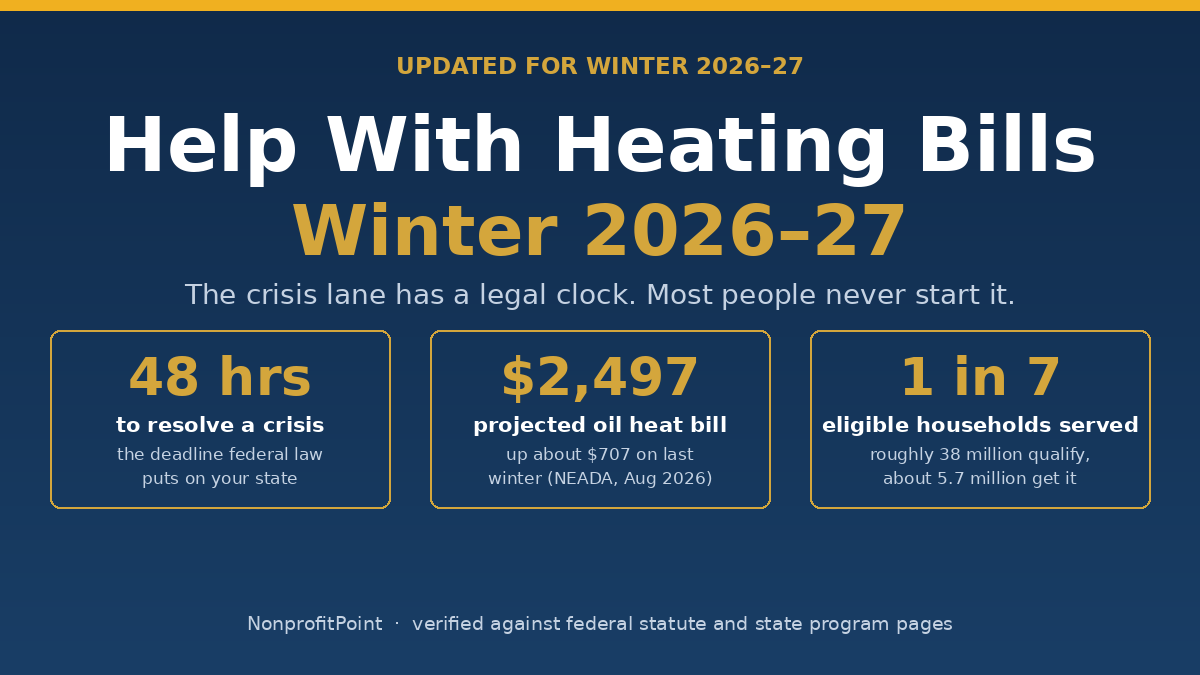
Start with the sentence that decides how fast you get help. If you have a shut-off notice or an empty tank, federal law gives your state 48 hours to resolve it, and 18 hours if the situation is life-threatening. That clock is written into 42 U.S.C. § 8623(c), and it starts when you apply for crisis benefits, not regular heating help. Most people never start it: they fill in the ordinary application, get told the wait is several weeks, and go home. The crisis lane is a different form, a different queue and a legally different obligation, and the words that put you in it are “I have a disconnection notice” or “I am out of fuel.”
The second thing worth knowing before you dial anything is that a good deal of the heating-help advice online is out of date in a way that costs you a morning. The free heating-oil program every listicle points to no longer exists, and the federal water-bill program that ran beside LIHEAP is finished while state pages describing it remain live. Both are in the graveyard box below.
Start here, in this order.
1. Call 2-1-1 (or use 211.org). Free, confidential, staffed around the clock, and it knows which local fund still has money this week. It is a referral service — it will not pay the bill itself.
2. Apply to your state’s LIHEAP office using the table below. With a notice or an empty tank, say the word crisis.
3. Call your utility and ask for two things by name: a deferred payment arrangement, and whatever hardship fund the company participates in. Utilities do not volunteer these.
What LIHEAP is, and who qualifies
The Low Income Home Energy Assistance Program is federal money handed to states, tribes and territories, which run it under their own names — HEAP in New York and Ohio, CEAP in Texas, EAP in Virginia, LIEAP in North Carolina, State Emergency Relief in Michigan. In most states the intake office is a local Community Action Agency rather than a state building; find yours through the Community Action Partnership locator.
There are two doors into eligibility, and people miss the second. Under 42 U.S.C. § 8624(b)(2), a household qualifies if anyone in it receives TANF, Supplemental Security Income, SNAP, or certain means-tested veterans’ pension benefits — categorical eligibility, which stands on its own. Otherwise you qualify on income, at “the greater of” 150 percent of the federal poverty guideline or 60 percent of your state’s median income. States may set a more generous line but may not set one below 110 percent of poverty.
The 2026 federal poverty guidelines took effect on 13 January 2026. Here they are with the 150 percent figures most states use — the guidelines from the Federal Register notice of 15 January 2026, the 150 percent column from Pennsylvania’s FY2027 LIHEAP state plan.
| Household size | 2026 poverty guideline | 150% of guideline |
|---|---|---|
| 1 | $15,960 | $23,940 |
| 2 | $21,640 | $32,460 |
| 3 | $27,320 | $40,980 |
| 4 | $33,000 | $49,500 |
| 5 | $38,680 | $58,020 |
| 6 | $44,360 | $66,540 |
| 7 | $50,040 | $75,060 |
| 8 | $55,720 | $83,580 |
Several states are more generous. Ohio runs at 175 percent of poverty — $27,930 for one person, $57,750 for four. New Jersey and Illinois use 60 percent of state median income, which in New Jersey means $50,005 a year for a single person. If a chart elsewhere told you that you earn too much, check your own state’s number before accepting it.
The money is real, but it runs out, and it runs late
Two facts about the program’s finances should change how you behave, not just how you feel. The first is scale. The Edison Electric Institute puts it plainly: more than 38 million households were income-eligible and only about 5.7 million received help — six of every seven eligible families got nothing, because the appropriation is a block grant that runs out. Nearly every state page carries some version of “first-come, first-served, until funds are exhausted.”
The second is timing. Last winter the money reached states late: about $3.6 billion went out on 28 November 2025 and the remaining roughly $421 million was not released until 20 April 2026, by which point the heating season was over. New York pushed its opening back to 17 November 2025 as a result; North Carolina’s priority window slipped to 10 December. For the coming winter the administration has again proposed eliminating LIHEAP, and the House Appropriations Committee has again declined — on 9 June 2026 it approved a bill raising the program to $4.055 billion. That bill is not law yet. The translation for a household is simple: apply on the first day your state opens, not the first cold week.
It matters more this year than most. NEADA’s 27 August 2026 projection, built on a crude-oil price shock, puts heating oil at $5.55 a gallon — roughly $2,497 for a household burning 450 gallons, about $707 more than last year, and $2,633 in its worse scenario.
When your state opens: the 2026–27 calendar
Be careful with any page giving confident dates for all fifty states right now. As of early September 2026, only Ohio and Pennsylvania have published full 2026–27 seasons. Everything else below is a year-round program, a standing rule that repeats annually, or last season’s dates — labelled as such rather than presented as fact.
| State | When to apply | What it pays | Where |
|---|---|---|---|
| Ohio | Confirmed 2026–27: 1 July 2026 to the end of May 2027 (the state application says 30 May, the Consumers’ Counsel factsheet 31 May). Winter Crisis Program 1 Nov – 31 Mar. | Varies by household, fuel and region; income limit 175% FPG | energyhelp.ohio.gov · 1-877-742-5622 |
| Pennsylvania | Confirmed 2026–27: opens Mon 2 Nov 2026, closes Fri 23 Apr 2027 | Cash grant $200–$1,000; crisis grant $25–$1,000 | PA DHS season facts |
| California | Year-round; program year 1 Oct 2026 – 30 Sep 2027 | Heating $94–$1,500; crisis up to $1,500; 60% SMI ($3,331.66/mo for one) | CSD · dial 2-1-1 |
| New Jersey | Standing rule: 1 Oct – 30 Jun | Heating capped at $1,278; emergency heating up to $800; benefits held flat for FY2027 | DCA · 1-800-510-3102 |
| New York | 2026–27 dates not posted. Last season was set for 3 Nov 2025, postponed twice in the shutdown, and finally opened 1 Dec 2025; regular benefit closed 10 Apr 2026 | $400 (gas/electric) to $900 (oil, propane) plus add-ons; income $3,473/mo for one | myBenefits.ny.gov · 1-800-342-3009 |
| Illinois | Last season 1 Oct – 15 Aug; seniors, disabled, under-5s and disconnected households apply a month before everyone else | Set locally; 60% SMI ($39,979/yr for one) | DCEO · 1-833-711-0374 |
| Texas | CEAP runs on the calendar year, no seasonal window | Set in state rule; income 150% FPG ($23,940 for one, $49,500 for four) | TDHCA |
| Georgia | Standing rule: first workday of December for 65+ and homebound, first workday of January for everyone else — 1 Dec 2026 and, because 1 Jan is a holiday and 2 Jan a Saturday, Mon 4 Jan 2027 | Average award $310–$350; 60% SMI ($34,549 for one) | DFCS · 877-423-4746 |
| North Carolina | Standing rule: 1–31 Dec for 60+ and disabled, 1 Jan – 31 Mar for everyone else | Income basis 130% FPG | epass.nc.gov · 1-800-662-7030 |
| Michigan | State Emergency Relief runs year-round, 1 Oct – 30 Sep | $600 natural gas or wood, $900 deliverable fuel, $900 all-electric, $200 deposits; no co-payment | MI Bridges |
| Virginia | Fuel: second Tuesday in October to second Friday in November. Crisis: 1 Nov – 15 Mar for heating equipment and deposits, but only January – 15 Mar for fuel and utility bills | Income 150% FPG, gross monthly | commonhelp.virginia.gov · 855-635-4370 |
| Washington | Year-round, by appointment through a local provider | Set locally; income 150% FPL | Commerce provider map · 360-725-2857 |
| Florida | Through local community action agencies | Crisis award up to $1,000 | floridaliheap.com · 2-1-1 |
Two rows are time-critical as you read this. Virginia’s fuel window is about a month and it is the only substantial one — the second Tuesday in October and second Friday in November fall on 13 October and 13 November this year. And Michigan’s Home Heating Credit must be filed by 30 September 2026. It is a tax credit rather than a grant, claimed on form MI-1040CR-7, and worth a standard allowance of $604 for up to one exemption, $815 for two and $1,027 for three, rising to $1,662 at six. You can claim it even if you did not otherwise have to file a Michigan return.
When LIHEAP is gone: utility hardship funds and charities
Dollar Energy Fund is the largest utility-partnered fund, operating with companies in eighteen states including California, Illinois, Ohio, Pennsylvania, Texas, Virginia and Washington. The grant goes straight onto your utility account. There is no national grant size — each participating utility sets its own rules, and they are stricter than people expect. The FirstEnergy Pennsylvania program caps grants at $600, requires income at or below 250 percent of poverty, requires at least $150 paid toward the account in the past three months ($100 if you are 62 or over), and is currently open only to customers whose service is already off. The hotline is 1-888-282-6816, and you apply through a partner agency rather than directly.
The Salvation Army runs two different heating funds, frequently confused. HeatShare operates in the upper Midwest with CenterPoint, Xcel and Minnesota Power; the Minnesota division reports serving about 7,800 households at an average near $400, on 1-800-842-7279. A separate HeatShare for Columbia Gas of Ohio customers gives up to $450 a year at incomes up to 300 percent of poverty. Project SHARE is the Georgia program, funded with Georgia Power and the state’s EMCs, capped at $500 in any twelve-month period. All are booked through a local case manager, not a national line.
If you live in Connecticut, stop reading and go apply. Operation Fuel is now Generation Power CT, gives up to $500 to households at or below 75 percent of state median income, and opens in narrow two-week windows: 1–15 September 2026, then 1–15 December 2026 and 1–15 March 2027. The September window is open right now; the line is (860) 243-2345, mornings only.
Beyond those, the local layer holds most of the remaining money. St. Vincent de Paul conferences are attached to individual parishes and each serves a fixed set of streets, so the one that can help is set by your address, not by which number you find first; Catholic Charities works through some 170 independent agencies. Electric cooperatives run Operation Round Up trusts funded by members rounding their bills up — worth asking about, though many fund community projects rather than bills, so ask whether yours pays energy accounts.
The graveyard
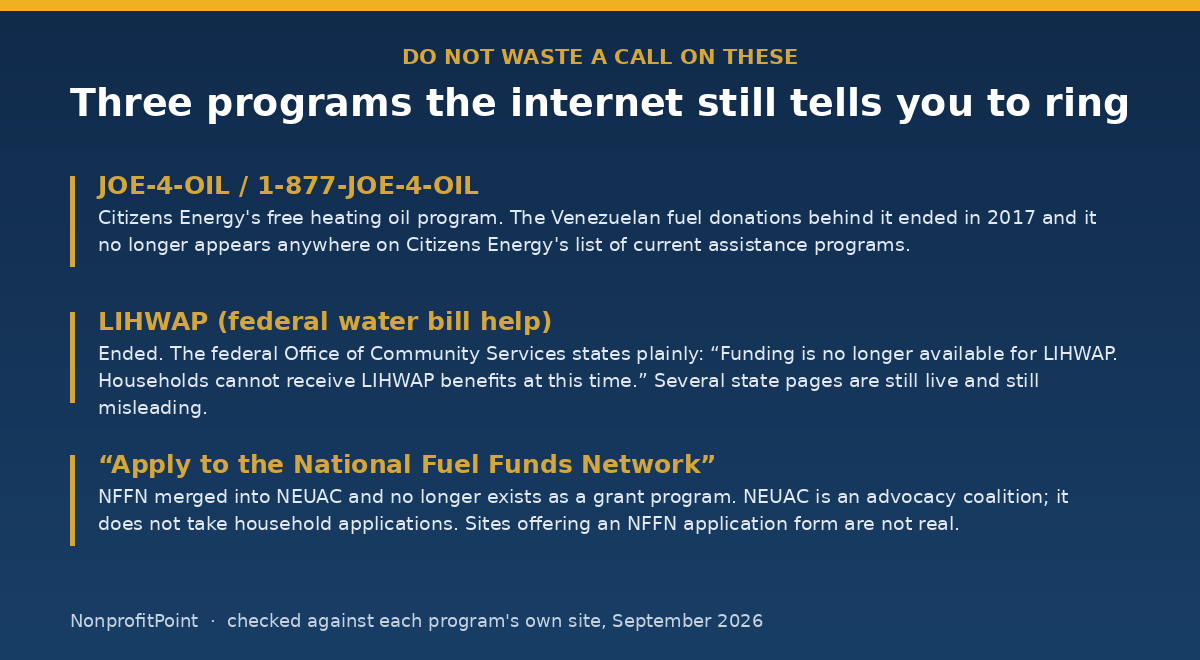
JOE-4-OIL, the Citizens Energy heating-oil program, still appears on dozens of help pages with the number 1-877-JOE-4-OIL. The donated fuel behind it dried up years ago, and it appears nowhere among Citizens Energy’s current assistance programs, which are now solar, an EV grant and a shelter heating fund for facilities rather than households.
LIHWAP, the federal water and wastewater bill program that ran alongside LIHEAP, is finished. The Office of Community Services says so directly: “Funding is no longer available for LIHWAP. Households cannot receive LIHWAP benefits at this time.” Several state LIHWAP pages remain online and will send you on a pointless errand. Some states run their own water assistance — real, but separate. What actually pays a water bill in 2026 is usually the utility’s own income-based rate rather than a grant; the cities that run one, and the charities that genuinely cover water, are set out in charities that help with water bills.
Finally, the National Fuel Funds Network no longer exists as something you can apply to; it merged into NEUAC, an advocacy coalition that takes no household applications. Any site offering an “NFFN application form” is not connected to anything real.
What your state actually guarantees against a shut-off
“They can’t shut off your heat in winter” is true in about a dozen states and false, or nearly so, in the rest. Protections come in four shapes, and knowing which one you live under tells you how hard to push.
Calendar moratoriums are the strongest. Wisconsin bars disconnection of heating service from 1 November to 15 April with no income test. Pennsylvania runs 1 December to 31 March but only below 250 percent of poverty. Minnesota’s Cold Weather Rule covers 1 October to 30 April but is conditional: you must make and keep an agreed payment plan. New Jersey’s Winter Termination Program ran 15 November to 15 March last season and, crucially, is not automatic — you must tell your utility you qualify.
Temperature triggers sound protective and are weaker than they read. Virginia blocks a shut-off when the forecast low is 32°F or below within 24 hours, and on Fridays, weekends and state holidays. Georgia combines a window (15 November to 15 March) with a freezing forecast and a signed payment agreement — so a 40-degree January day in Georgia is a lawful shut-off day. Texas is thinnest of the large states: protection applies only during an “extreme weather emergency,” the previous day’s high not exceeding 32°F with the freeze forecast to continue, and it lapses when the freeze does.
Protected-class rules cover some households and not others. North Carolina has no general moratorium: between 1 November and 31 March it protects only households containing someone 65 or over or disabled, who cannot pay, and who are certified by the local social services office. Michigan’s Winter Protection Plan runs 1 November to 31 March for customers 65 or over, those on state cash assistance, food assistance or Medicaid, or those under 150 percent of poverty; low-income participants pay 7 percent of their estimated annual bill monthly, while those over 65 pay nothing all winter. Washington protects 15 November to 15 March, but only if you notify the utility within five business days of the delinquency notice, self-certify income, apply for assistance and weatherization, and pay 7 percent of monthly income plus current usage.
And several states have no moratorium. Ohio offers something better instead: the Special Reconnect Order lets any customer of a regulated electric or gas utility keep or restore service by paying $175, whatever the balance, with no income test. Last season it ran 13 October 2025 to 15 April 2026; the 2026–27 order had not been issued when we checked, so confirm the figure with PUCO. Illinois mandates a winter deferred payment arrangement rather than banning shut-offs. New York’s HEFPA cold-weather period, 1 November to 15 April, requires special contact efforts and bars disconnection where health or safety is at risk, but is not a flat prohibition. California’s extreme-weather protections are heat-based, not cold-based, and Florida has none — a 2025 bill to create one died in committee.
The repair that stops this recurring
Every state that runs LIHEAP also runs the Weatherization Assistance Program, chronically under-applied because it does not feel urgent. It pays for insulation, air sealing and heating-system repair or replacement free. The income ceiling is more generous than LIHEAP’s — 200 percent of poverty under 10 CFR 440.22 — and a household containing someone who received TANF or SSI cash assistance in the past twelve months is automatically eligible. The Department of Energy reports weatherized households “save on average $372 or more every year.” The queue moves in months, which is why you join it in September rather than January. Apply through your state weatherization administrator.
Related help
If the heating bill is one of several, our guides to utility bills, energy bills, utility deposits, rent, food, pet food and winter coats each cover a different lane, and the master directory links the lot. For emergencies that fit no category, start with emergency financial assistance. Winter also brings Thanksgiving and Christmas assistance, both opening earlier than people expect.
Giving rather than asking? Fuel funds are among the few charities where a small gift becomes a traceable outcome — a named household’s account credited before the shut-off date. If you are deciding where to give this winter, see our vetted list of the best charities to donate to, and check what changed in the charitable tax deduction for 2026 first — the rules moved this year for itemizers and non-itemizers alike.
How this page was verified — 2 September 2026. Every date, dollar figure and phone number was checked against a primary source retrieved on the day of publication: the statutory text of 42 U.S.C. §§ 8623 and 8624; the 2026 HHS poverty guidelines in the Federal Register of 15 January 2026; 10 CFR 440.22 on eCFR; and the program pages or state plans of the energy assistance agencies in all thirteen states named above. Utility and charity fund details come from each fund’s own site.
What we deliberately did not publish. No income-limit dollar figures for North Carolina or Virginia: the charts those agencies link are undated and sit well below 130 and 150 percent of the 2026 guidelines, so they are probably stale. No regular-benefit amounts for Ohio, Illinois, Texas, Washington or Virginia, because those states publish none. No 2026–27 Ohio Special Reconnect Order figure, New Jersey Winter Termination dates or Dollar Energy Fund program-year terms, because none had been issued. No EIA winter cost forecast, because the Winter Fuels Outlook is an October publication.
Corrections, 2 September 2026. Published, then handed to an adversarial check told to find errors rather than confirm them. Six were found and fixed the same day: stale Michigan Home Heating Credit allowances; New York’s last opening date, 1 December 2025 rather than the superseded 17 November postponement; Georgia’s January opening, which falls on the first workday; Virginia’s crisis window, narrower for fuel bills than for equipment; Ohio’s end date, where two state sources disagree; and one loose phrase.
Written and verified by the Nonprofit Point editorial team. This page describes published program rules for general information; it is not legal advice, and eligibility decisions rest with the agency you apply to. Nonprofit Point is independent and not affiliated with any government agency, utility or organization named here.
Frequently asked questions
How do I get emergency help with my heating bill right now?
Apply for your state’s LIHEAP crisis or emergency component — not the regular benefit — and say you have a disconnection notice or no fuel. 42 U.S.C. § 8623(c) requires the state to resolve the crisis within 48 hours, or 18 hours if it is life-threatening. Call 2-1-1 at the same time; local funds sometimes move faster.
What is the income limit for heating assistance in 2026?
Federal law sets the ceiling at the greater of 150 percent of the federal poverty guideline or 60 percent of state median income. At 150 percent of the 2026 guidelines that is $23,940 for one person and $49,500 for four in the 48 contiguous states. Ohio uses 175 percent, and states using 60 percent of median income are often well above the poverty figure.
Can I get LIHEAP if I already receive SNAP or SSI?
Yes, and it is easier. A household in which anyone receives SNAP, SSI, TANF or certain means-tested veterans’ pension benefits is categorically eligible under 42 U.S.C. § 8624(b)(2), without a separate income test. You still have to apply, and states may still prioritise by need, so bring your award letter.
Can my gas or electricity be shut off in winter?
It depends on your state, and for much of the country the honest answer is yes. Wisconsin bars it outright from 1 November to 15 April. Pennsylvania, Minnesota and New Jersey have moratoriums with income or enrolment conditions. Virginia, Georgia and Texas block it only around freezing forecasts. North Carolina protects only certified elderly or disabled households; Florida has none.
Is JOE-4-OIL still giving out free heating oil?
No. The Citizens Energy heating oil program relied on donated Venezuelan fuel that ended in 2017, and it no longer appears on the company’s list of current assistance programs. The 1-877-JOE-4-OIL number still circulating on aggregator sites will not get you fuel this winter.
Is there still federal help with water bills?
Not federally. The Office of Community Services states that funding is no longer available for LIHWAP and households cannot receive benefits at this time. Some states and water utilities run their own assistance, and Dollar Energy Fund administers water hardship grants with several water companies, but the federal program is over.
When should I apply for heating assistance?
On the first day your state opens. LIHEAP is a block grant given first-come, first-served until it runs out, and only about one in seven eligible households receives it. Virginia’s fuel window is about a month; Georgia and North Carolina open to the general public only in January. Waiting for the first cold snap means competing with everyone else who waited.
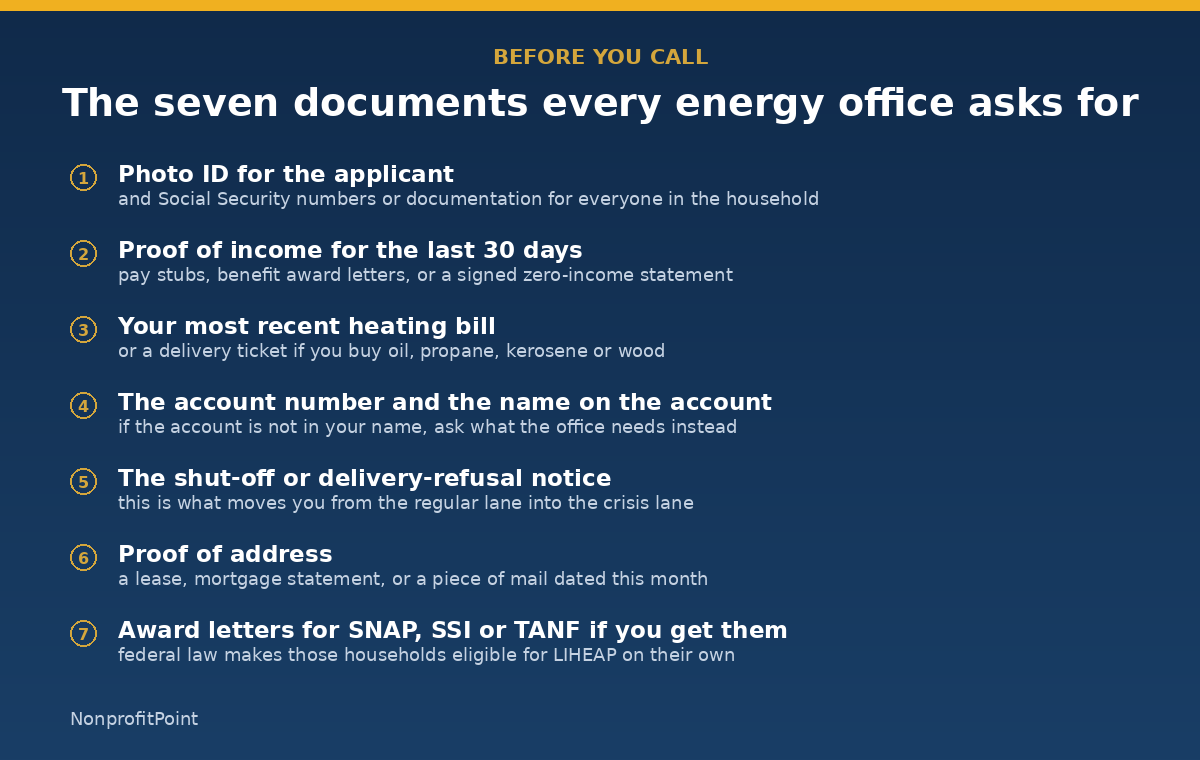
What documents do I need to apply?
Photo ID, Social Security numbers for the household, proof of income for the last 30 days, your most recent heating bill or fuel delivery ticket, the utility account number, proof of address, any shut-off notice, and award letters for SNAP, SSI or TANF. Assembling these first is the single biggest way to speed up a decision.
Over 60? Several programs on this page have a senior-only door.
Some states open LIHEAP applications to households with a member aged 60 or over weeks before everyone else, and federal regulation puts elderly households first in line for free weatherisation. Those rules, plus Medicare, SNAP, prescription and property tax help, are collected in our guide to charities that help seniors with bills.