Charities That Help With Water Bills: What Actually Pays in 2026

Almost every article about water bill help still tells you to apply for LIHWAP. That advice has been wrong for more than two years. The federal Low Income Household Water Assistance Program stopped taking applications in 2024, and the Department of Health and Human Services says so in a banner at the top of its own page: “NOTICE: Funding is no longer available for LIHWAP. Households cannot receive LIHWAP benefits at this time.”
There is no federal water bill program in September 2026. Two bills that would create one are sitting in committee. What replaced LIHWAP is not a charity at all — it is your own water utility, and in a dozen large American cities the utility will cut your bill permanently and erase the debt you have already run up, which no one-time grant can do.
This guide is organised the way the money actually flows: the utility rate first, the charities second, the legal protections third. Every programme below was checked against the organisation’s own live page on 11 September 2026. Where a programme publishes no dollar figure, this page says so instead of borrowing a number from somewhere else.
The correction that changes where you should apply
LIHWAP was an emergency programme, not a permanent one. Congress created it in two pieces — $638 million in the Consolidated Appropriations Act, 2021 and $500 million in Section 2912 of the American Rescue Plan Act — for a total of about $1.1 billion. Grantees had to obligate every dollar by the end of the project period and liquidate by 30 June 2024. There is no leftover pot. There is no state still spending federal LIHWAP money, because the deadline forecloses it.
Two bills in the 119th Congress would rebuild it. H.R. 4733, introduced 23 July 2025, would authorise $500 million a year for fiscal years 2026 through 2030; it was referred to the Subcommittee on Water Resources and Environment on 1 December 2025 and has not moved since. H.R. 8254, the Water Access and Affordability Act, introduced 13 April 2026, would build a far larger EPA-run programme. Both are in committee. Neither is law. The FY2026 Labor-HHS appropriations bill that cleared Congress in February 2026 contains no water assistance line.
EPA’s own December 2024 needs assessment, required by the infrastructure law, put the scale of the gap in plain numbers: “between 12.1 million and 19.2 million households throughout the U.S. lack access to affordable water services” — 9.2% to 14.6% of all households — and the shortfall between what those households can afford and what they are billed runs to between $5.1 billion and $8.8 billion a year.
Three more things the listicles get wrong
LIHEAP does not pay water bills. The statute defines “home energy” as “a source of heating or cooling in residential dwellings” (42 U.S.C. § 8622). HHS answers the question directly in its own consumer FAQ: “Does LIHEAP help pay for water and sewer bills?” — “No. LIHEAP funds can only be used to help you pay to heat or cool your home.” The one exception it publishes is evaporative coolers, where water is the cooling system. If a page tells you LIHEAP covers your water heating, it is guessing. (LIHEAP itself is very much alive for heating costs — see our guide to help with heating bills.)
EPA does not give households money. Its Real Water Technical Assistance programme states that it cannot assist “federal facilities or individuals/individual households.” EPA’s advice to consumers is to contact your utility — which, as it happens, is the correct advice.
Water.org and WaterAid America do not pay American water bills. Both are international development charities working in Kenya, Bangladesh, Uganda, India and elsewhere. They appear on “charities that help with water bills” lists constantly. Neither has a US household bill programme.
Start with your utility’s own rate, not with a charity
This is the single most expensive mistake people make. A charity grant clears one bill. An income-based water rate cuts every future bill, and in Philadelphia, Chicago and Baltimore it also destroys the arrears the grant was meant to cover.
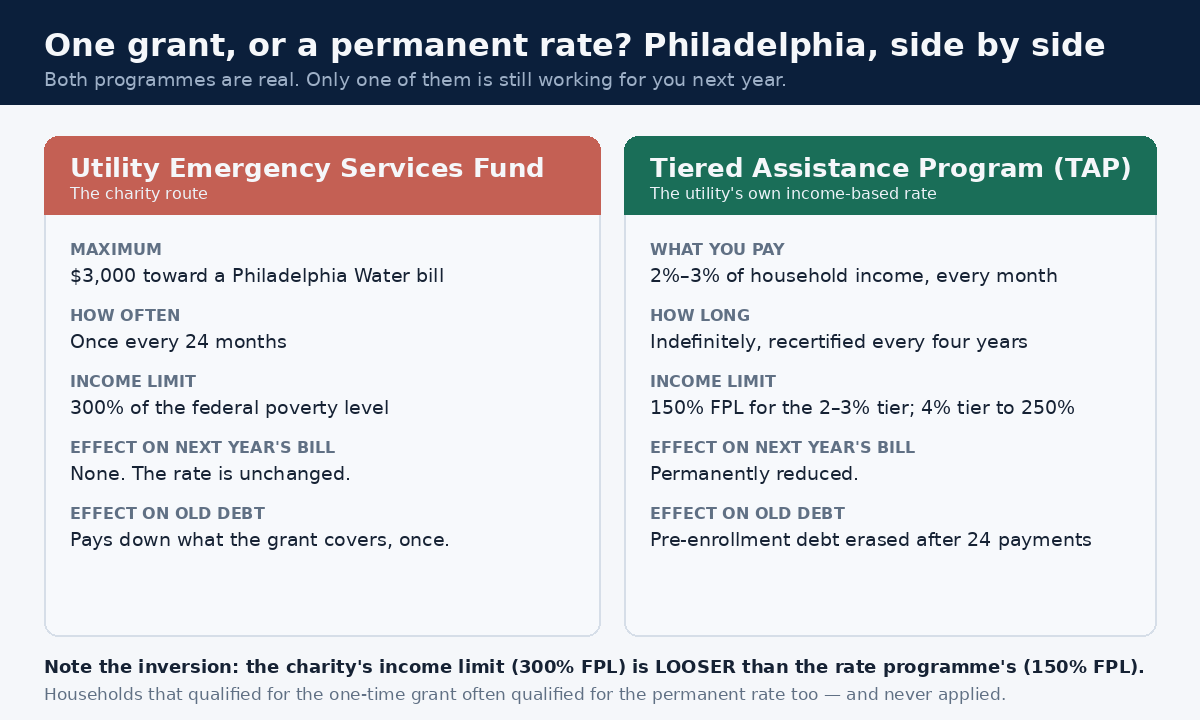
Philadelphia proves it cleanly, and the proof is uncomfortable. The city’s emergency charity — the Utility Emergency Services Fund — pays up to $3,000 toward a Philadelphia Water Department bill, once every 24 months, to households at or below 300% of the federal poverty level. The city’s own income-based rate, the Tiered Assistance Program, fixes the bill at 2% to 3% of household income for households at or below 150% of FPL — forever — and forgives pre-enrollment debt as you pay. Note the inversion: the charity’s income threshold is looser than the rate programme’s. Thousands of people who qualified for the one-time grant also qualified for the permanent rate and never applied for it.
In 2025 alone, TAP delivered $43 million in discounts and $8.8 million in penalty and arrearage forgiveness to 67,815 participating households. No charity in Pennsylvania comes close.
What the big city programmes actually give you
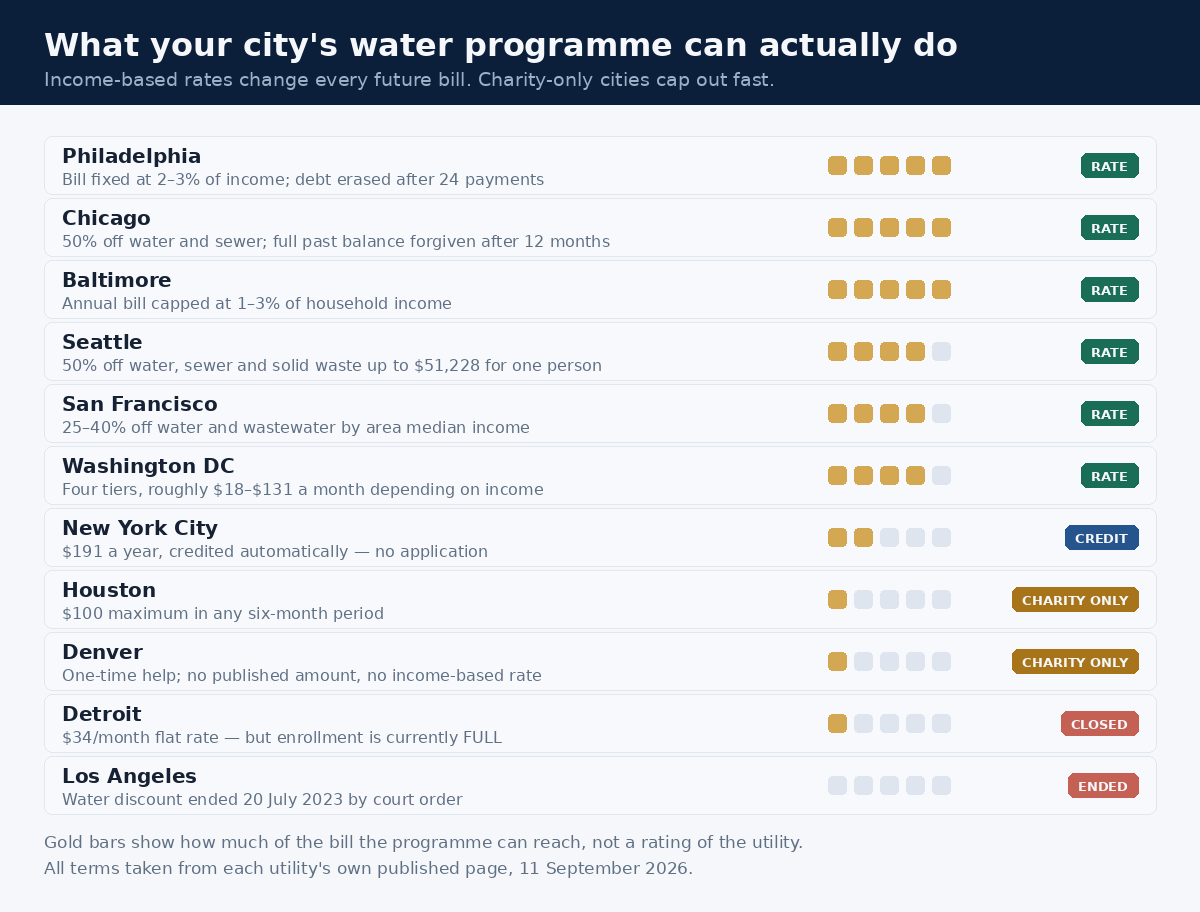
Amounts, income rules and application routes below come from each utility’s own published page. Where a utility publishes no figure, the table says “publishes no amount” rather than estimating one.
| City / utility | Programme | What it gives | Income rule as published | Apply |
|---|---|---|---|---|
| Philadelphia (PWD) | Tiered Assistance Program (TAP) | Bill fixed at 2–3% of household income (4% at 150–250% FPL and for hardship); pre-enrollment debt erased after 24 on-time payments | ≤150% FPL for the 2–3% tier ($1,995/mo for one person; $4,125/mo for four). 150–250% FPL for the 4% tier | cap.phila.gov · (215) 685-6300 |
| Philadelphia (seniors) | Senior Citizen Discount | 25% off the monthly bill | Age 65+ and household income under $42,100/year | cap.phila.gov · (215) 685-6300 |
| Washington, DC | DC Water CAP / CAP1 / CAP2 / CAP3 | Discount on the first 300–600 cubic feet each month plus a 50–75% cut in the CRIAC stormwater fee. DC Water puts the value at roughly $131, $101, $67 and $18 a month across the four tiers | Four tiers running from $20,614 (CAP+) up to $114,700 (CAP3) for a single-person household in FY26 | DOEE 202-350-9649 |
| Washington, DC (emergency) | SPLASH | Up to $350 for customers facing disconnection | Income-eligible, verified by the Greater Washington Urban League | 202-265-8200, Mon–Fri 9–5 |
| New York City | Home Water Assistance Program (HWAP) | A $191 annual credit, applied automatically — there is no application | One-to-four family home plus a 2025–26 HEAP heating benefit, or an approved SCHE, DHE or Veteran’s exemption | Automatic · (718) 595-7000 |
| Chicago | Utility Billing Relief (UBR) | 50% off water, sewer and the water-sewer tax; after 12 months of successful participation the entire previous unpaid balance is forgiven | 200% of LIHEAP limits — $3,332/mo for one person, $6,407/mo for four | webapps4.chicago.gov/eforms/ubr |
| Baltimore | Water4All | Caps the annual water and sewer bill at 1%, 2% or 3% of household income depending on income and household size | ≤200% FPL — $2,147/mo for one person, $4,417/mo for four | Online, or 410-396-5555 for a mailed form |
| Seattle | Utility Discount Program | 50% off water, sewer and solid waste (60% off City Light electricity) | $51,228/year for one person; $98,508 for four — far higher than most people assume | utilityassistance.seattle.gov · (206) 684-0268 |
| Seattle (emergency) | Emergency Assistance Program | Up to $537 a year, or $1,074 with children under 18 | Same UDP income guidelines | (206) 684-0268 |
| San Francisco | SFPUC Customer Assistance Program | 40% off water and wastewater at ≤30% of area median income; 25% off at ≤50% of AMI | $34,050 (40% tier) and $56,750 (25% tier) for one person in 2026 | (415) 551-3000 · 525 Golden Gate Ave, 1st floor |
| Portland, OR | Financial assistance, two tiers | Tiered bill discount, plus crisis vouchers of up to $500 for enrolled customers in a documented crisis | Tier 1 up to 60% of state median family income ($4,494/mo for one); Tier 2 up to 30% ($2,242/mo) | 503-823-7770 |
| Cleveland | Water Affordability Program | Moves you onto a published reduced rate schedule rather than a percentage discount | 200% FPL — $31,300/year for one, $64,300 for four | CHN Housing Partners, 216-774-2349 |
| Cleveland (seniors) | Homestead Program | Same reduced rate schedule; enrollment valid three years | Age 65+ or totally and permanently disabled, owner-occupant, income guidelines apply | By mail to the Division of Water Homestead Unit |
| Boston (BWSC) | Elderly and Disabled Discount | 30% off monthly water, sewer and stormwater charges | Age 65+ or fully disabled, owner-occupied 1–4 family home. BWSC publishes no income limit for this discount | 617-989-7800 |
| Atlanta | Care and Conserve | Bill assistance, plus a separate plumbing repair programme | Account must be six billing cycles old with $300+ past due, service legally on, consistent payment history. Atlanta publishes no income threshold and no maximum award | (404) 546-3620 · four weeks or more to process |
| Phoenix | Project Assist | Help with the City Services bill (water, sewer, trash). Publishes no amount. No low-income water rate exists | ≤200% of the federal poverty level | 602-534-2433 — appointments are limited; the line opens 7 a.m. Mondays |
| Houston | W.A.T.E.R. Fund | A maximum of $100 in any six-month period. Houston has no income-based water rate | Income at or below the HHS poverty guidelines; disabled, 60+, or other low income | WATER.FUND@houstontx.gov |
| Denver | One-time payment assistance | Publishes no amount and no income rule. No income-based discount rate exists | Not published | 303-893-2444 |
| Detroit | Lifeline H2O | Flat $34/month for water, sewerage and drainage, up to 4,500 gallons — but enrollment is currently full and closed to new applicants | ≤200% FPL when open | 313-435-2055 · fallback is EasyPay: $10 down, 36 months |
| Los Angeles | EZ-SAVE / Lifeline | No longer discounts water. The water discount ended 20 July 2023 by court order. Electricity and sewer discounts survive | $42,300/year for 1–2 people, rising to $108,300 for eight | 1-800-342-5397 |
Two patterns are worth naming. First, the ceiling on charity-only cities is brutally low: Houston’s entire municipal answer is $100 every six months, against Philadelphia’s permanent 2%-of-income rate. Where you live determines the size of the help far more than how poor you are, which is also true of assistance with household bills generally. Second, enrollment is now the scarce resource, not money. Detroit’s programme is full. Phoenix rations by a Monday-morning phone queue. Baltimore warns it may take three months for the discount to appear; Seattle says four to six weeks. The correct instruction is to apply to the rate programme now, before a shutoff notice arrives — not to wait for the crisis and then call a charity.
Charities that genuinely pay water bills
Once the rate programme is handled — or if your utility has none — these are the organisations that actually move money to a water account. The list is short, and it is short for a reason: there is no national charity in the United States whose purpose is paying household water debt. That absence is the real story of this subject in 2026.
Dollar Energy Fund — the one national administrator that covers water
Dollar Energy Fund is the clearest verified answer. Its own page says it works to maintain or restore “basic gas, water, wastewater and electric service.” It is not a charity you apply to in the abstract; it administers hardship programmes on behalf of named utilities, so the question is whether your water company participates.
Where it does, the terms are published. These are the water and wastewater programmes running in the 2025–26 programme year:
| Programme | Maximum grant | Income rule | Other published conditions |
|---|---|---|---|
| Pittsburgh Water (PGH2O) Hardship Program | $450 for water and $450 for wastewater, twice per calendar year | ≤200% of federal poverty income guidelines — $31,920 for one person, $66,000 for four | Balance of at least $1; residential only, no apartments with shared utility service. Open 1 Oct 2025 – 30 Sept 2026, first come first served. Apply through Pittsburgh Water, 412-255-2423 |
| Pennsylvania American Water — H2O Help to Others | Up to $500 in grants, plus 22–82% off monthly water charges, 37–85% off wastewater, and $40 a month forgiven from past-due balances | ≤250% FPIG. Households at 200–250% get grants only; at or below 200% get grants and the ongoing discounts | You must re-apply every year |
| California American Water Hardship Program | $750, one grant per programme year | ≤250% of the federal poverty guidelines — $82,500 for a household of four | Balance of at least $100 and service off or facing termination. Open 3 Nov 2025 – 30 Sept 2026. Monterey County residents apply through 2-1-1 |
| Maryland American Water Hardship Program | $500, one per programme year | ≤150% of the federal poverty guidelines | At least $50 paid in the past three months, balance of at least $50, service off or facing termination |
| West View Water Authority (PA) | $200, once every six months | ≤300% FPIG | Balance of at least $100, or $50 for customers aged 62 and over |
The condition nobody tells you about. Three of those five programmes state plainly that if the maximum grant will not be enough to restore service or stop the termination, the application will be denied and you will be asked to pay the difference first. A $500 grant against a $1,400 shutoff balance is not a partial payment — it is a rejection. Work out the gap before you apply, and ask the utility for a payment agreement that brings the balance within reach of the grant.
Apply through your utility’s referral, through a local community agency, or online through Dollar Energy’s MyApp portal; the organisation says applications typically process within two business days. The utility assistance hotline is 1-888-282-6816. Dollar Energy also publishes a fraud warning worth repeating: it “will never request payment over the phone, credit card information, or banking details to process assistance.”
Utility hardship funds run by a charity on the utility’s behalf
This is the oldest and most reliable model in the field: the water utility collects voluntary donations from customers who round up their bills, and a charity screens applicants and pays the utility directly. The programmes are tiny in geography and real in effect.
- Project SHARE, Athens-Clarke County, Georgia. Administered by the Salvation Army for Athens-Clarke County water customers. All assistance is “made payable to and sent directly to the Athens-Clarke County Public Utilities Department.” Eligibility is a needs assessment rather than a published income line, and the county publishes no maximum. Start with the Water Business Office for a referral, then book an interview on 706-543-5350. Two caveats the county states itself: an appointment or a completed application “does not guarantee processing or payment,” and SHARE funds “may not be used to pay any deposit.”
- H2O Foundation, Birmingham, Alabama. A standalone local charity covering water and sewer bills plus emergency plumbing repairs, aimed at seniors, people receiving disability benefits and households in a water emergency. Eligibility check at h2obham.org; (205) 778-1900. Publishes no maximum.
- H2O Help to Others, Pennsylvania American Water. Thirty-five years old, administered by Dollar Energy Fund rather than the Salvation Army. Terms in the table above.
The name is not a guarantee of scope. Marietta, Georgia runs a “Project SHARE” too — but it is administered by the local Salvation Army corps for energy bills, equipment repair, food, shelter and medicine, and water is not on the list. Check what your local fund actually covers rather than assuming the name means the same thing everywhere.
Community Action Agencies — the most widely available option nobody uses
Every part of the United States is covered by a Community Action Agency funded through the Community Services Block Grant. CSBG explicitly funds “housing, nutrition, utility, and transportation assistance” and “crisis and emergency services,” and in practice utility assistance includes water and sewer at the agency’s discretion.
Two honest caveats. There is no published national benefit amount — each agency sets its own rules under the state plan, and funds run out. And this is discretionary help, not an entitlement: when Illinois’ own energy assistance FAQ is asked whether the state programme covers water, the answer is “No, however you can check with your county agency for other programs they may have available that could assist you with your water and sewer needs.” That referral is not a formality; the county agency is frequently the only thing left.
Community Action Agencies are also the usual route into bill assistance aimed at older adults. Find yours at communityactionpartnership.com/find-a-cap. It searches by agency name, ZIP, state, county or radius. The site’s own tip: when searching by state, increase the search radius and the number of results.
Faith-based and local help — and what these organisations actually publish
The three names that appear on every list deserve a straight answer about what they do and do not offer.
The Salvation Army. Local corps genuinely do pay water bills — the Central Territory’s utilities page lists “Water Bills” among what local units help with, alongside rent, electric and gas. But there is no national programme, no national eligibility rule, no national dollar amount and no national application. Everything concrete is set by the corps nearest you, and funding is normally first come, first served. Use the location finder at salvationarmyusa.org/location-finder and call. Any article quoting you a national Salvation Army water figure is not quoting the Salvation Army.
Society of St. Vincent de Paul. Conference-level help is real and often generous, but the national office runs no assistance locator — only a thrift store finder — and its “get help” page now redirects to the homepage. The organisation’s own advice is to contact your community Catholic church and ask whether it has a St. Vincent de Paul conference. Conferences are usually bounded by parish, so the right conference is the one covering your address, not the nearest one.
Catholic Charities. The 170 local agencies do a great deal; the national membership office does nothing for individuals, and says so: “The Catholic Charities USA national membership office in Alexandria, Virginia, does not provide direct services to clients.” Use the find-a-local-agency tool and contact the agency directly; the same agencies are frequently the fastest route to emergency food assistance while your utility money is tied up. Note that water bills are not named on the national services list, so ask rather than assume.
211 — a referral service, not a payer
Dial 211, or use the local-211 search at 211.org. United Way reports 9.1 million referrals for housing, homelessness and utility bills in 2025, and its utilities page names water explicitly. 211 does not hold a fund; it knows which local agencies still have money this month, which is exactly the binding constraint now that LIHWAP is gone. In at least one case — California American Water’s hardship programme in Monterey County — 211 is the formal intake channel rather than just a referral.
One correction: the frequently repeated instruction to “text your ZIP code to 898-211” is a regional offering, not a national one. Some local 211s support text and chat; many do not. Call, or use the locator.
Who does not help, despite appearing on every list
A page that sends you to a dead programme costs you a week you may not have. These are the referrals to ignore:
- LIHWAP. Ended. HHS: “Households cannot receive LIHWAP benefits at this time.”
- LIHEAP. Home energy only. Not water or sewer, with the narrow evaporative-cooler exception.
- Water.org and WaterAid America. International development charities. No US bill assistance.
- Catholic Charities USA national office and Society of St. Vincent de Paul USA national office. Membership bodies. Use the local agency or conference.
- Operation Round Up. An electric cooperative charitable trust model. The co-op programmes checked fund food, shelter, clothing, health needs and education, and do not name water bills.
- EPA’s technical assistance programmes. Explicitly exclude individuals and individual households.
- wisconsinwater.help. A non-governmental site marketing itself as the “Wisconsin Low-Income Household Water Assistance Program” and routing callers to an “eligibility specialist” for a programme the federal government has confirmed is unfunded. It carries no government-affiliation disclaimer. Wisconsin’s real energy assistance line is (866) 432-8947, and Wisconsin’s own programme covers heating and electric, not water bills.
- Any non-government site built around the LIHWAP name. “Provider directories” for a programme that no longer exists are lead-generation at best. HHS warns that LIHWAP never charged a fee and never paid grants directly to individuals; its fraud hotline is 1-800-447-8477.
Two well-meaning legal aid pages are also out of date and still rank: Community Legal Services of Philadelphia states that Pennsylvania’s LIHWAP “is now available”, and Illinois Legal Aid Online says applications are still accepted in some Illinois counties — its own footer shows it was last revised in September 2023, before the federal sunset. Both are contradicted by the state agencies’ own current pages.
What the law lets your utility do to you — and what it does not
Water shutoff law is not the same as gas and electric shutoff law, and articles that treat them as one subject will get you turned away at the counter. The first question is not which state you are in. It is who owns your water system, because that determines which body of law applies.
If your water utility is owned by a city or county
A municipal utility is a government actor, and the Due Process Clause applies to it. The Supreme Court settled this in a water and utility case, Memphis Light, Gas & Water Division v. Craft, 436 U.S. 1 (1978). The Court held that notice “does not comport with constitutional requirements when it does not advise the customer of the availability of a procedure for protesting a proposed termination,” and that a customer is entitled to “an opportunity for the presentation to a designated employee of a customer’s complaint that he is being overcharged or charged for services not rendered.”
In practice: a city water department cannot simply cut you off over a bill you dispute. It has to tell you a protest procedure exists and give you access to a person empowered to review the bill before the cutoff date. The hearing does not have to be formal. If you are facing a municipal shutoff over a bill you believe is wrong — a leak, a misread meter, a charge for a period you did not occupy the property — put your dispute in writing, ask for the review the utility is required to offer, and say so before the disconnection date. This is the most underused right in the subject.
It does not reach privately owned water companies, which are not government actors.
If your water utility is privately owned and rate-regulated
Then the protections come from your state’s utility commission, and they vary sharply.
California has the strongest water shutoff law in the country. The Water Shutoff Protection Act (Health & Safety Code §§ 116900–116926) requires a 60-day delinquency before any shutoff, written notice at least seven business days ahead, and a mandatory amortisation plan that ordinarily clears the balance within twelve months. Shutoff is barred where a primary care provider certifies that losing water would be life-threatening or a serious threat to health and safety, and where the household is below 200% of the federal poverty level or receives CalWORKS, CalFresh, Medi-Cal or SSI. Reconnection fees for low-income customers are capped at $50 during normal hours and $150 after hours. Utilities must publish a written discontinuation policy in English plus five more languages. SB 3 of 2023 widened the scope: it now covers systems with at least 15 service connections or 25 year-round residents, not just the large systems the original 2018 law reached. Small-system customers are covered now, and most guides have not caught up.
New Jersey has both a winter and a summer moratorium, and both name water. N.J.A.C. 14:3-3A.5 states that “Electric, gas, water, and wastewater utilities shall not discontinue service” to protected households between 15 November and 15 March. A summer programme covers 15 June to 31 August for electric, water and sewer. The protected categories include recipients of Lifeline, HEAP, TANF, SSI, PAAD, General Assistance and USF — and, importantly, customers who cannot pay because of circumstances beyond their control such as unemployment, illness, medical expenses or a death in the family, which a customer may self-certify. That last category does not require an approved benefit. Customers may also request reconnection once a year.
Pennsylvania’s winter rule is much narrower for water than for energy. 52 Pa. Code § 56.100 runs from 1 December to 31 March, but for water it reaches only “heat related service” — water service whose loss disables the heating system. The well-known bar on terminating households at or below 250% of the federal poverty level applies to electric and natural gas distribution utilities, not water. And Chapter 56 binds only utilities under the Public Utility Commission’s jurisdiction; municipal authorities, which serve much of Pennsylvania, sit outside it.
Massachusetts has a carve-out that swallows the rule. 220 CMR 25.01 applies to gas, electric and water companies under the Department of Public Utilities “and all municipal gas and electric departments.” Municipal water departments are conspicuously absent — and they supply the large majority of Massachusetts households. If your water comes from a town water department, these protections do not reach you, whatever a general guide says.
Virginia ties water protection to heat. Va. Code § 56-245.1:3 bars disconnection of water or wastewater when the temperature is forecast to reach 92°F or above within 24 hours of the scheduled disconnection. Electric gets both a 92°F and a 32°F trigger; gas gets 32°F. The statute covers only utilities regulated by the State Corporation Commission, which again excludes most municipal systems.
Payment plans are a right in some states and a courtesy in most
California requires amortisation. New Jersey guarantees one reconnection a year. Elsewhere, a payment plan is generally something the utility may offer and may refuse — Washington’s Department of Health describes plans as something water systems “offer,” not something they owe. Ask for one anyway, always in writing, and always before the shutoff date rather than after: several of the charity programmes above will not fund an account unless the remaining balance is small enough for the grant to clear it.
State programmes: what is actually left in September 2026
The honest headline is that no state is running an open, statewide, general-eligibility water bill assistance programme. Here is where the LIHWAP-era programmes went.
| State | Status on 11 September 2026 |
|---|---|
| California | Closed. The Department of Community Services and Development states the LIHWAP deadline “has passed, and the program is no longer accepting applications.” Sunset 31 March 2024; helpline (866) 675-6623. The 2015 AB 401 low-income water rate mandate produced a report and a public process, not a funded programme. SB 1125, a Water Rate Assistance Program, passed both chambers in August 2026 and was presented to the Governor at 6 p.m. on 31 August 2026. As of 12 September 2026 it has been neither signed nor vetoed. |
| Michigan | The one state still dedicating money to water shutoff prevention — through the MI Water programme run by THAW. Households at or below 300% of the federal poverty level; bill assistance capped at $2,500, with a $5,000 lifetime household maximum. Bill assistance is statewide; the minor plumbing repair arm covers Wayne, Oakland and Macomb counties and THAW states it is not currently accepting applications for that arm. Call 1-800-866-8429. The statewide affordability legislation, SB 248, was reported out of committee on 5 November 2025 and has gone no further; the House bills have not had a hearing. Michigan appropriated $10 million for water assistance against the $60 million advocates say is needed. Any claim that a 3%-of-income cap is already law in Michigan is describing a bill, not a statute. |
| New Jersey | No general water grant, but the strongest shutoff protections in the country (above) and a Universal Affordability Tariff at New Jersey American Water, which said on 9 September 2026 that it is working with the Department of Community Affairs on the enrollment process “including potential automatic enrollment for eligible customers who already receive certain energy assistance benefits.” NJ SHARES also assists with water and wastewater bills alongside energy, phone, rent and property tax. |
| Pennsylvania | Closed. The Department of Human Services LIHWAP page returns a 404 and the current LIHEAP page covers heating bills only, with no water content. The 2023 crisis grants of up to $2,500 for drinking water and $2,500 for wastewater are gone. |
| Illinois | Closed. The state’s own FAQ answers “no” on water and sewer and refers households to their county agency. |
| New York | Effectively defunct. The state’s water assistance page has no open application path and points at the federal LIHWAP site. Fallbacks are Temporary Assistance through your local department of social services and the OTDA hotline 1-800-342-3009. New York City’s automatic $191 HWAP credit is separate and still running. |
| Maryland | No state water programme found; the Office of Home Energy Programs covers energy only (1-800-332-6347). In the DC suburbs, WSSC Water runs its own customer assistance programme independent of state funding. |
| Ohio, Wisconsin, Washington | No live statewide water bill programme. Wisconsin’s energy programme covers heating and electric; its only water item is conservation work, not bill payment. Washington’s Department of Health frames customer assistance as something individual water systems may choose to offer, and cites no state law requiring a low-income water rate. |
| Texas | The Public Utility Commission maintains a water and wastewater bill assistance page at puc.texas.gov; start there, and with your local Community Action Agency through the state’s CSBG network. |
If you are on a well or a septic system
Households outside a utility’s service area have a different set of options, and the programme most often named for them has been renamed.
USDA’s old Household Water Well System grants no longer exist under that name. The programme is now the Rural Decentralized Water Systems Grant Program (7 CFR Part 1776), and it now covers septic systems as well as wells. The mechanism matters: individuals cannot apply to USDA. USDA funds qualified nonprofits, which then run revolving loan funds or award sub-grants to homeowners. At the household level it is normally a loan of up to $15,000 at 1% fixed interest for up to 20 years, for households whose income over the past twelve months is no more than 60% of the state’s median non-metropolitan household income. Contact one of the current grantees listed on the programme’s contact tab.
The other route is Section 504 Single Family Housing Repair Loans and Grants. Loans go up to $40,000 at 1% fixed for 20 years, with no age limit, for very-low and low-income homeowners who cannot obtain affordable credit elsewhere. Grants go up to $10,000 with a $10,000 lifetime limit, but only to homeowners aged 62 or over with very-low income, and grant money must be used to remove health and safety hazards — which is where a failed well or septic system falls. Loans and grants can be combined up to $50,000. Apply through your local Rural Development office; there is no national online application.
What to do this week, in order
- Find out who owns your water system. It is on the bill. City department, county authority, regional authority or investor-owned company — this decides which rate programme, which shutoff law and which hardship fund apply to you.
- Apply to the utility’s own income-based rate first, even if your bill is current and even if you think you earn too much. Seattle’s ceiling is $51,228 for one person. DC’s top tier reaches $114,700. Most people who qualify never check.
- Ask for a written payment agreement before the shutoff date, not after. It stops the clock in several states and it brings the balance within reach of the grants that will not fund an account they cannot clear.
- Then go to the charity layer: Dollar Energy Fund if your utility participates, the local Community Action Agency, then the Salvation Army corps, St. Vincent de Paul conference or Catholic Charities agency nearest you. Call 211 to find out which of them still has money this month.
- If the bill itself is wrong, dispute it rather than fund it. A municipal utility owes you a protest procedure and a person to hear it. A disputed bill is the one category where the answer is a hearing rather than a grant — the same principle that governs disputed medical bills. Leaks are the usual culprit, and several utilities — Houston, Portland, Philadelphia among them — run leak adjustment or free repair programmes that are cheaper than any grant.
Every other kind of household bill has its own route, and they are collected in our Get Help Paying For directory.
Frequently asked questions
Is LIHWAP still available in 2026?
No. The federal Low Income Household Water Assistance Program has ended. HHS states on its own programme page that “Funding is no longer available for LIHWAP. Households cannot receive LIHWAP benefits at this time.” Grantees had to liquidate all funds by 30 June 2024, so there is no leftover federal money in any state. Two bills that would recreate the programme, H.R. 4733 and H.R. 8254, are in committee and have not passed.
Can LIHEAP pay my water bill?
No. LIHEAP covers home energy, which the statute defines as heating or cooling. HHS answers the question directly: “LIHEAP funds can only be used to help you pay to heat or cool your home.” The single exception it publishes is water used for air conditioning in an evaporative cooler, where the water is the cooling system.
What is the fastest way to lower a water bill permanently?
Enrolling in your water utility’s own income-based rate, where one exists. Philadelphia’s Tiered Assistance Program fixes the bill at 2–3% of household income and erases pre-enrollment debt after 24 payments. Chicago’s Utility Billing Relief cuts the rate by 50% and forgives the previous unpaid balance after twelve successful months. Baltimore’s Water4All caps the annual bill at 1–3% of income. A one-time grant cannot do any of that.
Does the Salvation Army pay water bills?
Local Salvation Army corps often do — the Central Territory lists water bills among the things local units help with. But there is no national programme, no national eligibility rule, no published national amount and no national application. You have to find and call the corps nearest you through the location finder at salvationarmyusa.org, and funding is usually first come, first served.
What charity actually pays water bills nationally?
No United States charity exists whose purpose is paying household water debt. Dollar Energy Fund comes closest: it administers hardship grants for water and wastewater utilities in several states, with published maximums between $200 and $750 depending on the utility. Whether it can help you depends on whether your water company is one of its partners. Its hotline is 1-888-282-6816.
Can my water be shut off in winter?
It depends on who owns your system and which state you live in. New Jersey bars water and wastewater shutoffs for protected households from 15 November to 15 March. Pennsylvania’s winter rule covers water only where losing it disables your heating, and its 250%-of-poverty protection applies to electric and gas, not water. California has no seasonal moratorium but requires 60 days of delinquency, seven business days’ notice and a mandatory payment plan, and bars shutoff on a medical certification. Many states have no water-specific winter protection at all.
What can I do if my water utility has no assistance programme?
Four things, in order. Ask for a written payment agreement. Contact your Community Action Agency through communityactionpartnership.com/find-a-cap — CSBG funds utility and crisis assistance, and the county agency is often the only remaining source. Call 211 to find which local funds still have money. And if the bill is disputed and the utility is government-owned, demand the protest procedure the Constitution requires before disconnection.
Is there still a water bill discount in Los Angeles?
No. LADWP’s water discount for both the EZ-SAVE low-income programme and the senior and disabled Lifeline programme ended on 20 July 2023 after a Los Angeles Superior Court ruling barred the charge that funded it. Customers enrolled in those programmes still receive the electricity and sewer discounts. Any guide telling you EZ-SAVE will cut your water bill is out of date.
How much is New York City’s water assistance credit, and how do I apply?
It is $191 a year, and there is no application. The Home Water Assistance Program credits eligible one-to-four family homes automatically — you qualify through a 2025–26 HEAP heating benefit or an approved SCHE, DHE or Veteran’s exemption. Separately, unpaid water and sewer charges in New York City can reach a lien sale at $3,000 or more outstanding for a year on a Tax Class 1 property, or $1,000 on Tax Class 2 and commercial. Single-family homes and accounts in a current payment agreement are exempt, and DEP normally requires at least 25% down to open one.
Can I get help with a well or septic system instead of a water bill?
Yes, through two USDA routes. The Rural Decentralized Water Systems Grant Program funds nonprofits that lend to homeowners — up to $15,000 at 1% for up to 20 years, for households at or below 60% of the state’s median non-metropolitan income. Section 504 offers repair loans up to $40,000 at 1% with no age limit, and grants up to $10,000 for homeowners aged 62 and over with very-low income, used to remove health and safety hazards. Apply through your local Rural Development office, not online.
Related help
- Help With Heating Bills: LIHEAP and Crisis Grants — the energy side of the same problem, and the programme that is still funded
- Charities That Help Seniors With Bills
- Complete Guide to Charities That Help With Bills and Expenses
- Charities That Help With Medical Bills
- Charities That Help With Emergency Shelter
- Charities That Help With Food
- Get Help Paying For… the full assistance directory
Researched and written by Alex Shabani for Nonprofit Point. Every programme, dollar figure, income threshold, statute and phone number on this page was checked against the administering organisation’s own live page or the governing document on 11 September 2026. Where an organisation publishes no amount or no income rule, this page says so rather than supplying one. Programmes close and refill without notice — confirm with the organisation before you rely on a figure here.