Charities That Help With Rent in Massachusetts: 18 Real Programs (2026)

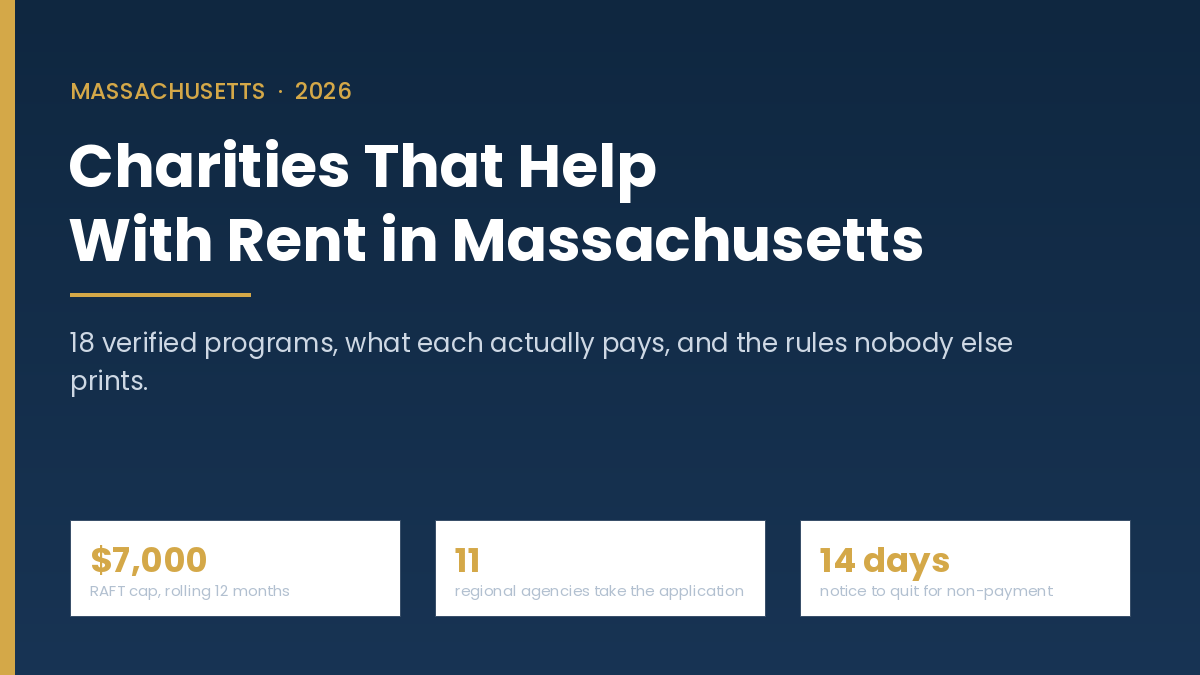
Massachusetts has the most generous state rent programme in the country, and most pages about it get the crucial part wrong. RAFT will pay up to $7,000 of the rent you already owe. It will not pay a single dollar of the rent you are about to owe. The administrative plan governing the programme says so in one line — “Rental stipends for future rent are not an allowable program expense” — and households who apply expecting a monthly subsidy lose weeks discovering it.
Two other things have changed that stale directories have not caught up with. The agency that runs housing money in Massachusetts is no longer the Department of Housing and Community Development; DHCD was folded into the Executive Office of Housing and Livable Communities in 2023, and the old web address now redirects. And since 30 June 2025 the central Rental Assistance Processing Center no longer processes RAFT applications — everything now runs through eleven regional agencies, and which one handles you is decided by your town, not by you.
This guide is the map: eighteen programmes and organisations that actually put money toward a Massachusetts tenancy, what each one pays, what it requires, the phone number the organisation publishes itself — and a section nobody else publishes, the ten organisations widely listed as paying rent in Massachusetts that do not. Every figure, rule and phone number below was read off the organisation’s own site or the codified statute on 10 September 2026. Where an organisation does not publish a detail, this page says so rather than inventing one.
Start here: the three moves that matter most
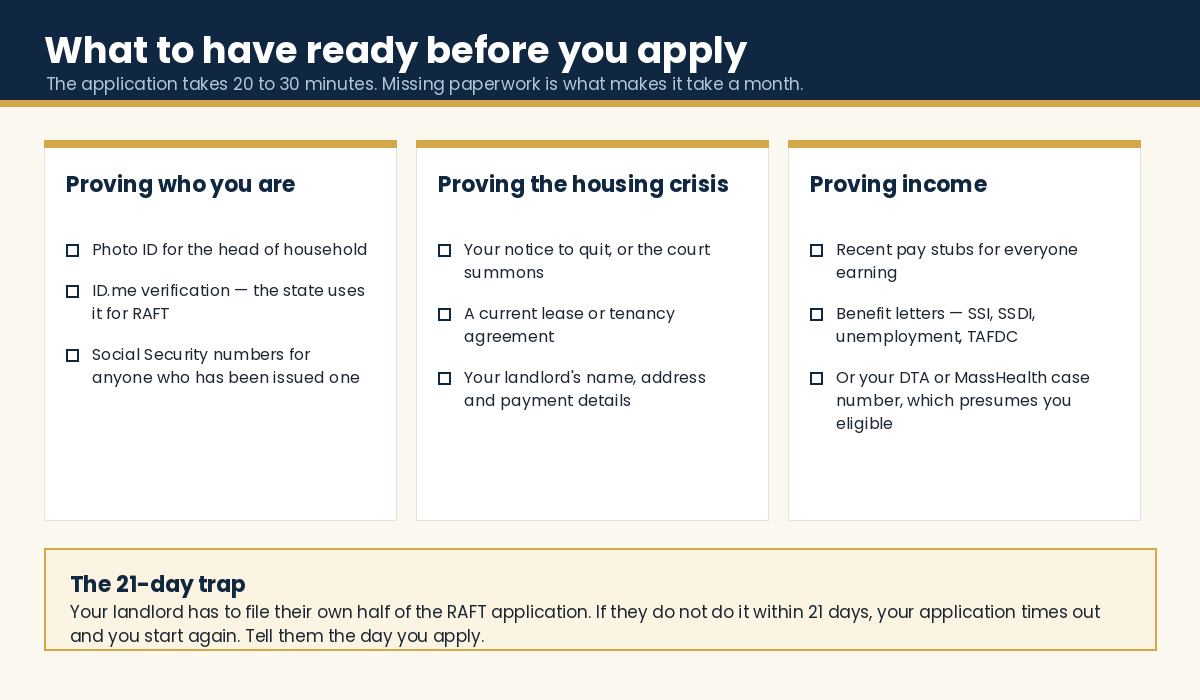
1. Apply for RAFT the day you get a notice to quit. The application is online at applyhousinghelp.mass.gov, takes 20 to 30 minutes, and requires ID.me identity verification. You need a notice to quit or a court summons in hand to claim arrears. If you cannot apply online, your regional agency will take it another way.
2. Tell your landlord the same day. RAFT is a two-sided application. Your landlord has to submit their half within 21 days, and if they do not, your application times out and you begin again. This is the most common avoidable failure in the whole system.
3. Call 2-1-1 or (877) 211-6277 for everything RAFT will not cover. Mass 211 is the state’s designated housing hotline, staffed 24 hours a day, seven days a week, free and confidential, with interpreters. TTY is (508) 370-4890. It does not hold money itself — it routes you to the local fund that does.
1. RAFT — Residential Assistance for Families in Transition
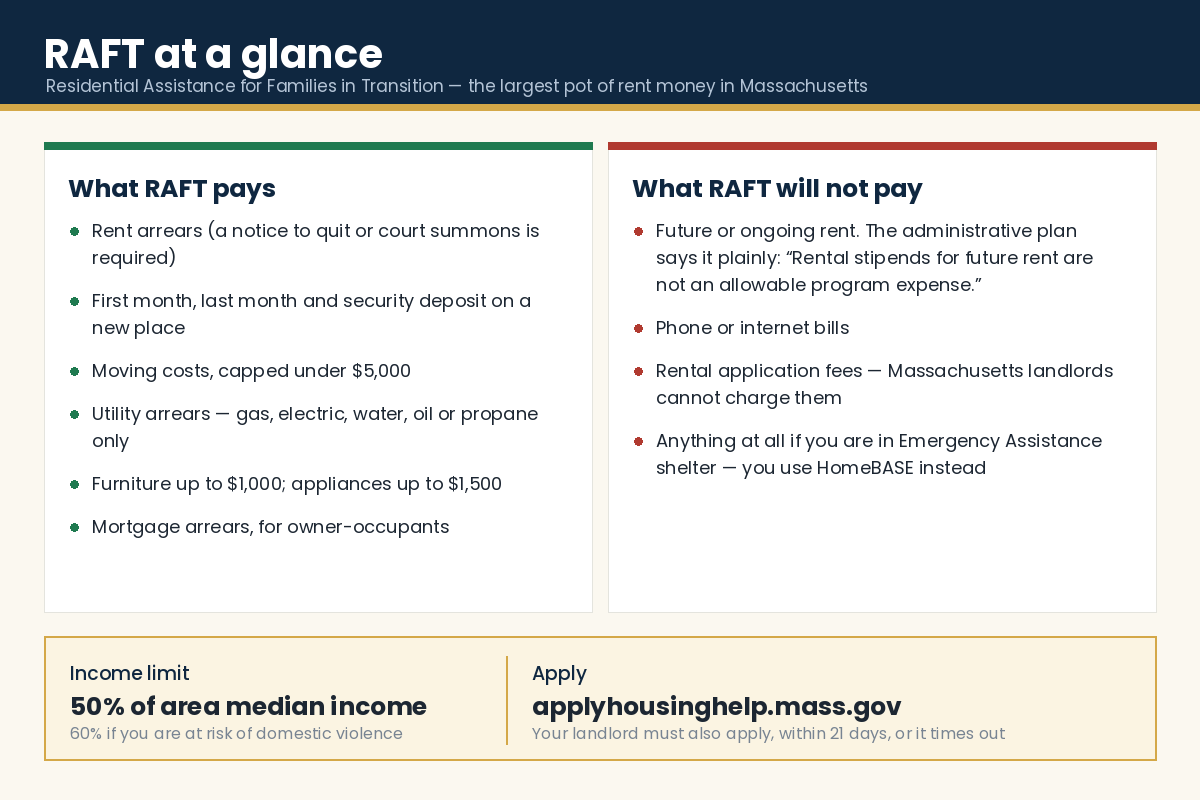
What it is. The state’s own description: “RAFT provides short-term emergency funding to help you with eviction, foreclosure, loss of utilities, and other housing emergencies.” It is state money, but it is delivered by eleven independent non-profits — which is why it belongs in a guide about charities rather than only in a guide about government.
How much. Up to $7,000 per household in any rolling twelve-month period. Rolling, not calendar: the administrative plan works through a household that received $9,000 across thirteen months and stayed compliant, because no twelve-month window inside that stretch exceeded $7,000. You may apply more than once in a year while the running total stays under the cap. Tenants who already hold an income-based subsidy are capped at six months of arrears in a rolling twelve months.
What it pays. Rent arrears; start-up costs meaning first month, last month and security deposit; moving costs, which must come in under $5,000; utility arrears limited to gas, electricity, water and deliverable fuel such as propane or oil; furniture up to $1,000; appliances up to $1,500; and mortgage arrears for owner-occupants. It does not pay phone or internet, and it does not pay rental application fees for the simple reason that Massachusetts landlords are not allowed to charge them.
Who qualifies. Income at or below 50% of area median income, or 60% where there is risk of injury or harm from domestic violence in the current housing. Because AMI is regional the dollar line moves: 50% in the Boston-Cambridge-Quincy area is $60,000 for a single person and $85,700 for a household of four; in Springfield $46,000 and $65,750; in Worcester $46,100 and $65,850. A household is presumed income-eligible if a member is verified in the state system as a Department of Transitional Assistance or MassHealth recipient. Households of all sizes and configurations qualify — you do not need children. Legal immigration status is not required. There is no future-sustainability test, which matters: you are not disqualified for being unable to show you can pay next month.
One exclusion to know. Families in Emergency Assistance shelter, or recently found eligible for it and diverted, use HomeBASE instead and are not eligible for RAFT. HomeBASE is the larger benefit, so this is a routing rule rather than a penalty.
Timing. The state publishes: usually fewer than 30 days for a decision, and payment usually within 14 business days of approval. Agency-published figures run longer, and the 21-day landlord clock runs regardless.
2. Who takes your application: the eleven regional agencies
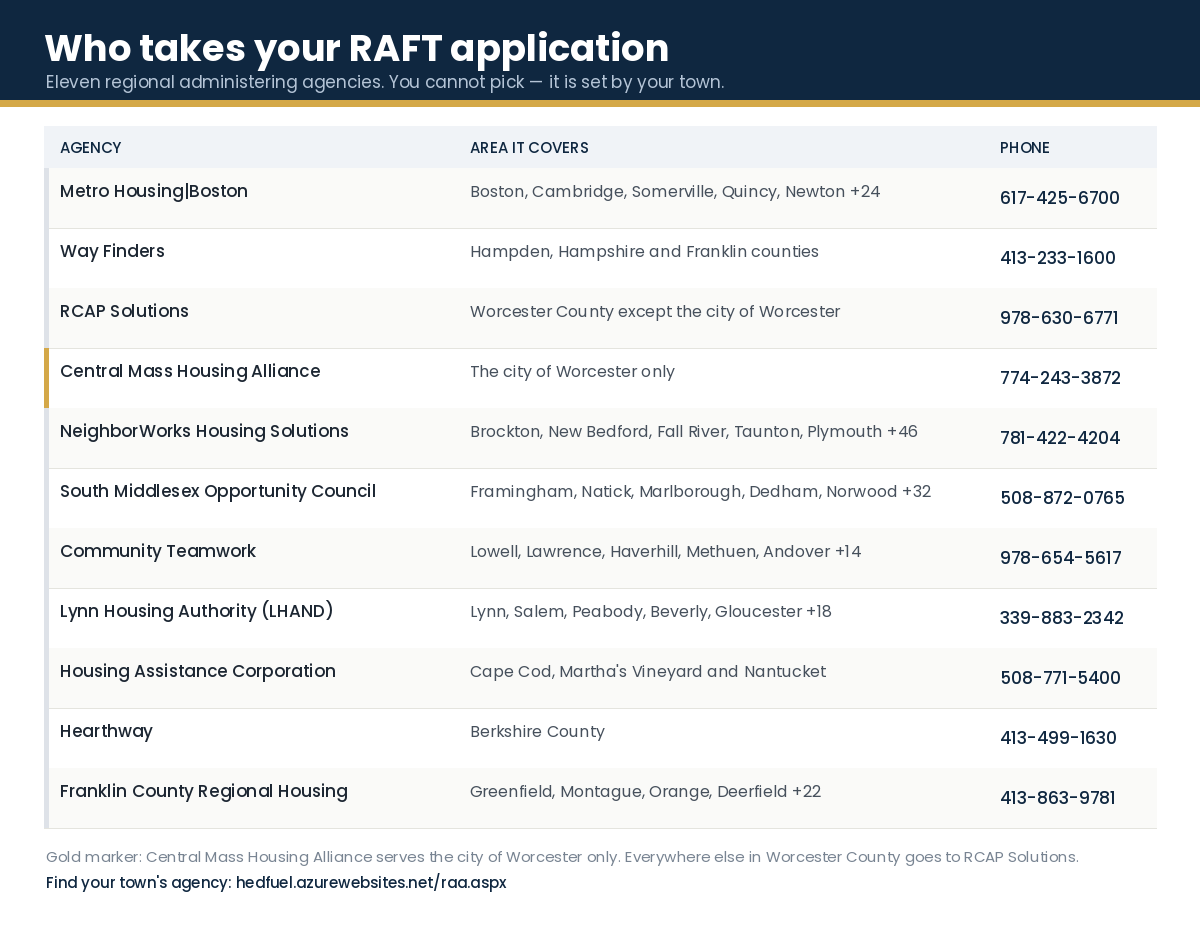
The single most useful thing on this page may be the Worcester County rule. Central Massachusetts Housing Alliance serves the city of Worcester and no other town. Everywhere else in Worcester County — Fitchburg, Leominster, Gardner, Milford, Southbridge, Webster, Clinton, Shrewsbury and sixty more — routes to RCAP Solutions in Worcester. Sending a Worcester County application to the wrong agency costs days.
A second routing rule: homeowner applications go to only four of the eleven — Hearthway, Housing Assistance Corporation, NeighborWorks Housing Solutions and Way Finders. Renters use all eleven.
The agencies also operate the state’s Housing Consumer Education Centers, which is why several of their intake addresses are literally HCEC mailboxes. The finder is at masshousinginfo.org; the official town-by-town RAA lookup is at hedfuel.azurewebsites.net/raa.aspx.
Several publish walk-in hours worth planning around. Metro Housing Boston at 1411 Tremont Street takes walk-ins Mondays only, from 9:00 a.m. until daily capacity is reached, and appointments Tuesday to Thursday. Central Massachusetts Housing Alliance at 18 Chestnut Street, Suite 100 in Worcester runs walk-ins Tuesday 9:30–11:30 a.m. and Wednesday 1:00–3:00 p.m. Hearthway at One Fenn Street in Pittsfield opens Tuesday, Wednesday and Thursday, 9 a.m. to 3 p.m.
3. HomeBASE — the biggest benefit, and you cannot apply for it
Up to $30,000 over a two-year period, which dwarfs RAFT. The catch is the door: “There is no open application for HomeBASE. Eligible families will be invited to apply.” You reach HomeBASE by being found eligible for Emergency Assistance family shelter and then diverted, which means the route in runs through the shelter system, not around it.
What it covers is broad: monthly rent help for up to two years in your own apartment, with a host, or co-sharing; first and last month’s rent, security deposit and broker’s fee; landlord bonuses of up to one month’s rent; up to $5,000 of rent or utility arrears where that debt is blocking a new lease; $2,500 for beds and a kitchen table; and moving costs, with one in-state move allowed every 24 months. You contribute at least 30% of gross monthly income toward rent. You do not need income to start.
A note on a contradiction we are not going to paper over: the HomeBASE page says two years and $30,000, while the Emergency Assistance page says rent help “for up to three years.” Two live state pages disagree. We are citing the dedicated HomeBASE page. Ask your diversion worker which applies to you.
Apply for Emergency Assistance at applyhousinghelp.mass.gov or (866) 584-0653, weekdays 8 a.m. to 5 p.m. HomeBASE is state-funded, and the state notes its funding is unaffected by changes in federal policy.
4. Emergency Assistance family shelter — and the six-month clock
EA is shelter, not cash, and it is capacity-constrained in a way the state states plainly: “The state is not able to expand EA Family Shelter capacity.” When there is no room, families join a contact list.
The rules changed in December 2025 and older guides have it wrong. As of 15 December 2025 all families entering EA are eligible for the Bridge Shelter Track, which allows a stay of up to six months, with hardship waivers available. A shorter 30-business-day Rapid Shelter Track exists on paper and is not currently active; the state has said it will be added if space becomes limited.
Eligibility: Massachusetts residency; pregnant or a child under 21; gross income at or below 115% of the federal poverty guidelines, which for 2026 means monthly gross at or below $1,530 for one person, $2,618 for three and $3,163 for four, rising $544 per additional member; homelessness caused by one of four no-fault reasons — fire, flood, natural disaster, condemnation or foreclosure; fleeing domestic violence; no-fault eviction; or a child exposed to a serious health and safety risk. Every family member needs eligible immigration status, and everyone 18 or over needs a CORI check. If you are denied, you have 21 days from the notice to appeal or you lose the hearing.
Ten offices take applications in person, and several are not open daily: Boston (2201 Washington St, Roxbury) and Springfield, Brockton, Chelsea, Lawrence and Worcester run Monday to Friday; Hyannis is Tuesday only; Lowell is Tuesday and Thursday; New Bedford and Salem are Monday, Wednesday and Friday.
5. Massachusetts Rental Voucher Program (MRVP) — the long game
MRVP is the state’s own Section 8 analogue and the only programme on this page that pays ongoing rent. You pay at least 30% of net monthly income; the voucher covers the rest up to a payment standard set by zip code and voucher size, so there is no single dollar cap to quote and any page that gives you one is guessing.
The income limit is 80% of area median income — far higher than RAFT’s 50%, which means households turned down for RAFT on income may still qualify here. Individuals, families, people with disabilities and elders are all eligible.
The honest warning: “Even if you are eligible for a voucher, you will be placed on a waiting list because of high demand,” and the state publishes no expected wait. Apply anyway, and apply early — through CHAMP at publichousingapplication.ocd.state.ma.us, or on paper at your local housing authority. Questions: 617-573-1250, weekdays 8:45 a.m. to 5 p.m., or EOHLCmrvp@mass.gov. If you are homeless you may qualify for a homeless priority that speeds the process.
6. Chapter 115 — the Massachusetts veterans’ benefit that pays rent
This one is routinely mislabelled as a charity. It is not: Chapter 115 is a statutory public benefit under M.G.L. c. 115, administered by the Executive Office of Veterans Services through local Veterans’ Service Officers, and it is means-tested on veteran status, family status, income and housing costs. It covers food, shelter, clothing, fuel and medical care, and the state’s Safety Net page lists rent assistance and prevention of veteran homelessness explicitly.
No benefit amounts are published — the state directs applicants to a benefit estimator instead. Apply through your local VSO, or contact the Executive Office of Veterans Services at 617-210-5480, weekdays 8:45 a.m. to 5 p.m. Veterans should also read housing assistance for disabled veterans for the federal programmes that stack on top of this.
What to have ready before you apply
The charities: who pays rent in Massachusetts, region by region
Greater Boston
Catholic Charities Boston (Catholic Charitable Bureau of the Archdiocese of Boston). Its Living Assistance programme provides “emergency fuel, rental, and utility assistance.” Priority goes to households with a utility shut-off notice or an eviction summons, public-housing tenants served with a notice to quit, households needing emergency fuel, and people who must move for safety reasons including domestic violence. The organisation publishes an unusually honest caveat and you should take it seriously: “Currently, financial assistance is not guaranteed due to limited funding.” No maximum amount and no income limits are published. Apply through the online interest form at ccab.org; the county dropdown accepts Suffolk, Norfolk, Essex, Middlesex and Plymouth, which is the effective service area. Offices include Dorchester (185 Columbia Road, 617-506-6600), Brockton (169 Court St, 508-587-0815), Lowell (70 Lawrence Street, 617-451-7988), Lynn (117 N. Common St, 617-451-7930), Salem (280 Washington St, 617-464-8071) and Somerville (270 Washington St, 617-506-6671).
Society of St. Vincent de Paul, Council of Boston. Helps with “food, housing, utility bills, or other hardships” across the Archdiocese of Boston — effectively eastern Massachusetts. Call 781-344-3100 or 781-341-4560. Understand how this model works before you call: help is delivered by parish-based volunteers called Vincentians, who typically make a home visit and then bring the case to the parish conference for a decision. Conferences serve the households inside their own parish boundaries, no amounts are published, and there is no statewide number. That is not evasiveness — it is how the money moves. Churches that help with rent explains the pattern in more depth.
Jewish Family & Children’s Service. Its Center for Basic Needs Assistance manages several funds and states that “financial assistance is available primarily for housing costs such as rent, moving expenses, fuel, and utilities.” It serves the Jewish community, existing JF&CS clients, and others in Greater Boston. Income eligibility applies but is not quantified, and no maximum grant is published. Call 781-693-1388 or email basicneeds@jfcsboston.org. Note that the amounts JF&CS does publish — $1,000 to $10,000 through the Hebrew Free Loan, $1,000 to $5,000 through the Max Rosenfeld Loan — are interest-free loans, not rent grants.
Rosie’s Place (women only). Its Housing Stabilization Program “can step in to help financially with rent arrearages and utility shutoffs, and help with transportation, the purchase of household items and furniture.” This is not an open application programme — it is an extension of existing casework with guests of Rosie’s Place, and last year it supported 58 women. 889 Harrison Avenue, Boston; 617-442-9322.
Action for Boston Community Development (ABCD). Assists Boston, Malden, Medford and Everett residents facing eviction to apply for funding sources, and runs two named move-in programmes with published income rules: Malden Start Secure covers first and last month’s rent for people living in or moving to Malden at or below 80% of AMI, with the added condition that rent cannot exceed 75% of household income; Medford Move-In covers first and last for Medford at or below 100% of AMI. Maximum amounts are not published. Email rentalassistance@bostonabcd.org or call 617-348-6330.
Worcester County
Catholic Charities Worcester County. “As funds allow, our Area Offices can provide limited financial assistance with rent, mortgage, and utility bills,” paid directly to the landlord or utility on your behalf after a structured application. Part of the funding comes from a grant from the Massachusetts Attorney General’s Office. Neither amounts nor income thresholds are published. Four walk-in offices, all 9:00 a.m. to 3:00 p.m. weekdays: Worcester (10 Hammond Street, 508-798-0191), Leominster (196 Mechanic Street, 978-840-0696), Milford (200 Main Street, 508-234-3800) and Southbridge (79 Elm Street, 508-765-5936).
Society of St. Vincent de Paul, Diocese of Worcester. Twenty-one active conferences across the diocese, from Gardner and Winchendon in the north to Milford, Uxbridge and Blackstone in the south. The council office is explicit that it does not take requests itself: “Assistance is provided by the local Conferences.” Use the map at svdpworcester.org to find yours; the council is at (508) 556-0559.
Worcester Community Action Council. Worth knowing precisely what this is: WCAC does not fund rent, it processes RAFT applications in partnership with RCAP Solutions for South County and Worcester residents, by appointment only — Wednesdays 9:00–11:30 a.m. at 18 Chestnut Street, Suite 500 in Worcester, and Fridays 9 a.m. to noon at the Southbridge Family Resource Center. Email resiliency@wcac.net or call (508) 754-1176.
Western Massachusetts
Way Finders is both the RAFT agency for Hampden, Hampshire and Franklin counties and a substantial housing organisation in its own right, with housing centres in Springfield, Holyoke and Northampton. 413-233-1600. It publishes a realistic expectation: it can take up to three business days simply to respond to a request for housing help.
Springfield Partners for Community Action is an application-assistance site and says so with admirable clarity: “Springfield Partners does NOT qualify applicants OR make payments. We will ASSIST you in completing the online application.” 721 State Street, Springfield; 413-263-6500, option 8.
Berkshire Community Action Council administers the FEMA-funded Emergency Food and Shelter Program, which “provides one-time emergency aide to residents in need of rent, mortgage and utility assistance.” It carries an unusual rule: recipients “must provide proof of the emergency but do not need to meet limited-income guidelines.” Funds may be limited. Offices at 1531 East Street and 14 Maplewood Avenue in Pittsfield, (413) 445-4503, and 85 Main Street in North Adams, (413) 663-3014, open 7:00 a.m. to 4:00 p.m. Monday to Thursday.
Catholic Charities, Diocese of Springfield is included here with a caution rather than a recommendation. Its GWTNI programme describes “annual, one-time financial support for residents facing eviction, overdue utility bills, or unsafe housing conditions,” but no amounts, eligibility rules or intake route are published, its housing programme CASSI is explicitly navigation rather than payment, and the contact form on its own site currently returns “This form is not accepting responses at this time.” Phone 413-732-3175 and ask directly.
Southeastern Massachusetts and the Cape
Catholic Charities, Diocese of Fall River runs eviction-prevention assistance funded by the federal Emergency Solutions Grant, for households at 30% of AMI with a housing court judgment to vacate, or at 50% of AMI with a notice to quit under the COVID-related track. Access is through Coordinated Entry: Fall River residents (774) 520-2555, New Bedford residents (508) 999-4757. The diocese serves Bristol, Barnstable, Nantucket, Dukes and Plymouth counties. Be aware that the programme page is visibly out of date — unrendered page code, COVID-era eligibility language and two different email domains for the same inboxes — so phone rather than relying on what it says.
Father Bill’s & MainSpring places prevention staff inside the housing courts at Plymouth, Canton, Brockton, Fall River, New Bedford, Taunton and Hyannis. Read what it actually offers carefully: it says families “may be eligible for temporary cash assistance for rent from the state through programs like Emergency Assistance or HomeBASE” — meaning it routes you to state money rather than paying from its own funds. Yawkey Housing Resource Center in Quincy 617-770-3314; Smith Family Housing Resource Center in Brockton 508-587-5441.
Housing Assistance Corporation is the RAFT agency for Cape Cod, Martha’s Vineyard and Nantucket, at 255 Independence Drive, Hyannis, 508-771-5400. On the islands it is effectively the only door.
Statewide
The Salvation Army requires the most honest treatment on this page. Its Massachusetts divisional page advertises “emergency rent and utility assistance,” but publishes no eligibility rules, no maximum amount, no application method and no phone number — it is national boilerplate pointing at a location finder. At corps level the picture is narrower: the Boston Kroc Center’s only published financial programme is utility assistance, and it serves the 02121, 02125 and 02127 zip codes only, referring everyone else to 617-542-5420. So the accurate advice is: rent help from the Salvation Army in Massachusetts is corps-by-corps and discretionary. Phone your nearest corps — Boston Kroc 617-318-6900, Worcester 508-756-7191, Springfield 413-733-1518, Lowell 978-458-3396, Lawrence 978-682-8038, New Bedford 508-997-6561, Brockton 508-583-1896, Lynn 781-598-0673, Pittsfield 413-442-0624, Quincy 617-472-2345, Cambridge 617-547-3400, Fall River 508-679-7900, Framingham 508-875-3341, Haverhill 978-374-7571, Holyoke 413-532-6312, Hyannis 508-775-0364, Plymouth 508-746-1559, Salem 978-744-5181 — and ask what the corps has this month.
Veterans
Veterans Inc. (Worcester) delivers the VA’s Supportive Services for Veteran Families programme and lists financial assistance for rent, utilities, moving expenses, security deposits, transportation, childcare and legal services. Three conditions, all required: veteran head of household or spouse; income not exceeding 80% of area median income; and either currently in permanent housing and seeking eviction prevention, or homeless with a scheduled move-in inside 90 days. Call 800-482-2565. Maximum amounts are not published.
New England Center and Home for Veterans (Boston) runs SSVF with time-limited payments for rent, security deposits and transportation, for households at or below 50% of AMI across Suffolk, Norfolk, Middlesex, Essex and Bristol counties. Programme line 617-371-1706.
Ten organisations widely listed for Massachusetts rent help that do not pay rent
This section exists because the wrong phone call costs a day you may not have. Every entry below was checked against the organisation’s own current site.
- Boston’s Rental Relief Fund — the page is gone. The URL now serves the Office of Housing Stability’s general page, which offers eviction-process help, legal help, eviction sealing and Access to Counsel, and mentions no cash fund. 617-635-4200.
- Jewish Family Service of Western Massachusetts — no rental or emergency financial assistance programme is published. Its services are Jewish Life, Older Adults, Behavioral Health, Citizenship & Immigration and the New American Program. Frequently paired with JF&CS Boston on other lists; they are different organisations doing different things.
- Valley Opportunity Council — no rent-arrears programme. Its housing pages cover the Main Street Shelter and properties it owns; its financial help is fuel and energy.
- Catholic Charities, Diocese of Springfield — largely navigation, not payment. See the caution above.
- Massachusetts Coalition for the Homeless — does not pay rent. Its programmes are A Bed for Every Child, Birth to Big Kid, the Casa Project and systemic advocacy.
- Mass 211 — information and referral only. Still the right first call; just not a source of money.
- United Way of Massachusetts Bay — states plainly that people seeking immediate assistance should contact Mass 211. It does not give direct aid.
- Community Action Agency of Somerville — its Housing Advocacy Program helps you pursue rental assistance and coordinate lease-up, and notes that its advocates are not lawyers. Somerville residents up to 80% AMI. 617-623-7370.
- Massachusetts Good Neighbor Energy Fund — energy bills only, never rent, for households between 60% and 80% of state median income who are not eligible for state or federal energy assistance. Applied for through a Salvation Army corps. Useful, but for a different bill — see charities that help with utility bills.
- Federal ERAP — the pandemic-era Emergency Rental Assistance Program. Massachusetts stopped taking federally funded ERAP applications in April 2022 and RAFT replaced it. Any page still telling you to apply is years out of date.
One more that deserves its own line, because it is a naming problem rather than a dead programme: ERMA, the Emergency Rental and Mortgage Assistance programme, was a COVID-era creation and is not among the programmes the state currently operates. Every plausible mass.gov URL for it returns a 404, it appears nowhere in the current RAFT administrative plan, and there is no ERMA application in 2026. Some agency websites still carry “erma” in a URL slug; the page behind it is RAFT.
What Massachusetts law gives you while you are sorting the money out
Fourteen days’ notice, whichever kind of tenant you are. M.G.L. c. 186 § 11 covers written leases and § 12 covers tenancies at will, and both require fourteen days’ written notice to quit for non-payment. The familiar “thirty days or a full rental period” figure is the no-cause rule, not the non-payment rule.
The right to cure, and it is better for tenants at will than most people realise. Under § 12, if you are a tenant at will who has not received a similar notice in the previous twelve months, your tenancy is not terminated if you pay the full rent due within ten days of receiving the notice. The statute also requires the landlord to print that right in the notice itself — and if they leave it out, your window to pay extends all the way to the day your answer is due in court. Lease tenants under § 11 can also cure up to the day the answer is due, but must pay the rent with interest and costs of suit.
Late fees cannot be charged for thirty days. M.G.L. c. 186 § 15B(1)(c): “No lease or other rental agreement shall impose any interest or penalty for failure to pay rent until thirty days after such rent shall have been due.”
Only a court can remove you. A landlord who changes the locks or otherwise tries to regain possession by force without judicial process faces a fine of $25 to $300 or up to six months’ imprisonment under M.G.L. c. 186 § 14, plus liability for actual and consequential damages or three months’ rent, whichever is greater, plus costs and attorney’s fees.
Eviction records can now be sealed. M.G.L. c. 239 § 16, added by the Affordable Homes Act and in force since May 2025, lets you petition to seal a no-fault eviction record at any time after the case concludes, a non-payment record after four years, and a fault eviction after seven — provided no further eviction action has been brought against you in that window. Cases dismissed or decided in your favour can be sealed at any time. Once sealed, you may answer “no record” on a housing or credit application, and consumer reporting agencies must remove the information within thirty days.
Free legal help, and get it early
Do not wait for the court date. Greater Boston Legal Services runs a housing line on 617-603-1807, weekdays 9 a.m. to 5 p.m. Community Legal Aid covers Berkshire, Franklin, Hampden, Hampshire and Worcester counties on (855) 252-5342, with published intake windows most weekday mornings. The Volunteer Lawyers Project takes intake on 617-603-1700 and runs a Housing Lawyer for the Day clinic. Every Housing Court runs a Lawyer for the Day programme — walk-in, first come first served, serving tenants and landlords both; if the attorney enters a formal appearance you get a two-week continuance of trial. And masslegalhelp.org is the self-help library, with a dedicated section on eviction and eviction sealing.
One caveat worth stating because it is widely oversold: the statewide Access to Counsel programme, which MLAC began administering in January 2025, is a prioritised and funding-limited programme delivered through six regional legal aid organisations. It is not a universal right to a lawyer, and there is no public tenant-facing hotline for it — you reach it through the organisations above. More options in free legal help for low-income households.
How to work this list
Apply to RAFT first and on the same day as your notice, because it is the largest sum and the slowest clock. While it processes, work the local list — the parish conference, the Catholic Charities area office, the community action agency — because those funds move faster and in smaller amounts, and nothing stops you receiving both. Tell each organisation what else you have applied for; several will ask, and none of them will be annoyed by it. If you are moving rather than staying, the money is easier to find: charities that help with security deposits and charities that help with moving costs both cover programmes that fund a move more readily than arrears.
And if the tenancy is already gone, do not spend days on rent money that cannot be recovered — go to charities that help with emergency shelter and call the Emergency Assistance line at (866) 584-0653.
Related help
Frequently asked questions
Does Massachusetts still have a state rental assistance program in 2026?
Yes, and it is one of the most generous in the country. RAFT — Residential Assistance for Families in Transition — provides up to $7,000 per household in any rolling twelve-month period, and it is open. It is run by the Executive Office of Housing and Livable Communities, which replaced the old Department of Housing and Community Development in 2023, and the application is at applyhousinghelp.mass.gov. The catch that trips up most applicants is what RAFT is for: arrears and move-in costs, not the rent you are about to owe.
Will RAFT pay my rent going forward?
No, and this is the single most common error published about the programme. The RAFT administrative plan in force says it in one sentence: “Rental stipends for future rent are not an allowable program expense.” RAFT pays rent you already owe, plus first month, last month, security deposit and moving costs if you are moving. If you need an ongoing monthly subsidy, the programme you want is the Massachusetts Rental Voucher Program, and you should expect a waiting list.
How much is the RAFT cap and how does the twelve-month rule work?
The cap is $7,000 in any rolling twelve-month period, not per calendar year and not per application. You can apply more than once inside a year as long as the running total stays under $7,000. The administrative plan gives a worked example of a household receiving $9,000 across thirteen months without breaching the cap, because no rolling twelve-month window inside that period exceeded $7,000. Tenants who already hold an income-based rental subsidy are limited more tightly, to six months of arrears in a rolling twelve months.
Who actually decides my RAFT application?
One of eleven regional administering agencies, and you do not get to choose which — it is set by the town you live in. The most common mistake is Worcester County. Central Massachusetts Housing Alliance handles the city of Worcester and nothing else; every other town in Worcester County goes to RCAP Solutions. The state’s own lookup tool at hedfuel.azurewebsites.net/raa.aspx will tell you which agency owns your town.
Do I need children in the household to get help with rent in Massachusetts?
Not for RAFT. The administrative plan states that households of all sizes and configurations may be found eligible. You do need children under 21, or to be pregnant, for Emergency Assistance family shelter and therefore for HomeBASE, which is the shelter-linked rehousing benefit. MRVP is open to individuals, families, people with disabilities and elders alike. So the child requirement applies to the shelter track, not to the rent-arrears track.
Do I need legal immigration status to get RAFT?
No. The administrative plan is explicit: households do not need legal immigration status to qualify for RAFT, though anyone in the household who has been issued a Social Security number has to provide it. Emergency Assistance family shelter is different — every family member must have an eligible immigration status, and a child with eligible status satisfies the requirement for the family.
How long does a Massachusetts rent application take?
The state publishes two numbers for RAFT: usually fewer than 30 days to get a response, and payment usually within 14 business days of approval. Agencies publish their own figures that run longer — Metro Housing Boston has said four weeks for a completed application, and Way Finders says up to three business days simply to respond to a housing-help request. The delay you can control is your landlord’s. They must file their own half of the application within 21 days or yours times out and you start again.
What is the income limit for rent help in Massachusetts?
RAFT sets it at 50% of area median income, or 60% if you are at risk of harm from domestic violence in your current housing. Because AMI is regional, the dollar figure differs: in the Boston-Cambridge-Quincy area the 50% line is $60,000 for one person and $85,700 for four, while in Springfield it is $46,000 and $65,750 and in Worcester $46,100 and $65,850. You are also presumed income-eligible if someone in the household is verified as a Department of Transitional Assistance or MassHealth recipient. MRVP runs on a much higher limit — 80% of AMI.
How fast can I be evicted in Massachusetts for not paying rent?
You get a fourteen-day notice to quit, whether you are a tenant at will under M.G.L. c. 186 § 12 or a tenant under a written lease under § 11. If you are a tenant at will and you have not had a similar notice in the previous twelve months, you can stop the eviction outright by paying the full rent owed within ten days of receiving the notice — and if the landlord’s notice failed to print that right, your window extends to the day your answer is due in court. Lease tenants can cure up to the day the answer is due, but must pay rent with interest and costs. Only a court can order you out; a landlord who changes the locks faces a fine, possible imprisonment, and liability for three months’ rent or actual damages, whichever is greater.
Which Massachusetts organisations show up on rent-help lists but do not actually pay rent?
Several, and it is worth knowing before you spend a call. Boston’s Rental Relief Fund page no longer exists — the Office of Housing Stability now offers eviction help and legal referral, not cash. Jewish Family Service of Western Massachusetts publishes no rental assistance programme. Valley Opportunity Council’s financial help is fuel and energy, not rent. Mass 211 and United Way of Massachusetts Bay are referral services and say so. Community Action Agency of Somerville helps you pursue rental assistance but does not fund it. The Massachusetts Good Neighbor Energy Fund pays energy bills only. And federal ERAP, still listed on many pages, stopped taking Massachusetts applications in April 2022.
How we verified this guide. Every programme, phone number, income rule, dollar amount and eligibility threshold on this page was read off the organisation’s own website or the governing document on 10 September 2026, not copied from a directory. RAFT figures come from the administrative plan in force, effective 1 July 2026, and from the Executive Office of Housing and Livable Communities’ own pages; the area median income thresholds come from the state’s own regional lookup tool. Statutes are quoted from the codified text of M.G.L. c. 186 §§ 11, 12, 14 and 15B and c. 239 § 16 on the Legislature’s official site. Where two state pages disagree — as they do on whether HomeBASE runs two years or three — we say so and cite the dedicated programme page rather than picking a side quietly. Where an organisation does not publish a detail, such as a maximum grant or an income threshold, we wrote that it does not publish it rather than filling the gap; only RAFT publishes a verified cap. Ten organisations that appear on other Massachusetts rent-help lists were deliberately listed as not paying rent because we could not confirm a rent programme at the source. We are not promising a re-verification cadence we cannot guarantee; this page carries the date it was checked. Funding in this field changes weekly, so call before you travel, and tell us if you find something that has moved.