Donorbox vs Givebutter (2026): The Fee Math, the Fine Print, and Who Each One Fits

Donorbox and Givebutter are the two names that come up in almost every small-nonprofit software conversation, and they charge for the same work in opposite ways. Donorbox bills you: a platform percentage on every gift, plus the payment processor’s cut, with a $150/month plan that buys the percentage down. Givebutter bills your donors: nothing comes out of your gift at all, as long as optional tips stay switched on and the donation is not one of the several types the policy excludes.
Which is cheaper depends less on the headline rate than on four things almost no comparison mentions: whether your Givebutter account was created before or after 9 September 2025, how much of your money arrives by bank transfer rather than card, whether you take donations in person on a card reader, and whether you are a US organisation at all. This page works through all four with the vendors’ own published numbers, read on 12 September 2026, and shows the arithmetic rather than a verdict badge.
Looking at more than two platforms? This page is the head-to-head. Our wider donation-platform comparison puts both of these against Zeffy and the rest of the market.
The short answer
| If this is you | Pick | Why |
|---|---|---|
| Event-heavy, auctions, peer-to-peer, mostly online card gifts | Givebutter (tips on) | Under the Givebutter Guarantee your organisation pays no platform fee and no processing fee. Donorbox charges 3.95% on events and memberships on its free plan. |
| Large bank-transfer (ACH) gifts, major-donor heavy | Donorbox | Stripe ACH is 0.8% capped at $5, and Donorbox caps its own fee at $25 on ACH. Givebutter with tips off charges 1.9% + 30¢ uncapped plus 3%. |
| Outside the United States | Donorbox | Givebutter requires a US EIN or SSN, a US bank account and a US phone number, and processes only in USD. Donorbox works wherever Stripe or PayPal does, in 50+ currencies. |
| You refuse to put a tip prompt in front of your donors | Either — but price it honestly | Tips off, Givebutter is a flat 3% platform fee plus 2.9% + 30¢. Donorbox Standard is 2.95% plus a discounted 2.2% + 30¢. The gap is smaller than the marketing implies. |
| Doing $150,000+ a year through donation forms | Donorbox Pro | $150/month buys the platform fee down from 2.95% to 1.75%. The break-even is $12,500 a month in form giving — the arithmetic is below. |
| Taking donations in person with a card reader | Read the fine print on both | Card-reader gifts are the one place Givebutter’s “0% platform fees” does not hold: they carry 1% plus 2.9% + 30¢. Donorbox’s kiosk is 1.75% plus 2.7% + 5¢ on a device that costs $80/month. |
Two pricing models, side by side
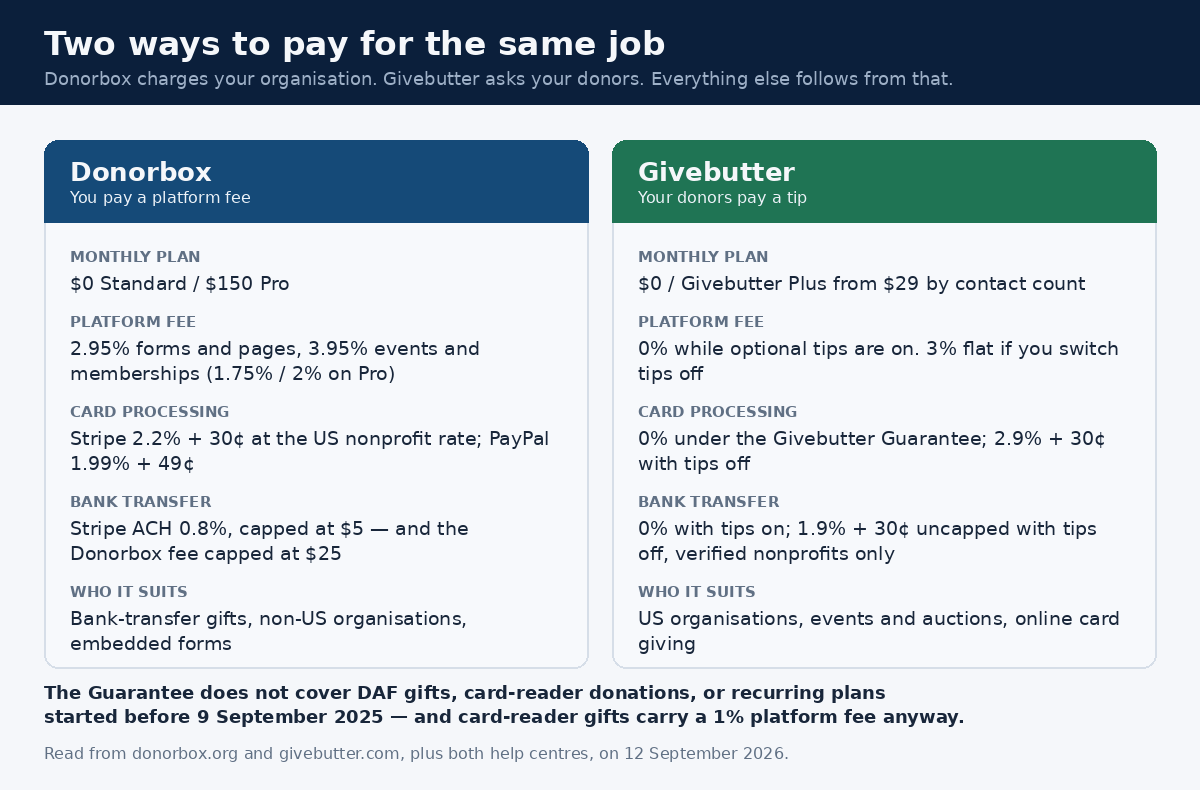
| Donorbox Standard | Donorbox Pro | Givebutter (tips on) | Givebutter (tips off) | |
|---|---|---|---|---|
| Monthly cost | $0 | $150 | $0 | $0 |
| Platform fee | 2.95% forms, pages, crowdfunding, org peer-to-peer 3.95% events, memberships, supporter peer-to-peer |
1.75% / 2% on the same split | 0% | 3% flat, all campaign types |
| Card processing | Stripe 2.2% + 30¢ (US nonprofit rate); PayPal 1.99% + 49¢ | 0% — Givebutter covers it | 2.9% + 30¢ | |
| Bank transfer | Stripe ACH 0.8%, capped at $5 per transaction | 0% | 1.9% + 30¢, verified nonprofits only | |
| Who pays | You, unless donors opt to cover fees | Donors, via an optional tip at checkout | ||
Donorbox publishes those platform rates as a band on its pricing page — “Fees between 2.95% and 3.95%” on Standard, “Fees between 1.75% and 2%” on Pro, “Fees between 1.6% and 2%” on Premium, which is quote-only. The band is not vague: the higher number applies to event ticketing, memberships and supporter-led peer-to-peer, the lower one to donation forms, fundraising pages, QuickDonate and organisation-led peer-to-peer. Team seats are capped at five on Standard, ten on Pro and thirty on Premium.
Givebutter’s model is one sentence on its pricing page: “0% platform fees across all campaign types when tips are enabled. If you disable tips, a flat 3% platform fee applies.” Processing is handled the same way — “Nonprofits don’t pay processing fees when tips are enabled, backed by the Givebutter Guarantee. Standard processor rates apply when tips are disabled.” The money to run the platform comes from donors choosing to add a tip, which Givebutter describes as “optional tips given as a thank-you from donors” that “never come out of the amount donated to your organization” and that donors “can be edited or removed” at checkout.
What “0% fees” does not cover
The Givebutter Guarantee is real, and for a typical online-giving mix it does what it says. It also has a published exclusion list, and that list is where nonprofits get surprised. Givebutter’s own help centre states the Guarantee “does not apply to”:
- Payment methods that cannot show a tip prompt — named as “DAFpay, and card reader/terminal transactions.” Donor-advised-fund gifts through DAFpay carry a 2.9% processing fee charged by Chariot, and Givebutter states plainly that for those gifts “Donors cannot cover processing fees and will not be prompted to leave a tip.”
- Recurring plans that began before 9 September 2025. Those stay on the pricing terms in force when the plan was created.
- Imported recurring plans, which are “not automatically covered” — you have to modify each plan after import to bring it under the Guarantee.
- Any campaign with tips switched off, which moves you to the flat 3%.
There is a fifth case that is not on the exclusion list but contradicts the headline anyway. In-person giving through a Givebutter card reader is documented as “the standard 2.9% + 30 cents per transaction rate, plus a 1% platform fee.” That is a platform fee on a campaign type, on a page that says there are none. The readers themselves cost $99 each. If your fundraising year is built around galas, walks and festival tables, price that 1% into your comparison rather than assuming the Guarantee travels with you.
The fork almost nobody tells you about: legacy vs standard pricing
On 9 September 2025 Givebutter changed how its tips-off pricing works, and announced it on 24 September 2025. Accounts created on or after that date are on standard pricing: the Guarantee with tips on, a flat 3% with tips off. Accounts created before it stay on legacy pricing unless they choose to move, and legacy charges by campaign type.
| Campaign type, tips OFF | Legacy account (created before 9 Sep 2025) | Standard account (created on or after) |
|---|---|---|
| Donation forms | 1% | 3% |
| Fundraising pages | 3% | 3% |
| Events and auctions | 5% | 3% |
Givebutter’s own guidance on which side to be on is unusually direct: “If you’re a donation form-heavy organization, sticking with legacy pricing may make more sense (1% legacy fee for forms vs. 3% standard fee). If you’re an event-heavy organization, switching to standard pricing could save you money (5% legacy fee for events vs. 3% standard fee).”
Two things make this worth checking before you do anything else. First, if you already have a Givebutter account, your fees are not what the current pricing page says — they are whatever applied on the day you signed up, unless you switched. Second, the switch is one-way: “Once you confirm, switching to Standard pricing is permanent and effective immediately. You cannot switch back to Legacy pricing.” A form-heavy legacy account that flips to standard to chase a marketing message triples its tips-off fee on its main revenue line, permanently.
Donorbox’s fee ladder, in full
Donorbox’s complexity is on the fee side rather than the plan side. The plan list is short — Standard at $0, Pro at $150/month with a stated but unpublished discount for annual billing, Premium by quote — but the fee that applies depends on which product the gift came through and which processor took the card.
| Gift arrives through | Standard | Pro | Premium |
|---|---|---|---|
| Donation forms, fundraising pages, QuickDonate, crowdfunding, organisation peer-to-peer | 2.95% | 1.75% | 1.6% |
| Event ticketing, memberships, supporter peer-to-peer | 3.95% | 2% | 2% |
| Cryptocurrency and stock | 3.95% all-in — “This includes both the Donorbox platform fee and the payment processing fee.” | ||
| Donorbox Live kiosk (in person) | 1.75% platform + Stripe 2.7% + 5¢. Device $80/month or $820/year on Standard and Pro, $50/month on Premium; extra devices $15/month. | ||
On top of that sit the processor’s own rates, and this is where Donorbox quietly wins back a chunk of what its platform fee costs. Because Donorbox runs your gifts through your own Stripe and PayPal accounts, a registered US nonprofit gets the discounted rates: 2.2% + 30¢ on cards and wallets through Stripe and 1.99% + 49¢ through PayPal, against the 2.9% + 30¢ and 2.89% + 49¢ that other entities pay. Givebutter’s published card rate is the undiscounted 2.9% + 30¢, which only matters when tips are off — but when tips are off, it matters on every single gift.
Bank transfers are the sharpest divergence. Stripe ACH through Donorbox is 0.8% capped at $5 per transaction, and Donorbox’s help centre adds a second cap that is not on its pricing page: “for ACH bank transfers (US direct bank debit), Donorbox fees are capped at $25.” Two caps stacked means a $5,000 bank gift costs $30 in total. The same gift on Givebutter with tips off costs $245.30, because neither the 3% platform fee nor the 1.9% ACH rate is capped. With tips on it costs nothing at all — which is the whole argument, and the reason the tip toggle is the single most consequential setting in either product.
The $150 question: when Donorbox Pro pays for itself
Pro buys the platform fee down. The break-even is arithmetic, not judgement:
- Form and page giving: 2.95% − 1.75% = 1.2 points saved. $150 ÷ 0.012 = $12,500 a month, or $150,000 a year, before the plan pays for itself.
- Events, memberships and supporter peer-to-peer: 3.95% − 2% = 1.95 points saved. $150 ÷ 0.0195 = $7,692 a month, about $92,300 a year.
Below those thresholds you are paying $1,800 a year for the feature set rather than the discount — Zapier and API access, crypto and stock giving, tracking and analytics, receipt rebranding, recurring-donation upsell and the AI assistant, all of which are excluded from Standard. That can be a perfectly good reason to buy it. It is just not a fee argument, and Donorbox’s own pricing page does not pretend otherwise: “More advanced fundraising features are available to Pro and Premium plan users at a monthly fee.”
Four scenarios, with the arithmetic shown
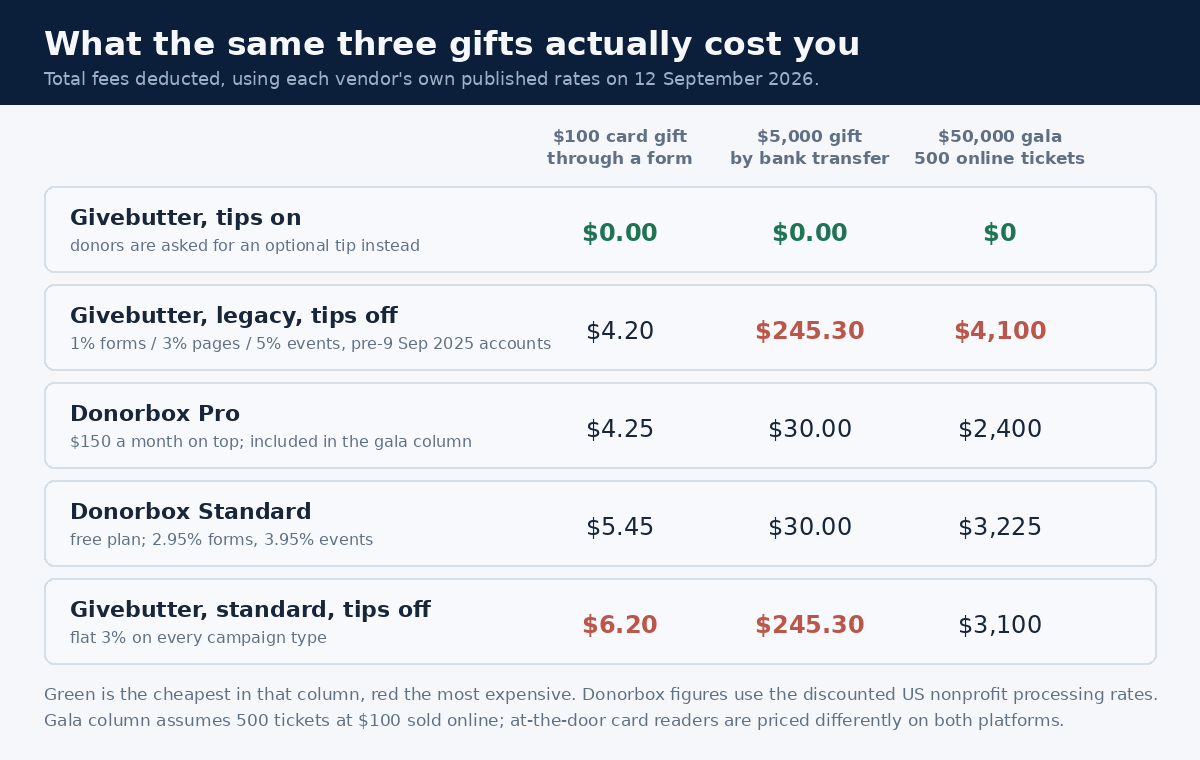
A single $100 card gift through a donation form
| Setup | Platform fee | Processing | You keep |
|---|---|---|---|
| Givebutter, tips on | $0 | $0 | $100.00 |
| Givebutter, legacy account, tips off | $1.00 (1%) | $3.20 | $95.80 |
| Donorbox Pro | $1.75 | $2.50 | $95.75 |
| Donorbox Standard | $2.95 | $2.50 | $94.55 |
| Givebutter, standard account, tips off | $3.00 (3%) | $3.20 | $93.80 |
The donor’s experience is not identical across those rows. In the top row the donor is asked to add a tip on top of the $100 and to cover the processing fee; Givebutter reports that fees are “covered by 92% of donors” on its current pricing page, while its legacy pricing article says “around 95%.” In the other rows the donor is asked for $100 and sees an optional fee-cover box.
A $5,000 gift by bank transfer
| Setup | Cost | You keep |
|---|---|---|
| Givebutter, tips on | $0 | $5,000.00 |
| Donorbox Standard (fee capped at $25, Stripe ACH capped at $5) | $30.00 | $4,970.00 |
| Givebutter, tips off (3% + 1.9% + 30¢, neither capped) | $245.30 | $4,754.70 |
Note also that Givebutter’s ACH is “only available for verified nonprofit accounts and fiscally-sponsored accounts” and settles in 5–7 business days, during which the funds cannot be withdrawn.
A $50,000 gala: 500 tickets at $100
| Setup | Platform | Processing | Total cost | Effective rate |
|---|---|---|---|---|
| Givebutter, tips on | $0 | $0 | $0 | 0% |
| Donorbox Pro (events 2%) | $1,000 | $1,250 | $2,250 + $150 plan | 4.8% |
| Givebutter, standard, tips off (3%) | $1,500 | $1,600 | $3,100 | 6.2% |
| Donorbox Standard (events 3.95%) | $1,975 | $1,250 | $3,225 | 6.45% |
| Givebutter, legacy, tips off (events 5%) | $2,500 | $1,600 | $4,100 | 8.2% |
This is the scenario Givebutter is built to win, and it wins it decisively — provided the tickets sell online. Sales taken at the door on a Givebutter card reader fall outside the Guarantee and carry 1% + 2.9% + 30¢.
In-person giving for a year
Hardware and subscription, before a single donation: a Givebutter card reader is $99 once. A Donorbox Live kiosk device is $80 a month, or $820 a year, with the card reader sold separately. On a $100 tap, Donorbox costs $4.50 (1.75% + 2.7% + 5¢) and Givebutter costs $4.20 (1% + 2.9% + 30¢). Givebutter is cheaper on both the hardware and the transaction; Donorbox’s kiosk buys a managed kiosk experience rather than a cheaper tap.
What you actually pay for features
Both products gate real functionality, and they gate it differently: Donorbox behind one flat plan price, Givebutter behind a subscription that scales with the size of your contact list.
| Contacts | Givebutter Plus, billed annually | Annual total | Donorbox Pro for comparison |
|---|---|---|---|
| Under 250 | $29/month | $348 | $150/month — $1,800/year, flat at any list size |
| 250–1,000 | $79/month | $948 | |
| 1,001–2,500 | $129/month | $1,548 | |
| 2,501–5,000 | $179/month | $2,148 | |
| 5,001–10,000 | $279/month | $3,348 |
Givebutter is emphatic that the CRM itself stays free — “You will never be required to pay for contacts in the free Givebutter CRM. Contact-based pricing applies only to Givebutter Plus subscribers.” But the things a growing organisation tends to want next are all on the Plus side of the line: automated workflows, task management, the advanced email editor, outbound texting, custom reports, file uploads, data hygiene, the QuickBooks Online integration and phone support. Two of those are double-gated — the advanced email editor and outbound texting are for “verified nonprofits” on Plus only. Above roughly five thousand contacts, the “free” platform costs more per year than Donorbox’s paid plan, for a different bundle of capabilities.
On the Donorbox side, Standard excludes advanced form customisation, crypto and stock giving, Zapier and API access, tracking and analytics, receipt rebranding, the AI assistant and recurring-donation upsell. Everything structural — unlimited forms, pages, ticketing, crowdfunding, peer-to-peer, memberships, QuickDonate, the donor portal, donor segmentation — is on the free plan.
Text giving is priced in opposite directions
Donorbox charges $19 a month for text-to-give with no cap on messages, and $50 a month to add a custom keyword on the 801801 short code; it runs in the US and Canada. Givebutter’s Text-to-Donate is free on every account, verified or not, subscriber or not, on the 53-555 short code — with real limits: five keywords per account, inbound messages only, US phone numbers on US carriers, and no tracking of which keyword produced which donation. Outbound texting — the thing most people mean by “texting donors” — is a separate Plus-and-verified-only product on Givebutter.
Text giving is its own purchase decision. Short codes, 10DLC registration and per-message costs sit outside most published pricing. Compare the text-to-give platforms properly before you buy a keyword you do not need.
Geography decides this for some organisations before price does
Givebutter is a United States product. Its own requirements page is explicit: to run a campaign you need a “US bank account (account and routing number, not Payoneer or PayPal)”, a “US government-issued EIN number (or US government-issued Social Security Number if you do not have an EIN)” and a “US-based phone number.” Donations can come from anywhere, but “all donations are processed in USD” — there is no second fundraising currency — and campaigns are not accessible in nine countries Givebutter names, among them Iran, North Korea, Russia, Saudi Arabia, Sudan and Syria.
Donorbox inherits Stripe’s and PayPal’s footprint instead of defining its own: “Donorbox is supported in any country where Stripe or PayPal is available for business accounts”, which it puts at Stripe’s 46 countries and PayPal’s 200-plus regions, with organisations in “over 96 countries” using it and 50-plus currencies available. UK charities get automatic Gift Aid submission, which Donorbox describes as turning “every £1 donation into £1.25.” Donorbox also publishes UK-specific processing rates — Stripe at 1.2% + 20p for EU Visa and Mastercard, PayPal at 1.4% + 20p, Bacs at 1% with a £2 cap.
If you are a Canadian, British, Australian or European organisation, this section is the whole comparison. Givebutter is not available to you unless you have a US entity.
Getting your money out
| Donorbox | Givebutter | |
|---|---|---|
| How payouts happen | Automatic through Stripe | Manual — “Withdrawals are not automatic – they need to be manually initiated from your Payouts page.” Verified nonprofits can request automated payouts. |
| Speed | Every 2 business days in the US, Canada and Australia; about 7 days for a first transfer; every 7 business days in most other countries | Funds become available on a 48–72 hour rolling basis, then standard payouts take 3–5 business days once initiated. The pricing page says 2–3 business days — the two pages disagree. |
| Payout fee | None published | None on standard payouts. Instant payouts cost 1.75% of the balance, arrive typically within 60 minutes, cap at $9,999, and are limited to three a day. |
| Partial withdrawals | n/a — automatic | Not allowed: “you can only withdraw the entire balance at once.” |
One detail worth knowing before your treasurer meets it: the Givebutter payout screen itself asks for a tip. Givebutter documents the prompt and the remedy — “if you leave us a tip by mistake, please contact our team, and we can credit this amount to your campaign.”
What your donors see, and what they say about it
These two platforms ask your donors for different things. Donorbox shows an optional fee-cover checkbox; the help centre explains that when a donor covers fees, “Donorbox will only keep the Donorbox fee rate”, and the pricing page claims donors can cover “over 90% of the processing fees” in one place and “all the fees” in another. Givebutter shows a tip line by default, pre-ticked, which donors can edit down to nothing: “To remove fees from your donation, click Edit and untick the box.”
Donor reaction to the tip model is not uniformly positive, and the clearest public evidence is on Givebutter’s own strongest review site. G2 tags 52 Givebutter reviews with “high fees on credit card transactions”, alongside clusters about pledge management and confusion around the tipping structure — on a product that G2 nonetheless ranks first in its category. If you adopt a tip-funded platform, you are accepting that a slice of your donors will read the prompt as a surcharge. Test your own checkout on a phone before you decide that is fine.
Review scores, with the caveat they deserve
| Capterra | G2 | |
|---|---|---|
| Donorbox | 4.8 from 625 reviews | 4.6 — count reported inconsistently (see note) |
| Givebutter | 4.8 from 872 reviews | 4.7 from 2,212 reviews |
Read on 12 September 2026. Both review sites block automated reading, so these came through a rendering fetch rather than a direct read, and G2 returned two different review counts for Donorbox on two pages of the same listing. Treat the star ratings as directionally right and the counts as approximate. Givebutter’s own site displays a Capterra badge reading 4.9, which does not match the 4.8 shown on Capterra itself.
Things we found on their own websites that they have not reconciled
Both vendors publish numbers that contradict other numbers they publish. None of this is disqualifying — it is what happens when marketing pages and help centres are maintained by different teams — but if you are building a budget off a quoted figure, quote the help centre rather than the landing page.
- Donorbox says both $3B and $4B raised on the platform, depending on which product page you land on.
- Donorbox’s ACH fee cap of $25 exists only in the help centre and not on the pricing page, where it would save someone a phone call.
- Donorbox’s text-to-give tier is called “Standard” on the pricing page and “Basic” in the help centre and on the feature page. Same $19.
- Givebutter Plus at the 250–1,000 contact tier is $92.20 a month in the help centre and $92.90 on the pricing page.
- Givebutter’s payout timing is 2–3 business days on the pricing page and 3–5 business days after initiation in the help centre, on top of a 48–72 hour hold.
- Givebutter’s “0% platform fees across all campaign types” sits alongside a help article documenting a 1% platform fee on card-reader donations.
- Donor fee-cover uptake is 92% on Givebutter’s current pricing page and “more than 95%” in its legacy pricing article.
Switching: what moves and what does not
Recurring donors are the asset that makes platform changes expensive. Donorbox sells the migration as a service — $195 flat on Standard and Pro, included on Premium. Givebutter can import recurring plans, but imported plans are “not automatically covered” by the Guarantee; you have to modify each plan while tips are enabled to bring it under the free terms, and plans that began before 9 September 2025 keep their original pricing regardless. Budget staff time for that, not just the fee.
Two other one-way doors: Givebutter’s legacy-to-standard pricing switch cannot be reversed, and a cancelled Givebutter Plus subscription “cannot be reactivated”, with email templates, file uploads, reports and workflows becoming inaccessible while the underlying data is retained for 180 days.
So which one
Choose Givebutter if you are a US organisation, most of your money arrives online by card, you run events, auctions or peer-to-peer campaigns, and you are comfortable asking donors for a tip. Under the Guarantee your cost is genuinely zero on those gifts, and no plan fee gets you there. Keep the exclusions in view: DAF gifts, card-reader gifts, and any recurring plan older than September 2025.
Choose Donorbox if you are outside the US, you need a currency other than the dollar, a meaningful share of your income arrives as large bank transfers, you want the discounted nonprofit processing rates on your own Stripe and PayPal accounts, or you want the donation form embedded in a site you control with Zapier and API access behind it. If your form giving clears $12,500 a month, Pro pays for itself; below that, buy it for the features or not at all.
Do the tip test before you commit. Everything in this comparison turns on one setting. Run a $25 donation through both checkouts on your own phone, with your own branding, and decide whether the tip prompt or the fee-cover checkbox is the one you want your donors to see for the next three years.
Frequently asked questions
Is Givebutter really free?
For most online gifts, yes — but “free” means funded by your donors rather than by you. With optional tips enabled, the Givebutter Guarantee means your organisation pays no platform fee and no processing fee. The published exclusions are transactions that cannot show a tip prompt (DAFpay and card-reader payments), recurring plans that started before 9 September 2025, imported recurring plans that have not been modified, and any campaign where you have switched tips off. Card-reader donations additionally carry a 1% platform fee.
Which is cheaper, Donorbox or Givebutter?
With Givebutter tips enabled, Givebutter — nothing is cheaper than zero. With tips disabled, it depends on the gift: Donorbox Standard takes $5.45 from a $100 card gift on a donation form against Givebutter’s $6.20, and Donorbox is dramatically cheaper on large bank transfers because both its platform fee and the Stripe ACH fee are capped. On a $5,000 ACH gift that is $30 against $245.30.
Does Givebutter charge a platform fee if I turn tips off?
Yes. Accounts created on or after 9 September 2025 pay a flat 3% on every campaign type. Accounts created before that date remain on legacy pricing — 1% on donation forms, 3% on fundraising pages, 5% on events and auctions — unless they choose to switch, which is permanent.
Is Donorbox Pro worth $150 a month?
As a pure fee decision, it pays for itself at about $12,500 a month in donation-form giving (the 2.95% to 1.75% drop) or about $7,692 a month in event, membership and supporter peer-to-peer giving (3.95% to 2%). Below that you are buying the features it unlocks — Zapier and API access, crypto and stock donations, analytics, receipt rebranding, recurring upsell — which may still be worth $1,800 a year to you.
Can you use Givebutter outside the United States?
Not as the fundraising organisation. Givebutter requires a US bank account, a US EIN or Social Security Number and a US phone number, and processes all donations in USD. Donors can give from abroad. Donorbox works in any country where Stripe or PayPal supports business accounts and handles 50-plus currencies, with automatic Gift Aid for UK charities.
Do donors have to leave a tip on Givebutter?
No. Givebutter states that tips “can be edited or removed by donors during the checkout process” and that the platform stays free to you even if nobody tips, provided tips remain enabled. The fee-cover box is pre-ticked, so a donor who wants to give exactly the amount they entered has to untick it.
How long do payouts take?
Donorbox pays out automatically through Stripe every two business days in the US, Canada and Australia, and every seven business days in most other countries, with a longer first transfer. Givebutter payouts are manual: funds become available 48 to 72 hours after the donation, and a standard payout then takes three to five business days. Instant payouts arrive within about an hour for 1.75% of the balance, capped at $9,999 and three per day.
Which is better for events and auctions?
Givebutter, on price, by a wide margin: with tips enabled a $50,000 online ticketed gala costs nothing, against roughly $2,400 on Donorbox Pro and $3,225 on Donorbox Standard, whose event fee is 3.95%. The exception is at-the-door card-reader sales, which sit outside the Guarantee.
Can I move my recurring donors from one platform to the other?
Donorbox offers recurring-donor migration for a flat $195 on Standard and Pro, included on Premium. Givebutter can import recurring plans, but an imported plan is not automatically covered by the Guarantee — the plan has to be modified while tips are enabled — and plans created before 9 September 2025 keep the pricing terms they started on.
Does either one include a free nonprofit CRM?
Both do, with different ceilings. Givebutter’s CRM is free with unlimited contacts, and the company states you will never be required to pay for contacts in it; the paid Givebutter Plus tier, which is priced by contact count from $29 a month, adds workflows, texting, the advanced email editor, custom reports and the QuickBooks integration. Donorbox includes donor management and segmentation on every plan, and integrates with Salesforce, Bloomerang, Blackbaud, HubSpot, Little Green Light, Neon One and others rather than trying to replace them.
Related guides
- Best Accounting Software for Nonprofits 2026 — what each platform costs once the money is in your books, and the $80 donated QuickBooks route
- Best Donation Platforms for Nonprofits
- Donorbox Review
- Best CRM for Nonprofits
- Best Peer-to-Peer Fundraising Software
- Best Text-to-Give Platforms
- Fundraising Ideas for Nonprofits
Written & reviewed by Atdhe Trepca, founder of Happy Productions and a nonprofit strategist. Every fee, plan price, limit and quoted sentence on this page was read directly from Donorbox’s and Givebutter’s own pricing pages and help centres on 12 September 2026; where the two vendors’ own pages disagree with each other, both figures are shown rather than one being chosen silently. Nothing here is drawn from a third-party fee table. Platform pricing changes without notice — confirm the current rate on the vendor’s own page before you commit. Some links on this page may become affiliate links; that has never changed and will never change which platform we recommend or the fees we report.