Charities That Help With Rent in Indiana: 16 Real Programs (2026)

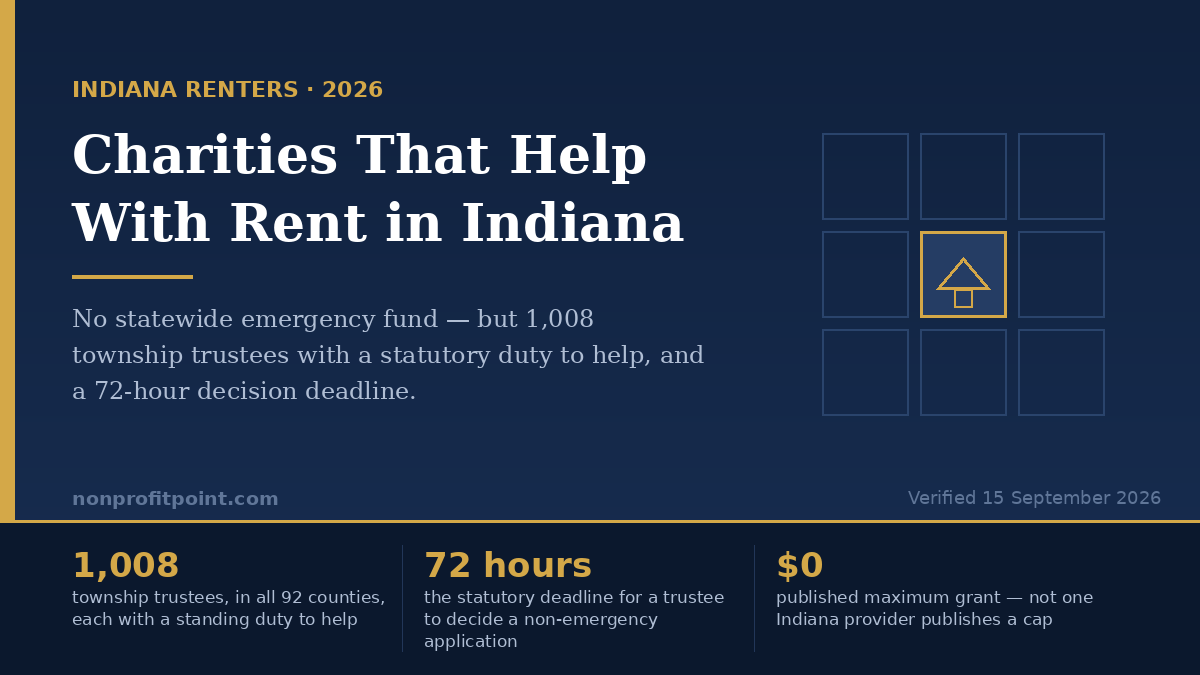
Indiana does not have a statewide emergency rental assistance programme. That is the first thing to know, and almost no other page says it plainly. The Indiana Housing and Community Development Authority’s own application portal returns one line for the old Indiana Emergency Rental Assistance fund — “There are presently no open calls for applications” — and the programme has been stripped out of IHCDA’s renter page and its entire site navigation. The deep link that thousands of search results still point at now returns a 404.
What Indiana has instead is unusual and, if you know how to use it, faster than any state fund: 1,008 township trustees who are required by statute to help you keep a roof over your head. Township assistance under Indiana Code 12-20 is not a grant programme that opens and closes. It is a standing legal duty, it runs in every one of Indiana’s 92 counties, and the trustee has to give you a decision within 72 hours.
This guide is the map. It covers the trustee system and how to find yours, the sixteen organisations and programmes that were verified as actually putting money toward an Indiana tenancy, the eight programmes that are dead but still ranking in search, and the parts of Indiana law that decide how much time you have. Every phone number, rule, deadline and statute below was read off the organisation’s own website or the codified Indiana Code on 15 September 2026. Where an organisation does not publish a figure, this page says so instead of inventing one — and as you will see, that turns out to be almost all of them.
Start here: the three moves that matter most
1. Find your township trustee and apply today. This is Indiana’s fastest route and the one out-of-state directories miss entirely. Use the Indiana Township Association’s lookup at in.wayeo.us. The trustee must decide within 72 hours of receiving a non-emergency application, weekends excluded, and your signed application stays valid for 180 days.
2. Call 2-1-1, or 866-211-9966. Indiana 211 is a division of the Family and Social Services Administration, staffed 24 hours a day, seven days a week, free, across all 92 counties. You can also text your ZIP code to 898-211 (Monday to Friday, 8:00am–6:00pm) or search in211.communityos.org yourself.
3. Count your days from the notice, not from the court date. Under Indiana Code 32-31-1-6 a landlord must give you at least ten days’ notice for unpaid rent — but that ten days can be contracted away in your lease, and paying the rent in full before the notice expires stops the termination outright. Read your lease before you assume you have ten days.
1. Township assistance: Indiana’s statutory rent route
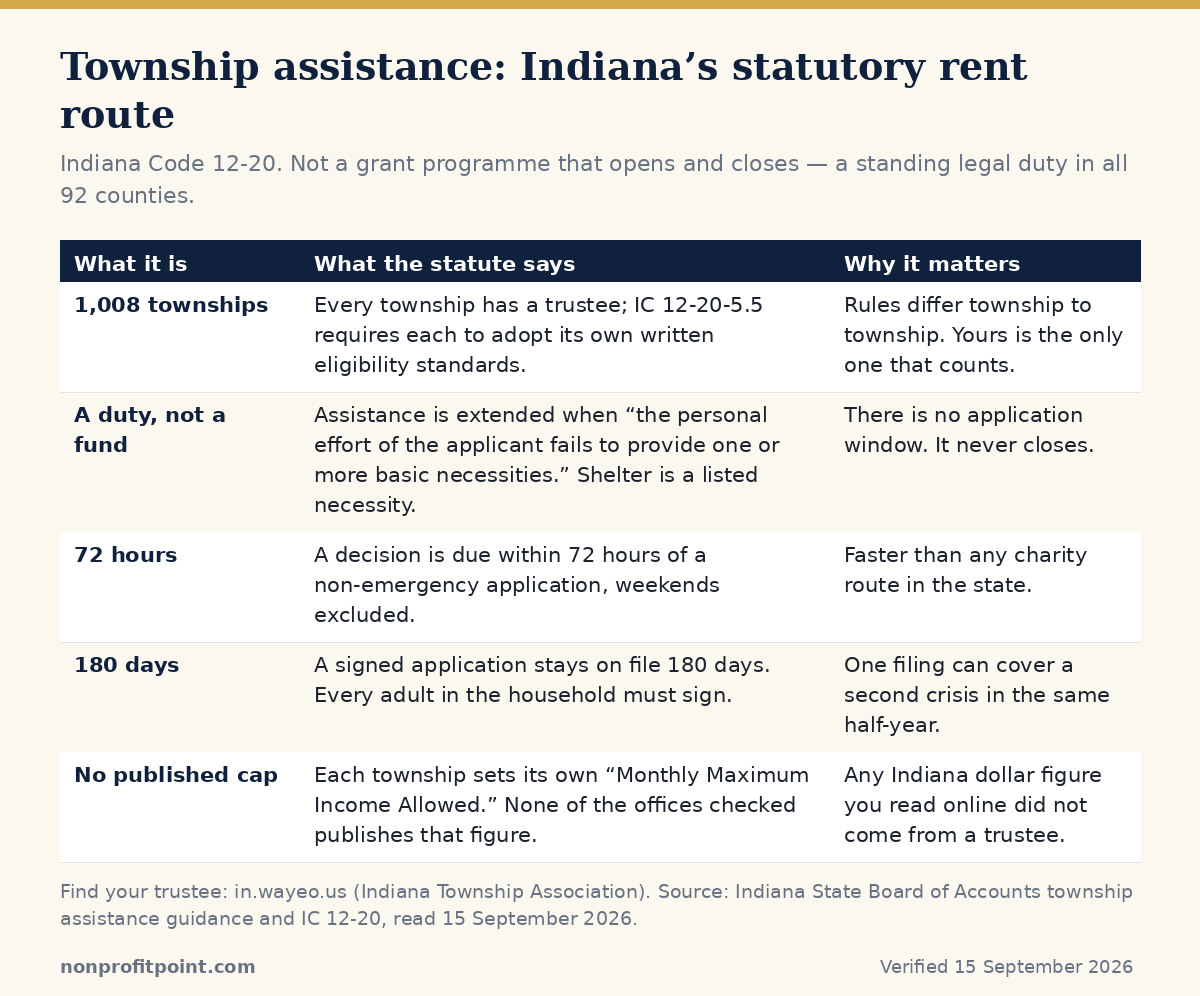
What it is. Indiana is one of very few states that still runs poor relief through townships. Under Indiana Code Chapter 12-20, the township trustee administers “township assistance,” and the Indiana State Board of Accounts’ own training manual for trustees sets out the trigger: a trustee “may provide and shall extend township assistance only when the personal effort of the township assistance applicant fails to provide one (1) or more basic necessities.” Shelter is a listed basic necessity. Rent is in scope.
How many. There are 1,008 townships across Indiana’s 92 counties, according to the Indiana Township Association. Every one of them has a trustee, and every one of them is required by IC 12-20-5.5 to adopt and publish its own written standards covering eligibility criteria, income and asset definitions, the application process, workfare and resource guidelines.
The deadlines are in the statute, and they are short. A trustee must issue a decision within 72 hours of receiving a non-emergency application, excluding weekends. A signed application stays on file for 180 days, and every adult in the household has to sign it.
What the statute forbids. Township assistance funds cannot be used for housing costs if the applicant lives with a relative who is able to assist, or if the landlord is a relative holding the property unencumbered, or a relative whose property was not rented out in the previous six months. These are the rules that catch people out, and they are worth reading before you apply.
The catch: there is no statewide dollar figure. Each township sets its own “Monthly Maximum Income Allowed” and, in practice, none of the trustee offices examined for this guide publishes that figure online. You will not find out what you qualify for until you sit down with a caseworker. That is not evasion on their part — it is how IC 12-20-5.5 is written.
Center Township Trustee, Marion County — 317-633-3610
Who it covers. Center Township only, which the office defines as the area bounded by the south side of 38th Street, the east side of Belmont Avenue, the west side of Emerson Avenue and the north side of Troy Avenue. The office states it directly: “If your address is outside of Center Township, you will have to apply for assistance in your home township.” An address lookup tool is on the site.
What it pays. Rent and mortgage assistance, alongside food, household and personal products, bus passes, medical and prescription help, traveler’s aid, utilities, burials and cremations, and school clothing. The housing page says assistance “can be provided if applicants meet the eligibility requirements” and that verification is required. No maximum grant is published.
The three eligibility tests, in the office’s own words: live in Center Township; be in need of basic necessities; be willing to help yourself as much as possible.
How to apply. In person. “You must come to our office and fill out the application form and a caseworker will interview you. The application is a legal affidavit… There are criminal penalties for deliberately giving false information.” Expect a home visit: “In most situations it will be necessary to make a home visit before assistance can be granted.”
What to bring. Sixty days of income verification for the household; sixty days of paid bill receipts including utilities; a copy of the lease or mortgage book; unexpired state ID or driver’s licence for every adult; Social Security cards or proof of application for everyone; tax returns and W-2s; and a WorkOne printout.
Where and when. Julia Carson Government Center, 300 E. Fall Creek Parkway N. Drive, Indianapolis, IN 46205. Monday 8–4, Tuesday 8–7, Wednesday to Friday 8–4, and the last Saturday of the month 8am–12pm by appointment. Denials are appealed in writing to the Board of County Commissioners of Marion County within 15 days.
The office also runs a Representative Payee Program for Marion County residents aged 18 and over who receive benefits — framed explicitly as eviction protection, and open to people who are not township assistance recipients.
Wayne Township Trustee, Marion County — 317-241-4191
The single most useful published rule in Indiana, and it is a limit. Wayne Township states it outright: residents “may apply for help with the current month’s rent. All back rent needs to be paid before we can provide assistance because we will work with apartment complexes and landlords to ensure that they will keep residents in their homes when receiving aid from our office.”
Read that twice, because it inverts what most people assume. Wayne Township pays the month you are in, not the months you have fallen behind. If you are carrying arrears, the trustee is not your route — a charity that pays arrears is, and several are listed further down this page.
How the amount is set. By inspection. “The township may require households requesting township assistance to allow an inspection of their living quarters. The inspector will assess the unit’s compliance with the minimum standards of health, safety, and decency, and will determine the amount of rental assistance per trustee standards. Determination will be made within 72 hours of the initial application.”
How to apply. Walk in, first come first served. “We encourage individuals to arrive as early as possible… some individuals may be asked to return on the next business day if all appointments are filled.” There is a 24/7 secure drop box outside the front door; a caseworker calls back “within 72 business hours.” Home visits are available by appointment for those who cannot travel.
The document rule that trips people up. Originals only. The phrase “Screenshots will not be accepted” is repeated throughout the office’s eleven-item checklist: photo ID for every adult 18 and over; Social Security cards for every household member (a 30-day grace period applies if one is missing); Green Card for non-citizens; naturalisation document or passport for naturalised citizens; proof of residence (lease and ledger, mortgage statement or property taxes); current utility bills issued within the last 30 days; signatures from all adults; 30 days’ proof of income for every adult; 30 days’ proof of how that income was spent; a doctor’s statement if any adult is medically unable to work; and, from January through July only, proof of federal and state tax filing plus proof of how any refund was spent.
Applicants must be 18 or over, must first apply for any other benefit programme they might qualify for, and will have assets counted — cash, checking and savings, CDs, stocks, bonds, mutual funds, grant and student loan and stipend proceeds, and recreational vehicles. The office publishes forms TA-1 and TA-1B and its “Wayne Township Assistance Guidelines (Revised February 12, 2026).” Wayne Township Government Center, 5401 West Washington Street, Indianapolis, IN 46241.
Wayne Township also runs burial assistance, disaster relief and relocation, utility assistance for disconnected service, school clothing (applications July 1 to August 31, by appointment), a Social Security Representative Payee service, diaper and feminine hygiene vouchers, and free pet food through Speedway Animal Rescue.
2. Indiana 211 — and who actually runs it
Indiana 211 is a division of the Indiana Family and Social Services Administration, not IHCDA. This matters because IHCDA promotes 211 heavily on its renter pages and a great many directories therefore credit the wrong agency. FSSA’s own description: “As a division of the State of Indiana Family and Social Services Administration, IN211 provides free, unbiased and confidential referrals to the best resources for specific needs.”
How to reach it. Dial 2-1-1 or 866-211-9966. Text your ZIP code to 898-211. Search online at in211.communityos.org. The phone line runs 24 hours a day, seven days a week, free to anyone, across all 92 counties; the texting service runs Monday to Friday, 8:00am to 6:00pm. Community Navigators receive 80+ hours of training.
One honest note: FSSA’s About Us page lists a texting number of 1-888-311-1846, which does not match the 898-211 shortcode published on its own main page and by the Indianapolis Continuum of Care. Use 898-211.
The service has statutory backing. The Indiana Utility Regulatory Commission recognised the 2-1-1 administrator in 2002 and issued a final order in 2004; the General Assembly passed supporting legislation effective 1 July 2004, codified at IC 8-1-19.5.
3. The statewide programmes that do exist
Housing Choice Vouchers (Section 8) — IHCDA, 317-232-0211
This is the one standing IHCDA rental assistance programme. IHCDA describes it as “an income-based rental assistance program for low-income families… A family receiving a voucher will pay approximately 30-40 percent of their income for their monthly rent payment.” It is administered through local housing authorities and partner agencies, and it runs on waiting lists, so it is not an answer to a notice you received this week. IHCDA’s language-access line for voucher applicants is 317-232-7788.
Waiting lists do open. Brightpoint in Fort Wayne is accepting Housing Choice Voucher waitlist applications right now for Allen (outside Fort Wayne city limits), DeKalb, Elkhart (outside Elkhart and Goshen city limits), Fulton, Kosciusko (outside Warsaw city limits), LaGrange, Marshall, Noble, Steuben and Whitley counties. Applications are online only and county-specific. Brightpoint’s reasonable accommodation line is 260-423-3546 ext. 330.
The Energy Assistance Program — closed now, reopening this autumn
Indiana’s LIHEAP programme, run as the Energy Assistance Program, matters to renters for a reason most guides miss: if your utilities are included in your rent, you can still qualify. IHCDA says so and asks for a “Tenant Verification Statement or Current Lease (for applicants with utilities in rent only).”
Its current status is closed. IHCDA’s page states: “The last day to apply for the Energy Assistance Program was April 20, 2026 at 5:00 PM Eastern Time… The Energy Assistance Program application is currently closed and will reopen Fall of 2026.” Second crisis and summer assistance applications are also not being accepted. The exact reopening date has not been published.
Be careful what you read in the meantime. On the day this guide was verified, the Indianapolis-area EAP site indyeap.org was still displaying “Please Note: EAP Applications are currently open” while simultaneously listing 20 April 2026 as the final day to apply. That page is showing last season’s copy. Trust IHCDA.
Income limit. 60% of state median income, assessed on the most recent three months of income. The table below is the programme year 2026 table as published; the 2027 figures have not been posted yet and will be higher.
| Household size | 1 month | 3 months | 12 months |
|---|---|---|---|
| 1 | $2,796 | $8,389 | $33,556 |
| 2 | $3,656 | $10,970 | $43,882 |
| 3 | $4,517 | $13,551 | $54,207 |
| 4 | $5,377 | $16,133 | $64,533 |
| 5 | $6,238 | $18,714 | $74,857 |
| 6 | $7,098 | $21,295 | $85,183 |
| 7 | $7,259 | $21,779 | $87,119 |
| 8 | $7,421 | $22,263 | $89,055 |
The winter shutoff protection is the part worth writing down. Under Indiana Code 8-1-2-121, from 1 December through 15 March a regulated utility may not disconnect residential service to a customer who is eligible for and has applied for EAP. The protection attaches when the application is submitted, not when it is approved, and it covers electric and gas from municipally owned, privately owned and cooperatively owned utilities alike.
Timelines, once the season opens. Local service providers have 14 days to determine eligibility for an in-person appointment and 55 days for drop-off, mail, fax, email, portal or proxy applications. Heating crises get mitigating action within 48 hours; life-threatening crises within 18 hours. Programme timelines begin no earlier than 1 November. A denied applicant may reapply 55 days after the previous submission. Appeals go to the local service provider within 30 days of denial, and the provider must respond in writing within 14 calendar days — do not appeal to IHCDA first. Apply online, by mail, in person, or by calling 2-1-1. IHCDA’s EAP line is 317-232-7777.
The 22 Community Action Agencies
IHCDA states that “There are 22 designated CAAs in Indiana to serve income-eligible Hoosiers in all 92 counties across the state,” and publishes an interactive map and county dropdown. The Indiana Community Action Association maintains a county-by-county finder at incap.org/find-your-caa.
Two cautions before you call one. First, INCAA notes that “Some counties receive weatherization and/or energy-assistance services from outside organizations or Community Action agencies (CAAs) that differ from the ones providing primary services to the county” — so the agency that handles your energy application may not be the agency that handles everything else. Second, and more importantly, IHCDA states plainly that “CSBG is NOT a program open to individuals and families for direct funding or assistance.” The block grant funds the agency; you apply to that agency’s individual programmes. Direct rent payment is not a universal Community Action offering, and this guide found agencies on both sides of that line.
Coordinated entry: Indiana has exactly two Continuums of Care
If you are already homeless or within days of it, the route is coordinated entry, and there are only two systems in the state: IN-502, the Indiana Balance of State CoC, administered by IHCDA and split into 16 regions, and IN-503, the Indianapolis CoC, led by the Coalition for Homelessness Intervention & Prevention. There is no separate Gary, Fort Wayne, Evansville or South Bend Continuum — all of Northwest Indiana sits inside the Balance of State as Regions 1 and 1A.
The Balance of State publishes a named coordinated entry contact for each of its 16 regions, along with winter and summer contingency plans, but there is no statewide coordinated entry hotline. In practice, 2-1-1 is the public route in. The Balance of State’s Coordinated Entry Policy and Procedures were updated in November 2025.
In Indianapolis, the access points are published and specific. CHIP (317-630-0853, 1014 Prospect Street) lists them:
- Adult & Child, 603 E Washington St, 9th Floor — walk-ins only, Wednesdays 9:00–11:00am and 1:30–3:00pm, or the coordinated entry assessment voicemail line on 317-296-4044 (CHIP warns it may take 48+ hours for a call back).
- Damien Center, 26 N Arsenal Ave — 317-632-0123, call to set an appointment.
- Horizon House, 1033 E Washington St — 317-423-8909 ext. 476.
- Veterans: HVAF of Indiana 317-951-0688 (rapid rehousing screener line 317-789-8404, walk-ins Monday to Friday 8am–5pm); InteCare 855-896-4345; Volunteers of America Ohio & Indiana 855-332-8387.
- Domestic violence: 1-800-332-7385. Youth and young adults 18–24: YouthLink 317-699-1994.
CHIP’s own instruction is worth repeating: “You might have to leave a message if you call, but someone should call you back. Please leave only one message, but call back if you do not hear from anyone within 2-3 business days.”
4. Organisations that actually pay rent, by region
Northeast Indiana — Fort Wayne and the 14 counties
Brightpoint — 260-423-3546 ext. 332. Brightpoint is the lead agency for coordinated entry in Balance of State Region 3, covering Adams, Allen, DeKalb, Huntington, LaGrange, Noble, Steuben, Wells and Whitley counties. Its Housing Solutions programme is “short-term housing assistance that helps individuals overcome temporary housing crises… assistance locating stable housing and paying for housing-related costs,” funded through the federal Emergency Solutions Grant. Eligibility: “Must be homeless or about to become homeless and be income eligible. If homeless, must be referred through Coordinated Entry.” Brightpoint also runs Permanent Supportive Housing for people who are HUD-defined homeless with severe mental illness, chronic substance abuse or HIV/AIDS, and SSVF for veterans. How to apply: leave a voicemail on ext. 332. Someone calls back within five business days. No maximum grant is published.
Catholic Charities, Diocese of Fort Wayne–South Bend. Fourteen counties, three regions, and — crucially — three different application windows. Applications are online only, opened in batches, and rationed:
| Region | Counties | When applications open | Phone |
|---|---|---|---|
| East (Fort Wayne) | Adams, Allen, Huntington, Wabash, Wells, Whitley | 1st and 3rd Tuesday, 8:00am and 3:00pm | 260-422-5625 |
| West (South Bend) | Elkhart, Kosciusko, Marshall, St. Joseph | 1st and 3rd Monday, 8:00am and 3:00pm | 574-234-3111 |
| North (Auburn) | DeKalb, LaGrange, Noble, Steuben | By appointment; no fixed window published | 260-925-0917 |
The organisation is unusually candid about the rationing: “We accept a limited number of online applications on the 1st and 3rd [Monday/Tuesday] of each month at 8:00 am and 3:00 pm… We receive a high volume of applications, and not all applications will qualify for assistance.” If the scheduled day is a holiday, the window moves to the next business day. Assistance covers “food, clothing, shelter, and utilities,” with rent falling under shelter. No maximum is published, deliberately: “Each region has specific funding sources which determine the type and amount of financial assistance we are able to provide.”
Expect commitment in return. “Each region requires case management to those requesting assistance. Case management includes meeting with a case manager and working through a budget and self-sufficiency plan.” The diocese describes the shift explicitly: “We are moving from a transactional program (short-term, one-time interactions) to a relational stabilization model (long-term, deeper engagement).” Bring proof of household income, identification, and copies of your lease, bills and invoices.
Southwest Indiana — Evansville and the Ohio Valley
Catholic Charities, Diocese of Evansville — 812-423-5456. This is the clearest published ruleset of any organisation verified for this guide, and it is worth quoting exactly: “Clients may receive emergency help once in a 12 month period. Rent must be past due or under threat of eviction.… Assistance appointments are scheduled Monday mornings on a first come, first serve basis beginning at 8:30am. You must call 812-423-5456, we do not accept walk-ins.”
So: no prospective rent, no walk-ins, one bite per year, and you need to be dialling at 8:30 on a Monday. The office is at 2111 Stringtown Road, Evansville, IN 47711. It also runs Neighbor to Neighbor, a faith-based life-skills course whose graduates “earn a voucher toward their rent, utilities, or other appropriate expense or outstanding bill” — a second, slower route to the same money that nobody lists.
ECHO Housing & Community Development — 812-423-8422. Founded 1991, based in Vanderburgh County and serving southwest Indiana, ECHO runs eight housing programmes spanning emergency shelter, permanent supportive housing, rapid rehousing and prevention, and affordable rental homes. Main service delivery is at 414 Baker Ave, Evansville, IN 47710. ECHO does not publish eligibility rules or grant maximums for its prevention programme.
ECHO does something more useful than most: it publishes its own referral list, which independently corroborates four other Evansville organisations. From its “Risk of Losing Housing” page: Salvation Army (rent, food, utilities) 812-422-4673; St. Vincent de Paul Society (rent & utilities) 812-425-3485; Catholic Charities (rent, utilities) 812-423-5456; and CAPE, utilities only, 812-425-4241. Note that last one carefully — CAPE is a utility resource, not a rent resource.
Society of St. Vincent de Paul, Evansville Council — 812-425-3485. Runs an Office of Emergency Assistance, open Monday to Friday, 8:15am–12:00 noon and 1:15–4:00pm, at 809 N. Lafayette Avenue. The model is the Vincentian home visit: “Contact our Coordinator’s Office @ 812.425.3485. Our staff is trained to assist you and help coordinate a plan to get you the help you need.” One transparency note: that SVdP Evansville pays rent specifically is verified on ECHO Housing’s referral list, not on SVdP’s own site, which says “emergency assistance” without itemising. Ask when you call.
Aurora, Inc. — 812-428-3246. 1001 Mary Street, Evansville, Monday to Friday 8:30am–4:00pm. Aurora’s Rapid Re-housing team “provides clients with temporary rental assistance, which can help with utility and security deposits as well as rental and utility assistance” — deposits and rent, which is a wider scope than most. The programme began in 2012; the organisation reports helping over 100 households in the past year with a 10% return-to-homelessness rate, and serving 1,600+ people a year overall. Aurora also conducts coordinated entry assessments, which makes it the practical way into the system for Balance of State Region 12. Its Homeless Outreach Team has operated since 1998 and is one of only three in Indiana, alongside Indianapolis and Bloomington. Entry is through homelessness status and coordinated entry, not a published income table.
South-central Indiana — Columbus and the five counties
Human Services, Inc. — 800-296-8026 or 812-372-8407. Serving Bartholomew, Decatur, Jackson, Johnson and Shelby counties, HSI publishes the most generous scope found anywhere in this research. Its Rapid Re-housing and Prevention Program: “The financial assistance can come in the form of rent and utility deposits, arrears on rent or utilities, and partial rent assistance… Participants MAY receive assistance anywhere from one month up to one year.” Deposits, arrears and ongoing partial rent, for up to twelve months. The condition: “Participants MUST be willing to work towards their goals and work within the program” — assistance is tied to coaching, reassessed monthly.
HSI also runs The Salvation Army Service Extension for Jackson County, and in doing so publishes the only detailed Salvation Army ruleset found in Indiana. Households can receive assistance once per 12 months, first come first served while funding lasts. For rent, a Landlord Affidavit is required, and: “The participant is required to pay all but the remaining portion of the rent before The Salvation Army can assist unless the landlord is willing to work with the tenant. Must guarantee 30 days of service with funds. The Salvation Army does not pay towards security deposits.” There is no income guideline, but income documentation for every adult is mandatory, and a zero-income form exists for those with none. Service extension contacts: Human Services Inc. on 812-522-8718 for Jackson County excluding Crothersville; Crothersville residents contact Toby Ortman on 812-793-2512 through First Baptist Church.
HSI’s other programmes include homeless prevention, the Horizon House 30-day emergency family shelter for Bartholomew County families, three permanent supportive housing homes, Section 8, energy assistance, a food pantry, Head Start and Early Head Start, an infant care pantry, and free Thursday sack lunches for families at or below 150% of poverty.
Indianapolis
Catholic Charities Indianapolis Crisis Office — 317-236-1512. The archdiocese lists “Food, clothing, limited transportation, rent and utilities money” for those in critical need. Eligibility rules, service boundaries, frequency limits, maximums and the application procedure are not published — the page offers the phone number and nothing else. Archdiocese-wide, Catholic Charities also runs Holy Family Shelter and Holy Family Transitional Housing in Indianapolis, Bethany House family shelter in Terre Haute, a maternity home and transitional housing for single mothers in New Albany, and the Martin’s Cloak pantry in Tell City.
Damien Center — 317-632-0123. Important caveat: this is an HIV-linked programme under the Ryan White and HOPWA frameworks, not a general public fund. For people who qualify it is substantial. Housing assistance covers “short-, medium- or long-term rental subsidy, utility assistance, or help paying for incidental expenses.” Long-term options “range from one year of rental assistance to permanent supportive housing,” with HOPWA applications reviewed monthly by a committee of Central Indiana HIV service and housing providers. Separately, Direct Emergency Financial Assistance “provides short-term assistance with rent, utilities, incidentals, or other one-time emergencies like car repairs or glasses,” with a committee meeting twice monthly. Selection is by panel, not by income table: “Applicants must demonstrate true need and opportunities, potential, and plans for future self-sufficiency.” 1420 East Washington Street, Indianapolis, IN 46201.
Horizon House — 317-423-8909. A verified coordinated entry access point at 1033 East Washington Street, open Monday and Tuesday 7:00am–3:00pm (Tuesday also 4:00–7:00pm), Wednesday 7:00am–12:30pm, Thursday 7:00am–3:00pm and 4:00–7:00pm, Friday 7:00am–3:00pm, Saturday 8:00am–1:00pm. Be clear about what it is: Horizon House’s own site describes intensive case management, housing-first navigation, credit repair, benefits enrolment and referrals — it does not state that it writes rent cheques. Treat it as your way into the system, not as a rent fund.
West-central Indiana — Lafayette and the eight counties
Area IV Agency on Aging and Community Action Programs — 765-447-7683. The Community Action Agency for Balance of State Region 4: Benton, Carroll, Clinton, Fountain, Montgomery, Tippecanoe, Warren and White. Its published rental assistance content is one paragraph: the agency “is an approved administrator of the Emergency Solutions Grant Program, which provides rental assistance to those who qualify.” Office at 660 N. 36th St., Lafayette, open 8:00am–4:30pm, with the information department to 4:00pm. Call rather than follow the website’s own apply link — it points to IndianaHousingNow.org, which is a housing search database, not an application portal. Eligibility rules and maximums are not published.
Northwest Indiana — Gary and the Region
This is the weakest-covered corner of the state, and saying so is more useful than padding it. Catholic Charities, Diocese of Gary lists “Community Outreach (Utility/Rent Assistance)” among six programmes at 940 Broadway, Gary, IN 46402 — but publishes no phone number, and its contact and programme pages both return 404. Do not trust any 219 number you find for it on a directory; call the diocesan office or go through 2-1-1. Sojourner Truth House in Gary is a day centre for women experiencing homelessness and states plainly “STH is not a shelter” — it offers a pantry and referrals, not rent, on 219-885-2282. For Lake, Porter, LaPorte, Jasper, Newton, Pulaski and Starke counties, the working route is 2-1-1 into Balance of State coordinated entry for Regions 1 and 1A, plus your township trustee.
5. The programmes that are dead but still ranking
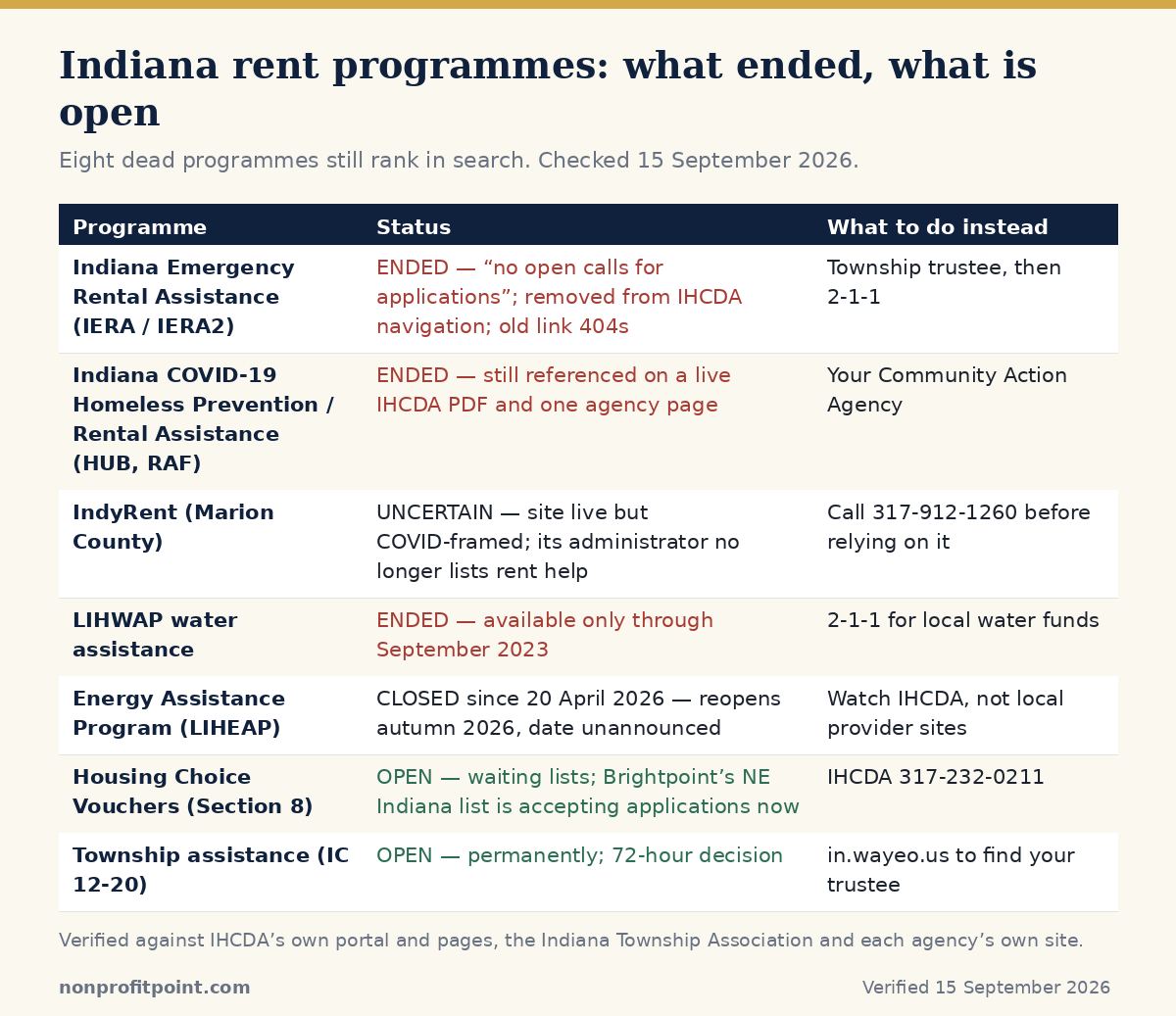
This is the section no other Indiana page publishes, and it is the reason so many people waste a week. All eight of these were checked on 15 September 2026.
- Indiana Emergency Rental Assistance (IERA / IERA2) — ended. IHCDA’s portal: “There are presently no open calls for applications.” Removed from the renter page and from site navigation; the old deep link 404s. Old PDFs are still reachable on in.gov and still rank in search, which is exactly why people land on it.
- Indiana COVID-19 Homeless Prevention and Rental Assistance (HUB / RAF) — ended. Still referenced in a live IHCDA PDF and still listed on Human Services Inc.’s current programmes page.
- IndyRent — treat as uncertain. indyrent.org is still live and the Indianapolis CoC still lists it (indyrent@jbncenters.org, 317-912-1260), but the site carries no open-or-closed banner and its content is still framed around COVID-era Treasury rules. Decisively, its administrator — John Boner Neighborhood Centers — no longer lists rental assistance on its own housing page, referring people instead to the City of Indianapolis Tenant Advocacy Program and to IHCDA. Call 317-912-1260 before you rely on it.
- LIHWAP, the water assistance programme — ended. IHCDA notes it was available only through September 2023.
- Energy Assistance Program PY2026 — closed since 20 April 2026, reopening “Fall of 2026,” date unannounced.
- The Indiana Eviction Task Force — concluded. Created by Supreme Court order in September 2021 to design a statewide pre-eviction diversion programme and distribute federal emergency rental assistance, it delivered its final report in January 2022. The federal money it was built around is gone, and no live statewide diversion programme could be found.
- Fort Wayne’s municipal homelessness prevention page — 404. The city’s COVID-era rental assistance is not findable on the city site.
- The Indiana courts’ housing self-help pages — 404. Both in.gov/courts/help/housing and in.gov/courts/selfservice/housing now return the judiciary’s error page after a site redesign.
6. What Indiana law gives you — and what it takes away
The ten-day notice, and its two escape hatches
Indiana Code 32-31-1-6: “If a tenant refuses or neglects to pay rent when due, a landlord may terminate the lease with not less than ten (10) days notice to the tenant unless: (1) the parties otherwise agreed; or (2) the tenant pays the rent in full before the notice period expires.”
Two things follow, and both matter more than the ten days. The phrase “unless the parties otherwise agreed” means the ten days can be shortened or waived in your lease, and Indiana leases routinely do. And paying in full before the notice expires stops the termination, full stop. Read your lease first, then count.
Eviction records can be sealed — and this is a 2022 law, not a 2021 one
Indiana Code Chapter 32-31-11, “Disclosure of Residential Eviction Information,” was enacted by P.L. 164-2022 and amended by P.L. 128-2025. Many articles misdate it.
Automatic sealing, on the court’s own motion, applies where the eviction is dismissed, judgment is entered for the tenant, or an adverse judgment is overturned or vacated on appeal. In those cases the court “shall, on its own motion, order the clerk of the court and the operator of any state, regional, or local case management system not to disclose or permit disclosure of any records in the case, including the petition by the landlord for possession of the rental unit.”
Tenant-initiated sealing is available where a judgment against you exists and either the money judgment has been satisfied, or seven years have passed since judgment was entered where there was no money judgment. If you were evicted years ago and it is still costing you apartments, this is the statute to take to Indiana Legal Services.
The thing Indiana lacks: local tenant protections are prohibited
Indiana Code 32-31-1-20 is titled “Local Units Prohibited From Regulating Rental Rates and Landlord-Tenant Relationship,” and it does exactly that. Local units may not regulate rental rates “through a zoning ordinance or otherwise,” and may not regulate tenant screening processes, security deposits, lease applications, leasing terms and conditions, disclosures, the parties’ rights, or landlord-imposed fees. Ordinances that violate it are “void and unenforceable.” The narrow exception is for properties receiving government funds specifically designated to reduce rents for low- or moderate-income tenants.
The practical meaning: Indianapolis, Fort Wayne, Bloomington and Gary cannot pass their own renter protections — no local rent caps, no local source-of-income protections, no local deposit rules. The preemption was broadened by amendments in 2020 and 2021. It is why every meaningful protection an Indiana renter has is state law or nothing, and it is a large part of why the township trustee system carries as much weight as it does.
Indiana also has no right to counsel in eviction cases. No statute, court rule or state programme establishes one.
Indiana Legal Services — 1-844-243-8570
Free civil legal help, and it handles evictions, being behind on rent, security deposits, damages, subsidised housing and eviction sealing. The intake line is open Monday to Thursday, 10:00am–2:00pm Eastern only — a four-hour window, four days a week — but the online application runs Monday to Friday, 24 hours. The administrative office is 317-631-9410.
Who qualifies. Generally income within 125% of the federal poverty guidelines, extending to 200% in certain circumstances depending on your expenses. There is an asset test: applicants must not have $10,000 or more in countable assets, excluding a primary residence, a vehicle and some other items. Some specially funded ILS projects use less restrictive guidelines, so apply even if you are marginally over. ILS represents citizens, people with established legal immigration status, and people without status who are victims of crime or trafficking. Its current eligibility guidelines document was last updated 12 February 2026.
If you only need a question answered rather than representation, ILS also runs IN Free Legal Answers, where a volunteer attorney answers a civil legal question at no cost — answers only, not representation in court.
7. An honest word about dollar amounts
Across every organisation and programme verified for this guide, not one Indiana rent assistance provider publishes a maximum grant. Not the trustees, not the Catholic Charities regions, not the Community Action Agencies, not the Salvation Army at divisional level, not the rapid rehousing programmes.
That is not secrecy. It is structural. Catholic Charities Fort Wayne–South Bend says the amount is decided by “specific funding sources” that differ by region. Wayne Township ties the amount to a home inspection. The trustees run against an internal “Monthly Maximum Income Allowed” that IC 12-20-5.5 requires them to adopt locally rather than publish statewide. The amount genuinely is not knowable until someone looks at your file.
So if you find a page quoting you an Indiana figure — “up to $1,500 in rental assistance,” that kind of thing — be sceptical. It did not come from the organisation. The productive question to ask on the phone is not “how much can I get,” it is “what do you pay for, and what do you need from me.” The answers to those two are published, and they are collected above.
Frequently asked questions
Does Indiana have a state rental assistance program in 2026?
No. The Indiana Emergency Rental Assistance programme has ended — IHCDA’s own portal says “There are presently no open calls for applications,” the programme has been removed from the agency’s renter page and navigation, and the old deep link returns a 404. Nothing statewide replaced it. The one standing IHCDA rental assistance programme is the Housing Choice Voucher programme, which runs on waiting lists and is not an emergency route. For an emergency, Indiana’s actual system is the township trustee, backed by 2-1-1 and your regional Community Action Agency.
What is a township trustee and can they really pay my rent?
Yes. Indiana runs poor relief through 1,008 township trustees across its 92 counties, under Indiana Code Chapter 12-20. The State Board of Accounts’ guidance for trustees says assistance must be extended “when the personal effort of the township assistance applicant fails to provide one (1) or more basic necessities,” and shelter is a listed basic necessity. It is a standing statutory duty rather than a fund that opens and closes. The trustee must decide within 72 hours of a non-emergency application, excluding weekends, and a signed application is valid for 180 days. Find yours through the Indiana Township Association’s lookup at in.wayeo.us.
How fast can I be evicted in Indiana for not paying rent?
Indiana Code 32-31-1-6 requires “not less than ten (10) days notice” to terminate a lease for unpaid rent, but with two qualifications that matter more than the number. The statute says “unless the parties otherwise agreed” — so the ten days can be shortened or waived in your lease, and Indiana leases commonly do. And paying the rent in full before the notice period expires stops the termination. Indiana has no right to counsel in eviction cases; free representation, if you get it, comes through Indiana Legal Services on 1-844-243-8570.
Which Indiana charities will pay rent I already owe?
Arrears are the dividing line. Catholic Charities of the Diocese of Evansville pays arrears and only arrears — its rule is that “rent must be past due or under threat of eviction,” once per twelve months, by phone on 812-423-5456 on Monday mornings from 8:30am, with no walk-ins. Human Services Inc. in Columbus covers “rent and utility deposits, arrears on rent or utilities, and partial rent assistance” for one to twelve months, on 800-296-8026. Wayne Township Trustee in Indianapolis is the opposite: it pays the current month only and states that “all back rent needs to be paid before we can provide assistance.”
Is there any Indiana program that pays a security deposit?
Two verified routes. Human Services Inc. in Columbus explicitly lists “rent and utility deposits” among what its Rapid Re-housing and Prevention Program pays, for Bartholomew, Decatur, Jackson, Johnson and Shelby counties. Aurora Inc. in Evansville states its rapid rehousing assistance “can help with utility and security deposits as well as rental and utility assistance.” Note the contrast with the Salvation Army, whose published rules through the Jackson County service extension say plainly: “The Salvation Army does not pay towards security deposits.”
My utilities are included in my rent. Can I still get energy assistance?
Yes. IHCDA states it directly: “If your utilities are included in rent, you may still qualify for EAP.” You will be asked for a Tenant Verification Statement or a current lease. The programme is closed at the moment — the last day to apply for programme year 2026 was 20 April 2026 and it reopens in autumn 2026, date not yet published. Watch the IHCDA page rather than local provider pages; on the day this guide was verified, one Indianapolis-area provider site was still displaying last season’s “applications are currently open” notice.
Can my power be shut off in winter in Indiana?
Not if you have applied for energy assistance and are eligible. Indiana Code 8-1-2-121 bars a regulated utility from disconnecting residential service between 1 December and 15 March for a customer who is eligible for and has applied for the Energy Assistance Program. The protection attaches when the application is submitted, not when it is approved, and it covers electric and gas service from municipally owned, privately owned and cooperatively owned utilities.
Can I get an old Indiana eviction taken off my record?
Sometimes, under Indiana Code Chapter 32-31-11, which was enacted in 2022 and amended in 2025. Sealing is automatic, on the court’s own motion, where the eviction was dismissed, judgment was entered for the tenant, or an adverse judgment was overturned on appeal. You can ask the court to seal a judgment against you where a money judgment has been satisfied, or where seven years have passed since judgment was entered if there was no money judgment. Indiana Legal Services lists eviction sealing among the housing matters it handles.
How much rental assistance can I actually get in Indiana?
No Indiana provider publishes a maximum, and that is a structural fact rather than an oversight. Catholic Charities Fort Wayne–South Bend says amounts are set by “specific funding sources” that differ by region. Wayne Township sets the amount by home inspection. Township trustees work against locally adopted income standards that Indiana Code 12-20-5.5 requires them to set township by township. If a page quotes you a specific Indiana dollar figure, it did not come from the organisation. Ask what a programme pays for and what documents it needs instead.
Why do Indianapolis and Fort Wayne have no local renter protections?
Because state law forbids them. Indiana Code 32-31-1-20 prohibits local units from regulating rental rates “through a zoning ordinance or otherwise,” and from regulating tenant screening, security deposits, lease applications, leasing terms, disclosures, the parties’ rights or landlord fees. Ordinances that do so are “void and unenforceable.” The preemption was broadened by amendments in 2020 and 2021. The practical effect is that every meaningful protection an Indiana renter has comes from state law or not at all — which is part of why the township trustee system matters as much as it does here.
How we verified this guide. Every organisation, phone number, application window, eligibility rule and deadline on this page was read off the organisation’s own website, or off the codified Indiana Code, on 15 September 2026. Nothing was copied from a directory. Statutory text for IC 32-31-1-6, IC 32-31-11 and IC 32-31-1-20 was read from the codified Indiana Code as republished by Justia, because the General Assembly’s own site serves its statute pages through a JavaScript application whose document endpoints did not return retrievable text on the day of checking; IC 12-20 material comes from the Indiana State Board of Accounts’ own township assistance training document. Where an organisation does not publish a figure — and on maximum grant amounts, none of them do — we wrote that it does not publish it rather than filling the gap. Eleven organisations commonly listed as Indiana rent-help providers were checked and deliberately left off or flagged, including two whose rental assistance pages return 404 and one whose website is serving injected spam. Eight programmes that are dead but still ranking in search are named in their own section. We are not promising a re-verification cadence we cannot guarantee; this page carries the date it was checked. Funding in this field changes weekly, so call before you travel, and tell us if you find something that has moved.