Charities That Help With Car Repairs in Ohio (2026): The County Fund That Pays Up to $2,000

The short version
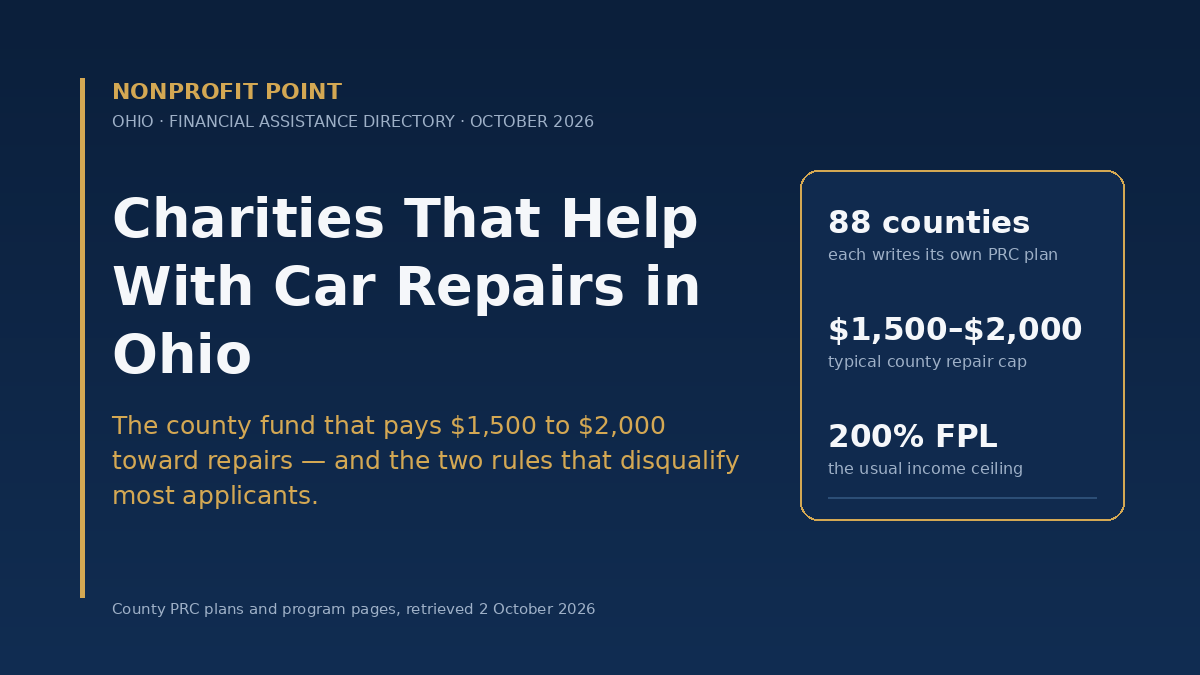
In Ohio, the money that pays for car repairs is not held by a charity. It is held by your county, under a program called Prevention, Retention and Contingency — PRC — and it pays between $1,500 and $2,000 in most counties that fund repairs at all. There are 88 county plans and no two are identical, which is why a generic list of national charities is close to useless here.
Two conditions knock out more Ohio applicants than anything else: nearly every county requires a minor child or a pregnancy in the household, and nearly every county requires you to be currently employed, usually 20 to 25 hours a week with recent paystubs. If you meet both, your odds in Ohio are genuinely good. If you meet neither, there are still two routes worth your time, and they are named further down.
Everything below was taken from county PRC plans, county job and family services pages and program websites on 2 October 2026, with the dollar figures quoted as those sources state them.
Start here: the county fund that actually pays
The Ohio Department of Job and Family Services describes PRC in one sentence: it “provides work supports and other services to help low-income families overcome immediate barriers to achieve self-sufficiency.” The critical detail is the next one — “Each county has a PRC plan stating the types of services available in that county and the eligibility criteria for them,” and “PRC services vary between counties based on community needs.”
That is why a car repair that is fully covered in Fairfield County may not be a funded category at all one county over. ODJFS publishes the plans for all 88 counties, and a county plan is the authoritative document — not a county web page summary, and certainly not a national charity directory.
Baseline state eligibility is narrow and worth knowing before you spend an afternoon: PRC serves “parents of children under 18, including noncustodial parents if they live in Ohio,” and “pregnant women or teens.”
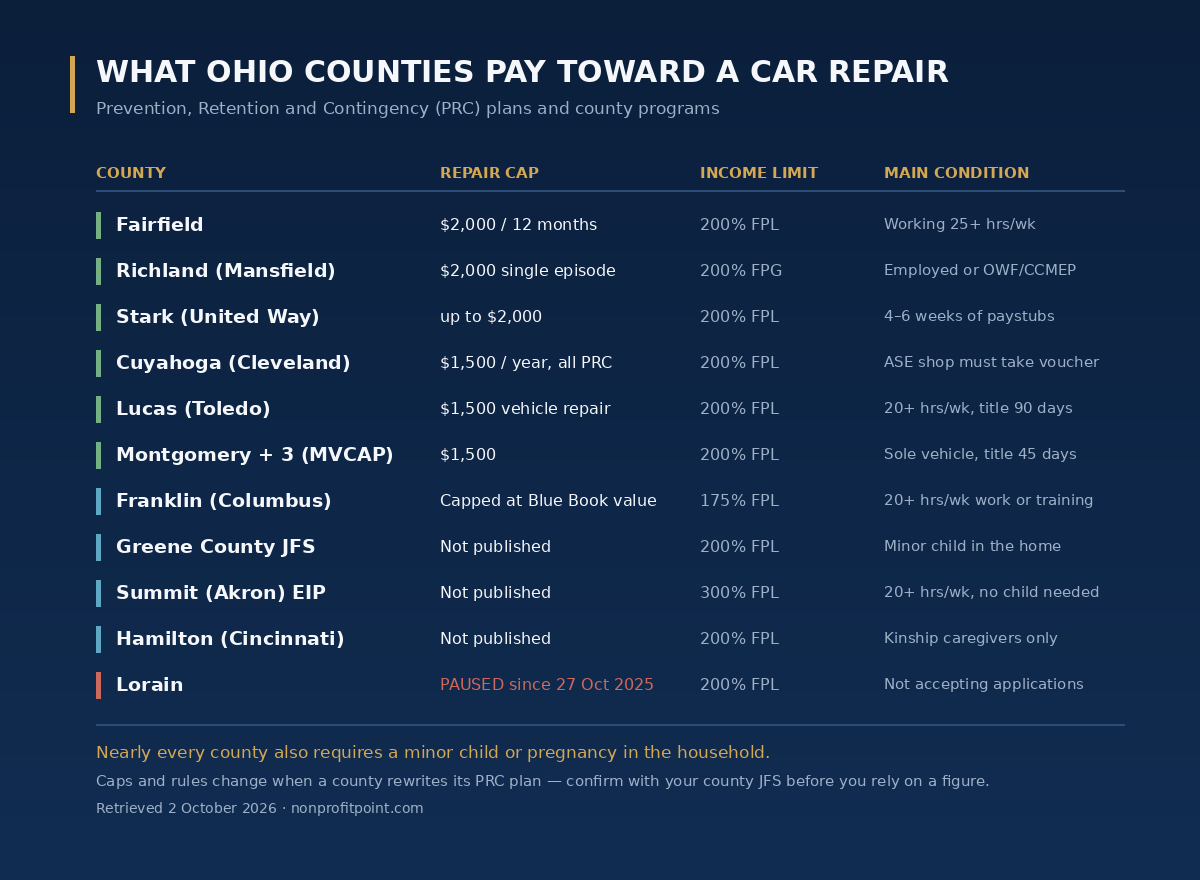
Fairfield County — $2,000, and the cleanest published terms in the state
Fairfield County Job and Family Services publishes one of the most usable PRC pages in Ohio. Car repair assistance “can be granted up to $2,000 in a 12-month period when funding allows.” Eligibility runs to households under 200% of the federal poverty guideline, with the applicant 18 or older and at least one dependent child under 18 in the home or a pregnancy.
Car repair carries one extra condition beyond the general PRC rules: it is for “an employed individual working at least 25 hours per week with a valid driver’s license and insurance.” That is a higher work threshold than most counties, so check your hours before applying. Applications go through an online Adobe Sign link on the county page, by phone on 740-652-7889, or by email to PRC23@jfs.ohio.gov.
Richland County — $2,000 per episode, and more if services are bundled
Richland County’s PRC plan, effective 1 December 2025, is one of the most recently rewritten in the state, which makes its numbers unusually trustworthy. It sets a “$2,000.00 maximum for a single episode… per consecutive 12-month period” for car repairs, rising to $3,000 where services are bundled.
Eligibility is 200% of the federal poverty guideline, for employed individuals or those meeting Ohio Works First or CCMEP participation requirements, and for parents or specified relatives with minor children. The plan is specific about the vehicle: registration in the applicant’s name, current liability insurance and a valid licence, and a hard exclusion — “PRC funds will not be used for repairs on vehicles deemed inoperable or unsafe by the automotive vendor.” If the shop writes the car off as unsafe, PRC will not chase good money after it.
Cuyahoga County — $1,500 a year, and the voucher condition people miss
Cuyahoga County Health and Human Services runs PRC for the Cleveland area with “a maximum issuance of $1,500 per year” across all PRC categories combined, not per repair. The application form lists “Vehicle Repair” as an explicit request category.
Eligibility runs to 200% of the federal poverty level, and the household rule is stated plainly: “You must live with at least one minor child, be pregnant, or be the non-custodial parent of a child.” Two documentation requirements catch people out. The county wants an “itemized estimate from an approved ASE certified mechanic,” and separately, “verification ASE certified mechanic will accept PRC voucher.” Confirm the shop takes the voucher before you pay for an estimate — a shop that will not accept it turns a valid application into a wasted week. Applications go to Cuy-PRC-Application@jfs.ohio.gov; the PRC information line is (216) 987-7392.
Montgomery, Darke, Greene and Preble Counties — a dedicated car repair program
Miami Valley Community Action Partnership administers PRC across four counties and runs the only page in Ohio that treats car repair as a program in its own right rather than a line in a plan. The “Monetary Cap: $1,500” is published, and so is the scope: repairs “to make a vehicle operable,” plus towing if the vehicle is undriveable. Excluded are “cosmetic repairs or body damage that doesn’t limit operability” and sales taxes.
Eligibility: “your gross household income must be at or below 200% of the Federal Poverty Level.” The vehicle must be your sole transportation and must have been in your name for at least 45 days. You need two written estimates from businesses registered in Ohio. Apply through MVCAP’s online form, by phone on 937-341-5000 ext. 198, or at PRC@mvcap.com. County lines are Montgomery (937) 341-5000, Darke (937) 548-8143, Greene (937) 376-7747 and Preble (937) 456-2800.
Lucas County — $1,500, with the longest title-holding rule
Toledo’s county plan sets a “$1,500 cap for vehicle repair which may be fully accessed for a single incident or may be distributed across multiple incidents,” at up to 200% of the federal poverty level. The work test is specific: “applicant must be employed a minimum of 20 hours per week at State minimum wage; must have secured employment for a minimum of 2 weeks.” The title must have been in your name a minimum of 90 days — the longest holding period we found in Ohio — and two repair estimates are required.
One honest caveat. The Lucas plan published on the state’s document server states an effective date of 1 October 2023 for the FFY 2023-2025 cycle, and a county resolution from October 2025 still refers to that plan. Treat the $1,500 figure as the best available published number and confirm it with the county before you rely on it.
Franklin County — no flat cap, but a tighter income test
Columbus works differently from everywhere else on this page. Franklin County’s FFY26-27 PRC plan, effective 8 October 2025, does not set a dollar cap on auto repairs at all. Instead it limits repair costs to the vehicle’s retail value as listed by Kelley Blue Book or NADAguides. On a $1,200 car that is a far smaller ceiling than Fairfield’s $2,000; on a $6,000 car it is considerably larger.
The trade is a tighter income test — 175% of the federal poverty level rather than the usual 200%. You need a minor child or a pregnancy, and the applicant “must be employed, in receipt of a job offer or, participating in a job training or workforce development program at least twenty (20) hours per week.” Note that a job offer counts, which is unusual and useful if the repair is what stands between you and a start date. The car “must be the AG’s sole means of transportation.” Use form FCDJFS 3800, the PRC Inbound Center on 614-233-2999, or franklin-cdjfs-agencyprc@jfs.ohio.gov.
Greene County JFS — the county that also pays insurance and car payments
Greene County residents have two routes: the MVCAP program above, and the county’s own PRC, which is broader in scope than most. Greene County JFS lists auto repair, auto insurance, auto payments and driver licence reinstatement as covered categories. Very few Ohio counties fund insurance or a car payment, so if those are the pressure point rather than a repair bill, this is worth a call.
Eligibility is family income under 200% of the federal poverty level, with a minor child in the home and Greene County residency. No dollar cap is published; call (937) 562-6000 and ask what the current maximum is before you build a plan around it.
Summit County — the exception if you have no children
If the minor-child rule is what disqualifies you, Akron is the place to look. Summit County funds car repairs through its Employment Incentive Program rather than core PRC, and EIP runs to 300% of the federal poverty level — the highest income ceiling we found anywhere in Ohio — with a 20 hour a week employment test and no minor child requirement. The plan states that “EIP participants may directly access car repairs… when the need for the service is identified and coordinated by EIP provider,” so the route in is through an EIP provider rather than a direct application.
Summit’s core PRC transportation help is rides only: “payment for temporary ride services (bus pass, ride share, taxi, etc).” One practical note — the old summitdjfs.org address now redirects to summitcountyjfsohio.gov, so bookmarks and older articles will send you to the wrong place. The phone number is 844-640-OHIO (6446).
Hamilton County — kinship caregivers only
Cincinnati is the most commonly misreported county on this topic. Hamilton County’s PRC plan does fund car repairs, but only inside its Kinship Caregiver Program, and only where the repair is tied to school or employment. The income test applies to the child — “income of the child shall not exceed 200% of the Federal Poverty Level” — and notably “there is no work requirement associated with these funds.”
If you are a grandparent or relative raising a child in Hamilton County, this is a real and under-used route. If you are not, Hamilton is not a general car repair county, whatever a directory tells you. The amendments in the state-hosted plan are dated 2019 and 2022, so confirm current terms with the county directly.
Lorain County — funded, but paused
Lorain County’s PRC plan covers “car repairs — not regular maintenance” and liability auto insurance for up to four months at 200% of the federal poverty level. But the county’s own page carries a notice: “As of 10/27/2025, PRC is temporarily paused. We are not accepting new applications at this time.” Worth checking monthly rather than crossing off, because the program is funded and the pause is administrative.
United Way of Greater Stark County — the strongest non-PRC program in Ohio
Run with Stark County Job and Family Services, this is the clearest standalone auto repair program we could verify in the state, and it pays “up to $2,000” for major repairs. The exclusions are published and narrower than people expect: no “towing, estimates, or cosmetic issues such as tires, windows, headlights, or bodywork.” It is for engine and transmission class problems, not wear items.
Eligibility: 18 or over, a Stark County resident, “have minor child in the home, or minor child for whom you pay child support,” “be employed (must be able to provide 4-6 weeks of paystubs),” and “meet income guidelines (must be 200% under the Federal Poverty Line).” Note the child-support clause — it is one of very few Ohio programs that counts a non-resident parent paying support as meeting the child requirement. Three comparable estimates from ASE-certified mechanics are required, applications go through a form linked from the United Way page, and the number is 330-491-0445.
Cincinnati: ChangingGears is a discount, not a grant
ChangingGears is widely listed as a charity that fixes cars for free in Cincinnati. It does not. It describes itself accurately: “ChangingGears sells restored cars and repairs cars at an affordable price to approved CityLink clients,” and “repairs cost about half of what a typical repair shop would charge.” The vehicle assessment is free; the repair is not.
Two gates matter. You must be an approved CityLink Center client, which means going through CityLink’s own intake first. And the repair program excludes engine, transmission and body work — the three things most likely to be the reason you are reading this page. ChangingGears also runs a Bridge Program with $175 monthly payments that requires accepting a full-time job offer paying $17 an hour or more, and a purchase program needing 20% down and $1,200 monthly income. It is at 800 Bank Street, Cincinnati, OH 45214; 513-357-2000.
Columbus: free safety repairs through Project Taillight
The Columbus City Attorney’s Office runs a programme that repairs safety equipment at no charge — safety lights, horn, warning devices, bulbs and casings, mirrors, brakes, tyres and exhaust. For a car that is roadworthy but failing on safety items, or one attracting repeated equipment citations, this is the best deal in the state.
Eligibility is Columbus residency, an income scale by household size, a vehicle seven years or older, and ownership outright with no payments or title loans against it. It is strictly once per customer: “previous participation in Project Taillight will make you ineligible for future participation.”
Current status matters here. The page states: “Applications have been paused to allow us to process the applications already received.” Email ProjectTaillight@columbus.gov to ask when the window reopens rather than submitting into a closed queue.
Central Ohio: a low-interest loan instead of a grant
The St. Vincent de Paul Microloan Program, run by the Diocese of Columbus, makes low-interest loans for car repair, home repair and job expenses, and specifically to pay off “high interest payday and car title loans.” It covers Coshocton, Delaware, Franklin, Hardin, Knox, Licking and Union counties.
Be clear that this is a loan, not aid — the maximum amount and the interest rate are not published, so ask before you commit. And check the status first: the programme’s page currently states that the loan programmes in Delaware County and Franklin County are temporarily not accepting pre-screening or final applications. The number is 614-376-3604.
What we could not verify, said out loud
Half the value of a page like this is telling you where not to spend your time. These appear on Ohio car repair lists across the web and do not survive a visit to the source.
Vehicles for Change does not serve Ohio. Its own page states that “our Keys to Independence program is currently limited to individuals and families who live in Maryland,” and that “all referrals must come through a participating sponsoring agency.” It is listed for Ohio by several directories anyway.
Working Cars for Working Families is not a place to apply. It describes itself as “a coalition of varied organizations” whose work includes “promoting non-profits that provide struggling families with cars.” There is no individual application. It is a policy network, and presenting it as an aid provider sends people into a dead end.
1-800-Charity Cars donates vehicles; it does not repair them. The organisation is live and national, providing “free donated vehicles to assist struggling families in their transition from dependency to self-sufficiency,” with applications at FreeCharityCars.org. If your car is beyond economic repair, that is the right door. It is the wrong door for a repair bill.
“Goodwill car repair” and “Salvation Army car repair” are, in Ohio, aggregator inventions. We could not find a single Goodwill or Salvation Army page in Ohio describing a car repair programme. Local Salvation Army corps do make discretionary emergency grants, so a call is not wasted — but there is no published Ohio programme to apply to, and any article that names one without linking the corps page is guessing.
The Scioto County vehicle repair pilot has ended. Community Action Organization of Scioto County ran a pilot paying up to $2,500 that, by its own announcement, “began April 1, 2024 and will end June 30, 2025.” Call (740) 354-7541 before assuming it has been renewed.
Modest Needs remains unverified by us. Its self-sufficiency grants are frequently cited for car repairs, but the site blocks automated retrieval, so we could not confirm the current grant amount, the eligibility rules or that car repair still qualifies. We will not pass through a figure we could not read on the source. Open modestneeds.org yourself and check before planning around it.
Where to call when nothing above fits
Ohio 211 is the state’s referral backbone, reachable by dialling 211 or 888-OHIO-211. Its own announcement is worth knowing: “as of July 1, 2026, Ohio 211 will be available in all 88 counties in Ohio” — coverage that was patchy for years is now complete.
Be realistic about what 211 is. It is a referral service operated by 13 regional organisations, not a fund. It does not pay for repairs, and its database does not list car repair as a standing category. What it does well is tell you which agency in your specific county currently has money, which is exactly the question that changes month to month and that no article can answer permanently.
Your county Job and Family Services office is the other number worth having. Ask one specific question: “Does this county’s current PRC plan fund vehicle repair, and what is the cap?” That phrasing gets a straight answer faster than asking about emergency assistance generally.
How to actually get a yes in Ohio
Check the title date before anything else. MVCAP requires the car in your name 45 days, Lucas County 90 days, Franklin 30. If you bought the car recently, you may simply need to wait, and knowing that now saves an application.
Get two estimates, and get them from the right kind of shop. Cuyahoga and Stark both require ASE-certified mechanics; MVCAP requires Ohio-registered businesses; Stark wants three comparable estimates. Ask the shop up front whether it accepts county vouchers, because several counties pay the shop directly and a shop that will not take a voucher invalidates an otherwise good application.
Have the paystubs ready. Stark wants four to six weeks of them. Fairfield wants 25 hours a week, Franklin and Lucas 20. Employment verification is the most common hold-up on these files and the easiest to pre-empt.
If the repair exceeds the car’s value, say so early. Franklin caps the repair at Blue Book value and Richland will not fund work on a vehicle the shop deems unsafe. If you are on the wrong side of that line, a vehicle-donation route is a better use of the same hours than a repair application that cannot be approved.
Apply in more than one place where you can. Greene County residents can approach both MVCAP and Greene County JFS. Stark County residents can try the United Way programme and PRC. The programmes are not formally coordinated and applying to one does not close the other.
Frequently asked questions
Are there charities that help with car repairs in Ohio?
The most reliable money is not from a charity but from your county, through the Prevention, Retention and Contingency programme, which pays $1,500 to $2,000 in most counties that fund repairs. The strongest genuine charity programme we verified is the United Way of Greater Stark County auto repair programme, which pays up to $2,000 for Stark County residents.
How much will Ohio pay toward a car repair?
It depends entirely on the county. Fairfield and Richland publish $2,000, Cuyahoga $1,500 a year across all PRC help, Lucas $1,500 for vehicle repair, and the Miami Valley Community Action Partnership $1,500 across Montgomery, Darke, Greene and Preble. Franklin County sets no flat cap but limits the repair to the vehicle’s Kelley Blue Book or NADAguides retail value.
What is PRC in Ohio?
Prevention, Retention and Contingency is a state programme that, in the Ohio Department of Job and Family Services’ own words, “provides work supports and other services to help low-income families overcome immediate barriers to achieve self-sufficiency.” Each of the 88 counties writes its own plan, so “services vary between counties based on community needs” — including whether car repair is funded at all.
Do I need children to get car repair help in Ohio?
In most counties, yes. PRC baseline eligibility covers “parents of children under 18, including noncustodial parents if they live in Ohio” and pregnant women or teens. The notable exception is Summit County, whose Employment Incentive Program funds car repairs at up to 300% of the federal poverty level with an employment test and no minor-child requirement.
Do I have to be working to qualify?
Usually. Fairfield requires 25 hours a week, Franklin and Lucas 20, and Stark County’s United Way programme asks for four to six weeks of paystubs. Franklin is the most flexible — a job offer or participation in a job training or workforce development programme counts as well as current employment. Hamilton County’s kinship caregiver route states there is no work requirement attached to its funds.
What is the income limit for car repair assistance in Ohio?
200% of the federal poverty level is the standard across most counties, including Cuyahoga, Lucas, Fairfield, Richland, Greene and Lorain, and for the Stark County United Way programme. Franklin County is tighter at 175%. Summit County’s Employment Incentive Program is the most generous at 300%.
Which Ohio county pays the most for car repairs?
Fairfield and Richland both publish $2,000, and Richland allows up to $3,000 where services are bundled. The United Way of Greater Stark County programme also pays up to $2,000 and is separate from PRC, so in Stark County it is worth asking about both.
Can I get free car repairs in Columbus?
Project Taillight, run by the Columbus City Attorney’s Office, repairs safety equipment at no charge — lights, horn, mirrors, brakes, tyres and exhaust — for Columbus residents meeting an income scale, with a vehicle seven years or older owned outright. It is once per person. Applications are currently paused while the office works through its existing queue.
Does Ohio 211 help with car repairs?
211 is a referral line, not a fund. It will route you to whichever agency in your county currently has money, which is useful because that changes month to month. Dial 211 or 888-OHIO-211. As of 1 July 2026 the service covers all 88 Ohio counties.
My repair costs more than my car is worth. What then?
Several counties will not fund it. Franklin caps repair spending at the vehicle’s retail value, and Richland’s plan states that “PRC funds will not be used for repairs on vehicles deemed inoperable or unsafe by the automotive vendor.” At that point a vehicle-donation programme such as 1-800-Charity Cars, which provides free donated vehicles rather than repairs, is a better use of your time than a repair application.
Related help
If you are working through transport costs in Ohio, or comparing how other states handle the same problem, these guides pick up where this one stops:
- Charities that help with car repairs — the national picture and the programmes that operate in every state.
- Car repair help in Illinois and in Pennsylvania — the two neighbouring states with the most distinctive rules.
- Emergency financial assistance guide — what to do when the bill is due before any application clears.
- Get help paying for — our full index of assistance guides by need.
Every figure, eligibility rule and application status on this page was taken from the county’s own PRC plan or the programme’s own website on 2 October 2026. County PRC plans are rewritten on federal fiscal year cycles and caps change with them — confirm with your county Job and Family Services office before you rely on a number here.