Charities That Help With Service Dogs: What’s Actually Free in 2026

A trained service dog is one of the few forms of disability assistance that almost nobody buys outright. The charities that place them say it costs between $35,000 and $75,000 to breed, raise, train and support a single dog — and most of them hand that dog to the person who needs it for nothing. That is the good news, and it is genuinely good.
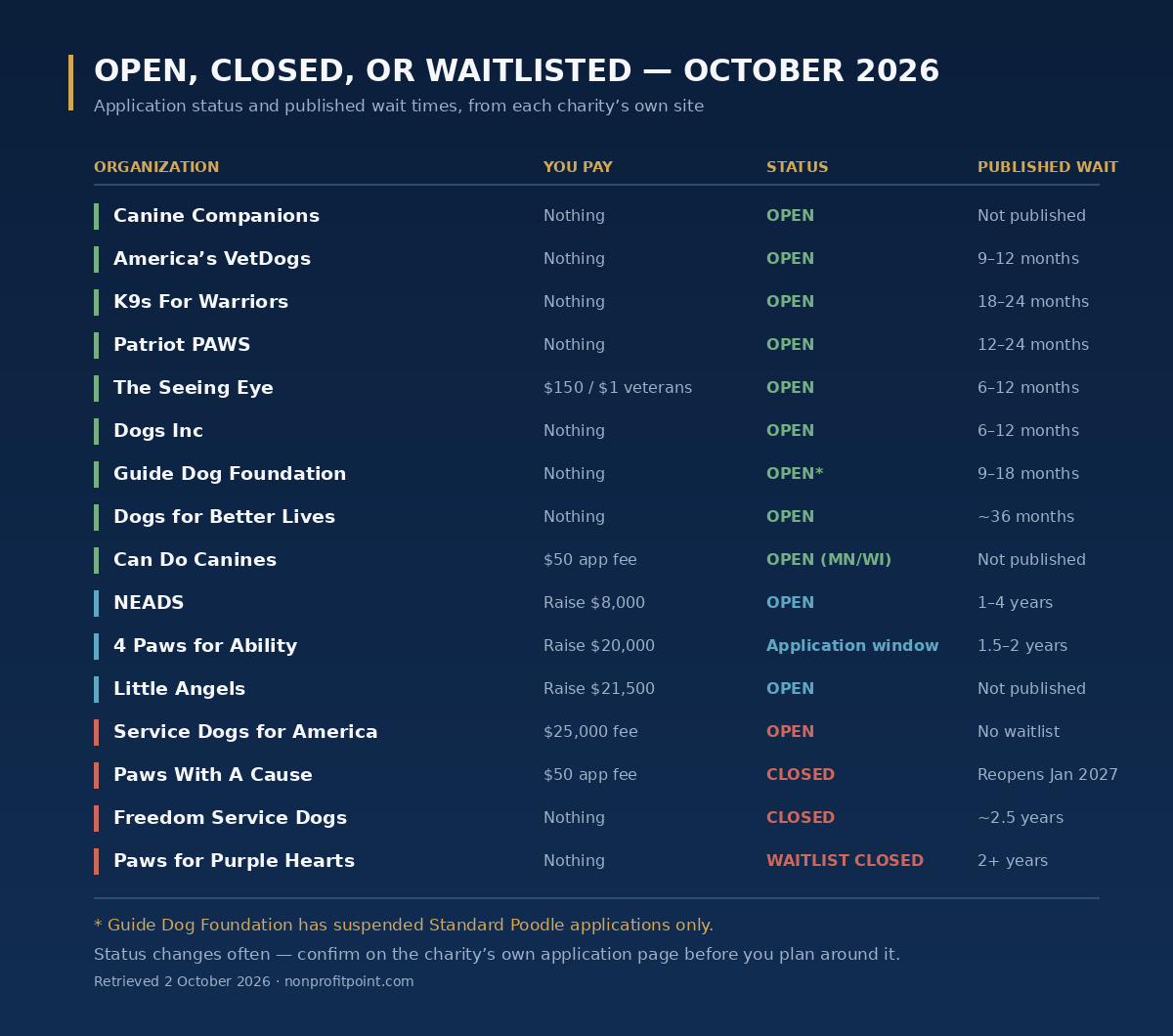
The complication is that “free” and “available” are not the same word. As of early October 2026, three of the best-known placement charities in the United States are not accepting applications at all, one charges $25,000, and three more will only match you after you have personally raised somewhere between $8,000 and $21,500. Meanwhile the one grant program that almost every “how to pay for a service dog” article still recommends has been shut down since 2024.
This guide names who actually places dogs at no cost right now, what each one requires of you, how long their own published wait times are, and where the real money gaps are. Every figure below was taken from the organization’s own website on 2 October 2026, and the quotes are theirs, not ours.
What a service dog really costs — and who absorbs it
Before you look at any application, it helps to understand the economics, because they explain every rule you are about to meet. Here is what the placement charities themselves publish about their own costs.
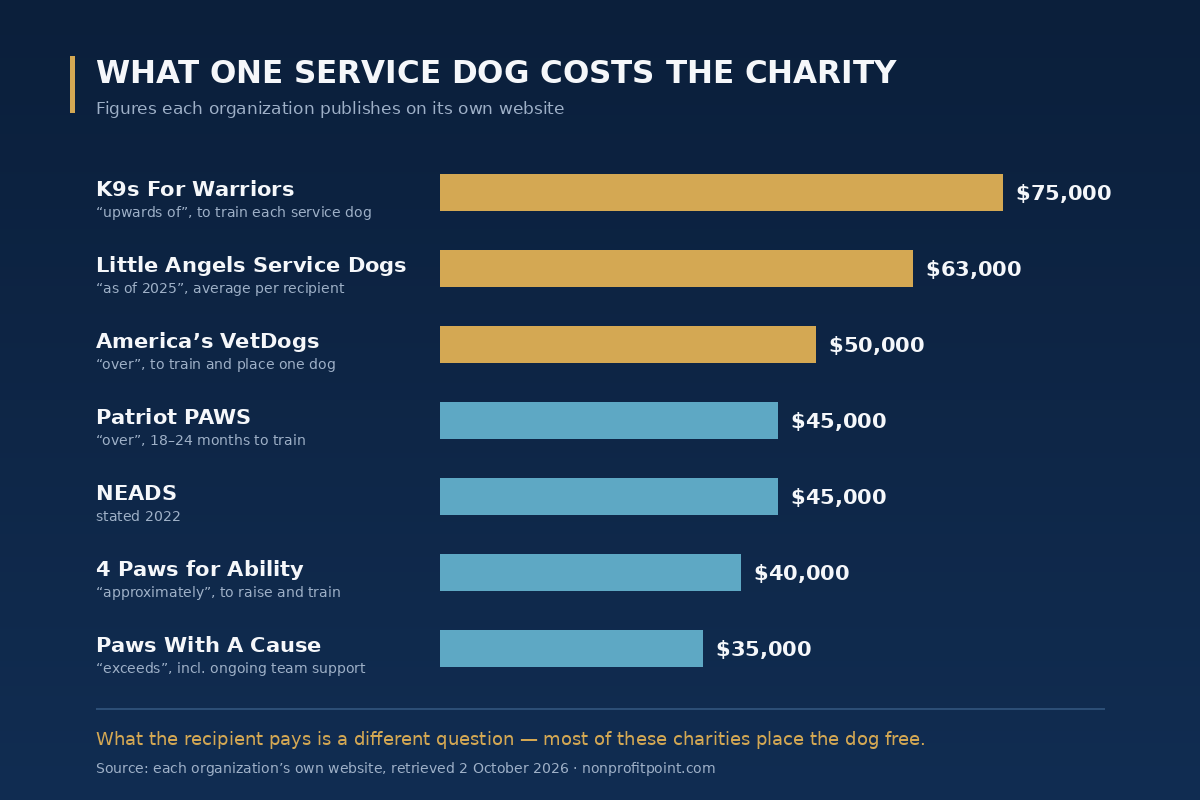
K9s For Warriors states that “it costs upwards of $75,000 to train each Service Dog.” Little Angels Service Dogs writes that “as of 2025, Little Angels plans to spend an average of $63,000 per recipient that joins our waitlist.” America’s VetDogs says “it can cost over $50,000 to train and place one assistance dog.” Patriot PAWS: “Each of our Service Dogs takes 18–24 months to train at a cost of over $45,000.” Paws With A Cause puts its all-in sponsorship, including lifetime team support, at a figure that “exceeds $35,000.”
Two things follow from those numbers. First, no charity can place dogs on demand — the bottleneck is dogs and trainers, not money alone, which is why waits are measured in years rather than weeks. Second, when an organization asks you to fundraise, it is usually asking for roughly half of its own cost, not for a markup. 4 Paws for Ability says this plainly: “The cost to raise and train a service dog is approximately $40,000… we raise half of that and the families complete their fee for service, which includes the other half.”
Where each charity stands right now
Application status is the most perishable fact in this field. A charity that was open in July can be closed in October. This is the current picture.
Charities that place a service dog at no cost to you
Canine Companions
The largest non-profit provider of assistance dogs in the United States, and the cleanest answer to “who gives a service dog away.” Its FAQ is unambiguous: “Canine Companions service dogs and all follow-up services are provided free of charge to the recipient.” There is no application fee and no fundraising requirement. It places service dogs for adults and children with physical or developmental disabilities, hearing dogs for Deaf and hard-of-hearing adults, PTSD service dogs for veterans at selected training centers, facility dogs for professionals, and — since its merger with Early Alert Canines — medical alert dogs for people with insulin-dependent diabetes.
Eligibility: “Individuals applying for a service dog must be at least 18 years old with an established, stable home life,” and the organization notes that applicants aged 25 and over are typically the most suitable. Children must be at least five. What you still pay: your travel to a regional training center and meals during the two-week Team Training class, plus food, grooming and routine veterinary care afterwards. Canine Companions retains legal ownership of the dog throughout its working life. Response time: “All inquiring individuals should receive a response from Canine Companions within 4-6 weeks.” A numeric wait is not published; the FAQ says only that “service dog candidates have the longest wait.”
America’s VetDogs
For active military, honorably discharged veterans and first responders with a work-related disability, PTSD, or a visual or hearing impairment. “There is no cost to the student. Although it can cost over $50,000 to train and place one assistance dog, all of our services, including transportation and accommodations at our New York campus are provided at no cost to the student.” Budget “approximately $75 – $100 per month” for the dog’s upkeep afterwards.
Wait: this is the shortest published wait of any national program we could verify — “Our current average wait time for approved applicants is now 9-12 months, depending on the client’s needs.” Process: a short online application, then medical and mental health documentation, a support-person form and a video; VetDogs commits to responding “within 15 business days.” Its PTSD program requires that you be in ongoing counseling and have been under consistent care of a mental health professional for at least a year.
K9s For Warriors
Veteran-specific, PTSD-specific, and almost entirely built from rescue dogs. The program is “provided at no financial cost to the Veteran,” and it serves “all-era military Veterans who have been diagnosed with service-connected PTSD, traumatic brain injury and/or military sexual trauma living in the United States or surrounding territories.” A verified clinical diagnosis of PTSD, TBI or MST is required to qualify.
Wait: “Our waitlist is between 18 and 24 months, though it may vary depending on several factors.” Commitment: a mandatory three-week residential training program on campus. Note one detail applicants often miss — “Veterans will not be able to choose their dog or the training campus location.” Travel to campus may be out of pocket, though K9s says outside resources may be available to help.
Patriot PAWS Service Dogs
Texas-based, serving veterans with mobility limitations, post-traumatic stress and traumatic brain injury. “We train and provide Service Dogs of the highest quality at no cost,” and “Veterans will never receive a bill.” On-campus accommodation at the Veteran House during training is also free of charge.
Eligibility: broad and clearly stated — “Any Veteran with an honorable discharge is welcome to apply for a Service Dog.” A background check is part of the process. Wait: “Due to our large volume of requests, it may take between 12-24 months for you to be matched with a dog.” The six-step process runs from application through a Client Services call, documentation, onboarding, a two-phase graduation with in-home follow-up training, and lifelong support.
Can Do Canines
A strong option with a hard geographic limit. Can Do Canines places mobility assist, hearing assist, diabetes assist, seizure assist and autism assist dogs, and states that “we proudly place our dogs free of charge through the support of our amazing donors.” Its page for medical professionals is more precise: “With Can Do Canines, there is a $50 application fee; otherwise, we do not charge clients for the dogs.”
The catch: “For those interested in our mobility, hearing, diabetes or seizure assist programs we are accepting applications from those residing in Minnesota and Wisconsin.” Autism Assist is Minnesota only. Minimum ages differ by program — 18 for diabetes and hearing, 10 for mobility, and two to seven years old for autism assist. It is an Assistance Dogs International accredited organization.
Dogs for Better Lives
The main national source of hearing dogs. “There is no charge to receive a Hearing Dog,” and hearing dog applications are currently open. Eligibility is specific: live in the United States, be 18 or older, need the dog to alert to at least three sounds in the home, be able to care for the dog without assistance, and have no other dog in the household except possibly a retired Dogs for Better Lives hearing dog. A fenced yard is typically required, and you commit to a minimum of one full year of training as a team.
Be realistic about the wait: the organization’s FAQ states that “the current expected wait time is approximately 36 months.” It also warns that “the cost of feeding and caring for one of our professionally trained dogs could be over $1,500 per year.” Its Autism Assistance Dog applications are a separate matter and are currently closed, with re-opening expected in winter 2027.
Two excellent programs that are closed right now
Paws With A Cause places service dogs for physical mobility, hearing dogs, seizure response dogs, service dogs for children with autism and medical alert dogs. “PAWS clients do not pay to receive their Assistance Dogs.” But applications run on an annual window, and that window is shut: “The PAWS client application request form is closed for 2026 and will reopen in January 2027.” When it reopens there is “a non-refundable $50 fee that covers the cost of processing applications,” and PAWS receives more than 1,000 requests a year. Its eligibility bar includes being able to afford $1,600–$2,000 a year for the dog’s upkeep, a support system of at least two people outside your household for emergency care, and background screening for every adult in the home.
Freedom Service Dogs of America trains for veterans and first responders with PTSD or TBI, people with physical disabilities, and people with autism aged 15 and up. “We provide our assistance dogs to our clients free of charge.” But: “Please note that we are NOT currently accepting inquiries for assistance dogs.” Even once reopened, “those accepted onto our waitlist can expect to be matched with a dog within approximately 2.5 years.” All clients must travel to Englewood, Colorado for matching, a two-week placement class and twice-yearly recertification.
Paws for Purple Hearts, which serves veterans and service members with physical disabilities, PTSD, TBI and MST, waives all service dog and boot camp training fees for recipients — but “our waitlist is closed,” and even for those on it, “it may take two years or more to match you with a dog.” It gives priority to existing clients needing a successor dog. If you are a veteran, this is the one to bookmark and check quarterly rather than plan around.
Guide dog schools: the most reliable door in the whole field
If the disability in question is blindness or low vision, you are in the best-funded, longest-established and most consistently open corner of the assistance dog world. Guide dog schools have endowments that placement charities for other disabilities simply do not, and it shows in their wait times. Several of them also appear in our guide to charities that help blind people and their families, which covers the wider support picture beyond dogs.
The Seeing Eye
The oldest guide dog school in the world, in Morristown, New Jersey, and the only major program on this list that charges a deliberate token fee: “Students pay $150 for their first dog and $50 for each successor dog. Veterans of the military pay $1. Payments may be made in installments after students leave the school.” The school frames the fee as a commitment device — “a fraction of the total cost to create a match between person and dog.”
Eligibility: at least 16 years old, “motivated and emotionally stable, capable of walking one to two miles a day,” with an active daily routine, adequate independent travel skills, sufficient hearing, a clean living environment and at least intermediate English. Orientation and mobility training is required. Wait: “Generally, once an applicant is accepted, class placement is within six months to a year.” Training on campus runs three and a half weeks for a first dog, two and a half for a returning student.
Guide Dogs for the Blind
Campuses in California and Oregon. “All services are provided at no cost — this includes your guide dog, transportation to and from one of our campuses in California or Oregon, instruction, equipment, and more.” Unusually, there is no age floor at all: “There are no age requirements for our Guide Dog Program.” An ophthalmologist’s report is required for first-time applicants, and an orientation and mobility professional’s report if you have had O&M training in the past five years. It is an accredited member of the International Guide Dog Federation.
Guiding Eyes for the Blind
Yorktown Heights, New York. “Guiding Eyes provides all services completely free of charge to people who are blind or with vision loss,” and it goes a step further than most: “We provide a stipend to every graduate of $600 per calendar year to cover basic veterinary care for their working guide dog.” That stipend is the single most generous aftercare term we found anywhere in this research.
Eligibility: at least 16 years old with no upper age limit, legally blind (20/200 or less in the better eye with correction, or a visual field of 20 degrees or less), resident in the United States or Canada, and having completed orientation and mobility training. Expect to budget $80–$100 a month for food and supplies beyond the stipend.
Leader Dogs for the Blind
Rochester Hills, Michigan. “Our program is offered at no cost to clients,” and Leader Dog also coordinates and covers public transportation to and from campus for clients travelling within the United States, Mexico and Canada. You must be at least 16 at the time of attendance and “be able to walk for 30 minutes at a time, multiple times per day, without using a walker or a wheelchair.” The organization is Assistance Dogs International accredited and tells applicants to plan on roughly $1,500 a year for the dog’s food, vaccinations and veterinary care.
Dogs Inc (formerly Southeastern Guide Dogs)
Worth flagging because the name changed and older articles still send readers to the wrong place: guidedogs.org now redirects to dogsinc.org. “For over 40 years, Dogs Inc has been training guide dogs and providing them at no cost,” and the free package is broader than most — premium dog food, annual veterinary care, monthly flea and tick preventatives, and financial help for unexpected veterinary bills. Requirements are short: a visual impairment, completed O&M training, at least 15 years old, able to care for a dog, and a safe home. Wait: “From application to match day, guide dog candidates experience an average waiting period of 6-12 months,” followed by a 20-day campus stay in Palmetto, Florida.
Guide Dog Foundation for the Blind
Smithtown, New York, and the sister organization of America’s VetDogs. “When you are accepted to the guide dog training program, the Foundation will cover all expenses including travel to and from your home to our campus.” You must be legally blind, able to demonstrate the need for a guide dog for everyday travel, and “applicants must reside in the USA or Canada and have a stable living arrangement.” Wait: “there is an average wait of nine to eighteen months before they will be invited to attend a class.” One current restriction to know: the Foundation has suspended new applications for Standard Poodles, which it breeds for applicants with a medical need for a hypoallergenic dog.
Charities that place the dog but ask you to fundraise
These organizations are not selling you a dog. They are asking you to cover part of their cost, and all of them provide fundraising help. If you are going down this road, our walkthrough of service dog fundraising ideas covers the campaign mechanics that actually move money at this scale.
NEADS World Class Service Dogs — $8,000
The lowest fundraising bar we verified. “We ask each of our accepted clients to support NEADS by raising $8,000,” and the organization supplies staff support for the campaign. Veterans are exempt: there is no charge for veterans who are eligible for NEADS services. It serves people with physical disabilities aged 12 and up, hearing dog clients aged 15 and up, children with autism or other developmental disabilities aged 8 to 12, and veterans with a permanent disability, severe hearing loss or a PTSD diagnosis. Applications are open. Wait: “The average waiting period for a NEADS Service Dog could be 1 to 4 years after application, interview, and acceptance.”
4 Paws for Ability — $20,000
The specialist for children. 4 Paws welcomes applications “from individuals who are under 18 years old, or older than 18 and are not their own legal guardians, or local military veterans,” with veterans needing an honorable discharge and residence within a three-hour radius. Its fee is explicit and is called a fee for service rather than a donation: “This fee for service is $20,000 and certain breeds (papillons and goldendoodles) require an additional $3,000 due to grooming and health considerations.” There is also a one-time $50 application processing payment. Wait: “on average, it takes about 1.5 to 2 years to receive your service dog after the completion of your fee for service.” 4 Paws became a fully accredited member of Assistance Dogs International in December 2025.
Little Angels Service Dogs — $21,500
The highest fundraising commitment on this list, and the organization is candid about why: “As of 2025, Little Angels plans to spend an average of $63,000 per recipient that joins our waitlist.” Recipients “must commit to paying or fundraising at least $21,500 with the support and guidance of our staff.” There is “a $75 application fee,” and once approved “the recipient may choose to join our waiting list with a $500 down payment.” Handler training runs two weeks in California, Texas or New Hampshire. It is ADI accredited.
Service Dogs for America — the $25,000 outlier
Include this one for completeness, but understand what it is. Service Dogs for America, in Jud, North Dakota, is ADI accredited and trains mobility, emergency medical response and PTSD dogs — and it charges a price rather than asking you to fundraise a share: “There is no fee for the preliminary application. There is a $50 non-refundable fee for the full application. The fee for a service dog is $25,000.” That price includes a minimum of three weeks of team training on campus, guest housing, equipment, certification, home visits and additional task training. A staff member works with approved clients on fundraising, grants, payment plans and scholarships.
What you buy with that money is speed: “We do not currently have a wait list for applicants who have been medically approved by our independent Medical Review Board to receive a service dog.” In a field where free programs run 18 months to four years, that is a real trade-off rather than a rip-off — but it is a $25,000 trade-off, and most people reading this guide should exhaust the free list first.
The grant that everyone still recommends — and that no longer exists
If you search for help paying for a service dog, you will be pointed at the Assistance Dog United Campaign. Skip it. The campaign’s own website carries this notice on its homepage and its grant information page: “Unfortunately, due to a lack of funding, Assistance Dogs United will be discontinued in 2024. Open vouchers will still be honored.”
ADUC issued vouchers of up to $5,500 toward service, hearing and guide dogs and up to $2,500 toward social and therapy dogs, redeemable at member programs. It was the single best-known funding route for individuals, and dozens of charity listicles, state resource directories and AI answers still present it as live. It is not. Anyone sending you there in 2026 has not checked.
Here is the uncomfortable conclusion, stated plainly because the alternative is wasting your time: we could not verify a single currently operating national nonprofit that gives individuals cash toward acquiring a service dog. The money paths that do exist are the free-placement charities above, the fundraise-a-share models, and — for a dog you already have — general veterinary assistance funds. Treat any page promising “service dog grants” as something to verify against the granting organization’s own website before you invest an afternoon in it. The same scepticism is worth applying to where you give; our review of the worst disability charities to avoid explains how to read a disability nonprofit’s finances before you trust it.
What does exist: help with the dog’s veterinary bills
None of these programs are service dog specific. They fund pets, and a service dog qualifies as a pet for their purposes. They are small, and they are worth knowing when a working dog needs care you cannot cover.
RedRover Relief Urgent Care Grants are for an animal with an illness or injury needing urgent, specific treatment. “The average grant is around $250,” intended to “fill a small gap in funding.” Household income cannot exceed $60,000 a year, and both applicant and animal must live in the United States. Diagnostics, routine care and office exams are excluded. Applications run on a weekly cycle — the form closes Fridays at 4 p.m. Pacific and reopens Mondays at 9 a.m.
The Pet Fund covers non-basic, non-urgent care and is limited to “a $500 limit per applicant,” with requests placed on a waiting list for available funding. You must have owned the animal six months or longer and have a source of income, which may include unemployment insurance or SSI. Be prepared for delays: the fund says it receives hundreds of requests a day.
Frankie’s Friends funds emergency and specialty veterinary care, with grants that “will not exceed $1000.00 per pet, per household.” The pet must be family owned, must have a good prognosis as determined by a veterinary professional, and you need a diagnosis, treatment plan and cost estimate before applying. The owner pays the initial exam and diagnostics.
If the ongoing cost of feeding a working dog is the pressure point rather than a vet bill, our directory of charities that help with pet food lists pantries and programs that will cover that side.
What the VA does and does not pay for
This is the single most misunderstood item in the field, and the Department of Veterans Affairs states it directly: “VA does not provide service dogs (SD) but does provide veterinary health care and other benefits in support of guide dogs and hearing and mobility service dogs to maximize the life and utility of these specialized dogs.”
Asked whether VA will pay for the dog, the same page answers: “No. Veterans approved for service dogs are referred to Assistance Dogs International accredited agencies or International Guide Dog Federation accredited agencies.” Because those agencies place dogs free, VA’s fact sheet notes there should be no charge for the dog or its training.
What VA does provide is a commercially available veterinary insurance policy. The policy “will guarantee coverage for all treatment (and associated prescription medications), subject to premiums, copayments, deductibles or annual caps, determined to be medically necessary, including euthanasia, by any veterinarian who meets the requirements of the insurer.” It also covers hardware clinically required for the dog to do its job, repairs and replacements for that hardware, and pre-approved travel expenses associated with obtaining the dog.
What it does not cover is equally specific: “VA will not pay for items such as license tags, nonprescription food, grooming, insurance for personal injury, non-sedated dental cleanings, nail trimming, boarding, pet-sitting or dog-walking services, over-the-counter medications, or other goods and services not covered by the policy.”
To qualify, the dog must have completed a training program run by an ADI or IGDF accredited organization, and you must supply the completion certificate from that organization. Start by contacting your VA clinical care provider or your medical center’s Service Dog Champion.
One program is frequently confused with all of this. The PAWS pilot — Puppies Assisting Wounded Service Members — runs at five VA medical centers: Anchorage, Asheville, Palo Alto, San Antonio and West Palm Beach. It is an eight-week course in which veterans with PTSD help train candidate service dogs, one session a week. Participants do not receive a dog through it. It is a therapeutic program, not a placement program, and it is worth joining on its own merits rather than as a route to a dog.
How to apply without losing a year
Four practical rules, drawn from the application pages themselves rather than from general advice.
Apply to several organizations at once, and check status before you write a word. Three of the sixteen programs here are closed today. Open the application page itself — not a directory, not a blog post — and look for a current status line before you start assembling documents.
Get the medical documentation moving first. Almost every program needs the same package: a physician’s form, a specialist’s report matched to the disability, references, and in several cases a mental health report and video of your home. Guiding Eyes, Guide Dogs for the Blind and the Guide Dog Foundation all require forms signed by a doctor, and those are the slowest moving parts of any application. Request them the week you decide to apply.
Check whether you are inside the service area before anything else. Can Do Canines is Minnesota and Wisconsin. 4 Paws asks veterans to be within three hours. Freedom Service Dogs requires repeat travel to Colorado. Guide Dog Foundation and Guiding Eyes require US or Canadian residence. A perfect application to the wrong geography is a wasted month.
Budget honestly for the dog you are about to receive. Leader Dogs and Paws With A Cause both put annual upkeep at roughly $1,500–$2,000. America’s VetDogs says $75–$100 a month. Dogs for Better Lives says over $1,500 a year. Several programs screen for the ability to meet that cost, and it is a fair question — a working dog with unmet veterinary needs stops being a working dog. If that number is the obstacle, the broader charities that help with medical bills and household assistance routes are worth working through in parallel.
Frequently asked questions
Can I get a service dog for free in 2026?
Yes, from several organizations. Canine Companions states its dogs and all follow-up services “are provided free of charge to the recipient.” America’s VetDogs, K9s For Warriors, Patriot PAWS, Guide Dogs for the Blind, Guiding Eyes, Leader Dogs, Dogs Inc, the Guide Dog Foundation and Dogs for Better Lives all place at no cost as well. What you will pay in every case is the dog’s ongoing care, and in some cases your own travel to training.
Which free service dog program has the shortest wait?
Of the programs that publish a number, America’s VetDogs is the shortest at “9-12 months” for approved applicants, followed by The Seeing Eye and Dogs Inc at six to twelve months and the Guide Dog Foundation at nine to eighteen months. Dogs for Better Lives publishes the longest at approximately 36 months. Canine Companions, Little Angels and Paws With A Cause do not publish a figure.
Does the VA pay for a service dog?
No. VA’s own page states it “does not provide service dogs” and refers approved veterans to agencies accredited by Assistance Dogs International or the International Guide Dog Federation, which place dogs free. VA does provide a veterinary health insurance policy covering medically necessary treatment and prescriptions, plus required hardware and pre-approved travel to obtain the dog.
Is the Assistance Dog United Campaign still giving grants?
No. The campaign’s own website states: “Unfortunately, due to a lack of funding, Assistance Dogs United will be discontinued in 2024. Open vouchers will still be honored.” Articles and directories still listing it as an active source of $5,500 vouchers are out of date.
Why do some charities ask me to raise thousands of dollars?
Because they are asking you to cover part of their own cost, not to buy the dog at a profit. 4 Paws for Ability explains that a dog costs it approximately $40,000 and that it raises half while the family completes the other half. NEADS asks $8,000, 4 Paws $20,000, and Little Angels $21,500 — all with staff fundraising support.
Are there service dog charities for children?
Yes. 4 Paws for Ability is built around applicants under 18. NEADS places with children aged 8 to 12 who have autism or other developmental disabilities, and from age 12 for physical disabilities. Canine Companions accepts children from age five. Can Do Canines places autism assist dogs with children aged two to seven, in Minnesota only.
What does ADI accreditation mean, and does it matter?
Assistance Dogs International accredits programs against standards for training, placement and client support. It matters for one concrete reason beyond quality: VA requires that a veteran’s dog have completed a program run by an ADI or IGDF accredited organization before its veterinary insurance benefit applies, and the veteran must supply the accredited organization’s completion certificate.
How much does it cost to keep a service dog each year?
The organizations’ own estimates cluster between $900 and $2,000. America’s VetDogs says “approximately $75 – $100 per month.” Leader Dogs tells applicants to expect roughly $1,500 annually for food, toys, vaccinations and veterinary care. Paws With A Cause requires applicants to afford $1,600–$2,000 a year. Dogs for Better Lives puts it at potentially over $1,500. Guiding Eyes offsets part of this with a $600 annual veterinary stipend to graduates.
Can I get help with my service dog’s vet bills?
Not from service dog specific funds, but general veterinary assistance applies. RedRover Relief Urgent Care Grants average around $250 and require household income under $60,000. The Pet Fund caps grants at $500 for non-basic, non-urgent care. Frankie’s Friends grants do not exceed $1,000 per pet per household and require a diagnosis and treatment plan first.
What is the difference between a service dog, a therapy dog and an emotional support animal?
A service dog is individually trained to perform specific tasks for a person with a disability and has public access rights under the Americans with Disabilities Act. A therapy dog visits hospitals, schools and facilities to provide comfort to others and has no public access rights. An emotional support animal provides comfort by its presence, is not task trained, and has no ADA public access rights. Almost every charity in this guide places service dogs only; Paws for Purple Hearts, for example, explicitly states it does not train emotional support dogs.
Related help
If a service dog is one part of a larger set of costs you are trying to cover, these guides pick up where this one stops:
- Charities that help with wheelchairs — mobility equipment grants, loan closets and refurbishment programs.
- Charities that help with hearing aids — for the same households that qualify for hearing dogs.
- Charities that help blind people — the wider support network around vision loss.
- Emergency financial assistance guide — what to do when the bill is due before any application clears.
- Get help paying for — our full index of assistance guides by need.
All costs, eligibility rules, application statuses and wait times in this guide were taken from each organization’s own website on 2 October 2026. Application windows and waitlists change frequently — confirm on the charity’s own application page before you plan around anything here.