Charities That Help With Pet Food: Free Pantries and Programs (2026)

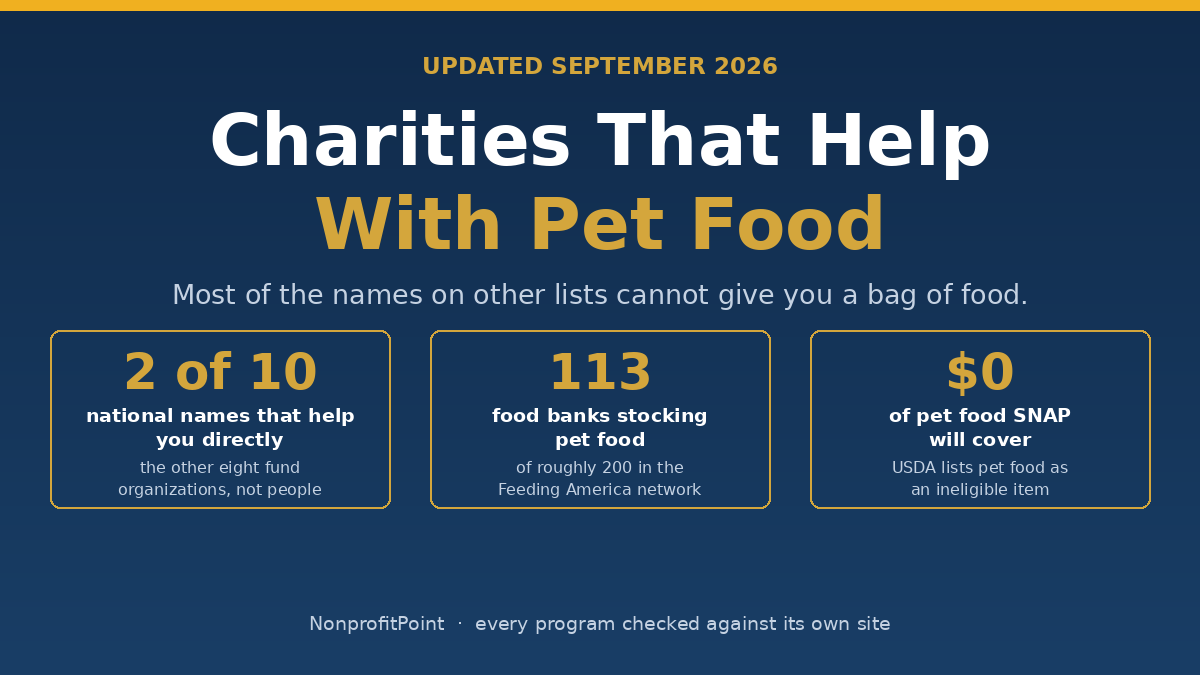
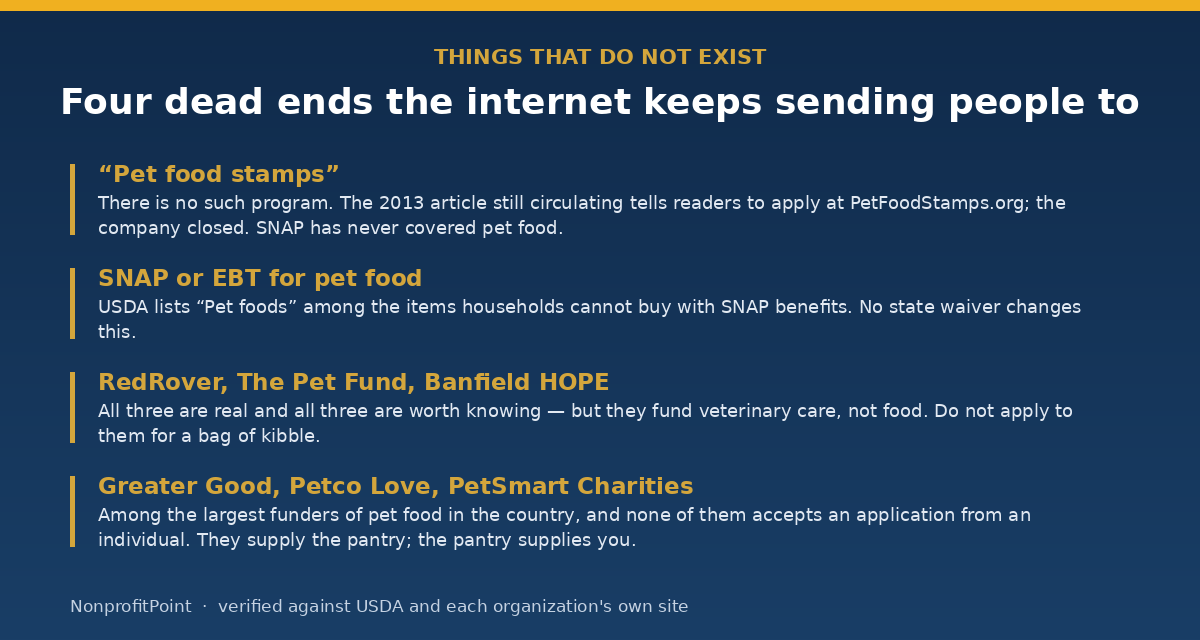
Here is the thing almost every “charities that help with pet food” list gets wrong, and it costs people a wasted week. Most of the organizations on those lists cannot give you a bag of food. RedRover, The Pet Fund and the Banfield Foundation are real, well-run and worth knowing — but all three fund veterinary care, not food. Greater Good Charities, Petco Love and PetSmart Charities move enormous quantities of pet food around the country and none of them takes an application from an individual; they supply the pantry, and the pantry supplies you. Of the ten national names that dominate these results, exactly two can put food in your hands, and both do it through a local partner rather than by post.
So this page is organized the way the help actually works: the local pantry first, because that is where the food is; then the national organizations, sorted honestly into the ones you can approach and the ones you cannot; then the two questions that decide whether you drive home with food or without it.
Start here.
1. Search Pet Help Finder, run by the Open Door Veterinary Collective and cross-endorsed by both Humane World for Animals and United Way 211. Its operator reports more than 6,600 listed resources.
2. Search the Feeding Pets of the Homeless provider map, filtering for “Food & Supplies.”
3. Call your own local humane society or animal shelter and ask whether it runs a pet food pantry — and call your human food bank too, because many now stock pet food and almost none advertise it.
Start with your local food bank — yes, the human one
Feeding America reported that “more than 113 Feeding America food banks offer pet food, in addition to human food and household essentials” — a figure published in September 2023, and the most recent national count we could find. The network has roughly two hundred member food banks, so this is a substantial minority rather than a standard service, and it is very rarely mentioned on a food bank’s website. You have to ask.
The reason food banks started doing it is worth hearing from the person who runs one. Eric Cooper, chief executive of the San Antonio Food Bank, described in that same article the family who came in having decided to give up the dog: “Their little girl says to me, ‘Do you think they’ll have to give me up too?’” He also noticed something else: “We have 14,000 seniors getting food boxes each month. We were buying [canned] tuna to get a nice mix [of protein], only to learn that some of the seniors were feeding the tuna to their cats!” That is the whole problem in one sentence. If a household cannot feed the animal, it feeds the animal out of its own box.
Pet food pantries you can actually walk into
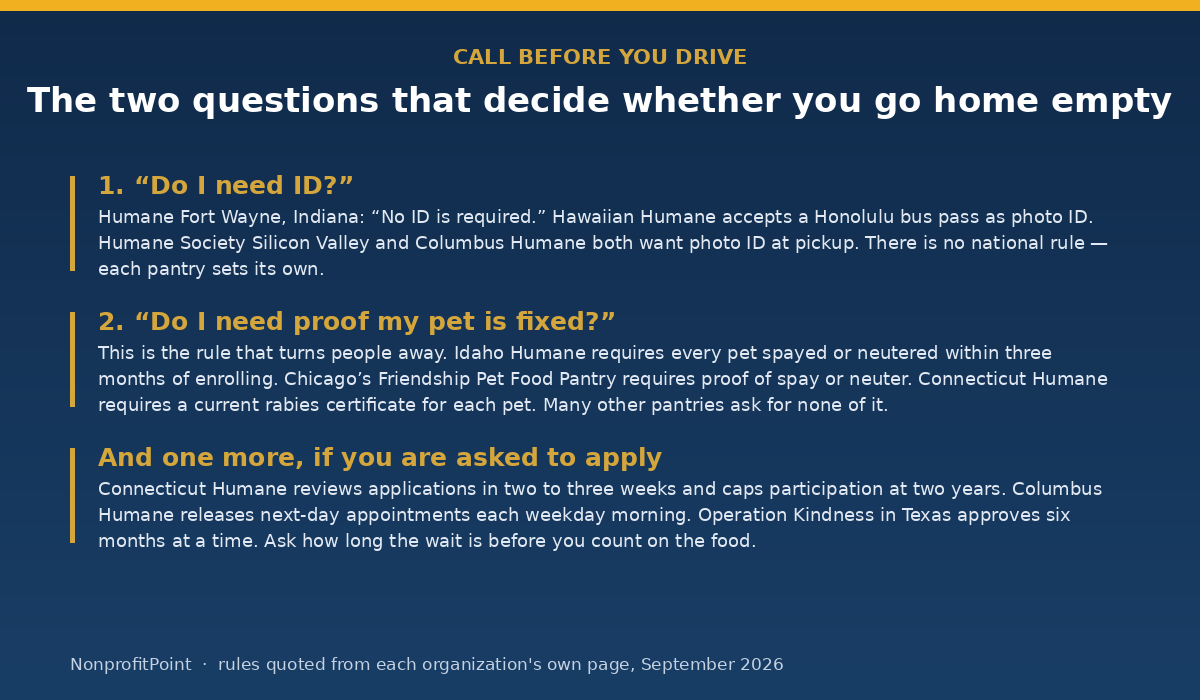
These are verified against each organization’s own page. Rations, hours and rules differ wildly, which is the point — there is no national program and no national rulebook.
| Program | Where | What you need | When |
|---|---|---|---|
| Humane Fort Wayne 260-744-0454 |
Five sites across Fort Wayne, Indiana | “No ID is required” | Saturdays 9–11am at Hanna St, plus four church and community sites on set weekdays |
| Wisconsin Humane Society Milwaukee 414-264-6257 |
Six campuses: Milwaukee, Green Bay, Kenosha, Ozaukee, Racine, Door County | “Open to the public” — no income test stated | During adoption hours at each location |
| Hawaiian Humane Society (808) 356-2222 |
Two campuses, Oʻahu | Photo ID — and a Honolulu bus pass counts. One application per household | Mōʻiliʻili Tue & Fri 10am–1pm; Hoʻopili Sun & Wed 10am–1pm |
| Humane Society Silicon Valley (408) 262-2133 ext 110 |
Milpitas, California | Santa Clara County residents in financial hardship; photo ID at pickup. No cat-colony caregivers | Thu–Sun 12:00–3:30pm, every 30 days |
| Humane Society of Southern Arizona (520) 327-6088 |
Tucson, Arizona | Low income, on a state or federal assistance program, in hardship — or a community-cat caregiver. ID, 18+ | Published distribution dates, 4–6pm; call to confirm the current calendar |
| Columbus Humane 614-602-6700 |
Columbus, Ohio | Open to anyone; may be asked for ID; no pickup by proxy | By appointment — next-day slots posted most weekday mornings by 10am. One visit per 30 days |
| Connecticut Humane Society 800-452-0114 |
Newington, Waterford, Wilton | Application, hardship documents, a color photo of each pet, and current rabies vaccination | Reviewed in two to three weeks; three months at a time, two years maximum |
| Idaho Humane Society 208-296-8750 |
Boise, Idaho | Proof of need (EBT, Medicaid, SSI, paystub…), pet owned 6+ months, and all pets fixed within 3 months | Twice monthly; published rations of 8–15 lbs per animal per month |
| Mohawk Hudson Humane Society 518-434-8128 |
Menands, New York | “Open to anyone needing help caring for their animals” | Mon–Fri 12–6pm, Sat 10am–4pm |
| Operation Kindness (972) 418-7297 |
Carrollton, Texas (DFW) | Application; approved for six months, then reapply | Thursdays & Sundays 11am–1pm, drive-through |
| Chicago pantry list (Anti-Cruelty Society) | Chicago, Illinois | Varies — Friendship Pet Food Pantry requires proof of spay or neuter; Irving Park serves current clients only | Friendship: third Saturday, 9–11am. PAWS Chicago runs pop-ups: 773-217-9113 |
One entry deliberately absent: the Austin Humane Society pet food pantry, whose own page says the program “is currently taking a pause.” It is still listed as active on national directory sites. That is the single most useful thing to understand about this whole category: a directory listing is a lead, not an appointment. Check the organization’s own site, then call the number on it, before you spend gas money.
The national organizations, sorted honestly
Feeding Pets of the Homeless is the one built for people without housing, and it is the closest thing to a national pet food program. It does not post food to you. It supplies partners — “food banks, pantries, soup kitchens and shelters” — and tells you to find one on its map and call ahead. It also runs free wellness clinics for homeless and low-income owners, funds emergency veterinary care through an online application reviewed weekdays, and supplies crates to shelters so a pet can stay with its owner. Phone (775) 841-7463.
Best Friends Animal Society is mostly a referrer nationally, but hands out food directly in the cities where it runs a pet resource centre. Its Northwest Arkansas pantry gives dog and cat food to residents and community-cat caregivers at 1312 Melissa Drive, Bentonville, 11am to 7pm, seven days a week, on 479-974-1363. If you are not near one of those centres, treat Best Friends as a signpost.
Humane World for Animals, formerly the Humane Society of the United States, runs no pet food program at all — but its resource page is the best curated set of locators in the field, and it also publishes a guide to starting a pantry if your area has none.
And then the group you should not write to. Greater Good Charities distributes donated pet food through its GOODS program to partner “Ambassador” organizations; its Rescue Bank page states that it serves “pre-qualified animal welfare non-profits” and explicitly not “individual consumers,” and admits it reaches “many, but not all, regions of the country.” PetSmart Charities is probably the largest single funder of pet food distribution in the United States — it supplies both the Feeding America and Meals on Wheels pipelines — and it funds partners rather than people. Petco Love awards grants to shelters and pantries on published cycles. The money reaches you; the application does not start with you.
Veterinary bills are a different lane, with different doors
If what you actually need is a vet, three national programs take applications from individuals and none of them will help with food. RedRover Relief Urgent Care grants average around $250, are for one animal with a life-threatening injury or illness that has a good prognosis, and carry a hard rule: household income cannot exceed $60,000 a year. The Pet Fund is the mirror image — it funds only non-urgent care, up to $500, excludes emergencies and basic care outright, and runs a wait list that staff quote to you before you apply. Banfield Foundation HOPE Funds help income-qualified owners whose pet has an immediately life-threatening condition, with treatment completed at a Banfield hospital. Read the exclusions before you build a plan around any of them.
If you are a homebound senior
The program is called Meals on Wheels Loves Pets, it delivers pet food alongside the meal, and in June 2026 Meals on Wheels America and PetSmart Charities announced 20 million pet meals delivered, a 33 percent increase on 2025. The catch is structural and nobody says it out loud: it is not a program you can apply to. You have to already qualify for home-delivered meals, and your local provider has to run the pet add-on — roughly two in five do. Meals on Wheels Sacramento County states it flatly: “AniMeals is not a standalone pet food assistance program.” Existing clients simply tell the driver; new applicants raise it during the intake phone assessment.
It matters more than it sounds. Meals on Wheels America’s own research reports that more than one in five clients go without food themselves to feed their pet.
Leaving an abusive home with an animal
This lane exists and is well funded, but it pays for boarding rather than food, and — importantly — a survivor cannot apply directly. RedRover Safe Escape grants must be submitted by a domestic violence advocate on the survivor’s behalf; they cover up to 45 days of boarding at $40 per animal per day while the survivor is in shelter. RedRover reports 297 animals helped and 7,895 nights of boarding in 2025. Safe Housing grants of up to $60,000, and the Purina-backed Purple Leash Project, go to shelters to build pet-friendly space, on deadlines of 1 March, 1 June and 1 September. If you need to find a shelter that takes animals, use RedRover’s Safe Place for Pets directory — and call the shelter, because it carries listings that have not been reviewed recently.
Veterans, and the honest state of that lane
There is no national pet food program for veterans, and pages that imply otherwise are padding. What exists is local: the Veterans Service Commission of Summit County in Akron, Ohio gives out free dog and cat food every Thursday from 1–3pm at 250 Opportunity Parkway, on 330-643-2845 — the model to look for at your own county veterans service office. Pets for Patriots is frequently listed as a pet food charity, which overstates it: it is an adoption program, and its one-time $200 retailer gift card is described by the organization as help to “buy pet food, supplies, and essentials.” That is real, but it is a single card that comes with adopting through the program, not ongoing food assistance. Otherwise, veterans use the same local pantries as everyone else, and most of them do not means-test differently.
No, you cannot buy pet food with SNAP — and “pet food stamps” is not a thing
This is the most searched question in the category and the answer has never changed. The USDA lists “Pet foods” among the items households cannot buy with SNAP benefits, alongside cleaning supplies, hygiene items, alcohol and tobacco; its retailer training material is blunter still, listing “Dog food/cat food/other pet foods” as non-allowable. There is no state waiver and no exception. Note in passing that the Food and Nutrition Service has been reorganized into the Food and Nutrition Administration during 2026, so you may be redirected to an fna.usda.gov address; the rule is the same.
“Pet food stamps” is a separate and more irritating problem. A widely shared 2013 article still tells readers to apply at PetFoodStamps.org for a nationwide benefit; the company behind it closed, and commenters have been reporting the site as discontinued for a decade. There is no government pet food benefit of any kind. Be equally careful with sites carrying names like “National Relief Program” or a SNAP-flavoured domain: the ones we checked carry their own disclaimers admitting they are not government agencies and distribute nothing, while running affiliate and lead-generation offers around the advice.
Related help
Pet food is usually not the only bill in trouble. Our guides to food assistance, heating bills, utility bills, rent and vet bills cover the neighbouring lanes, and the master directory of help paying for things links everything in one place. If the pressure is broader than one bill, start with emergency financial assistance or the list of organizations providing free financial assistance.
Want to help instead? A pet food pantry is one of the cheapest interventions in animal welfare — a bag of kibble is the difference between a family keeping its dog and surrendering it, and Shelter Animals Count reports owner relinquishments were 30 percent of shelter intakes in 2025. Donate to the pantry nearest you rather than to a national brand, or see our vetted list of the best charities to donate to.
How this page was verified — 2 September 2026. Every program, rule, address and phone number was checked against that organization’s own website on the day of publication, not against another list. The SNAP rule is quoted from the USDA’s eligible-items page and its retailer training notice. Where an organization funds pet food but does not accept applications from individuals, we say so rather than listing it as though it does.
What we deliberately did not publish. No income threshold for Feeding Pets of the Homeless or the Banfield HOPE Funds, because neither publishes one. No wait-list length for The Pet Fund, because it is quoted to applicants individually. No 2026 count of Feeding America food banks stocking pet food — the 113 figure is dated September 2023 and is the most recent published. No operating detail for New York City’s new pet food pantry funding, because the FY2027 budget allocation is confirmed but locations, hours and eligibility are not yet published.
Corrections, 2 September 2026. Published, then handed to an adversarial check told to find errors rather than confirm them. One was found and fixed the same day: we had described Pets for Patriots as offering no food help at all, when its own benefits page says the $200 card is for “pet food, supplies, and essentials.” The claim has been narrowed to what the source supports. Every other “does not help individuals” finding on this page held up on re-checking, including Greater Good’s own statement that its GOODS program “does not provide direct assistance to individuals and their personal pets.”
Written and verified by the Nonprofit Point editorial team. Program rules and stock change without notice; call the organization before you travel. Nonprofit Point is independent and not affiliated with any government agency or organization named here.
Frequently asked questions
Where can I get free pet food near me?
Start with three searches, in this order: Pet Help Finder, the Feeding Pets of the Homeless provider map, and your own local humane society’s website. Then call your human food bank and ask directly, because more than a hundred Feeding America food banks stock pet food and very few advertise it. Always confirm on the organization’s own page before travelling, since directory listings outlive the programs they describe.
Can you buy pet food with SNAP or EBT?
No. The USDA lists pet food among the items households cannot buy with SNAP benefits, and there is no state waiver or exception. This has never changed, and any site suggesting otherwise is either out of date or selling something.
Is there such a thing as pet food stamps?
No. A 2013 article promoting PetFoodStamps.org still circulates widely, but the company behind it shut down and there has never been a government pet food benefit. Any site asking for personal details in exchange for “pet food stamp” eligibility should be treated as a lead-generation operation.
What do I need to bring to a pet food pantry?
It depends entirely on the pantry, which is why you call first. Humane Fort Wayne requires no ID at all. Hawaiian Humane accepts a bus pass as photo identification. Idaho Humane requires proof of financial need and every pet spayed or neutered within three months. Connecticut Humane requires a current rabies certificate for each animal. The spay-neuter rule is the one that most often turns people away, so ask about it specifically.
Does RedRover help with pet food?
No. RedRover Relief funds emergency veterinary care, averaging around $250 per grant, for one animal with a life-threatening condition and a household income under $60,000. Its other grants pay for boarding for pets of domestic violence survivors. Neither covers food.
Can I apply to Greater Good Charities or PetSmart Charities for pet food?
No. Both fund pet food on a large scale, but they supply nonprofits, shelters and pantries rather than households. Greater Good states that its distribution serves organizations and not individual consumers. Find the local pantry they supply and apply there.
Is there pet food help for homebound seniors?
Yes, through Meals on Wheels Loves Pets, but you cannot apply to it directly. You must already receive home-delivered meals, and your local provider must run the pet program — roughly two in five do. Existing clients can simply ask their driver; new applicants should raise it during the intake assessment.
What help exists if I am leaving an abusive relationship with a pet?
RedRover Safe Escape grants cover up to 45 days of boarding at $40 per animal per day, but the application must be submitted by a domestic violence advocate rather than by the survivor. Safe Place for Pets lists shelters that can house people with animals. Call the shelter directly, as listings are not always current.