Charities That Help With Internet Bills: Verified 2026 Programs

Reviewed and fact-checked 25 September 2026. Every price, discount amount and eligibility rule below was read directly from the program’s own page on that date. Where we could not confirm a figure at the source, we say so rather than repeat it.
Here is the blunt version, before the details: there is no charity that will pay your overdue internet bill. We looked hard for one. The Salvation Army, St. Vincent de Paul and Catholic Charities all publish what their utility assistance covers, and none of them lists internet. 211 will take your call but its own national bill-help page does not include internet either. The federal program that did exactly this job — the Affordable Connectivity Program — has been dead since June 2024.
What does exist is a set of programs that make the bill much smaller going forward: a federal discount, a handful of nonprofits selling unlimited service for about $15 a month, low-income tiers from nearly every major internet provider, and — if you live in New York — a price ceiling written into state law. Used in the right order, these take a typical $70 household internet bill down to somewhere between $10 and $20.
This guide covers all of them, with the current price, who qualifies, how to apply, and the traps. The biggest trap, which almost nothing else on this topic mentions, is that most cheap plans are closed to you if you already owe that company money. We name the one provider that lets you in anyway.
What actually exists in 2026: the short version
| Program | What it is | Cost to you | Who it’s for |
|---|---|---|---|
| Lifeline | Federal monthly discount | Up to $9.25 off ($34.25 on Tribal lands) | 135% of poverty guidelines, or SNAP / Medicaid / SSI / housing assistance / veterans pension |
| Human-I-T | Nonprofit 5G hotspot service | About $15/mo | 200% of poverty guidelines or program enrollment; nationwide |
| PCs for People | Nonprofit internet + refurbished computers | $15/mo, less on longer terms | 200% of poverty guidelines or 60% of area median income |
| Compudopt Connect | Nonprofit 5G service | $20/mo, $99 router if needed | Available in all 50 states |
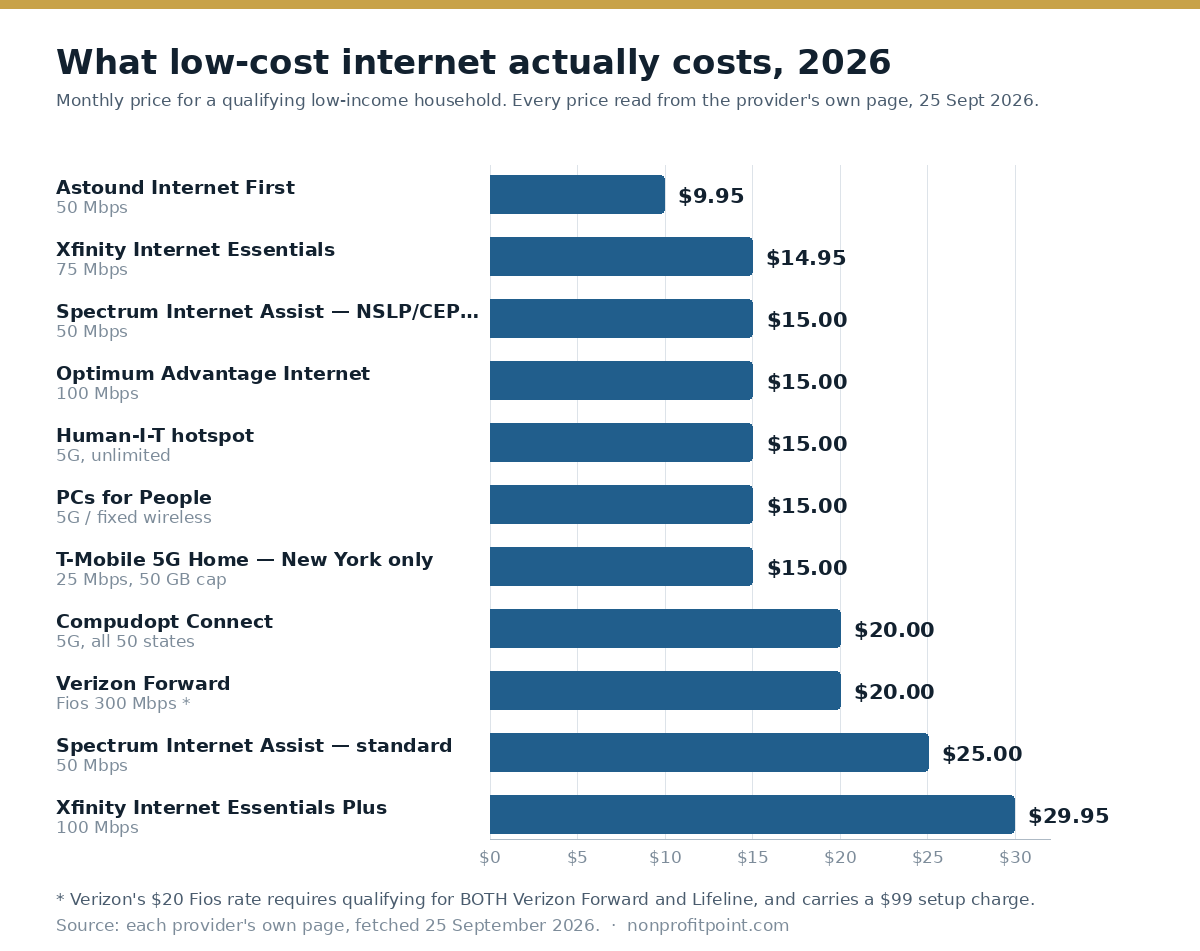
| ISP low-income tiers | Xfinity, Spectrum, Optimum, Astound, Verizon, AT&T, Mediacom | $9.95–$29.95/mo | Usually a benefits program or 200% of poverty guidelines — and usually no past-due balance |
| New York Affordable Broadband Act | State-mandated price cap | $15/mo for 25 Mbps | New York households on SNAP, Medicaid, school lunch, SCRIE, DRIE or a utility affordability benefit |
| California LifeLine broadband pilot | State subsidy pilot | Up to $20/mo standalone, $30 bundled | California LifeLine households, through participating carriers |
| Library hotspot lending | Free loan of a mobile hotspot | Free, where it survives | Library cardholders — but federal funding for this ended in February 2026 |
First, the thing most articles get wrong: the ACP is gone
If you have read anything else about internet bill help, you have probably seen the Affordable Connectivity Program described as though you can still sign up. You cannot. The Universal Service Administrative Company, which ran the program for the FCC, states it plainly:
“The ACP ended on June 1, 2024, due to a lack of additional funding from Congress.”
While it ran, the ACP was genuinely large: USAC’s own description says it “provided a discount of up to $30 per month for broadband services,” rising to “up to $75 per month” for households on qualifying Tribal lands, plus “a one-time device discount of up to $100 for a laptop, desktop computer, or tablet.” Enrollment stopped on 7 February 2024 and the money ran out four months later.
Nothing has replaced it. Bills have been introduced — the Promoting Access to Broadband Act of 2026 exists as S.4438 in the Senate and H.R.8576 in the House, both introduced on 29 April 2026 — but we checked the official legislative status records for both, and each one is still sitting in committee with no floor action and no public law number. A bill in committee is not a benefit you can apply for.
This matters practically, not just historically. A large amount of the advice you will find online was written while the ACP existed and has never been updated. If a page tells you to apply for a $30 monthly broadband credit, that page is at least two years stale, and you should distrust everything else on it too. We found a state veterans’ affairs page still advertising “federal assistance to support those having difficulty paying for their internet services” — almost certainly an un-updated ACP notice, naming no administrator, no eligibility rule and no amount.
Lifeline: the only ongoing federal discount
Lifeline survived. It is smaller than the ACP was, and it long predates it — but it applies to internet service, not just phone service, and it is the first thing to apply for.
How much it’s worth
“Lifeline is a federal program that helps lower the monthly cost of phone or internet service. Qualifying consumers can get a monthly discount of up to $9.25 off the cost of their phone, internet, or bundled services. Consumers living on qualifying Tribal lands can get up to $34.25 per month.”
USAC, About Lifeline
One detail worth getting right, because it is widely misreported: $9.25 is the broadband and bundled amount. Voice-only service gets $5.25. USAC’s rules page sets out the support amounts by service type, and a subscriber on voice-only service that meets the voice minimum standards draws $5.25, not $9.25. If your goal is internet, make sure the plan you pick is a broadband or bundled plan.
The $34.25 Tribal figure is the total, not an extra $34.25 on top. It is the standard $9.25 plus an enhanced Tribal benefit of up to $25.
Who qualifies
Two routes — income, or program enrollment. On income, USAC’s consumer site states: “You can get Lifeline if your income is at 135% or less than the 2026 Federal Poverty Guidelines.” The 2026 table it publishes:
| Household size | 48 states, D.C. & territories | Alaska | Hawaii |
|---|---|---|---|
| 1 | $21,546 | $26,933 | $24,786 |
| 2 | $29,214 | $36,518 | $33,602 |
| 3 | $36,882 | $46,103 | $42,417 |
| 4 | $44,550 | $55,688 | $51,233 |
| 5 | $52,218 | $65,273 | $60,048 |
| 6 | $59,886 | $74,858 | $68,864 |
| 7 | $67,554 | $84,443 | $77,679 |
| 8 | $75,222 | $94,028 | $86,495 |
| Each additional person, add | $7,668 | $9,585 | $8,816 |
On program enrollment, the current qualifying list is: Medicaid; SNAP; Supplemental Security Income; Federal Public Housing Assistance, including Housing Choice Vouchers (Section 8), Project-based Rental Assistance and Public Housing; affordable housing programs for American Indians, Alaska Natives or Native Hawaiians; and the Veterans Pension and Survivors Benefit. A child or dependent’s enrollment counts.
Here is the single most common error made about Lifeline eligibility. Free and Reduced-Price School Lunch, WIC and Pell Grants were ACP criteria. They are not general Lifeline criteria. Plenty of pages still list them, because they were copied from ACP-era guidance. Under Lifeline they appear only in one narrow place: the extended eligibility route for survivors of domestic violence, human trafficking and related crimes under the Safe Connections Act, which also allows a household income at or below 200% of the poverty guidelines and provides up to six months of emergency Lifeline support with privacy protections.
If you live on qualifying Tribal lands, the list widens to include Bureau of Indian Affairs General Assistance, Tribal TANF, income-qualifying Head Start, and the Food Distribution Program on Indian Reservations.
What the service has to actually deliver
A Lifeline plan is not allowed to be a token. USAC publishes minimum service standards that a provider must meet to be reimbursed. The current standards are 1,280 GB per month at 25/3 Mbps for fixed broadband, and 4.5 GB per month at 3G or better for mobile broadband, with 1,000 minutes for mobile voice. The FCC paused scheduled increases to these data allowances in July 2026, so they hold until December 2027.
How to apply
Three routes: online, by mail, or through a participating company. The online application runs through the National Verifier at getinternet.gov — note that this is a newer address than the nv.fcc.gov one many older articles still print. Mail applications go to the Lifeline Support Center, PO Box 1000, Horseheads, NY 14845. The support line is (800) 234-9473, and it will mail you an application if you need help applying because of a disability.
If you live in Oregon or Texas, you apply through your state, not the National Verifier.
To find a provider, USAC runs a “Companies Near Me” search at lifelinesupport.org. Use it, but read USAC’s own caveat: “The search results may not show every company that is near you. A company may still offer Lifeline even if it is not on this list.” Ask providers directly as well.
Two rules that catch people out
One benefit per household, where a household is “a group of people who live together and share income and expenses.” Two roommates who keep separate finances are two households; a couple sharing a budget is one.
Use it or lose it. USAC’s wording: “If you don’t pay out-of-pocket for your Lifeline service every month, you must use it at least once every 30 days to keep your service.” Miss that, and you get a 15-day notice before shutoff. And you must recertify every year — you get 60 days to respond, and de-enrollment follows if you don’t.
On Tribal lands there is also Link Up, a discount of up to $100 off the initial set-up fee, with a no-interest payment plan for up to $200 over a year if the cost runs higher. Note that Link Up is tied to setting up phone service, not internet installation.
Nonprofit internet: the strongest option for most households
This is the part of the landscape that almost nobody knows about, and for a household with a damaged account history or no provider choice, it is usually the best answer. A handful of nonprofits sell internet service directly, at prices the commercial low-income tiers barely beat, with no credit check and no contract.
Human-I-T
A nonprofit (EIN 46-0773284) operating nationally. It sells unlimited 5G internet through a portable hotspot for about $15 a month — its service page says “starting at $15/month” and its FAQ says “$15 per month,” while the store lists $14.99. There are no long-term contracts, no hidden fees and no cancellation fees.
You can buy a 5G hotspot outright (around $87.98, which is the device plus the first month) or rent a 4G LTE hotspot for about $10 a month on top of service. There is also a SIM-only option if you already have a compatible device.
Eligibility is 200% of the Federal Poverty Guidelines, or enrollment in SNAP, Medicaid, Social Security benefits, Section 8, TANF, WIC, National School Lunch, Lifeline, energy assistance, VA benefits, need-based financial aid, Head Start or General Assistance. Approved eligibility stays valid for 15 months, and the same approval also unlocks refurbished laptops, desktops and tablets.
One practical detail that trips people up: Human-I-T does not accept pay stubs as proof. It wants a benefit award letter, a benefit renewal letter or statement, a recent tax return, a Social Security or VA benefit statement, or a retirement or pension statement. Their line is 1-888-391-7249.
PCs for People
Plans “starting at $15 per month and as low as $10 per month for longer-term plans,” prepaid, with — in their words — “no credit checks or hidden fees” and no rental equipment. Published terms run $15 for one month, $75 for six months, and $135 for twelve. The service is 5G or 4G LTE, with fixed wireless up to 100/10 Mbps in some areas, plus hotspot devices and whole-building installations.
Eligibility is below 200% of the federal poverty guidelines or 60% of area median income, or enrollment in a long list of programs including SNAP, WIC, TANF, Head Start, LIHEAP, Medicaid, free and reduced lunch, Section 8, SSI, SSDI and Pell Grants. You need photo ID plus documentation dated within the last 12 months. Eligibility must be re-proven yearly.
One honest caveat. PCs for People’s own site is ambiguous about where its internet service actually reaches. It says anyone in the country can shop online, but describes serving a set of specific retail markets — and the sentence saying “ten markets” is followed by a list of twelve (Atlanta, Baltimore, Cleveland, Cook County, Denver, Greater St. Louis, Hampton, Kansas City, Mankato, Seattle, St. Paul and Philadelphia). Computers ship nationally; check whether service reaches your address before you count on it.
Compudopt Connect
$20 a month for 5G service, with prepaid options at $57 for three months up to $192 for a year, advertised as “available in all 50 states” with “No Long Term Contract,” “No Credit Check” and “No Introductory Rate.” If you do not already have a Compudopt router, there is a one-time $99 cost.
Compudopt’s general programs screen at 200% of the poverty line or benefits enrollment, and it also runs free computer giveaways and free community networks in Atlanta, Dallas and Mesa. We should flag that the Connect page itself publishes no income test, so we cannot tell you whether one applies — ask when you register. Their line is (855) 532-5060.
And one that gives you nothing directly
You will see the National Digital Inclusion Alliance recommended in lists like this one. It is a coalition of digital-inclusion organizations and a policy advocate. It does not provide internet service, devices or bill assistance to households. Its value to you is indirect. The same is broadly true of EveryoneOn, which is still very much operating but functions as a directory: its Offer Locator matches your ZIP code to providers and refurbishers, which is genuinely useful, but it does not pay anything.
Provider low-income plans, one by one
Nearly every major provider runs a discounted tier. These are often the cheapest option on paper. Read the next section before you get attached to one.
Xfinity Internet Essentials
“$14.95/mo for up to 75 Mbps, or $29.95/mo for up to 100 Mbps” for Internet Essentials and Internet Essentials Plus. Qualify through a program — the page names the National School Lunch Program, housing assistance, Medicaid and SNAP — or with “a household income at or below 200% of the Federal Poverty Level.” Approved households can also buy a Dell laptop or Chromebook for $149.99 plus tax. Professional installation costs extra. You also cannot be a current Xfinity internet customer, or have been one in the last 90 days.
Spectrum Internet Assist
50 Mbps. There are two prices, and the difference matters: “$25/mo if you meet certain qualifications,” dropping to “$15/mo if you receive one of these three government assistance programs: National School Lunch Program (NSLP), Community Eligibility Provision (CEP) of the NSLP, Supplemental Security Income (SSI).” Seniors 65 and over receiving SSI qualify. A modem is included but Advanced WiFi is not — that is an extra $10 a month.
Note for former Cox customers: Charter’s acquisition of Cox completed in August 2026, and Cox’s old Connect2Compete and ConnectAssist pages are now dead or redirected to Spectrum-branded terms. If you were on a Cox low-income plan, you are on Spectrum’s terms now.
Optimum Advantage Internet
“$15/mo” for up to 100 Mbps download and 100 Mbps upload, with free installation and a gateway included, limit one per household. Optimum’s terms also include a clause worth knowing: it “may waive the eligibility criteria for Optimum Advantage Internet at its sole discretion and without notice” — which means asking is sometimes worth it even if you think you don’t qualify.
Astound Internet First
“50 Mbps Internet for $9.95/mo,” or “150 Mbps for $19.95/mo,” with one month free for new customers. Qualify through programs like National School Lunch, housing assistance, Medicaid and SNAP — or through prior enrollment in the ACP, which Astound still accepts as a qualifying route. Astound says it reviews applications within about 48 hours and installs within 5–7 business days after approval. You must not have subscribed to Astound in the 60 days before applying.
Verizon Forward
“Get home internet for as low as $20/mo,” built on “a service discount of up to $30/mo” applied to 5G Home and Fios plans. Two conditions people miss: the $20 Fios 300 Mbps rate requires qualifying for both Verizon Forward and Lifeline, and carries a $99 setup charge; the $20 5G Home rate requires pairing it with a postpaid Verizon mobile phone plan. Frontier Fiber 200 Mbps at $20 needs only Verizon Forward.
Access from AT&T
AT&T runs a low-income program, but it deliberately does not publish a national price: “Your monthly price and internet speed depend on what services are available at your address.” Eligibility is a qualifying program or household income “below 200% of the federal poverty guideline,” and AT&T’s accepted-program list is one of the broadest in the industry — SNAP, SSI, Medicaid, school lunch and breakfast, CEP schools, Head Start, Pell Grants, federal public housing assistance, LIHEAP, BIA General Assistance and more. We are not going to print a national Access from AT&T price, because AT&T does not publish one. Any article quoting you a flat monthly figure for it is guessing.
The exception is New York, where state law forces a number: AT&T advertises “AT&T Internet Air for $15/mo. or less” there, with paperless billing required.
Mediacom Xtream Connect
Formerly Connect2Compete, now renamed — the old URL is dead. Up to 100 Mbps down and 20 Mbps up, unlimited data, no contract, free installation, with a five-year price lock. The qualifying program list is long and includes SNAP, Medicaid, WIC, SSI, federal housing assistance, veterans pension, school lunch and breakfast, Pell Grants, Lifeline and several Tribal programs. Mediacom does not publish a price on the page — it is gated behind your address — so we can’t quote you one.
T-Mobile
Project 10Million is still running, but it is not something a household signs up for: it is administered through schools and districts, which distribute free hotspots and data based on the share of students eligible for the National School Lunch Program. If you have a K–12 student, ask the school, not T-Mobile.
T-Mobile’s actual low-income home plan is New York only: “$15/month Home Internet” with 50 GB of data a month, a minimum download speed of 25 Mbps and a certified preowned gateway. Watch the terms — there is a $35 device connection charge, speeds drop to 600 Kbps after the 50 GB allotment, and credit approval is required.
The past-due balance trap
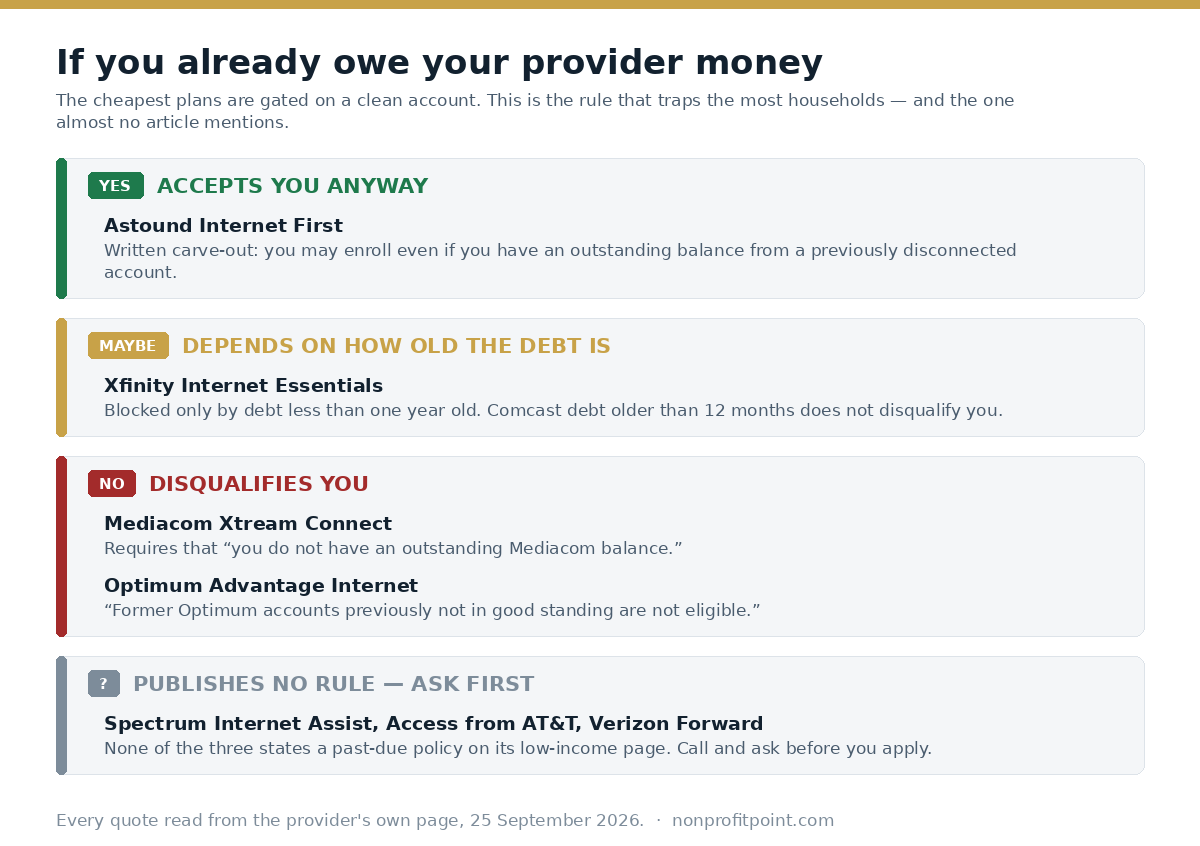
This is the cruellest mechanism in the whole system, and it is the reason a lot of people bounce off every option on this page. Falling behind on your internet bill is what locks you out of the cheap plan that would have prevented you falling behind.
Xfinity requires that “You have no outstanding balance” and specifies “No debt owed on any Comcast account that is less than 1 year old.” Mediacom requires that “You do not have an outstanding Mediacom balance.” Optimum states that “Former Optimum accounts previously not in good standing are not eligible,” and defines not in good standing as an account “with unpaid bill after due date.”
Two pieces of good news inside that.
Xfinity’s rule has an expiry date built into it. The disqualifying debt is debt “less than 1 year old.” Comcast debt older than twelve months does not block an Internet Essentials application. If you were disconnected two years ago, you are likely eligible now.
Astound is the one provider with a written carve-out. In its own FAQ: “You may enroll in this program (if you qualify) even if you have an outstanding balance with us from a previously disconnected account. The account holder will still remain responsible for the outstanding debt.” You still owe the money — but you can get service.
Spectrum, AT&T and Verizon publish no past-due rule at all on their low-income pages. That is not the same as saying there isn’t one. Ask before you apply.
And if every provider in your area says no, this is exactly the situation the nonprofit hotspots exist for. Human-I-T, PCs for People and Compudopt do not run credit checks and have no relationship with the company you owe.
State programs
New York: the only state with an enforceable price cap
New York’s Affordable Broadband Act is real, it is in force, and it is worth more than any federal program currently available. The statute itself requires qualifying providers to offer service at:
“no more than fifteen dollars per month, inclusive of any recurring taxes and fees” at a “minimum download speed equal to the greater of twenty-five megabits per second”
New York General Business Law § 399-zzzzz
Note “inclusive of any recurring taxes and fees” — that is a true $15, not $15 plus the usual additions.
Your household qualifies if it is eligible for or receiving any of: free or reduced-price lunch through the National School Lunch Program; SNAP; Medicaid; the Senior Citizen Rent Increase Exemption; the Disability Rent Increase Exemption; or an affordability benefit from a utility.
The obligation falls on “every person, business, corporation, or their agents providing or seeking to provide wireline, fixed wireless or satellite broadband service in New York state,” with an exemption available for providers serving “no more than twenty thousand households” where the Public Service Commission finds compliance would be unsustainable.
New York State’s own implementation materials also describe a second tier at $20 a month for at least 200 Mbps. We’d attribute that tier to the State’s implementation guidance rather than to the statutory text, which specifies the $15/25 Mbps floor. The law took effect on 15 January 2025, after the Supreme Court declined to review it in December 2024. You can see it working in the plans above: Xfinity, AT&T and T-Mobile all publish New York-specific $15 offers that exist nowhere else in the country.
California: a broadband pilot, newly added
California LifeLine has historically been a phone program — the CPUC describes it as “discounted home phone and cell phone services to qualified households.” That changed with Decision 25-08-050, which launched a three-year Home Broadband Pilot providing “up to $20 per month for standalone broadband and up to $30 per month for bundled broadband and voice,” with a service standard of 100/20 Mbps and 1,280 GB a month, plus reimbursement for a new connection up to $39 once a year per household.
Because it is a pilot, carrier participation is not universal. Ask your carrier directly whether it participates.
Everywhere else
Be sceptical of any page claiming your state has an “ACP replacement.” We could not verify a single enacted mandated low-income internet rate outside New York. Massachusetts, California and Vermont have all seen bills introduced along New York’s lines; none has been enacted. Some states do top up Lifeline — Michigan, for example, publishes state Lifeline discounts that differ from the federal amounts, with enhanced amounts for residents 65 and over — so it is worth checking your own public utilities commission. But a bill is not a benefit.
Libraries — and some genuinely bad news
Public library hotspot lending has been one of the quiet successes of the last decade. Many systems lend a mobile hotspot free with a library card. Heights Libraries in Ohio lends a hotspot kit for two weeks to adult cardholders in good standing. Euclid Public Library lends one per patron with one renewal, charging $1 a day if it’s late to a $3 maximum. The Central Library of Rochester and Monroe County “loans out mobile hotspots for free,” circulating for three weeks and returnable to any library in the system.
But the federal funding behind these programs was pulled. In a 2-1 vote at its September 30 open meeting, the FCC reversed the E-Rate hotspot lending rules adopted in July 2024. The resulting order, published in the Federal Register on 21 January 2026 and effective 20 February 2026, rescinds the rules and finds that the Communications Act “does not permit funding of off-premises use of Wi-Fi hotspots and the associated wireless internet services with E-Rate program support.” The FCC also directed USAC to deny pending FY2025 funding requests for hotspots.
The practical effect: some library hotspot programs will shrink or close, and others will continue on local funding. Because this was done by FCC rule rather than by statute, a future Commission could revisit it. What it means for you today is simple — call your library and ask, rather than assuming. And do not rely on old listings; the New York Public Library’s much-publicised hotspot program, for instance, has been closed since 2022.
What does not work, and why we’re telling you
Most guides to this topic pad themselves out with organizations that sound plausible and deliver nothing. Here is what we checked and found wanting, so you don’t spend a week on it.
211 will not pay your internet bill
211 is worth calling — it is the best map of hyper-local help that exists. But be clear about what it is. Its own utilities page says that if you are “having trouble paying a utility bill or need help finding lower-cost options for phone or internet, you can always contact your local 211 for help.” Read the verb: finding lower-cost options for internet, as against paying a utility bill. And 211’s dedicated “I need help paying my bills” page covers housing, mortgage, heating, cooling, water, power, healthcare and prescriptions — internet is not on it.
Some local 211s go further than the national body. Maryland’s, for example, lists “Phone and Internet Bill Help” as a program area. We could not verify what that help actually consists of; in most cases it means a Lifeline referral.
The big faith-based charities don’t list internet
This is the finding that surprised us most, and it is worth stating clearly because so many articles imply otherwise.
The Salvation Army’s national utility assistance page describes keeping families in their homes and names heat “in the coldest winters,” air conditioning “in the brutal summers,” and “fresh water to drink and bathe in.” Internet and broadband do not appear on it at all. The Society of St. Vincent de Paul describes its work as to “feed, clothe, house and heal,” listing rental assistance, homelessness prevention, thrift stores, food pantries, disaster recovery and charitable pharmacies — not internet. Catholic Charities has no single national service list, but at a representative diocese, emergency assistance covers “rent, utilities, vehicle repairs, and clothing assistance,” with no mention of internet.
So when you ask a faith-based charity for help with an internet bill, understand that you are asking for an exception, not applying to a program. That is not hopeless — local affiliates with internet-provider partnerships have occasionally paid internet bills, and a local Salvation Army corps in Nevada documented exactly such a program funded by an ISP partnership during the pandemic. Ask your local office. Just don’t expect a published policy to back you up.
There is no arrears program
We looked specifically for any currently-operating program that pays an overdue internet bill to stop a disconnection, and found none. The federal government’s own consumer page on help with phone and internet bills lists exactly one program — Lifeline — which is a forward-looking monthly discount, not arrears relief. LIHEAP, which does pay arrears, covers home energy only and does not touch telecommunications.
There is a structural reason for this, and it is the most useful thing to understand about your situation: internet is not regulated as a utility. The shutoff protections, winter moratoria and arrears-forgiveness programs that exist for gas, electricity and water simply have no equivalent for broadband. If you are behind on your internet bill, there is no regulator to appeal to and no crisis fund to draw on.
Which changes the strategy. Do not spend your effort hunting for someone to cover the old bill. Spend it switching to a $10–$20 plan you can actually sustain — and, if the debt is with your current provider, look at the nonprofit hotspots or Astound, which will take you anyway.
Don’t forget the device
Internet service with nothing to use it on is not much of a win. Several of the organizations above also supply hardware, and the same eligibility approval usually covers both.
PCs for People and Human-I-T both sell low-cost refurbished computers to eligible households — and with Human-I-T, a single approval, valid for 15 months, unlocks laptops, desktops, tablets and the internet plan together. Compudopt runs free computer giveaways alongside its service. Xfinity sells approved Internet Essentials customers a Dell laptop or Chromebook for $149.99 plus tax. Tech Goes Home, which operates around Boston and through more than 300 schools and community sites, pairs a Chromebook (or an iPad in its early-childhood program) with 15 hours of digital skills training and internet access if needed — we should note it publishes no price, and the widely-quoted “$50 Chromebook” figure traces to a student newspaper rather than to the organization, so ask rather than assume. Computers with Causes redistributes donated equipment, though it publishes no recipient eligibility rules.
One to approach carefully: the On It Foundation appears on many lists as a free-computer charity, but its own page lists a Dell laptop at $150–$165, states no eligibility criteria or service area, and routes applications to a separate website. We would not describe it as a free-laptop program. For a fuller treatment of device help, see our guide to free laptops for low-income families.
The order to do this in
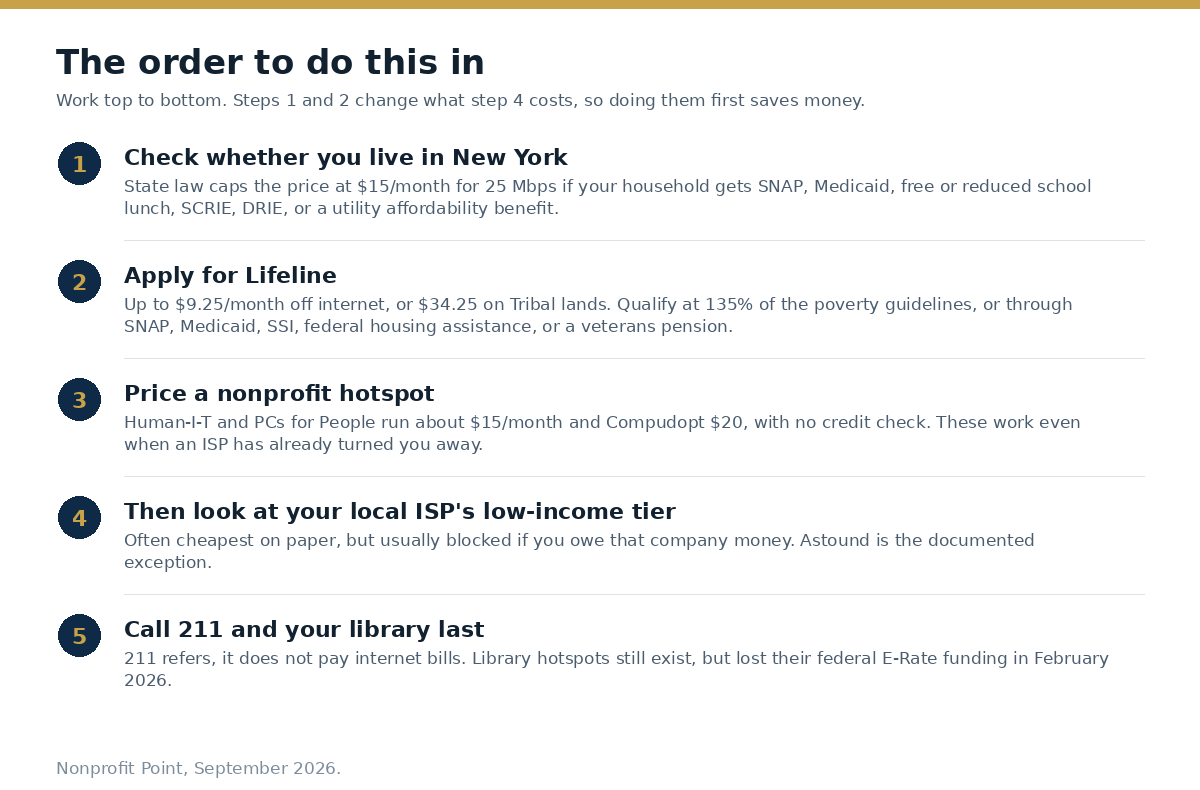
Sequence matters, because the early steps change what the later ones cost.
1. If you’re in New York, start there. The state price cap is stronger than anything else available, and it is a legal obligation on the provider rather than a discretionary program.
2. Apply for Lifeline. It stacks. Verizon’s cheapest Fios rate, for instance, explicitly requires that you hold both Verizon Forward and Lifeline. Applying takes one session at getinternet.gov and the benefit follows you between providers.
3. Price a nonprofit hotspot before you talk to an ISP. It gives you a real number to compare against — about $15 a month with no credit check — and it is your fallback if every provider turns you down.
4. Then check the low-income tier where you live. Often the cheapest, but gated on a clean account. Check the past-due rules above first so you don’t waste an application.
5. Call 211 and your library last. Both are worth doing — local funds exist that no national list captures — but neither is likely to pay a bill.
If your internet bill is one of several you’re behind on, it’s worth working the whole picture rather than one line item: our guides to charities that help with utilities, help with heating bills and charities that help with water bills cover the utilities that do have arrears programs and shutoff protections — which is where your limited time is best spent.
Related help
- Charities that help with utilities — electric, gas and water, including the arrears programs internet doesn’t have
- Help with heating bills — LIHEAP, crisis grants and winter shutoff protection
- Free laptops for low-income families — the device side of the same problem
- Charities that give money to individuals — direct cash assistance programs
- Emergency financial assistance guide — what to do when several bills are due at once
- Charities that help seniors with bills — including the SSI route into the cheapest Spectrum tier
- Free financial assistance organizations — the wider directory
Frequently asked questions
Is there any charity that will pay my overdue internet bill?
We could not find one that does it as a published program. The Salvation Army, St. Vincent de Paul and Catholic Charities all list what their utility assistance covers and none includes internet. 211’s national bill-help page does not list internet either. Local affiliates with internet-provider partnerships have occasionally paid internet bills as an exception, so calling your local office is worth ten minutes — but the realistic strategy is switching to a plan you can sustain, not getting the old bill cleared.
What replaced the Affordable Connectivity Program?
Nothing. The ACP ended on 1 June 2024 when its funding ran out. Bills to create a successor have been introduced — the Promoting Access to Broadband Act of 2026 is S.4438 in the Senate and H.R.8576 in the House, both introduced on 29 April 2026 — but both remain in committee and neither has become law. Lifeline, worth up to $9.25 a month, is the only ongoing federal internet discount.
How much is the Lifeline discount for internet?
Up to $9.25 a month off broadband or a bundled voice-and-broadband plan, and up to $34.25 a month if you live on qualifying Tribal lands. Voice-only service draws a smaller $5.25. The discount applies to one benefit per household, where a household means people who live together and share income and expenses.
Can I get a cheap internet plan if I already owe the company money?
Usually not, and this is the single biggest obstacle. Mediacom requires no outstanding balance; Optimum excludes former accounts not in good standing; Xfinity excludes debt less than one year old — though that means Comcast debt older than twelve months does not disqualify you. Astound Internet First is the exception, stating that you may enroll even with an outstanding balance from a previously disconnected account, though you still owe the debt. Nonprofit providers like Human-I-T and PCs for People run no credit check at all.
What is the cheapest internet plan for a low-income household?
Of the plans we verified, Astound Internet First at $9.95 a month for 50 Mbps is the lowest, followed by Xfinity Internet Essentials at $14.95 for 75 Mbps. Several options cluster at $15: Spectrum Internet Assist for households on school lunch, CEP or SSI; Optimum Advantage; and the nonprofit hotspots from Human-I-T and PCs for People. Availability is the deciding factor — most households can only actually buy from one or two of these.
Does 211 help with internet bills?
211 will help you find lower-cost internet options and refer you to local programs, and its utilities page explicitly mentions internet in that context. What it does not generally do is pay the bill. Its own national page on help paying bills covers housing, energy, water, healthcare and prescriptions, and does not list internet. Treat 211 as a referral line, not a funding source.
Do libraries still lend free internet hotspots?
Some do, but this is shrinking. The FCC reversed the E-Rate rules that funded library and school hotspot lending, effective 20 February 2026, and instructed USAC to deny pending funding requests. Programs running on local funding continue; those that depended on E-Rate may not. Several systems — Heights Libraries and Euclid Public Library in Ohio, and the Monroe County system in New York among them — still publish active lending programs. Call your own library rather than relying on a list.
I live in New York. Is the $15 internet law real?
Yes. New York General Business Law § 399-zzzzz requires qualifying providers to offer service at no more than fifteen dollars a month, inclusive of recurring taxes and fees, at a minimum of 25 Mbps, to households eligible for free or reduced-price school lunch, SNAP, Medicaid, SCRIE, DRIE, or an affordability benefit from a utility. It took effect on 15 January 2025. You can see providers complying: Xfinity, AT&T and T-Mobile all publish New York-only $15 offers.
Does Lifeline cover home internet or only phone service?
Both. Lifeline supports broadband and bundled voice-and-broadband service, not just phones, and a Lifeline broadband plan must meet minimum service standards — currently 1,280 GB a month at 25/3 Mbps for fixed broadband, or 4.5 GB at 3G or better for mobile broadband. Some older pages describe Lifeline as a telephone program; that description is out of date.
What documents do I need to apply?
For Lifeline, either proof of income or proof of enrollment in a qualifying program, such as a benefit award letter. Nonprofits are stricter about form than you might expect: Human-I-T accepts benefit award and renewal letters, tax returns, and Social Security, VA, retirement or pension statements, but explicitly does not accept pay stubs. PCs for People requires photo ID plus documentation dated within the last twelve months. Gather a current benefit letter before you start and you will clear most applications in one sitting.
How we checked this
Every price, discount amount, eligibility rule and quoted sentence on this page was read directly from the source on 25 September 2026 — provider pages for commercial plans, USAC and FCC material for Lifeline and the ACP, the Federal Register and the American Library Association for the E-Rate hotspot decision, New York’s own statutory text for the Affordable Broadband Act, the CPUC for California’s pilot, and official legislative status records for the bills in Congress.
Where a figure could not be confirmed at its source, we have said so rather than repeat it from elsewhere. That applies to Access from AT&T’s national price and speed, which AT&T does not publish; Mediacom Xtream Connect’s price, which is gated behind an address check; Tech Goes Home’s cost to participants; and whether Compudopt Connect itself applies an income test. Several widely-circulated figures for these exist online. We could not verify them, so we have left them out.
Prices on this kind of plan move, and eligibility rules change without announcement. Confirm the current terms with the provider before you commit.