Charities That Help With Car Repairs in Pennsylvania (2026): What Actually Pays

Pennsylvania is a long state with thin transit outside Philadelphia and Pittsburgh. For most of the 67 counties, a car that fails inspection is not an inconvenience — it is the end of a job. So the search for a charity that will pay the repair bill is urgent, and the search results are unusually misleading. The national lists that rank for this phrase send Pennsylvanians to a Maryland-only program, to a loan that stopped covering repairs in 2023, and to a college service notice written in 2010.
The honest picture is narrower and more useful. Pennsylvania has one statewide program that will actually write a check for a car repair, and it is run by the Department of Human Services, not by a charity. It has one genuine free-repair garage, in Harrisburg, open to any Pennsylvania resident who can get the car there. It has a cluster of real, funded, income-tested programs in Allegheny County and the surrounding valley. And it has almost nothing in Philadelphia, Erie, Scranton, Wilkes-Barre, Reading or the Lehigh Valley — which is worth knowing before you spend a week calling.
Every program, dollar figure, eligibility rule and phone number below was read off the administering agency’s or organization’s own website on 24 September 2026. Where a figure is published in two places and the two disagree, this page says so instead of picking one. Where we could not verify something, we say that too.
The short version
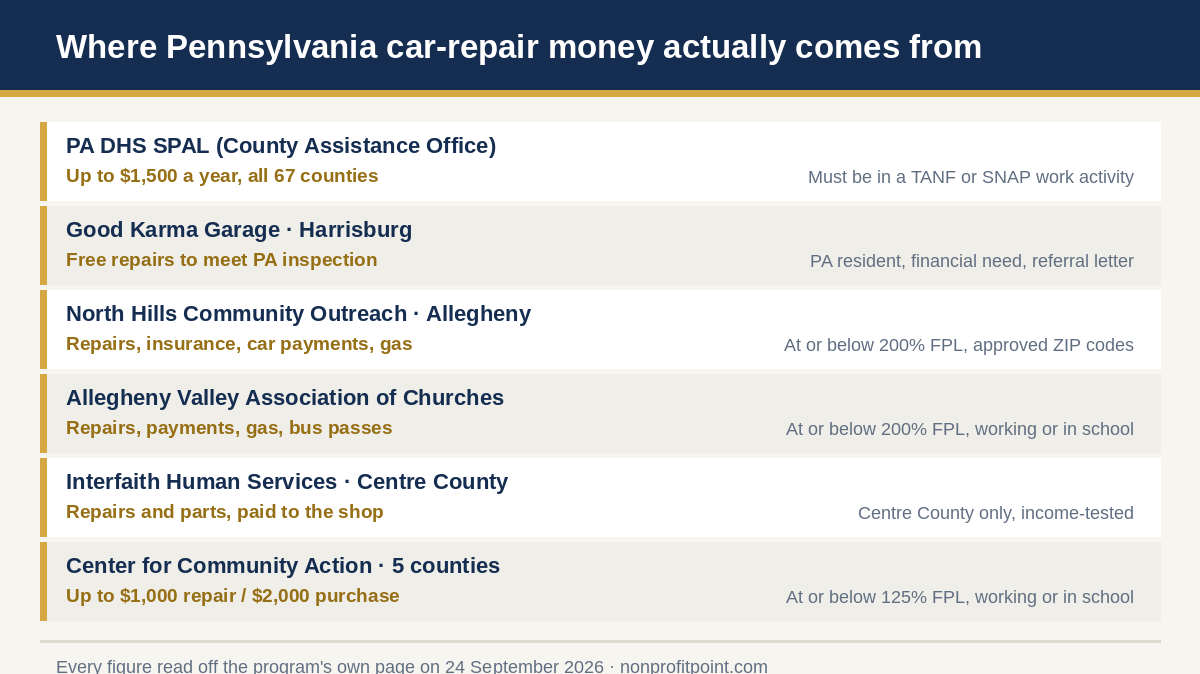
- If you receive cash assistance or SNAP and are in a work or training activity, your County Assistance Office is the strongest route in the state. Ask for a Special Allowance for Supportive Services. It pays the shop directly.
- If you can drive the car to Harrisburg, Good Karma Garage repairs vehicles to Pennsylvania inspection standard at no cost to qualifying drivers. It is the only nonprofit garage of its kind we could verify in the state.
- If you live in Allegheny County or the Allegheny Valley, North Hills Community Outreach and the Allegheny Valley Association of Churches both pay for car repairs for households at or below 200% of the federal poverty level.
- If you live in Centre, Bedford, Fulton, Huntingdon, Mifflin, Juniata, Cumberland, Perry, Montour or Butler County, there is a named local program for you. They are listed below.
- If you live in Philadelphia, Erie, Scranton, Wilkes-Barre, Reading or Allentown, there is no local car-repair charity we could verify. Your realistic route is the County Assistance Office, plus a call to 2-1-1.
Start here: the state allowance that actually pays for repairs
Pennsylvania’s Department of Human Services runs a benefit called a Special Allowance for Supportive Services, usually shortened to SPAL. It is not widely advertised, it is not called a grant, and most people who qualify have never heard of it. It is administered through the county assistance offices, and one of its categories is motor vehicle repair.
The governing rule is 55 Pa. Code § 165.46, expanded in the Cash Assistance Handbook at section 135.6, last revised 22 February 2024. The regulation reads:
“When there is no other type of practical transportation available or other available transportation is more expensive, a special allowance may be authorized toward the purchase, down payment or repair of a motor vehicle.”
What it pays
Here the published sources diverge, and you should know that before you walk in. The DHS page that lists supportive services shows motor vehicle repair as payable “as required for work or approved activities” — that is, with no stated ceiling. The policy handbook is stricter:
“The amount of the maximum allowance for all transportation SPALs is the actual cost of up to $1,500 annually.”
The handbook also defines the year: “A program year runs from July 1 through June 30.” So the working assumption should be up to $1,500 a year across all transportation help combined — repair, mileage, bus passes and the rest — and you should ask your caseworker to confirm what is left in your program year before you get an estimate.
Two rules in the handbook matter enormously for people driving old cars:
“NOTE: The Kelley Blue Book value of a car has no impact as to whether a repair can be approved.”
That single sentence is why SPAL beats most charity programs. A $1,200 transmission job on a car worth $900 is not automatically refused. What is refused is maintenance: routine servicing, oil changes, filters and fluids are not allowable unless they are needed to pass inspection or return the car to safe and legal operation.
There is also a vehicle purchase category, up to $1,500 for the purchase of one vehicle in a lifetime, for cash assistance recipients. It “may not be combined with motor vehicle repair allowance at time of authorization or purchase” — so in any single authorization you are choosing repair or purchase, not both.
Who qualifies
SPALs support participation in an approved activity. In practice that means you are receiving cash assistance or SNAP and you are taking part in RESET, EARN, or SNAP Employment and Training — or you are exempt and volunteering for it. The item has to be something you need in order to take a job offer, get to a training activity, or get a child to day care while you attend one. And there is a rule worth anticipating: an allowance is made only to the extent the item is not available from another source at no cost, which means the caseworker may point you at Good Karma Garage or a local agency first. That is not a brush-off; it is the rule.
How to ask, and the deadlines the county owes you
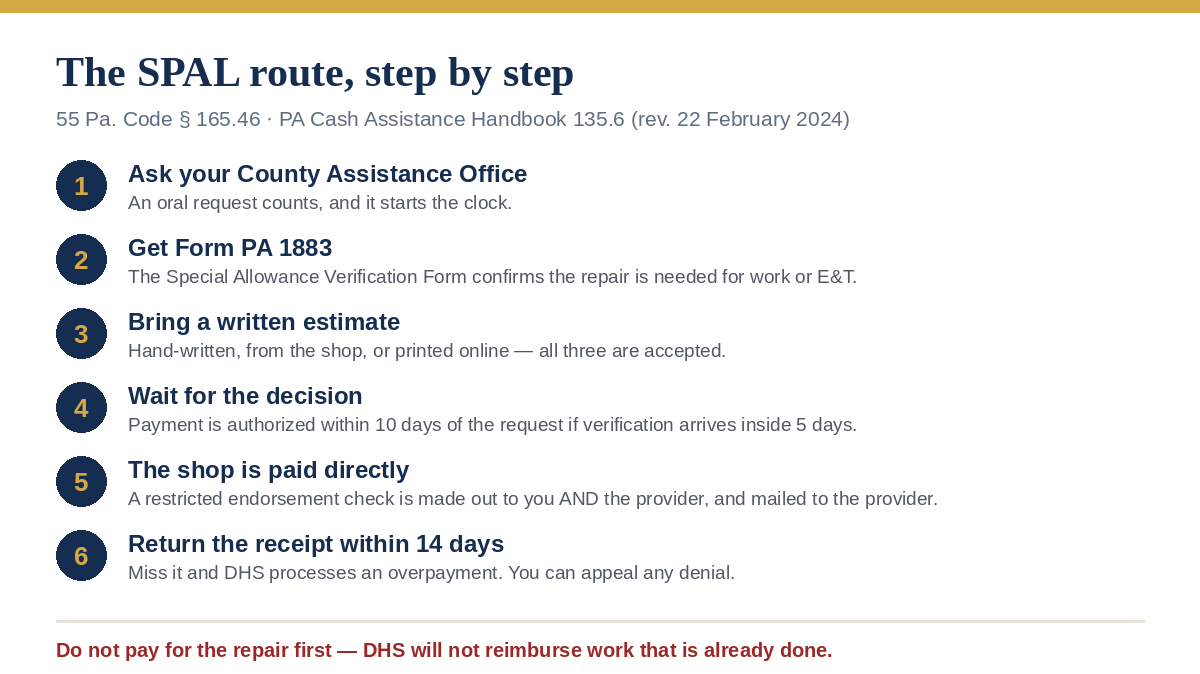
The mechanics are specific enough to be worth following exactly.
- Ask. Out loud is enough. A request made in person or by phone counts and starts the clock.
- Get Form PA 1883. The handbook describes it plainly: “The Special Allowance Verification Form, PA 1883 is used to confirm that the item or service requested is needed and required to enable participation in RESET or SNAP E&T activities.”
- Bring a written estimate. The handbook accepts an estimate that is hand-written by you, produced by the retailer, or obtained online.
- Hold them to the timetable. If verification reaches the office within five calendar days of your request, payment must be authorized no later than ten days after the request. If verification arrives later, payment is due within five days of receiving it.
- Do not pay first. Special allowances are paid in advance of the date payment is due to the provider, and the Department will not pay for something already obtained. Money you have already spent is money you will not get back.
- The shop gets the check, not you. Payments for repairs are issued “via the restricted endorsement check process” — made payable to you and the provider jointly, and mailed directly to the provider.
- Return the receipt inside 14 days. “The original receipt must be provided by the individual within 14 days of receiving the benefit” or an overpayment is processed against you.
- If you are refused, appeal. The handbook is explicit that you have the right to appeal a county decision on a special allowance request.
One more thing the county owes you: it must tell applicants and recipients, orally and in writing, that special allowances exist, including the annual and lifetime limits, at application, at renewal, and whenever your agreement of mutual responsibility is written or revised. If nobody has ever mentioned it to you, that is a failure on their side, not a sign you are ineligible.
Good Karma Garage: the one free repair shop in Pennsylvania
Good Karma Garage at 610 Division Street in Harrisburg runs a program called Working Class Hero, and it is the closest thing Pennsylvania has to a charity that simply fixes your car. Its own description:
“This program is designed to aid people with maintaining their vehicle to the Safety Inspection and Emissions standards of Pennsylvania… completed at no cost. The participant is only required to pay the shop inspection fees for both the safety and emission inspections.”
It is also not a one-time favour. Once you are approved, the garage invites you to come back the following year for inspection without reapplying.
What it covers: “suspension components, steering, braking systems, tires and wheels, lighting and electrical systems, exhaust systems, and the chassis.”
What it does not cover: “transmission problems, oil changes, charging issues, no start conditions, rough running engine, internal engine issues, problems with power windows and heater or AC issues.” Collision damage is excluded from free repair, though the garage will do it at a reduced rate, and parts for luxury brands may not be fully covered.
Who qualifies. You must be a legal Pennsylvania resident; the vehicle must be currently registered in Pennsylvania and registered to you; it must be your primary means of transportation; you must demonstrate financial need with a recent federal tax return or proof of state assistance; and you must provide a letter from a church, a social services organization, veterans affairs or a similar nonprofit confirming that need. The garage also reserves the judgement that the car must be economically practical to repair.
One number to plan around. If your check-engine light means an emissions waiver is the cheapest way out, the garage says you will be asked to pay at least $450 toward the repair — and it is careful to add that this is a PennDOT rule rather than its own. That matches the state regulation, which we cover further down.
Expect to wait. The top of the program page currently carries this notice: “Due to a massive increase in applications, it is taking several weeks for us to process submissions. Please be patient and also realize that we only have so much money to work with.” Apply anyway, but do not plan around a fast yes. And take the appointments seriously — miss two and they refer you elsewhere.
How to apply: complete the online application at goodkarmagarage.com, then send the tax information and the confirmation letter when they ask. The garage calls you to schedule an inspection. Bring insurance and registration. Phone (717) 635-9050; email jeffcase@goodkarmagarage.com.
Western Pennsylvania: where the charity money actually is
If you live in or near Allegheny County, you have options that the rest of the state does not. This is not an accident — Allegheny County’s Department of Human Services channels federal Community Services Block Grant money into transportation assistance, and two organizations spend it.
North Hills Community Outreach — Transportation Financial Assistance
NHCO runs the broadest vehicle-cost program in Pennsylvania. Its own list of what the money can cover is unusually generous:
“Car repairs. Gas cards. Port Authority CONNECT Cards. Past due car insurance. Past due auto loans that are not yet in repossession. PennDOT Services. AAA memberships. Car seats.”
Eligibility: you must live in Allegheny County within the areas served by North Hills Community Outreach, South Hills Interfaith Movement or the Allegheny Valley Association of Churches, and household gross monthly income must be at or below 200% of the federal poverty income guidelines. The program is aimed at people whose employment depends on the car; NHCO describes it as targeted at supporting and stabilising a person’s job, and in some cases education or retraining.
What it is not: “NHCO’s Transportation Assistance Program does not offer physical rides to individuals.” If you need a ride rather than a repair, this is the wrong door.
How to apply: there is no online form. You contact the programme manager directly — Dan Wonders, 412-487-6316 ext. 3225, djwonders@nhco.org. For the Turtle Creek and Mon Valley area, Angela Kearns, 412-487-6316 ext. 3539, amkearns@nhco.org, and note that office is by appointment only. The main office is 1975 Ferguson Road, Allison Park, PA 15101.
NHCO also names its repair money after a person: the Julian DiNino Car Repair Fund, established in memory of a 22-year-old mechanic, feeds this programme and shares proceeds with the Allegheny Valley Association of Churches. Worth knowing if you are deciding where to send a donation rather than where to ask for one.
Allegheny Valley Association of Churches
AVAC runs the same kind of programme on the same county funding, in the Allegheny Valley portions of Allegheny and Westmoreland counties. Its own description of what is available: “car payments, car repairs, insurance payments, gasoline vouchers, bus passes, car seats and more.”
Eligibility: income at or below the 200% poverty guideline, documented, and a demonstrated need to get to a job, a job search, or school. PA 211’s record on the programme states the requirement more bluntly: the person asking for help must be employed or going to school.
How to apply: the organization asks you to contact its assistance coordinator, Beth Kendra, (724) 226-0606 ext. 10, beth@avaoc.org. The office is at 1913 Freeport Road, Natrona Heights, PA 15065, open Monday to Friday, 9am to 4pm.
Butler County and northern Allegheny: The Lighthouse Foundation
The Lighthouse Foundation runs a Car Connection programme that pairs financial and vehicle-maintenance education with help acquiring a car for work. Read the guidelines before you invest time in it, because two conditions disqualify a lot of people: its published 2026 guidelines require the applicant to have at least $1,000 saved toward the purchase, and state that the programme is for households without a vehicle — households that already have one are disqualified. So it is a route to a different car, not a repair for the one in your driveway. Eligibility also requires a valid licence and at least 25 hours a week of work for at least three months, with pay stubs.
Separately, PA 211’s record for the Foundation’s Whole Life Ministries programme says it “can also help with car repairs by purchasing replacement car parts (up to $250), but will not cover the cost of labor.” We could not find that parts figure on the Foundation’s own website, so treat it as PA 211’s description and confirm it on the phone. Contact Jen Bellis, 724-903-0064, or the main line 724-586-5554. Service area: Butler County and northern Allegheny County.
Westmoreland County: Keys2Caring
Keys2Caring in Greensburg is a small transportation-focused nonprofit. PA 211 describes it as providing “low- and no-cost automotive repairs for single parents, survivors of domestic violence, and veterans who need car repairs to be able to get to work / educational activities.” Its own website confirms an active organization with a transportation mission but does not publish eligibility rules, amounts or an application form, so the phone is the only way in: (724) 600-2098, info@keys2caring.org, 141 Arch Avenue, Suite 4, Greensburg, PA 15601.
One Pittsburgh programme people are still sent to in error
Community Growth Fund in Pittsburgh runs the Pennsylvania version of Ways to Work, and its page says this in plain type: “The Ways to Work Program no longer offers auto repair loans as of December 1st, 2023.” What it does offer now is financing for a used vehicle up to $10,000 in value at 8% interest over 48 months, through licensed dealerships only, for residents of nine south-western counties. There is no income limit, but you must have been employed consecutively for three months or more at a minimum of 20 hours a week, you cannot hold a current auto or personal loan, and the process takes 90 days or more because of the required financial classes. Contact is by email only: intake@cgfund.org.
Central Pennsylvania: several small programmes that really do pay
Centre County: Interfaith Human Services
Interfaith Human Services in State College runs a named Emergency Vehicle Repair Program, and it is one of the better-documented in the state. Its description:
“This Program focuses specifically on helping eligible residents who depend on their vehicles to get to their places of employment or to perform their jobs. Disabled and senior citizens (65+) who meet income guidelines are also eligible.”
There is a useful extra: the programme may also be used “one time only” toward the cost of a driver’s licence, vehicle registration, vehicle inspection or an insurance payment. Eligibility is limited to Centre County residents and is calculated against the current federal poverty guidelines. You must provide an estimate from a service station, repair shop or retail parts business, and once approved the money is paid directly to the provider — which means the do-it-yourselfer can be reimbursed for an itemised parts cost. Phone (814) 234-7731; 251 Easterly Parkway, Suite 200, State College, PA 16801.
Bedford, Fulton, Huntingdon, Mifflin and Juniata: Center for Community Action
The Center for Community Action runs a Vehicle Assistance Program with the clearest published caps of any charity on this page: “You may receive up to $1,000 for repairs or $2,000 towards a new vehicle.”
Eligibility is tight but readable: you must be employed or hold a notice of employment with a start date no later than ten days after intake, or be pursuing post-secondary education 20 hours a week or more; and household income must be at or below 125% of the federal poverty guidelines — a stricter test than the 200% used in Allegheny County. Counties served, per the agency: Bedford, Huntingdon, Fulton, Mifflin and Juniata. Phone (717) 325-4380, 216 North 2nd Street, Suite D, McConnellsburg, PA 17233.
Smaller central and northern programmes PA 211 lists by name
These are indexed by PA 211 under car repair and maintenance assistance. We have not fetched each organization’s own site, so the descriptions below are PA 211’s wording and the amounts, if any, should be confirmed on the phone.
- Samaritan Fellowship, Carlisle (Cumberland County) — “emergency financial assistance for rent, utility bills, medications, auto repair, and fuel. Payment is made directly to vendor.” 333 South Spring Garden Street; (717) 243-7338.
- Join Hands Ministry, New Bloomfield (Perry County) — “limited direct financial assistance, financial planning, emergency heat response, automobile repair.” 51 South Church Street; (717) 582-7844.
- Love INC of Bedford County, Everett — a repair-services programme that “pays for or provides maintenance and repair services for people who cannot otherwise afford to fix essential household appliances or other essential possessions.” 80 State Street; (814) 652-0025.
- The Good Samaritan Mission, Danville (Montour County) — emergency assistance including “car repairs (if working).” 568 Ferry Street; (570) 275-2500.
- Fulton County Family Partnership — ETAP, McConnellsburg — “Focuses on assisting individuals in obtaining and repairing their own vehicles.” 22438 Great Cove Road, Suite 102; (717) 485-6767.
- Love INC of Greater Hershey, Dauphin County — listed by PA 211 under car repair assistance, though its own site does not mention it. It serves Hershey, Hummelstown and the Dauphin County portion of Elizabethtown, plus people who attend a partner church. (717) 835-0101.
- Neighbors in Christ, Newville (Cumberland County) — not repair, but relevant: assists with a car insurance payment “if it means a person has no other transportation to work.” (717) 385-1053.
Philadelphia and the southeast: thin, and here is the honest answer
Pennsylvania’s largest city has the least car-repair charity coverage in the state. PA 211’s own taxonomy for car repair and maintenance assistance returns roughly twenty records statewide, and none of them is in Philadelphia. We checked the obvious candidates and found nothing: Philadelphia Corporation for Aging’s transportation programme is rides and SEPTA fare only; Catholic Charities of Philadelphia lists four pillars of service and none involves a vehicle; no Philadelphia workforce board publishes a car-repair supportive-service grant.
Two things do exist, and they are worth using.
St. Vincent de Paul, Archdiocese of Philadelphia
The Archdiocesan council names car repair explicitly in its description of what its conferences do: “bringing hope, and friendship along with encouragement and perhaps financial help for housing, utilities, car repairs, food.” Help is granted conference by conference at parish level, so there is no published amount and no published income test — the decision is local. The request form covers Bucks, Chester, Delaware and Montgomery counties and Philadelphia (northeast, northwest and south). Request help at svdp-phila.info/request-assistance, or call 484-704-7153 or email svdp@svdp-phila.info. The council’s office is at 661 W. Germantown Pike, Suite 210, Plymouth Meeting, PA 19406.
Central Montco Technical High School — student-performed repairs
This is the cheapest legitimate repair route we found anywhere in the southeast, and almost nobody knows about it. The school’s automotive programme takes vehicles from the public: the work is “performed by our students for the purpose of learning automotive technology services,” labour is free, and “the individual requesting the work is responsible for paying and or supplying all materials and parts.” A donation to the programme is requested. Work is accepted only when it has instructional value, which means you are in a queue behind the curriculum, and there are no warranties on the work. There is no residency restriction published. Submit the CMTHS Vehicle Service Request form on cmths.org and a teacher contacts you with a date. 821 Plymouth Road, Plymouth Meeting, PA 19462; 610-277-2301.
If neither fits, the realistic Philadelphia answer is the County Assistance Office route described above. Philadelphia County Assistance Office headquarters is at 801 Market Street, Philadelphia, PA 19107; 215-560-7226.
Erie, Scranton, Wilkes-Barre, Reading, Allentown and Lancaster
We looked hard for a local car-repair charity in each of these markets and did not find one. That is a finding, not an omission, and it is the opposite of what most directory pages will tell you.
- Erie. St. Martin Center, the city’s main self-sufficiency agency, publishes food, rent, deposit and mortgage help — no vehicle assistance. Erie County Technical School’s automotive page describes curriculum only, with no public vehicle intake. PA 211 returns no car-repair provider in Erie County. Erie County Assistance Office: 1316 Holland Street, Erie; 814-461-2000 or 1-800-635-1014.
- Scranton and Wilkes-Barre. Catholic Social Services of the Diocese of Scranton publishes food, shelter and case-management programmes, with no vehicle or transportation-cost assistance named. PA 211 returns no car-repair provider in Lackawanna or Luzerne. Lackawanna CAO: 100 Lackawanna Avenue, Scranton, 570-963-4525. Luzerne CAO: 205 South Washington Street, Wilkes-Barre, 570-826-2100.
- Reading and Berks. No car-repair provider in PA 211’s Berks listings. Berks CAO: 625 Cherry Street, Reading, 610-736-4211.
- Allentown, Bethlehem and the Lehigh Valley. New Bethany in Bethlehem offers housing, rent and utility arrears and food, with no vehicle assistance. Community Action Lehigh Valley publishes no vehicle programme. Lehigh CAO: 555 Union Blvd., Allentown, 610-821-6509. Northampton CAO: 201 Larry Holmes Drive, Easton, 610-250-1700.
- Lancaster and York. Community Progress Council in York coaches on transportation as a self-sufficiency domain but does not fund repairs. PA 211’s transportation listings for these counties return gas money and bus passes only — the Salvation Army’s Lancaster extension units, First Presbyterian Church of York’s Caring Ministry and Saint Matthew Evangelical Lutheran Church in York all help with fuel or passes, none with repairs. Lancaster CAO: 832 Manor Street, 717-299-7411. York CAO: 130 N. Duke Street, 717-771-1100.
One narrow exception reaches several of these counties. The Eastern PA Trans Equity Project runs rapid-response crisis grants that can cover vehicle repair, paid directly to the mechanic, for applicants who identify as transgender or are the parent of a transgender minor child. Grants are once per approved applicant and subject to available funding. The published grant cap and the list of counties served have both changed recently, so check the current terms on the project’s crisis-grants page before applying rather than relying on a figure quoted elsewhere.
Veterans: one statewide fund, with two rules that surprise people
Pennsylvania Wounded Warriors is statewide and does pay toward “car payment, insurance, or repair.” Two things trip applicants up.
First, it will not pay for “vehicle purchases and major car repairs.” This is a fund for a manageable bill, not an engine.
Second, and more important: “We do not work directly with veterans and we do not send funds directly to veterans.” The organization works only through veterans’ advocates — VA medical centres and clinics, county veterans affairs offices, National Guard and DMVA staff, the American Red Cross and similar nonprofits. So the first call is to your county veterans affairs office, not to the fund. Bring proof of Pennsylvania residency, your DD-214 or NGB-22, and — for a vehicle request — your driver’s licence, registration and proof of insurance. Eligibility requires 12 months of Pennsylvania residency, an Honorable or General Under Honorable Conditions discharge, at least 15 months of service, and no assistance from the fund in the previous 12 months (24 for a General discharge). Camp Hill office: (717) 761-4017.
Inspection, emissions, and the $450 number
Most Pennsylvania car-repair emergencies are inspection emergencies, so it is worth understanding the rule that sets the ceiling on what you may have to spend.
PennDOT’s emission inspection programme publication, PUB-763, dated April 2025, defines the programme’s regions. The Philadelphia region covers Bucks, Chester, Delaware, Montgomery and Philadelphia; the Pittsburgh region covers Allegheny, Beaver, Washington and Westmoreland. The regulation names further counties in additional regions, so the practical step is to ask your inspection station whether your county tests emissions before assuming either way. Subject vehicles are emission inspected annually in coordination with the safety inspection, and there are exemptions — among them motorcycles, classic and antique vehicles, and “vehicles driven less than 5,000 miles in the previous 12 months.” That mileage exemption is genuinely useful for a second car or a car driven mostly locally, and almost nobody claims it.
The waiver is the part that matters when you cannot afford the fix. The regulation sets a minimum repair expenditure of $450 from the third programme year onward, adjusted annually by the Consumer Price Index, with qualifying repairs completed within 60 days before the initial inspection and performed by certified technicians. That is the source of the $450 figure Good Karma Garage quotes. It is a floor on your spending, not a grant — the waiver only becomes available once you have spent it.
Four claims about Pennsylvania car repair that do not hold up
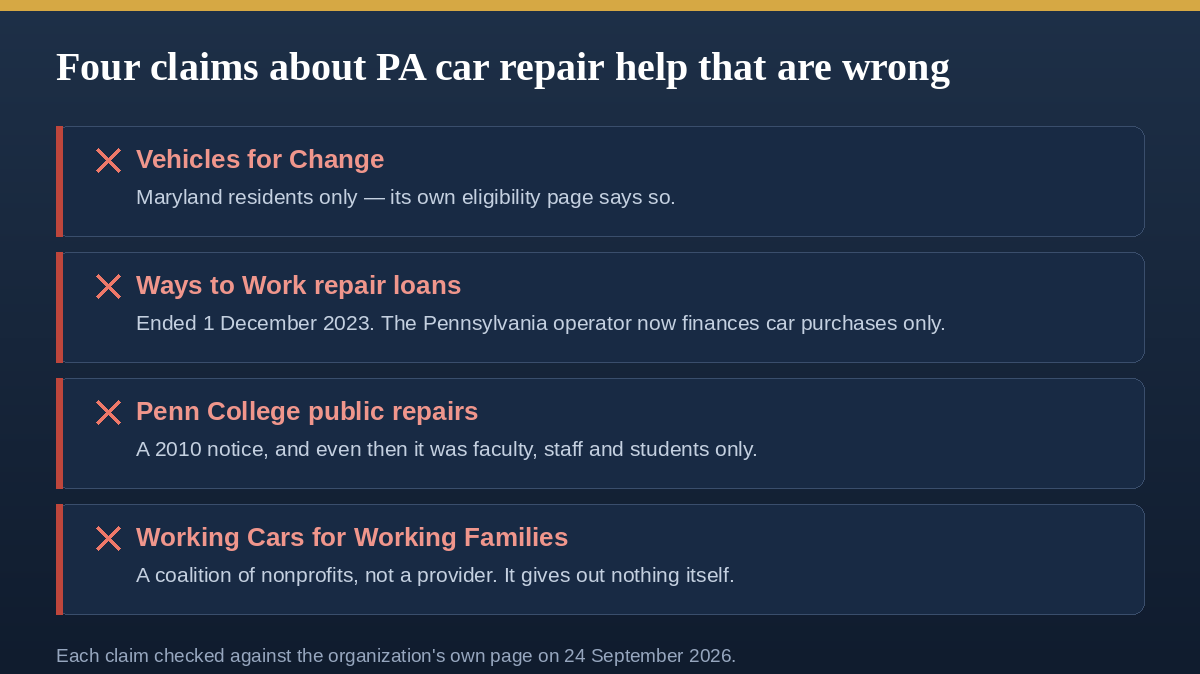
Each of these appears on widely-read lists that rank for this search. Each was checked against the organization’s own page.
- Vehicles for Change does not serve Pennsylvania. Its eligibility page says the Keys to Independence programme “is currently limited to individuals and families who live in Maryland,” and requires a Maryland driver’s licence. Pennsylvania is not mentioned on the page. It is also not a repair programme — recipients pay a programme fee of $950 plus title, registration and tag fees for a car, and the organization does not accept direct applications at all.
- Ways to Work no longer lends for repairs. Discontinued 1 December 2023, per the Pennsylvania operator’s own page. It finances car purchases only, in nine south-western counties.
- Pennsylvania College of Technology is not a public repair shop. The page that circulates is a news article dated 14 September 2010, and even then the service was restricted to current faculty, staff and students.
- Working Cars for Working Families gives out nothing. It is a coalition of organizations advocating for fair access to used cars, not a provider, and its site carries no Pennsylvania directory.
Two more worth knowing before you spend an afternoon on them. Good360 distributes donated goods to nonprofits, not to individuals, and car repair is not among them. 1-800-Charity Cars does accept applications from Pennsylvania residents at or below 200% of the federal poverty level, but it awards vehicles; the site says nothing about repairs, and applicants must be able to insure and maintain a car once awarded. Treat it as a long-shot car giveaway rather than repair help.
Where to call when nothing above fits
PA 211 is the front door for the whole state. It is operated by the United Way of Pennsylvania and connects callers in all 67 counties to a database of local resources. Dial 211 from anywhere in Pennsylvania; if that fails, the backup line is 1-855-567-5341. You can also text your zip code to 898-211, or search directly at search.pa211.org. Ask by name for car repair and maintenance assistance — it is a specific category in their taxonomy, and asking for it by name gets you a better answer than asking for “help with my car.” One caution: 211 refers, it does not pay. And it cannot help by email.
PA Navigate is the state’s second referral platform, run by DHS on the findhelp system, covering food, housing, utilities and transportation. It is free to use: “That connection is provided at no cost to you.” Find it at panavigate.org.
Your Community Action Agency is where the local repair money actually lives. The Community Action Association of Pennsylvania has 42 member agencies covering all 67 counties, and the programmes listed above — the Center for Community Action’s vehicle programme is one — are run by individual members. The network page does not advertise car repair, so you have to ask your county’s agency directly. Find yours at thecaap.org/findanagency.
How to actually get a yes in Pennsylvania
- Get a written estimate first, from a shop licensed to do Pennsylvania state inspection. Almost every programme on this page pays against an estimate and pays the shop, not you. An estimate from an inspection-licensed mechanic also carries more weight with a county assistance office, because the handbook contemplates exactly that.
- Do not authorise the work before you have the answer. DHS will not pay for a repair already done, and most charities on this page pay the vendor directly. A repair you have already paid for is usually unrecoverable.
- Lead with the job. Nearly every programme here is funded to protect employment. “I will lose my job on Monday without this car” is the sentence these programmes exist to answer; “my car is broken” is not.
- Ask the county assistance office even if you think you do not qualify. SNAP households in employment and training count, not only cash assistance recipients, and the office has a duty to tell you the allowance exists.
- Get the referral letter early if you are applying to Good Karma Garage. A letter from a church, a social services agency or a veterans office is a hard requirement, and chasing it after you apply adds weeks to an already slow queue.
- If the repair costs more than the car is worth, change the question. The Kelley Blue Book rule means a county assistance office may still fund it — but if you are outside that system, a vehicle-purchase programme may be a better use of the same effort.
Frequently asked questions
Are there charities that help with car repairs in Pennsylvania?
Yes, but fewer than national lists suggest, and they are concentrated in the west and centre of the state. Good Karma Garage in Harrisburg repairs cars to Pennsylvania inspection standard at no cost for qualifying drivers. North Hills Community Outreach and the Allegheny Valley Association of Churches pay for repairs in Allegheny County and the Allegheny Valley at or below 200% of the federal poverty level. Interfaith Human Services covers Centre County, and the Center for Community Action covers Bedford, Huntingdon, Fulton, Mifflin and Juniata with up to $1,000 for repairs. The strongest programme in the state is not a charity at all — it is the Special Allowance for Supportive Services run through county assistance offices.
Does Pennsylvania pay for car repairs through welfare or SNAP?
It does. The Department of Human Services runs Special Allowances for Supportive Services, and motor vehicle repair is one of the categories. It is available to people receiving cash assistance or SNAP who are taking part in an approved employment and training activity such as RESET, EARN or SNAP E&T. The Cash Assistance Handbook caps all transportation allowances together at the actual cost of up to $1,500 a year, on a programme year running 1 July to 30 June, while the department’s public services table lists repair as payable “as required.” Ask your caseworker which applies to your case before you get an estimate.
Will the state refuse to fix a car that is not worth much?
No. The Cash Assistance Handbook is explicit: “The Kelley Blue Book value of a car has no impact as to whether a repair can be approved.” What is excluded is routine maintenance — oil changes, filters, fluids and general servicing — unless those items are needed to pass inspection or return the car to safe and legal operating condition.
How do I apply for a Special Allowance for Supportive Services?
Ask your county assistance office; an oral request in person or by phone is enough and it starts the clock. The office issues Form PA 1883, the Special Allowance Verification Form, and you supply a written estimate, which may be hand-written, produced by the shop or printed from online. If verification reaches the office within five days of your request, payment must be authorised within ten days of the request. Payment goes to the repair shop by restricted endorsement check made out to you and the provider jointly. You must return the original receipt within 14 days or an overpayment is processed. You can appeal a denial.
Is there a free car repair garage in Pennsylvania?
One that we could verify: Good Karma Garage at 610 Division Street, Harrisburg, through its Working Class Hero programme. It repairs vehicles to Pennsylvania safety and emissions inspection standards at no cost, with the participant paying only the shop inspection fees. It covers suspension, steering, brakes, tires and wheels, lighting and electrical, exhaust and chassis, and does not cover transmissions, oil changes, charging problems, no-start conditions, rough-running or internal engine issues, power windows, heating or air conditioning. You must be a Pennsylvania resident with the car registered to you in Pennsylvania, demonstrate financial need, and supply a referral letter from a church, social services agency, veterans office or similar nonprofit. Phone 717-635-9050. Expect a wait of several weeks.
Is there any car repair help in Philadelphia?
Very little. PA 211’s car repair category returns no Philadelphia provider. The one charity that names car repair in the region is the Society of St. Vincent de Paul’s Archdiocesan council, whose 50-plus parish conferences may give financial help for housing, utilities, car repairs and food; request help at svdp-phila.info or call 484-704-7153. Central Montco Technical High School in Plymouth Meeting repairs public vehicles with free student labour if you pay for parts. Otherwise the realistic route is the Philadelphia County Assistance Office at 801 Market Street, 215-560-7226.
Does Vehicles for Change operate in Pennsylvania?
No. Its eligibility page states that the Keys to Independence programme is currently limited to individuals and families who live in Maryland, and requires a Maryland driver’s licence. Pennsylvania is not mentioned anywhere on the page. It is also not a repair programme — it places donated cars for a programme fee of $950 plus title, registration and tag fees, and it does not accept applications directly from individuals.
Can I still get a Ways to Work loan for a car repair in Pennsylvania?
No. The Pennsylvania operator, Community Growth Fund in Pittsburgh, states on its own page that the programme no longer offers auto repair loans as of 1 December 2023. It now finances used-vehicle purchases up to $10,000 at 8% interest over 48 months, through licensed dealerships only, for residents of Allegheny, Beaver, Butler, Fayette, Greene, Indiana, Lawrence, Washington and Westmoreland counties. There is no income limit, but the process takes 90 days or more.
What is the $450 emissions figure people mention in Pennsylvania?
It is the minimum repair expenditure required before you can apply for an emission inspection waiver. PennDOT’s emission inspection programme publication sets the minimum at $150 for the first two programme years and $450 from the third year onward, adjusted annually by the Consumer Price Index, with qualifying repairs completed within 60 days before the initial inspection and performed by certified technicians. It is a floor on your own spending, not a grant, and it only applies in the counties that test emissions.
Can veterans in Pennsylvania get help with a car repair?
Yes, through Pennsylvania Wounded Warriors, but not by applying yourself. The organization states that it does not work directly with veterans and does not send funds directly to veterans — requests come through a veterans’ advocate such as a VA medical centre, a county veterans affairs office, National Guard or DMVA staff, or the Red Cross. It covers car payments, insurance and repair, but excludes vehicle purchases and major car repairs. You need 12 months of Pennsylvania residency, an Honorable or General Under Honorable Conditions discharge, at least 15 months of service, and no assistance in the previous 12 months.
Who should I call first if I live somewhere with no local programme?
Two calls. Your county assistance office, to ask about a special allowance for a motor vehicle repair — that route exists in all 67 counties. And PA 211: dial 211 anywhere in Pennsylvania, or text your zip code to 898-211, and ask specifically for car repair and maintenance assistance rather than general help with a car. PA 211 refers rather than pays, so treat it as a way to find a local programme, not as a source of money.
Related help
If this page did not solve it, these will help next.
- Charities that help with car repairs — the national picture, and which programmes are real
- Car repairs in New York, California and Georgia — the other state guides
- Charities that help with rent in Pennsylvania — if the car trouble is putting rent at risk
- Charities that help with car insurance — NHCO and AVAC both cover insurance too
- Charities that help with car payments — if the loan, not the engine, is the problem
- Free cars for low-income families — when the repair costs more than the car is worth
- Charities that help with transportation — rides, passes and gas cards
- Emergency financial assistance — if more than one bill is due at once
How we verified this guide. Every programme, dollar figure, eligibility rule, phone number and open-or-closed status on this page was read off the administering agency’s or organization’s own website on 24 September 2026. State benefit material comes from 55 Pa. Code § 165.46 and the Pennsylvania Cash Assistance Handbook section 135.6, last revised 22 February 2024, and from the Department of Human Services county assistance office directory. Emission and inspection material comes from PennDOT publication PUB-763, dated April 2025. Charity material comes from each organization’s own site: Good Karma Garage, North Hills Community Outreach, the Allegheny Valley Association of Churches, the Lighthouse Foundation, Keys2Caring, Interfaith Human Services, the Center for Community Action, Community Growth Fund, the Society of St. Vincent de Paul Archdiocese of Philadelphia, Central Montco Technical High School and Pennsylvania Wounded Warriors. Referral material comes from PA 211, operated by the United Way of Pennsylvania, and from PA Navigate. Where a figure appears only in PA 211’s database and not on the organization’s own site — the Lighthouse Foundation’s $250 parts limit, Keys2Caring’s eligibility, Love INC of Greater Hershey’s car repair listing — this page says so and tells you to confirm by phone. Where we could not verify something, including a current grant cap for the Eastern PA Trans Equity Project, we have said so rather than printing a number. Written and verified by Alex Shabani for Nonprofit Point.