Charities That Help With Car Repairs in Florida (2026): The $1,000 Route Nobody Writes About

Florida is the state where the national “charities that help with car repairs” lists do the most damage, because the one organisation they all name is the one that has been turning people away since November 2025. Wheels of Success in Tampa is a genuinely excellent charity. Its application page today reads: “We will not be accepting any applications for any vehicle–related services until further notice.” The notice under it says the suspension runs “from now until at least January 5, 2026” — a date that passed more than eight months ago without the page being updated.
Meanwhile the two largest sources of car–repair money in Florida are not charities at all. They are written into Florida statute, they are administered by your local CareerSource board rather than by the Department of Children and Families, and between them they name car repair in black letter law. One of them is a one–time payment of up to $1,000. Almost nothing written about this topic mentions either.
Everything on this page — every dollar figure, eligibility rule, phone number, county list and open–or–closed status — was read off the administering agency’s or organisation’s own website on 18 September 2026. Where a programme is closed, this page says so. Where an organisation publishes no phone number, this page says that too, rather than inventing one. And where a widely repeated claim about Florida is false, this page names it and shows the source that contradicts it.
The short version: where the money actually is
Florida has four organisations or county programmes that will put money toward fixing your car and are accepting applications today, plus two statewide statutory routes that most people never hear about. It has one well–known charity that is currently closed, and it has a long list of organisations that every national guide names and that do not, on their own websites, offer this help at all.
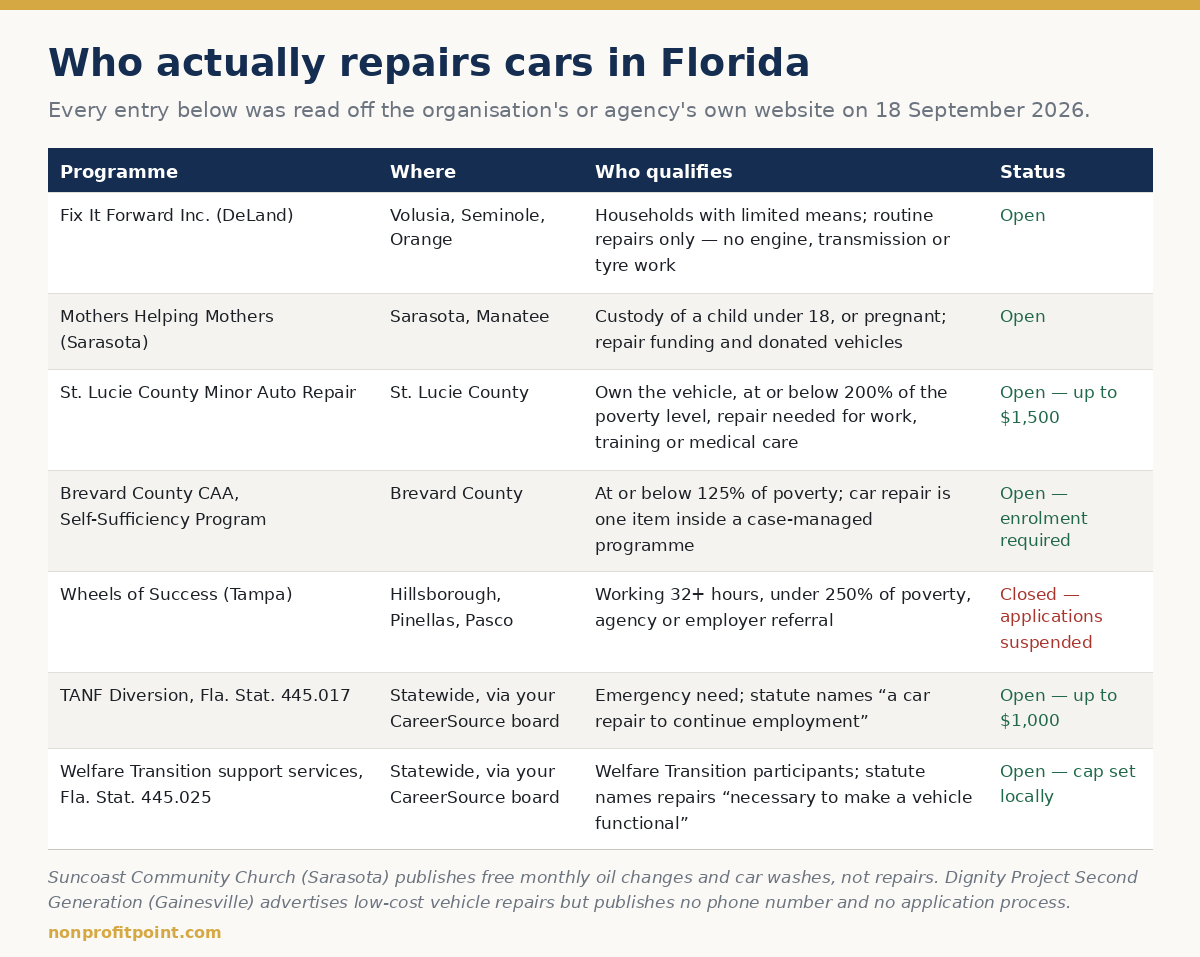
Read that table in the order the money is likely to reach you. If you live in Volusia, Seminole, Orange, Sarasota, Manatee, St. Lucie or Brevard, there is a local door to knock on. If you live anywhere else in Florida — including Miami, Jacksonville, Fort Myers, Pensacola and Tallahassee — your realistic route is the statutory one, and it starts with a phone call to a CareerSource office, not to a charity.
Start here: the $1,000 route that Florida law actually names
Florida’s welfare statute contains a sentence that almost no assistance guide has read. Section 445.017 of the Florida Statutes governs “diversion” — the idea that some people asking for ongoing cash assistance do not need it, and need one bill paid instead. Subsection (1) opens:
“Many customers of the one–stop delivery system do not need ongoing temporary cash assistance, but, due to an unexpected circumstance or emergency situation, require some immediate assistance to secure or retain employment or child support.”
Then it says what those obligations look like:
“These immediate obligations may include a shelter or utility payment, a car repair to continue employment, or other services that will alleviate the applicant’s emergency financial need.”
And subsection (2) sets the amount: up–front diversion involves “Offering a one–time payment of up to $1,000 per family.”
You apply to CareerSource, not to DCF — and that is why people miss it
This is the single most common reason Floridians never find this money. Diversion is a TANF benefit, so people go to the Department of Children and Families. But the statute puts the decision somewhere else: under subsection (3), “the local workforce development board must determine that all requirements of eligibility for diversion services would likely be met.” The local workforce development board is your regional CareerSource office.
Florida’s own Temporary Cash Assistance programme, by contrast, pays cash and nothing else. DCF’s TCA page describes a monthly benefit for families with children and makes no mention of vehicle repair or transportation assistance of any kind. Its only vehicle reference runs the other way: it is an asset test, capping the combined value of licensed vehicles for work–required household members at $8,500. If you call DCF and ask for help with a car repair, the honest answer from that agency is no. The yes, if there is one, is at CareerSource.
One condition to weigh before you accept it: taking an up–front diversion payment generally means agreeing not to apply for ongoing cash assistance for three months, and repaying the diversion payment if you do. If your situation is a single broken alternator standing between you and a job you already have, that trade is usually worth it. If you are about to lose income altogether, it may not be.
The second statute: support services for Welfare Transition participants
If you are already in Florida’s Welfare Transition Program, a second and more detailed provision applies. Section 445.025, “Other support services,” authorises transportation expenses “when the assistance is needed to comply with work activity requirements or employment requirements” and then spells out what that covers, including:
- “vehicle operational and repair expenses, including repair expenditures necessary to make a vehicle functional”
- “vehicle registration fees”
- “driver license fees”
- “liability insurance for the vehicle for a period of up to 6 months”
The statute also tells you what to bring: a request for vehicle repair must include “an estimate of the cost prepared by a repair facility.” Get the written estimate before you call, not after.
A third provision, section 445.031, extends this past the point at which you leave cash assistance. Transitional transportation “may be provided, if funds are available, for up to 2 years after the participant is no longer in the program,” and it may include the expenses in section 445.025 “as well as a vehicle valued at not more than $8,500 if the vehicle is needed for training, employment, or educational purposes.” If you left welfare for a job in the last two years and your car has since died, you are inside that window.
What the boards actually publish — and what they don’t
Here is the frustrating part, stated plainly rather than papered over. Florida’s statewide WIOA supportive–services policy does not name vehicle repair at all. CareerSource Florida’s Policy 109 lists twelve categories — transportation, childcare, housing, work attire, tools, testing fees and so on — and repairs are not among them. What it does say is that “WIOA regulations provide local areas the discretion to provide the supportive services they deem appropriate,” and that limits “may be established,” including “a maximum amount of funding and maximum length of time.”
So the amount is local, and almost no Florida board publishes it. We checked the public pages of ten regional boards, including Tampa Bay, Broward, Central Florida, Northeast Florida, Southwest Florida, Brevard/Flagler/Volusia and the Capital Region. They say “transportation assistance” and stop. Exactly one board publishes a written policy that names vehicle repair and attaches numbers to it.
CareerSource North Central Florida’s supportive–services policy, effective 20 May 2025, covers WIOA adult, dislocated worker and youth participants and Welfare Transition participants, and it is worth quoting because it tells you what a board’s internal rules look like:
- “The current annual cap is $1,500 per individual per program year.” That is an overall supportive–services cap, not a car–repair allowance — childcare or tools come out of the same $1,500.
- “Vehicle repairs are restricted to those affecting the safe functioning of the vehicle.” Brakes and tyres, yes. Air conditioning, no.
- “Estimates in excess of $500 require a diagnosis by an independent specialist approved by the CSNCFL CEO.”
Do not assume your board matches those numbers. Do assume the shape is similar: a cap, a safety test, and a second opinion on anything large. Ask your board for its supportive–services policy by name. Boards that do not advertise a benefit will still describe it if you ask for the written policy.
The Florida nonprofits that will actually touch your car
Fix It Forward Inc. — DeLand, serving Volusia, Seminole and Orange
This is the find of this guide, and it appears in none of the national round–ups. Fix It Forward describes itself on its own site as “a 501(c)(3) nonprofit organization that aims to help people in poverty and homelessness by providing free car repairs for households with limited means,” currently serving Volusia, Seminole and Orange counties. It was founded in 2024 by Ed Rosa, an Army veteran, and files under EIN 99–0897350 from DeLand.
Read the scope limit carefully, because it is the difference between a useful referral and a wasted afternoon. Fix It Forward does “routine repairs, such as oil changes, brakes, and modern–day maintenance.” It explicitly cannot handle “significant engine repairs like head gaskets, tire work, transmission overhauls, or replacements,” and it does not do “cosmetic restorations like bodywork or paint.” Local reporting indicates the founder prioritises homeless people, veterans and low–income families with small children.
How to apply: there is a request form on fixitforward.net. The organisation publishes no telephone number on its own website, so the form is the route. Do not confuse it with Fix It Forward Ministry of Fargo, North Dakota, which is a separate organisation, works only by referral from local agencies, and outranks the Florida one on some searches.
Mothers Helping Mothers — Sarasota and Manatee
The strongest option on the Gulf coast, and unusual in that it does both halves of the problem. Its vehicle programme says it will “accept donated vehicles, collaborate with local mechanics for repairs, and provide fully functional vehicles to eligible families in need.” Separately, its emergency assistance “may include financial support for rent, utility bills, essential car repairs, or other critical expenses necessary to help families avoid homelessness and regain stability.”
Who qualifies: you must live in Sarasota or Manatee County and must “have custody of children under 18 or be pregnant.” No third–party referral is required — you book an appointment to become a client, then submit the assistance request. Bring photo identification to every appointment, and proof of your children or pregnancy to the first one. Phone: 941–953–7572. No income ceiling is published, which is unusual and worth testing if you are marginally above other programmes’ limits.
Wheels of Success — Tampa Bay: excellent, and currently closed
Wheels of Success serves Hillsborough, Pinellas and Pasco and does exactly what Florida needs more of: “assistance with automotive repairs, preventative maintenance and car–care classes for families who have transportation but cannot afford repairs and maintenance,” alongside vehicle replacement, licensing help and down payments. Its eligibility rules are demanding by design — you must be working at least 32 hours a week or hold a verifiable job offer, sit at or below 250% of the poverty level, and be “referred by one of the following sources: Social Service Agencies, Churches, Employers, Board Members.” Recipients agree to pay it forward with a monthly amount based on income and three service hours a month.
None of that is available today. The applications page carries the suspension quoted at the top of this guide, and it has not been revised since November 2025 even though the date it names has long passed. The rest of the site is plainly current — the homepage was updated in late August 2026 and carries a 2026 copyright — which makes the stale notice on the applications page the most likely reading: the suspension is real and the end date simply was not updated.
What to do about it: if you are in Tampa Bay, do not write Wheels of Success off and do not rely on it either. Email rather than call — the organisation asks partner agencies to email — and ask two questions: whether the suspension is still in force, and whether an agency you already work with is a partner organisation, because partner referrals were treated differently from public applications. Phone (813) 417–1090. In the meantime, treat the CareerSource route above as your primary option, not your fallback.
Two Florida organisations that are narrower than they look
Suncoast Community Church, Sarasota publishes a “Free Monthly Oil Change” and free car washes “for those in need.” Local press has described a wider auto ministry that sends broken–down cars to trusted mechanics, but that programme does not appear anywhere on the church’s own website, so this guide does not claim it. Call 941–924–6411 and ask. Free preventative maintenance is not nothing — an oil change you have been deferring is a cheaper problem than the engine it eventually becomes.
Dignity Project Second Generation, Gainesville describes “low cost repairs on vehicles and computers” and refurbishing used cars to donate or sell cheaply, with a stated focus that includes veterans. It is at 1125 SE 4th Street, Suite A. We are naming it because Gainesville has nothing else, and flagging honestly that its site publishes no phone number, no eligibility criteria, no prices and no application process, and carries no date stamp anywhere. The older organisation’s domain, dignityproject.org, is dead — it serves a self–signed certificate and will not load. Visit in person or write.
County government: one real programme, and it is not where you would expect
St. Lucie County’s Minor Auto Repair Program — up to $1,500
Of Florida’s 67 counties, St. Lucie is the only one we could find with a dedicated, named, publicly documented car–repair programme. It is funded through the Community Services Block Grant that the county’s Human Services Division receives from the state, and it is specific about what it will and will not do: “Only small repairs such as batteries, tires, water hoses, brakes, engine belts, etc., are eligible for financial assistance. Any repairs over $1,500 must require approval.” The county pays the licensed repair facility directly — “The program does not reimburse individuals for vehicle repairs” — so do not authorise the work and then apply.
Eligibility: live in St. Lucie County, own the vehicle, and need the repair “to maintain employment, secondary education/training and/or for ongoing health care.” Income must sit at or below 200% of the federal poverty level. The county publishes the table: $31,920 for a household of one, $43,280 for two, $54,640 for three, $66,000 for four, rising by $11,360 per additional person to $111,440 at eight.
What to bring: photo ID for every adult, Social Security cards for the whole household, birth certificates for children under 18, thirty days of income documentation, proof of county residency, a utility bill, a valid driver licence, active Florida registration and insurance, proof of employment or of ongoing medical care for the last thirty days, and one repair quote. Apply via the online questionnaire on the county’s page, or call 772–462–1777 and press 0. The page carries no date stamp and no statement about current funding, so phone before you plan around it.
Brevard County — car repair inside a self–sufficiency programme
Brevard County’s Community Action Agency runs a Self–Sufficiency Program whose services “might include child care, rent assistance, tuition/books, uniforms, job placement, and minor car repairs.” Note the hedge in the county’s own wording, and note the structure: this is not a standalone repair fund you can apply to, it is one line item inside an intensive, case–managed programme you must enrol in. The income test is stricter than St. Lucie’s — at or below 125% of the poverty guidelines — and the county asks that applicants be ready to start work or training immediately. Contact the agency at the Dr. Joe Lee Smith Community Center, 415 Stone Street, Cocoa, (321) 633–1951. One correction worth making: a widely syndicated guide locates this programme “outside Orlando.” It is in Cocoa, on the Space Coast, an hour away.
Why your county probably has neither
Both of those programmes exist because a local agency chose to spend federal Community Services Block Grant money that way. CSBG is passed from the state to local community action agencies and county human–services divisions, and each decides its own service mix. That is why there is no statewide answer, and why the question worth asking your county is specific rather than general: not “do you help with car repairs,” but “does your CSBG allocation fund vehicle repair, and if not, which agency in this county receives it?” We could not read Florida’s own CSBG state plan — the state’s site blocks automated access — so we are not claiming this is common. We are claiming it is possible, and that two counties prove it.
When replacement, not repair, is the realistic answer
If the estimate exceeds what the car is worth, stop trying to fix it. Two routes exist in Florida, and neither is fast.
Free Charity Cars / 1–800–Charity Cars is headquartered in Altamonte Springs and awards donated vehicles nationwide. Its published requirements are a US residency, age 18 or over, a valid driver licence, income at or below 200% of the federal poverty level, a genuine need, internet access, a completed online application, and “financial means to pay for fees such as tag, title, emissions, insurance, etc.” It is emphatic that applying is free: “It is always free to apply for a vehicle… we NEVER ask for your card information for ANY fees.” Two things to understand before you pin hopes on it. Selection works by geography and recency — “When a vehicle is donated in your area we begin reviewing the most recent applications first” — and applications are deleted after three months, so reapplying matters. And on the organisation’s own donor page: “the vast majority of donated vehicles do not qualify to be ‘program vehicles’” — most are auctioned to fund the charity rather than awarded. Phone 1–800–242–7489.
NABC Recycled Rides refurbishes and gifts vehicles, and has done so in both Orlando and Tampa Bay. You cannot apply: “Candidates for a vehicle cannot self–nominate, or be nominated by a family member or friend” — they must be sponsored by a charity that already knows them. If you have a caseworker, a church or a veterans’ service officer, ask them to nominate you. If you do not, this route is closed to you, and no amount of calling will open it.
For a fuller treatment of vehicle–award programmes, see free cars for low-income families.
Florida has no smog check — and that kills an entire category of advice
A large share of the car–repair assistance that exists in the United States is emissions–driven. California will pay up to $1,450 through its Bureau of Automotive Repair. Arizona runs a voluntary vehicle repair programme. Texas ran AirCheckTexas until it was defunded. All of them exist because those states test vehicles and need a way to help people who fail.
Florida does not test vehicles. The US Environmental Protection Agency records it flatly in the Federal Register: “Florida terminated the I&M program on July 1, 2000 and repealed Chapter 325 F.S. in 2001.” Florida’s own Department of Environmental Protection tells the same story in its State Implementation Plan package — the 1988 Clean Outdoor Air Law created inspection and maintenance in six urban counties, and “In 2001, these SIP revisions were approved by EPA, Chapter 325, F.S., was repealed, and the I&M program was ended.”
The consequence is simple and worth stating so you stop searching for it: there is no Florida emissions–repair voucher, because there is no Florida emissions test to fail. Any page offering you one has copied a California or Arizona programme into a Florida heading.
The claims about Florida car repair that do not hold up
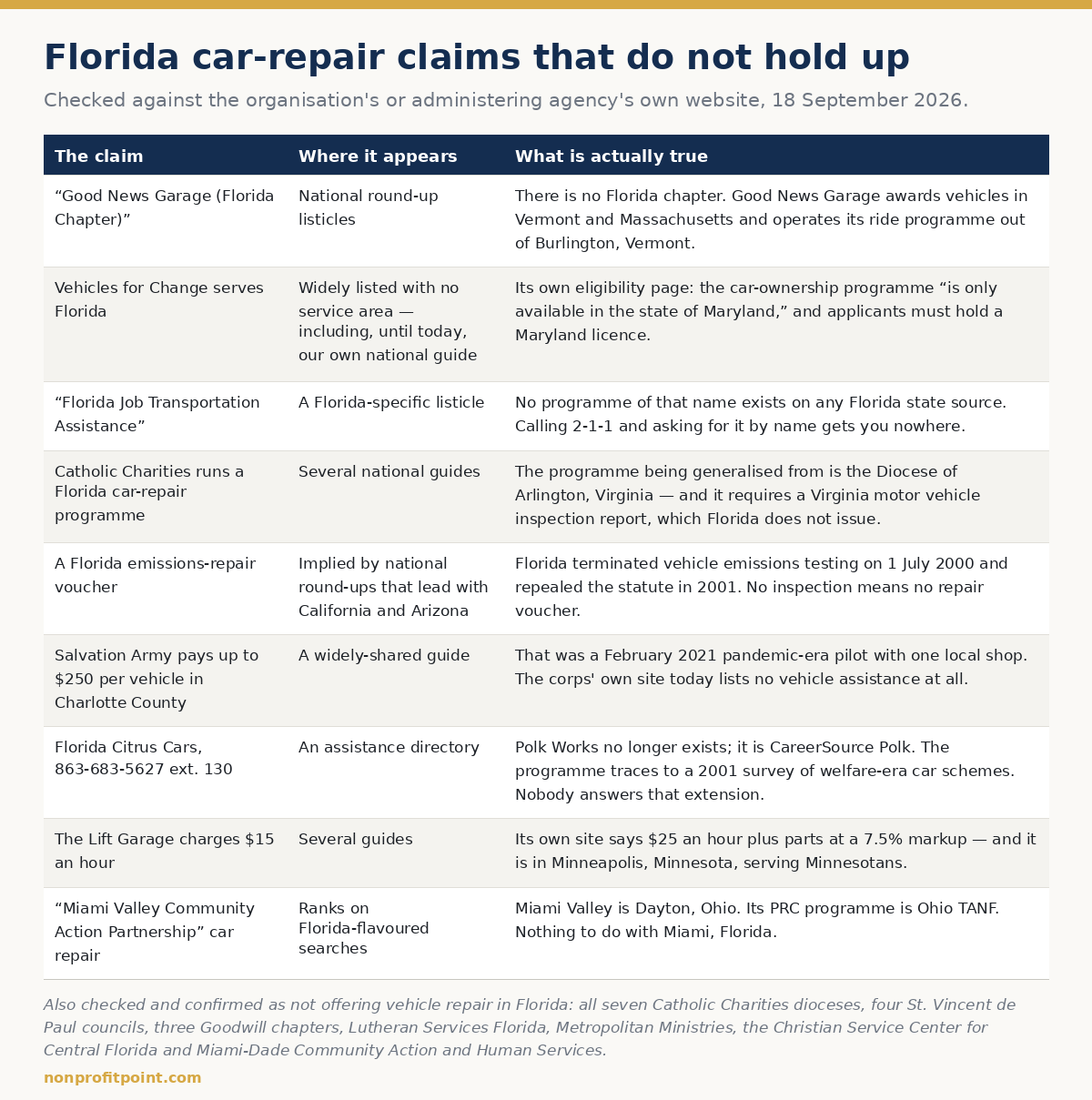
Some of these deserve more than a table row.
“Good News Garage (Florida Chapter)” does not exist
Good News Garage is a real and well–run charity. Its own programmes page places it in New England: its vehicle programme is “currently awarding vehicles to residents of Vermont… and in Massachusetts,” and its ride service “is operated out of our Burlington, Vermont office.” There is no Florida chapter and never has been.
Vehicles for Change is Maryland only — including on our own national page
Vehicles for Change appears on almost every car–assistance list with no service area attached, and Florida readers apply in good faith. Its own eligibility page is unambiguous: the car–ownership programme “is only available in the state of Maryland,” and applicants “must be a Maryland resident and posess a Maryland drivers license.” Our own national guide, charities that help with car repairs, described Vehicles for Change without stating its service area. That was our error, we found it while writing this page, and we have corrected it there.
“Florida Job Transportation Assistance” is an invented programme
At least one Florida–specific guide names a programme by this title. It does not exist on any Florida state source, and searching the exact phrase returns essentially nothing but that page. If you call 2–1–1 and ask for it by name, you will get a confused specialist and no help. The real statewide routes are the two statutes above.
The Catholic Charities car–repair programme is in Virginia, and its rules cannot be met in Florida
“Catholic Charities helps with car repairs” circulates widely. The programme people are describing belongs to the Diocese of Arlington, Virginia, and its eligibility list requires an applicant to live within the Arlington diocese, hold a current Virginia licence and registration, and “present a Virginia motor vehicle inspection report showing inspection failures.” That last requirement is structurally impossible in Florida, which issues no such report. We checked all seven Florida dioceses — Miami, Orlando, St. Petersburg, Venice, Palm Beach, St. Augustine and Pensacola–Tallahassee — and none publishes a vehicle–repair programme. Several offer emergency financial assistance with wide discretion, so calling your diocese is not pointless; expecting a repair programme is.
The Salvation Army’s $250 Charlotte County offer ended five years ago
A much–copied guide reports that the Salvation Army in Charlotte County covers “up to $250 per vehicle.” That traces to local television coverage from February 2021 describing a pandemic–era partnership with one repair shop. The Port Charlotte corps’ own site today lists Angel Tree, disaster relief, Pathway of Hope, adult rehabilitation and anti–trafficking work — and no vehicle or transportation assistance of any kind. The only Florida Salvation Army site we found mentioning car repair is Miami’s, and it appears in fundraising copy describing what emergency assistance may cover, with no eligibility rules, no cap and no application route published. Call 305–456–5610 and ask; do not treat it as a programme.
“Florida Citrus Cars” and the Polk Works phone extension are long dead
An assistance directory still lists Florida Citrus Cars at 863–683–5627 extension 130, applied for through “Polk Works’ One–Stop Career Centers.” Polk Works no longer exists — it is CareerSource Polk — and the programme traces to a 2001 survey of welfare–era car–ownership schemes. Nobody answers that extension. What Polk does have is not a repair programme: CareerSource Polk awarded 30 vehicles on 20 August 2026 as a one–off 30th–anniversary event with a local dealership. It was a giveaway, not a standing benefit, and no recurrence has been announced.
Two more worth knowing before you dial
The Lift Garage is frequently quoted at “$15 an hour for labor.” Its own site now says “Customers at The Lift pay $25/hour for labor and parts are sold at a 7.5% markup” — and it is at 2401 E. Lake Street, Minneapolis, serving Minnesotans. “Miami Valley Community Action Partnership” ranks on Florida–flavoured searches and runs a genuine car–repair programme. Miami Valley is Dayton, Ohio.
Modest Needs: real, national, and misdescribed
Modest Needs does fund car repair, and it pays the mechanic rather than you: “Modest Needs’ policies prohibit our sending cash directly to an applicant.” The misdescription is the eligibility. Its Self–Sufficiency Grant exists to help people who are “working and live just above the poverty level” and are therefore “ineligible for most types of conventional social assistance.” Two gates catch most readers of a low–income guide: “At least one adult member of the applicant’s household must be documentably employed at the time of the application,” and the household’s largest income source must be employment, child support, veterans’ benefits or retirement income. If your household income is mostly cash assistance or disability, this is not your programme. We are deliberately not quoting a maximum grant figure, because the widely circulated one does not appear on Modest Needs’ own site.
Checked and confirmed as not offering vehicle repair in Florida
So that you do not spend a week rediscovering this: we read the current service pages of all seven Florida Catholic Charities dioceses; four St. Vincent de Paul councils (South Pinellas, North Broward, Orlando and Holy Family); three Goodwill chapters (Suncoast, Central Florida and Southwest Florida, all of which accept vehicle donations and none of which gives repairs); Lutheran Services Florida; Metropolitan Ministries in Tampa; the Christian Service Center for Central Florida; and Miami–Dade Community Action and Human Services. None of them publishes vehicle–repair assistance. Two further state routes are commonly misread: Florida’s Division of Vocational Rehabilitation funds adaptive vehicle modification for people with disabilities pursuing employment, not general mechanical repair; and the Florida Commission for the Transportation Disadvantaged funds rides, not repairs — which makes it a real answer when the repair is simply out of reach.
FEMA after a hurricane: real, and not what the numbers say
Florida’s one genuinely large disaster–related route to a repaired vehicle is FEMA’s Other Needs Assistance. Federal regulation at 44 CFR 206.119 lists transportation costs including “(i) Repairing or replacing vehicles.” FEMA’s own guidance puts it plainly: “FEMA can give money to help repair or replace a vehicle that is not drivable because of a disaster,” covering “any fees or work needed to make the car safe and drivable, including medically required items, labor, towing, paint, carpet, etc.”
There is no national FEMA vehicle maximum — and the figure you have seen is not one
This is the correction that matters most. FEMA does not publish a national dollar ceiling for vehicle repair or replacement. The amount is “based on the amount your state, territorial, or tribal government sets for repairing or replacing disaster–damaged vehicles.” The figure that circulates — $43,600 — comes from the Federal Register notice setting the maximum for the Individuals and Households Program as a whole, for disasters declared on or after 1 October 2024. That is the ceiling for every other–needs category combined. It is not a car allowance, and writing as though it were is how readers end up expecting five figures for a transmission.
The insurance rule is the opposite of what most people assume
People with liability–only cover often assume they are excluded. They are the intended recipients. FEMA requires that “the vehicle meets the registration and insurance requirements” of the state — in Florida, that is the legal minimum — and then requires that “you don’t have comprehensive insurance, or your insurance doesn’t cover the disaster–caused damage.” Comprehensive cover is what disqualifies you, not the lack of it. You must also own or lease the vehicle (“even if they’re still making payments”) and not have another vehicle that meets the household’s needs, though FEMA “may provide assistance for multiple vehicles” where a household can show it needs more than one.
As of today, there is no open Florida disaster to apply under
We queried FEMA’s own declarations data on 18 September 2026. Florida has had no major disaster declaration since 1 January 2025 — the only 2026 Florida declarations are fire management assistance for the Railroad Complex and Cow Creek fires in April, neither of which carries Individual Assistance. The last declarations with household assistance were the 2024 hurricanes, and their registration periods have closed. Keep this route in mind for the season, not for this week, and check fema.gov/disaster/declarations and disasterassistance.gov rather than trusting any guide’s snapshot — including this one.
The honest coverage map: Florida’s five largest metros have nothing open
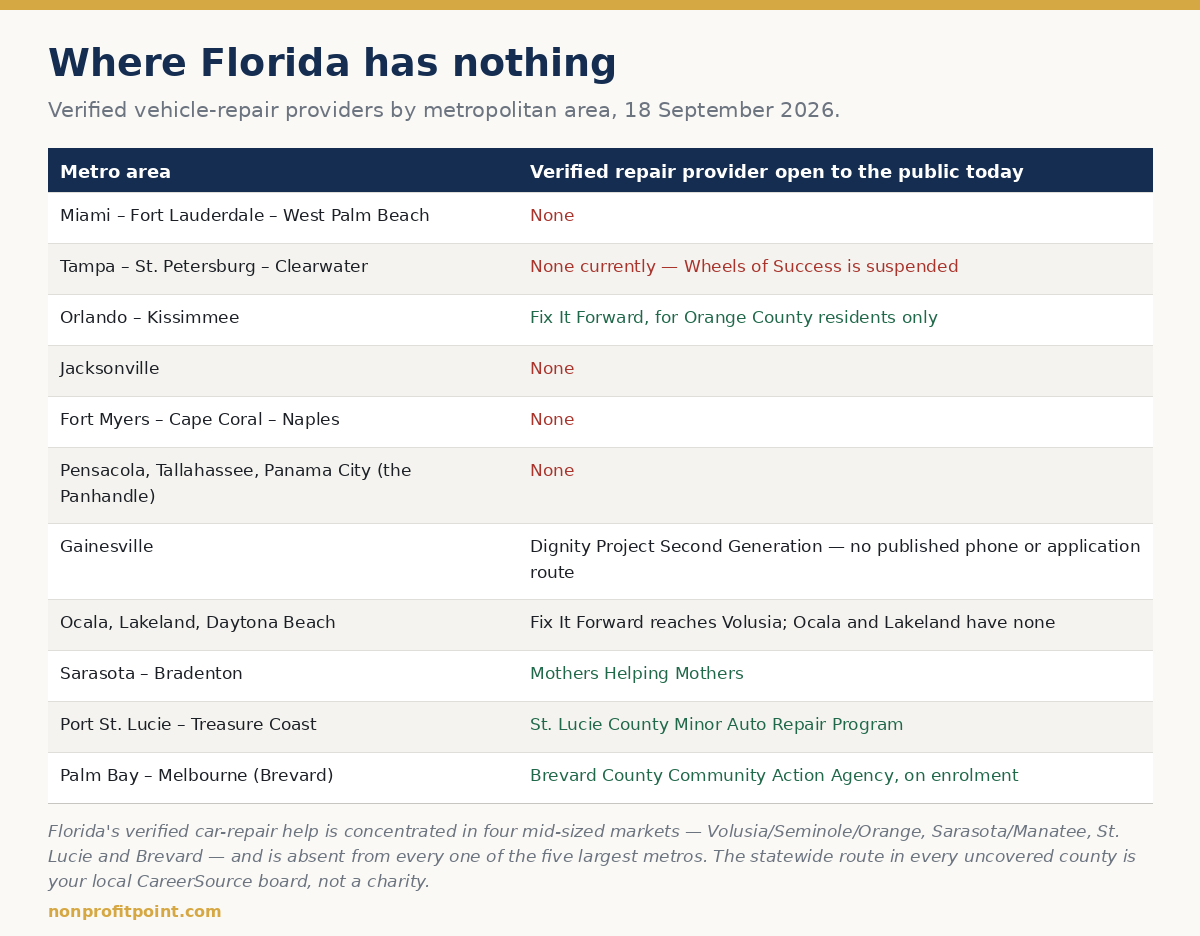
We are printing the gap rather than filling it with plausible names, because a fabricated local listing wastes a phone call that someone with a broken car cannot spare. With Wheels of Success suspended, not one of Florida’s five largest metropolitan areas has a verified vehicle–repair charity accepting applications from the public. The help that exists is concentrated in four mid–sized markets: Volusia/Seminole/Orange, Sarasota/Manatee, St. Lucie and Brevard.
Nor could we verify a single Florida church “car ministry” of the kind that is common in Texas, North Carolina and Minnesota. We searched thirteen cities. Every result was either an out–of–state ministry or a content farm with no organisation behind it. The one exception is Suncoast Community Church in Sarasota, and its own site documents oil changes, not repairs. If you run or know of a Florida auto ministry, that absence is an opportunity, not a fact of nature.
2–1–1 in Florida: eleven centres, not one queue
Florida 211 is “comprised of 11 centers that provide community resource navigation,” covering all 67 counties, with “over 40,000” programmes in the statewide directory. Four of the eleven sit inside local United Ways. Two practical consequences. First, dial 2–1–1 and describe the problem in employment terms — “I need a repair to keep my job” — because a specialist can search a database that the public website does not fully expose. Second, because these are eleven regional operations rather than one state call centre, what 211 can offer differs sharply between counties, and a dead end in one county says nothing about the next. 211 makes referrals; it does not hold a repair fund.
Florida’s other front door is Hope Florida, a state–backed navigation service reached on 833–GET–HOPE (833–438–4673). Understand what it is before you call: it describes itself as fostering “community collaboration between the public and private sector, faith–based communities, and nonprofits,” and its navigators “post real–time needs” to people who might meet them. It does not advertise paying for car repairs. It is a matchmaker, and in a state this thinly covered a matchmaker has value — but it is not money.
Before you pay: what Florida law requires your repair shop to do
This matters because the households that need repair assistance are the most exposed to being overcharged. Section 559.905 of the Florida Statutes requires a written estimate on any repair work exceeding $150, and that estimate must state “the estimated cost of repair which must include any charge for shop supplies” and “a statement indicating what, if anything, is guaranteed in connection with the repair work.” It must also contain “a statement allowing the customer to indicate whether replaced parts should be saved” for inspection or return.
The shop must also give you a separate disclosure, in capital letters of at least 12–point type, letting you request a written estimate, decline one, or set a maximum figure above which the shop must call you before continuing. Use it. Setting a ceiling in writing before work begins is the single most effective protection available to you, it costs nothing, and it is the number every assistance programme above will ask you for anyway.
How to actually get a yes in Florida
- Get a written estimate first. Every route on this page — statutory, county and charitable — wants one, and section 445.025 requires “an estimate of the cost prepared by a repair facility.” Do not authorise the work; all of these programmes pay the shop, and none reimburses you.
- Call your CareerSource board before you call a charity. Ask two specific questions: whether you qualify for up–front diversion under section 445.017, and whether the board will send you its written supportive–services policy. Specific questions get past front–desk scripts that specific benefits are invisible to.
- Frame it as employment, always. Every statutory route and both county programmes are conditioned on work, training or medical access. “I need my car fixed” is a request. “I lose my job on Monday without this repair” is an eligibility statement.
- Check whether your county is one of the two. If you are in St. Lucie or Brevard, apply there today. If not, ask your county human–services division which agency receives its Community Services Block Grant, and ask that agency directly.
- Then work the local charity, if your county has one. Volusia, Seminole and Orange: Fix It Forward, for routine work only. Sarasota and Manatee: Mothers Helping Mothers. Tampa Bay: email Wheels of Success to ask whether the suspension has lifted.
- Dial 2–1–1 anyway, and dial it more than once. Eleven regional centres, forty thousand programmes, and a directory the public site does not fully expose. A no in August is not a no in November; these funds are seasonal and grant–cycle driven.
- If the repair costs more than the car is worth, stop. Apply to Free Charity Cars, ask a caseworker about an NABC nomination, and read free cars for low-income families and charities that help with car payments before you borrow against the vehicle.
Frequently asked questions
Are there charities that help with car repairs in Florida?
Fewer than the national lists suggest, and they are regional. Fix It Forward in DeLand does free routine repairs for Volusia, Seminole and Orange counties. Mothers Helping Mothers in Sarasota funds essential car repairs and awards donated vehicles to families in Sarasota and Manatee. Wheels of Success in Tampa does both but has suspended applications. Beyond those, help comes from government rather than charity: St. Lucie County pays up to $1,500 for minor repairs, Brevard County includes minor car repairs in its self–sufficiency programme, and two Florida statutes let your CareerSource board pay for repairs directly.
Does Florida have a government programme that pays for car repairs?
Yes, two, and both run through your local CareerSource board rather than the Department of Children and Families. Section 445.017 of the Florida Statutes authorises a one–time diversion payment of up to $1,000 per family and names “a car repair to continue employment” as a qualifying emergency. Section 445.025 authorises vehicle repair expenses as a support service for Welfare Transition participants, including “repair expenditures necessary to make a vehicle functional.” The amount under the second route is set locally by each board.
Will Florida TANF or Temporary Cash Assistance pay to fix my car?
Not directly. Florida’s Temporary Cash Assistance programme pays monthly cash to families with children and mentions no vehicle assistance; its only vehicle rule is an $8,500 asset limit on licensed vehicles for work–required household members. The TANF money that can reach a car repair is the diversion payment under section 445.017, and the decision on that sits with your local workforce development board, not with DCF.
Is Wheels of Success still accepting applications in 2026?
No. Its applications page states that it “will not be accepting any applications for any vehicle–related services until further notice,” with a suspension for non–partner organisations running “from now until at least January 5, 2026.” That page has not been revised since November 2025 even though the rest of the site is current, so the end date appears simply not to have been updated. Partner agencies are asked to email rather than call. If you are in Hillsborough, Pinellas or Pasco, email to ask whether the suspension has lifted, and pursue the CareerSource route in the meantime.
Which Florida county helps with car repairs?
St. Lucie County is the only one in Florida with a dedicated, publicly documented car–repair programme. Its Minor Auto Repair Program covers small repairs such as batteries, tyres, hoses, brakes and belts up to $1,500, requires residency, vehicle ownership, active insurance and household income at or below 200% of the federal poverty level, and pays the repair shop directly. Brevard County includes minor car repairs within a case–managed self–sufficiency programme at a stricter 125% income limit. No other Florida county publishes one.
Does Florida have an emissions repair assistance programme?
No, and it cannot have one. Florida terminated its vehicle inspection and maintenance programme on 1 July 2000 and repealed the governing statute, Chapter 325, in 2001. Programmes such as California’s Bureau of Automotive Repair assistance and Arizona’s voluntary repair programme exist to help motorists who fail an emissions test. Florida does not test, so there is nothing to fail and no voucher to claim. Any page offering a Florida emissions repair voucher has copied another state’s programme.
Does Catholic Charities help with car repairs in Florida?
Not as a published programme. We checked all seven Florida dioceses — Miami, Orlando, St. Petersburg, Venice, Palm Beach, St. Augustine and Pensacola–Tallahassee — and none lists vehicle–repair assistance. The Catholic Charities car–repair programme that circulates online belongs to the Diocese of Arlington, Virginia, and requires a Virginia motor vehicle inspection report, which Florida does not issue. Several Florida dioceses do offer discretionary emergency financial assistance, so calling your own diocese is worth doing; expecting a repair programme is not.
Will FEMA pay to repair my car after a hurricane in Florida?
It can, under Other Needs Assistance, but only for disaster–caused damage inside a declared disaster area, and only where you do not have comprehensive insurance or your insurance does not cover the damage. Liability–only cover does not disqualify you; comprehensive cover generally does. There is no national FEMA maximum for vehicle repair — the amount is set by the state for each disaster, and the $43,600 figure often quoted is the cap for all Other Needs Assistance categories combined, not a car allowance. As of 18 September 2026 Florida has no open declaration with Individual Assistance.
Does the Salvation Army help with car repairs in Florida?
Not as a published programme. The often–quoted “$250 per vehicle in Charlotte County” comes from a February 2021 pandemic–era partnership with one repair shop, and the Port Charlotte corps’ own site today lists no vehicle assistance at all. The Miami Area Command names car repair among things its emergency financial assistance may cover, but publishes no eligibility rules, no cap and no application route. Call and ask, but do not plan around it.
What if there is no charity in my part of Florida?
That is the likeliest outcome, and it is the reason this guide leads with statute rather than charity. There is no verified vehicle–repair charity accepting public applications in Miami, Jacksonville, Fort Myers, the Panhandle, Ocala or Lakeland. In those places the route is your CareerSource board under sections 445.017 and 445.025, your county human–services division and whichever agency holds its Community Services Block Grant, and 2–1–1 called more than once. If the repair exceeds the car’s value, switch to a vehicle–award programme instead of chasing repair money.
Related help
If this page did not solve it, these will help next.
- Charities that help with car repairs — the national picture, and what actually travels between states
- Car repairs in California and car repairs in Texas — the two states with the largest dedicated repair money
- Charities that help with rent in Florida — the same CareerSource and county agencies, for housing
- Charities that help with car insurance — including the six months of liability cover Florida statute allows
- Charities that help with car payments — if the loan, not the repair, is the problem
- Free cars for low-income families — when the repair costs more than the car is worth
- Charities that help with transportation — rides, passes and the programmes that reach every Florida county
How we verified this guide. Every programme, dollar figure, eligibility rule, phone number, county list and open–or–closed status on this page was read off the administering agency’s or organisation’s own website on 18 September 2026. Statutory material comes from the 2025 Florida Statutes as published by the Florida Senate — sections 445.017, 445.025, 445.031 and 559.905. State programme material comes from the Florida Department of Children and Families, CareerSource Florida’s Policy 109 on supportive services and needs–related payments, CareerSource North Central Florida’s supportive–services policy effective 20 May 2025, the Florida Division of Vocational Rehabilitation’s services policy manual, the Florida Commission for the Transportation Disadvantaged, Hope Florida and Inform Florida. The emissions finding comes from the United States Environmental Protection Agency’s Federal Register notice on the removal of Florida’s motor vehicle rules and from the Florida Department of Environmental Protection’s own State Implementation Plan package. Federal disaster material comes from 44 CFR 206.119, FEMA’s transportation–assistance guidance of July 2025, the Federal Register notice of maximum assistance under the Individuals and Households Program effective for disasters declared on or after 1 October 2024, and a query of FEMA’s own declarations data run on 18 September 2026. Nonprofit material comes from each organisation’s own website; registration was checked against IRS records. Several corrections are printed here rather than quietly absorbed, including one to our own national guide, which described Vehicles for Change without noting that its programme is available only in Maryland. Where a claim could not be verified — the wider auto ministry attributed in local press to a Sarasota church, and the reach of Community Services Block Grant funding beyond two counties — this page says so instead of asserting it. Written and verified by Alex Shabani for Nonprofit Point.