Charities That Help With Rent in Tennessee: Who Actually Pays in 2026

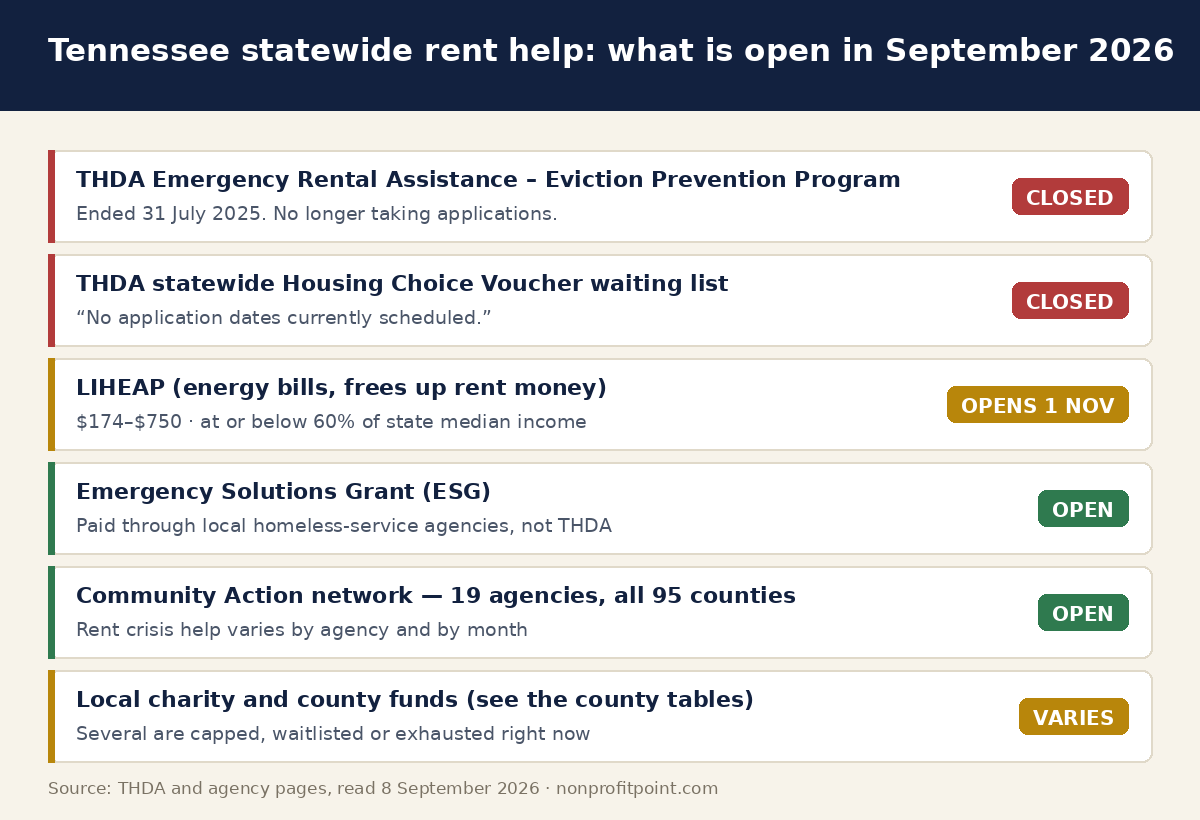
If you are behind on rent in Tennessee, start with the fact that almost every other page on this subject still gets wrong: Tennessee no longer has a statewide rental assistance program. The Tennessee Housing Development Agency’s Emergency Rental Assistance – Eviction Prevention Program closed more than a year ago, and THDA says so on its own page in one sentence: “The program ended on July 31, 2025 and is no longer taking applications.”
The state’s own advice now is to call 2-1-1. That is not a brush-off — it is the correct first move — but it is not an answer either, because what 211 finds for you depends entirely on which county you live in and which local fund still has money this week. This guide is the map of those local funds: who actually pays a landlord in Tennessee, what each one requires, the phone number the organization publishes itself, and — the part nobody else publishes — which doors are shut right now, so you do not burn three days of a fourteen-day notice on a dead line.
Every program, phone number, income rule and closure notice below was read off the organization’s own website on 8 September 2026. Where an organization does not publish a detail, this page says so instead of inventing one.
Start here: the three calls that matter most
1. Dial 2-1-1, or text your ZIP code to 898-211. Tennessee’s 211 is not one statewide call centre — it is a network of regional United Way centres, each with its own direct line and hours. Memphis and the Mid-South: (901) 415-2790 or toll-free 866-735-7211 (“211 LINC”, run with the Memphis Public Library). East Tennessee and Knoxville: (865) 215-4211, Monday to Friday 8 a.m. to 4 p.m., or email help@easttn211.org. Chattanooga and the Tennessee Valley: (423) 265-8000, Monday to Friday 8 a.m. to 5 p.m.; callers in north Georgia and Alabama use 1-866-921-3035. Middle Tennessee navigators answer Monday to Friday, 8 a.m. to 5 p.m. Central. Dialling 211 from any Tennessee phone routes you to the right one automatically.
2. Call your Community Action Agency. Tennessee routes most of its crisis housing and energy money through nineteen community action agencies that between them cover all ninety-five counties — not through a state hotline. The county sections below tell you which one is yours.
3. If you have already been served with a detainer warrant, call legal aid the same day. Free eviction lawyers by region are listed near the end of this guide. In Tennessee the gap between a notice and a court date can be short, and a lawyer is free where a fund may be empty.
What happened to Tennessee’s statewide rental assistance
Between 2021 and 2025, Tennessee ran the federally funded Emergency Rental Assistance – Eviction Prevention Program (ERA-EPP) through THDA. It paid back rent and utilities for households facing eviction across the counties that did not run their own local ERA programme. It is finished. THDA’s page states the ending date — 31 July 2025 — and directs renters to 211. If you have a question about an application filed before that date, the address THDA gives is ERA-EPP@thda.org, and its general line is 800-228-THDA.
A second door closed alongside it, and this one gets less attention. THDA administers the Housing Choice Voucher (Section 8) programme directly in seventy-two of Tennessee’s ninety-five counties. Its waiting-list page currently reads “Closed”, with “No application dates currently scheduled.” So the two things a Tennessee renter is most often told to do — apply for state rental assistance, get on the voucher list — are both unavailable as of today.
One more correction worth making before you go looking: THDA’s Tennessee Housing Trust Fund and its Rebuild and Recover line are not tenant assistance. The Trust Fund pays for rental-housing development, a gap subsidy for developers, and an emergency repair programme for elderly and disabled homeowners; Rebuild and Recover is disaster-recovery money for communities. Neither will pay your rent, whatever a directory listing tells you.
What is actually open statewide in 2026
The Community Action network — nineteen agencies, all ninety-five counties
This is the backbone of crisis assistance in Tennessee, and it is under-publicised because there is no single number to call. The Tennessee Association of Community Action lists nineteen member agencies covering every county in the state. Each one administers a different mix of federal money — Community Services Block Grant, LIHEAP, sometimes Emergency Solutions Grant funds — and each decides its own intake process. What one agency can pay in September, another cannot, and the same agency’s answer changes when a grant cycle turns over.
The six agencies covering Tennessee’s largest counties:
- Davidson County (Nashville): Metropolitan Action Commission — 615-862-8860
- Shelby County (Memphis): Shelby County Community Services Agency — 901-222-4200
- Knox County (Knoxville): Knoxville-Knox County Community Action Committee — 865-546-3500
- Hamilton County (Chattanooga): City of Chattanooga Office of Family Empowerment — (423) 643-6434
- Rutherford, Sumner, Williamson, Wilson, Cheatham, Robertson and Trousdale counties: Mid-Cumberland Community Action Agency, Gallatin — 615-742-1113
- Montgomery County (Clarksville): Clarksville-Montgomery County Community Action Agency — 931-896-1800
A note on that Chattanooga number. The statewide association’s directory lists 423-643-6400; the City of Chattanooga’s own page and the local community services directory both list 423-643-6434. We publish the number the agency itself publishes.
LIHEAP — not rent, but it frees up rent money
THDA administers Tennessee’s Low Income Home Energy Assistance Program through those same nineteen local agencies. It pays your utility company directly, which means the money you would have sent to the power company can go to the landlord instead. Three numbers matter:
- What it pays: THDA states assistance “will range from $174 to $750 depending on household energy burden.”
- Who qualifies: “Income eligible households are those at or below 60% of the State Median Income.” Note that this is state median income, not the federal poverty guideline — the threshold is meaningfully higher than most crisis programmes, and households that are turned away elsewhere often qualify here.
- When: THDA’s LIHEAP page, last revised in May 2026, describes online applications opening at 8 a.m. Central on 1 November. Tennessee has run the same autumn opening for several seasons, but THDA had not posted a 2026–27 date at the time of writing. Ask your local agency for this year’s exact date rather than assuming it.
Emergency Solutions Grant — the quiet homelessness-prevention money
THDA does not pay ESG money to tenants. It sub-grants it to local homeless-service agencies, which then use it for five things: street outreach, emergency shelter, rapid re-housing, HMIS data, and — the one that matters here — homelessness prevention, which explicitly covers rental assistance plus utility deposits and application fees to stop someone losing housing they already have.
There is no ESG application line and no published dollar cap. The way in is to ask your community action agency or your local continuum-of-care provider whether they hold ESG prevention funds this cycle. It is worth asking by name, because “do you have any rent assistance” and “do you have ESG homelessness-prevention funds” get different answers from the same front desk more often than they should.
Memphis and Shelby County
MIFA — the first call in Memphis
The Metropolitan Inter-Faith Association is the largest emergency-assistance organisation in the Memphis area, and its housing-stability programme covers rent or mortgage. Its most recent federal filing, for the year ending June 2025, shows $11.68 million in revenue against $13.88 million in expenses — an organisation spending down reserves to keep the doors open, which is context worth having when you call.
- Who qualifies: Shelby County residents only; you must have a late rent or mortgage notice; the crisis or income loss must have happened within the past 90 days; you cannot have received MIFA assistance in the past 12 months. MIFA states that first-time applicants get preference.
- How to apply: online only, through MIFA’s application portal, which is open 7 a.m. to 3 p.m., Monday to Friday, excluding holidays.
- Help desk: (901) 529-4538.
- Not published: a dollar cap, and whether payment goes to the landlord directly.
Shelby County Community Services Agency — and the first-Monday rule
The county’s Comprehensive Emergency Assistance Program pays rent or mortgage “to prevent the loss of housing due to eviction or foreclosure.” It is real money and the eligibility ceiling is generous — income at or below 200% of the federal poverty guidelines, which is roughly double what most crisis funds allow. You need Shelby County residency, proof of income or documented wage loss, a current lease or mortgage, photo ID and Social Security cards for everyone in the household.
The catch is the calendar, and it is the single most important operational fact in Memphis. Appointment slots are released online on the first Monday of each month at 8:30 a.m., and the agency states plainly that “Assistance cannot be given if you have not successfully secured an appointment slot online on the First Monday of the Month.” When the slots fill, the scheduler simply returns an error. In practice this is a monthly rush, not a queue. Set an alarm for 8:25 a.m. on the first Monday, have your documents scanned already, and do not wait until you are served.
Phone 901-222-4200; 1188 Minna Place, Memphis.
Other Memphis doors worth a call
- The Salvation Army, Memphis — the Kentucky & Tennessee divisional office confirms a rent and utility assistance programme, but Memphis publishes no eligibility rules or amounts of its own. MIFA’s referral list gives the assistance line as (901) 543-8586; the corps is at 696 Jackson Avenue.
- Society of St. Vincent de Paul, Memphis — covers “utilities, food, rent, or a mortgage,” but funds are administered by individual parish conferences and assigned by ZIP code, and SVDP says outright that “Funds are limited and vary per St. Vincent de Paul Conference.” It also lists ZIP codes with no conference coverage at all: 38116, 38118, 38053, 38127, and 38117 south of Poplar. Check your ZIP before you call. Office: 1306 Monroe Avenue.
- Catholic Charities of West Tennessee — 901-722-4762, 85 North Cleveland, open 8 a.m. to 2 p.m. Its published page covers homeless services and does not describe a rent fund; ask specifically rather than assuming.
Nashville and Davidson County
Metro Action Commission
Nashville’s community action agency runs the city’s main emergency assistance for rent, mortgage and related crises, applied for through an online portal or in person at 1281 Murfreesboro Pike. In-person hours are 8 a.m. to 3:30 p.m., Monday to Friday; the call centre stays open until 4:30 p.m. Phone 615-862-8860.
Metro Action publishes income limits rather than award caps. For fiscal year 2025–26 its housing-assistance ceilings are $19,562.50 for a one-person household, $26,437.50 for two, $33,312.50 for three and $40,187.50 for four, rising by $6,875 for each additional person beyond eight. Those figures work out to exactly 125% of the federal poverty guideline, though the agency does not label them that way. It publishes no maximum award, and this programme has a documented history of closing and reopening as funding turns over — there was no closure notice on its page on the day of writing, but call before you travel.
Catholic Charities of Tennessee
Its emergency assistance explicitly covers “overdue rent payments” and “overdue utility payments,” alongside food and diapers, and the organisation describes it as short-term help “based on available funding.” Phone (615) 352-3087; 2806 McGavock Pike. Amounts and income limits are not published.
The Salvation Army, Nashville Area Command — the process changed
Nashville’s corps offers “short-term financial assistance to help with rent, electric, and water bills,” but the way you ask for it changed on 20 October 2025 and a lot of directories have not caught up. All requests now go through an online portal at SAHelp.org. Phone and email requests are no longer accepted. The command states it can “only accept a set number of applications each week,” and applications reopen each Monday. If you call 631 Dickerson Road and get told to go online, that is not a brush-off — it is the actual process.
Rooftop — out of money right now
Rooftop is Nashville’s best-known private eviction-prevention fund, and as of today its application page carries a “Funding Exhausted” banner with no date on it. Keep it on your list anyway, because when it is funded its rules are unusually clear and its cap is unusually workable:
- Total balance due must be under $2,500, including all fees — attorney fees included. Rooftop warns that “On the 25th of the month, the next month will be added to the balance,” so an account that qualifies on the 24th may not on the 26th.
- Davidson County residency; the lease must be in the applicant’s name; a documented one-time hardship; and provable income sufficient to sustain the tenancy afterwards.
- Funding is available once every 12 months.
- Rooftop contacts the landlord directly to verify the balance. Its case-review team meets Tuesdays and Thursdays.
Phone 615-485-5920; 108 7th Avenue South. The apply button disappears from the page when applications are closed, so the button’s presence is the status indicator.
What MDHA can and cannot do
The Metropolitan Development and Housing Agency runs Nashville’s Housing Choice Voucher and Moderate Rehabilitation programmes. It does not run an emergency cash fund, and its waiting lists are shut: “MDHA is not currently accepting applications for our affordable housing waiting lists,” with no reopening date announced. Phone (615) 252-8400. If someone tells you to “apply to MDHA” for help with this month’s rent, they are pointing you at a landlord, not a fund.
Knoxville and Knox County
Knoxville-Knox County Community Action Committee
CAC is the community action agency for Knox County, and its Emergency Solutions Grant money specifically funds “payment of housing deposits, first month’s rent, utility deposits, and other supportive services.” That wording matters: this is strongest for someone moving into housing, and thinner for someone trying to clear arrears in a lease they already hold. CAC states applicants “must meet income and other eligibility requirements” without publishing a threshold. Main line (865) 546-3500; social services at the Ross Building, 2247 Western Avenue, (865) 544-5200.
Volunteer Ministry Center — Bush Family Refuge
This is the closest thing Knoxville has to a walk-in eviction-prevention front door. VMC describes Bush Family Refuge as “a walk-in navigation center offering prevention services (rental assistance and eviction mitigation), crisis intervention and referrals, vital document services.” Assessments run Tuesday to Thursday, 9 a.m. to 11 a.m., and VMC states that no documentation is needed for an assessment, an ID or a referral — which makes it a good first stop if your paperwork is the thing standing in your way. Phone 865-673-0235; main office 865-524-3926, 511 North Broadway.
One practical warning: VMC’s standalone eviction-prevention page has moved, and the URL still circulating in directories returns a 404. The programme is live; the link is not. Use the phone number.
What Knoxville’s other big names actually do
Catholic Charities of East Tennessee runs four housing programmes — supportive housing for adults with severe mental illness, Samaritan Place for people aged 60 and over, The Home Place in Chattanooga for people living with HIV/AIDS, and a children’s emergency shelter. None of them is a general eviction-prevention fund. If you fit one of those four descriptions, call (865) 524-9896; if you do not, this is not your door.
Knox Area Rescue Ministries publishes emergency shelter, meals, a medical clinic, case management, recovery programming and legal aid — not rent payment. KARM’s own site blocks automated access, so we could not read it directly on the day of writing and are relying on its published programme listings; confirm by phone if someone has told you KARM pays rent. It houses people who are already homeless; it does not pay a landlord to keep you in a lease you have.
Chattanooga and Hamilton County
Metropolitan Ministries
This is the rent door in Chattanooga. Metropolitan Ministries names the programme precisely: “emergency financial assistance: eviction prevention assistance (past due rent/mortgage help) & utility assistance (past due water, sewer, gas or electric).” It also describes its own constraint with more honesty than most: “Three days a week people from all over Chattanooga and North Georgia call in for urgent help paying their bills. But we can only help so many people each day.” Phone 423-624-9654. Intake days, income limits and amounts are not published — call early in the day.
City of Chattanooga Office of Family Empowerment
OFE describes itself as “the Community Action Agency serving Hamilton County.” Its published assistance programmes are LIHEAP, a Family Support Program, fair-housing education, a sewer lateral assistance programme, tax relief and down-payment assistance of up to $15,000 for first-time buyers. A distinct rent-payment programme is not named on its site, so treat OFE as your LIHEAP and referral route rather than a direct rent fund. Phone (423) 643-6434; 501 West 12th Street; ofeinfo@chattanooga.gov.
Two Chattanooga organisations that do not pay rent
Chattanooga Room in the Inn provides transitional housing for women and children experiencing homelessness — 423-624-6144 — and describes no rent-payment programme. Partnership for Families, Children and Adults is a substantial and genuinely useful agency covering sexual assault services, domestic violence shelter and advocacy, deaf and hard-of-hearing services, youth mentoring and elder home care, at (423) 755-2822. It publishes no rent or eviction-prevention programme at all, despite appearing on nearly every Chattanooga assistance listicle.
The rest of Tennessee
Outside the four big metros, your community action agency is usually the whole answer, with Family Promise affiliates as the second call in the eastern half of the state.
Community action: Mid-Cumberland CAA in Gallatin (615-742-1113) covers Rutherford, Sumner, Williamson, Wilson, Cheatham, Robertson and Trousdale. Clarksville-Montgomery County CAA is on 931-896-1800. For any other county, the Tennessee Association of Community Action’s agency directory maps all ninety-five.
Family Promise affiliates in Tennessee and their published numbers: Knoxville (865) 584-2822, Greater Chattanooga 423-756-3891, Blount County (865) 233-4737, Bradley County 423-650-4106, Greater Kingsport 423-246-6500, Greater Johnson City (423) 202-7805, Bristol (423) 528-3036, and Roane County 865-245-8255. Two honest caveats: Family Promise’s national model is congregational shelter rather than cash rent assistance, and individual affiliates do not publish whether they cut rent cheques — ask directly. And there is currently no Family Promise affiliate in Nashville or Memphis on the national directory.
One national fund that genuinely pays Tennessee landlords
Modest Needs Foundation is worth knowing about precisely because it works differently from everything above. It is a national, donor-funded organisation that makes one-time emergency grants to low-income working households, and it pays the landlord directly. Its published exclusion is specific and catches people out: it cannot make a rental payment if you are renting from a family member. It requires documentation of identity, income, employment and the exact expense.
Two things to be clear-eyed about. It is not a Tennessee programme — you are competing with applicants nationwide. And an application is an opportunity, not an award; Modest Needs offers the chance to apply and does not publish a success rate or a typical wait. Treat it as a parallel application you file while you work the local list, not as a plan.
Doors that are closed — check this list before you call
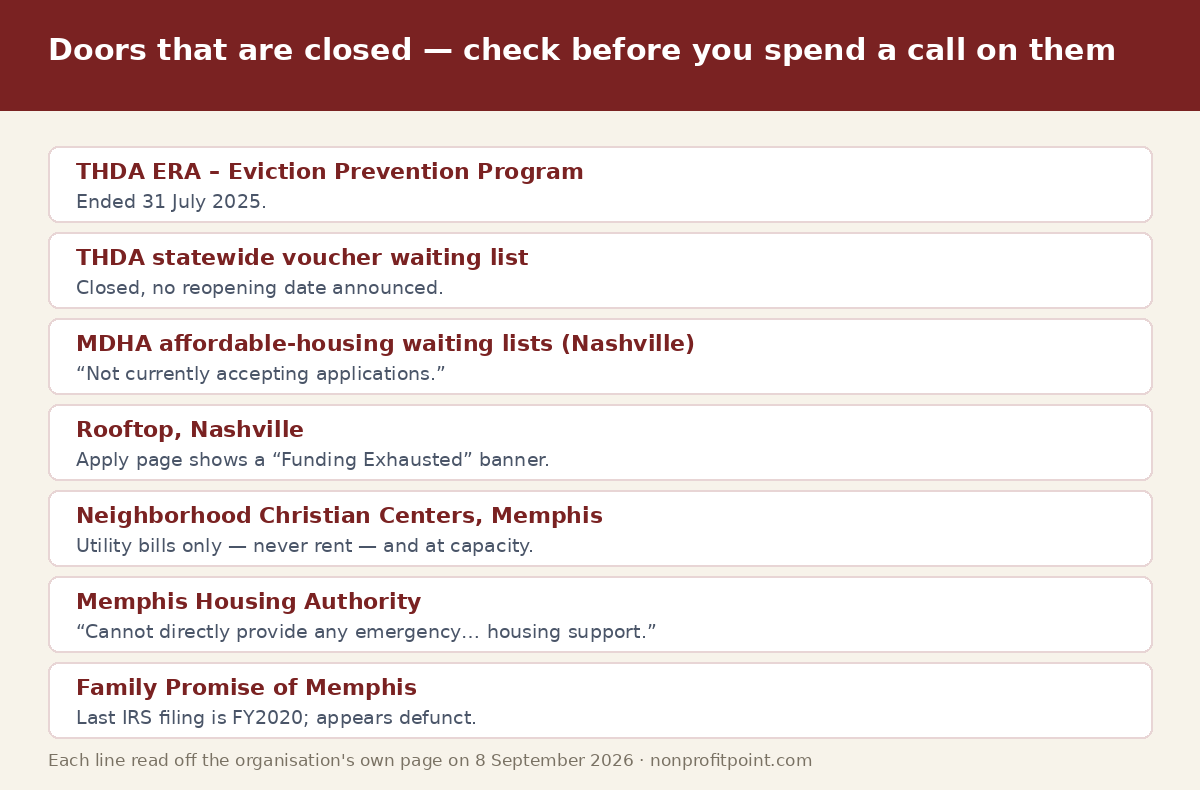
Each of these appears on Tennessee rent-help lists and each will cost you a phone call or a wasted application:
- THDA Emergency Rental Assistance – Eviction Prevention Program. Ended 31 July 2025. Still the top search result for “Tennessee rent assistance.”
- THDA’s statewide Housing Choice Voucher waiting list. Closed, no application dates scheduled.
- MDHA’s affordable-housing waiting lists in Nashville. Not currently accepting applications.
- Rooftop, Nashville. Funding exhausted as of today — check whether the apply button has returned before assuming otherwise.
- Neighborhood Christian Centers, Memphis. Frequently listed as a rent-and-utility charity. Its own programme page is utility bills only, never rent, and it was showing capacity-closed language at the time of writing, reopening on the third Wednesday of the month while funds last. (901) 881-6013.
- Memphis Housing Authority. Its own FAQ says it “cannot directly provide any emergency, temporary or transitional housing support.” It runs public housing units and the voucher waiting list — nothing else.
- Family Promise of Memphis. Its last IRS filing on record is for fiscal year 2020, showing revenue of −$3,476, and it is not in the IRS’s most recent list of tax-exempt organisations. It appears to be defunct.
- Nashville Rescue Mission and Room In The Inn. Both are excellent at what they do — shelter, meals, recovery, transitional and permanent supportive housing. Neither publishes a programme that pays an existing landlord to prevent an eviction.
- Habitat for Humanity affiliates. Homeownership and home repair for owners. Nothing to do with rent.
- United Way of Greater Nashville’s rent-and-mortgage page. A useful directory of twenty-three partner agencies — and nothing more. It is not a fund, and its own page was last modified in June 2024. The money sits with the partners it links to.
Your legal clock in Tennessee: what the statutes actually give you
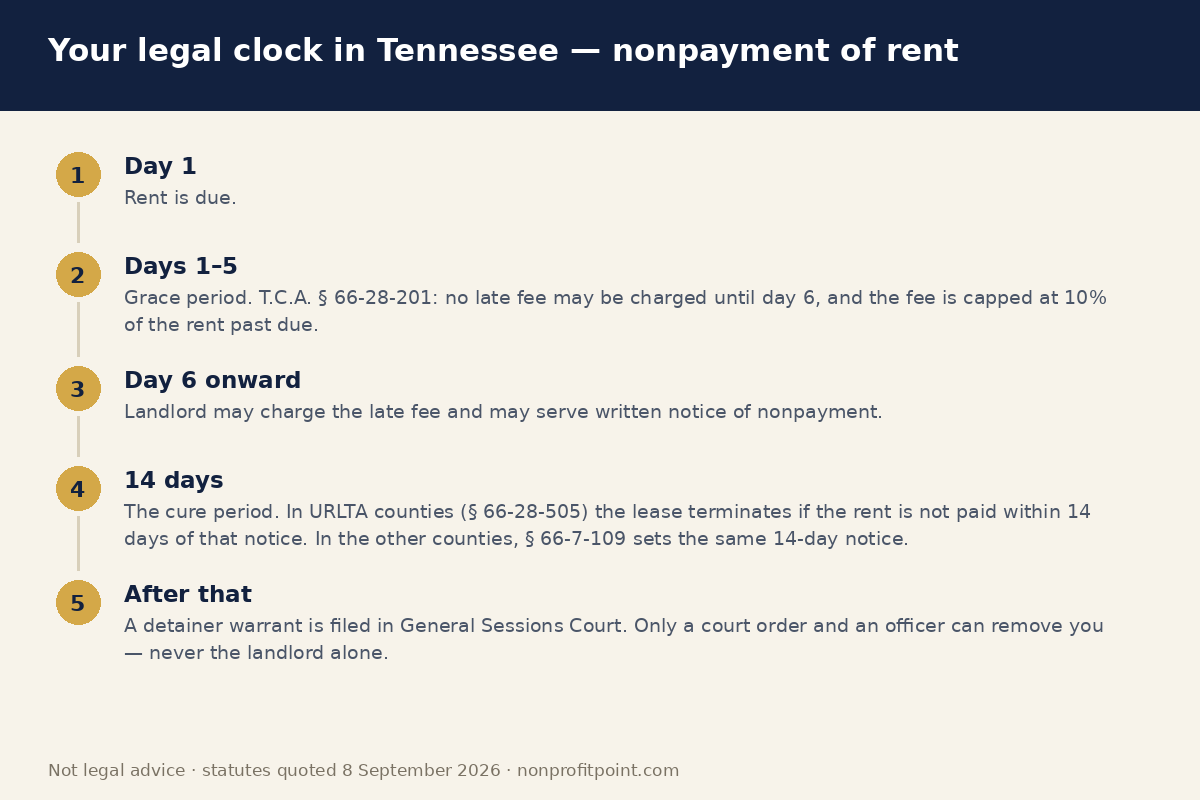
Tennessee has a split landlord-tenant system, and almost every national guide gets this wrong by quoting one statute as if it applied everywhere. The Uniform Residential Landlord and Tenant Act applies only in counties with a population above 75,000. Seventeen counties qualify: Anderson, Blount, Bradley, Davidson, Hamilton, Knox, Madison, Maury, Montgomery, Rutherford, Sevier, Shelby, Sullivan, Sumner, Washington, Williamson and Wilson. Everywhere else, a different chapter of the code governs.
The practical outcome is more reassuring than the complexity suggests, because both routes land on the same number:
- Five-day grace period, statewide by statute in URLTA counties. T.C.A. § 66-28-201: “There shall be a five-day grace period beginning the day the rent was due to the day a fee for the late payment of rent may be charged.”
- Late fees are capped at 10%. The same section: any late-payment charge “shall not exceed ten percent (10%) of the amount of rent past due.” A larger fee is not enforceable, and it should not be sitting in the balance a charity is being asked to clear.
- Fourteen days to cure, either way. In URLTA counties, § 66-28-505 provides that if the breach is not remedied within fourteen days after receipt of notice, the rental agreement terminates. In the remaining counties, § 66-7-109 states that “fourteen (14) days’ notice by a landlord shall be sufficient notice of termination of tenancy.”
- Only a court can evict you. After the notice period the landlord files a detainer warrant in General Sessions Court. A landlord who changes the locks, removes your possessions or cuts off the utilities instead of going to court is acting outside the law, and that is worth telling legal aid about in your first sentence.
None of this is legal advice, and the statutes have exceptions that a lawyer will spot and this page will not. Use the fourteen days. Almost every fund on this page needs several days between your application and a cheque, and the applications that fail are usually the ones filed on day thirteen.
Free eviction lawyers in Tennessee, by region
- Middle Tennessee and the Cumberlands — Legal Aid Society of Middle Tennessee and the Cumberlands covers forty-eight counties from eight offices, including Davidson, Williamson, Rutherford, Montgomery, Cheatham and Robertson. Statewide intake: 1-800-238-1443. Expect a callback rather than an immediate answer, so call early.
- Memphis and Shelby County — Memphis Area Legal Services, the primary provider for Shelby, Fayette, Tipton and Lauderdale counties. Main line (901) 523-8822; toll-free for outlying counties (888) 207-6386; the Eviction Settlement Program and fair-housing intake runs on (901) 432-4663. That last number is the one to use if you already have a court date.
- East Tennessee — Legal Aid of East Tennessee covers twenty-six counties. Knoxville (865) 637-0484; Chattanooga (423) 756-4013 or (800) 572-7457; Cleveland (423) 303-2266; Johnson City (423) 928-8311 or (800) 821-1312; Morristown (423) 587-4850 or (800) 821-1309.
- West Tennessee outside Memphis — West Tennessee Legal Services covers twenty-one counties from Benton to Weakley. Toll-free 800-372-8346; main office 731-423-0616; Memphis office 901-471-8006.
West Tennessee Legal Services and Memphis Area Legal Services both list Shelby, Fayette, Tipton and Lauderdale. In practice MALS is the Memphis-area provider and WTLS covers the rural parts of those counties; if one turns you away on geography, call the other rather than assuming you are out of options.
Making the call go well
Tennessee’s funds are small, capped and administered by people making triage decisions all day. A few things move an application faster, and they are all free:
Have the ledger, not the story. Nearly every organisation here needs the exact balance owed, the lease with your name on it, photo ID, Social Security cards for the household, and proof of income or of the income loss. The Shelby County programme asks for all of that up front; MIFA wants the late notice; Rooftop wants a hardship it can point to and income it can see continuing. Scan them before you apply, not while the portal is timing out.
Know your landlord’s payment details. Most of these programmes pay the housing provider, not you — Modest Needs says so outright, and Rooftop contacts the landlord to verify the balance before it approves anything. Have their contact information ready, and tell them a third-party payment may be coming. An unexplained cheque from an agency has stalled more than one approved case.
Ask about the calendar, not just the money. The single biggest cause of a wasted Tennessee application is a timing rule rather than an eligibility rule: Shelby County’s first-Monday slots, the Salvation Army’s Monday reopening and weekly cap, MIFA’s 7 a.m. to 3 p.m. portal window, VMC’s Tuesday-to-Thursday assessments, Metropolitan Ministries’ three intake days. Ask “when does your next intake open?” on every call, and write the answer down.
Apply in parallel. Nothing on this page prohibits applying to more than one organisation at once, and the twelve-month rules mean you should spend the attempt where it is most likely to land. Work the list top to bottom in your county rather than waiting for one answer.
Related help
Frequently asked questions
Is there still a state rental assistance program in Tennessee?
No. THDA’s Emergency Rental Assistance – Eviction Prevention Program ended on 31 July 2025 and is no longer taking applications; THDA now refers renters to 2-1-1. THDA’s statewide Housing Choice Voucher waiting list is also closed, with no application dates scheduled. What remains is local: nineteen community action agencies covering all ninety-five counties, LIHEAP for energy bills, Emergency Solutions Grant money held by local homeless-service agencies, and the county-level charities listed on this page.
How fast can I be evicted in Tennessee for not paying rent?
You get a five-day grace period before a late fee can even be charged, under T.C.A. § 66-28-201, and that fee is capped at 10% of the rent past due. After written notice of nonpayment you have fourteen days to pay: § 66-28-505 in the seventeen counties covered by the Uniform Residential Landlord and Tenant Act, and § 66-7-109 in the rest of the state, both landing on fourteen days. Only after that can the landlord file a detainer warrant in General Sessions Court, and only a court order carried out by an officer can remove you.
Which Tennessee counties are covered by URLTA, and does it matter for me?
URLTA applies in counties with populations above 75,000: Anderson, Blount, Bradley, Davidson, Hamilton, Knox, Madison, Maury, Montgomery, Rutherford, Sevier, Shelby, Sullivan, Sumner, Washington, Williamson and Wilson. For the nonpayment timeline it matters less than you would expect, because both statutes give fourteen days. It matters more for deposits, repairs and retaliation rules, which is a good reason to tell legal aid which county you are in on the first call.
I live in Memphis. What is the single most important thing to know?
The Shelby County Community Services Agency’s rent programme releases its appointment slots online on the first Monday of each month at 8:30 a.m., and it states that assistance cannot be given without a slot secured that day. Miss it and you are waiting a month. Meanwhile MIFA’s online application is open 7 a.m. to 3 p.m. weekdays, requires a late notice and a crisis within the past 90 days, and will not consider you if you received MIFA help in the past twelve months. Apply to both.
Does anyone in Tennessee pay the money to me rather than the landlord?
Almost never. Modest Needs states plainly that it pays landlords directly, and Rooftop contacts your landlord to verify the balance before approving anything. LIHEAP pays your utility company. Assume the cheque goes to the housing provider, have your landlord’s payment details ready when you apply, and warn them the payment is coming.
What if I do not have children in the household?
Tennessee is better than some states here. The Shelby County programme sets eligibility on income — at or below 200% of the federal poverty guidelines — not on household composition. LIHEAP works on 60% of state median income. MIFA, Rooftop, Metropolitan Ministries, the Salvation Army corps and the St. Vincent de Paul conferences all publish crisis-based rather than child-based rules. The one thing you lose without children is priority in some shelter and rapid-rehousing queues.
Which Tennessee rent programs have closed that I might still see listed?
THDA’s ERA-EPP (ended 31 July 2025), THDA’s statewide voucher waiting list, and MDHA’s affordable-housing waiting lists in Nashville are all shut. Rooftop in Nashville is showing a funding-exhausted banner. Neighborhood Christian Centers in Memphis is utility-only and was at capacity, reopening on the third Wednesday of the month. Family Promise of Memphis appears defunct — its last IRS filing is for 2020. And the Memphis Housing Authority states in its own FAQ that it cannot provide emergency housing support at all.
Can I get a free lawyer for an eviction in Tennessee?
Yes, and it costs nothing. Legal Aid Society of Middle Tennessee and the Cumberlands covers forty-eight counties on 1-800-238-1443. Memphis Area Legal Services covers Shelby, Fayette, Tipton and Lauderdale on (901) 523-8822, with a dedicated Eviction Settlement Program line on (901) 432-4663. Legal Aid of East Tennessee covers twenty-six eastern counties — Knoxville (865) 637-0484, Chattanooga (423) 756-4013. West Tennessee Legal Services covers twenty-one western counties on 800-372-8346. Call the day you are served, not the day before court.
How we verified this guide. Every programme, phone number, income rule, dollar amount and closure notice on this page was read off the organisation’s own website on 8 September 2026, not copied from a directory. Statutes are quoted from the codified text of T.C.A. §§ 66-28-201, 66-28-505 and 66-7-109. Where two sources disagreed on a phone number — as they do for the Chattanooga Office of Family Empowerment — we published the number on the organisation’s own site and said so. Where an organisation does not publish a detail, such as a dollar cap or a current open-or-closed status, we wrote that it does not publish it rather than filling the gap. Several organisations that appear on other Tennessee rent-help lists were deliberately left off this one because we could not confirm a rent programme at the source. Funding in this field changes weekly; call before you travel, and tell us if you find something that has moved.