Charities That Help With Rent in Michigan: 18 Real Programs (2026)

Start with the correction that will save a Michigan renter the most wasted time in 2026, because it is coming from the state’s own largest city. The City of Detroit’s official housing page still tells renters that “money for rent & utilities are available through the Covid-19 Emergency Rental Assistance Program (CERA),” complete with an AMI table promising “up to 12 months of rental assistance” and a link to ceraapp.michigan.gov. CERA has been closed since June 30, 2022 at 9:00 p.m. — MSHDA’s own press release says so — and when we loaded that application portal in August 2026 it returned an HTTP 503 error under the page title “Offline.” A community action agency in Jackson still runs a headline reading “Rent & Utility Assistance Still Available Through The CERA Program.” A site publishing new Michigan rental-assistance articles as recently as June 2026 describes a MSHDA “emergency rental assistance” program with a “COVID-19 hardship” pathway. No such MSHDA program exists.
Here is the second correction, and it is the one that actually decides whether you keep your apartment. Michigan has no large-scale statewide rent-assistance program in 2026. The only statewide money a renter can apply for directly is State Emergency Relief (SER) from the Michigan Department of Health and Human Services, and its relocation caps are $410 to $1,040 per household for an entire fiscal year — not per month. Michigan’s two-bedroom Fair Market Rent is $1,327. A family of four can receive $740 in total across the whole year, covering back rent, deposit, first month’s rent and moving costs combined. That is 56% of one month’s rent. Not one page ranking on the first results page for “rent assistance Michigan” publishes that number.
What does work in Michigan is a specific, mappable system that national listicles never explain: a county-by-county network called HARAs that actually holds the local prevention money, a court rule that pauses your eviction for 14 to 28 days while a rental-assistance application is pending, free eviction lawyers behind one statewide number, veteran programs that pay landlords directly in all 83 counties, and tribal housing departments that pay deposits and arrears. This guide lists 18 real sources of rent help in Michigan — with eligibility, phone numbers verified on each organization’s own website, and a plain list of what is closed — checked in August 2026.
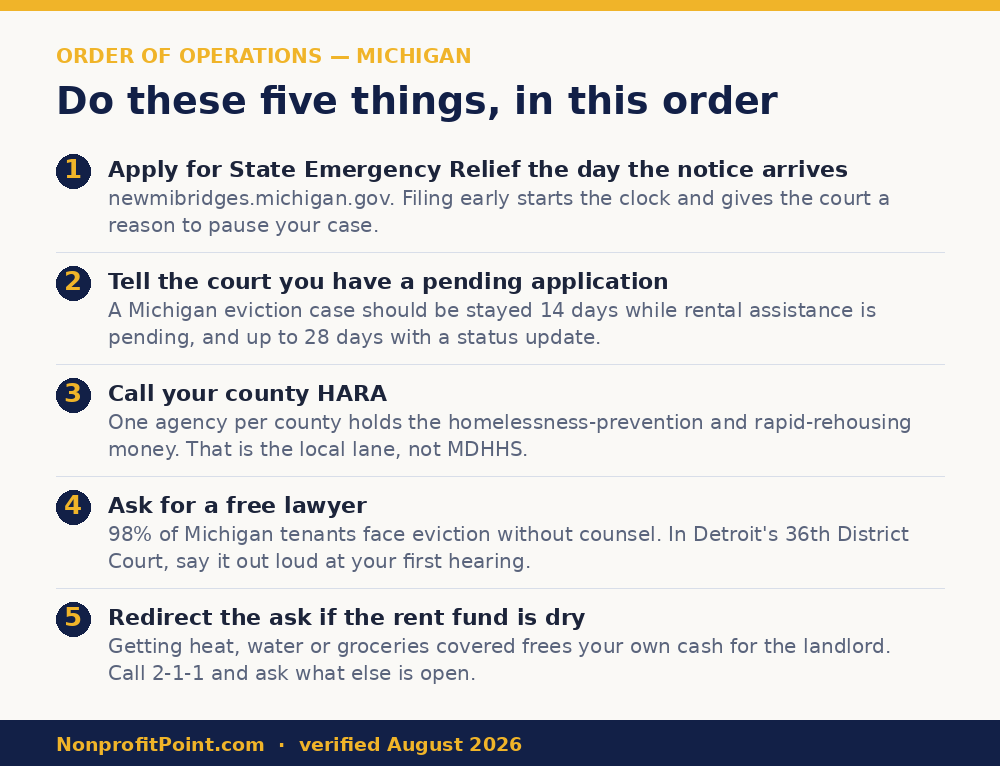
📞 Start here: two phone calls, in this order. First, apply for State Emergency Relief at newmibridges.michigan.gov — even a pending application is worth a 14-day pause in eviction court. Second, dial 2-1-1 (or 1-844-875-9211, or text your ZIP code to 898211) and ask for the HARA for your county by name. Michigan 211 answers 24/7 in 180+ languages and indexes more than 27,000 programs. Its own honest warning is worth repeating: “only 1 in 4 eligible households receive rent payment assistance.” Apply to more than one place, the same week.
18 charities and programs that help with rent in Michigan (2026)
1. MDHHS State Emergency Relief — the only statewide rent money, and its real limits
State Emergency Relief is the one program every Michigan renter should apply to, and it is also the one most badly misdescribed online. Its relocation services, per MDHHS policy manual ERM 303, effective April 1, 2026, cover four things: moving expenses, a security deposit, first month’s rent, and rent arrearage. Court costs and fees included in a judgment are allowable. The fiscal-year maximums per household are $410 for one person, $520 for two, $620 for three, $740 for four, $870 for five, and $1,040 for six or more. The manual states it flatly: “The amounts shown in the table are not monthly issuance amounts. They are the fiscal year maximum amounts per SER group.” Its own example: a household of six with three months of arrears receives a maximum of $1,040. The fiscal year runs October 1 to September 30, which means an application filed in late September and one filed in early October draw on different years’ money.
The trap that gets people denied: for a household at imminent risk of homelessness, MDHHS requires “a court summons, order or judgment resulting from an eviction action,” and then says, in bold in its own manual, “a demand for possession non-payment of rent or notice to quit is not acceptable.” The 7-day notice that starts every Michigan eviction is not enough paperwork on its own. The documents must also state the exact amount required to stop the eviction — a landlord ledger without a dollar figure will fail. Other rules worth knowing: the cash asset limit is $15,000; your total housing obligation cannot exceed 75% of net countable income; income above the need standard becomes a copayment you must pay before MDHHS releases its share; the standard of promptness is 10 business days; and, in a line almost nobody quotes, “residence in the state of Michigan is not required. SER serves all persons physically present in Michigan.”
Apply: newmibridges.michigan.gov, or form DHS-1514 at any county MDHHS office (you may file in any county in Michigan). County office directory: michigan.gov/mdhhs.
2. Your county HARA — the local agency that actually holds the money
This is the single most useful thing in this guide, and the reason most national articles fail Michigan readers. MSHDA designates one Housing Assessment and Resource Agency (HARA) per county. HARAs administer the state’s Emergency Solutions Grant homelessness-prevention and rapid-rehousing dollars and the HOME-ARP Homeless Prevention Program — the funding that replaced the pandemic-era programs. You do not apply to MSHDA for these. You apply to your county’s HARA. The full 83-county list is published by MSHDA under “HARA Contact List”; the highest-population entries are in the table further down this page.
Two things to know before you call. First, HARA money is funding-limited, not entitlement-based — Neighborhoods, Inc. of Battle Creek, the Calhoun County HARA, says plainly that “program availability may depend on current funding.” Second, response is rarely same-day: Community Housing Network, the Oakland County HARA, publishes a two-business-day response time and states that it “does not provide immediate or emergency housing assistance.” Call the day the notice arrives, not the day before court.
3. Detroit Housing Services HelpLine — one number for the whole city
If you rent in Detroit, Hamtramck or Highland Park, the City runs a single triage line: 866-313-2520, Monday to Friday 8 a.m.–6 p.m. and Saturday 9 a.m.–noon. It does not cut checks itself; it is the access point to more than 30 programs, including eviction-prevention counseling, legal services and direct relocation assistance, and it now also serves as an entry point for homeless services. It fielded roughly 150,000 calls in its first year. The Detroit Housing Network — Bridging Communities, Central Detroit Christian, Jefferson East, Matrix Human Services and Wayne Metro — is reachable at the same number, press #3, though its renter services are education and counseling rather than cash.
4. Homeless Action Network of Detroit (CAM) — 313-305-0311
HAND operates the Coordinated Assessment Model, the Detroit HARA and the front door to shelter and rehousing for Detroit, Hamtramck and Highland Park. Their own instruction: “If you need a safe place to stay tonight and live in Detroit, Hamtramck, or Highland Park, call 313-305-0311.” Be aware of the boundary — CAM is oriented toward people already experiencing homelessness, not tenants still in their unit with a court date. If you are still housed, the City HelpLine and the eviction-defense lane below will move faster for you. CAM also warns that shelter beds are limited and change daily, and that some shelters do not accept overnight walk-ins.
5. Wayne Metropolitan Community Action Agency — the Out-Wayne HARA
Wayne Metro runs rent assistance, security deposits and utility help through its Supportive Housing and Homeless Services programs, and is the designated HARA for Wayne County outside Detroit (office at 2121 Biddle Ave., Wyandotte). It says openly that “due to the requirements and/or limitations of the grants, the amount and type of assistance will vary from program to program.” Call (734) 284-6999 for Out-Wayne; Detroit-area callers reach the CONNECT Center at (313) 388-9799. One thing to skip: Wayne Metro’s online “universal application” only covers weatherization and housing counseling — there is no online path to rent assistance, so do not wait on a form. Its Housing Stability program is classes, not money.
6. United Community Housing Coalition — Detroit’s eviction-defense engine
UCHC does not pay rent. It does something that in Detroit is often worth more: it handled 8,378 eviction-defense cases in FY2025 and administers the city’s Right to Counsel program alongside Michigan Legal Services, Lakeshore Legal Aid, and the Legal Aid and Defender Association. Income limit is 200% of the federal poverty level; the focus is cases filed in the 36th District Court. Eviction Defense Helpline: (313) 725-4646. Main office (313) 963-3310, Monday–Friday 8:30 a.m.–5 p.m., appointment required. Their tax-foreclosure line is (313) 725-4560.
7. Detroit’s Right to Counsel — and the fact that there is no hotline
Detroit is the only place in Michigan with a tenant right to counsel, created by a 2022 city ordinance and run through the Office of Eviction Defense. It covers tenants in 36th District Court eviction cases with household income up to twice the federal poverty level, immigration status does not affect eligibility, and it served 16,283 households between March 2023 and December 2025.
Here is what every other guide gets wrong: there is no application phone number, because there is no application. You get the lawyer by showing up at your hearing and asking the judge for one — in person at room 417, or in the designated breakout room for a virtual hearing. If a website gives you a “Right to Counsel hotline,” it invented it. One caution for late 2026: the program has been running on a funding cliff, with ARPA money that ran through June 2026 and a philanthropic grant expiring at year’s end, so do not skip applying elsewhere on the assumption it is guaranteed.
8. St. Vincent de Paul — the parish conference route
SVdP Detroit distributes roughly $900,000 in rent assistance and $3.6 million in utility assistance annually across six counties: Wayne, Oakland, Macomb, Lapeer, Monroe and St. Clair. It works through 26 parish-based conferences, so your request routes to whichever conference covers your neighborhood — which is exactly why availability varies street by street. Call (313) 393-2930 or 1-877-788-4623, press 1, and leave a message. Outside Detroit, SVdP councils operate in Lansing (seven counties, by parish), Grand Rapids (contact form only — no published intake phone) and Kalamazoo, where the St. Catherine of Siena conference takes calls at (269) 978-2341 after 9 a.m. Monday for a callback, by appointment only, and asks eviction cases to bring the notice, the landlord’s details and the court documents. Ignore any article quoting a national “$300 to $800” SVdP range; conferences are volunteer-run and publish no such figure.
9. Community Housing Network — Oakland County’s HARA
CHN’s Housing Resource Center is the designated HARA for Oakland County and screens for rapid rehousing, homeless prevention and housing stability services. “Anyone can call the Housing Resource Center,” they say, though each program has its own rules. Reach them at (248) 269-1335 or 1-866-282-3119, text “housing” to the same number, or email HRC@chninc.net; walk-in hours are Tuesday and Wednesday, 9 a.m.–3:30 p.m. at 5505 Corporate Dr., Troy. Their Troy office line is (248) 928-0111. Oakland County also runs Oakland Connects at 1-800-848-5533. Note that Lighthouse MI, which many Oakland residents call first, states directly that “all those interested in eviction prevention programs must call the Housing Resource Center at Community Housing Network to be screened” — so start at CHN and save yourself a call.
10. Macomb Community Action — rent and mortgage help in Macomb County
Macomb Community Action runs Community Action Centers that provide, in its own words, “rent and mortgage assistance” for eviction, homelessness and foreclosure, alongside utility shutoff help and the WRAP water credit. Documentation is required and eligibility varies by program. Central office (Robert VerKuilen Building, 21885 Dunham Rd., Clinton Township): 586-469-6964. South office (11370 Hupp Ave., Warren): 586-759-9150. General line: 586-469-6999. The county’s HARA and coordinated-entry line is listed by MSHDA as 586-469-5656. Shelter entry in Macomb runs through the county’s Coordinated Entry System — MCREST (586-415-5101) is the shelter, not the intake.
11. Genesee Community Health Center Housing Resource Center — Flint’s open door
This is the clearest rent payer we verified anywhere outside Metro Detroit. GCHC’s Homeless Prevention Program pays rental arrearages, security deposits, utility deposits, moving costs, short-term motel stays, and utility and water bills, and it takes walk-ins at 422 W. 4th Avenue, Flint. You qualify if you live in Genesee County and have an eviction or disconnection notice, are doubled-up after losing housing, or face a hardship that puts your housing at risk. Bring ID, proof of income and the notice. Call 810-600-4525 and choose option 2.
Address correction that matters: this program was formerly run by Catholic Charities as “One Stop Housing,” and older contact lists still circulating online send Flint renters to 901 Chippewa St. under the Catholic Charities name at the same phone number. The agency and the building have both changed. Go to 422 W. 4th Avenue.
12. Salvation Army Kent County Social Services — the Grand Rapids HARA
In Kent County the Salvation Army’s Housing Assessment Program is the designated HARA and describes itself as the primary entry point for housing services in the county, delivering rapid rehousing, housing-loss prevention and longer-term rental assistance. Call (616) 459-9468 or dial 211; the office is at 1215 Fulton Street East, Grand Rapids, Monday–Friday 8:30 a.m.–4:30 p.m. Two Grand Rapids notes worth having: Family Promise of West Michigan (616-475-5220) publishes an active waiting list — 23 families as of this writing — and Community Rebuilders (616-458-5102) is both a housing agency and the local SSVF grantee for veterans. Families with children can book through communityhousingconnect.org.
13. Advent House Ministries — the Ingham County HARA (Lansing)
Advent House is Ingham County’s HARA and lead coordinated-entry agency, running permanent supportive housing, rapid rehousing and housing navigation. Its own careful wording is the honest version of what every HARA offers: case management for eligible Ingham County residents, with “financial assistance… available based on meeting current program guidelines and funding availability.” Call 517-485-4722 or email social@adventhouse.com; 743 N. Martin Luther King Blvd., Lansing. A weekend day shelter operates Saturday and Sunday, 8 a.m.–5 p.m.
14. Housing Resources Inc. and RentAble — Kalamazoo, with a date to watch
HRI is the Kalamazoo County HARA and works with renters behind on rent or utilities and facing eviction, including through an eviction-diversion partnership with the City of Kalamazoo District Court. Call 269-382-0287 and press 1 for an intake specialist, Monday–Friday 8:30 a.m.–4:30 p.m. (closed noon–1 p.m.), at 643 W. Crosstown Pkwy.
Kalamazoo also has something unusual: RentAble, run by United Way of South Central Michigan for the county’s Continuum of Care, which pays up to $2,000 per household, once, for application fees, security deposits, rent increases, owed utilities and similar costs. Eligibility is Kalamazoo County residency, income between 50% and 120% of area median, and at least one housing barrier — eviction history, a criminal record, nontraditional income, poor credit, or a history of domestic violence or trafficking. As of August 2026 RentAble is at capacity and not accepting applications; it reopens October 6, 2026 at 9:00 a.m. Mark the date: rentable@uwscmi.org, 269-343-2524 ext. 125.
15. Housing Access of Washtenaw County — 734-961-1999
HAWC is the single point of entry for every emergency shelter and housing resource in Washtenaw County, including rental assistance and eviction prevention. The call center runs 8:30 a.m.–5 p.m. and returns voicemails in 24–48 hours. Have full Social Security numbers for everyone in the household, current household composition, and consent from every adult 18 or older — they will ask. Washtenaw also runs the Barrier Busters fund, which covers rent, utilities and move-in costs, but understand the mechanism: it is a network of 100-plus member agencies, each with a designated “Barrier Buster,” and a tenant cannot apply to it directly — you reach it through a member agency such as SOS Community Services (734-484-5411).
16. TrueNorth Community Services — five counties in west Michigan
TrueNorth is the HARA for Lake, Mason, Muskegon, Newaygo and Oceana counties and states plainly that it offers “rent payments to prevent homelessness, or secure housing for those in crisis.” For a housing crisis call (877) 446-8730; the main office line is (231) 924-0641 at 6308 S. Warner Ave., Fremont. Muskegon County residents aged 60 or older have an extra lane: the county’s Senior Millage funds rental assistance for income-qualified seniors through TrueNorth. Goodwill Industries of West Michigan publishes the same housing description but routes applicants to TrueNorth — one program, two front doors.
17. Northern Michigan — one 24/7 number for ten counties, and the U.P.
Northwest Michigan Community Action Agency’s rapid-rehousing program pays rental assistance, security deposits, rental application fees and moving costs across ten counties: Antrim, Charlevoix, Emmet, Benzie, Grand Traverse, Kalkaska, Leelanau, Missaukee, Roscommon and Wexford. The regional coordinated-entry call center runs 24 hours a day, seven days a week, at 1-844-900-0500 — the only around-the-clock housing intake line we found in the state. Local offices: Traverse City (231) 947-3780, Petoskey (231) 347-9070, Cadillac (231) 775-9781.
In the Upper Peninsula, Community Action Alger-Marquette runs Emergency Solutions Grant assistance covering “security deposit and/or short-term rental assistance, and help with past due rent”; their instruction is to call 1-800-562-9762 ext. 207 for an assessment (office 906-228-6522, 1125 Commerce Dr., Marquette). Because HARA assignments differ across the U.P., also call your own county’s community action agency: Chippewa-Luce-Mackinac CAA 906-632-3363, Menominee-Delta-Schoolcraft CAA (906) 786-7080, Gogebic-Ontonagon CAA (906) 667-0283. One more U.P. option: the Salvation Army’s Escanaba corps publishes emergency rent and utility assistance, though not a phone number — use 211 to reach it.
18. Veterans and tribal citizens — the two best-funded lanes in Michigan
If anyone in your household is a veteran, this is the strongest resource on the page. Supportive Services for Veteran Families (SSVF) pays security deposits, rent, utilities and moving costs, always directly to the landlord, for veterans with an honorable discharge and income under 80% of area median who are homeless or at imminent risk. Michigan’s FY2026 grantees cover all 83 counties:
- Volunteers of America Michigan — 14 counties incl. Wayne, Kent, Ingham, Kalamazoo, Muskegon, Ottawa, Jackson — 1-877-509-8387
- Southwest Counseling Solutions (Wayne) — (313) 481-7919
- Oakland Livingston Human Service Agency (Genesee, Lapeer, Livingston, Macomb, Oakland, Shiawassee) — (517) 599-6954
- Disability Network Oakland & Macomb (nine counties incl. Washtenaw, St. Clair, Monroe) — (586) 268-4160
- Community Rebuilders (Kent) — (616) 458-5102
- Mid Michigan Community Action (14 counties incl. Bay, Saginaw, Midland, Isabella) — (877) 213-5955
- Northwest Michigan CAA (23 northern counties) — (844) 900-0500
- Community Action Agency (Branch, Cass, Hillsdale, Jackson, Lenawee, St. Joseph) — 1-800-491-0004
- Alger Marquette Community Action Board (Upper Peninsula) — 906-228-6522 ext. 207
The VA National Call Center for Homeless Veterans is 877-424-3838, free and confidential, 24/7. HUD-VASH vouchers exist in Michigan but cannot be applied for directly — the VA medical center refers you to the housing authority. The four referring facilities are Detroit (313-576-1000), Saginaw (989-497-2500), Lansing (517-267-3925) and Iron Mountain (906-774-3300).
Michigan’s twelve federally recognized tribes run their own housing programs, and several pay exactly what renters need. The Pokagon Band of Potawatomi Homeless Prevention Program pays eviction redemption, security deposits, first month’s rent and other emergency housing needs up to $1,500, for enrolled citizens 18 and older within its ten-county service area — (269) 783-0443 or (877) 983-0385; a separate Pokagon program provides a monthly rental subsidy of up to $300 for as long as three years. The Grand Traverse Band runs a NAHASDA rental subsidy plus rental security deposit assistance — (231) 534-7800. The Sault Ste. Marie Tribe of Chippewa Indians Housing Authority runs income-based rental and rental voucher programs across a seven-county U.P. service area — 906-495-1450. For eviction cases in tribal court, Michigan Indian Legal Services assists members of all twelve tribes at 231-947-0122.
Free eviction lawyers in Michigan — one number, and why it beats the money
Michigan courts handled 148,299 new landlord-tenant filings in 2025 and 711,037 across 2022–2025, according to the State Court Administrative Office. The Michigan Supreme Court’s Justice For All report found that 98% of tenants and 14% of landlords go unrepresented — and that when pandemic-era funding let legal aid represent tenants in 12% of cases, 97% of those tenants avoided eviction. Read that pairing twice: a free lawyer is statistically the highest-value phone call in this guide.
Statewide intake is the Counsel & Advocacy Law Line, 1-888-783-8190 (it covers Lakeshore Legal Aid and Legal Services of South Central Michigan). michiganlegalhelp.org is free and carries do-it-yourself court forms plus a lawyer directory. Regional offices: Washtenaw (734) 665-6181, Battle Creek (269) 965-3951, Jackson (517) 787-6111, Lansing 1-800-968-0044, Monroe (734) 241-8310, Farmworker Legal Services (269) 492-7190, and Legal Aid of Western Michigan at (616) 774-0672 / 800-442-2777 across 17 western counties.
⚖️ The rule most Michigan tenants never hear. If you have a pending application for rental assistance, your eviction case should be stayed — paused — for 14 days, and with a status update at that hearing, extended another 14 days, for a total of 28. If you have no pending application, the court should still set the next hearing at least seven days out. After a judgment you usually have 10 days to pay or move, and you can ask for more time. Only a sheriff or court officer can physically remove you — a landlord changing your locks or boarding up your unit is acting illegally. Which is why step one is filing for State Emergency Relief the day the notice arrives, even if the money will not cover everything: the application itself buys you weeks.
What closed in Michigan — and who quietly stopped paying rent
Half of the search results for Michigan rent help point at programs that no longer exist or organizations that no longer do this work. Here is the current state of play, verified in August 2026, so you do not spend a week on dead ends.
- CERA is closed — June 30, 2022. It paid out over $750 million to more than 142,000 Michigan households at an average of about $5,600 each, and then it ended. The application portal returns an error page.
- The Michigan Eviction Diversion Program is not a live statewide program. It was a 2020 COVID-era initiative; it appears nowhere in MSHDA’s current program lists. The funding that replaced it is HOME-ARP and ESG, delivered through HARAs.
- All MSHDA Housing Choice Voucher waiting lists are currently closed, in MSHDA’s own words, as are all homeless waiting lists. Project-Based Voucher lists open on specific dated windows at individual properties — check MSHDA’s waiting list page rather than assuming Section 8 is an option this month.
- Matrix Human Services has exhausted its rent and mortgage assistance funds. Their site: “FUNDS ARE EXHAUSTED – We cannot accept applications at this time.” Their counseling remains open.
- THAW does not pay rent at all — it is heat, electricity and water only — and as of August 2026 it is “temporarily not accepting new applications” for energy assistance and is not accepting water assistance applications either. Its Emergency Solutions Grant work is referral-only through CAM. THAW’s old CERA page is still live on its site; ignore it.
- Catholic Charities of Southeast Michigan does not offer emergency rent assistance. Its published services are food, clothing, adoption and foster care, behavioral health, senior services and housing case management. We checked the other Michigan diocesan agencies too: Catholic Charities West Michigan publishes no rent assistance; the Diocese of Kalamazoo agency offers home heating assistance, not rent; Catholic Human Services in the Gaylord diocese offers behavioral health and family services, not financial aid; Catholic Charities of Shiawassee & Genesee no longer runs the Flint housing program. Call them for food, counseling and case management by all means — but do not build your rent plan on them.
- The Salvation Army in Michigan has no statewide rent application process. The national page promises “emergency rent and utility assistance” but publishes no eligibility, no documents list, no dollar limits and no intake process, and availability is set corps by corps. Some corps say so bluntly — the Flint corps states it “does not have funds to financially help with rent, water, or property taxes” and refers callers to 211. Petoskey, by contrast, publishes a real process at (231) 347-3531. The honest instruction is: call your nearest corps and ask whether it has rent funds this month.
- michiganhousinglocator.com is no longer a state tool. It now redirects to a private commercial rental marketplace. For state-affiliated affordable rental listings, use MSHDA’s Affordable Rental Housing Directory at housing.state.mi.us.
- Modest Needs should not be on your list. In August 2025 the founder and former CEO of the Modest Needs Foundation pleaded guilty in the Southern District of New York to wire fraud and eight counts of tax evasion for diverting more than $2.5 million in charitable donations to himself since at least 2015 — including more than $300,000 toward his own Manhattan rent. Federal prosecutors said he created a fake board of directors made up of a bartender, a friend and his house-cleaner. We have removed it from our recommendations sitewide.
- “National rent assistance” directories are not charities. The two largest carry disclaimers stating they are not associated with any government agency or nonprofit and do not provide assistance directly; one lists a rural Iowa callback number for “Michigan” help. There is no national fund that pays Michigan rent. Anyone promising one is collecting your data.
Rent help by Michigan metro — where to start
| Metro / county | First call | Backup |
|---|---|---|
| Detroit / Hamtramck / Highland Park | Detroit Housing HelpLine 866-313-2520 | UCHC eviction defense (313) 725-4646; CAM (313) 305-0311 |
| Wayne County (outside Detroit) | Wayne Metro (734) 284-6999 | SVdP (313) 393-2930; SSVF (313) 481-7919 |
| Oakland County | Community Housing Network (248) 269-1335 | Oakland Connects 1-800-848-5533 |
| Macomb County | Macomb Community Action 586-469-6999 | HARA / coordinated entry 586-469-5656 |
| Flint / Genesee | Genesee CHC Housing Resource Center 810-600-4525 | SSVF (OLHSA) (517) 599-6954 |
| Grand Rapids / Kent | Salvation Army Housing Assessment (616) 459-9468 | Community Rebuilders (616) 458-5102 |
| Lansing / Ingham | Advent House Ministries 517-485-4722 | Legal aid 1-800-968-0044 |
| Kalamazoo | Housing Resources Inc. 269-382-0287 | RentAble reopens Oct 6, 2026 — 269-343-2524 x125 |
| Ann Arbor / Ypsilanti | Housing Access of Washtenaw (734) 961-1999 | SOS Community Services 734-484-5411 |
| Saginaw / Bay / Midland | United Way of Saginaw Project HOME 989-758-4357 | Mid Michigan CAA (877) 213-5955 |
| Muskegon / Lakeshore | TrueNorth (877) 446-8730 | Legal Aid of Western Michigan 231-726-4887 |
| Battle Creek / Calhoun | Neighborhoods, Inc. of Battle Creek (269) 968-1113 | Legal aid (269) 965-3951 |
| Traverse City / northern MI | Coordinated entry 1-844-900-0500 (24/7) | NMCAA Traverse City (231) 947-3780 |
| Upper Peninsula | Community Action Alger-Marquette 1-800-562-9762 x207 | Your county CAA (see #17 above) |
What you’ll need to apply
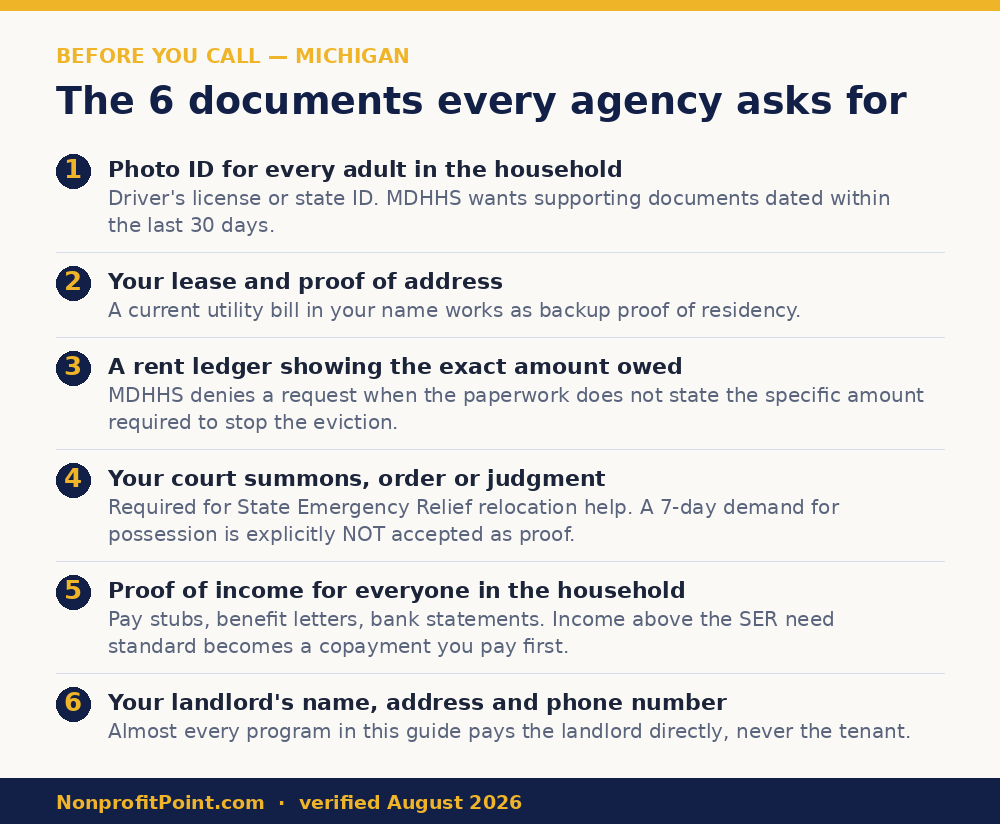
Michigan agencies ask for a near-identical packet, so assemble it once and reuse it. You need photo ID for every adult; your lease and proof of address; a rent ledger or past-due notice stating the exact amount owed; your court summons, order or judgment if the landlord has filed; proof of income for every household member; and your landlord’s name, address and phone, because nearly every program pays the landlord directly rather than you.
Two Michigan-specific realities to plan around. First, MDHHS wants supporting documents dated within the last 30 days and gives you 10 days to produce them once asked — so gather before you file, not after. Second, Washtenaw’s HAWC and several coordinated-entry systems will ask for full Social Security numbers for everyone in the household plus consent from every adult; if a household member is unreachable, say so at intake rather than stalling the file. And if you are turned down for SER, the appeal deadline is 90 days from the application date — a real second bite that most people never take.
Why Michigan rent help runs out — the numbers behind the scramble
None of this is because Michigan renters are asking wrong. The state’s two-bedroom housing wage is $25.53 an hour against a minimum wage of $13.73 — 74 hours a week at minimum wage to afford a two-bedroom at Fair Market Rent. Statewide median gross rent is $1,129 per the Census Bureau; two-bedroom Fair Market Rent runs $1,411 in metro Detroit and $1,531 in Grand Rapids. Roughly 309,822 renter households — 28% of all Michigan renters — are extremely low income, against a shortage of about 195,462 homes affordable and available to them. And in November 2025 Michigan joined twenty other states in suing HUD over a Continuum of Care funding notice that cuts the share of grants going to permanent housing from roughly 90% to about 30%; the state received over $100 million in CoC funding in 2024, with roughly 7,000 households, including about 2,000 families with children, estimated to be at risk. That is the backdrop for every “funds exhausted” notice above — and the reason to apply in several places the same week rather than waiting on one answer.
Tips to get approved faster
File the SER application the day the notice arrives, before you have every document — the filing date starts a 30-day eligibility period and gives the court a reason to pause your case. Bring the court paperwork, not the 7-day notice, when the request is for relocation money; MDHHS will look your case up in MiCOURT Case Search itself, so the docket number ending in “LT” is worth writing down. Ask your HARA specifically about Emergency Solutions Grant homelessness prevention and HOME-ARP by name — front-desk staff often quote the general program when a targeted fund is open. Say the words “I would like a free lawyer” at your first hearing if you are in Detroit’s 36th District Court. And if the rent fund is genuinely dry everywhere, redirect the ask: file the Home Heating Credit on form MI-1040CR-7 before its September 30, 2026 deadline (renters qualify; the standard allowance runs from $604 to $1,662 depending on exemptions), get groceries or a utility bill covered, and put your own cash toward the landlord.
Related help for Michigan renters:
- Charities that help with rent — our national guide to every major rent-assistance source
- Rent help in California, Texas, Florida, New York, Pennsylvania, Illinois, Ohio, Georgia and North Carolina — our other state guides
- Security-deposit and move-in help and hotel vouchers when there is nowhere to sleep tonight
- Emergency shelter, utility assistance and food assistance — the fastest ways to free up cash for rent
- Help for single mothers, housing assistance for disabled veterans, and medical-bill assistance
- The best charities in Detroit and our emergency financial assistance directory
- Get help paying for… — our master directory of every assistance guide on Nonprofit Point
Frequently asked questions
Is CERA still available in Michigan in 2026?
No. Michigan’s COVID Emergency Rental Assistance program stopped accepting applications on June 30, 2022 at 9:00 p.m., after distributing more than $750 million to over 142,000 households. The application portal is offline. Several websites — including the City of Detroit’s own housing page and at least one community action agency — still describe CERA as open. They are out of date. What exists now is State Emergency Relief through MI Bridges, plus Emergency Solutions Grant and HOME-ARP money delivered through your county HARA.
How much rent will State Emergency Relief actually pay?
Between $410 and $1,040 depending on household size, and that is the maximum for an entire fiscal year, not a monthly amount. One person, $410; two, $520; three, $620; four, $740; five, $870; six or more, $1,040. The fiscal year runs October 1 through September 30. That total has to cover any combination of rent arrears, security deposit, first month’s rent and moving costs. If your income is above the SER need standard for your household size, the difference becomes a copayment you must pay before MDHHS releases its share.
What is a HARA and why does everyone keep telling me to call one?
A Housing Assessment and Resource Agency is the single agency MSHDA designates in each Michigan county to run the homelessness-prevention and rapid-rehousing money — Emergency Solutions Grant and HOME-ARP funds. You cannot apply to MSHDA for these directly; the HARA is the door. Examples: Homeless Action Network of Detroit for Detroit, Wayne Metro for the rest of Wayne County, Community Housing Network for Oakland, Genesee Community Health Center for Flint, Advent House for Lansing, Housing Resources Inc. for Kalamazoo. Dial 211 and ask for your county’s HARA by name.
Can my eviction be paused while I wait for rent assistance?
Yes, and this is the most useful thing most Michigan tenants never hear. If you have a pending application for rental assistance, the eviction case should be stayed for 14 days, and with a status update at that hearing it should be extended for another 14, for a total of 28 days. Even with no pending application, the court should set your next hearing at least seven days out. After a judgment you generally have 10 days to pay or move, and you can ask the court for more time. Only a sheriff or court officer can remove you — a landlord who changes your locks or boards up the unit is breaking the law.
Does Catholic Charities pay rent in Michigan?
Not in most of the state, as of August 2026. We checked the Michigan diocesan agencies’ own websites. Catholic Charities of Southeast Michigan lists no rent assistance among its services; Catholic Charities West Michigan publishes none; the Diocese of Kalamazoo agency offers home heating assistance rather than rent; Catholic Human Services in the Gaylord diocese runs behavioral health and family programs; and the Flint agency no longer operates the county housing program it once did. They remain excellent sources of food, counseling, senior services and housing case management — just not a rent check. St. Vincent de Paul, which is a separate organization, does pay rent in several regions.
Can I get a free lawyer for an eviction in Michigan?
Often, yes, and it changes outcomes dramatically — the Michigan Supreme Court found that when legal aid represented tenants, 97% avoided eviction, while 98% of tenants statewide have no lawyer at all. Statewide intake runs through the Counsel & Advocacy Law Line at 1-888-783-8190, and michiganlegalhelp.org has free court forms and a lawyer directory. In Detroit, tenants at or below 200% of the federal poverty level in 36th District Court eviction cases have a right to counsel — but there is no hotline for it. You get it by attending your hearing and asking the judge for a free lawyer.
What rent assistance exists for veterans in Michigan?
Supportive Services for Veteran Families is the strongest option, covering all 83 counties through nine grantees, and it pays security deposits, rent, utilities and moving costs directly to the landlord. Eligibility is an honorable discharge, income under 80% of area median, and being homeless or at imminent risk. The largest Michigan grantee is Volunteers of America Michigan at 1-877-509-8387. The VA National Call Center for Homeless Veterans is 877-424-3838, staffed 24/7. HUD-VASH vouchers also operate in Michigan, but you cannot apply directly — a VA medical center in Detroit, Saginaw, Lansing or Iron Mountain has to refer you.
About this guide. Compiled and fact-checked by the Nonprofit Point editorial team, which researches financial-assistance and charity-vetting resources for U.S. households. Every program status, dollar figure and phone number above — including the State Emergency Relief caps from MDHHS policy manual ERM 303 effective April 1, 2026, the CERA and Eviction Diversion Program closures, the MSHDA voucher waiting-list status, the Matrix and THAW funding pauses, the RentAble reopening date, and the Michigan Catholic Charities service checks — was verified against official state, county, tribal, federal and charity materials in August 2026. Phone numbers were taken from each organization’s own website wherever possible. Funds open and close quickly; always confirm availability by phone or through 2-1-1 before traveling to an office. Nonprofit Point is an independent resource and is not affiliated with the agencies listed.