Charities That Help With Baby Supplies: Free Diapers, Formula & Gear (2026)

Start with the warning, because it is the one thing on this page that can do a parent real harm. The domain jakesdiapers.org — the address that has sat near the top of “free diapers” listicles for years — is no longer a diaper charity. We loaded it on August 21, 2026. It now serves a page titled “Online Casinos — PayID Payment Speeds Compared,” followed by a ranked list of offshore gambling operators and their deposit-bonus affiliate links. The old nonprofit page titles still show up in search results, so a mother searching for diapers at midnight can click a link that looks like a charity and land on a casino. The real organization rebranded years ago and now operates as Jake’s Network of Hope at jakesnoh.org. If any page, printout or church bulletin in your life still lists the old address, cross it out.
The second correction reshapes this entire guide. Almost nothing in the baby-supply world is something you apply to directly. The National Diaper Bank Network does not send you diapers. Baby2Baby, which reaches more than a million children a year, has no application form at all. Cribs for Kids does not ship a crib to your house. Cradles to Crayons will not take your call. All of them move goods through partner agencies — shelters, clinics, food pantries, home-visiting programs, school districts — so the parent’s job is to find the local partner, not to petition the national office. Articles telling you to “apply to these ten national charities” are sending people who cannot afford one wasted afternoon on ten.
The third is the reason any of this exists. No federal benefit program buys diapers. SNAP’s own eligible-items rules exclude “any nonfood items,” and WIC is a food package by statute. California’s legislature put it plainly in the findings of a 2025 law: “The benefit programs CalFresh and the California Special Supplemental Nutrition Program for Women, Infants, and Children (WIC Program) do not provide diaper aid.” That gap is why diaper banks exist, and it is why the order in which you make your calls matters more here than in almost any other kind of assistance.
This guide covers 16 real routes to free diapers, formula, cribs, car seats and baby gear, each with what it actually gives, who qualifies, and how to ask. It also names the programs that are closed, the ones that only look national, and the two federal rights that are worth more than most of the charity on this list combined.
Start here if money is short across the board. Baby supplies are usually the visible edge of a wider squeeze. Our guides to charities that help single mothers, charities that help single fathers, charities that help with food and charities that help with rent cover the programs that free up the money you are currently spending on diapers.
What diaper need actually looks like
The figure quoted everywhere is “one in two families.” The measured number is lower and worth stating accurately. The NDBN Diaper Check 2026, published April 15, 2026 and fielded by SSRS across 1,006 households with a child under four in diapers, found 40% reported diaper insecurity — the National Diaper Bank Network characterizes that as “nearly 1 in 2,” which is the network’s framing, not the measurement. It rose to 62% among households at or below 200% of the federal poverty guidelines, and 78% of diaper-insecure households had someone working in the past twelve months. This is not a non-working-poor problem.
The cost is the part that gets skipped. In the same study 45% skipped a credit-card or bill payment, 34% skipped meals and 29% delayed rent or mortgage to buy diapers, and those who missed work over it lost an average of 5.3 days in thirty. The mechanism is brutal and simple: most childcare centers require parents to supply six to eight diapers a day, so a family that runs out cannot send the child, and a parent who cannot send the child cannot work. Baby2Baby puts the household cost at $80 to $100 per month per baby, close to $1,000 a year, and ranks diapers the fourth-highest household expense after rent, food and utilities. Nationally, NDBN’s 2025 annual report counts more than 240 member diaper banks distributing 243 million diapers to roughly 405,000 children a month through 14,000+ partner agencies.
Diapers: five routes that actually end in diapers
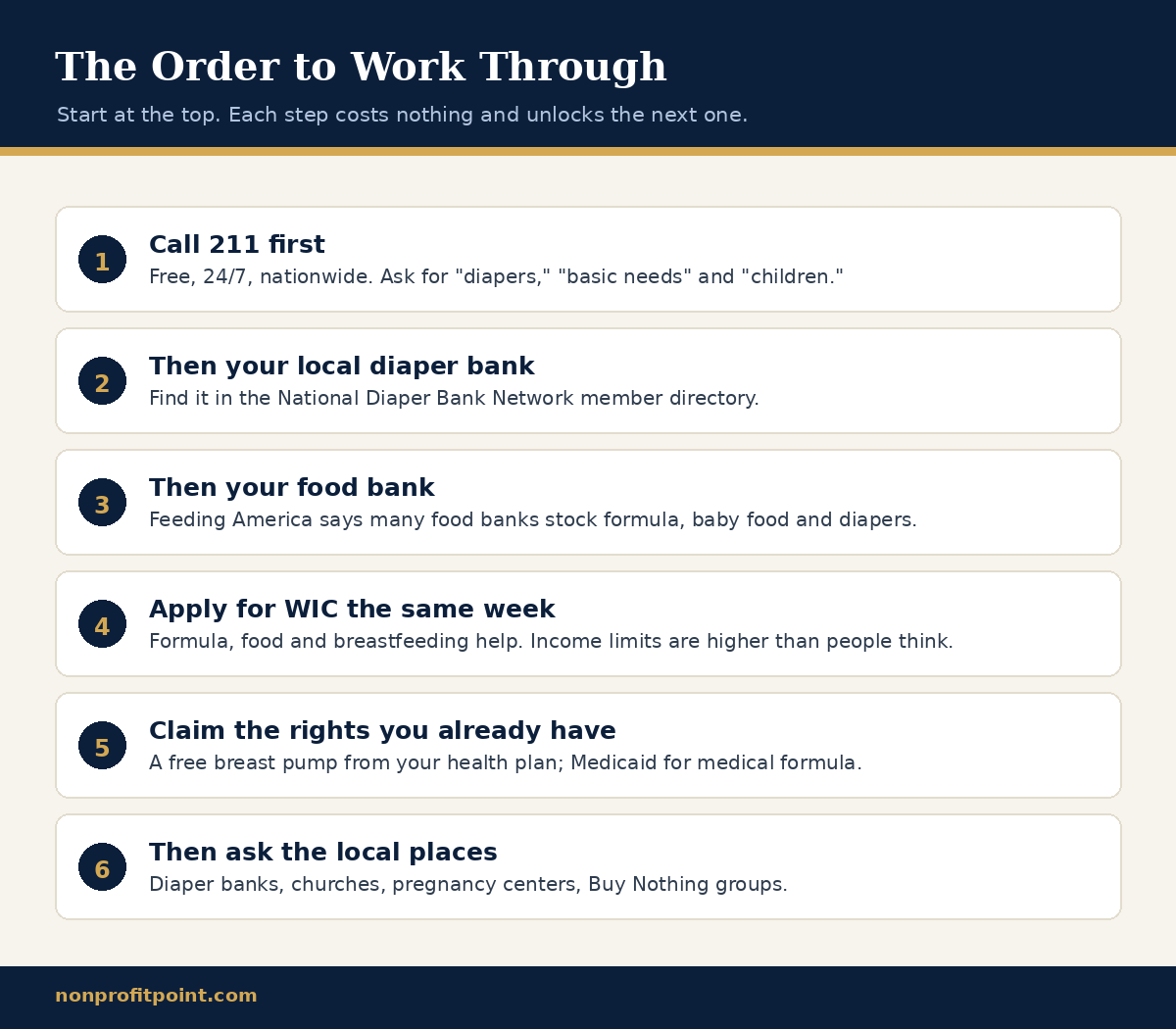
1. Call 211 first — free, 24/7, and it is the front door everyone else points to
What it gives: a live referral to whoever is handing out diapers near you this week. Who qualifies: anyone; there is no income test to ask a question. How: dial 211 from any phone, or search your local 211 at 211.org/about-us/your-local-211. The network covers 99% of the U.S. population and makes roughly 19 million referrals a year.
The trick is the vocabulary. 211’s own “I need help with” menu has no diaper category, so asking for “diapers” alone can dead-end. The National Diaper Bank Network’s instruction is to “ask about or search for diapers or basic needs” and to “also check the listings under children.” Use all three words. One caution: there is no national 211 text shortcode, whatever you have read. Some local 211s take texts; many do not. Call.
2. Your local diaper bank, found through the NDBN member directory
What it gives: a monthly diaper allotment, typically 25 to 50 diapers per child per month, set by the individual bank. Who qualifies: set locally — some banks means-test, many simply serve whoever walks into a partner site. How: the member directory at nationaldiaperbanknetwork.org/member-directory.
Two things to know before you go. It is an A-to-Z list organized by state, not a ZIP-code search tool, so scroll to your state and read. And NDBN itself does not give out diapers — the number published on its site is a New Haven administrative office, not a helpline. Calling it will not produce diapers. Most member banks also work the same way: they supply partner agencies, and the agency is where you pick up. Sweet Cheeks Diaper Bank in Greater Cincinnati states the model outright — it “distributes products to a trusted network of local nonprofits and healthcare providers, who then provide them directly to families” — and tells families to find a distribution site on its map and “call the number listed to confirm hours and what to bring before you visit.” Do that. Diaper sites run on fixed days and run out.
3. Your food bank — the most underused door in this entire guide
What it gives: food, and often much more. Feeding America states it directly on its own help page: “Many food banks help with free baby food, formula, and diapers. They can also connect you to your local diaper bank.” Who qualifies: most pantries serve on self-declared need with no application. How: enter your ZIP at feedingamerica.org/need-help-find-food.
Note Feeding America’s own hedge — “many,” not all. But a food bank is usually closer, open more often and less paperwork-heavy than anything else on this list, and one call covers three needs at once. If you are already using a pantry and have never asked about diapers, ask this week. For the wider food picture, see our guide to food assistance programs.
4. California only: the CalWORKs diaper benefit, $30 a month
What it gives: $30 per month, per child under 36 months. This is the only verified direct-to-family diaper money in the United States. Who qualifies: here is the part every listicle omits — it is not every CalWORKs family. State law provides that “a participant who is participating in a welfare-to-work plan shall be eligible for thirty dollars ($30) per month to assist with diaper costs for each child who is under 36 months of age.” The California Department of Social Services spelled out the two conditions in All County Letter 18-38: a qualifying child under 36 months, and participation in the welfare-to-work program. Families who are sanctioned, exempt or excused from welfare-to-work, and child-only cases where the parent is ineligible for CalWORKs, do not qualify.
How: you do not apply for it separately. Apply for CalWORKs at BenefitsCal.com or your county social services office; if you qualify, CDSS instructs counties that payments “will be issued by default (automatically) to clients who are eligible.” The amount cannot be prorated. Confirm the current figure with your county — the $30 has been in place since April 2018 and was still being described as $30 in state legislative findings in October 2025, but county practice is the thing to verify.
5. California only: Golden State Start — 400 diapers, no application, no income limit
What it gives: Baby2Baby describes it as “400 free Baby2Baby diapers to every baby born in participating hospitals, regardless of family income,” handed over “around the time of hospital discharge.” Who qualifies: everyone delivering at a participating hospital — “There are no income limits, applications, or paperwork for families.” How: nothing to do but check the hospital list at baby2baby.org/goldenstatestart before you choose where to deliver, if you have that choice. The initiative began rolling out in summer 2026 with new hospitals onboarding weekly, and it is diapers only at this stage.
6. Baby2Baby nationally — real, enormous, and not something you can apply to
What it gives: diapers, clothing and basic necessities to more than a million children a year, in “homeless shelters, domestic violence programs, foster care, hospitals and school districts.” Who qualifies: children reached through those institutions. How: there is no individual intake and no application form anywhere on the site, and the published number is a Los Angeles office line, not a request line. The usable piece is its partner-referral list, which names local organizations by state — those are the ones to call.
7. If a medical condition is involved: Medicaid may cover diapers outright
What it gives: ongoing diapers or pull-ups, billed as durable medical equipment, for a child whose incontinence stems from a documented condition — not simply for a child who has not potty trained. Who qualifies: there is no national rule; each state sets its own policy under the federal EPSDT requirement, which obliges states to cover “any additional 1905(a) services…found to be medically necessary…regardless of whether the service is covered in a state’s Medicaid plan.” In practice the age floor is usually three years (36 months). Ohio’s rule, effective July 1, 2024, requires a Certificate of Medical Necessity confirming the child is “at least thirty-six months of age” plus “the applicable diagnosis of the specific disease, injury, developmental delay, or developmental disability causing the incontinence,” with prior authorization renewed at least annually.
How: ask your child’s pediatrician or specialist for a prescription and a certificate of medical necessity, then call the number on the Medicaid card and ask for the incontinence-supply policy by name. Families of children with disabilities routinely go years without being told this exists.
Formula and feeding: where the free milk actually is
8. WIC — the largest source of free formula in the country, and the most misunderstood
What it gives: infant formula, food, breastfeeding support and health referrals. For a fully formula-fed infant, USDA’s maximum monthly allowances run up to 806 reconstituted fluid ounces at 0–3 months, 884 at 4–5 months and 624 at 6–11 months. USDA also provides that “special infant formulas and medical foods may be provided when prescribed by a physician for a specified medical condition.”
Who qualifies: pregnant, postpartum (up to six months) or breastfeeding people, infants, and children up to their fifth birthday, at or below 185% of the federal poverty guidelines, plus a nutritional-risk screening that is free. For July 1, 2026 through June 30, 2027 in the 48 contiguous states and D.C., the annual income ceilings are $29,526 for a household of one, $40,034 for two, $50,542 for three, $61,050 for four, $71,558 for five and $82,066 for six. A pregnant applicant counts as two people. Two rules people miss: if you or the child already receive Medicaid, SNAP or TANF, you are automatically income-eligible; and states may set limits lower than the federal maximum.
And it is not just for mothers. USDA’s own front page says so: “Moms, dads, foster parents, and anyone else raising kids under 5 can apply for support for the kids in their care.” The program’s name is the single biggest reason custodial fathers, grandparents and foster parents never apply.
How: use the eligibility prescreener and the state agency directory at fna.usda.gov/wic, then contact your local agency to book an appointment. There is no national WIC hotline — the program is state-administered, and any article giving you a single 1-800 number for WIC is wrong. One more thing to know before you shop: WIC state agencies award a competitively bid rebate contract to one formula manufacturer, so “the brand of infant formula provided by WIC varies by state agency.” Your neighbor in the next state gets a different brand, and that is normal.
Two housekeeping notes for 2026. USDA’s Food and Nutrition Service was renamed the Food and Nutrition Administration on June 1, 2026, so fns.usda.gov links now redirect to fna.usda.gov. And WIC’s pandemic-era flexibility to certify participants remotely is currently scheduled to expire September 30, 2026 unless extended — if a virtual appointment matters to you, book early.
9. Abbott’s Patient Assistance Program — free specialty formula when nothing else covers it
What it gives: free Abbott nutrition product, including metabolic formulations, EleCare, PediaSure Peptide and Similac Alimentum, administered through Pathway Plus: “When no other coverage options exist, Pathway Plus can assess your eligibility for the Abbott Nutrition Patient Assistance Program.” Who qualifies: four conditions, all of them — U.S. residence with “no healthcare insurance coverage for the requested product,” “no access to alternative sources of coverage,” meeting financial criteria (the thresholds are not published), and requiring “100% of caloric needs from the requested product.” That last one is strict and rules out partially fed children. How: call 1-866-801-5657.
10. Enfamil’s reimbursement team — not free formula, but it wins coverage
What it gives: benefits verification, prior-authorization help and letters of medical necessity for PurAmino, Nutramigen, Pregestimil, EnfaCare and metabolic products — the paperwork that decides whether insurance or Medicaid pays for a $50 can. Who qualifies: anyone whose child needs one of those products. How: 1-800-222-9123 (1-800-BABY123). Understand what this is: a team that helps you win coverage, not a giveaway.
11. State metabolic food programs, reached through newborn screening
What it gives: free metabolic formula and low-protein medical foods for children with inborn errors of metabolism. Kentucky’s program, for instance, serves families with “no insurance,” “insurance that has been denied,” or who have “exhausted their insurance benefits” — “as funding allows.” How: find your state’s newborn screening program through HRSA’s state directory at newbornscreening.hrsa.gov/your-state and ask what medical-food assistance the state runs. These programs are small, quiet, and almost never listed in general assistance articles.
12. Free lactation, nutrition and sleep counselors — MyGerber, and the federal helpline
What it gives: Gerber staffs certified sleep, nutrition and lactation counselors who are, in the company’s words, “standing by and free to use,” reachable “24-7” by text, chat or video, and “never bots, always real experts.” No purchase is required. Separately, the federal Office on Women’s Health Helpline answers breastfeeding questions at 800-994-9662 (TDD 888-220-5446), 9 a.m. to 6 p.m. ET, Monday to Friday — information and support only; the staff do not diagnose or prescribe. If you are also short on food, the USDA National Hunger Hotline is 1-866-3-HUNGRY (1-866-348-6479), Monday to Friday 8 a.m. to 8 p.m. ET, or text 914-342-7744.
13. Donor human milk, and what it really costs
What it gives: pasteurized donor milk for premature and fragile infants, dispensed “either in hospitals or homes” by the 30+ nonprofit member banks of the Human Milk Banking Association of North America. Who qualifies: it varies by bank, and so does the paperwork — the Mothers’ Milk Bank Northeast notes that “state regulations require families in New York and New Jersey to provide a prescription” while “a prescription is not required for first-time orders from families outside New York and New Jersey.” Cost: outpatient families pay a processing fee; the New York Milk Bank publishes $4.90 per ounce. That is real money, which is why the next sentence matters: some banks run hardship funds. Milk Bank Northeast’s Compassion Fund is available “when outpatient capacity allows” to families with a prescription “facing financial challenges.” How: find your nearest bank at hmbana.org/find-a-milk-bank and ask two questions — do I need a prescription, and do you have financial assistance.
The two rights worth more than most of the charity above
14. Your health plan owes you a breast pump. Most parents never claim it.
HealthCare.gov states the rule without hedging: “Your health insurance plan must cover the cost of a breast pump. It may be either a rental unit or a new one you’ll keep,” and plans “must provide breastfeeding support, counseling, and equipment for the duration of breastfeeding.” The underlying federal guideline is broader still — HRSA’s Women’s Preventive Services guideline covers lactation “equipment and supplies,” which “include, but are not limited to, double electric breast pumps (including pump parts and maintenance) and breast milk storage supplies.”
Two limits to know so you are not surprised. The requirement covers Marketplace plans and most others but not grandfathered plans — individual policies purchased on or before March 23, 2010. And “your plan may have guidelines on whether the covered pump is manual or electric, the length of the rental, and when you’ll receive it,” so the plan chooses the model and the timing, not you. If you are uninsured or your plan will not budge, USDA notes you “may be able to get or rent a pump through WIC” — phrased as a possibility, not a promise, because supply is local.
15. Cribs, car seats and the safe-sleep network
Cribs for Kids runs the national safe-sleep network — “over 2,000” partners, of which “many provide portable cribs to those who qualify.” Note the word many: some partners only do education. The published criteria are financial need, an infant 12 months or younger, and agreeing to receive safe-sleep education. Search by ZIP at cribsforkids.org/find-a-crib or call 1-888-721-CRIB (1-888-721-2742); the national office does not ship cribs to individuals. State health departments run parallel programs — Alabama’s distributes pack-n-plays “through referrals from partner agencies” and openly says it has purchased “a limited number,” while D.C. gives a crib to a District resident with a baby under one who “participate[s] in a safe sleep education session with a DC SSP partner” (1-800-MOM-BABY).
Car seats are different, and the usual advice is wrong. Safe Kids Worldwide and NHTSA do not give out seats — they run free inspections. Safe Kids coalitions host “more than 8,000 free car seat inspection events” a year (find one at events.safekids.org), and NHTSA’s technicians “will inspect your car seat free of charge, in most cases.” Worth doing — but it is not a seat. The routes that actually end in a seat are local. Michigan pairs its Maternal Infant Health Program with Medicaid health plans for families who are MIHP-enrolled, in a Medicaid health plan and TANF-eligible, with the health plan ordering the seat. Mississippi’s Safe Riders Magnolia program serves “caregivers currently receiving Medicaid, WIC, SNAP or any other federal assistance or in the third trimester of pregnancy” and requires child-passenger-safety education first (injuryprevention@msdh.ms.gov, 601-206-1010; the state last reviewed that page in October 2024, so call). And many Medicaid managed-care plans offer a seat as a value-added benefit tied to completing prenatal visits — look up your own plan’s extra benefits page, or call the number on your card and ask for “value-added services.”
16. Clothing, gear and furniture — including two programs you can actually apply to yourself
Room to Grow is one of the very few direct-apply programs in this guide. Families in Boston and New York City enroll before the start of their third trimester and receive “13 visits over 3 years” — two-hour appointments every three months combining parent coaching with selecting clothes, books, toys and gear. It enrolls families “eligible for other benefits, such as SNAP, WIC, TANF,” with “no requirements around age, marital or relationship status, or number of children,” in English and Spanish. Be aware of their own caveat: “sometimes families are not accepted to join the program because of limited capacity.” Apply at roomtogrow.org/apply-now.
Cradles to Crayons covers Boston, Chicago and Philadelphia only, and distributes “through our network of Service Partners” — if you already have a caseworker or social worker, they can order for you.
Buy Nothing and Freecycle are the fastest thing on this page and require nothing. The Buy Nothing Project describes itself as “the world’s largest free-goods platform” with “over 14 million members”, running through an app and curated local Facebook groups; Freecycle is “a grassroots & entirely nonprofit movement of people who are giving and getting stuff for free in their own Towns,” and “membership is always free.” Strollers, high chairs, clothes and gear move through both constantly, often the same day you ask. Do not accept a used car seat this way — you cannot verify its crash history or expiry.
Military families have two more. Operation Homefront’s Star-Spangled Babies baby showers have “provided over 23,000 military families with free baby supplies” since 2008; events are announced on operationhomefront.org/events, and at the time of writing none were listed, so watch the page. Operation Shower serves mothers whose partner is “deployed or deploying during the pregnancy,” who are themselves active duty with a deploying group, or whose partner was injured on deployment, with the baby no older than three months; group showers are requested by a Family Readiness Officer or Ombudsman, while the “B is for Baby” box allows self-nomination.
Pregnancy resource centers: real supplies, and what you should know first
Search “free diapers near me” and a large share of results are pregnancy resource centers. In a small town they are often the most generous source of baby goods, and this guide will not pretend otherwise — but you should know what you are walking into, because most articles either hide them or promote them without context.
How they usually work. Most run an “Earn While You Learn” points model: you watch parenting lessons and earn points to spend in an on-site baby boutique. One Georgia center advertises that you can “learn essential parenting skills and get the supplies your baby needs (think diapers, wipes, clothing, toys, and more) all for FREE,” with a tier offering “a FREE convertible car seat or pack ’n play just by completing 12 EWYL lessons.” A North Dakota clinic runs points redeemable for “clothes, diapers, and gear, at no financial cost to you.” The exchange rate is modest and worth knowing: a Texas center awards 75 points for watching a video and 25 for the worksheet, and one class plus homework buys roughly one package of wipes.
What they are not. These are generally not licensed medical clinics. A 2022 review in the International Journal of Women’s Health found that only 26% of such centers have a registered nurse and 16% a physician on staff, and that just 13% disclosed on their websites that the center was not a medical facility. Because most are not licensed medical providers, HIPAA generally does not apply — the California Attorney General’s 2022 consumer alert warned that they “may not be licensed medical clinics or be required to keep medical records private.” And they do not provide the full range of reproductive care: Care Net, a network of more than 1,200 affiliates, states it plainly — “we do not offer or refer for abortion services or emergency contraception.”
The practical read. If you want diapers, clothes and a car seat and will attend classes, these centers are a genuine and often warm source of them. Go in knowing the staff may not be clinicians, that what you share may not be protected as it would be at a doctor’s office, and that contraception and pregnancy-options counseling is not what they do. Keep medical care with a licensed provider and use the boutique for what it is.
What to walk past
Every list in this niche recycles the same dead ends. These are the ones we checked and cut.
The hijacked domain. jakesdiapers.org is an offshore casino affiliate page as of August 21, 2026. The successor organization, Jake’s Network of Hope at jakesnoh.org, works mainly through partner nonprofits and offers a cloth-diaper loan where no partner is nearby. It has posted about a direct-to-individual pilot, but that page carries no date, criteria or working application link — call first.
National office phone numbers presented as help lines. The numbers published by the National Diaper Bank Network and Baby2Baby are administrative offices. Neither will send you diapers, and both are widely reprinted as though they will.
“Free formula samples” from manufacturers. Similac StrongMoms no longer exists under that name — the address redirects to MySimilac Rewards, a loyalty program where you “may receive formula coupons” and “may also get formula samples.” Enfamil Family Beginnings is similar, and its headline “$400” is an aggregate ceiling across coupons, rebates and a photo book, not $400 of formula. Join if you like; do not plan a month around them.
ByHeart, for now. Every ByHeart infant formula product was recalled during an infant botulism outbreak that sickened 48 infants across 17 states; CDC declared the outbreak over on February 26, 2026 with root-cause work continuing, and the company’s own site still shows order management unavailable. Freebie blogs still advertise ByHeart samples. Do not go looking for one.
Newborns in Need does real work through volunteer chapters, but has no application path for parents anywhere on its site — it is a crafting-and-donation organization, and the poverty statistics on its own about page are from 2019–2020.
“The Salvation Army gives free baby clothes,” and the same for St. Vincent de Paul. Neither publishes a national baby-supply program. Both are worth calling — St. Vincent de Paul works through “4,000+ Conferences” deciding case by case on a home visit — but what you get is set entirely locally, and no article can promise it.
Related help
- Charities that help mothers and babies — the maternal-health side of the same need.
- Grants for single mothers and charities that help single fathers — cash and program help for one-parent households.
- Charities for premature babies — NICU-specific support, including donor milk.
- Free clothing programs and school clothes assistance for older children.
- Charities that help with medical bills and utility assistance — the bills that crowd out diaper money.
- Best charities for low-income families — a wider starting map.
Frequently asked questions
How can I get free diapers today?
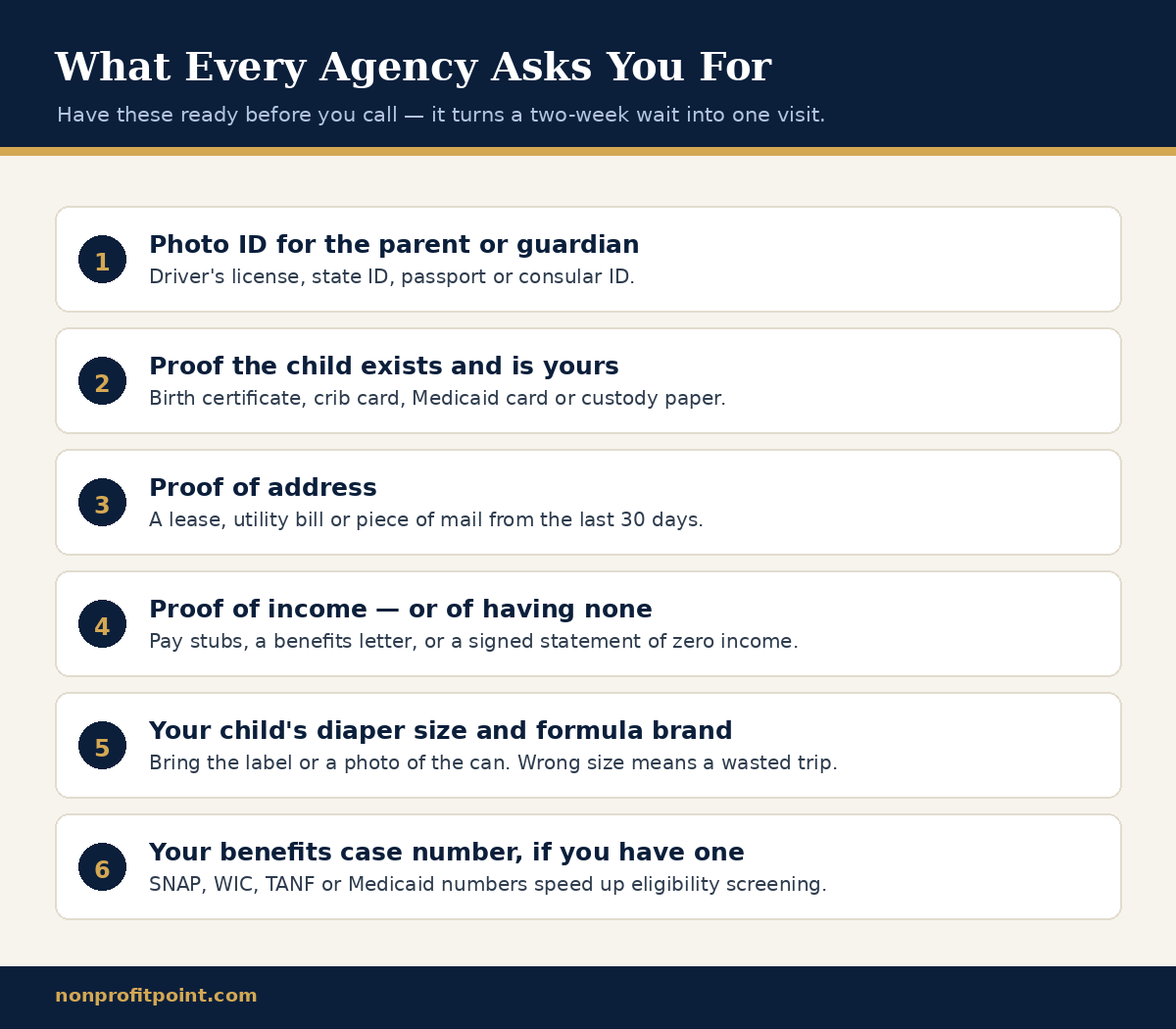
Dial 211 and ask about “diapers,” “basic needs” and “children” — all three phrasings, because 211’s menu has no diaper category. While you wait, call your food bank: Feeding America says “many food banks help with free baby food, formula, and diapers,” and pantries are usually open more often and ask for less paperwork than anything else. Then look up your nearest diaper bank in the National Diaper Bank Network member directory and call the distribution site, not the national office, to confirm hours and what to bring. Bring photo ID, proof of the child, proof of address and your child’s diaper size.
Do SNAP or WIC pay for diapers?
No. SNAP’s eligible-items rules exclude “any nonfood items,” and WIC is a supplemental food package by statute. California’s legislature stated it directly in 2025: “The benefit programs CalFresh and the California Special Supplemental Nutrition Program for Women, Infants, and Children (WIC Program) do not provide diaper aid.” TANF is different — it arrives as cash, so it can be spent on diapers, but only a minority of families below the poverty line receive it. The one verified direct diaper payment in the country is California’s CalWORKs benefit of $30 a month per child under 36 months, and it is limited to welfare-to-work participants.
Is there a national phone number for free diapers?
There is no diaper hotline. 211 is the closest thing, and it is a referral service rather than a supplier. Do not call the numbers published by the National Diaper Bank Network or Baby2Baby — those are administrative offices that do not take requests from families, even though both numbers are reprinted constantly as if they do. There is also no national 211 text shortcode; some local 211s accept texts, many do not.
Can I get free baby formula if I do not qualify for WIC?
Sometimes, and it depends on why you need it. If your child requires a specialty or metabolic formula, three real doors exist: Medicaid’s EPSDT rules can require coverage of medically necessary formula for children under 21; Abbott’s Patient Assistance Program at 1-866-801-5657 gives free product when there is no insurance coverage, no alternative coverage, financial need is established, and the child takes 100% of calories from the product; and your state’s newborn screening program, found at newbornscreening.hrsa.gov/your-state, may run a metabolic food program. For standard formula, food banks are the practical answer. Manufacturer “rewards” programs are marketing loyalty schemes and promise only that you “may” receive samples.
How do I get a free car seat?
Not from Safe Kids or NHTSA — both run free inspections, not giveaways. The real routes are local. Start with the number on your Medicaid card and ask for “value-added services”; many Medicaid managed-care plans give a seat for completing prenatal visits. Some states run distribution programs: Michigan works through the Maternal Infant Health Program with Medicaid health plans for TANF-eligible families, and Mississippi’s Safe Riders Magnolia program serves caregivers on Medicaid, WIC, SNAP or other federal assistance, or in the third trimester, after a car-seat safety class. Pregnancy resource centers frequently offer a convertible seat for completing a parenting course. Never take a used car seat from a giveaway group — you cannot verify crash history or expiry.
Do I have to be on benefits to get help from a diaper bank?
Usually not. Eligibility is set by each bank and its partner agencies, and many serve anyone who comes to a distribution site with no means test at all. Others ask for proof of income or enrollment in SNAP, WIC, TANF or Medicaid. The only way to know is to call the specific site. Bring proof of income if you have it and a signed statement of zero income if you do not — agencies accept that far more often than people expect.
Is jakesdiapers.org still a diaper charity?
No. As of August 21, 2026 that domain serves an online-casino comparison page with gambling affiliate links, while its old nonprofit page titles still surface in search results. The organization it belonged to now operates as Jake’s Network of Hope at jakesnoh.org, which works primarily through partner nonprofits and offers a cloth-diaper loan for individuals with no partner agency nearby. Call before relying on any direct-to-individual program there.
About this guide. Compiled and fact-checked by the Nonprofit Point editorial team, which researches financial-assistance and charity-vetting resources for U.S. households. Every program status, dollar figure and phone number above — including the WIC income guidelines effective July 1, 2026, USDA’s maximum monthly formula allowances, the CalWORKs diaper benefit under California Welfare & Institutions Code section 11323.2 and CDSS All County Letter 18-38, Ohio’s incontinence-supply rule effective July 1, 2024, the ACA breast-pump requirement and the HRSA women’s preventive services guideline, the Cribs for Kids and Room to Grow eligibility criteria, and the status of the jakesdiapers.org domain — was verified against official federal, state and organizational sources in August 2026. Phone numbers were taken from each organization’s own website. The USDA Food and Nutrition Service became the Food and Nutrition Administration on June 1, 2026. Programs open, close and run out of stock quickly; always confirm by phone or through 2-1-1 before traveling to an office. Nonprofit Point is an independent resource and is not affiliated with the agencies listed.
Still in the adoption process? Charities that help with adoption costs covers the grants, interest-free loans and employer benefits available before the baby comes home — including the federal credit that became partly refundable in 2025.


![Get Debt-Free: Discover 9 Charities That Help with Debt Today [Full List]](https://nonprofitpoint.com/wp-content/uploads/2023/03/Charities-that-help-with-Debt-min-768x432.png)