Charities and Grants for Grandparents Raising Grandchildren (2026)


If you are a grandparent raising a grandchild, the most valuable thing available to you is almost never a charity grant. It is a benefit you are already entitled to and probably have not claimed, because the agency that administers it has no particular reason to come looking for you.
That benefit is the TANF child-only grant, and the thing that makes it unusual is that it ignores your income. Most assistance tests the adult. This one tests the child. A retired grandmother on a pension, a working uncle, an older sister with a mortgage: all of them can be over the income limit for every other programme in the building and still qualify, because the grant was written to consider only the needs and income of the child.
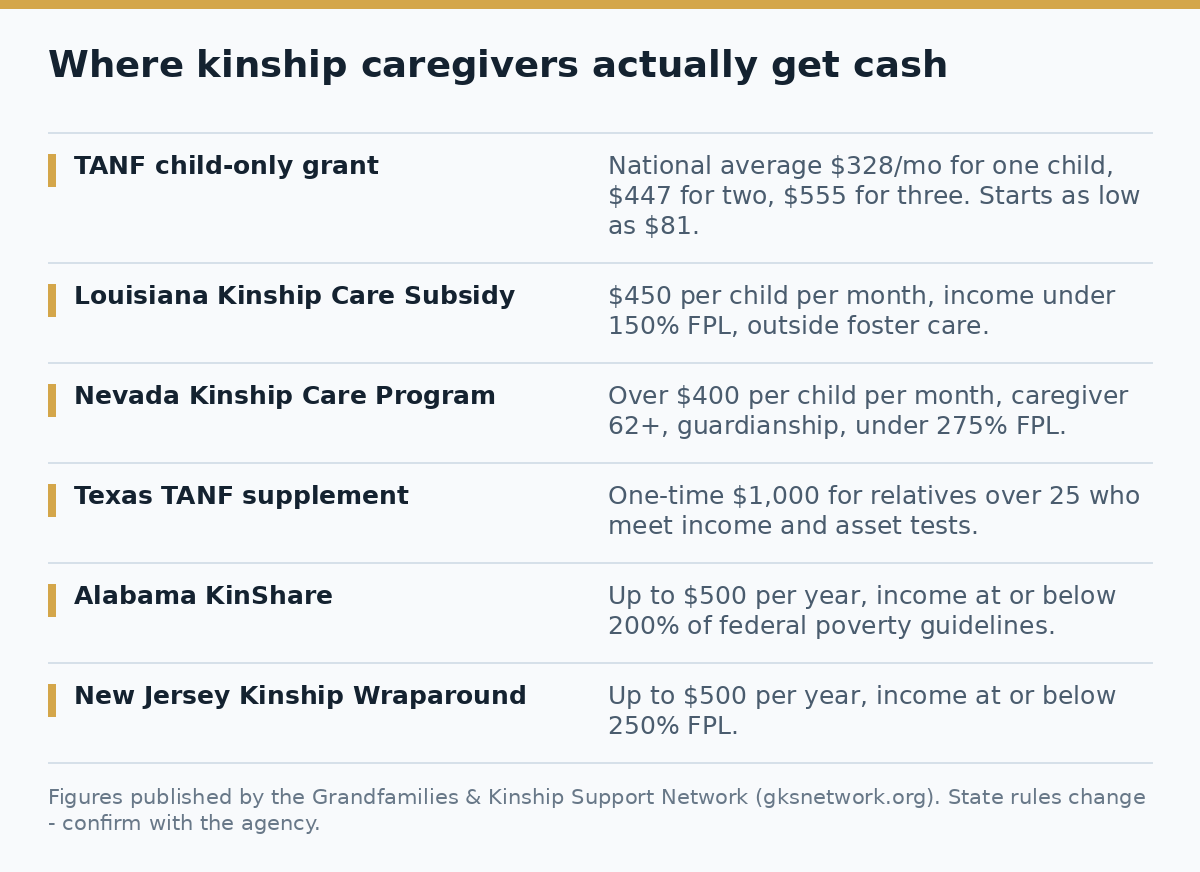
The Grandfamilies and Kinship Support Network, the national technical assistance centre run by Generations United, puts the national average at about 328 dollars a month for one child, 447 dollars for two and 555 dollars for three. It also says plainly what most relative caregivers are not told: that most relative caregivers should be able to receive a monthly child-only grant on behalf of the child until that child becomes an adult, with no 60 month federal time limit and no work requirement attached.
That is the floor. What sits above it depends almost entirely on one thing, and it is worth settling before you make a single phone call.
The decision that sets everything else: your legal footing
Kinship care in the United States runs on four different legal footings, and the money attached to each one is wildly different. Families routinely spend years on the cheapest footing without ever being told the others exist.
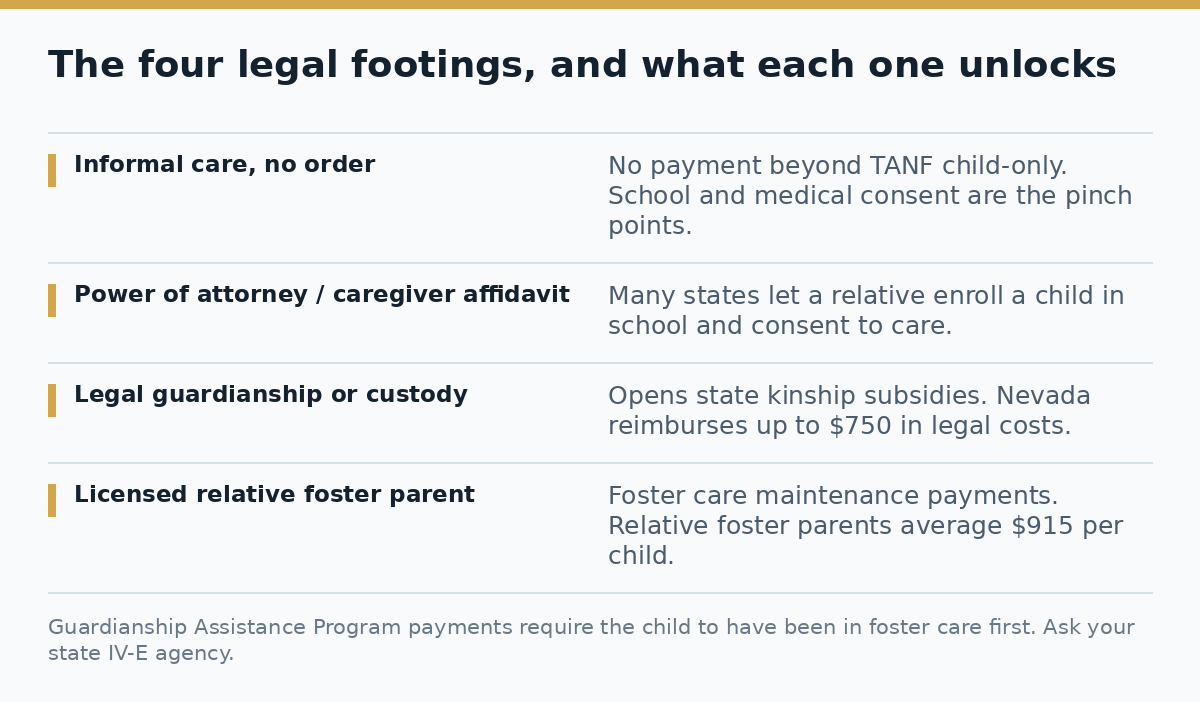
Informal care with no order. The child lives with you by agreement with the parent. Nothing is filed. You can usually still get the TANF child-only grant, SNAP and Medicaid for the child. You generally cannot get state kinship subsidies, and you will hit a wall the first time a school or a clinic asks who has authority to sign.
A power of attorney or caregiver affidavit. Many states let a parent sign authority over to a relative, or let the relative sign a sworn affidavit, specifically so the child can be enrolled in school and receive medical care. It is not custody and the parent can revoke it. It solves the two problems that cause the most day to day misery, and it usually costs nothing.
Legal guardianship or custody. A court order giving you decision making authority. This is the gate to the larger state kinship subsidies: Nevada requires guardianship for its programme and reimburses up to 750 dollars in guardianship legal expenses, which tells you how seriously it treats the cost of getting there.
Licensed relative foster parent. The child is formally in state custody and placed with you, and you are licensed as their foster carer. This pays the most by a wide margin. The average foster care maintenance payment for relative foster parents is 915 dollars per child, roughly three times the average TANF child-only grant. It also means ongoing involvement with the child welfare agency, which many families do not want, and in a great many cases it is simply not on offer because the child never entered the system.
One point worth being blunt about. The gap between 328 dollars and 915 dollars for raising the same child is not a reflection of need. It is a reflection of which door the child came through. If a caseworker is placing a child with you right now, ask directly whether licensing is available to you, and ask before you agree to an informal arrangement, because converting afterwards is much harder.
TANF child-only grants: how to actually get one
Each state and territory sets its own rules, including its own definition of relative. Some define it broadly enough to include godparents and family friends. The amounts vary enormously, from roughly 81 dollars a month for a first child at the bottom to several hundred at the top, and adding more kin children to an existing grant usually increases it only slightly. This is not a per child payment the way foster care is.
Four things to know before you apply.
- Many states do not publish child-only information online at all. The Network says so explicitly. You may have to call the TANF programme and ask for it by name. Asking for “help” will get you routed to the family grant, which is income tested on you and time limited to 60 months.
- You may be asked to assign child support rights to the state. A good cause exception exists, and under federal policy any reason can qualify, though each jurisdiction decides whether to grant one. If pursuing the parent for support would put the child or you at risk, say so at the application.
- Ask for a combined application. Some states can check SNAP and Medicaid eligibility off the same form. SNAP is different from the child-only grant in one important way: it does ask about your income, and uses it to set the amount.
- Short term crisis help is a separate thing. Many states can issue short term TANF benefits for a crisis, a utility bill or school supplies without work requirements. These last no more than four months, and some states limit them to kinship families already involved with child welfare.
The state kinship subsidies that pay more than TANF
A minority of states run a dedicated kinship subsidy on top of or instead of the child-only grant. These are the ones with published amounts:
- Louisiana, Kinship Care Subsidy Program. 450 dollars per child per month for qualified relatives with income below 150 percent of the federal poverty level, caring for children outside the foster care system. TANF funded, running since 1999.
- Nevada, Kinship Care Program. Over 400 dollars per child per month for relative caregivers aged 62 and older who have obtained guardianship, with household income below 275 percent of the federal poverty level, plus up to 750 dollars in guardianship legal costs.
- Texas. A one time 1,000 dollar TANF supplement for grandparents, aunts, uncles and siblings over 25 who meet income and asset tests.
- Alabama, KinShare. Up to 500 dollars a year for relatives related by blood, marriage or adoption, with income at or below 200 percent of federal poverty guidelines.
- New Jersey, Kinship Wraparound Program. Up to 500 dollars a year for relatives or legal guardians with income at or below 250 percent of federal poverty guidelines.
Other states, including Massachusetts, Wyoming, Colorado, Vermont, Connecticut, Wisconsin, Idaho, South Carolina and West Virginia, run kinship programmes whose amounts are not centrally published. Tribal programmes exist too. The absence of a published figure is not evidence that the programme is small, and it is a reason to call rather than a reason to skip.
The fastest way to find out what your own state does is the GrandFacts sheet. Generations United and its Grandfamilies and Kinship Support Network maintain one for every state and territory, covering data, key state and local programmes, public benefits, educational assistance and legal relationship options. Eight Tribal GrandFacts exist as well, created with the National Indian Child Welfare Association. They are free at grandfamilies.org.
Kinship navigator programmes: the free case manager nobody mentions
A kinship navigator is a person whose job is to help relative caregivers find and use the programmes above. Information, referral and follow up, plus connections to training and legal assistance. Free to the family.
The reason more states have them now is money. The Family First Prevention Services Act, Public Law 115-123, amended Title IV-E so that approved agencies can claim a 50 percent federal financial participation match for qualifying navigator programmes, provided the model is rated promising, supported or well supported by the Title IV-E Prevention Services Clearinghouse. Section 427(a)(1) of the Social Security Act sets what they must do, including coordinating with 211 and 311 systems and involving kinship caregivers themselves in the design.
Approved models in use include the Colorado Kinnected Kinship Navigator Program, Delaware KIN-TECH, the Foster Kinship Navigator Program, 30 Days to Family, Arizona Kinship Support Services and the Washington State Kinship Navigator. The federal listing of which states run which model has known inconsistencies, so treat it as a starting point and confirm with your state Title IV-E agency rather than relying on the table.
What the Older Americans Act gives grandparents over 55
This is the most under-used programme on the list, and the reason is a naming problem. It sits inside the aging services network, not the child welfare system, so kinship families never think to look there.
The National Family Caregiver Support Program, authorised under Title III-E of the Older Americans Act, covers five service categories: information about available services, help gaining access to services, individual counselling and support group organisation and caregiver training, respite care, and supplemental services on a limited basis. Since the 2020 reauthorisation its eligibility explicitly includes relatives who are not parents, aged 55 or older, caring for children under 18, and relatives aged 55 or older caring for adults aged 18 to 59 with disabilities.
Respite care is the part that matters most to exhausted caregivers, and it is the part people are most surprised to learn they can have. There is no means test written into the eligibility above. Funding is allocated to states by their share of the population aged 70 and over, so capacity varies.
Call the Eldercare Locator at 1-800-677-1116, Monday to Friday, 8am to 9pm Eastern. It is run by the Administration for Community Living and it will route you to your Area Agency on Aging. Ask for the Title III-E caregiver programme by name, and ask specifically about respite and supplemental services.
The benefits that follow the child, not your income
These are the ones most often missed because caregivers assume their own income disqualifies the household.
- Medicaid or CHIP for the child. Children in kinship care very often qualify on their own circumstances. Apply for the child separately rather than as part of your household where the state allows it.
- SNAP. Does consider your income, unlike the child-only grant, but household composition rules for a child in your care can work in your favour. Worth applying even if you expect to be over.
- School meals and WIC. Free and reduced price school meals, and WIC for children under five.
- Child care subsidy. Funded through the Child Care and Development Fund and administered by states. Kinship caregivers are frequently eligible and frequently never told.
- Supplemental Security Income. If the grandchild has a qualifying disability, SSI pays on the child’s own circumstances. The Social Security Administration publishes the 2026 federal payment standard as 11,929.46 dollars a year for an eligible individual, which works out to roughly 994 dollars a month, with state supplements in some states on top.
If the household is tight month to month while you wait on any of this, our guides to charities that give money to individuals, charities that help with food and help with heating bills cover the emergency layer.
The tax credits grandparents routinely miss
The IRS qualifying child relationship test for the Earned Income Tax Credit lists, verbatim, a grandchild, niece or nephew alongside sons, daughters, stepchildren, adopted and foster children, and siblings including half and step siblings. A grandparent raising a grandchild is squarely inside it.
Three tests have to be met alongside the relationship. The age test: under 19 at year end and younger than you, or under 24 and a full time student for at least five months, or permanently and totally disabled at any age. The residency test: the child lived in the same home as you in the United States for more than half the tax year, with temporary absences for school, illness, hospital stays, vacation, military service or juvenile detention counting as time at home. The joint return test: the child must not have filed a joint return, except purely to claim a refund of withheld tax.
When more than one person could claim the same child, the IRS tiebreaker rules apply. A non-parent, which is what a grandparent is in tax terms, can claim the child where a parent is eligible but does not claim them, provided the non-parent’s adjusted gross income is higher than the highest AGI of any eligible parent. That last condition catches people out, and it is worth getting free help with rather than guessing. IRS VITA sites prepare returns at no cost for families under the income threshold.
School enrolment and medical consent, without going to court
Two practical walls come up almost immediately, and both have solutions short of custody.
For school, most states have a mechanism that lets a relative caregiver enrol a child without a court order, usually a caregiver affidavit, an educational power of attorney or a residency affidavit. Children who are considered homeless under the McKinney-Vento Act, which can include some children living with relatives after losing housing, have an additional federal right to immediate enrolment without the usual records, and every district has a designated liaison who is obliged to help.
For medical care, a parental authorisation or power of attorney for health care is the usual route, and many states have a specific statutory form. Your state GrandFacts sheet lists the legal relationship options available where you live, which is the quickest way to find out which of these your state actually offers.
For the court steps that do need a lawyer, ask the kinship navigator first, then your local legal aid office, then the state bar referral service. Some states, Nevada among them, reimburse guardianship legal costs after the fact.
How to work this in one week
- Day one, read your state GrandFacts sheet at grandfamilies.org. Fifteen minutes, and it tells you which of the programmes above exist where you live.
- Day one, call 211. Ask by name for the kinship navigator programme and for the TANF child-only application. Not “help for grandparents”.
- Day two, call the Eldercare Locator on 1-800-677-1116 if you are 55 or older. Ask for your Area Agency on Aging and the Title III-E caregiver programme, including respite.
- Day two, apply for the TANF child-only grant. Ask whether the agency can screen for SNAP and Medicaid off the same application.
- Day three, apply for the child’s Medicaid or CHIP separately if the combined application did not cover it.
- Within the week, settle the school and medical consent paperwork using whichever mechanism your state offers.
- Before you file taxes, check the EITC and Child Tax Credit with a free VITA preparer rather than assuming you cannot claim the child.
None of this is a loan. None of it has to be repaid. Several of these run at the same time, and applying for one does not disqualify you from the others.
Sources
Every figure on this page comes from one of the following, each read on 20 October 2026.
- Generations United, GrandFacts — the state and Tribal fact sheets, covering data, local programmes, benefits, education and legal options.
- Eldercare Locator — routing to your Area Agency on Aging, 1-800-677-1116.
- Administration for Community Living — National Family Caregiver Support Program, Title III-E eligibility including relatives 55 and older raising children.
- Grandfamilies & Kinship Support Network — TANF child-only grants for kin caregivers, including the national average amounts.
- Grandfamilies & Kinship Support Network — State strategies for TANF child-only grants, source of the Louisiana, Nevada, Texas, Alabama and New Jersey figures.
- Administration for Children and Families — Kinship Navigator Program, Family First funding and the 50 percent federal match.
- Internal Revenue Service — EITC qualifying child rules, including the grandchild relationship test and the tiebreaker rules.
- Social Security Administration — SSI federal payment standard for 2026.
Related help
- Grants for single mothers
- Charities that help single fathers
- Charities that help with school clothes
- Charities that help with childcare
- Charities that help with baby supplies
- Charities that help seniors with bills
Frequently asked questions
Can grandparents get paid for raising grandchildren?
Yes, in most cases, although the amount depends entirely on your legal footing. Almost every relative caregiver can claim a TANF child-only grant, which averages about 328 dollars a month for one child nationally. Caregivers who become licensed relative foster parents receive foster care maintenance payments, which averaged 915 dollars per child. Several states run their own kinship subsidies on top, and a few pay more than TANF does.
What is a TANF child-only grant?
It is a cash benefit that looks only at the needs and income of the child, not the income of the adult raising them. That is why a grandparent with a pension or a salary can still qualify. The Grandfamilies and Kinship Support Network puts the national average at 328 dollars a month for one child, 447 for two and 555 for three, with the lowest state grants starting around 81 dollars a month.
Do I need legal custody to get help?
Not for everything. TANF child-only grants, SNAP, Medicaid for the child and school meals generally do not require a court order. Custody or guardianship becomes necessary for the larger state kinship subsidies, for the Guardianship Assistance Program, and often for enrolling a child in school or consenting to medical care without the parent present.
What is a kinship navigator program?
It is a free service that helps relative caregivers find and apply for benefits, training and legal help. The Family First Prevention Services Act lets state child welfare agencies claim a 50 percent federal match for approved navigator models, which is why more states have them now than five years ago. Ask your state Title IV-E agency whether one operates near you, or call 211.
Does the Older Americans Act help grandparents raising children?
Yes. The National Family Caregiver Support Program under Title III-E of the Older Americans Act explicitly covers relatives who are not parents, are aged 55 or older, and are caring for children under 18. It funds respite care, counselling, support groups, caregiver training and limited supplemental services. Your Area Agency on Aging administers it. The Eldercare Locator at 1-800-677-1116 will connect you.
Can I claim my grandchild on my taxes?
Usually yes, if the child lived with you more than half the year. The IRS qualifying child relationship test for the Earned Income Tax Credit explicitly includes a grandchild, as well as a niece or nephew and siblings. The child must also be under 19, or under 24 and a full time student for at least five months, or permanently and totally disabled at any age. Tiebreaker rules decide who claims the child when a parent could also claim them.
What is the Guardianship Assistance Program?
It is a Title IV-E funded subsidy for relatives who take legal guardianship of a child who was in foster care. Because it runs through the foster care system, the child normally has to have been placed in licensed foster care with you first, which is the single biggest reason informal kinship families cannot access it. Not every state operates one. Your state child welfare agency is the only reliable source on current rules.
Where should a grandparent start?
Start with two phone calls on the same day. Call 211 and ask specifically for the kinship navigator and the TANF child-only application. Then call the Eldercare Locator at 1-800-677-1116 and ask for your Area Agency on Aging caregiver programme. Read your state GrandFacts sheet at grandfamilies.org before either call so you know what your state actually offers.