Year-End Charitable Giving Deadlines 2026: Every Cut-Off Date, by Gift Type


Most year-end giving advice gives you one date. December 31. It is the right date and it is nearly useless on its own, because almost none of the ways people actually give money reach the charity the same day they decide to give it. A wire takes days. A mutual fund transfer takes weeks. An IRA distribution takes however long your custodian takes, and your custodian is not thinking about your tax year.
This guide is the dates themselves: what has to happen by when, for each way of giving, to put the gift in the 2026 tax year. Two things make 2026 harder than usual. The calendar is unkind, and the postal rule that used to protect late givers quietly stopped working in December 2025.
The deadline that matters, and the four that matter more
The Internal Revenue Service deadline is December 31, 2026. The gift must be made by then. The whole question is what “made” means, and the answer is different for each asset:
- Cash, check and card count on the date of mailing or the date of charge.
- Securities count on the date the shares are unconditionally delivered to the charity, not the date you instruct your broker.
- IRA distributions count on the date the money leaves the IRA payable to the charity, not the date you request it.
- Donor-advised funds count on the date you fund the account, and not at all on the date you recommend a grant out of it.
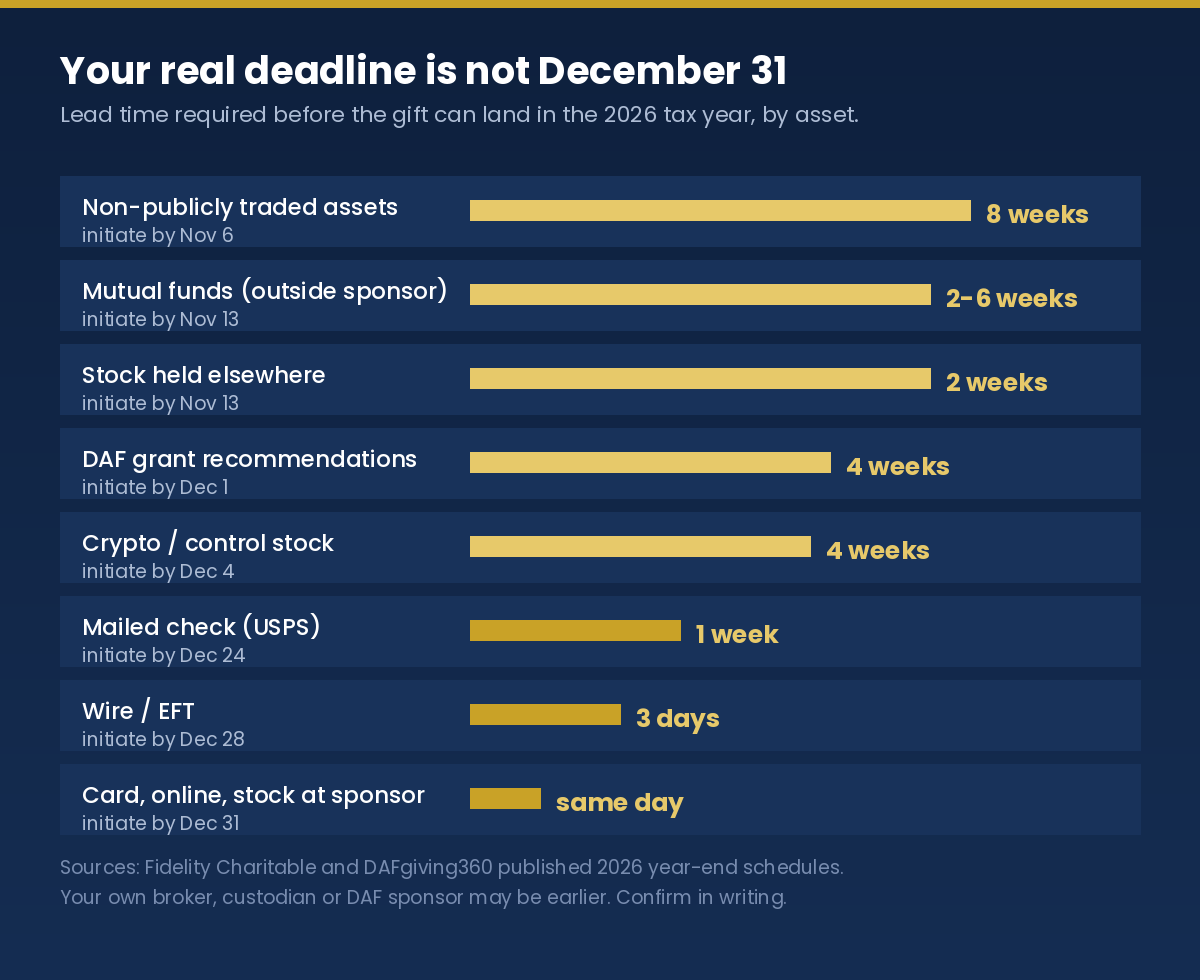
Every one of those except the card charge involves a third party with its own processing queue. That is why the four dates that decide whether your gift lands in 2026 are usually in November and early December, not on New Year’s Eve.
The 2026 calendar gives you four business days
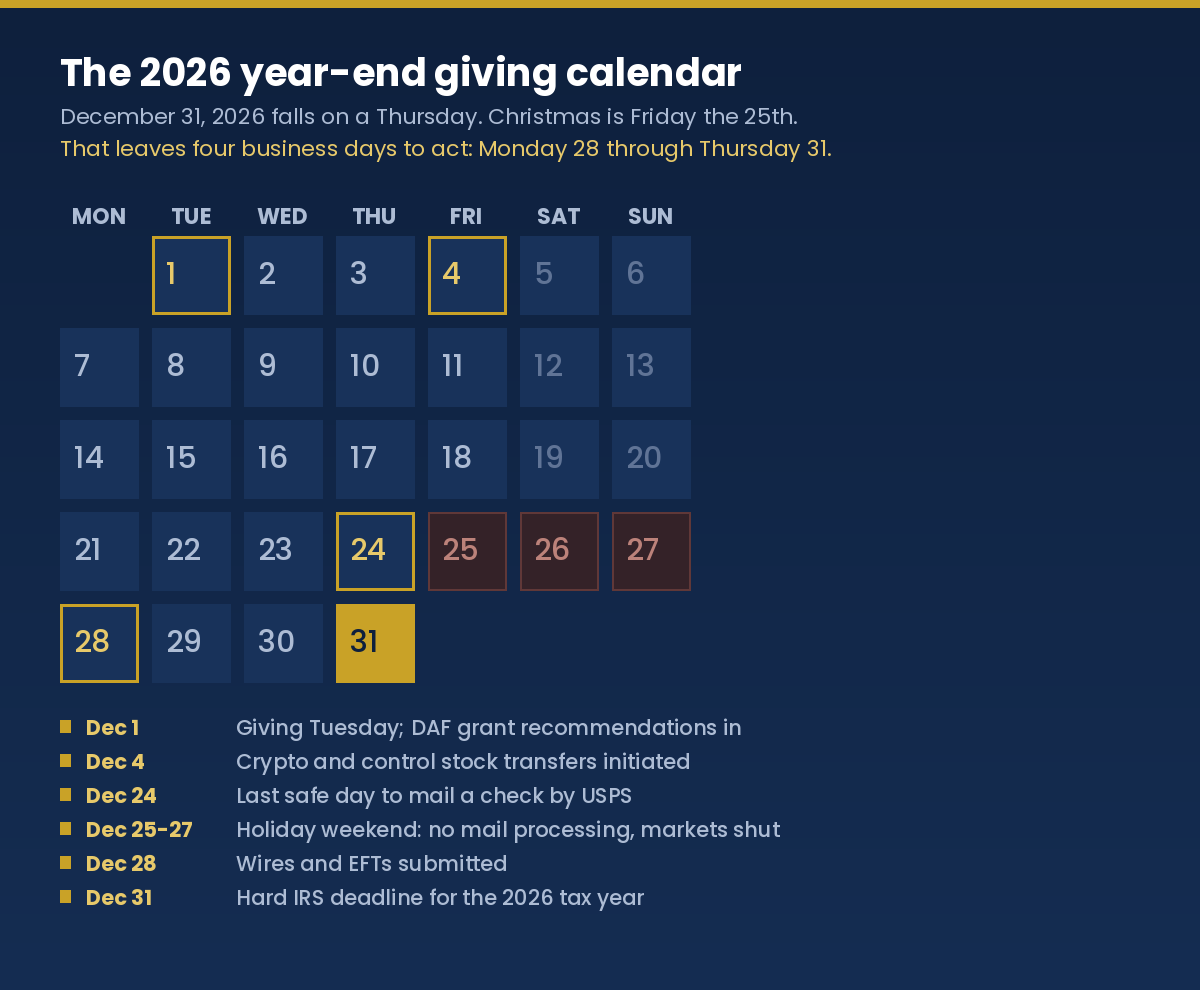
December 31, 2026 falls on a Thursday. Christmas Day is Friday, December 25, which means the holiday closes banks, markets and mail processing for Friday, Saturday and Sunday in a single block. When everything reopens on Monday, December 28, you have four business days left: Monday, Tuesday, Wednesday, Thursday.
Four business days is enough to charge a card, submit a wire or walk a check into a post office. It is not enough to open a donor-advised account, liquidate a position, retitle a vehicle or get a non-cash gift appraised. If any of those is on your list, the useful deadlines are the ones below, and they have mostly already passed by the time most people start thinking about year-end giving.
Checks in the mail: the postmark rule, and what broke it
What the rule actually says
A check is treated as contributed on the date you mail it, provided it is properly addressed, carries proper postage, and clears in due course. This is the single most donor-friendly timing rule in the code. A check postmarked December 31 that the charity does not open until January 8 and does not deposit until January 12 is still a 2026 gift.
The rule has always depended on an assumption nobody examined: that the postmark on the envelope records the day you mailed it.
What changed on December 24, 2025
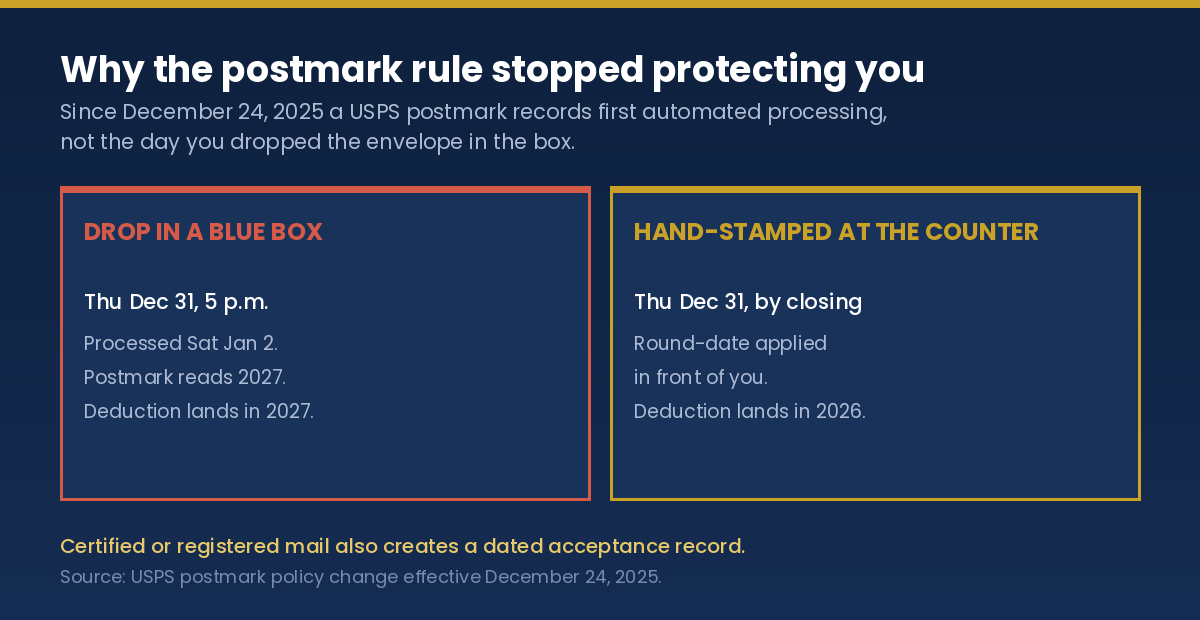
Effective December 24, 2025, the United States Postal Service clarified that a machine postmark reflects the date of first automated processing at a regional facility, not the date an envelope was deposited at a local collection point. Mail dropped in a blue box on a Thursday evening may not reach a processing centre until the following Monday, and the postmark will say so.
Apply that to 2026. A check dropped in a collection box after the last pickup on Thursday, December 31 goes into a weekend that starts with New Year’s Day, a federal holiday. First processing could plausibly be Saturday, January 2 or Monday, January 4. The envelope would carry a 2027 postmark, and the gift would be a 2027 gift, whatever the date you wrote on the check.
This is not a hypothetical that affects a handful of people. Mailing a check in the last days of December is one of the most common ways Americans give, and the entire protection donors relied on now depends on Postal Service throughput over a holiday weekend.
Three ways to protect the date
- Get a hand-stamped round-date at a retail counter. A clerk applies the postmark in front of you, with the day you are standing there. This is the cleanest fix and it is free.
- Buy postage at the counter rather than using a stamp. A printed retail label carries the acceptance date.
- Send it certified or registered. Both produce an official dated record of acceptance, independent of when the envelope is processed.
Or do the obvious thing and mail it by Wednesday, December 24. DAFgiving360 names exactly that date as the last safe day to mail by USPS for the 2026 tax year, for exactly this reason.
Credit card, debit card and online gifts
A contribution charged to a credit card is deductible in the year you charge it, not the year you pay the card bill. If you give $2,000 on December 29, 2026 and pay that statement in late January 2027, the deduction is a 2026 deduction. Carrying a balance into the new year does not move it.
There is one piece of exposure, and it is narrow. The date that governs is the date the charge is made. For a donation submitted through a charity website very late on December 31, the gateway may authorize immediately or it may batch the transaction and submit it in the morning. Charities and payment processors handle this differently, and the donor has no visibility into which is happening.
If a gift is large enough that the tax year genuinely matters, give it on December 29 or 30 and keep the emailed confirmation with its timestamp. If it is a $50 gift, give it whenever you like.
Text-to-give runs on a different rule entirely
This one is a genuine trap, because it looks like a card gift and is not. A contribution made by pay-by-phone account or text message is deductible when the financial institution pays the amount, not when you send the text.
Text donations are usually billed through your mobile carrier, and the carrier remits on its own cycle. A text sent on December 30 may not be paid across until the January billing run. The telephone bill showing the date and the amount is the substantiation, and the date on that bill is the date that counts.
If you are giving by text in late December and the amount matters for your return, do not. Use a card instead.
Stock and mutual funds: your deadline is in November
Gifts of appreciated securities held longer than a year are the most tax-efficient way most people give, because you deduct the market value and nobody pays the capital gains. They are also the gifts most likely to miss the year.
The governing rule is delivery, not instruction. A stock certificate is treated as contributed when it is unconditionally delivered to the charity. For an electronic transfer, the gift is made when the shares arrive in the charity account. A transfer request submitted on December 30 that settles on January 5 is a 2027 gift.
Published 2026 schedules from two of the largest sponsors give the realistic lead times:
- Publicly traded securities held outside the sponsor: initiate by November 13; assets must be received by 11:59 p.m. ET on December 31. Allow roughly two weeks.
- Mutual funds held outside the sponsor: initiate by November 9 to 13. Fund transfers commonly take two to six weeks, because they often move by re-registration rather than through the ordinary settlement system.
- Restricted or control stock: paperwork by December 1 to 4.
- Non-publicly traded and illiquid assets: initiate by November 6. Eight weeks is not unusual.
- Securities already held at the receiving sponsor: December 31, same day.
One practical note that costs people real money: do not sell the stock and donate the cash. Selling first realises the gain and you pay tax on it. Transfer the shares.
IRA qualified charitable distributions
If you are 70 and a half or older, a qualified charitable distribution is usually the best-value gift available to you, because the money never appears in your adjusted gross income at all. For 2026 the limits are:
- $111,000 per individual.
- $222,000 for a married couple, where each spouse distributes from their own IRA.
- $55,000 as a separate one-time election to fund a charitable gift annuity or a charitable remainder trust.
The timing rule is that the distribution must leave the IRA by December 31, payable directly to the charity. If your custodian issues a paper check to the charity, the check has to be cashed by the charity within the year on most custodians’ reading, and custodians commonly stop accepting QCD requests in mid-December precisely because of the float.
Three constraints that catch people out. A QCD cannot go to a donor-advised fund, a private foundation or a supporting organization. You must be 70 and a half on the date of the distribution, not at some point during the year. And the funds must go directly from custodian to charity; if the money passes through your hands first, it is an ordinary taxable distribution followed by an ordinary deduction, which is a materially worse outcome.
If you are 73 or older, a QCD also counts toward your required minimum distribution, which is the mechanism that makes it so efficient.
Donor-advised funds: two deadlines people confuse
A donor-advised fund has two dates, and only one of them is a tax date.
Funding the account is the deductible event. Cash, securities or other assets must be received by the sponsor in good order by December 31, 2026 to produce a 2026 deduction. The cut-offs are the asset cut-offs above: November for outside securities, December 28 for wires and EFTs, December 31 for cash and for assets already at the sponsor.
Granting out of the account is not a tax event at all. You already took the deduction when you funded it. Sponsors still ask for grant recommendations by around December 1, 2026 so the charities receive the money before year end, but that is a service deadline, not an IRS one. Missing it delays a cheque; it does not cost you a deduction.
The confusion runs the other way too. People sit on a funded donor-advised account for years believing the clock is running. It is not. There is no federal payout requirement on a donor-advised fund, which is a real criticism of the vehicle, but it does mean a December grant recommendation is never urgent for tax reasons.
Payroll deduction
Gifts withheld from your pay are contributed as they are withheld, so the operative date is your final pay period of 2026, not December 31. If your employer runs a workplace campaign, the enrolment deadline is usually in October or November and the last withholding falls in the final December cycle.
The substantiation rule here has a quirk worth knowing. Each payroll deduction amount of $250 or more is treated as a separate contribution for the written acknowledgment threshold. Someone giving $100 a fortnight has given $2,600 over the year and has never crossed $250 in a single contribution, so no acknowledgment letter is required at all. A pay stub, a W-2 or another employer document showing the amount withheld, together with a pledge card from the charity, is the record.
Vehicles, boats and airplanes
The contribution date is the date the organization receives the vehicle, which in practice means the date it is picked up or delivered and the title transfers. Arranging a tow on December 30 for collection on January 3 is a 2027 gift.
Vehicle gifts are also the ones with the most unforgiving paperwork. For any vehicle with a claimed value above $500, the charity must furnish you a Form 1098-C within 30 days of the sale if it sells the vehicle, or within 30 days of the contribution if it keeps it or makes significant intervening use of it. Without that acknowledgment you cannot deduct more than $500, regardless of what the vehicle was worth.
Start a vehicle donation in November. The combination of scheduling a collection, transferring a title and waiting on a form issued after a sale is not a December project.
Crypto and other non-cash property
Cryptocurrency is treated as property, not currency. The gift is made when the transfer clears on-chain and the receiving organization controls the asset. Sponsors publish early-December paperwork deadlines for crypto, around December 4, with the asset required to have cleared by December 31.
The appraisal rules are where non-cash gifts fail. Above $500 in total non-cash contributions you file Form 8283 Section A. Above $5,000 for an item or group of similar items you need a qualified appraisal and Form 8283 Section B. Appraisers are not available on December 29, so this is a November decision or it is next year’s gift.
The paperwork deadlines that fall after December 31
Not every deadline is in December, and the ones that are not get forgotten.
For any single contribution of $250 or more, you need a contemporaneous written acknowledgment from the charity. Contemporaneous has a precise meaning: you must receive it on or before the earlier of the date you file your 2026 return or the due date of that return including extensions. The acknowledgment must state the amount of cash or a description of the property, and whether you received any goods or services in return, with a good faith estimate of their value if you did.
Two related thresholds. A charity must give you a written disclosure for any quid pro quo payment over $75 where you received something back, such as a gala ticket or an auction item. And the burden of getting the letter sits with you, not the charity. The Internal Revenue Service has disallowed otherwise legitimate deductions over a missing or defective acknowledgment, and there is no cure once the return is filed.
The practical instruction is simple. Keep every confirmation email from December, and if a gift of $250 or more has not produced a letter by the end of January, ask for one before you file.
Check the charity before the money moves
A deadline is only worth meeting if the gift is deductible, and that depends on the recipient holding current tax-exempt status. Organizations do lose it, usually for failing to file for three consecutive years, and a gift made after automatic revocation is not deductible. The IRS Tax Exempt Organization Search is free and takes under a minute.
December is also peak season for the other problem: organizations that are perfectly legal, perfectly deductible and spend almost nothing on the cause. If you are deciding where year-end money goes rather than how to send it, our guide to the best charities to donate to covers the ratios worth looking at, and the companion list of the worst veteran charities shows how wide the gap can get inside a single cause area.
If you would rather your money reach households directly, charities that help with Christmas and charities that give money to individuals both run their heaviest intake in December, and charities that help with medical bills deal with the need that spikes hardest at year end when deductibles reset.
What this guide does not cover
Deliberately, the deduction arithmetic. Tax year 2026 brought a new deduction for people who do not itemize, a new floor for people who do, and a cap that applies at the top rate, and those changes decide how much your gift is worth rather than when it counts. They are set out with worked examples in our guide to the charitable tax deduction for 2026.
This page answers one question only: by what date does the gift have to be made. Get the date right first. The arithmetic only matters if the gift landed in the year you meant.
This article is general information about filing dates and recordkeeping, not tax advice. Dollar limits and deadlines described here are the published figures for the 2026 tax year. Confirm your own custodian, broker or sponsor cut-offs directly, since many are earlier than the dates above, and speak to a tax professional about your own position.
Frequently asked questions
What is the deadline for charitable donations to count for 2026?
December 31, 2026. The gift has to be made by then, and what counts as made depends on how you give. A card charge counts the day it is charged. A mailed check counts the day it is postmarked. A stock transfer counts the day the shares actually land in the charity account, which is usually weeks after you ask. Submitting a request on December 31 is not the same as making a gift on December 31.
Does a check count if it is postmarked December 31 but received in January?
Yes. A check mailed with proper postage and addressing is treated as contributed on the date you mail it, so a December 31 postmark puts the gift in the 2026 tax year even though the charity opens the envelope in January. The practical difficulty is proving the postmark date, because since December 24, 2025 a machine postmark records when the Postal Service first processed the envelope rather than when you posted it.
If I donate online at 11:59 p.m. on December 31, does it count for 2026?
Almost certainly, but not automatically. The rule is that a contribution charged to a credit card is deductible in the year it is charged, not the year you pay the bill. The exposure is that some payment processors batch late-night transactions and submit them for authorization the following morning, which would place the charge on January 1. Giving a day or two earlier removes the question entirely.
When should I start a stock donation so it lands in the 2026 tax year?
Mid-November for anything held outside the receiving charity or sponsor, and early November for assets that are not publicly traded. Fidelity Charitable suggests initiating a mutual fund transfer by November 9; DAFgiving360 suggests November 13 for outside securities and mutual funds, and November 6 for complex or illiquid assets. Mutual fund transfers commonly run two to six weeks.
What is the QCD limit for 2026?
$111,000 per individual for 2026, or $222,000 for a married couple where both spouses have their own IRA and each makes a distribution. You must be at least 70 and a half on the date of the distribution. A separate one-time election lets you direct up to $55,000 in 2026 to fund a charitable gift annuity or a charitable remainder trust.
Does a grant from my donor-advised fund give me a deduction in 2026?
No. Your deduction happened when you funded the donor-advised account, not when you recommend a grant out of it. Granting in December feels like year-end giving but has no effect on your 2026 return. If you want a 2026 deduction from a donor-advised fund, the money has to go into the fund by December 31.
Do I need a receipt by December 31?
No. The deadline for a written acknowledgment is tied to your tax return, not to year end. For any single gift of $250 or more you must have the acknowledgment in hand by the earlier of the date you file your 2026 return or its due date including extensions. What you cannot do is give in December, file in February, and ask for the letter in March.
Can I still deduct a donation if I do not itemize in 2026?
Yes, for the first time in several years. Tax year 2026 introduces a deduction for non-itemizers alongside a new floor that applies to itemizers. The mechanics, the dollar figures and the worked examples are covered separately in our guide to the 2026 charitable tax deduction; this page deals only with the dates.
What happens if my gift misses the December 31 deadline?
Nothing is lost, it simply moves. A gift that lands on January 2 is deductible on your 2027 return instead of your 2026 one. That matters if you were bunching deductions into a single year to clear a threshold, and it matters very little otherwise. There is no mechanism for electing to treat a January gift as a December one.
Is Giving Tuesday 2026 a tax deadline?
No. Giving Tuesday falls on December 1, 2026 and is a fundraising campaign, not a tax date. It is worth knowing for a different reason: it is also roughly when donor-advised fund sponsors want grant recommendations in, and it sits a week before the crypto and control stock cut-offs. Treat it as the start of the year-end window rather than a deadline of its own.