Charities That Help With Car Repairs in Texas (2026): Who Actually Pays, and What Closed

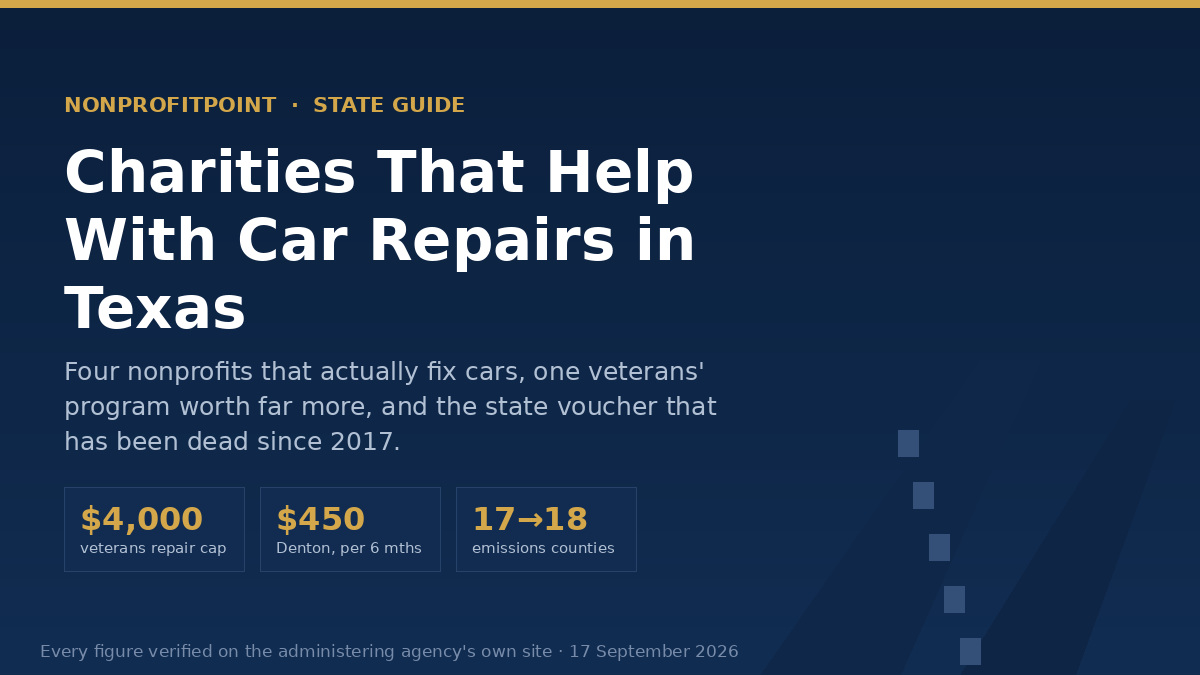
Texas is the state where the national “charities that help with car repairs” lists fall apart fastest. They send you to a Dallas nonprofit whose website is now a blank placeholder. They send you to a state voucher program that was killed by a line–item veto in 2017. They send you to the Salvation Army, which publishes no car repair program in Texas at all. And they quote a toll–free number that has been answering nobody since the Obama administration’s last full year.
What actually exists in Texas is narrower than those lists suggest and larger than you would guess — but it sits in places the lists never look. The single biggest pot of car–repair money in this state is a veterans’ program that will pay up to $4,000 on one vehicle. The second biggest is a workforce program that names “car repairs” in state policy and pays the mechanic directly, which almost nobody writing about this topic has read. Below those sit exactly four nonprofits that will put your car on a lift, and they are concentrated in Houston, Denton, Lubbock and Conroe.
Everything on this page — every dollar figure, eligibility rule, phone number, application route and open–or–closed status — was read off the administering agency’s or organization’s own website on 17 September 2026. Where a program is closed, this page says it is closed. Where an organization does not publish a dollar amount, this page says so rather than repeating a number somebody else invented. And where a widely–repeated claim about Texas is simply false, this page names it and shows the source that contradicts it.
The short version: where the money actually is
Ranked by how much a real person can actually receive, largest first.
| Route | Who it is for | Published amount | Status today |
|---|---|---|---|
| Texas Veterans Commission — Fund for Veterans’ Assistance | Veterans, dependents and surviving spouses who are named on the vehicle title | Up to $4,000 for necessary repairs (FY27 rules) | Open — apply through a local grantee, not TVC |
| Workforce Solutions support services (Choices/TANF, SNAP E&T, WIOA) | People already enrolled in an employment plan at a local board | Caps set by each of the 28 boards; TWC’s own worked example is $500 | Open — paid direct to the repair shop, never to you |
| Metro Auto Ministry (Denton / DFW) | Low–income drivers meeting any two of nine criteria | Up to $450 per repair, renewable every six months | Open — funding not guaranteed on any given day |
| God’s Garage (Conroe / greater Houston) | Single mothers, widows, wives of deployed military | Free repairs; no published cap | Open — limited seminar capacity gates applicants |
| Wrench It Forward (Lubbock / South Plains) | Households at or under 200% of the federal poverty guideline | Labor capped at $15/hour, parts at cost, free diagnosis | Open — posted income table is out of date, call first |
| One–Time TANF (Texas HHS) | Families in crisis who meet TANF eligibility | $1,000 unrestricted cash | Open — but this is not a car repair program, see below |
| AirCheckTexas “Drive a Clean Machine” | — | — | CLOSED. Defunded 2017. Still listed everywhere. |
| Texas counties and cities | — | — | Nothing published. No Texas county runs a vehicle repair benefit. |
If you read nothing else: there is no general–purpose government car repair program in Texas. The state had one, the Legislature never repealed it, and the governor vetoed its funding in 2017. Nothing replaced it. What is left is a veterans’ program, a workforce program you must already be enrolled in, four small nonprofits, and 2–1–1.
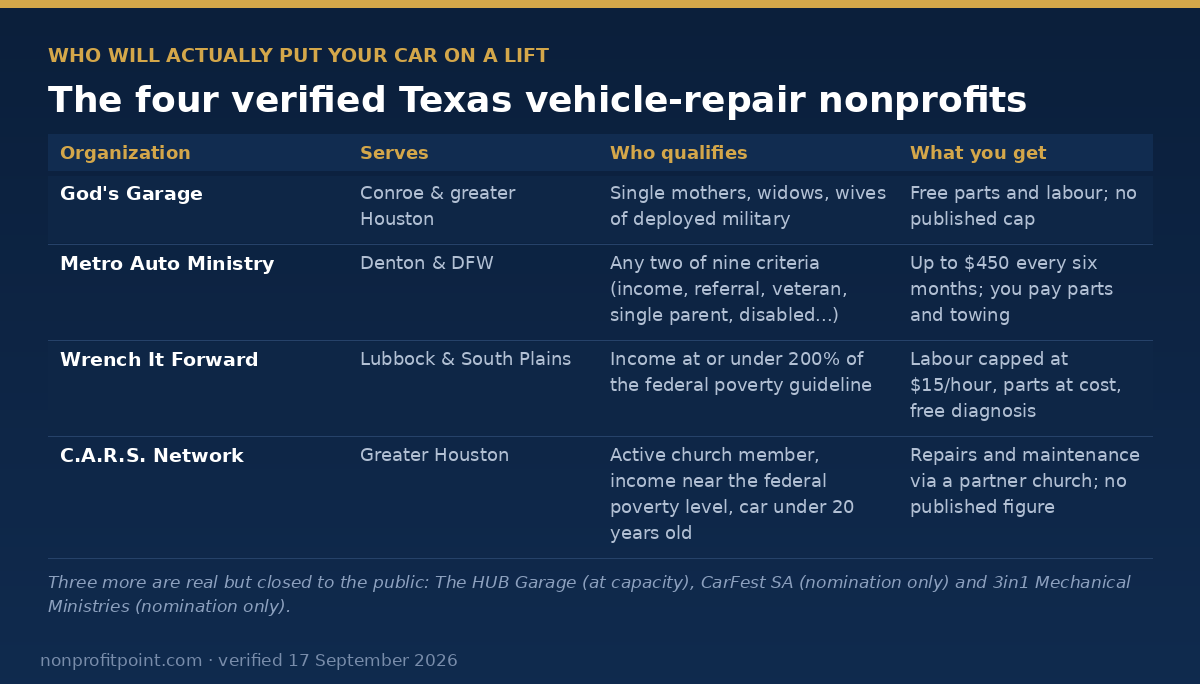
The four Texas nonprofits that will actually fix your car
These are the only organizations in Texas that publish a vehicle repair program on their own website, that are currently operating, and that an ordinary member of the public can approach directly. Everything in this section came off the organization’s own pages, not off a directory.
1. God’s Garage — Conroe and greater Houston
The most generous of the four, and the most tightly scoped. God’s Garage repairs cars and gives cars away, and it charges nothing for either: “No. We do not charge for labor or parts. Vehicles are gifted free of charge to qualifying applicants.”
Who qualifies. The published eligibility is narrow and specific — “We serve: Single mothers / Widows / Wives of deployed military personnel.” Applicants must have a valid driver’s license or state ID, demonstrated financial need, and “a willingness to participate in the required Restore U life–skills seminar.”
The bottleneck nobody mentions. The Restore U seminar is mandatory, and it is rationed: “Not all applicants are invited to this step due to limited capacity.” Applying is not the same as being served. Apply early and expect a queue.
How to apply. Online only, through the portal they call “The One,” at godsgarage.org/get–help. Have ready: photo ID, proof of income, proof of residence, vehicle registration if you are asking for repairs, and insurance.
Contact. 2100 E Davis St., Conroe, TX 77301. No phone number is published anywhere on their site — contact is contact@godsgarage.org or the web form, and they warn that “as a volunteer–led organization, response times may vary” with a typical reply inside two to three business days. Faith is not a condition of service: the organization states that assistance “is not dependent on a person’s faith background.” Registered with the IRS as Gods Garage Inc., Conroe, EIN 47–5406083.
2. Metro Auto Ministry — Denton and the DFW area
The only Texas organization on this list that publishes a hard dollar figure and a renewal cycle: “We cover up to $450 of your repair every six months you qualify.” You pay for parts, towing, and anything above the $450 — up front, before work starts.
What they cover. General diagnostics, belts, hoses and electrical, brake systems, fluid–leak detection, steering and suspension, and light transmission work. What they will not do: alignments, tires, oil changes on their own, engine replacements, full transmission replacements, head gaskets, turbos, or any body work.
Who qualifies. You must meet any two of nine published criteria: a referral from one of their 34 named partner organizations; full–time student also working 20+ hours a week; household median income under twice the federal poverty line; receiving any government assistance; job lost within the last month; veteran or active military; single parent; homeless; disabled.
How to apply. Web form only, at metroautoministry.org/request. You will need the VIN and your qualifying documents. Appointments run Tuesdays and Thursdays, 9am–2pm, booked about a week out.
Contact. Email only, and they are blunt about it — “we never answer calls.” metroautoministry@gmail.com. Read their funding warning before you plan around them: “We rely on fundraisers for all of our work — there is no guarantee we’ll have funds available for your repair at any given time.”
3. Wrench It Forward — Lubbock and the South Plains
A nonprofit repair shop rather than a grant program. You still pay — just far less. “Our standardized price is a maximum cost of $15.00 an hour for the labor plus the cost of the parts provided at no additional mark–up.” The initial diagnosis is free.
What they cover. Oil changes, brakes, suspension and steering, engine diagnostics, front end, starting and charging systems, fuel and exhaust. They are not equipped for major engine work, tires, transmission overhauls, body work or paint.
Who qualifies. Published verbatim: “You must be able to get your vehicle to our shop / Income must not exceed 200% of the Federal Poverty Guideline / Provide a valid driver’s license / Provide proof of current automobile insurance / Provide proof of ownership of vehicle (title or registration).”
A correction, printed rather than passed along. The income table on their application page is out of date and internally inconsistent. It shows a one–person household limit of $27,180, which is 200% of the 2022 federal poverty level, not the current one — so the real threshold today is higher than their page says, and people are likely self–rejecting who would qualify. The same table lists household size 7 at $83,820 and household size 8 at $83,260, which is arithmetically impossible. The organization itself is plainly operating: its most recent Form 990, for the year ending December 2024, was filed on 10 September 2025 (EIN 35–2583450). Call them; do not rely on the posted table.
Contact. 806–701–4568. 1111 31st Street, Lubbock, TX 79411. Applications to info@wrenchitforwardlbk.org or dropped at the shop.
4. C.A.R.S. Network (C.A.R.S. Ministry) — greater Houston
A church–channel model: you do not apply to C.A.R.S., you apply through a partner congregation or nonprofit. They provide “affordable preventive maintenance, vehicle inspections, and diagnostic services,” a mobile mechanic service, and donated vehicles.
Who qualifies. The published criteria are unusually specific, and one of them will disqualify a lot of readers: “Church Membership or Attendance: You must be actively attending or a member of a local church.” Also required — proof of income from the last 60 days; household income “at or no more than 20% above the Federal Poverty Level”; the vehicle registered in your name; “the vehicle cannot be more than 20 years old”; a valid driver’s license; and if the car is financed, payments current.
How to apply. “All guests interested in car repairs must first meet with the Care Coach at their local organization to determine eligibility.” If you are not connected to a church, they will connect you to a partner.
Contact. 407–209–2277, info@carsnetwork.org. Mailing address P.O. Box 34220, Houston, TX 77234. Note the area code: 407 is central Florida, not Houston — this is the number their own site publishes, but confirm it reaches the Texas operation before you rely on it. Affiliated with Bridge His Grace Ministry Inc., South Houston, EIN 82–2474767. Do not confuse this organization with “CARS Ministry” at carsministry.net, which is in Lakeville, Minnesota.
Real, but narrower than the lists claim
These five exist and do good work. None of them is a route an ordinary Texan can walk in and use today, and every list that presents them as one is setting readers up for a wasted week.
The HUB Garage (Hutto / Austin) — at capacity, and there is no public application
Their own page says “Unfortunately we are currently at capacity for recipients” and explains the model: “Normally, participating auto repair shops vet single moms that come into their existing locations for help.” Selection happens inside a partner shop. There is no form for the public, and no phone. Their headline figures — more than 800 vehicles repaired, an average repair cost of $1,890 — are real and impressive, and irrelevant to somebody who cannot get in the door this month.
CarFest SA (San Antonio) — nomination only, nominations closed
Substantial and genuine: 187 individuals and families given repairs, 80 cars given away, $705,000 in scholarships. But “Only registered 501(c)(3) non–profits are eligible to submit nominations,” and the nominations page currently reads “CLOSED AT THIS TIME.” Individuals cannot apply. Their site also carries contradictory scheduling — the repair–program page says nominations open 1 January 2026 while the footer still advertises an April 2026 event that has already passed — so treat any published window as unconfirmed. If you are in San Antonio and in need, the useful move is to ask a nonprofit that already serves you to nominate you when the window reopens.
3in1 Mechanical Ministries (Houston) — gifts cars, does not run a public repair program
Verbatim: “We do not accept clients directly from the community. Rather, we serve clients who are nominated to us through our partner organizations.” Their partners serve survivors of trafficking, young adults who have aged out of foster care, and people rebuilding after incarceration. Their own impact numbers are 20 clients served across 9 ministry partners — a small, focused operation, not a Houston–wide repair resource.
Texas Workforce Solutions – Vocational Rehabilitation Services — modification, not repair
VR publishes “modification for your vehicle tailored to help your disability” and transportation help including bus–pass vouchers. That is adaptive equipment for a disability that is a barrier to employment, delivered through an employment plan. It is not a general mechanical repair benefit, and listing it as one — as several roundups do — wastes the time of disabled Texans with a broken alternator. Statewide line 512–936–6400.
Memorial Assistance Ministries (Houston) — transportation listed, repair unspecified
MAM’s published program list includes “Other Emergency Help (Medical, Transportation, Household/Clothing),” which is as close as any Houston social–service agency gets to naming this need — but nothing on their site says car repair and no dollar figure is published. Service area is 23 specified ZIP codes, there is no online application, and they warn that “coming in person is not a guarantee of enrollment, financial assistance, or resources.” 1625 Blalock Rd, Houston, TX 77080. (713) 468–4516.
The largest car repair money in Texas is a veterans’ program — up to $4,000
The Texas Veterans Commission runs the Fund for Veterans’ Assistance (FVA), which makes grants to local organizations that then deliver direct financial assistance. Its General Assistance rules name vehicle repair explicitly and attach the largest published figure of any car–repair route in this state.
From the FY27 grant program requirements — the rules governing grants operating right now — verbatim:
“Transportation Assistance (Vehicle): cost to provide fuel not to exceed 3 months, necessary repairs not to exceed $4,000, insurance, and loan payments not to exceed a 3–month period or $3,000 to beneficiaries’ primary vehicle. These payments are per beneficiary household per grant period to allow safe travel in support of basic needs, work, school, medical appointments. General maintenance is not allowable.”
Texas Veterans Commission, Fund for Veterans’ Assistance, Annex B: Fiscal Year 2027 Grant Program Requirements, Appendix 1: General Assistance Grant Program, Version 1.1, published 19 August 2026
Who is eligible. “Eligible Beneficiaries: Veterans, Dependents, Surviving Spouses; & can demonstrate financial need.” Note the second half — the FY2024–25 version of the same document did not include the financial–need qualifier. It does now.
The requirement that disqualifies most people who get this far. “The client must be the person named on mortgage, rent, utility, loan, vehicle title, or other bill/invoice presented for financial assistance.” If the car is titled to your spouse, your parent or your adult child and not to the veteran, this route closes. Sort the title before you apply, not after.
“General maintenance is not allowable” appears verbatim in every version of this document going back to 2024. Brakes that have failed are a repair; a scheduled service is maintenance. Bring a diagnosis, not a service schedule.
You do not apply to TVC. You apply to a grantee.
This is the step almost every article on this subject gets wrong. TVC is a grant–maker; it does not write checks to veterans. You apply to an organization that holds an FVA grant in the Financial Assistance category and serves your county.
FY27 Financial Assistance grantees, awarded 21 May 2026, include: Catholic Charities Archdiocese of San Antonio ($300,000), Catholic Charities of Central Texas ($275,000), the City of Fort Worth ($340,000), the City of Dallas ($150,000), the Department of Texas VFW Foundation ($400,000), Hidalgo County Community Service Agency ($400,000), Family Pathfinders of Tarrant County ($136,000), Goodwill Industries of Central Texas ($200,000), Houston Area Urban League ($250,000), Northwest Assistance Ministries ($200,000), Katy Christian Ministries ($200,000), Easter Seals of Greater Houston ($100,000), Caritas of Austin ($116,000), Caritas of Waco ($175,000), Haven for Hope of Bexar County ($115,000), PTSD Foundation of America ($300,000), Semper Fi & America’s Fund ($300,000), Texas Neighborhood Services ($250,000), The Salvation Army–Abilene ($200,000), Hope for the Warriors ($200,000) and the National Guard Association of Texas ($250,000), alongside county Veteran County Service Officer grants in Bell, Cameron, Cass, El Paso, Harris, Hays, Montgomery, Polk, Trinity, Willacy, Williamson, Wilson, Zapata, Bee, Caldwell and San Patricio counties.
Note carefully: The Salvation Army does not run a car repair program in Texas — but its Abilene command holds an FVA Financial Assistance grant, which is a different thing and applies only to veterans. A separate group of FVA Transportation Services grantees (Burnet County, the City of El Paso, East Texas Council of Governments, Val Verde County, Webb County) provides rides, not repairs. Do not confuse the two categories.
Find your grantee through the TVC directory, or call TVC at 512–463–1157 and ask which Financial Assistance grantee covers your county. Award amounts are published; how much of each grant remains unspent is not, so call before you plan.
The cap is dropping. If you are a Texas veteran with a broken car, this matters.
TVC published its FY28 requirements on 16 September 2026 — the day before this page was written — and the vehicle provision has been rewritten:
“Vehicle Assistance: Assistance for the primary privately owned vehicle, consisting of fuel, insurance, loan payments, including late fees, and necessary repairs not to exceed 3 months or $3,000. These payments are per beneficiary household per grant period to allow safe travel in support of basic needs, work, school, and medical appointments. General maintenance is not allowable.”
TVC, Fund for Veterans’ Assistance, Annex B: Fiscal Year 2028 Grant Program Requirements, Appendix 1: General Assistance Grant Category, published 16 September 2026
Read the two side by side and the change is structural, not just a smaller number. Under FY27, repairs carry their own dedicated $4,000 ceiling and insurance and loan payments are capped separately at $3,000. Under FY28, fuel, insurance, loan payments and repairs are folded into one list governed by a single trailing limit of $3,000. We are not going to assert the combined reading as settled — the sentence is ambiguously drafted and TVC has not published a clarification, which is exactly why the bullet is quoted above in full rather than paraphrased. If the combined reading is right, the practical reduction for a veteran needing repairs is far bigger than “$4,000 to $3,000” suggests.
What is not ambiguous is the timing. Texas fiscal years run 1 September to 31 August. FY27 rules govern until 31 August 2027; FY28 grants have not been awarded yet. For anyone reading this in 2026 or the first eight months of 2027, $4,000 is the operative number — and there is a real argument for not waiting.
The route almost nobody writes about: Workforce Solutions support services
Texas state workforce policy names car repair as an allowable support service, repeatedly and explicitly, across three separate programs. This is the second–largest source of car–repair money in the state and it is almost entirely absent from the articles that rank for this topic.
From the TWC Choices Guide (September 2024), section B–704, the list of participation activity–related expenses includes, verbatim: “Tools · Uniforms · Equipment · Transportation · Car repairs · Housing or moving expenses · Cost of vocationally required examinations or certificates.”
Section B–1107 tells the 28 local boards what their transportation policies must cover, verbatim: “Vehicular (repair, insurance, registration, inspection and consumables, such as tires)” — and then requires them to set limits: “Boards must establish financial caps based on type of support — vehicle repair, prepaid gas cards, bus passes — and time period — week, month, or quarter.”
TWC Technical Assistance Bulletin 293 (14 January 2020) lists it program by program. Allowable for SNAP E&T recipients: “Minor car repairs.” Allowable for TANF/Choices and WIOA customers: “Minor car repairs,” plus “Car insurance,” “Vehicle inspection fees,” “Contracting with private organizations or services to refurbish previously owned cars,” and “Financial support (loans or grants) that enables customers to purchase a vehicle.” The same bulletin carves out a limit worth knowing: “Car insurance, vehicle inspection fees, and vehicle registration fees are not allowable transportation services for SNAP E&T customers” — repairs still are.
Four rules that decide whether you get paid
- You must already be enrolled. Car repair here is a support service attached to an active employment plan — Choices/TANF, SNAP Employment & Training, or WIOA. You cannot walk into a Workforce Solutions office and request a repair grant on its own. If you are on SNAP or TANF and not yet in an employment program, that enrollment is the first call.
- You must own the car. Boards are required to “require participants to demonstrate ownership of a vehicle before any payment of expenses for repairs, insurance, or registration.” If the vehicle belongs to someone else, policy requires “a hold harmless agreement or other protection… signed by the vehicle owner” before repairs proceed.
- The money never touches your hands. Verbatim: “Ensure that prepayment for a customer’s vehicle repairs is prohibited… payable directly to the vendor after completion of repairs and receipt of invoice.” Expect the board to pay the shop, after the work, against an invoice.
- The cap is local, and it is probably not published. TWC requires every board to set one but does not set a statewide figure. TWC’s own worked example, verbatim: “For example, customers may receive up to $500 for car repairs or other expenses related to car maintenance with approved documentation. The maximum amount may be adjusted if the customer provides justifiable proof of need.” That $500 is an illustration TWC offers boards, not a Texas entitlement. Anyone telling you “Texas pays $500 for car repairs” has misread this sentence.
The one Texas board that publishes its actual numbers
Of the 28 local boards, Workforce Solutions Coastal Bend is the only one we could find publishing a support–service table with dollar figures on its public website. Its policy 4.0.101.07 lists car repairs at a “Maximum — up to $500; Limited to minor repairs. One–Time Expense; Requires verification of need from vendor,” auto insurance at “$100; One–time expense,” and travel at a rate “not to exceed $15.00 per day.”
Its scope language is the clearest published statement in Texas of what “minor repairs” means: “Car repairs will be approved only for repairs that would allow a vehicle to be operable and safe to drive. Repairs may include: replacing worn out tires, brakes, batteries, and other essential parts. A guideline to consider in evaluating these repairs is those that are essential for passing a vehicle state inspection.” Excluded: “major repairs such as: replacing air conditioning compressors or major engine/transmission overhauls.” Procurement requires “three (3) written bids.”
One honest caveat. That published policy is dated effective 31 October 2014 and no newer version is posted. It is genuinely published and it is genuinely old. Use it as evidence that this route is real and as a guide to what boards ask for — then call your own board and ask for its current cap. Workforce Solutions Greater Dallas, Gulf Coast, Capital Area and Alamo all maintain these policies internally, as TWC requires, but none of them publishes the dollar figures.
What Texas will not do — and the claims that say otherwise
Texas TANF does not pay for car repairs
One–Time TANF is real and it is worth knowing about. The Texas Works Handbook, section A–2410, verbatim: “One Time Temporary Assistance for Needy Families (OTTANF) provides $1,000 cash assistance for families in crisis.” Applicants must “meet all TANF eligibility requirements; and not currently receive TANF.” A companion $1,000 One–Time TANF for Relatives payment sits in section A–2420.
Neither section mentions car repair, vehicle repair or transportation anywhere. It is unrestricted cash for a family in crisis, and a recipient could of course spend it on a transmission — but it is not a car repair benefit and the crisis criteria that open the door are household events such as loss of employment or loss of a child’s financial support, not a broken car. Articles that describe Texas TANF as a repair fund send readers to HHSC when the car–repair authority in this state sits with TWC, a different agency entirely. Apply at YourTexasBenefits.com, or call 2–1–1 and choose option 2.
No Texas county or city publishes a vehicle repair benefit
We checked Harris, Bexar, Travis and Tarrant counties directly, plus the statewide county assistance framework. Travis County Health and Human Services publishes exactly six assistance categories — food pantry, utilities, home repair (“roofing, HVAC, electrical & plumbing systems, septic systems”), home weatherization, social work and case management, and burial services. No vehicle repair, no transportation.
The County Indigent Health Care Program, the statutory Texas county assistance vehicle that listicles occasionally gesture at, covers “Vaccines, Medical screening services, Annual physical examinations, Inpatient and outpatient hospital visits, Laboratory and radiology, Skilled nursing facility services.” It is a medical program. Car repair is categorically outside it.
The closest thing to a municipal car–repair benefit in Texas is the City of Fort Worth’s $340,000 and the City of Dallas’s $150,000 FVA Financial Assistance grants — and those are veterans–only, state–funded pass–throughs, not city programs.
Community Action Agencies: caseworker discretion, not a published program
We checked six Texas Community Action Agency and CSBG websites and found no published vehicle–repair language on any of them. That does not mean a CAA has never paid for a repair — CSBG dollars are flexible and caseworkers have discretion — but it does mean nobody should tell you this is a program you can apply to. Ask your local CAA; do not count on it.
The programs still ranking on Google that no longer exist
AirCheckTexas “Drive a Clean Machine” is closed, and the $600 voucher is gone
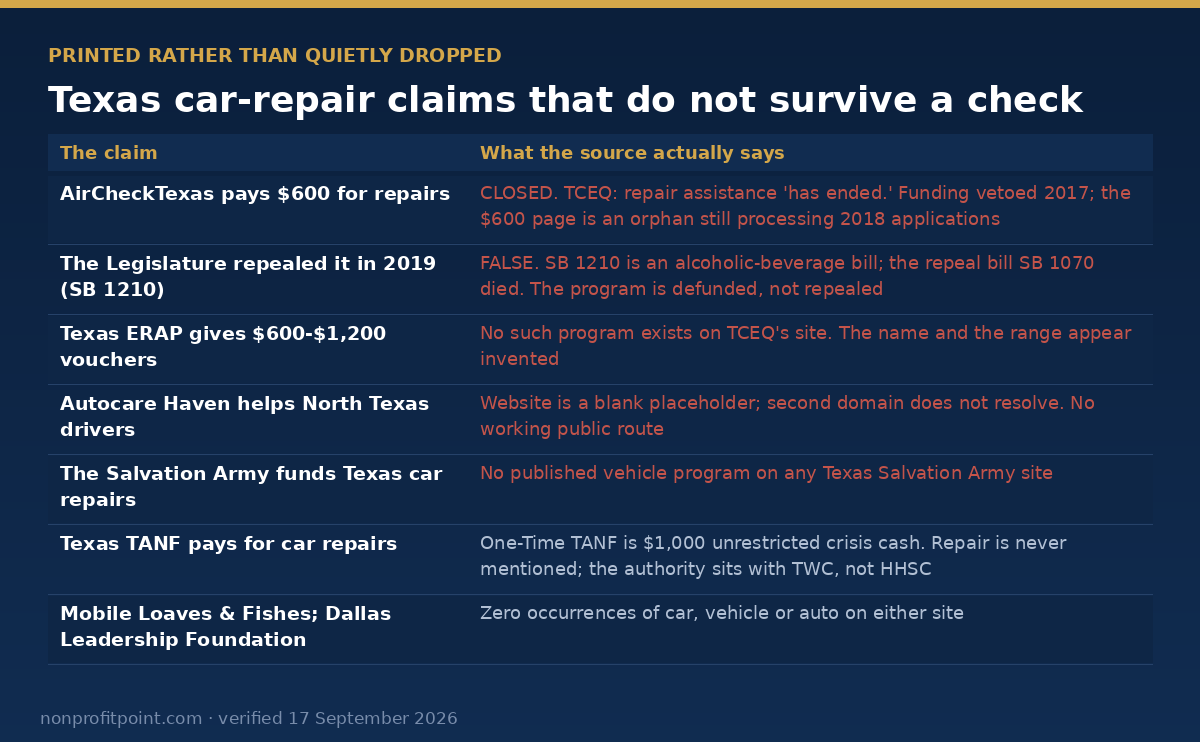
This is the single most–repeated false claim about car repair help in Texas. The Texas Commission on Environmental Quality’s own page, last updated 24 October 2025, states it plainly: “Vehicle repair assistance through the AirCheckTexas Drive a Clean Machine Program has ended.” A companion TCEQ page adds that repair and replacement assistance have both ended, and redirects motorists to “waivers… available for eligible motorists through the Texas Department of Public Safety.”
The North Central Texas Council of Governments, which administered the program across the DFW counties, explains why, verbatim:
“During the 85th Legislative Session in 2017, funding for the AirCheckTexas Drive a Clean Machine Program was vetoed… Since then, the program has operated on previously collected funds. As of this time, no additional funding has been secured; thus, program operations have closed.”
North Central Texas Council of Governments
Governor Abbott line–item vetoed roughly $87 million from the program in the 2017 budget. The Houston–Galveston Area Council’s program page is now a 404; its last application day was in April 2019.
Here is where the bad information comes from, specifically. An orphaned legacy page still sits live on an NCTCOG subdomain advertising exactly the figures you see quoted across this niche — a repair voucher “up to $600,” a replacement voucher “up to $3,500,” a nine–county eligibility list, and a toll–free application line. Its own text gives it away: it announces that it is “currently processing: REPLACEMENT applications received on: February 22, 2018” and carries a footer stamp reading “10/01/2015 – 02/01/2017.” Aggregators scrape it, never check the date, and republish an eight–year–old page as current help. Do not call that number. Do not fill in that form. There is nothing at the other end.
The Legislature never actually repealed the program — a correction to the correction
A second layer of misinformation has grown on top of the first: that the Texas Legislature repealed the repair assistance program in 2019 under Senate Bill 1210. Both halves are wrong, and the record is easy to check. SB 1210 of the 86th Legislature is an alcoholic–beverage bill — its caption reads “Relating to the removal, destruction, and disposal of certain alcoholic beverages that become unfit for consumption after a natural disaster.” The bill that would have repealed the program, SB 1070, died: its last recorded action on 14 May 2019 is “Not again placed on intent calendar.”
So the Low–Income Vehicle Repair Assistance, Retrofit and Accelerated Vehicle Retirement Program remains on the books in Health and Safety Code §382.209, and TCEQ amended rather than repealed its implementing rules in 2024. It is defunded and dormant, not repealed. The practical consequence for you today is identical — there is no money and no application — but the distinction matters for anyone watching whether a future Legislature restores funding to a program that still legally exists.
“Texas Emissions Repair Assistance Program (ERAP)” does not exist
A claim circulating on at least one site describes a “Texas Emissions Repair Assistance Program” issuing $600 to $1,200 vouchers in Harris, Dallas, Tarrant, Travis and El Paso counties. A site–restricted search of tceq.texas.gov returns nothing under that name. TCEQ’s actual programs are TERP, which funds heavy–duty and commercial fleet projects rather than consumer repairs, and the closed AirCheckTexas. The program name and the dollar range appear to be invented.
Autocare Haven’s website is gone
Autocare Haven was the flagship North Texas free–repair nonprofit, covered by NPR and KERA in 2023 and cited in most directories that mention Texas at all. As of 17 September 2026, autocarehaven.org returns a blank placeholder page containing nothing but the domain name repeated three times; the donate page 404s and the organization’s second domain does not resolve at all. Any directory still listing Autocare Haven as an active Texas resource is citing a dead website. We are not declaring the organization defunct — we cannot see inside it — but there is currently no working route for a member of the public to reach it.
Organizations commonly listed for Texas car repair that do not offer it
| Named on other sites | What their own website actually says |
|---|---|
| The Salvation Army (Texas) | No published car repair program in any Texas division. The North Texas services page lists twelve programs, none automotive. Zero vehicle–assistance language across the state, North Texas, Houston and Austin sites. |
| St. Vincent de Paul (Dallas, Houston, San Antonio) | No car repair. Published help is rent, utilities, food, prescription medication, budgeting. The only vehicle item anywhere is “Donate Your Vehicle.” |
| Catholic Charities Dallas / Fort Worth / Galveston–Houston / Central Texas | No vehicle repair program at any of the four. Fort Worth runs a low–cost ride fleet, not repairs. Dallas’s only automotive item is “Vehicle Donations.” |
| Christian Community Service Center (Houston) | Named specifically by at least one 2026 listicle. Their own published help is rent, utilities and medical assistance. Zero vehicle language sitewide. |
| Mobile Loaves & Fishes; Dallas Leadership Foundation | Both named in a 2026 roundup as Texas car–repair helpers. Zero occurrences of “car,” “vehicle” or “auto” on either site. The claim is fabricated. |
| Cars4Christmas | cars4christmas.org currently reads “Coming Soon… We’re under construction.” No program content, no Texas presence. |
| Wheels for Wishes | A car donation intake operation benefiting Make–A–Wish. It does not repair anyone’s car. |
| Mission Waco, Buckner International, Interfaith Ministries, Family Eldercare | All checked; none publishes vehicle repair help. |
| “St. Vincent de Paul car repair assistance” page ranking for Texas | It is the Holy Spirit Conference in Virginia. Everything it lists is Virginia–only and references Virginia vehicle registration. |
| Texas “Wheels to Work” | Real rule, but it provides automobiles to Choices–eligible workers who cannot otherwise keep a job. It is not a repair authorization. (Repair money for the same population comes through support services — see above.) |
| On the Road Lending (Dallas) | Real and Texas–based, but it makes car loans, not repairs, and requires monthly take–home pay of $2,000 or more. |
| Freewheels Houston | Repairs bicycles. Genuinely useful, entirely unrelated. |
The Texas inspection rules changed — and they are about to change again
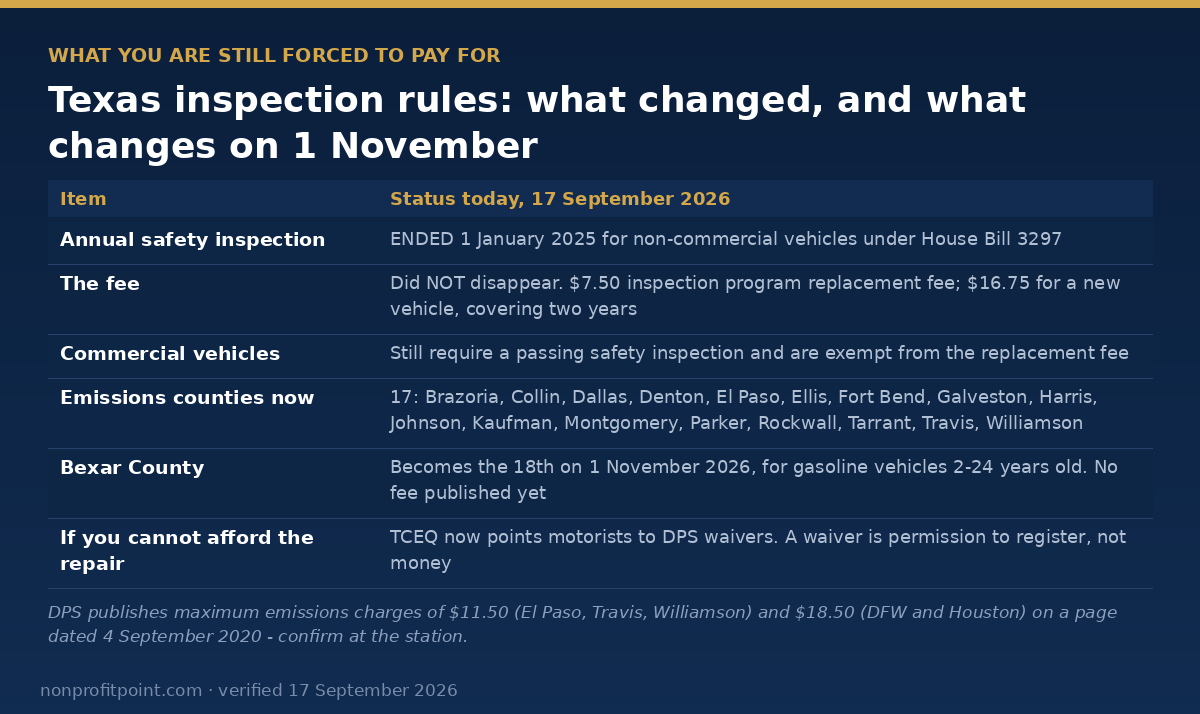
This is not a repair program, but it decides what a low–income Texan is actually forced to pay for, and almost every page on this topic is out of date about it.
Annual safety inspections for non–commercial vehicles ended on 1 January 2025 under House Bill 3297. The Department of Public Safety confirms the change and the cost: non–commercial vehicles now pay a “$7.50 inspection program replacement fee per HB 3297,” and new vehicles pay “$16.75 to cover two years.” Commercial vehicles still require a passing safety inspection and are exempt from the replacement fee.
Two opposite misreadings are circulating and both are wrong. The fee did not disappear — it was renamed. And safety inspections ending did not end emissions testing.
Seventeen Texas counties still require an emissions test, grouped by TCEQ as follows:
- Houston–Galveston–Brazoria: Brazoria, Fort Bend, Galveston, Harris, Montgomery
- Dallas–Fort Worth: Collin, Dallas, Denton, Ellis, Johnson, Kaufman, Parker, Rockwall, Tarrant
- Austin: Travis, Williamson
- El Paso: El Paso
Bexar County becomes the eighteenth on 1 November 2026. DPS states it directly: “Bexar County will begin emission inspections on Nov 1st, 2026,” applying to “gasoline powered vehicles 2–24 years old in Bexar County.” If you are in San Antonio, a failing emissions system becomes a registration problem for the first time in six weeks. Any page that says “17 counties” without a date, or “18” as though it is already live, is wrong for part of the year.
On cost: DPS publishes maximum emissions–test charges of $11.50 in El Paso, Travis and Williamson and $18.50 in the DFW and Houston areas. That fee page carries a date of 4 September 2020, so treat the amounts as indicative and confirm at the station. No Bexar County fee has been published ahead of the November start, and we are not going to guess one by analogy with another region.
If you cannot afford the emissions repair, ask DPS about a waiver. With the repair assistance program gone, TCEQ’s own closed–program pages now point motorists to DPS waivers as the remaining route. That is not money; it is permission to register a car you cannot yet afford to fix. In a state with no repair fund, it is frequently the difference between keeping a job and losing one.
Where Texas has nothing: the honest coverage map
We searched each major metro by name, by program type, by “garage ministry” and “auto ministry” phrasing, and through the IRS nonprofit registry by organization name. Here is what the verified Texas map looks like:
| Region | Verified vehicle–repair nonprofit? |
|---|---|
| Greater Houston / Conroe | Yes — God’s Garage, C.A.R.S. Network, and 3in1 (nomination only) |
| Denton / DFW | Yes — Metro Auto Ministry |
| Lubbock / South Plains | Yes — Wrench It Forward |
| Austin area | The HUB Garage only, and it is at capacity with no public application |
| San Antonio | CarFest SA only, nomination–only and currently closed |
| Fort Worth proper | None found |
| El Paso | None found |
| Rio Grande Valley | None found — Catholic Charities RGV mentions aid that “could include transportation,” with no program, criteria or figure |
| Corpus Christi | None found — but this is the one region whose workforce board publishes its car–repair cap |
| Tyler / Longview, Waco, Amarillo | None found |
Every search result for the regions marked “none found” traced back to a national aggregator, a car–donation intake site, or an out–of–state organization. That absence is the finding. It is more useful to a reader in McAllen or El Paso than a fabricated local listing would be, because it tells them to stop searching for a charity and start working the three routes that do reach every county in Texas: the veterans’ program if they qualify, a Workforce Solutions employment plan, and 2–1–1.
Several IRS–registered Texas nonprofits carry names that suggest exactly this work — Indigent Car Care in Longview, Hope Garage and Cars At Owens Garage in Cedar Park, Wheels of Giving in Dallas, Give A Ride and Wheels Is Necessary in Houston, Farvas Auto Repair in San Antonio. None of them has a locatable website or published program, and Indigent Car Care has no Form 990 on record at all. We are naming them here so that a reader in one of those towns can make a phone call we could not — not listing them as resources.
2–1–1 Texas: what it is and what it is not
2–1–1 Texas, a program of the Texas Health and Human Services Commission, runs “24 hours a day, 7 days a week, 365 days a year” and is reachable by dialling 2–1–1 or toll–free on (877) 541–7905, with live chat in English and Spanish.
It is a referral database, not a fund. There is no statewide 2–1–1 car repair money. What it can do is tell you which local agency, church or community action office near you has discretionary dollars this month — which changes constantly and is precisely the information no article can give you. Set your expectations accordingly: call it early, call it more than once, and ask specifically for “transportation assistance” and “vehicle repair,” which are separate categories in their database.
How to actually get a yes in Texas
- Start with the title. Both of the largest routes in this state — the veterans’ program and Workforce Solutions — require the applicant to be the registered owner. If the car is titled to a relative, fix that before you apply anywhere, or be ready with a signed hold–harmless from the owner.
- If anyone in the household is a veteran, a dependent or a surviving spouse, go there first. Up to $4,000 through an FVA grantee dwarfs every other option, and the cap is set to fall on 1 September 2027. Call TVC on 512–463–1157 and ask for the Financial Assistance grantee covering your county.
- If you receive SNAP or TANF, ask about the employment program, not the repair. The phrase that opens the door at a Workforce Solutions office is not “can you fix my car” — it is “I want to enrol in Choices / SNAP Employment and Training, and I need transportation support services.” Car repair is a support service attached to a plan.
- Get a written diagnosis and an itemised estimate before you ask anyone for money. Coastal Bend requires three written bids; TWC requires an invoice; the veterans’ program distinguishes repair from maintenance. A diagnosis makes you fundable in a way “my car is broken” does not.
- Expect payment to go to the shop, not to you. Prepayment is prohibited across TWC programs. Choose a shop willing to wait for an invoice to be paid by a third party, and tell them that at the counter.
- If you are in an emissions county and the failure is emissions–related, ask DPS about a waiver in parallel. It will not pay for the repair, but it can keep you registered and driving while you work the funding.
- Do not stop at one no. Every one of the four verified nonprofits warns, in its own words, that funding is intermittent. Metro Auto Ministry renews eligibility every six months. CarFest SA reopens nominations annually. A no in September is not a no in January.
Frequently asked questions
Are there charities that help with car repairs in Texas?
Four, and they are regional rather than statewide: God’s Garage in Conroe (single mothers, widows and wives of deployed military), Metro Auto Ministry in Denton (up to $450 every six months), Wrench It Forward in Lubbock (a nonprofit shop charging a maximum of $15 an hour for labour plus parts at cost), and the C.A.R.S. Network in Houston (accessed through a partner church). Three more — The HUB Garage, CarFest SA and 3in1 Mechanical Ministries — are real but cannot be approached directly by the public. Large parts of Texas, including El Paso, the Rio Grande Valley, Waco, Amarillo and Tyler, have no verified vehicle–repair nonprofit at all.
Does Texas have a government program that pays for car repairs?
Not a general one. The state’s repair assistance program, AirCheckTexas Drive a Clean Machine, closed after its funding was vetoed in 2017 and nothing replaced it. Two targeted routes remain: the Texas Veterans Commission’s Fund for Veterans’ Assistance, which allows up to $4,000 in necessary repairs under its FY27 rules for veterans, dependents and surviving spouses named on the vehicle title; and support services at the 28 local Workforce Solutions boards, which name car repair as allowable for people enrolled in Choices/TANF, SNAP Employment & Training or WIOA.
Is AirCheckTexas still available in 2026?
No. The Texas Commission on Environmental Quality states on its own page that “vehicle repair assistance through the AirCheckTexas Drive a Clean Machine Program has ended.” The North Central Texas Council of Governments confirms that funding was vetoed in 2017 and that “program operations have closed.” An orphaned legacy page still advertising a $600 repair voucher, a $3,500 replacement voucher and a toll–free application line remains live on a regional subdomain, which is where most of the outdated listings come from. It has been processing nothing since 2018.
How much will the Texas Veterans Commission pay toward a car repair?
Up to $4,000 for necessary repairs to a beneficiary’s primary vehicle under the FY27 General Assistance rules, per beneficiary household per grant period, with fuel capped at three months and insurance and loan payments capped separately at three months or $3,000. General maintenance is excluded. You apply through a local FVA grantee rather than to TVC directly. Under the FY28 rules published on 16 September 2026, fuel, insurance, loan payments and repairs are combined under a single limit of three months or $3,000 — a reduction that takes effect on 1 September 2027.
Will Workforce Solutions pay for my car repair in Texas?
It can, if you are already enrolled in an employment program. State policy lists “car repairs” as an allowable participation expense in the Choices Guide and “minor car repairs” as allowable for SNAP Employment & Training, TANF/Choices and WIOA customers. Each of the 28 local boards sets its own cap; TWC’s illustrative example is $500, which is an example rather than a statewide entitlement. You must own the vehicle, prepayment is prohibited, and payment goes directly to the repair shop against an invoice.
Does Texas TANF cover car repairs?
No. One–Time TANF provides $1,000 in unrestricted cash assistance to families in crisis who meet TANF eligibility and are not currently receiving TANF. Neither that policy section nor its companion mentions vehicle repair or transportation, and the qualifying crises are household events such as loss of employment rather than a broken car. The car–repair authority in Texas sits with the Texas Workforce Commission, not with Health and Human Services.
Do Texas counties help with car repairs?
No Texas county or city publishes a vehicle–repair benefit. We checked Harris, Bexar, Travis and Tarrant directly. Travis County’s six published assistance categories include home repair but not vehicle repair. The County Indigent Health Care Program, sometimes cited in this context, is a medical program covering vaccines, screenings, hospital visits and skilled nursing — nothing automotive. The nearest exceptions are the City of Fort Worth and City of Dallas, which hold state veterans’ grants, not municipal repair funds.
Does Texas still require a vehicle inspection?
Annual safety inspections for non–commercial vehicles ended on 1 January 2025 under House Bill 3297, but the fee did not go away — it became a $7.50 inspection program replacement fee, or $16.75 covering two years for a new vehicle. Commercial vehicles still require a passing safety inspection. Seventeen counties still require emissions testing, and Bexar County becomes the eighteenth on 1 November 2026 for gasoline–powered vehicles two to twenty–four years old.
What if I cannot afford to fix an emissions failure in Texas?
With the state repair assistance program closed, TCEQ now directs motorists to the Texas Department of Public Safety, noting that “waivers may be available for eligible motorists.” A waiver does not pay for the repair; it can allow you to register the vehicle. Pursue it alongside a funding application rather than instead of one, because it buys time rather than solving the underlying failure.
Does the Salvation Army help with car repairs in Texas?
Not as a published program. We checked the Texas, North Texas, Houston and Austin Salvation Army sites and found no vehicle–assistance language on any of them; the North Texas services page lists twelve programs, none automotive. One exception is easy to misread: the Salvation Army’s Abilene command holds a Texas Veterans Commission Financial Assistance grant, which can reach vehicle repairs — but only for veterans, dependents and surviving spouses, and only through that program’s rules.
Related help
How we verified this guide. Every program, dollar figure, eligibility rule, phone number and open–or–closed status on this page was read off the administering agency’s or organization’s own website on 17 September 2026. State material comes from the Texas Commission on Environmental Quality’s vehicle inspection and maintenance pages (last updated 24 October 2025 and 2 February 2026), the Department of Public Safety’s HB 3297 and Bexar County notices, the Texas Works Handbook sections A–2410 and A–2420, the Texas Workforce Commission’s Choices Guide of September 2024, Technical Assistance Bulletin 293 of 14 January 2020 and WD Letter 07–17 Change 1 of 18 March 2024, the published support–services policy of Workforce Solutions Coastal Bend, and the Texas Veterans Commission’s Fund for Veterans’ Assistance Annex B appendices for FY2024–25, FY27 and FY28. Legislative history was checked against Texas Legislature Online. Nonprofit material comes from each organization’s own site; registration and filing status were checked against IRS records. Several corrections are printed here rather than quietly absorbed: AirCheckTexas is closed and the $600 voucher still circulating comes from an orphaned page that has been processing nothing since 2018; the program was defunded by veto in 2017 and never repealed, contrary to a widely repeated claim about Senate Bill 1210, which is an alcoholic–beverage bill; the “Texas Emissions Repair Assistance Program” does not exist; Autocare Haven’s website is now a blank placeholder; the Salvation Army, St. Vincent de Paul, Catholic Charities, Christian Community Service Center, Mobile Loaves & Fishes and Dallas Leadership Foundation publish no Texas car–repair program despite being listed for one; and Wrench It Forward’s posted income table is based on 2022 poverty guidelines and contains an arithmetic error, so readers are told to call rather than self–reject. Where a figure is not published — God’s Garage’s repair cap, the C.A.R.S. Network’s assistance amount, the car–repair caps of the Dallas, Gulf Coast, Capital Area and Alamo workforce boards, the Bexar County emissions test fee — this page says it is not published rather than filling the gap. Program funding is appropriated annually, nonprofit funds run out without notice, and application windows close quietly; confirm status by phone before you commit to a repair.