Charities That Help With Rent in Washington State: 40+ Real Programs (2026)

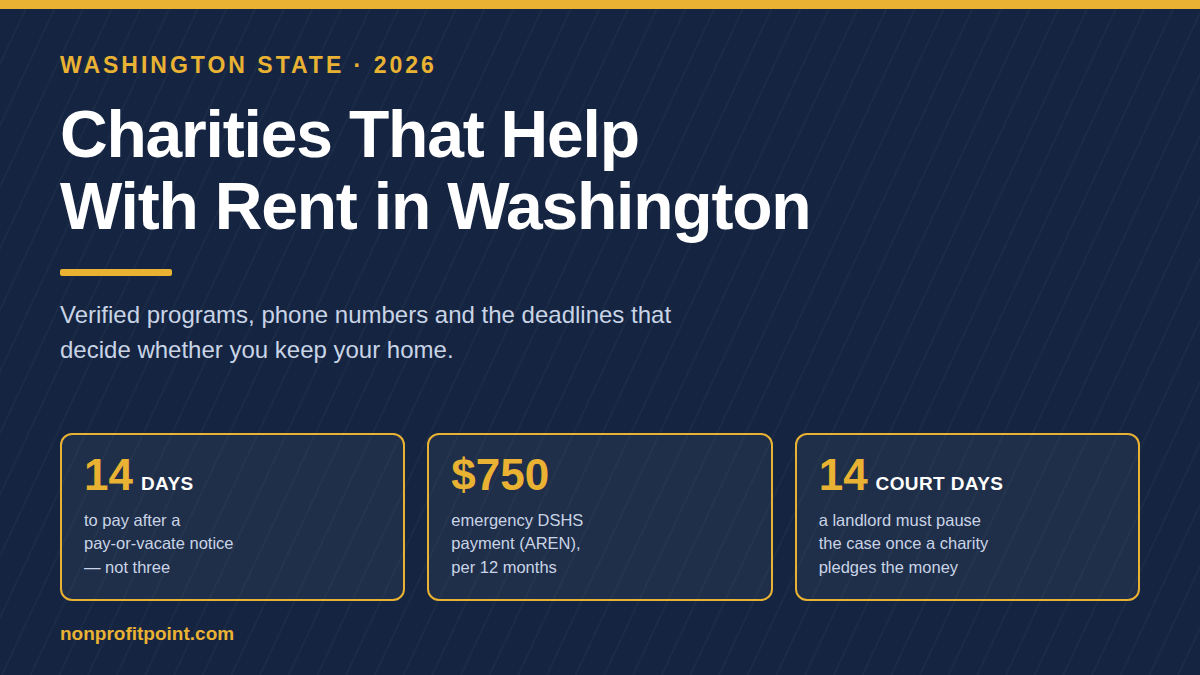
Start with the sentence that makes most Washington rent guides wrong. If you rent a home or apartment in Washington and you are behind on rent, your landlord must give you 14 days to pay, not three. The three-day figure still printed on dozens of “rent help” pages comes from RCW 59.12.030(3), and the same sentence that contains it says the period is “14 days after service for tenancies under chapter 59.18 RCW.” Chapter 59.18 is the Residential Landlord-Tenant Act. That is you. Anyone quoting you three days is describing a rule for tenancies that are not residential, and is stealing eleven days you are entitled to.
The second thing is the single most valuable fact on this page, and almost nobody publishes it. Under RCW 59.18.410(2), if you can get a written pledge of emergency rental assistance from a government agency or a nonprofit, your landlord “shall accept” it — before the pay-or-vacate notice expires, and also after it expires if the pledge contributes to the total owed. More than that: the landlord “shall suspend any court action for 14 court days” after giving the charity the payment information, so the money has time to arrive. And where you have a pledge letter, the deadline to reinstate your tenancy stops being five court days after judgment and instead runs “until the date of eviction.” A pledge letter is not a favour. It is a statutory trump card, and the whole point of the phone list below is to get you one.
The third thing is what most guides get backwards. Washington guarantees a free lawyer to low-income tenants in eviction cases under RCW 59.18.640 — but the right attaches when a court case is filed, not when you get a notice. A 14-day pay-or-vacate alone will not get you appointed counsel. When the Summons and Complaint arrive, call the Eviction Defense Screening Line at 1-855-657-8387 that day. Washington’s Office of Civil Legal Aid confirmed in an October 2025 program memo that post-writ cases “are now limited to advice and counsel only.” Call before the writ, and you get a lawyer. Call after, and you get advice.
Everything below — every phone number, dollar limit, open-or-closed status and set of office hours — was read on the organization’s own website or on an official Washington state, county or city page on September 1, 2026. Where an organization does not publish an amount or an income limit, we say “not published” instead of inventing one.
📞 Start here: four calls, in this order.
1. Call your county’s Coordinated Entry or eviction-prevention line from your region’s section below. In most of Washington that number is the gate to the money; calling a charity directly usually sends you back to it.
2. If you receive TANF or have children and almost no income, ask your DSHS office for AREN or Diversion Cash Assistance — 877-501-2233. These are the only cash benefits you can apply for directly.
3. If you have a notice but no court case, call CLEAR at 1-888-201-1014, weekdays 9:15 a.m.–12:15 p.m. In King County, dial 2-1-1 instead. Age 60+, call 1-888-387-7111 — no income limit.
4. If you have been served a Summons and Complaint, stop and call the Eviction Defense Screening Line, 1-855-657-8387, immediately.
The deadlines that decide your Washington case
1. Fourteen days from the pay-or-vacate notice — RCW 59.12.030(3)
Fourteen days, counted from service of the written notice. And the notice itself has to be right. RCW 59.18.057 requires that every 14-day notice be “in substantially the following form” and then prints that form in the statute — including the requirement that it tell you about the Eviction Defense Screening Line at 855-657-8387, about 2-1-1, about the CLEAR hotline at (888) 201-1014, about the senior line at (888) 387-7111, and about your right to a court interpreter. A notice missing those elements is arguably defective, and that is a question worth putting to a lawyer.
Two more things the statute says that landlords sometimes gloss over: payment must be accepted “by nonelectronic means including, but not limited to, cashier’s check, money order, or other certified funds,” and “any payment you make to the landlord must first be applied to the total amount due as shown on this notice” — not to late fees first.
2. Five court days after judgment — unless you have a pledge letter
If the case goes to judgment, RCW 59.18.410(2) gives you five court days before the judgment can be executed. Pay the rent due, court costs, late fees capped at $75 total, and any awarded attorney fees within that window and “any judgment entered shall be satisfied and the tenant restored to his or her tenancy.” If you have been reinstated before in the previous 12 months, add $50 for each prior reinstatement.
The exception is the whole ballgame. The statute reads: “Before entry of a judgment or until five court days have expired after entry of the judgment, unless the tenant provides a pledge of financial assistance letter from a government or nonprofit entity, in which case the tenant has until the date of eviction…” Get the pledge letter, and the five-day clock becomes the eviction date.
3. Before the writ executes — ask for a stay
Under RCW 59.18.410(3) the court “may stay the writ of restitution upon good cause,” on a motion made before the writ is executed. The judge weighs seven factors, including whether the nonpayment was willful, whether circumstances were beyond your control, your ability to pay, your payment history and the hardship eviction would cause. A stay can run up to 90 days, but you must pay one month’s rent within five court days of the order and clear the full judgment within the 90. The burden is on you, which is exactly why you want the free lawyer before this point.
The statewide doors
1. AREN — up to $750, and the only one you apply for directly
Additional Requirements for Emergent Needs is a DSHS payment governed by WAC 388-436-0002. It pays up to $750 in any 12-month period, counted across all adults in the assistance unit, and preventing eviction is a listed use. You must be eligible for TANF or State Family Assistance — the rule says plainly, “if you do not get or do not want to get TANF or SFA, you cannot get AREN.” You must also show a good reason for the shortfall and prove you tried to negotiate with the landlord first.
The clause worth quoting at your caseworker: “We have the discretion to approve an AREN payment above the $750 limit when your health and safety are in imminent danger.” Ask for it by name.
2. Diversion Cash Assistance — up to $2,000, once
If you do not want ongoing monthly cash aid, WAC 388-432-0005 allows $2,000 once in a 12-month period for families who expect to be self-supporting for the next year. It is paid to the landlord where possible. Read the catch before you take it: if you apply for TANF within 12 months of receiving DCA, DSHS converts it to a loan and recovers it by cutting your grant 5% a month.
Apply for either at washingtonconnection.org, at any Community Services Office, or by phone at 877-501-2233.
3. Housing and Essential Needs — deep help, narrow gate
HEN pays rent and utilities through a local contractor, but you must be unable to work for at least 90 days because of a physical or mental incapacity. People receiving Aged, Blind or Disabled assistance get a HEN referral automatically. HEN gives you no cash — it is a referral to a provider that pays your landlord. The maximum is set by the county contractor and is not published. The financial interview runs by phone at 877-501-2233, 8 a.m. to 2 p.m. weekdays. DSHS also warns that HEN “services are subject to funding availability, which may be discontinued at any time.”
4. Coordinated Entry — and the Community Action Agency behind it
There is no open statewide rental assistance fund in Washington. The Department of Commerce says so in its own words: “Commerce programs do not provide direct assistance,” and “Commerce does not give direct rent assistance to individuals.” State and federal money flows to counties and nonprofits, and you reach it through Coordinated Entry. Commerce maintains the statewide list of access points at deptofcommerce.app.box.com/v/CEAccessPoints (last updated May 15, 2026).
If your county is not named below, use the second link instead: wapartnership.org/agencies lists all 30 Community Action Agencies covering Washington’s 39 counties. In small counties the Community Action Agency is the rent money.
5. 2-1-1 refers; it does not pay
Dial 2-1-1, or 1-877-211-9274, or search search.wa211.org at any hour. It is a referral service with more than 17,000 listings. It has never paid anyone’s rent, and expecting otherwise costs you a morning.
Free legal help — two numbers, and picking the wrong one costs a day
| Court case already filed (Summons and Complaint in hand) | Eviction Defense Screening Line 1-855-657-8387 or nwjustice.org/apply-online |
| Notice but no court case, outside King County | CLEAR 1-888-201-1014, weekdays 9:15 a.m.–12:15 p.m. |
| Notice but no court case, King County | Dial 2-1-1 (or 1-800-621-4636), weekdays 8 a.m.–6 p.m. |
| Age 60 or over, anywhere in Washington | CLEAR*Sr 1-888-387-7111 — no income limit |
To qualify for the appointed attorney you must be “indigent,” which the statute defines as receiving TANF, ABD, food stamps, Medicaid, SSI, pregnancy assistance, refugee resettlement benefits or poverty-related veterans’ benefits — or having after-tax income at or below 200% of the federal poverty level.
Expect the line to be busy. Yakima County Volunteer Attorney Services puts it bluntly on its own site: “The hotline takes calls across the state so they are very busy. You will likely need to call every 5-10 minutes to get through.” If your hearing arrives and no attorney has been assigned, ask the judge for more time to get your free lawyer.
King County — Seattle, Bellevue, Kent, Federal Way
Keep King County Housed is the countywide fund, run by United Way of King County at uwkc.org/renthelp, 206-461-3700. It is open, and it is a lottery: “We select households completely at random. There are a lot of people needing rental assistance, so we cannot tell you when you will be selected.” You must live in King County, owe back rent at your current address, be at or below 80% of area median income, and have a landlord willing to participate. The cap is $10,000 per household, and you can only be selected once every two years. It will not cover move-in costs or rent owed at a previous address. Fill in the intake form and save your Record ID. Payments issue two to three weeks after approval.
Several well-known Seattle organizations — the Urban League, El Centro de la Raza — do not run their own rent funds and will route you into this same waitlist. That is not a reason to skip them, but do not treat them as separate money.
South King County is the exception, and it moves fast. Multi-Service Center opens online applications for Burien, Federal Way, Kent and SeaTac on the first business day of each month at 9:00 a.m., until capacity is reached. Its published income ceiling is 50% AMI — $4,583 gross monthly for one person, $6,545 for a household of four. You must have a lease, a landlord willing to work with you, and a verifiable emergency. Federal Way 253-838-6810, Kent 253-854-4406. Renton is out of funding and is not accepting applications for September 2026.
East and North King County: Hopelink, 425-869-6000, serves Bellevue, Bothell, Duvall, Redmond and Kenmore. It requires that you have received “a 14- or 30-day pay or vacate notice,” and it draws from a monthly request log at random: “There is no guarantee you will be selected, as we often have far more requests than our funding can accommodate.” Income ceiling $4,583 for one person, $6,546 for four. In Bellevue, families with children under 18 can also try Bellevue LifeSpring, 425-451-1175 ext. 102, currently running a two-to-three-week waitlist.
Seattle: St. Vincent de Paul of Seattle/King County takes every request through one helpline, 206-767-6449, weekdays 8 a.m. to 3 p.m., with an online form open 7 a.m. to 7 p.m. Chief Seattle Club runs eviction prevention including past-due rent and utilities — housing department 206-677-0912, weekdays 9 a.m. to 1 p.m. Mary’s Place draws new families weekly, but only families who have previously received Mary’s Place services. The Salvation Army Seattle Temple runs a monthly lottery for past-due balances only, one household per 12 months, restricted to ZIP codes 98103, 98105, 98107, 98115, 98117, 98125, 98133, 98155, 98177, 98195 and 98028.
For rights advice rather than money, Solid Ground’s King County Tenant Resource Hotline puts a live counselor on the phone weekdays 9 a.m. to 1 p.m.: 206-580-0762 or 1-855-485-8767. For eviction defence, the Housing Justice Project holds walk-in clinics at the King County Courthouse (516 Third Avenue, Room W314) weekdays 10 a.m. to noon and at the Regional Justice Center in Kent (401 Fourth Avenue North, Room 1281) Monday to Thursday 10 a.m. to noon. KCBA notes honestly that “due to high case volumes, we are unable to guarantee assignment of an attorney to every tenant.”
Pierce County — Tacoma, Lakewood, Puyallup
Pierce County runs the most clearly documented eviction-prevention program in the state, and it is a monthly lottery held on the 10th. Applications close at 11:59 p.m. on the 10th; households are notified the next business day. You must have an eviction notice, 30-day, or 14-day pay-or-vacate in hand, be under 80% AMI, be no more than three months behind, and not live in subsidized housing. It pays up to three months of arrears plus one month of current rent, and up to three further months with case management. Apply through the county portal linked from piercecountywa.gov/7142/Eviction-Prevention.
Two organizations will help you fill it in: Multicultural Child and Family Hope Center, 253-593-6641 ext. 113, and Associated Ministries of Tacoma, 253-383-3056. Note what Associated Ministries says about its own funds: “No. We do not provide rental or utility assistance.” They are a door, not a wallet.
For coordinated entry, call 2-1-1 weekdays 9 a.m. to 4 p.m., or Access Pierce at 253-572-4357. After-hours shelter: 253-444-4563. St. Vincent de Paul Tacoma–Pierce County takes walk-ins with no appointment at its resource centers — helpline 253-426-1710 — though its published services name rental deposits rather than arrears. For eviction defence, Tacomaprobono takes phone intake 253-572-5134 from 10 a.m. to noon, Monday to Thursday; their own site warns there is no voicemail on that line.
Snohomish, Skagit, Whatcom and Island
Snohomish County routes everything through Volunteers of America Western Washington Connect: 360-862-4357 (360-VOA-HELP) or 1-800-223-8145, weekdays 8:30 a.m. to 4:30 p.m. The county publishes no dedicated arrears fund; prevention navigators negotiate with landlords and screen you for Coordinated Entry. The Salvation Army Everett Corps, 425-259-8129, does pay rent through its bill-pay assistance, though it publishes no eligibility rules or cap. Snohomish County Legal Services: 425-258-9283.
Skagit County is a problem. Community Action of Skagit County (360-416-7585) is the Community Action Agency, but its Housing Resource Center page is password-protected and its coordinated-entry page returns a 404 — a renter cannot read the intake rules on the agency’s own site. Until that is fixed, VOAWW Connect (360-862-4357) is the verified door; it states it serves Skagit.
Whatcom County: the Opportunity Council is the agency, and you should know before you dial that its own page says “Our Homeless Prevention Program and Interest List are currently at capacity.” The prevention line, 360-746-3826, is open Monday to Wednesday, 9 a.m. to noon only. The Whatcom Homeless Service Center is 360-734-5121. Lydia Place, 360-671-7663, provides financial assistance including rent to families at risk. The Whatcom Dispute Resolution Center offers free landlord mediation at 360-676-0122 ext. 115 but explicitly does not provide “rental assistance or other $.”
Island County is one of only a handful of counties that publishes its rule plainly. The county-run Housing Support Center, 360-678-8284, open 9 a.m. to 3 p.m. Monday to Thursday, provides diversion, deposit assistance and rent assistance — and requires a 14-day pay-or-vacate or eviction notice for rent help. Opportunity Council’s Oak Harbor office is 360-679-6577, subject to the same capacity limit above.
Clark, Thurston, Kitsap and the southwest
Clark County (Vancouver) has the longest opening hours of any door in Washington. The Council for the Homeless Housing Hotline, 360-695-9677, runs weekdays 9 a.m. to 8 p.m. and weekends and holidays 11 a.m. to 5 p.m. Everything in Clark County goes through it, including Share Vancouver’s HEN rent assistance: “HEN clients must enter the program through the Housing Solutions Center.” Separately, St. Vincent de Paul Vancouver takes applications by phone “most Wednesday mornings, beginning at 10:00 am” at 360-694-5388. Their published rules: your name on the lease, no more than two months owed, no help within the last five years, and inside their service boundary. They add, honestly, “Demand for this service far exceeds our ability to help.”
Thurston County (Olympia) publishes the most honest page in the state, beginning “There are currently limited resources for rent assistance in Thurston County.” Its Homeless Prevention Rent Assistance program splits by household, and two of the four doors are restricted:
- Families with children and DV survivors — Family Support Center of South Sound, 360-754-9297 ext. 200. HPRA is now by direct referral only from Northwest Justice Project or South Sound Legal Aid; no self-referrals or walk-ins. A separate one-time payment of up to $750 is still reachable through the Family Navigator.
- Young adults 18–24 — Community Youth Services is closed to new applications.
- Adults 24+ without children — Catholic Community Services, 360-583-3410, “open with limited capacity.”
- Latino and Hispanic households — CIELO, 360-764-6769, “open with limited capacity, based on funding availability.”
Kitsap County: the Housing Solutions Center, run by Kitsap Community Resources, takes walk-ins at 1201 Park Avenue, Bremerton — 360-473-2056 or 360-473-2035. Port Orchard 360-473-2146, Poulsbo 360-932-9889, Bainbridge 360-801-2564. Hours vary by site, so call first. St. Vincent de Paul Bremerton runs rental and utility assistance at 360-377-2929 ext. 7, Monday, Tuesday, Thursday and Friday, 10:30 a.m. to 2:30 p.m.
Grays Harbor, Pacific and Lewis: Coastal Community Action Program takes walk-ins weekdays 8:15–10:45 a.m. and 1:15–3:45 p.m. at Aberdeen 360-533-5100, Long Beach 360-642-6100, Raymond 360-209-6778 and Centralia 360-836-1937. Its At Risk Housing Program requires that you be at or below 80% of HUD income guidelines and behind at least the current month, and it pays past-due rent plus court fees incurred by the landlord. Lewis County directs its own residents to the Centralia office. Use coastalcap.org — not coastalca.org, which is a different agency in North Carolina and ranks in search.
Clallam and Jefferson: Olympic Community Action Programs, Port Townsend walk-in Monday to Thursday 9 a.m. to 3 p.m., 360-385-2571. Their housing page is mid-rewrite and publishes no eligibility criteria at present. Cowlitz County: Coordinated Entry contact 360-414-5599; note that Lower Columbia CAP states plainly that its “COVID-19 rental assistance has ended with all funds depleted.”
Spokane and eastern Washington
Spokane splits its front door by household type, and calling the wrong one costs you a day. Households without children go to SNAP, 509-456-7627. Households with children go to Catholic Charities Homeless Family Coordinated Assessment, 509-325-5005. Spokane County states flatly that it “does not offer direct service to individuals experiencing homelessness.”
SNAP runs in-person coordinated assessments at 124 E. Pacific Avenue on Mondays, Tuesdays and Wednesdays at 8 a.m. and 1 p.m. Its Housing Stability for Singles program covers rent and utility arrears for adults with no minor children under 80% AMI, but not legal fees, moving costs, or debts to a previous landlord. After assessment you go into a waiting pool: “Due to high demand, this program cannot guarantee immediate assistance.”
Catholic Charities Eastern Washington also runs an Emergency Assistance Program at 509-456-2253, 12 E. 5th Avenue, which helps with rent and utilities through parish and community partners across eastern Washington.
The City of Spokane requires landlords to serve a resources notice under SMC 10.57.250, and it is a genuinely useful list. Beyond SNAP and Catholic Charities it names Family Promise of Spokane (families) 509-747-5487, Nuestras Raíces Centro Comunitario 509-557-0566, Career Path Services 509-326-7520, YWCA Spokane for domestic violence survivors 509-326-2255, and the Housing Justice Project–Spokane at 509-878-6488. HJP-Spokane holds a pre-eviction legal clinic at the Central Library the first and third Friday, 1:30 to 3:30 p.m., and a post-writ clinic every Thursday, 1 to 3 p.m. If you already have a writ of restitution, that Thursday clinic is the most useful two hours in eastern Washington.
Yakima County operates a “no wrong door” system with four access points: Yakima Neighborhood Health Services, 102 S Naches Ave, 509-249-6232; YNHS Sunnyside, 509-837-8200; Northwest Community Action Center in Toppenish, 509-865-7630; and Rod’s House for ages 18–24, 509-895-2665. The Northwest Community Action Center is the one that actually pays — move-in costs, rental assistance, HEN and one-time eviction-prevention assistance for households at or below 80% of area median income, in partnership with Northwest Justice Project.
Tri-Cities (Benton and Franklin): Community Action Connections has posted a warning on its own housing page — “Currently not accepting new housing applications” — and directs people in immediate crisis to call 509-545-4042 or go to the Housing Resource Center. The Benton County Housing Resource Center is the real door and publishes its limits, which almost nobody in eastern Washington does: walk-in screening Tuesday, Wednesday and Thursday, 8 a.m. to 4 p.m. (closed noon to 1), at 7102 W. Okanogan Place Suite 201, Kennewick, 509-737-3946. Assistance is available once every six months, covers up to three months of rent arrears plus allowable late fees and a one-time legal-fee payment, and is paid directly to landlords only.
Wenatchee (Chelan and Douglas): the Homeless Housing Network coordinated entry line is 509-436-9086. Chelan-Douglas Community Action Council, 509-662-6156, fills most programs from that list; its homeless-prevention door requires that you be at imminent risk and owing rent to a landlord. Catholic Charities Wenatchee, 509-662-6761, provides short-term rental subsidies.
Walla Walla, Columbia and Garfield: Blue Mountain Action Council runs eviction prevention and rent assistance plus legal assistance and HEN referrals — 509-529-4980 or housing@bmacww.org. Note a change that took effect today: as of September 1, 2026 BMAC moved to a four-day week, “open Monday through Thursday from 8AM to 5PM and closed on Fridays.” Most directories still show Monday to Friday. Their own caution: “Completion of the application does not guarantee rental assistance funds.”
Kittitas and Grant (Ellensburg, Moses Lake): HopeSource covers both from one number, 509-925-1448 — Ellensburg at 606 W. 3rd Avenue and Moses Lake at 1000 W. Ivy Avenue, both weekdays 8 a.m. to 4 p.m. One online application covers eviction prevention, shelter, rapid rehousing and veteran housing.
Okanogan County publishes the clearest small-county intake in the state. Okanogan County Community Action Council, 509-422-4041: “We may be able to assist your household if you received an eviction notice due to non-payment.” Bring photo ID, the eviction notice, your lease, and proof of income. Use 509-422-4041, not the older number in some directories.
Whitman County (Pullman) is one of two agencies in eastern Washington that publishes an income threshold: Community Action Center, 509-334-9147, states “Emergency Rental Assistance is available for households with income at or below 30% area median income.” Open Monday to Thursday, 8 a.m. to 5 p.m. Its Section 8 waiting list is currently closed. Asotin County is served from Lewiston, Idaho, by Community Action Partnership, 208-746-3351 or 1-800-326-4843.
Stevens, Ferry, Pend Oreille and Lincoln: Rural Resources Community Action, 509-685-6056, is explicit that its programs cover “back rent owed” and utility shut-off assistance as well as move-in costs. Klickitat and Skamania: Washington Gorge Action Programs, 509-493-2662 — “Limited funds are available to help households in danger of being evicted for not paying their rent.” Goldendale 509-773-6834, Bingen 509-493-4234, Skamania 509-427-8229.
Tribal rent assistance
The Colville Indian Housing Authority operates a Rental Assistance Grant for enrolled members of the Confederated Tribes of the Colville Reservation — 509-634-2160, Nespelem, open Monday to Thursday 7 a.m. to 5:30 p.m. You must be 18 or over, owe nothing to CIHA or any tribal housing program, not own a home, and be renting inside Washington State. Read one line before you apply: “This is a once in a lifetime grant.” Spend it on the crisis that actually needs it.
The Yakama Nation Housing Authority, 509-877-6171, is frequently listed as rent assistance. It is not. Its published services are elder services, home-buyer assistance, weatherization and more than 600 units of low-income rental housing. Its “rental application” is an application to rent a YNHA unit, not help with a private tenancy.
The graveyard: Washington rent doors that are closed
These appear on rent-help lists across the internet. Every one was checked on September 1, 2026.
- The Eviction Resolution Pilot Program expired July 1, 2023. The legislature’s own disposition table records it: “59.18.660 — Eviction resolution pilot program. Expired July 1, 2023.” It was never made permanent. Worse, the ERPP forms packet is still live on the Washington Courts website three years later, and it is findable by search. Do not file under it.
- T-RAP and ERAP are closed. ERAP ended June 30, 2021. T-RAP is described in the past tense by Commerce; the exact closure date is not published anywhere we could find, so we are not going to invent one.
- The Tenancy Preservation Program “paused new applications on June 15, 2023” and remains paused. It is also routinely misdescribed: it is a zero-interest loan to the landlord that the tenant must repay in full.
- The Landlord Mitigation Program does not help tenants. It reimburses landlords. Renters call 360-725-2949 and are turned away.
- Byrd Barr Place’s “Help With Rent” page is still live in Seattle and still invites applications for a program it says ends “September 31, 2022.” Byrd Barr’s own homepage lists no rent program. It does run energy assistance at 206-812-4940, though its own page currently states it “is not currently scheduling appointments for Energy Assistance until further notice.”
- King County’s rent-help.kingcounty.gov still tells visitors they “can now apply” for pandemic-era EPRAP. That program became Keep King County Housed in 2023. Use uwkc.org/renthelp.
- Seattle’s new $8 million rental assistance program is real and is 2027. It was announced in June 2026 as an RFP, with an online application “expected to launch in 2027” and administering agencies not yet chosen. Nobody facing eviction this month can apply.
- Catholic Community Services’ King County HEN program is closed to new clients: “At this time, we are NOT able to offer rent and utility assistance to new clients.”
- Washington’s own Attorney General page still describes a Commerce “rent assistance program” that “may prevent evictions by paying past due, current and future rent.” Commerce’s own site says the opposite. Commerce is right.
Real organizations that do not pay rent
Do not spend a phone call on these expecting money: Solid Ground (counseling and hotline only), King County Regional Homelessness Authority (serves people already homeless, not housed tenants behind on rent), Wellspring Family Services (referral-only, for families already homeless), Associated Ministries (“we do not provide rental or utility assistance”), Everett Gospel Mission and Interfaith Family Shelter (shelter only), Whatcom Dispute Resolution Center (mediation only), Transitions Spokane (“contacting Transitions directly does not speed up placement”), Tri-City Union Gospel Mission (shelter and recovery), and Habitat for Humanity affiliates (homeownership).
Two search traps worth naming. tpch.net ranks for “Pierce County coordinated entry” and lists access points in Tucson, Arizona. coastalca.org ranks for Coastal Community Action and is an agency in Newport, North Carolina. Check the area code before you dial.
Utility money frees up rent money
If your rent is short because the power bill ate it, fix the power bill. Washington’s LIHEAP serves households at or below 150% of the federal poverty level, and you apply through your local provider rather than the state — the provider map is at fortress.wa.gov/com/liheappublic/map.aspx. The program year runs October 1 to September 30; the 2026–27 opening date is not published statewide, but some agencies have posted theirs: Community Action Council of Lewis, Mason and Thurston opens Lewis County September 30, Mason County October 1 and Thurston County October 9, 2026. Washington also runs SHEAP, which reaches much higher incomes — up to 80% of area median — though its published page has not been updated since September 2024, so confirm the current figures with your provider. Our guide to charities that help with utilities covers the rest.
One scam warning, from a county that watches it happen
Thurston County publishes this on its own rent assistance page, and it is the clearest version we have seen from any government body in Washington: “Rent assistance programs do not ask for full social security numbers. Rent assistance programs will never ask you for money.” Nobody legitimate charges an application fee for rent help, and nobody legitimate needs your full SSN over the phone to put you on a waitlist.
Related help while you work the list
- Charities that help with rent — the national list, for programs that operate in every state
- Get help paying for… — our master directory of every assistance guide on this site
- Help with security deposits — if you are moving rather than staying
- Emergency hotel vouchers — for the nights between housing
- Emergency shelter — if the eviction goes through
- Charities that give money to individuals — direct cash programs
- Charities that help with bills — the broader bill-assistance list
Frequently asked questions
How many days do I have to pay rent in Washington before eviction?
Fourteen days from the date the written pay-or-vacate notice is served on you. RCW 59.12.030(3) sets three days for some tenancies but says the period is “14 days after service for tenancies under chapter 59.18 RCW” — and chapter 59.18 covers ordinary residential rentals. The notice must also follow the form printed in RCW 59.18.057, which includes telling you about the Eviction Defense Screening Line and the CLEAR hotline.
Is there still statewide emergency rental assistance in Washington in 2026?
No. There is no open statewide rental assistance fund. The Department of Commerce states on its own site that “Commerce programs do not provide direct assistance” and “Commerce does not give direct rent assistance to individuals.” The pandemic-era programs, ERAP and T-RAP, are closed. Money now reaches renters through county Coordinated Entry systems and Community Action Agencies, listed above.
Can someone else pay my back rent to stop a Washington eviction?
Yes, and the law is unusually strong about it. RCW 59.18.410(2) says a landlord “shall accept” a written pledge of emergency rental assistance from a government or nonprofit entity, both before and after the pay-or-vacate notice expires, and “shall suspend any court action for 14 court days” after providing payment information so the funds can arrive. Where you have a pledge letter, your deadline to reinstate the tenancy runs until the date of eviction rather than five court days after judgment.
What is AREN and how much does it pay?
Additional Requirements for Emergent Needs is a DSHS payment of up to $750 in a 12-month period, and preventing eviction is a listed use. You must be eligible for TANF or State Family Assistance, show a good reason for the shortfall, and have tried to negotiate with your landlord first. DSHS has written discretion to exceed $750 “when your health and safety are in imminent danger.” Apply at washingtonconnection.org or 877-501-2233.
Do I get a free lawyer for an eviction in Washington?
If you are indigent and a court case has been filed, yes — RCW 59.18.640 requires the court to appoint an attorney, subject to appropriated funding. Indigent means receiving TANF, ABD, food stamps, Medicaid, SSI or certain other benefits, or income at or below 200% of the federal poverty level. Call the Eviction Defense Screening Line at 1-855-657-8387 as soon as you receive a Summons and Complaint. Do not wait: the Office of Civil Legal Aid reported in October 2025 that post-writ cases are “limited to advice and counsel only.”
Which number do I call if I have a notice but no court case yet?
CLEAR, at 1-888-201-1014, weekdays 9:15 a.m. to 12:15 p.m., if you live outside King County. King County residents dial 2-1-1 instead. Anyone aged 60 or over can call CLEAR*Sr at 1-888-387-7111 with no income limit. Expect to redial; legal aid providers say plainly that you may need to call every five to ten minutes to get through.
Which Washington organizations should I not bother calling for rent?
Solid Ground, the King County Regional Homelessness Authority, Wellspring Family Services, Associated Ministries of Tacoma, Everett Gospel Mission, Interfaith Family Shelter, the Whatcom Dispute Resolution Center, Transitions Spokane and Tri-City Union Gospel Mission all state on their own sites that they do not provide rent assistance, or that they serve only people who are already homeless. They are real organizations doing real work; they are just not the rent door.
Can I get help with utilities if I cannot get help with rent?
Often, yes, and it is worth doing because it frees up rent money. LIHEAP serves households at or below 150% of the federal poverty level and is applied for through a local provider, not the state. SHEAP reaches up to 80% of area median income. Many Community Action Agencies run both alongside their rent programs, so ask about energy assistance in the same phone call.
Every program status, phone number, dollar limit and set of office hours on this page was read on the organization’s own website or on an official Washington state, county or city page on September 1, 2026. Statutory citations link to the text on the Washington State Legislature’s site. Where an organization does not publish an amount, an income limit or its hours, we say so rather than estimating. Programs run out of money without notice — call before you travel.