Charities That Help Single Fathers: 18 Real Programs (2026)


Start with the part almost every other page on this topic gets wrong: there is no national grant program for single fathers. Search the phrase and you will land on a wall of sites promising “$5,000 single dad grants” and asking for your phone number. None of them are grant programs. They are lead-generation pages, and the hours you spend filling out their forms are hours you are not spending on the money that is actually sitting there.
What does exist is bigger than a grant, and single fathers use less of it than they should. Nearly every major safety-net program in the United States is written around the adult caring for the child, not around gender — and most single dads have never been told that in plain language. The federal government has said as much about its own history: an HHS issue brief on father engagement states that “historically, the social safety net has focused on mothers and children, leaving some fathers ignored and even excluded,” with the result that some fathers “feel distrustful of human services, ostracized from the service system, and stigmatized for needing assistance.”
This guide is the correction. Below are 18 real programs a single father can use — what each one actually gives, who qualifies, the phone number or page that starts the application, and the ones that will turn you away at the door so you do not waste the trip. Every figure, phone number, and policy was verified against the program’s own official page in August 2026.
🟪 Start here: three moves, in this order. First, dial 2-1-1 — free, confidential, and it maps every local fund in your ZIP code before you burn a day on the wrong office. Second, file for the benefits you already qualify for (SNAP, WIC, Medicaid/CHIP, LIHEAP, child care subsidy); they stack, and none of them turn on whether you are the mother or the father. Third, work the charities for whatever gap is left. If you want the full map of assistance guides on this site, start at Get Help Paying For….
First, the hard truth about “single father grants”
We went looking for a national nonprofit that writes checks specifically to single dads. There isn’t one. Not a small one, not a regional one operating nationally — none. Every high-ranking result for “grants for single fathers” traces back to content farms and payday-adjacent lead pages that exist to harvest contact details.
The same is true, incidentally, of “grants for single mothers” — the difference is that mothers are at least routed toward the real programs by the sheer volume of coverage aimed at them. (Our companion guide, grants for single mothers, walks the same ground and finds the same thing: the real money is in benefits and local charity funds, not in a mythical grant.)
So the honest strategy for a single father is not to hunt for a dad-shaped grant. It is to claim, methodically, the programs listed below — several of which pay cash, several of which pay a specific bill directly to the utility or landlord, and all of which are open to you.
Cash, rent, and utility help (1–4)
1. 2-1-1 — the free phone call that should come first
What it gives: referrals, not money — but it is the fastest route to the money. 211 is a nationwide referral service run through United Way and local partners; its own site says “211 connects you to expert, caring help. Every call is completely confidential,” and that call-center coverage reaches “99% of the U.S. population.” In its most recently published impact figures, 211 responded to more than 15.3 million requests for help in a year.
Why it matters for dads: almost all emergency rent and utility money in America is held locally, by churches, community action agencies, and small funds that never appear in a Google search. A 211 specialist has the current list, including which funds still have money left this month.
How to use it: dial 2-1-1 from any phone, or find your local 211 at 211.org. Say the specific bill (“I have a shut-off notice for $340 due Friday”) rather than “I need help” — specific asks get matched to specific funds.
2. TANF — the cash assistance program, and yes it is for fathers
What it gives: monthly cash assistance, plus in most states work supports and sometimes a one-time emergency payment. Amounts and rules are set state by state.
Eligibility: TANF is written around needy families with children and relatives caring for children — nothing in the eligibility rules turns on the caregiver’s gender. HHS describes the program as designed “to help families with children experiencing low-income achieve economic security and stability,” and one of its statutory purposes is to “provide assistance to needy families so that children can be cared for in their own homes or in the homes of relatives.”
How to apply: not federally. As HHS puts it, “the federal government does not provide TANF cash assistance directly to the public” — states, territories, and tribes run it. Use the state selector at acf.gov/ofa/map, which lists each state office with address and phone. You must apply in the state where you live.
Worth knowing: TANF receipt also makes you automatically income-eligible for several other programs on this list, including WIC and Head Start. Apply for it first even if the monthly amount looks small — it is a key that opens other doors.
3. LIHEAP — help with the power bill, including shut-off crises
What it gives: HHS describes LIHEAP as federally funded assistance “to reduce the costs associated with home energy bills, energy crises, weatherization, and minor energy-related home repairs.” In practice that means a payment made directly to your utility, a crisis payment when you have a shut-off notice, and in many states free weatherization work.
How to apply: through your state or tribal LIHEAP office. HHS routes applicants to energyhelp.us, and publishes the National Energy Assistance Referral (NEAR) hotline at 1-866-674-6327, staffed “on weekdays 9:00 am to 7:00 pm (Eastern Time).”
Dad-specific note: LIHEAP eligibility is household income and household size. Your children count as household members whether or not you receive child support for them, and whether or not you are the parent on the birth certificate’s first line. Bring proof they live with you. For the wider picture, see our guide to charities that help with utility bills.
4. The Salvation Army — rent, utilities, and the Christmas lane
What it gives: the Salvation Army publishes utility assistance “to keep families who are struggling to pay basic bills in their homes” and “rental assistance and mortgage relief to eligible households facing financial difficulties.” It frames the target household as one “normally able to make ends meet but need help when unexpected situations arise.”
The catch, stated plainly: assistance “varies by location.” Every corps sets its own funds, caps, and calendar. What Denver offers is not what rural Alabama offers. So the useful question is never “does the Salvation Army pay rent?” but “what does my corps have this month?”
How to apply: find your corps through the Salvation Army location finder and call before you go.
Why single dads should note the Angel Tree program specifically: the Christmas gift program is run “by a different Salvation Army Corps Community Center in each county,” and its published document list asks parents for photo ID, proof of residence, children’s birth certificates, and — the important line — “official custody or guardianship papers.” That is a program explicitly built to accept a custodial father’s paperwork. Applications open at saangeltree.org; if it says your area isn’t served, the site tells you to contact the local corps directly. See also our roundup of charities that help with Christmas.
5. Society of St. Vincent de Paul — the home-visit model
What it gives: direct, discretionary help decided face to face. SVdP describes its method as: “We go to them in a Home Visit, we listen to them, we pray with them, and we provide whatever help we can to meet their needs.” Services across the network span “rental assistance and homelessness prevention, to thrift stores and food pantries, to disaster recovery and charitable pharmacies.” The scale is real: more than 4,000 local conferences, 81,000 members, and by its own accounting “more than $1.7 billion in aid to more than 5 million people every year.”
The honest weak point: SVdP publishes no national intake line and no locator for people seeking help. Its own contact page tells you to “contact your community Catholic church and ask if they have a Society of St. Vincent de Paul” or to search the web for the society plus your city. (The national office number, 314-576-3993, is administrative — do not call it expecting aid.) 211 can usually give you the local conference’s number in one call.
6. Catholic Charities — broad services, open to all faiths
What it gives: depends heavily on the local agency, but the national network covers affordable housing, food and nutrition, health, disaster relief, workforce development, and what it calls “foundational services” — the bucket that holds emergency rent and utility help. The network states plainly that its agencies serve “regardless of their faith” and provide care “to all our sisters and brothers.” There are roughly 170 agencies nationwide.
Call before you count on it. This is the caveat most 2026 listicles omit: several Catholic Charities agencies lost significant federal funding in 2025 and cut services well beyond the programs that were defunded. The Southwest Kansas agency, for example, diverted undesignated dollars to cover shortfalls and scaled back emergency assistance, rental aid, and utility support for the general community — its executive director said of that work, “we’re not able to do that.” The national organization is stable; specific local offices are thinner than they were. Confirm by phone before you rely on a Catholic Charities appointment to stop an eviction.
How to apply: the local agency finder takes a city, state, and ZIP.
7. Your Community Action Agency — the most underused door in this list
What it gives: varies by agency, but CAAs are the local delivery arm for a lot of federal anti-poverty money — commonly LIHEAP intake, weatherization, and case management, and often Head Start. The national network describes itself as “nearly one thousand agencies in local communities” funded through the Community Services Block Grant, “a federal program that allocates funding to states to connect Americans to greater opportunity.”
Why it matters: a CAA case manager can enroll you in several programs in one appointment instead of five. For a single father working full-time, the appointment you can take on a lunch break is worth more than five you cannot.
How to find yours: the Find a CAP tool searches by ZIP, state, county, or service. Ask the local agency what it actually runs — the service mix genuinely differs county to county.
Food help (8–10)
8. SNAP — and how household rules work in your favor
What it gives: a monthly EBT benefit for groceries. Amounts scale with household size and net income.
The household rule that matters: USDA counts as one SNAP household “everyone who lives together and purchases and prepares meals together,” and most children under 22 are included in a parent’s household even if they buy food separately. For a custodial dad this is straightforward: you and your kids are one household, your income is measured against their needs, and the benefit scales accordingly.
How to apply: USDA is explicit that you “contact your local SNAP office” and that “each state has its own application form.” Apply in the state where you currently live.
9. WIC — the program most single dads think they cannot use
This is the single most useful correction in this guide. WIC is titled “Women, Infants, and Children,” and that name has kept an unknown number of fathers from ever calling. The agency’s own front page settles it in one sentence: “Moms, dads, foster parents, and anyone else raising kids under 5 can apply for support for the kids in their care.”
What it gives: monthly food benefits for specific nutritious foods, infant formula, breastfeeding support, nutrition counseling, and referrals. The categories WIC serves are pregnant women, recently pregnant and breastfeeding women, infants, and children up to their fifth birthday. A father applies on behalf of the infant or child — the child is the participant.
Income test: gross income at or below 185% of the federal poverty guidelines. And there is a shortcut: if you or the children in your care already receive Medicaid, SNAP, or TANF, you “may already be income eligible for WIC.”
How to apply: WIC is run through state and local agencies — “you will need to get in touch with a WIC agency in your area to start the application process by phone or online.” Note that USDA’s nutrition programs now sit under the Food and Nutrition Administration; old fns.usda.gov links redirect to fna.usda.gov/wic.
10. Feeding America food banks — no gatekeeping
What it gives: free groceries. Feeding America describes a food pantry as “where people can get free food… A food pantry gets its food from a food bank and gives it directly to people.” The network runs more than 200 member food banks.
Eligibility — the cleanest sentence in this whole guide: “Anyone who needs extra help affording food can visit a food pantry or meal program.” There is no gender test, no marital-status test, and generally no income paperwork. The only common restriction is geography: “some pantries or programs may have additional requirements, like living in a certain area.”
How to find one: the food bank locator takes a ZIP code. Our fuller guide to charities that help with food covers mobile pantries, school meal programs, and summer food service.
Diapers, clothes, and kids’ essentials (11–12)
11. National Diaper Bank Network
What it gives: free diapers through a network the organization describes as “more than 300 member basic needs banks, spanning 50 U.S. states, the District of Columbia and Puerto Rico” (its member directory lists 240+ diaper banks specifically). Members distributed 239.1 million diapers in 2023. The network reports that “nearly 1 in 2 young U.S. families struggles with diaper need.”
Why this matters more than it sounds: diapers cannot be bought with SNAP or WIC benefits. A father with an infant and no diaper money has a real, specific hole in the safety net, and this is the program that fills it.
How to get them: NDBN’s own instruction is to “call 2-1-1” or search the 211 site, where specialists “identify local resources that may be able to help provide diapers and other basic necessities.” You can also work the member directory directly. Eligibility rules are set by each local bank.
12. Cradles to Crayons and Baby2Baby — excellent, but you cannot apply
Both organizations move enormous volumes of children’s clothing, shoes, diapers, and school supplies. Both are also referral-only, and this is where most guides mislead readers.
Cradles to Crayons states it “distributes our children’s items through our network of Service Partners who are already in the community, working directly with families.” If you already have a caseworker or social worker at a partner agency, ask them to place an order for you; if you do not, the organization’s own advice is to get in touch with a partner agency and see whether you qualify for their services first. It also operates directly in only three cities — “Boston, Chicago, and Philadelphia” — while raising awareness nationally.
Baby2Baby reaches “more than one million children in all 50 states,” but distributes to “nearly 1,000 nonprofit organizations and government agencies” — foster care agencies, school districts, shelters, clinics, diaper banks — not to families directly. There is no family application form.
The practical takeaway for a dad: the question is not “how do I apply to Baby2Baby?” It is “which agency near me is already a partner?” Ask your child’s school family liaison, your Head Start center, your CAA case manager, or 211. For clothing specifically, see charities that help with school clothes and free school supplies for kids.
Child care, health, and housing (13–17)
13. Child care financial assistance (CCDF subsidy)
What it gives: a state-administered subsidy that pays most of your child care bill so you can work or go to school. As childcare.gov puts it, “states and territories receive funding from the federal government to provide child care financial assistance to help families with low-income pay for child care so they can work or attend school.”
Why it is the highest-value program on this list for a working dad: full-time infant care routinely costs more than rent. A subsidy that covers most of it is worth more per month than any charity grant you will find.
How to apply: “select your state or territory and review the ‘Financial Assistance for Families’ page to find your local child care financial assistance program” at childcare.gov. One warning: the number 800-424-2246 circulates online as a “child care help line.” It is Child Care Aware’s military and DoD fee assistance line. Unless you are a service member, use the state route. Our guide to charities that help with childcare costs covers the nonprofit side.
14. Head Start and Early Head Start
What it gives: free early education and child care, plus health screening, meals, and family case management — Early Head Start from birth to three, Head Start from three to five.
Eligibility: “your family qualifies for the Head Start program if your household income is at or below the poverty level.” Families also qualify automatically if they receive public assistance (TANF, SSI, or SNAP), or have children in foster care or experiencing homelessness. If you are already on SNAP, you are already in.
How to apply: “talk to your local Head Start program. They’ll help you find out if your child qualifies, give you the forms you need, and tell you what documents you’ll need to submit.” Use the center locator or call 1-866-763-6481, Monday to Friday, noon to 6pm ET.
15. Medicaid and CHIP for your kids
What it gives: free or very low-cost health coverage for children, and in many states for the parent too. CHIP exists specifically for families who earn too much for Medicaid but cannot afford private coverage.
How to apply: through your state. Medicaid’s own guidance is direct: “you must contact your state Medicaid agency to apply for Medicaid or CHIP.” The federal help line is 1-877-KIDS-NOW (1-877-543-7669), and the state selector is at insurekidsnow.gov.
Do this before you need it. Coverage prevents the medical debt that pushes single-parent households under. If bills have already landed, see charities that help with medical bills.
16. HUD housing vouchers, public housing, and free housing counseling
What it gives: the Housing Choice Voucher program (Section 8) “helps low-income families, elderly persons, veterans and disabled individuals afford housing in the private market,” typically capping your share of rent near 30% of income.
Eligibility, in HUD’s words: “a family’s annual income and family size determines eligibility under the program… Generally, families must be extremely low-income or very low-income to qualify… The head of the household must have a valid Social Security number.” The operative phrase is head of household — not mother.
How to apply: “you must apply for rental assistance through your local Public Housing Agency,” found through HUD’s PHA directory. HUD warns that “due to high demand and long waiting lists… you may need to apply to multiple Public Housing Agency waitlists” — so apply to several the same week, not one at a time. HUD’s public housing and voucher customer line is (800) 955-2232.
The underused piece: HUD-approved housing counseling is free and covers rent problems, eviction, and mortgage delinquency. Call 800-569-4287. If your problem is this month’s rent rather than a voucher, start with charities that help with rent; if you have nowhere to sleep tonight, go to emergency shelter help first.
17. Habitat for Humanity — and the clearest nondiscrimination language in this guide
What it gives: not a free house. Habitat is explicit: “Habitat does not give away houses; instead, future homeowners partner with local affiliates and volunteers to build or rehabilitate a home and pay an affordable mortgage.” Monthly payments are structured so they “do not exceed 30% of the homebuyer’s gross monthly income at closing.”
Eligibility: a housing need (inadequate or unsafe housing, or rent above 30% of gross income), household income generally not exceeding 60% of area median income, willingness to partner through “sweat equity,” and ability to pay the mortgage.
Why single fathers should read the fine print here: Habitat follows “a nondiscriminatory policy in line with the Fair Housing Act and Equal Credit Opportunity Act,” and states that “race, sex, color, national origin, religion, familial status, age, marital status, disability and income from public assistance are not a factor in choosing homeowners.” Sex, familial status, and marital status are all named explicitly. Selection is run locally, so start with your nearest affiliate.
18. Operation Homefront — for military and recently separated dads
What it gives: Critical Financial Assistance — “short-term financial help for military families who are experiencing financial hardship,” covering “overdue bills, home repairs, or other critical family needs.”
Read the eligibility carefully, because most articles get this wrong. There are three tracks, and they do not pay for the same things:
- Wounded, ill, or injured: you “actively served in the United States military post 9/11 and sustained a wound, illness, or injury in the line of duty,” with an Honorable or General discharge and within 10 years of separation. This track has the widest coverage — auto insurance, auto payments, baby items, home essentials, food, home repairs, medical, rent and mortgage, travel, utilities, and vision care. Up to 5 lifetime assists.
- Deployed: rank E-1 to E-6, currently deployed to a hostile fire pay location, assigned to a ship at sea 30+ days, or on qualifying unaccompanied overseas orders. Nearly the same coverage list. Up to 3 lifetime assists.
- General active duty: “a service member of rank E-1 to E-6 with DEERS eligible/legal dependents” — but this track covers food assistance and dependent vision care only. Up to 3 lifetime assists.
How to apply: through the portal at my.operationhomefront.org, or call the intake coordinator at 1-877-264-3968. Once assigned, “the assigned caseworker will reach out to discuss your request within 24-48 business hours.” Operation Homefront holds a Four-Star, 98% rating from Charity Navigator on its most recent assessment.
The dad-specific network: real support, but not cash
There is a genuine fatherhood-services infrastructure in the United States. It is worth using. It just does not write checks, and any page telling you otherwise is selling something.
fatherhood.gov and the 1-877-4DAD411 line
The National Responsible Fatherhood Clearinghouse is, in its own words, “an Office of Family Assistance (OFA) funded national resource” that has operated since October 2006. Its practical value to an individual dad is the Find A Fatherhood Program locator — search by city or ZIP and it returns the federally funded fatherhood programs near you — plus a helpline published on the site as 1-877-4DAD411 (1-877-432-3411), with email at Help@FatherhoodGov.Info.
Those local programs are funded through HHS’s Fatherhood FIRE grants (“Fatherhood Family-focused, Interconnected, Resilient, and Essential”), and what they typically provide is substantial: parenting and co-parenting classes, conflict resolution and communication, financial literacy, employment assistance and case management, and often transportation, childcare, and meals so you can actually attend. The employment-and-case-management piece is the one to ask about — a case manager who knows the local system is functionally worth more than a one-time grant.
Regional organizations worth a call
- Fathers’ UpLift (Boston and Cincinnati) — describes itself as the country’s first mental health and substance abuse treatment facility for fathers and families, offering therapy, reentry support, advocacy, and workforce development. Phone 617-708-0870. No direct cash assistance.
- The Fatherhood Project (affiliated with the Department of Psychiatry at Massachusetts General Hospital) — programs for pediatric, prenatal, divorced, recovering, and teen fathers, plus national trainings. Phone 617-724-2044.
- Dads Resource Center (State College, PA; primarily Pennsylvania) — “provides education, resources and advocacy for single fathers struggling to be in the lives of their children because of biases by family courts.” Coaching, mentorship, and pro se legal support, free. It is a small organization — roughly $107,000 in annual revenue on its most recent public filing — so treat it as a Pennsylvania resource, not a national one.
- Single Parent Advocate (North Texas) — explicitly serves “single moms, single dads, and their children,” connecting families to food, housing, and local partners. Referrals rather than cash.
One name to skip: National Fatherhood Initiative is frequently listed in articles like this one as a place for dads to get help. Its own site is blunt about why that is wrong: “You might think that an organization called National Fatherhood Initiative would provide direct services to fathers, but we don’t.” It builds curricula for the agencies that run programs. Its one direct-to-dad product is a $15 self-paced online course.
The money you may already be owed: child support
Roughly one in five custodial parents in the United States is a father — 3.0 million of the 13.9 million custodial parents counted by the Census Bureau in its 2022 child support survey. And custodial fathers leave a great deal of money on the table.
Only 33.4% of custodial fathers had a child support order or agreement in place, against 43.2% of custodial mothers. Among those who were owed support, 64.1% of fathers received any payment at all, against 77.8% of mothers. Custodial fathers received $3.0 billion of the $4.8 billion they were supposed to receive.
The first gap — the one you can close this month — is the order itself. A third of custodial dads have one; two-thirds do not. The federal child support program is explicit that this door is open to you: “although the majority of custodial parents are mothers, anyone with custody of a child can sign up for child support services (e.g., mother, father, grandparents, or legal guardian).”
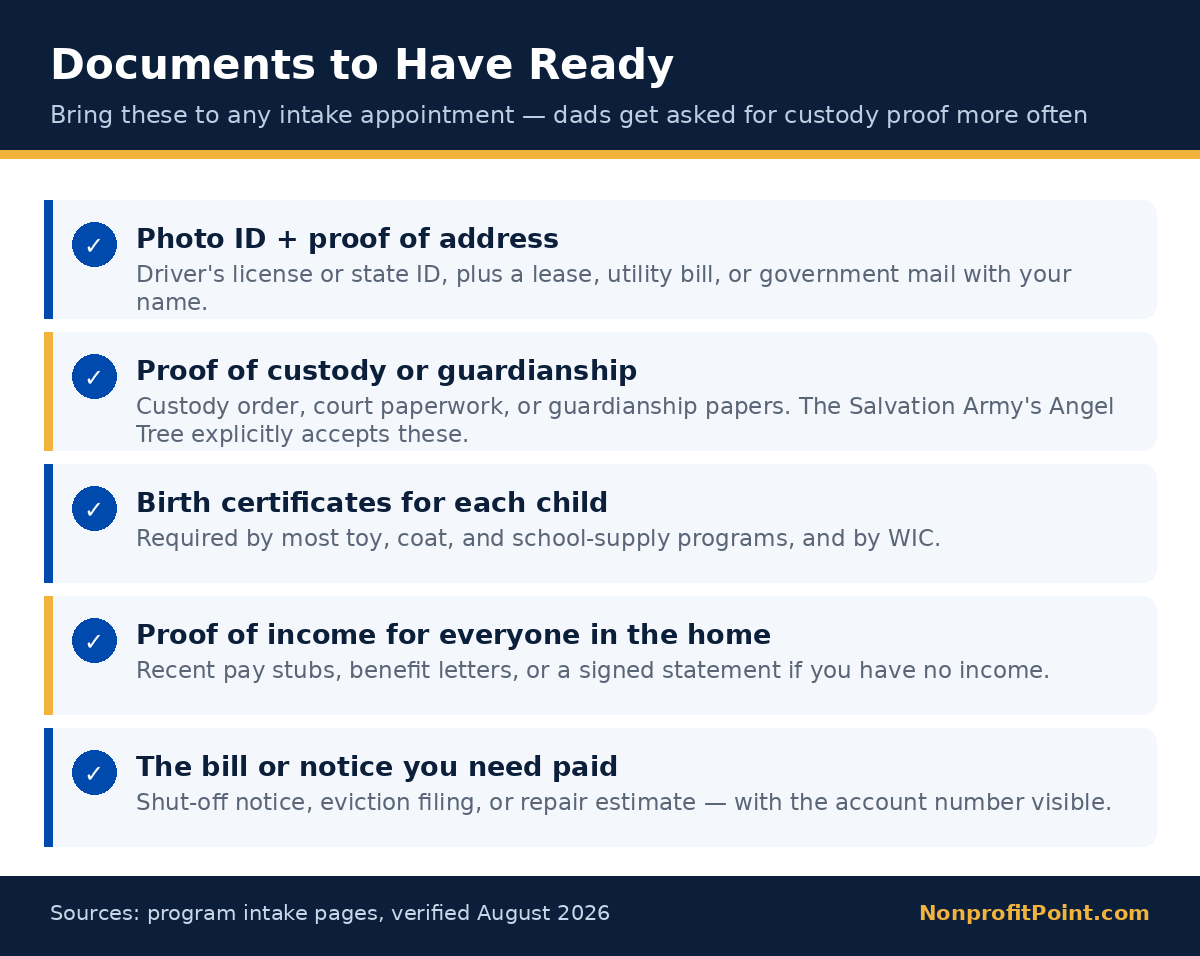
How to open a case: “you can sign up through your local, state or tribal child support agency,” using the contact map at acf.gov/css. The application fee is capped: “the child support agency can charge an application fee of up to $25.” Bring birth certificates, any existing order or divorce decree, payment records, income and asset information, and expense information for the child’s health care, day care, and special needs.
Free legal help
Two national front doors: LSC’s Find Legal Aid, which locates the federally funded civil legal aid organization nearest you, and LawHelp.org, which provides “free legal rights resources, court forms, self-advocacy tools and referrals to nonprofit legal aid organizations in every state and territory.”
Set your expectations honestly: legal aid offices triage, and contested custody cases are frequently outside what a given program will take. Neither organization promises representation in a custody dispute. What you can reliably get is a screening, self-help forms, and a referral — and in many counties, a court self-help center that will walk you through filing.
What the numbers actually say about single fathers
The picture is less bleak than the “struggling single dad” framing and more precarious than the “dads are fine” framing. Both matter when you are deciding whether to bother applying.
How many: the Census Bureau counted 2,574,000 father-only one-parent families with own children under 18 in 2025, against 7,666,000 mother-only families — so roughly a quarter of America’s single-parent families are headed by a father. Counted a different way, 3,340,000 children under 18 lived with their father only in 2025.
Poverty: among families that include a custodial parent, the family poverty rate in 2022 was 12.6% for custodial fathers and 22.6% for custodial mothers — both well above the 11.3% rate for all families with children under 21. Single dads are, on average, better off than single moms and materially worse off than married-couple households. Roughly one in eight is below the poverty line.
That last number is the argument for reading the rest of this page. A twelve-percent poverty rate across 2.5 million households is hundreds of thousands of fathers who qualify for programs they are not enrolled in.
What to walk past
Three things that will waste your time or your money:
“Single father grant” sites. If a page promises a specific dollar figure for single dads and asks for your phone number before it names a program, close the tab. Real programs are named, run by an identifiable agency, and never charge you to apply. (The one legitimate fee anywhere on this page is the child support application fee, capped at $25 and paid to a government agency.)
Anyone charging a fee to “find you grants.” 211 does this free. So does a Community Action Agency case manager.
Modest Needs. It appears on nearly every list like this one. We have removed it from our recommendations following a Department of Justice guilty plea concerning diverted funds. Do not send it your paperwork.
The order to work this list
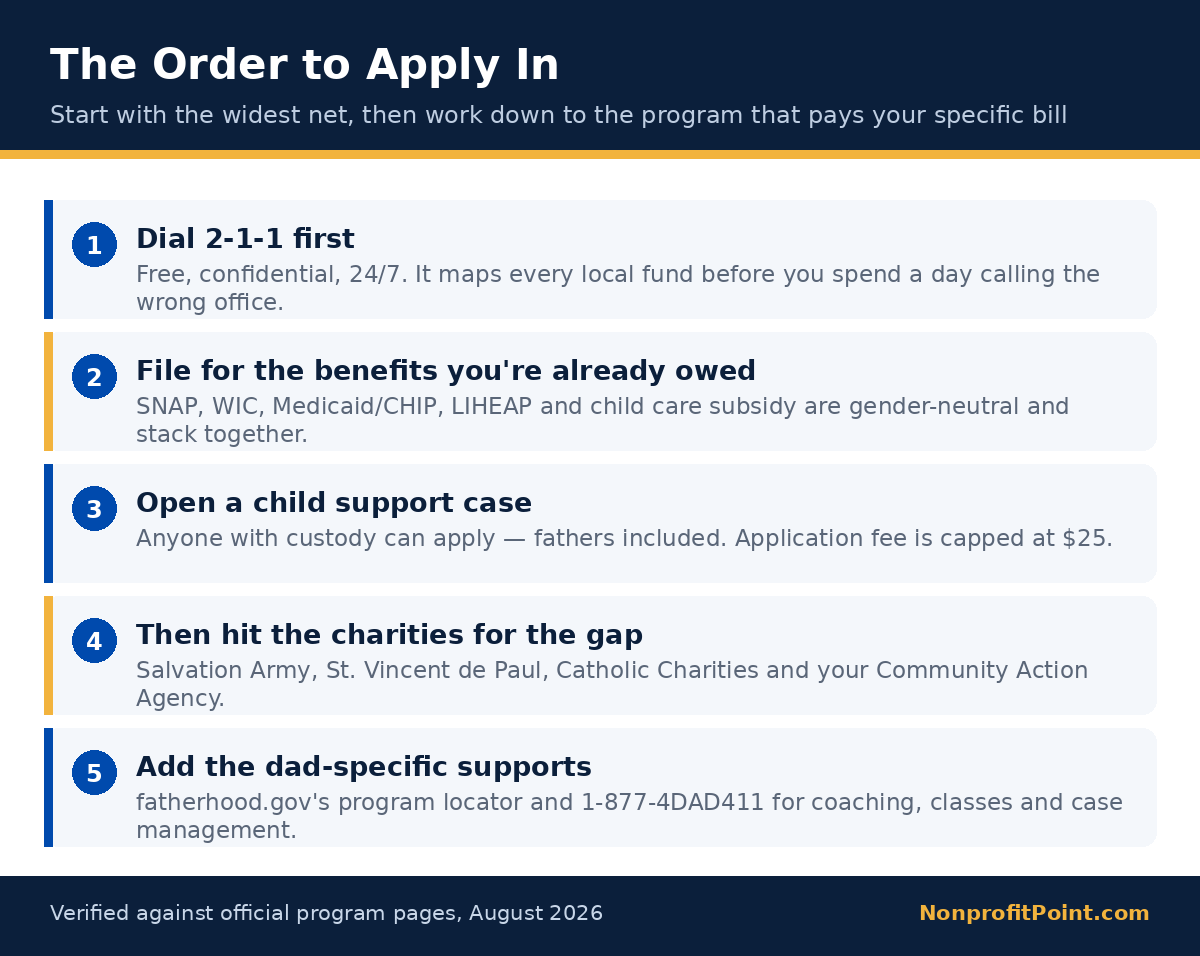
If you do nothing else on this page, do these five things in this order. Call 2-1-1 and describe the specific bill. Apply for SNAP, WIC, Medicaid/CHIP, LIHEAP, and the child care subsidy — they stack, and TANF receipt unlocks several of the others automatically. Open a child support case if you do not have an order; two-thirds of custodial fathers don’t. Then work the local charities — Salvation Army, St. Vincent de Paul, Catholic Charities, your Community Action Agency — for whatever gap remains. Finally, find your nearest federally funded fatherhood program through fatherhood.gov and ask specifically about case management and employment support.
None of it is fast. All of it is real. And every one of those doors is open to you as a father — whatever the program is called.
For the complete index of assistance guides on this site, see Get Help Paying For…, our roundup of charities that help with bills, and the parallel guide to charities that help single mothers, which covers several programs shared by both.
Frequently asked questions
Are there grants specifically for single fathers?
No. We looked hard and found no national nonprofit or government program that gives cash grants exclusively to single fathers. Every top search result promising one traces back to lead-generation sites, not grant programs. What exists instead is a stack of gender-neutral programs — TANF cash assistance, SNAP, WIC, LIHEAP, child care subsidy, Medicaid/CHIP, housing vouchers — plus local charity funds reached through 2-1-1. Those are worth far more per month than any “single dad grant” you will be offered online.
Can a single father get WIC?
Yes. Despite the program name, the federal agency that runs WIC states directly: “Moms, dads, foster parents, and anyone else raising kids under 5 can apply for support for the kids in their care.” The child is the participant, and you apply on the child’s behalf. Income must be at or below 185% of the federal poverty guidelines, and if you or the children already receive Medicaid, SNAP, or TANF you may already be income eligible. Contact your local WIC agency by phone or online to start.
Can a father collect child support from the mother?
Yes. The federal child support program says plainly that “although the majority of custodial parents are mothers, anyone with custody of a child can sign up for child support services (e.g., mother, father, grandparents, or legal guardian).” Only 33.4% of custodial fathers had an order in place as of the Census Bureau’s 2022 survey, against 43.2% of custodial mothers — so this is the single most commonly skipped step. Sign up through your local, state, or tribal child support agency; the application fee is capped at $25.
Does TANF cash assistance go to single fathers?
Yes. TANF eligibility is built around needy families with children and relatives caring for children; nothing in the rules turns on the caregiver’s gender. The catch is that the federal government does not pay TANF directly — states, territories, and tribes run it, with their own amounts and rules. Apply through your state agency, listed on HHS’s state help map. Getting on TANF also makes you automatically income-eligible for WIC and Head Start, so apply even if the monthly cash amount looks small.
What help is available for a single father with no income at all?
Start with the programs that do not require income to qualify: a Feeding America food pantry, whose stated rule is that “anyone who needs extra help affording food can visit a food pantry or meal program,” and 2-1-1 for local emergency funds. Then file for SNAP, Medicaid, and TANF the same week — zero income does not disqualify you, it usually maximizes the benefit. Head Start counts homelessness and public-assistance receipt as automatic eligibility. If you have nowhere to sleep, call 211 and ask for coordinated entry into the local shelter system.
Are there charities just for single dads?
A few real ones exist, but they provide services rather than money, and most are regional: Fathers’ UpLift in Boston and Cincinnati (617-708-0870), The Fatherhood Project at Massachusetts General Hospital (617-724-2044), Dads Resource Center in Pennsylvania, and Single Parent Advocate in North Texas. Nationally, the best dad-specific route is fatherhood.gov’s Find A Fatherhood Program locator plus its 1-877-4DAD411 line, which points you to federally funded local programs offering parenting classes, case management, and employment help. Note that National Fatherhood Initiative, despite the name, states on its own site that it does not provide direct services to fathers.
About this guide. Compiled and fact-checked by the Nonprofit Point editorial team, which researches financial-assistance and charity-vetting resources for U.S. households. Every eligibility rule, phone number, and figure above — including USDA’s statement that dads can apply for WIC, the federal child support program’s custodial-parent language, Operation Homefront’s rank and expense-category limits, Habitat’s nondiscrimination policy, and the Census Bureau’s 2025 family and 2022 child support figures — was verified against the issuing agency’s or organization’s own published materials in August 2026. Program funding, waitlists, and local capacity change constantly; always confirm by phone or through 2-1-1 before relying on any single office. Nonprofit Point is an independent resource, is not affiliated with the organizations listed, and does not provide legal or financial advice.