Charities That Help With Wigs: Free and Low-Cost Wigs for Cancer and Alopecia Hair Loss (2026)

A medical wig is the rare expense that is both unavoidable and almost never budgeted. Hair starts coming out two or three weeks into chemotherapy, or alopecia areata turns a patch into a bare scalp over a single season, and the quotes you get back run from about 100 dollars for a synthetic cap to several thousand for hand-tied human hair. The sponsors of this year’s federal wig bill used that same range when they reintroduced it in February 2026.
This page is about the recipient side of that problem: who gives wigs away, who pays toward one, what each program actually asks for, and the exact wording that gets an insurer to treat a wig as medical equipment instead of a beauty purchase. It is deliberately not a round-up of good causes in the hair-loss space. If you are looking for organizations to support, read our guide to the best charities for alopecia. If you want to give your hair rather than receive a wig, start with hair donation charities and their length and condition rules. Neither of those pages tells you how to apply for help, which is what follows.
The one thing that changed in 2026
For two decades the standard advice was to call the American Cancer Society and order from its tlc catalog. That door is closed. The Society’s page for EverYou, the program that succeeded tlc, now states that the EverYou program is no longer available as an American Cancer Society service and that as of April 1, 2026, new purchases are no longer offered, with customer support running only through May 31, 2026. The Society now points people to ebeauty.com for wigs, Amoena for mastectomy products and ChemoBeanies for headwear.
That matters because a great many hospital handouts, nonprofit referral lists and older articles still send people to a catalog that cannot take an order. If a social worker hands you a printout naming tlc or EverYou, the list is out of date, and the rest of it probably is too. The American Cancer Society itself is still very much in play, through its 24 hour helpline on 1-800-227-2345 and its online resource search, which is how you find the local wig bank that no national list will ever name.
Free wigs for children and young adults
The children’s programs are the most generous and the most structured, because they build custom hairpieces rather than ship stock units. Expect a fitting appointment and a wait.
Wigs For Kids
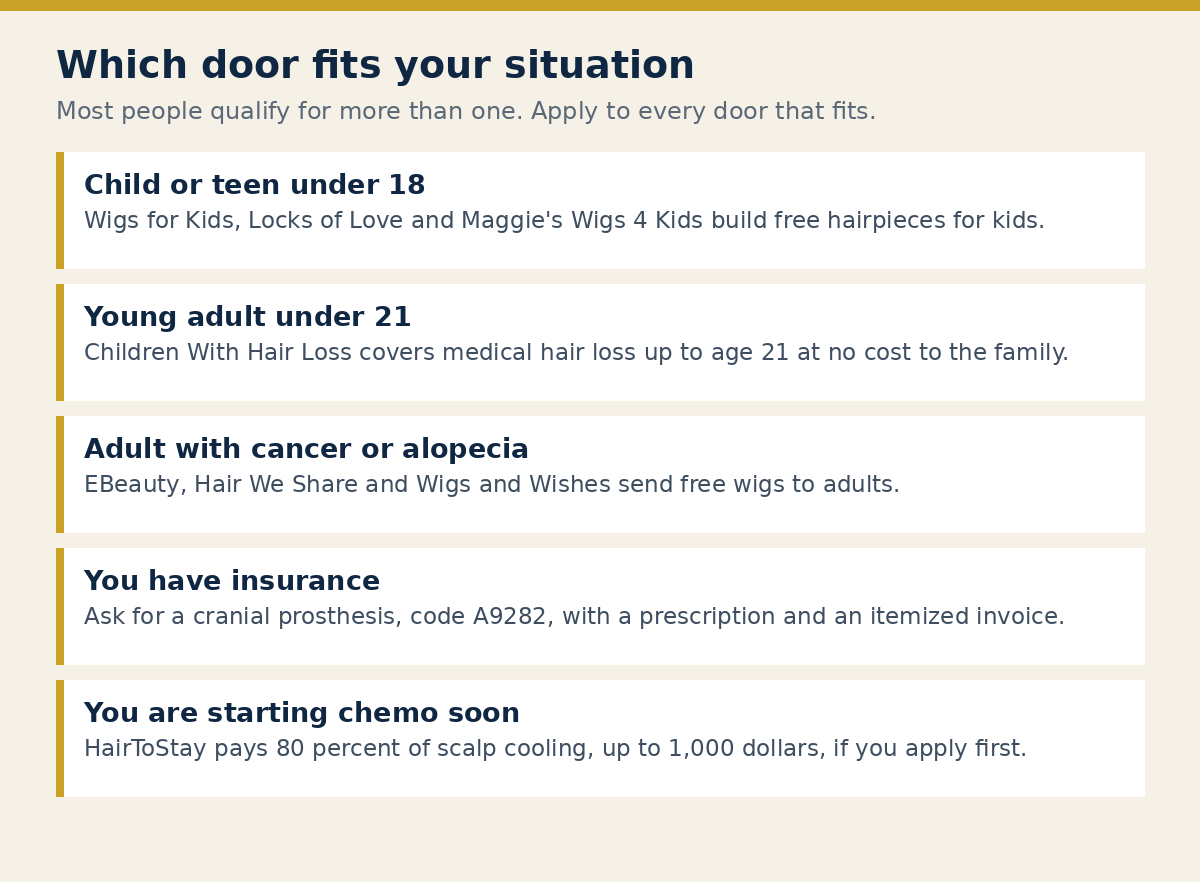
Wigs For Kids serves children up to 18 years of age experiencing hair loss for medical reasons, naming chemotherapy, radiation therapy, alopecia, trichotillomania, burns and other medical causes. Its hairpieces are designed for complete hair loss; for partial hair loss the organization asks families to contact it before applying. The charity states plainly that it never charges for its hair replacement systems.
The process runs in four steps: an application plus an interview to establish eligibility, then proof of age and medical documents for approval, then a measurement appointment with a designated stylist, then a second appointment for delivery and styling instruction. The phone number is (440) 333-4433. Start the application before the first fitting slot you want, because the stylist network is the bottleneck, not the paperwork.
Children With Hair Loss
Children With Hair Loss provides hair replacement at no cost to children and young adults under 21 facing medically related hair loss, including cancer treatment, alopecia, trichotillomania and burns. The higher age ceiling matters: a 19 year old is too old for most of the children’s charities and too young to be comfortable in the adult programs, and this is the one that covers the gap. Applications go through the organization’s hair application form. It is based at 12776 Dixie Highway, South Rockwood, Michigan 48179, and the phone number is (734) 379-4400.
Locks of Love
Locks of Love provides hairpieces to children and is one of the few programs that still runs on paper. Its instructions are to download the application and send it with the requested information by certified mail or a carrier such as FedEx, UPS or DHL to the Case Manager, Locks of Love, 234 Southern Boulevard, West Palm Beach, Florida 33405, and the organization states that it needs all of that information before its Board of Directors can grant approval. The application page does not publish the eligibility criteria, so call the case manager on 561-833-7332 and confirm them before you pay for certified mail.
Maggie’s Wigs 4 Kids of Michigan
A Michigan program for children aged 3 to 18 that states no child is turned away and no family ever pays. Apply through its application page or call (586) 772-6656. If you are outside Michigan, this is still worth a call: regional programs often know which neighbouring states have an equivalent.
The Magic Yarn Project
Not a conventional wig, and for some children a better answer than one. The Magic Yarn Project makes volunteer-crafted character wigs and beanies from soft yarn, in more than 50 wig styles and over two dozen beanie styles, and they are always free for families, with no charge for shipping either. Families request directly for a child; hospitals, cancer centers and nonprofits can request a box. The organization is based at PO Box 83, Palmer, Alaska 99645. Children who will not tolerate the weight or heat of a conventional wig frequently will wear one of these.
Free wigs for adults
Adult programs ship stock or donated wigs and turn around much faster, usually in days rather than months.
EBeauty
EBeauty mails free wigs to women facing hair loss from cancer or other medical conditions, and it is the organization the American Cancer Society now names on its own site. The request requires a doctor note and up to five photos of yourself showing your preferred hair color and length from before the hair loss. EBeauty states that a wig typically ships within 48 hours of the request and should arrive in five to eight business days. A 25 dollar pay it forward donation is offered as optional, for later. The phone number is 410-205-5870.
Hair We Share
Hair We Share provides customized human hair wigs free of charge to anyone whose financial means do not allow them to purchase one. The qualifying test here is financial rather than diagnostic, which makes it one of the few options for people whose hair loss is medical but whose diagnosis does not fit a cancer-specific program. Contact runs through the form on its site.
Wigs and Wishes
Wigs and Wishes, founded by stylist Martino Cartier and based at 124 Salina Road, Sewell, New Jersey 08080, provides free wigs to people undergoing cancer treatment and grants wishes for children with cancer, working through a network of participating salons and stylists who donate their services. Because the fitting happens in a real salon chair, ask when you request a wig whether a participating salon is within reach of you. The number is 856-582-6600 and the address for enquiries is info@wigsandwishes.org.
If you have not started chemotherapy yet, read this first
Scalp cooling can prevent much of the hair loss that creates the wig problem, and the reason most people never try it is the price. HairToStay is the national nonprofit that subsidizes it, and its terms are specific enough to plan around.
The subsidy covers 80 percent of your paid invoices up to a maximum of 1,000 dollars, and donor-targeted funds for particular centers, regions or demographics can raise that ceiling to roughly 1,500 dollars. To qualify, household income must be at or below 400 percent of the federal poverty level, you must be a chemotherapy patient diagnosed with a solid tumor cancer, you must be a full time United States resident treated at a United States facility, and you must be using a scalp cooling system from Dignitana, Paxman, Penguin Cold Caps or Cooler Heads. Patients with blood cancers are not eligible.
The timing rules are where people lose the money. HairToStay does not subsidize scalp cooling expenses incurred before your application is approved, so apply before the first chemotherapy session. After approval you must submit your first treatment invoice within eight weeks or the subsidy is inactivated, and reactivation requires a fresh application and a 25 dollar fee. Individual invoices must go in within four weeks of their date, and the full subsidy must be used within six months of approval. Decisions are described as taking about a week, with the organization’s own FAQ saying one to two business days. The helpline is 800-270-1897.
Making insurance pay: the word is cranial prosthesis
A wig billed as a wig is a cosmetic purchase. The same object billed as a cranial prosthesis or scalp hair prosthesis is medical equipment, processed under HCPCS code A9282, described in the code set as wig, any type, each. The word on the prescription and the word on the invoice decide which pile your claim lands in, so get both changed before you buy anything.
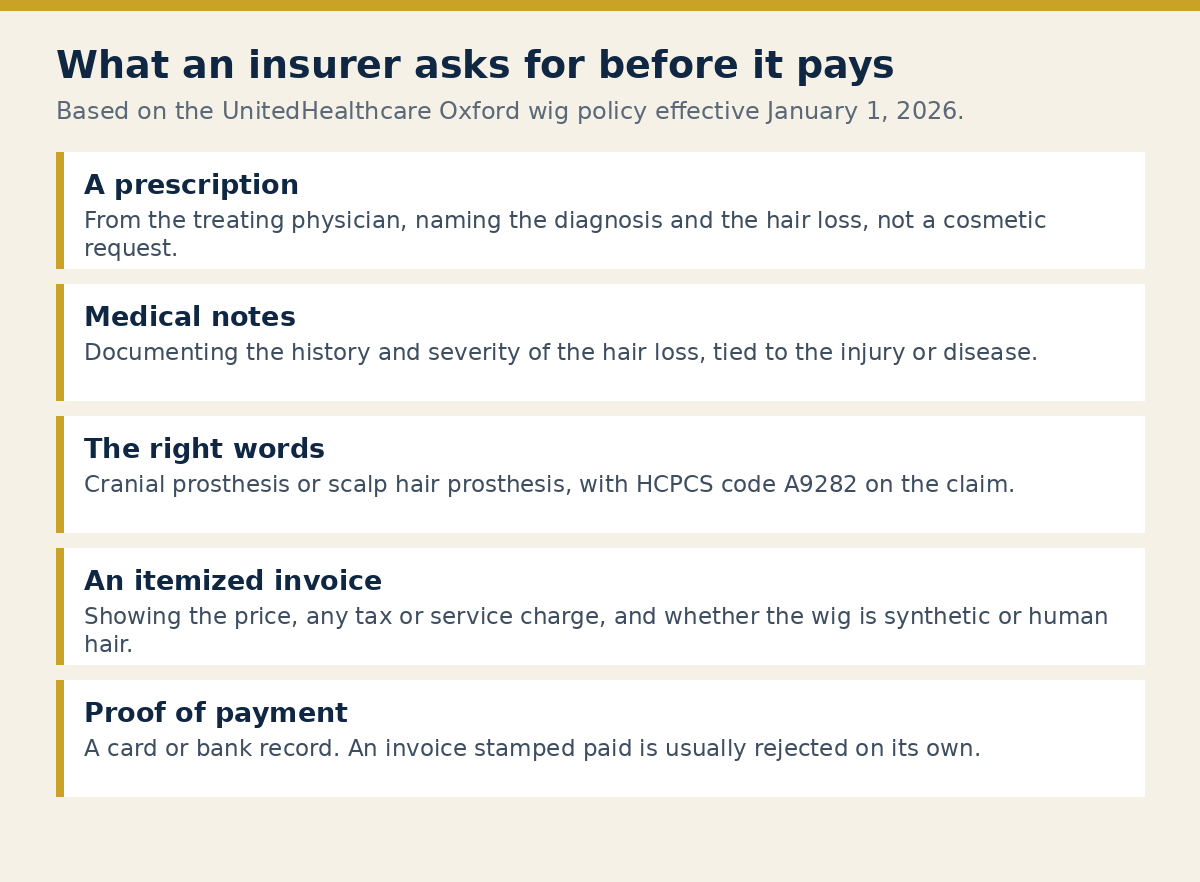
The UnitedHealthcare Oxford administrative policy for wigs, effective January 1, 2026, is a useful map of what a large insurer wants, even if your plan is elsewhere. It states that coverage for wigs is based upon state mandates, and it sets out the rest in detail. For Connecticut groups, wigs are covered when hair loss results from chemotherapy or radiation and the wig is prescribed by a licensed oncologist. For New York groups and New Jersey large groups, coverage applies to severe hair loss due to injury, disease or as a side effect of the treatment of a disease, and is limited to one wig per member per lifetime. New Jersey small products do not provide coverage for wigs at all.
The documentation it requires is the packet to assemble: a prescription from the treating physician, medical notes documenting the history and severity of the hair loss, a diagnosis specific to an injury or disease, an itemized invoice showing the wig price and any taxes or service charges and stating whether the wig is synthetic or human hair, and proof of payment, with the policy noting that an invoice marked paid will not count as proof of payment. If you want a human hair wig rather than synthetic, the policy requires documentation of an allergy to synthetic wigs.
The exclusions are equally worth knowing before you spend. That policy will not pay for repair or replacement caused by misuse, malicious damage or gross neglect, or to replace a lost or stolen wig; hair implants or plugs; human hair without a documented synthetic allergy; hair loss from natural or premature aging, including male and female pattern baldness; hair loss from pregnancy or the postpartum period; or styling, coloring and color correction. Budget for the maintenance yourself.

State mandates, and the plan that ignores them
Minnesota has the strongest mandate found in this review. Minnesota Statutes section 62A.28 requires covered health plans to provide coverage for scalp hair prostheses, including the equipment and accessories needed for regular use, when the prosthesis is worn for hair loss from a health condition such as alopecia areata or the treatment for cancer. Coverage is limited to 1,000 dollars per benefit year, plans may limit it to one prosthesis per benefit year, a doctor must prescribe it, and any other limitation needs a clinical basis. The section carries amendments through 2024.
Beyond Minnesota, a Minnesota Department of Commerce evaluation report dated February 12, 2024 surveyed other states and listed Connecticut, Massachusetts, Maryland, New Hampshire and Rhode Island with 350 dollar annual caps and Oklahoma with a 150 dollar cap, with New Jersey’s measure recorded as proposed. The report says its table is not exhaustive, so a state missing from it is not proof that no mandate exists; your state insurance department is the authority.
One caveat undoes all of this for a large share of working people. State insurance mandates reach fully insured plans. They do not reach self-funded employer plans, which are governed by federal law and are how most large employers cover their staff. If your benefits are self-funded, the mandate in your state is irrelevant and the plan document is the only rule. Ask your benefits office which kind of plan you are in before you build an appeal around a state statute.
Medicare and Medicaid
Medicare does not cover wigs. That is the entire reason the Wigs as Durable Medical Equipment Act exists; it was reintroduced on February 23, 2026 by Representatives Ayanna Pressley and Jim McGovern with Senator Richard Blumenthal, and it would allow cranial prosthetics to be covered under the Medicare program. The sponsors note that many private insurers already cover wigs for people with treatment-related hair loss or alopecia areata, that alopecia areata affects approximately 6.9 million Americans, and that a wig can carry an out-of-pocket cost from 100 dollars to several thousand. Until the bill passes, a Medicare beneficiary needs the charity route, a Medicaid benefit, or the tax route below.
Medicaid is a different story, and it varies state by state. New York is the clearest published example. The New York State Medicaid durable medical equipment procedure code manual, effective July 1, 2026, lists A9282 as wig, any type, each, with coverage limited to medically-induced or congenital hair loss. The code is flagged as requiring authorization through the dispensing validation system rather than a direct bill, and it carries the frequency code for twice per lifetime. If you are on Medicaid in another state, ask the plan for its DME procedure code manual and look up A9282 rather than asking a general question at a call center, because the answer lives in that document. New York’s prior approval line for DME questions is (800) 342-3005.
The tax route most people miss
IRS Publication 502 is explicit: you can include in medical expenses the cost of a wig purchased upon the advice of a physician for the mental health of a patient who has lost all of their hair from disease. Two conditions make that useful or useless. You have to itemize deductions, and your total medical expenses have to exceed the publication’s threshold of 7.5 percent of adjusted gross income, which for most households means a year with substantial other medical costs, which is often exactly the year in question.
For most people the easier version is a flexible spending account or a health savings account, which lets you buy the wig with pre-tax dollars without waiting for a tax return. Administrators normally want a letter of medical necessity from the prescribing doctor on file, which is the same letter the insurance claim needs, so write it once and use it three times.
Programs that no longer exist
Half the work of finding help is crossing off the dead ends that older lists keep alive. Three worth striking from any list you have been handed:
- The tlc catalog and EverYou stopped taking new purchases on April 1, 2026, with support ending May 31, 2026.
- Lolly’s Locks, which supplied high quality wigs to cancer patients who could not afford them, shut down in late 2018. It is still cited on referral lists seven years later.
- The National Alopecia Areata Foundation does not fund wig purchases. It is frequently listed as though it did. Its own wig resources page states that it does not provide financial support for wig purchases, and instead directs people to Wigs For Kids, Locks of Love, Hair We Share and Children with Hair Loss, while it campaigns for Medicare coverage.
Build the packet once
Nearly every route above wants the same five things, so assemble them in one folder before you make a single call: a prescription naming the diagnosis and using the words cranial prosthesis; a short letter of medical necessity from the prescribing doctor; medical notes showing the history and severity of the hair loss; photographs of your hair from before the loss, which the charities ask for and which no one ever has afterwards; and, once you buy, an itemized invoice plus card or bank proof of payment. Take the photographs today if hair loss has not started yet. It is the single most commonly missed item in this whole process.
Then apply widely rather than sequentially. These programs are not mutually exclusive, the charity ones carry no means test in several cases, and the slowest of them takes months. People who end up paying full price are usually the ones who applied to one organization, waited, and were turned down for an age or diagnosis rule they could have read in advance.
Related help
- Charities that help with medical bills – for the hospital balances that usually arrive alongside the wig quote.
- Organizations that help cancer patients financially – rent, utilities and living costs during treatment.
- Free transportation for medical appointments – rides to chemotherapy and scalp cooling sessions.
- Charities that help with prosthetics – the same cranial prosthesis billing logic applied to limbs and other devices.
- Charities that help cancer patients – the wider map of cancer-specific assistance.
Frequently asked questions
Does insurance pay for a wig after chemotherapy?
Often yes, but only if the claim is built correctly. UnitedHealthcare Oxford, whose wig policy took effect on January 1, 2026, bases wig coverage on state mandates and asks for a prescription from the treating physician, medical notes documenting the history and severity of the hair loss, a diagnosis tied to an injury or disease, an itemized invoice showing the price and whether the wig is synthetic or human hair, and proof of payment. That policy states that an invoice stamped paid will not count as proof of payment on its own. Other insurers ask for a similar packet, so assemble it before you buy.
What is a cranial prosthesis and why does the word matter?
A cranial prosthesis is the medical term for a wig worn because of disease or injury rather than for fashion. Claims systems process it under HCPCS code A9282, described as wig, any type, each. Writing cranial prosthesis or scalp hair prosthesis on the prescription and the invoice is what moves the purchase out of the cosmetics category, where it is almost always denied, and into the medical equipment category, where a mandate or plan benefit can reach it.
Does Medicare cover wigs in 2026?
No. Medicare does not cover wigs, which is why a bill to change that keeps returning to Congress. On February 23, 2026, Representatives Ayanna Pressley and Jim McGovern and Senator Richard Blumenthal reintroduced the Wigs as Durable Medical Equipment Act, which would allow cranial prosthetics to be covered under the Medicare program. Until it passes, Medicare beneficiaries have to work the charity, Medicaid and tax routes instead.
Which states require insurance to cover wigs?
Minnesota has the strongest mandate found in this review: statute 62A.28 requires covered plans to pay for scalp hair prostheses worn for hair loss from a health condition such as alopecia areata or cancer treatment, capped at 1,000 dollars per benefit year, with a doctor prescription required and a limit of one prosthesis per benefit year. A February 2024 Minnesota Department of Commerce survey also listed Connecticut, Maryland, Massachusetts, New Hampshire and Rhode Island at 350 dollars a year and Oklahoma at 150 dollars a year, and said the table was not exhaustive. State mandates do not bind self-funded employer plans.
Where can an adult get a free wig?
EBeauty mails free wigs to women facing medical hair loss and asks for a doctor note and up to five photos showing your hair before the loss. Hair We Share provides customized human hair wigs at no charge to people whose finances do not allow them to buy one. Wigs and Wishes, based in Sewell, New Jersey, provides free wigs to people with cancer through a salon network. The American Cancer Society helpline at 1-800-227-2345 can also point you to local wig banks, which are often attached to hospitals.
Is there an age limit on free wigs for children?
It depends on the charity. Wigs For Kids serves children up to 18 years of age and never charges for a hair replacement system. Children With Hair Loss serves children and young adults under 21 at no cost. Wigs 4 Kids of Michigan serves children 3 to 18 and states that no family ever pays. The Magic Yarn Project sends free character wigs and beanies to children with cancer, burns or other medical hair loss, with no fee for the wig or the shipping.
Can I deduct the cost of a wig on my taxes?
IRS Publication 502 says you can include in medical expenses the cost of a wig purchased upon the advice of a physician for the mental health of a patient who has lost all of their hair from disease. That deduction only reaches people who itemize and whose total medical expenses pass the publication threshold of 7.5 percent of adjusted gross income. A flexible spending account or health savings account is usually the easier route, and both normally want a letter of medical necessity on file.
Did the American Cancer Society stop sending wigs?
Yes. The American Cancer Society page for EverYou, the program that replaced its tlc catalog, states that the EverYou program is no longer available as an American Cancer Society service and that as of April 1, 2026, new purchases are no longer offered, with customer support running only through May 31, 2026. The Society now refers people to ebeauty.com for wigs and continues to run its 24 hour helpline and online resource search.

![Get Debt-Free: Discover 9 Charities That Help with Debt Today [Full List]](https://nonprofitpoint.com/wp-content/uploads/2023/03/Charities-that-help-with-Debt-min-768x432.png)