Charities That Help With Wheelchairs (2026): 16 Real Programs, and the 7 That Can’t Help Americans

A power wheelchair is one of the few pieces of equipment that can cost more than the car parked outside, and it is the one most likely to be denied. So people do what anyone would do: they search for a charity that will simply give them a chair.
Here is the problem with almost every list you will find. We checked the ten organizations that appear most often on “wheelchair charity” round-ups against those organizations’ own websites in September 2026. Seven of them cannot help an American at all. Two have dead domains. One closed in 2022. Three only ship overseas, and one of those states in writing that it “cannot fulfill any domestic or international individual requests.” Those seven still sit near the top of Google, collecting clicks from people in genuine difficulty.
This guide does the opposite. Every program below was read on its own website or its own .gov page on 30 September 2026, and every dollar figure is quoted from the page that publishes it. Where an organization publishes no amount, we say so rather than guessing. Where an organization’s own site contradicts itself — and one major one does — we show you both pages and tell you what to ask.
Start here: the order that actually works
Charities are almost never the first stop for a wheelchair. They are the stop that fills the gap after insurance has done what it will do. Working in the wrong order is the single most common reason people wait months for a chair they could have had in weeks.
- Insurance first. Medicare, Medicaid or VA. A wheelchair is a covered benefit in all three. The obstacle is documentation, not entitlement.
- Your state Assistive Technology Act program second. There are 56 of them, they lend and re-issue equipment, and hardly anyone uses them.
- Your diagnosis-specific charity third. MDA, MSAA, the ALS Association and Triumph Foundation all fund or supply mobility equipment for specific conditions.
- A local reuse program fourth. Refurbished chairs, often free, usually within driving distance.
- General-need charities last, because most of them require a social worker to apply on your behalf and take the longest.
If you only do one thing today, do step two. It is free, it exists in every state and territory, and almost no one searching for a wheelchair has heard of it.
1. Medicare: what it covers and what it leaves you to pay
Medicare.gov states plainly that “Medicare Part B (Medical Insurance) covers wheelchairs and power-operated vehicles (scooters) if you’re eligible,” and the durable medical equipment page lists “Wheelchairs and scooters” among covered DME. Power chairs and scooters are covered “only when they’re medically necessary.”
Your share. “After you meet the Part B deductible, you pay 20% of the Medicare-approved amount (if your supplier accepts assignment).” For 2026, CMS puts the deductible at a specific number: “The annual deductible for all Medicare Part B beneficiaries will be $283 in 2026, an increase of $26 from the annual deductible of $257 in 2025.”
So the arithmetic for a Medicare beneficiary is: $283 once per year, then 20 cents on every dollar Medicare approves. On equipment that a supplier bills in the thousands, that 20% is exactly the gap the charities below exist to close.
Three requirements that trip people up.
- “You must have a face-to-face examination and a written prescription from a treating provider before Medicare covers a power wheelchair or scooter.” Under 42 CFR 410.38, that encounter must have happened “within the 6 months preceding the date of the written order/prescription,” and it can be a telehealth visit.
- “Medicare will only pay for DME items if you get them from suppliers who are enrolled in Medicare.” A cheaper chair from a non-enrolled seller is a chair you pay for entirely.
- “You may have to get prior approval (known as ‘prior authorization’) for certain types of power wheelchairs.” Your supplier normally files this, not you.
Rent or buy. Medicare says some DME is rented, some purchased, and “some items become your property after you’ve made a certain number of rental payments.” For complex rehabilitative power wheelchairs, CMS requires suppliers to offer a purchase option up front; decline it and payment runs “on a capped rental basis… for no more than 13 months of continuous use, followed by transfer of title to the equipment to the beneficiary.”
Changing on 28 October 2026 — read this if you need a lightweight manual chair. CMS has added a manual wheelchair base to the list of items needing prior authorization before Medicare will pay: “CMS selected one HCPCS code (K0005) subject to required prior authorization to begin nationwide on 10/28/2026.” K0005 is the ultra-lightweight manual wheelchair. If that is the chair your therapist has recommended, expect an extra approval step from late October onward and start the paperwork earlier than you otherwise would.
2. Medicaid: your state cannot simply refuse to cover a wheelchair
This is the most widely mis-stated fact in this whole subject, so it is worth being exact. You will often read that durable medical equipment is an “optional” Medicaid benefit that states may skip. That is wrong, and believing it costs people chairs.
Medicaid.gov confirms that “States establish and administer their own Medicaid programs and determine the type, amount, duration, and scope of services within broad federal guidelines.” But wheelchairs do not sit in the optional list. They sit inside home health services, which is a mandatory benefit. The governing regulation, 42 CFR 440.70(b)(3), covers “Medical supplies, equipment, and appliances suitable for use in any setting in which normal life activities take place,” and it is explicit about what states may not do:
“States can have a list of preapproved medical equipment supplies and appliances for administrative ease but States are prohibited from having absolute exclusions of coverage on medical equipment, supplies, or appliances. States must have processes and criteria for requesting medical equipment that is made available to individuals to request items not on the State’s list.”
Two practical consequences. First, if your state’s preapproved list does not include the chair you need, the state must still give you a route to request it — a blanket “we don’t cover that” is not permitted. Second, the same regulation notes that “State Medicaid coverage of equipment and appliances is not restricted to the items covered as durable medical equipment in the Medicare program,” so a Medicaid denial that simply copies a Medicare rule is worth appealing.
What genuinely varies by state is amount, duration, scope, the prior-approval list and how hard the appeal is. Not whether wheelchairs are covered at all. (Prosthetics, by contrast, is a genuinely optional Medicaid benefit — we cover that separately in our guide to charities that help with prosthetics.)
3. Veterans: the most generous route in the country, if you are enrolled
The VA Prosthetic and Sensory Aids Service describes itself as “the largest and most comprehensive provider of prosthetic devices and sensory aids in the world.” Its stated eligibility is narrow in form and wide in substance: “General eligibility for prosthetic services/items is for Veterans enrolled in the VA health care system who have a medical need for a prosthetic service/item.”
Enrolled veterans referred by a physical medicine and rehabilitation physician “can receive a full range of services and durable medical equipment, including but not limited to: Durable medical equipment; Mobility aids, such as walkers and wheelchairs; Communication and assistive devices…” Note the gate: enrolled, medical need, and a PM&R referral. The referral is the step most veterans miss.
Automobile allowance and adaptive equipment
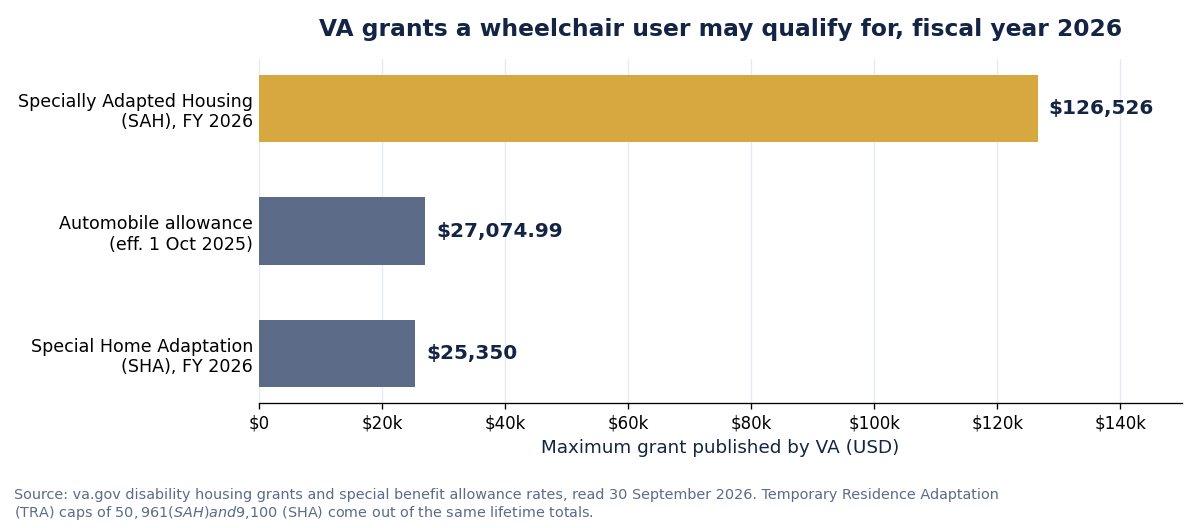
VA’s special benefit allowance page, under the heading “Automobile allowance — Effective October 1, 2025,” states: “If you have a service-connected disability that prevents you from driving, we may pay up to $27,074.99 toward a specially equipped vehicle for you.” The payment goes to the seller, not to you: “The seller of the specially equipped vehicle needs to submit a claim to us. Then we pay them a one-time payment directly.”
Eligibility requires a service-connected disability including at least one of: loss or permanent loss of use of one or both feet; the same for one or both hands; permanent decreased vision of 20/200 or less in the better eye with glasses; a severe burn injury; ALS; or ankylosis in one or both knees or hips (which qualifies for adaptive equipment only).
The single most expensive mistake here is buying first. VA’s own page asks and answers it: “Can I buy a vehicle or adaptive equipment first, then file my claim? No. You’ll need to file your claim and get our approval before you buy a vehicle or adaptive equipment.”
Housing grants that pay for ramps, doorways and roll-in showers
A chair you cannot get into your own bathroom is only half a solution. VA’s disability housing grants exist for exactly that, and for FY 2026 the published maximums are:
- Specially Adapted Housing (SAH): “up to $126,526 for FY 2026.”
- Special Home Adaptation (SHA): “up to $25,350 for FY 2026.”
- Temporary Residence Adaptation, for adapting a family member’s home: up to $50,961 (SAH-eligible) or $9,100 (SHA-eligible).
These are lifetime totals you can draw on in stages: “you can use money from your grant up to 6 different times over your lifetime.” One qualifying disability for SAH is “the loss, or loss of use, of one lower extremity (foot or leg) after September 11, 2001, which makes it so you can’t balance or walk without the help of braces, crutches, canes, or a wheelchair” — and VA notes that only 120 veterans and service members per fiscal year can qualify on that particular basis, a cap set by Congress. If housing is the binding constraint rather than the chair itself, our guide to housing assistance for disabled veterans goes through the application in more detail.
4. The 56 state programs almost nobody uses
Every US state and territory runs an Assistive Technology Act program, funded by the federal Administration for Community Living. ACL confirms the count on its own program page — “56 State AT Program grantees” — covering every state plus the District of Columbia, Puerto Rico, American Samoa, the Northern Mariana Islands, Guam and the US Virgin Islands.
These programs are not grant-makers in the usual sense. They do four specific things, and ACL defines each:
- Device reutilization — “support the reuse of assistive technology that is no longer needed or used by its original owner and is acquired by a new owner at substantial cost savings.” In plain terms: a refurbished wheelchair, often free or nearly so.
- Device loan — “allow individuals to borrow AT for a limited time period to try out and determine if a device will meet their needs before a purchase is made.” This is how you find out whether you want a rigid frame or a folding one before anyone spends money.
- Device demonstration — “comparing and contrasting the functions and features of devices through hands-on exploration guided by a knowledgeable professional.”
- State financing — “support the purchase/acquisition of AT through financial loans or other initiatives that directly provide AT to consumers at no cost.” ACL adds that “Each State Grant for Assistive Technology program includes financing activities.”
How to use it: ACL points readers to the AT3 Center directory at at3center.net/stateprogram, which lists every state and territory program with named contacts broken out by device loan, demonstration, reuse and financial loan. There is no single national phone number — the numbers are per state.
If your state’s reuse program has a chair in your size, this is typically the fastest route in the entire guide: no grant cycle, no income documentation, no committee.
5. Charities that help if you have a specific diagnosis
Diagnosis-specific charities are the most reliable non-government money in this space, because the eligibility question is simple and the organization already knows what a chair costs.
Muscular Dystrophy Association — DME Grant Program
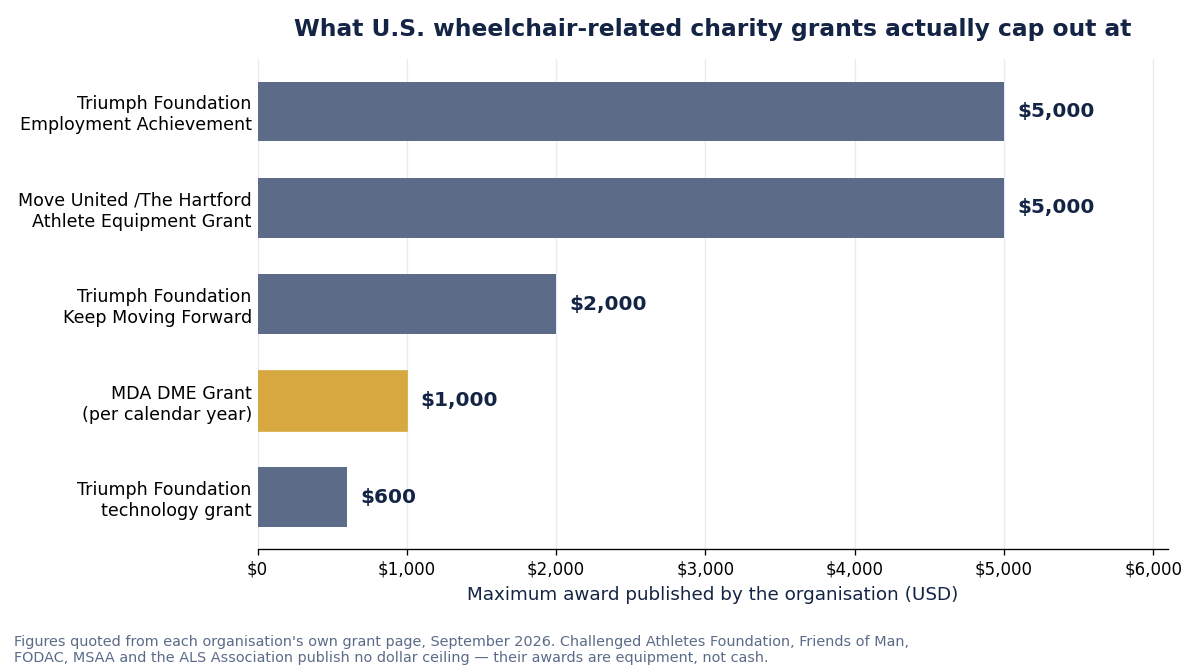
The single most straightforward national application in this guide. MDA’s equipment assistance program states: “Awards of up to $1,000 are available upon review and funding. MDA members can submit one DME Grant application per calendar year.”
- Eligible: “You (or a loved one) have been diagnosed by a physician as having a neuromuscular disease covered under MDA’s program” and “are a U.S. Citizen or a legal and permanent resident of the U.S.” Membership is free and is part of the application.
- Covers: “Manual and power wheelchairs, scooters, lift chairs, batteries,” plus hospital beds, orthotics and daily living aids.
- Two rules that disqualify most late applicants: funds go “direct to the vendor,” never to you; and MDA “will not reimburse or pay directly to an applicant” for items “already purchased or on order.” Apply before you order.
- Timing: after approval, “payment can take up to 45 days to process and be received by vendor.”
- Contact: 1-833-ASK-MDA1 (1-833-275-6321). Apply through the form on mda.org’s equipment assistance page; you will need an unpaid invoice or quote.
Multiple Sclerosis Association of America — Equipment Distribution Program
MSAA ships equipment to your door: “MSAA provides these products at no charge to individuals with MS who qualify for assistance, and items are shipped directly to the client.”
Read the product list carefully, because this is where most write-ups get MSAA wrong. The standard catalogue is mobility-adjacent rather than a wheelchair catalogue — grab bars, bath benches, a quad cane, a foldable cane, a drop-foot brace, a walker with seat and four wheels, resistance bands, a reacher. You select one item.
Wheelchairs sit outside that list and are handled by phone: MSAA’s application states that standard manual wheelchairs are available on a limited basis and asks applicants to call (800) 532-7667, ext. 154, adding that MSAA “will help determine if you are eligible for assistance through insurance or other resources prior to MSAA approval.” Other published conditions: you must be a US resident, must not have received MSAA equipment within the last three years, must meet the income requirement, and must include a letter or prescription proving the MS diagnosis. MSAA’s own page was last updated 18 June 2026.
The ALS Association — Independence & Mobility Program
ALS progresses fast enough that insurance timelines often fail outright, and the ALS Association’s program is built around that. Equipment is accessed “by individuals who have no coverage of needed equipment and in some cases, individuals with coverage but who have an immediate and critical medical need,” and covers mobility aids, transfer devices, ramps, bathroom and bedroom equipment, plus communication devices.
Do not treat it as one uniform national loan closet. Access runs through your local ALS care services team, and several regions run their own separate loan programs with their own rules — the Florida equipment loan program, for instance, is limited to “Florida residents with a verified diagnosis of ALS who are uninsured, underinsured, who cannot access the benefits of their insurance… or who are waiting for insurance approval.” Start with your clinic or neurologist, or the national line on 800-782-4747.
Triumph Foundation — spinal cord injury
Triumph runs the only clearly published grant ladder in this guide for people with spinal cord injury or disorder. “Applicants must be residents of the United States of America, with priority given to Southern California residents.”
- Keep Moving Forward grant: “$2,000 when funds are available,” for adaptive equipment for daily living, home modifications, return-to-work costs and therapy or recreational activities.
- Technology grant for returning to school or work: “$600 grant maximum.”
- Employment Achievement Award: “$5,000” maximum, for licenses, business equipment and other costs of getting back to work.
- Triumph also runs an Equipment & Supply Exchange of donated used durable medical goods.
- Caveat worth a phone call: out-of-state applicants are restricted from certain items, including hand controls, large home modifications and custom ramps. Whether a wheelchair itself is fundable under Keep Moving Forward, as opposed to other adaptive equipment, is worth confirming on (213) 328-7774 before you build a plan around it.
6. Charities that help on need rather than diagnosis
Friends of Man — national, but only a professional can apply
Friends of Man is the best-kept secret on this list and the one most often described incorrectly. Its national assistance list explicitly includes “Mobility equipment (wheelchairs, scooters, lifts, etc.)” and wheelchair ramps, along with stairlifts, prostheses and vehicle adaptations with hand controls. It has operated since 1982 and is all-volunteer.
The catch is the application route: “If you are in need of assistance for YOURSELF, a referring professional must contact us to apply on your behalf.” The referring professional cannot be a colleague or relative, and the organization names caseworkers, healthcare professionals, social workers, community and patient advocates, school professionals and clergy as qualifying referrers.
Published requirements include “Total household income of 300% or less of Federal Poverty Guidelines,” at least three months in a stable independent living environment, not being homeless or in assisted living, hospice, long-term or institutional care, and being free of alcohol or substance abuse for at least a year. Friends of Man does not assist with back bills for items already ordered or received — another reason to apply before you buy.
What to do: ask the social worker at your hospital, clinic, school district or place of worship to submit the request form at friendsofman.org. Handing them the link is usually faster than explaining the program.
Variety — the Children’s Charity (children and young adults)
Variety’s national Freedom Program “delivers vital life-changing equipment and services for mobility, independence and social inclusion to individual children and children’s organizations,” including wheelchairs, walking aids, specialized seating, adaptive bicycles, hoists and modified vehicle access.
Applications are handled by local chapters, not nationally — the national site tells you to “contact Variety of the United States or your local Variety Office” and publishes no form. Chapters exist in around twenty US markets including Philadelphia, Pittsburgh, New York, Buffalo, Detroit, Chicago, St. Louis, Kansas City, Memphis, Texas, Florida, Georgia, Iowa, Southern and Northern California, Southern Nevada and Eastern Tennessee.
Chapter rules are real and specific. Variety Wisconsin, for example, requires that “Applicants must reside in Wisconsin and be 21 years of age or younger,” funds “things that are not covered by insurance or other funding sources,” and describes itself as standing “in the gap when all other resources have been exhausted.” Its Freedom Grant list names wheelchairs, standers, adaptive strollers, lifts and ramps. Reach that chapter on 262-777-2093.
One honest caveat: the national usvariety.org Freedom Program page has not been meaningfully updated since 2021. Go to the chapter, not the national site.
FODAC — free equipment, if you can get to Georgia
Friends of Disabled Adults and Children is the largest and most concrete reuse operation we verified, providing “free or low-cost wheelchairs and other home medical equipment” and stating that it delivers “over $15 million annually in equipment and services to individuals with disabilities.”
The terms are unusually clear: “All of our home medical equipment is free. There is a lifetime registration fee of $25.00. Clients are required to purchase new batteries necessary for power equipment.”
The limit is geographic and absolute: “Unfortunately, we do not have the funds or resources to ship items. All items must be picked up at our Tucker facilities.” Call 770-491-9014, press 2, with the user’s height and weight, to ask whether the item is in stock; staff will hold it for two business days. The home medical facility is open Monday to Thursday, 9:00 a.m. to 4:45 p.m.
If you are not in Georgia, this is the model to look for locally — and your state AT program’s reutilization contact is how you find the equivalent.
Easterseals affiliates — loan closets under a dozen different names
There is no single national Easterseals equipment program, and any list that claims otherwise has not checked. What exists are affiliate-level loan closets with inconsistent names and rules. Easterseals Iowa, for example, publishes both a short-term option — “Up to five pieces of equipment can be checked out for 30 days at no cost” — and a long-term one: “Durable medical equipment (DME) loans are provided to Iowans… This includes electric hospital beds, power and manual wheelchairs, and adaptive bathroom devices. Equipment is provided at a nominal fee and can be used for an unlimited length of time.”
Find your affiliate through the state selector at easterseals.com/find-your-easterseals, then ask specifically about a loan closet or DME loan program. The national line is 800-221-6827.
7. Sport and everyday-mobility chairs are different applications
An everyday chair and a sport chair are funded by different organizations, and insurance will generally not touch the second. Two programs matter.
Challenged Athletes Foundation — open right now, closes 13 November
CAF’s annual grant program is the main route to a sport wheelchair in the United States, and its window is open as this is published: “CAF’s 2026-2027 Annual Grant Program will open for applications on September 28 and close on November 13.” Awards are announced the following March.
Published eligibility: open to individuals in the US with a permanent physical disability; “Teams, organizations, or groups are not eligible”; “Hearing impairments, intellectual, and developmental disabilities do not qualify”; medical verification of disability, one year of financial documentation and two letters of recommendation are required. Applicants “may apply every 3 years if under 18, or every 5 years if 18 and over.”
CAF does not publish a dollar ceiling. It awards equipment through vendor partnerships — the named sport chair makers include Box Wheelchairs, Eagle Sportschairs, Per4Max, RGK, Top End, Melrose, Vesco Metal Craft and Power Soccer Shop — and states it makes “more than 90 pieces of adaptive sports equipment available at discounted pricing.” Payment goes to the vendor.
Move United — $5,000, but you cannot apply cold
The Hartford Athlete Equipment Grant “provides up to $5,000 in adaptive sports equipment,” which is the largest sport-equipment figure we verified. The first eligibility bullet, however, is decisive: applicants must be “Invited to apply by Move United or a Member Organization.” You must also be registered for a qualifying event and “be present for the gifting moment/presentation,” and recipients “will be surprised at the event and will not be notified in advance.”
The practical move is therefore not to apply but to join a Move United member organization in your area and compete, which is how invitations happen. Move United also runs a Survivor Adaptive Sports Fund for “people with permanent physical disabilities who have been victims of gun violence or acts of terrorism,” with no published amount.
8. Two veterans’ charities worth knowing — with honest caveats
The Independence Fund supplies “specialized all-terrain trackchairs” to “our nation’s severely wounded, ill, and injured Veterans,” engineered for “snow, mud, and dirt.” These are outdoor mobility devices, not replacements for a daily chair. As of 30 September 2026 the organization’s own apply page reads, in full: “This page is currently being updated. If you need assistance, please reach out to l.bryan@independencefund.org.” So the only working route today is that email address or the phone line, 888.851.7996.
The Gary Sinise Foundation runs a Mobility Devices & Vehicles program covering “Specially Adapted Vehicles,” “Handcycles & Sporting Gear” and “Motorized Wheelchairs & More” for severely wounded veterans and first responders. We have to be blunt about the gap: the page publishes no eligibility criteria, no application, no nomination process and no amounts. The only route in is the foundation’s general contact form, or (615) 575-3500. Referral through a VA case manager or a veterans service organization is realistically how people reach it. If you see a listicle quoting a “R.I.S.E. program” here, it is out of date — that URL now returns a 404.
9. The seven organizations that cannot help you — and why they keep appearing
These names dominate wheelchair-charity search results. Each was checked on its own domain on 30 September 2026.
| Organization | What we found on its own site |
|---|---|
| Free Wheelchair Mission | Its FAQ states: “Unfortunately we do not provide wheelchairs to anyone inside the United States and cannot fulfill any domestic or international individual requests.” It distributes only through approved partners in developing countries. The “$80 per wheelchair” figure you may have seen is a donor sponsorship cost, not a price to a recipient. |
| Wheels for the World (Joni and Friends) | Listed under the organization’s own International Ministry. Collected used chairs are refurbished in US prisons and “loaded for transport abroad” to “people with disabilities in developing countries.” US collection sites are not distribution points. |
| Mobility Worldwide | Its mission is mobility “to those in developing countries who have lost the ability to walk.” Its US locations are volunteer build shops. The product is a hand-cranked three-wheeled Mobility Cart, not a wheelchair. |
| Travis Roy Foundation | Closed. Its website is now a single memorial page: “The Travis Roy Foundation, 1996–2022.” No grants, no application. Any list still recommending it is wrong. |
| Pass It On Center | Dead. passitoncenter.org fails TLS validation outright and, over plain HTTP, returns one line: “You see this page because there is no Web site at this address.” Use your state AT program’s reuse contact instead. |
| Different Needz Foundation | Domain does not resolve. differentneedz.org has no DNS record. The similarly named .com is an unrelated commercial marketplace for buying and selling used equipment, not a grant-maker. |
| Chariots of Hope | Parked domain. chariotsofhope.org serves only a redirect script to a domain-parking lander. The most recent independent coverage is from 2011. |
Why do they persist? Because round-up articles copy each other and nobody re-opens the links. That is the same failure mode we documented in our review of the worst disability charities to avoid: the problem is rarely fraud, it is stale information with a good domain behind it.
The Wheelchair Foundation problem
One organization deserves separate treatment, because its own website says two incompatible things and we are not going to pretend otherwise.
The “Get a Wheelchair” page carries a heading called United States Applications and states the foundation provides “standard manual wheelchairs only” to Americans who qualify, with four requirements: “You do not have the financial means to purchase a wheelchair. You require a wheelchair for life-long use. You live in the 48 contiguous United States (we cannot ship individual chairs to Alaska or Hawaii). You are within the wheelchair’s maximum weight capacity of 300 lbs.” It gives one contact: info@wheelchairfoundation.org.
The Contact page on the same domain states: “Please note Wheelchair Foundation is unable to fulfill requests for single wheelchairs.” It explains that chairs ship “in bulk (in quantities of 280 wheelchairs) as containerized freight,” with occasional locally funded distribution in the San Francisco Bay Area, Northern California and the Fort Lauderdale area of Florida.
Both pages were live on 30 September 2026. Our reading is that individual US requests are handled case by case when local funding exists, which is why the general policy says no and the application page says maybe. It costs nothing to email and ask — but do not build a plan around it, and do not stop working the routes above while you wait. The published phone number is (877) 378-3839.
10. How to apply so that you are not refused on paperwork
Most denials in this field are documentation failures, not eligibility failures. Assemble this once and reuse it for every application:
- A written prescription or Letter of Medical Necessity from your treating clinician, naming the chair type and why a lesser device will not do. This is the document that does the most work, everywhere.
- A dated, itemized quote from the supplier, unpaid. MDA, Friends of Man and most grant programs will not reimburse anything already bought or on order.
- Proof of the denial, if insurance has already refused. Several charities exist specifically to cover what insurance would not, and want to see it in writing.
- Income documentation — usually last year’s tax return or recent benefit statements. Friends of Man works to 300% of the Federal Poverty Guidelines; MSAA publishes its own income table.
- Proof of diagnosis, separate from the prescription, for diagnosis-specific charities.
- Your referring professional’s details if the program requires one.
Then apply to several at once. These organizations are not in competition; MDA pays a vendor, your state AT program lends a chair, and a local reuse program may have a loaner that carries you through the wait. Sequential applications are how six weeks becomes six months.
How to find a wheelchair loan closet near you
Local reuse is the fastest and least publicized route to a chair, and there are three reliable ways to find one:
- Your state Assistive Technology Act program — at3center.net/stateprogram, filtered to the device reutilization contact. This is the replacement for the defunct national Pass It On Center.
- 211. Dial 211 from any US phone, or use 211.org, and ask specifically for a durable medical equipment loan closet rather than for “wheelchair help.” The wording matters; the generic request gets routed to financial assistance.
- Eldercare Locator, 1-800-677-1116, if the user is an older adult. It is a public service of the Administration for Community Living and will route you to your Area Agency on Aging, many of which run loan closets. It is the wrong tool for a younger wheelchair user.
Churches, Lions Clubs, Kiwanis chapters, hospice organizations and volunteer fire departments frequently run informal loan closets that appear in none of these directories. If a local hospice will not take your call, the hospital discharge planner usually knows which ones exist.
What this actually costs you: the realistic picture
For most readers, the money looks like this. Medicare or Medicaid pays the bulk. Medicare beneficiaries clear the $283 deductible, then owe 20% of the approved amount. A diagnosis-specific charity such as MDA covers up to $1,000 of that co-pay, paid directly to the supplier. A state AT program lends a chair for the weeks the approval takes. If all that still leaves a gap, a social worker submits a Friends of Man request.
Nobody in this system hands over a free power chair on request. What they do, collectively, is turn an impossible number into a manageable one — which is the same structure we describe for charities that help with medical bills and for charities that help with hearing aids. The difference with wheelchairs is that the government benefit underneath is stronger than most people realize, and the charities are best used to close a percentage, not to replace it.
Frequently Asked Questions
Can I get a completely free wheelchair in the United States?
Yes, but usually a refurbished one rather than a new custom chair. The realistic free routes are a state Assistive Technology Act program’s device reutilization service, a local loan closet, or an organization like FODAC in Georgia, which states that “All of our home medical equipment is free” apart from a one-time $25 lifetime registration fee. New custom chairs are almost always funded through Medicare, Medicaid or VA with a charity covering the co-pay.
How much does Medicare pay toward a wheelchair in 2026?
Medicare Part B covers wheelchairs and scooters as durable medical equipment when they are medically necessary. After you meet the Part B deductible, which CMS has set at $283 for 2026, you pay 20% of the Medicare-approved amount provided your supplier accepts assignment. You must have had a face-to-face examination and hold a written prescription from a treating provider, and the supplier must be enrolled in Medicare.
Can my state Medicaid program simply refuse to cover a wheelchair?
No. Wheelchairs fall under home health services, which is a mandatory Medicaid benefit, and 42 CFR 440.70 states that “States are prohibited from having absolute exclusions of coverage on medical equipment, supplies, or appliances.” States may maintain a preapproved equipment list, but they must also provide a process for requesting items that are not on it. What varies by state is amount, duration, scope and how the appeal works, not whether wheelchairs are covered at all.
Which wheelchair charity is easiest to apply to?
For people with a qualifying neuromuscular disease, the MDA DME Grant Program is the most straightforward national application: membership is free and part of the form, awards run up to $1,000 per calendar year, and payment goes directly to the vendor. The critical rule is that applications must arrive before you order the equipment, because MDA will not reimburse items already purchased or on order.
Why do so many wheelchair charity lists recommend organizations that cannot help Americans?
Because round-up articles copy one another without re-opening the links. Free Wheelchair Mission states on its own FAQ that it does not provide wheelchairs to anyone inside the United States. Wheels for the World and Mobility Worldwide distribute in developing countries. The Travis Roy Foundation closed in 2022, and the Pass It On Center, Different Needz Foundation and Chariots of Hope no longer have working websites. All seven still appear routinely in search results.
Is there a deadline for wheelchair grants?
Most equipment grants are rolling, but sports funding is not. The Challenged Athletes Foundation states that its 2026-2027 Annual Grant Program opened on September 28 and closes on November 13, with awards announced the following March. Medicare also has a date worth noting: CMS has selected HCPCS code K0005, the ultra-lightweight manual wheelchair, for required prior authorization nationwide beginning 10/28/2026.
Do I need a social worker to apply for wheelchair assistance?
For some programs, yes. Friends of Man, which covers mobility equipment nationally, states that “a referring professional must contact us to apply on your behalf,” and that the referrer cannot be a colleague or relative. It names caseworkers, healthcare professionals, social workers, community and patient advocates, school professionals and clergy as qualifying referrers. Most other programs in this guide, including MDA and MSAA, accept applications directly from the individual or their family.
What help is available for a wheelchair-accessible home or vehicle?
For veterans, VA publishes fixed ceilings for fiscal year 2026: up to $126,526 for a Specially Adapted Housing grant, up to $25,350 for a Special Home Adaptation grant, and up to $27,074.99 in automobile allowance toward a specially equipped vehicle, effective 1 October 2025. VA is explicit that you must file your claim and get approval before buying a vehicle or adaptive equipment. For non-veterans, Friends of Man lists wheelchair ramps, stairlifts and vehicle hand controls among the items it covers nationally.
Related help
- Charities that help with medical equipment — the wider equipment picture beyond mobility devices.
- Charities that help with medical bills — for the hospital and specialist costs that usually arrive alongside a chair.
- Charities that help disabled adults — broader living-cost and independence support.
- Charities that help with prosthetics — the one major benefit area that genuinely is optional under Medicaid.
- Free transportation for medical appointments — how to reach the face-to-face exam Medicare requires.
- Charities that help with assisted living costs — when mobility needs outgrow the home.
- Emergency financial assistance guide — if the wheelchair is one of several bills at once.
Bottom line
The honest answer to “which charity will give me a wheelchair” is that no single one will, and the ones most likely to come up in a search cannot help you at all. What works is a stack: the government benefit you are already entitled to, your state’s assistive technology program for a chair to use while you wait, a diagnosis-specific charity to cover the co-pay, and a local reuse program as the backstop.
Start with the two calls that cost nothing — your state AT program’s device reuse contact, and 211 — and get the Letter of Medical Necessity written this week. Everything else in this guide runs on that one document.
All program details, eligibility rules and dollar figures in this guide were read on the organizations’ own websites or on .gov pages on 30 September 2026. Programs change; confirm current terms with the organization before you rely on them.