Housing Assistance for Disabled Veterans: 12 Real Programs (2026)

A service-connected disability changes what “home” has to do for you. A house with narrow doorways, a second-floor bathroom, or three steps at the front door can turn into a daily obstacle course — and for veterans on a fixed disability income, the cost of fixing it (or of housing at all) can feel out of reach. The good news: housing assistance for disabled veterans is one of the better-funded corners of the assistance world. Between VA grants that now run into six figures and nonprofits that build fully adapted homes at no cost, real help exists at every level of need.
This guide covers 12 legitimate programs — federal VA grants, VA homeless-assistance programs, and national nonprofits — that help disabled veterans buy, build, adapt, or keep a home. For each one you’ll find who qualifies, what you actually get, and exactly how to apply. Grant amounts and program details were verified against VA.gov and each organization’s official website in July 2026.
If you need help right now: a veteran who is homeless or about to lose housing can call the VA’s National Call Center for Homeless Veterans at 877-424-3838, free and confidential, 24/7. You don’t need to be enrolled in VA health care to call.
The Two Kinds of Help (Read This First)
Veteran housing programs fall into two buckets, and knowing which one you need saves weeks of applying to the wrong places. Adaptation and ownership programs — the VA’s SAH, SHA, TRA, and HISA grants, plus nonprofits like Homes For Our Troops and Purple Heart Homes — help veterans with service-connected disabilities make a home livable or acquire an adapted one. Housing-stability programs — HUD-VASH, SSVF, and the VA’s foreclosure-avoidance help — are for veterans of any disability status who are homeless, at risk of homelessness, or behind on the mortgage. Most disabled veterans qualify for something in both buckets, and several of these programs stack.
12 Programs That Provide Housing Assistance for Disabled Veterans
1. VA Specially Adapted Housing (SAH) Grant — up to $126,526
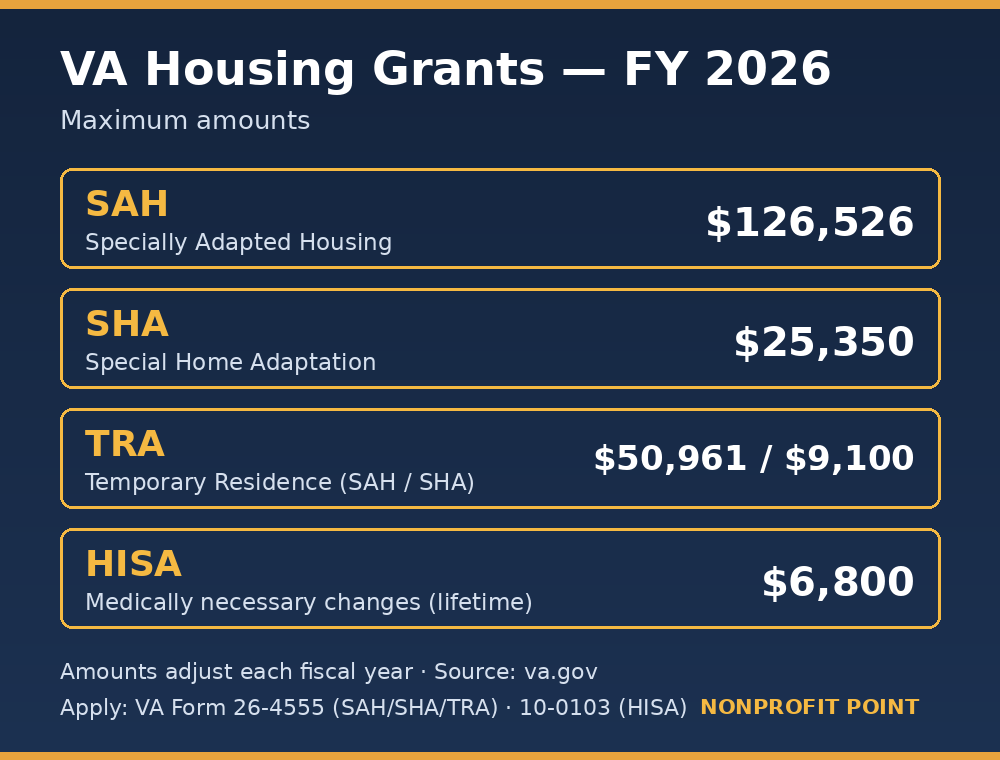
The SAH grant is the largest single housing benefit the VA offers: up to $126,526 in fiscal year 2026 to buy, build, or remodel a permanent home so you can live independently — think wheelchair-accessible layouts, roll-in showers, widened doorways, and ramped entrances.
Who qualifies: You must own (or will own) the home, and have a qualifying service-connected disability: the loss or loss of use of more than one limb; the loss or loss of use of a lower leg along with the lasting effects of an organic disease or injury; blindness in both eyes (20/200 visual acuity or less); certain severe burns; or the loss or loss of use of one lower extremity after September 11, 2001 that prevents balancing or walking without braces, crutches, canes, or a wheelchair (Congress caps that last category at 120 grants per fiscal year — if you qualify but miss the cap, you can receive it in a future year).
How to apply: Apply online with VA Form 26-4555 at va.gov/housing-assistance/disability-housing-grants, or by mail or in person at a regional office. One detail most people miss: you don’t have to use it all at once — the grant can be tapped up to 6 times over your lifetime, up to the current maximum, and the cap resets upward most years with construction costs.
2. VA Special Home Adaptation (SHA) Grant — up to $25,350
The SHA grant funds up to $25,350 (FY 2026) in home adaptations for a different set of qualifying disabilities than SAH. It covers changes like assistive-technology installs, accessible bathrooms and kitchens, and modifications for burn or respiratory injuries.
Who qualifies: You or a family member must own (or will own) the home, and you need a qualifying service-connected disability: the loss or loss of use of both hands, certain severe burns, or certain respiratory or breathing injuries.
How to apply: Same route as SAH — VA Form 26-4555, online, by mail, or in person. Like SAH, the SHA grant is usable up to 6 times over your lifetime, and unused balance stays available in future years.
3. VA Temporary Residence Adaptation (TRA) Grant — up to $50,961
Living temporarily with family while you recover or wait on a permanent home? The TRA grant adapts their house for you — and you don’t have to own it. TRA pays up to $50,961 if you qualify under the SAH track, or up to $9,100 if you qualify under the SHA track (FY 2026 amounts).
Who qualifies: You must be living temporarily in a family member’s home that needs changes to meet your needs, and you must otherwise qualify for an SAH or SHA grant (see #1 and #2).
How to apply: Same application, VA Form 26-4555. Note that TRA money counts against your lifetime SAH/SHA grant total, so plan the split with your VA agent if a permanent-home project is also coming.
4. VA HISA Grant — $6,800 for Medically Necessary Home Changes
The Home Improvements and Structural Alterations (HISA) benefit is the fastest-moving of the VA housing grants because it runs through VA health care rather than the benefits side. It pays for medically necessary changes to your primary residence: permanent ramps, roll-in showers, accessible sinks and counters, and plumbing or electrical work needed for home medical equipment.
Who qualifies (and how much): It’s a lifetime benefit of $6,800 for veterans and service members with a service-connected disability (also available at $6,800 for a non-service-connected condition if you hold a service-connected rating of at least 50%), or $2,000 for other eligible non-service-connected disabilities. Renters can use HISA too, with a notarized authorization from the property owner. It won’t pay for exterior decking, hot tubs, home security systems, portable/removable equipment, routine maintenance, or new construction.
How to apply: Submit VA Form 10-0103 with a prescription from a VA physician (diagnosis + medical justification), an itemized contractor estimate, and a color photo of the unimproved area, through the Prosthetic & Sensory Aids Service at your VA medical center. Details at prosthetics.va.gov. HISA is separate from the SAH/SHA grants, so many veterans use both.
5. HUD-VASH — Housing Vouchers Plus VA Case Management
HUD-VASH pairs a HUD Housing Choice (Section 8) rental voucher with VA case management and supportive services, and it’s the backbone of permanent housing for veterans coming out of homelessness. The voucher covers the portion of rent you can’t, in regular private-market apartments — this is long-term help, not a shelter bed.
Who qualifies: Veterans experiencing homelessness who meet income rules and VA health care eligibility, with priority based on need. A policy change in recent years excluded service-connected disability compensation from the initial income calculation, which opened HUD-VASH to many more disabled veterans who were previously “over income” on paper.
How to apply: There’s no web form — entry runs through VA homeless programs. Call the National Call Center for Homeless Veterans at 877-424-3838 or talk to the Homeless Coordinator at your VA medical center, and ask for a HUD-VASH assessment. Program overview at department.va.gov/homeless/hud-vash.
6. SSVF — Rapid Re-Housing and Eviction Prevention
Supportive Services for Veteran Families (SSVF) is the VA program most likely to write a check fast when a veteran household is about to lose housing. The VA funds nonprofit agencies in every state to deliver rapid re-housing and homelessness prevention — including temporary financial assistance that can cover rent arrears, security deposits, moving costs, and utility payments, plus help finding a new unit.
Who qualifies: Very low-income veteran families (generally at or below 50% of area median income) who are homeless or at imminent risk of becoming homeless. You do not need a disability rating — though disabled veterans on fixed incomes are a large share of who SSVF serves.
How to apply: Apply through the SSVF provider agency serving your county, not the VA itself. Call 877-424-3838 and ask for the SSVF intake agency near you, or find the current provider list at department.va.gov/homeless.
7. VA-Backed Home Loans — No Down Payment, No Funding Fee for Disabled Veterans
The VA home loan isn’t a grant, but for disabled veterans it’s meaningfully cheaper than for everyone else: VA-backed purchase loans require no down payment and no private mortgage insurance, and veterans receiving VA disability compensation are exempt from the VA funding fee — a savings that typically runs into the thousands on a purchase loan.
Who qualifies: Veterans, service members, and some surviving spouses who meet service requirements and obtain a Certificate of Eligibility (COE). The funding-fee exemption applies to those entitled to compensation for a service-connected disability.
How to apply: Request your COE and compare VA-approved lenders at va.gov/housing-assistance/home-loans. Already have a VA loan and struggling with payments? Contact a VA loan technician at 877-827-3702 or start at the VA’s help-to-avoid-foreclosure page — the VA has repayment plans, forbearance options, and purchase-relief programs that only work if you engage before foreclosure.
8. Homes For Our Troops — Mortgage-Free Adapted Homes
Homes For Our Troops (HFOT) builds and donates specially adapted custom homes — mortgage-free — for severely injured post-9/11 veterans. Homes are built where the veteran chooses to live, with 2,800+ square feet of adaptations like wheelchair-height counters, roll-under sinks, and automated systems. HFOT has delivered over 420 homes since 2004, spends roughly 90 cents of every dollar on program services, and holds a 4-star Charity Navigator rating.
Who qualifies: Post-9/11 veterans severely injured in service — typically multiple limb amputations, partial or full paralysis, blindness, severe burns, or severe TBI — generally aligned with VA SAH-grant-level injuries. The veteran’s SAH grant is applied toward the build, and HFOT covers the rest.
How to apply: Submit an assistance inquiry at hfotusa.org/help or call (866) 787-6677. Expect a comprehensive selection process, and note HFOT stays involved after key handover — including three years of pro-bono financial planning.
9. Tunnel to Towers Foundation — Smart Homes and Homeless Veteran Housing
The Tunnel to Towers Foundation runs two housing programs relevant here. Its Smart Home Program builds mortgage-free, specially adapted smart homes for catastrophically injured veterans and first responders — homes controlled by tablet, with automated doors, lighting, and temperature. Its Homeless Veteran Program develops housing (including comfort-home communities and housing villages) and services aimed at ending veteran homelessness nationwide.
Who qualifies: Smart Homes serve catastrophically injured veterans and first responders; the Homeless Veteran Program serves veterans experiencing homelessness, typically in partnership with local VA and service agencies.
How to apply: Program details and application information are at t2t.org. If you’re applying for a Smart Home, gather your service and medical records first — the review is thorough.
10. Purple Heart Homes — Free Modifications for Every Era
Where HFOT focuses on post-9/11 catastrophic injuries, Purple Heart Homes serves service-connected disabled veterans from every era — WWII through today — at no cost to the veteran. Its Veterans Aging in Place program handles ramps, grab bars, accessible bathrooms, and doorway widening; it also builds fully accessible modular homes placed on a veteran’s property, and runs a Veteran Home Ownership Program for qualified veterans who don’t currently own. The organization has completed 1,700+ projects serving 4,000+ veterans.
Who qualifies: Veterans with a service-connected disability who were honorably discharged and live in an unsafe or inaccessible home. Projects are sized to the veteran’s actual needs, from a weekend ramp build to a full modular home.
How to apply: Apply directly at purplehearthomesusa.org (Application for Assistance) or call (704) 838-4044.
11. Operation Homefront — Transitional and Permanent Housing
Operation Homefront supports military and veteran families in financial crisis, and housing is one of its core lanes. Its transitional housing programs provide rent-free housing with caseworker support — including housing near major military medical centers for families of wounded service members during treatment and recovery — and its permanent-homes program places veteran families in donated homes with a path to mortgage-free ownership after a successful transition period.
Who qualifies: Varies by program; generally wounded, ill, or injured service members, veterans, and their families, with financial-need screening. Each program posts current openings and criteria on the website.
How to apply: Check current program availability and apply at operationhomefront.org. Operation Homefront also runs critical financial assistance (paid directly to creditors) that can cover a rent or mortgage payment in a one-time crunch.
12. Habitat for Humanity and Rebuilding Together — Repairs and Accessibility
Two national repair networks quietly do a large share of veteran home modifications. Many Habitat for Humanity local affiliates run veteran-focused repair and build initiatives (often under the Veterans Build banner) — affordable homeownership with sweat equity, plus critical repairs and accessibility work. Rebuilding Together affiliates provide free critical home repairs and safety/accessibility modifications for low-income homeowners, with dedicated veteran programs in many markets.
Who qualifies: Both work through local affiliates with their own income limits (typically low-to-moderate income homeowners); veteran status is prioritized in their veteran-specific programs.
How to apply: Find and contact your local affiliate at habitat.org and rebuildingtogether.org. If either has a waitlist, ask about their next veteran-build event — timelines are often shorter around Veterans Day.
Housing costs don’t stop at the front door. Disabled veterans in most states also qualify for property-tax relief — see our guide to charities and programs that help pay property taxes. And our Get Help Paying For… directory maps every assistance guide we publish in one place.
Don’t Skip the State-Level Money: Property Tax Exemptions
Nearly every state offers a property-tax exemption for disabled veterans, and in a large number of them, a veteran rated 100% permanently and totally disabled pays no property tax at all on a primary residence. Partial ratings usually earn partial exemptions. This is often worth thousands of dollars a year — recurring, forever — and it’s routinely left unclaimed because nobody tells the veteran it exists. Apply through your county assessor or your state’s Department of Veterans Affairs, and bring your VA rating letter.
How to Apply Without Losing Months, Step by Step
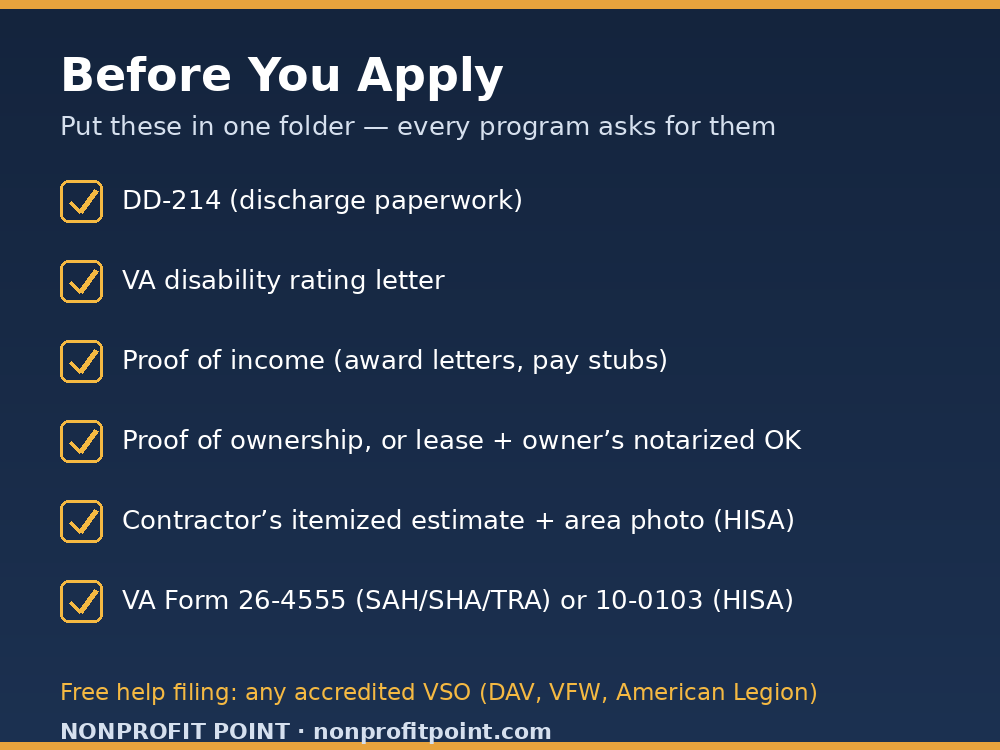
1. Get your paperwork in one folder first. Nearly every program on this list asks for the same core documents: your DD-214, your VA disability rating letter, proof of income, and proof of home ownership or your lease. HISA adds a VA physician’s prescription, a contractor’s itemized estimate, and a photo of the area to be modified. Having these ready is the single biggest speed lever.
2. File the VA grants before the nonprofit applications. Nonprofits like Homes For Our Troops expect your SAH grant to be part of the build funding, and every nonprofit reviewer moves faster when your VA rating and grant eligibility are already documented.
3. If housing is unstable, call 877-424-3838 today — not after eviction. SSVF’s prevention money and the VA’s foreclosure help both work dramatically better before you’re out of the home. The same call routes you to HUD-VASH if you’re already homeless.
4. Apply in parallel, and say yes to the site visit. VA grants, one or two nonprofits, and your county tax exemption can all be in flight at once — they don’t conflict, and several stack. Most home-adaptation programs require an assessment visit; scheduling it quickly is usually what separates a this-year project from a next-year one.
5. If you get stuck, borrow a professional. Accredited Veteran Service Officers (VSOs) at the DAV, VFW, American Legion, or your county veterans office will prepare and chase VA paperwork for free. A VSO can also fix the most common rejection cause: a disability rating that under-describes your current condition.
Vetting a charity before you share your records? Smart. Cross-check our guide to the worst veteran charities to avoid — every organization listed above is one of the legitimate ones, but plenty of sound-alike “veteran housing funds” are not.
Frequently Asked Questions
How much is the VA housing grant for disabled veterans in 2026?
For fiscal year 2026, the Specially Adapted Housing (SAH) grant pays up to $126,526 and the Special Home Adaptation (SHA) grant up to $25,350. The Temporary Residence Adaptation (TRA) grant pays up to $50,961 (SAH track) or $9,100 (SHA track), and the HISA medical-necessity benefit adds $6,800 ($2,000 for some non-service-connected conditions) over a lifetime. Amounts adjust most years.
Do 100% disabled veterans get free housing?
Not automatically — there is no blanket free-housing benefit. But a 100% permanent-and-total rating unlocks the strongest combination available: SAH/SHA adaptation grants, a funding-fee-exempt VA loan, full property-tax exemptions in many states, and priority with nonprofits like Homes For Our Troops and Purple Heart Homes that build or adapt homes at no cost to qualifying veterans.
What charities build free homes for disabled veterans?
Homes For Our Troops builds mortgage-free specially adapted homes for severely injured post-9/11 veterans. The Tunnel to Towers Foundation builds mortgage-free smart homes for catastrophically injured veterans. Purple Heart Homes builds accessible modular homes and does free modifications for service-connected disabled veterans of every era, and Operation Homefront places veteran families in donated homes with a path to ownership.
Can the VA help if I’m behind on my mortgage or about to become homeless?
Yes. Call the National Call Center for Homeless Veterans at 877-424-3838 (24/7, free) to reach SSVF — which can pay rent arrears, deposits, and moving costs — or HUD-VASH if you’re already homeless. If you have a VA-backed loan, call 877-827-3702 before missing payments; VA loan technicians can arrange repayment plans and forbearance.
Can I get help adapting a home I don’t own?
Yes, two ways. The TRA grant (up to $50,961 in FY 2026) adapts a family member’s home you’re living in temporarily. The HISA benefit also works for renters, with a signed, notarized authorization from the property owner. Purple Heart Homes and Rebuilding Together generally require ownership, so ask before applying.
How do I apply for a VA disability housing grant?
File VA Form 26-4555 for SAH, SHA, or TRA — online at va.gov, by mail, or at a regional office. For HISA, submit VA Form 10-0103 through your VA medical center with a VA physician’s prescription, an itemized contractor estimate, and a photo of the area. A free accredited VSO can prepare either application with you.
Related Help
- Help for Veterans in Need: Top Nonprofits
- Charities That Help With Housing
- Emergency Housing Assistance Charities
- Charities That Help With Home Repairs
- Charities That Help With Rent
- Charities That Help With Medical Bills
Written & reviewed by Atdhe Trepca, founder of Happy Productions and a nonprofit strategist. Grant amounts, eligibility rules, and application steps in this guide were verified against VA.gov and each organization’s official website in July 2026 — including FY 2026 grant maximums published by the VA. Because VA grant caps adjust each fiscal year and nonprofit programs change intake windows, confirm current details on the linked official pages before you apply.