Respite Care and Family Caregiver Grants: What Actually Pays (2026)

There are roughly as many unpaid family caregivers in the United States as there are people in a mid-sized state, and most of them have never taken a day off. Not because help does not exist, but because the help is scattered across four different federal systems, none of which advertises, and each of which calls the same thing by a different name.
This guide is about the money. Not advice on coping, not a list of self-care suggestions. Which programmes actually pay for someone else to take over for a few hours, who qualifies for each, what they pay, and the order to work them in so you are not waiting eighteen months on a Medicaid waiver when a free programme would have covered you this month.
One thing to clear up first, because it is the single most common and most expensive misunderstanding in this whole area.
Medicare does not pay for respite care, with one exception
People assume Medicare covers it. It does not. Medicare pays for skilled care, not for custodial care, and respite is custodial by definition.
The exception is hospice. Once the person you care for has elected the Medicare hospice benefit, the hospice team can arrange short term inpatient respite care, and Medicare covers the stay. Medicare states the cost share plainly: you may pay 5 percent of the Medicare-approved amount for inpatient respite care, and your copayment cannot be more than the inpatient deductible amount.
That is a real and underused benefit, and families in hospice frequently do not know it exists. But it only opens once hospice has been elected, which is a decision about the course of an illness and not a decision about caregiver fatigue. For everyone outside hospice, the funding comes from somewhere else entirely.
Every route that actually pays, and who qualifies
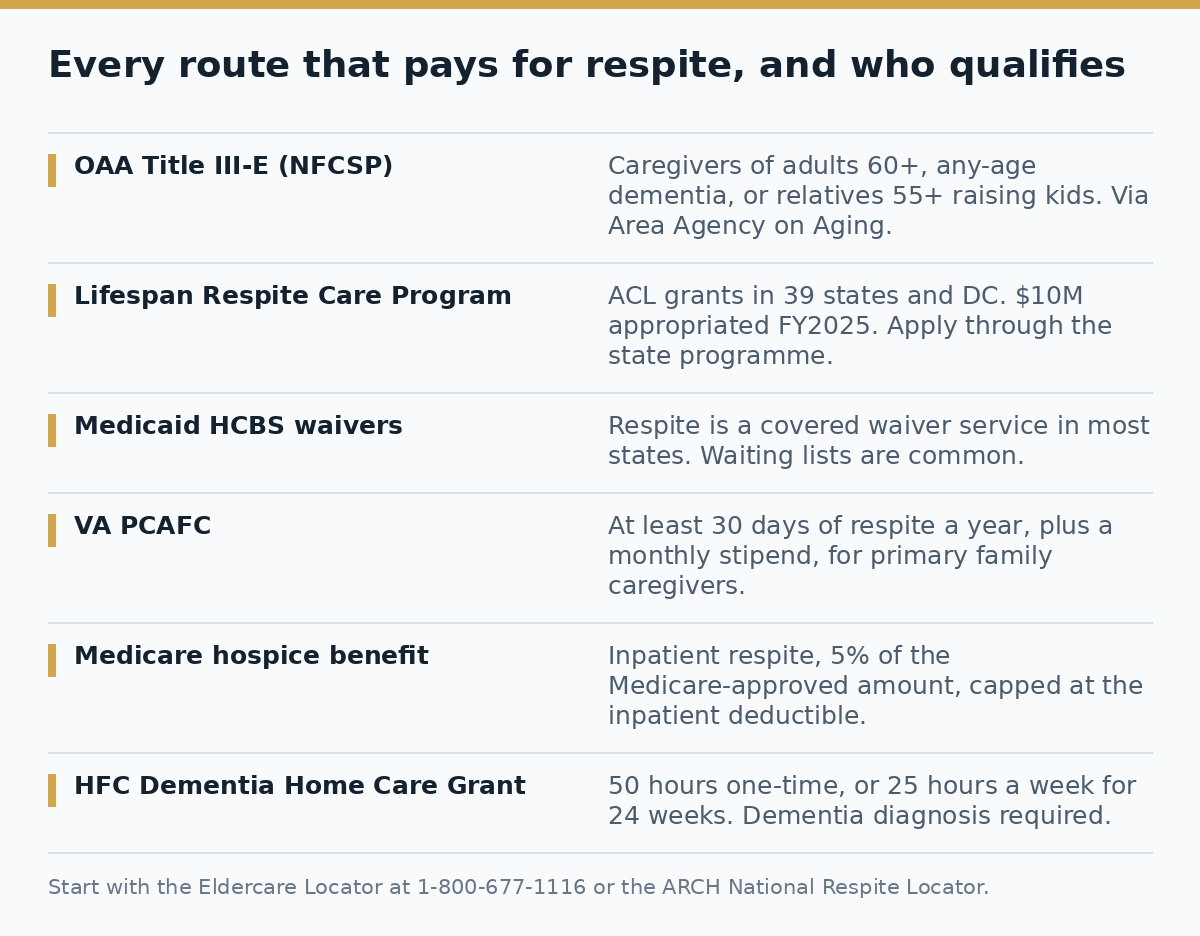
Six routes carry essentially all of the respite funding in the country. They have different eligibility rules, different waiting times and different amounts, and several of them can run at the same time.
1. The Older Americans Act: the one with no means test
The National Family Caregiver Support Program, authorised under Title III-E of the Older Americans Act at Section 371 and established in 2000, is the first place to go and the place fewest people start. It funds five categories of service: information about available services, help gaining access to services, individual counselling and support group organisation and caregiver training, respite care, and supplemental services on a limited basis.
Eligibility, as set after the 2020 Older Americans Act reauthorisation, covers four groups:
- Adult family members or other informal caregivers providing care to individuals aged 60 and older.
- Adult family members or other informal caregivers of a person of any age with Alzheimers disease or a related disorder, regardless of the care recipient’s age.
- Relatives who are not parents, aged 55 or older, caring for children under 18.
- Relatives aged 55 or older, including parents, caring for adults aged 18 to 59 with disabilities.
Notice what is not in that list: an income test. Funding is allocated to states by their share of the population aged 70 and over, which means local capacity varies and some Area Agencies on Aging operate waiting lists or ask for a voluntary contribution. But the programme is not designed around poverty, and caregivers who assume they earn too much routinely rule themselves out of something they qualify for.
How to reach it: call the Eldercare Locator on 1-800-677-1116, Monday to Friday, 8am to 9pm Eastern. It is operated by the Administration for Community Living and exists to route you to your Area Agency on Aging. Ask for the Title III-E family caregiver programme by name, then ask two specific questions: how many respite hours are available, and whether supplemental services can cover anything else you need.
2. Lifespan Respite: the state layer on top
The Lifespan Respite Care Program was enacted by Congress in 2006 under Title XXIX of the Public Health Service Act and reauthorised in 2020. It is a grant programme: the Administration for Community Living awards competitive grants to state agencies, Aging and Disability Resource Centers, and agencies working with statewide respite coalitions. Families are not eligible applicants and cannot apply to it directly.
Since 2009 ACL has made awards to agencies in 39 states and the District of Columbia, and Congress appropriated 10 million dollars for the programme in fiscal year 2025, two million above the fiscal 2022 enacted level.
What matters for a family is what states do with it. Grantees build statewide respite databases, train paid and volunteer respite providers, and run person-centred service options including vouchers. The voucher is the part worth chasing. ARCH advises contacting your state Lifespan Respite programme or state respite coalition first for provider information, for ways to pay for respite, and specifically for emergency respite funding.
3. Medicaid: the biggest money and the longest wait
Medicaid home and community based services waivers cover respite as a service in most states, and for families who qualify this is the largest and most durable source of funded hours. It is also the slowest. Waivers are capped programmes and waiting lists running into years are normal in some states for some populations.
Two things worth knowing beyond plain respite. First, many states run self-directed HCBS programmes in which the person receiving care controls a budget and can hire their own workers, including in many cases a family member. Second, several states operate structured family caregiving models that pay a live-in family caregiver a daily rate. Rules on which relatives may be paid, and whether a spouse qualifies, vary by state and sometimes by waiver.
The practical instruction is simple: apply early, and apply while you are working the faster routes above. Nothing about being on a waiver waiting list stops you using Title III-E respite in the meantime.
4. The VA, for caregivers of veterans
The Program of Comprehensive Assistance for Family Caregivers is the most generous single package available to any family caregiver in the country, and it is tightly gated.
The veteran must have a VA disability rating of 70 percent or higher, individual or combined, must need at least six months of continuous, in-person personal care, must be enrolled in VA health care, and must have been discharged from the US military or have a medical discharge date. The caregiver must be at least 18 and be a spouse, child, parent, stepfamily member or extended family member of the veteran, or live full time with them, or be willing to.
Approved Primary Family Caregivers receive a monthly stipend, CHAMPVA health care if they do not already qualify under another health plan, free legal and financial planning assistance, at least 30 days of respite care per year, telehealth therapy through the VA virtual psychotherapy programme for caregivers, and access to military commissaries and exchanges. Primary and Secondary caregivers both receive caregiver education and training, mental health counselling and certain travel benefits.
Apply jointly on VA Form 10-10CG, online, in person at the caregiver support team of your nearest VA medical center, or by mail to the 10-10CG Evidence Intake Center, PO Box 5154, Janesville, WI 53547-5154. The VA says not to include medical records with the application. The Caregiver Support Line runs Monday to Friday, 8am to 8pm Eastern.
There is a separate, much lighter programme, the Program of General Caregiver Support Services, for caregivers who do not meet the PCAFC bar. It carries no stipend but does carry support services. Ask about it in the same call rather than treating a PCAFC denial as the end.
5. Disease-specific charities, where the hours are real
The most concrete charitable respite offer currently running is the HFC Dementia Home Care Grant, from Hilarity for Charity in partnership with Home Instead. Two forms:
- Recharge Respite Grant. A one-time grant of 50 hours of respite care, to be used within three months of the award.
- Extended Relief Respite Grant. 25 hours of respite care per week for six months, which is 24 weeks. The number awarded is limited.
Care is delivered by a Home Instead Care Professional. To qualify, the person being cared for must have a professional diagnosis of Alzheimers or a related dementia, must currently live at home, and the family caregiver must be facing financial and emotional hardship. Applicants must live in the United States or Canada; Puerto Rico and other US territories are excluded. Applications are online only, reviewed monthly, with notification by email within 60 to 90 days. One application per person per quarter, a maximum of three awards in any 18 month period and no more than two Extended Relief grants.
Beyond HFC, local Alzheimers Association chapters run respite scholarships and care consultations, and their helpline on 800-272-3900 operates 24 hours a day, seven days a week. Disease organisations including the National MS Society and regional ALS and Parkinsons groups run comparable local funds. These are chapter-level and the amounts differ by area, so the only reliable way to find out is to call the chapter covering your county.
6. The ARCH National Respite Locator, and how to use it honestly
The ARCH National Respite Locator Service is a database run by the ARCH National Respite Network that helps families and professionals find respite services in their state and local area. It lists home care agencies, assisted living facilities and state or community-based agencies.
ARCH is unusually candid about its limits, and the caveats are worth repeating because they protect you. The locator is for informational purposes only and is not comprehensive. Being listed is not an endorsement, and not being listed does not mean a provider lacks one. ARCH does not check the backgrounds, references or experience of listed providers, and does not guarantee the accuracy of listings or the quality of the providers. Vetting is your job.
If the locator turns up nothing usable, ARCH points to state respite registries, the Eldercare Locator and Aging and Disability Resource Centers. ARCH can be reached on 703.256.2084.
The order to work it in
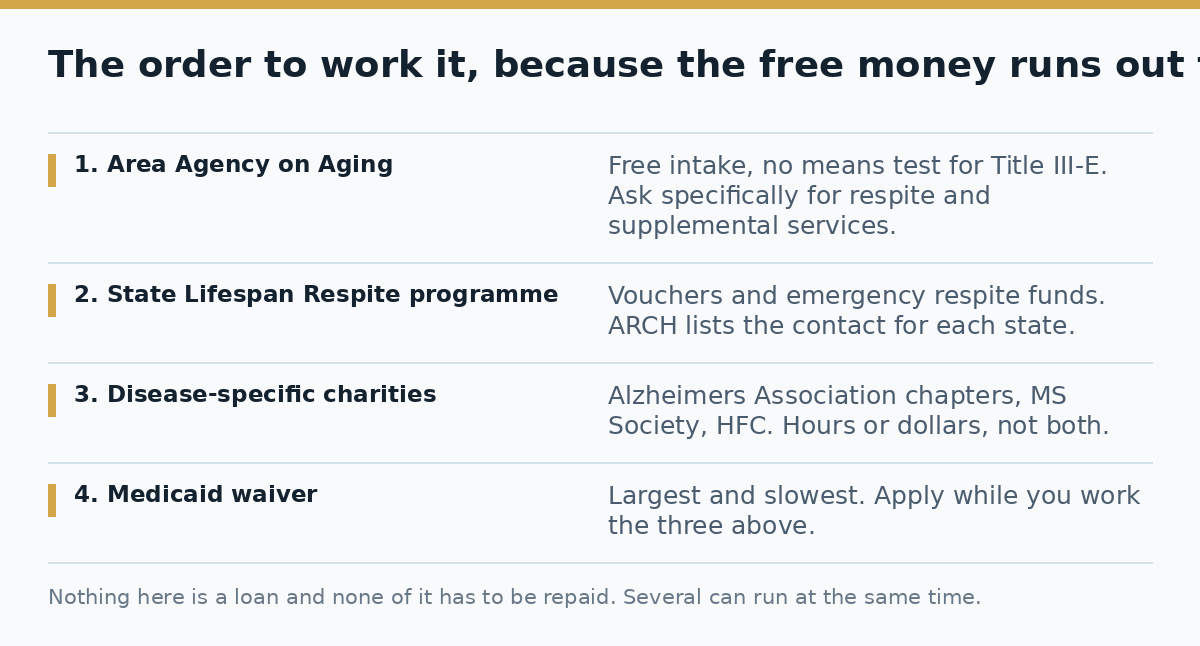
The sequence matters more than people expect, because the fast money and the slow money are not the same money, and starting with the slow one costs you months.
- Call the Eldercare Locator, 1-800-677-1116, this week. Title III-E has no means test and the intake is free. Ask for respite hours and for supplemental services.
- Ask the same Area Agency whether your state has a Lifespan Respite programme, and whether it issues vouchers or holds emergency respite funds. If they do not know, find your state respite coalition through ARCH.
- If there is a diagnosis, call the disease charity. HFC for dementia, the Alzheimers Association chapter, the MS Society. These award hours rather than cash and the timelines are measured in weeks, not days.
- If the veteran test is met, file VA Form 10-10CG. It is the largest package on the list.
- Apply for the Medicaid waiver regardless of how long the list is. It costs nothing to be on it and everything above remains available while you wait.
Two practical notes. Ask every programme whether respite can be used in an emergency as well as planned, because the programmes that allow emergency respite are the ones that keep a crisis from turning into a nursing home admission. And ask what happens to your hours if you do not use them in the period, since some are use-it-or-lose-it and some roll.
What this does not cover, and where the real gap is
Honesty is more useful here than encouragement. For a caregiver who is not 55 or older, not caring for someone over 60, not caring for someone with dementia, not a veteran’s caregiver and not Medicaid eligible, the funded options thin out very fast. That describes a great many people caring for a working-age spouse or an adult child with a physical disability.
For that group the honest answer is: the state Lifespan Respite programme is the main shot, because its eligibility is set by the state rather than by federal category, and some states define it broadly. After that it is local, which means the county, the faith community, volunteer respite programmes and the disease organisation if there is one. It is a genuine gap in the federal structure rather than something you have failed to find.
If the money pressure around the caregiving is broader than respite alone, our guides to charities that help seniors with bills, charities that help with medical bills and charities that help with assisted living costs cover the adjacent layers.
Sources
Every figure on this page comes from one of the following, each read on 20 October 2026.
- Eldercare Locator — routing to your Area Agency on Aging and the Title III-E caregiver programme, 1-800-677-1116.
- Administration for Community Living — National Family Caregiver Support Program, the five service categories and the four eligible groups.
- Administration for Community Living — Lifespan Respite Care Program, eligible applicants, the 39 states and DC, and the FY2025 appropriation.
- ARCH National Respite Network — National Respite Locator and its stated limits.
- US Department of Veterans Affairs — PCAFC eligibility, benefits, the 30 days of respite and VA Form 10-10CG.
- Medicare — Hospice coverage including inpatient respite and the 5 percent copayment.
- Hilarity for Charity and Home Instead — Dementia Home Care Grant, the 50-hour and 25-hour-a-week awards and the eligibility rules.
Related help
- Charities that help with assisted living costs
- Charities that help seniors with bills
- Charities that help with wheelchairs
- Charities that help with medical bills
- Charities and grants for grandparents raising grandchildren
- Charities that give money to individuals
Frequently asked questions
What is respite care?
Respite care is short term care for someone who needs daily help, arranged so that the family member who normally provides that care can rest. It can be a few hours at home, a day programme, or an overnight stay in a facility. It can be planned in advance or arranged in an emergency. The point of it is the caregiver, not the patient.
Does Medicare pay for respite care?
Only through the hospice benefit. If the person you care for has elected hospice, Medicare covers short term inpatient respite care arranged by the hospice team, and you pay 5 percent of the Medicare-approved amount, with the copayment capped at the inpatient deductible amount. Outside hospice, Medicare does not cover respite or ongoing custodial care at home.
How do I get free respite care?
Start with your Area Agency on Aging. The National Family Caregiver Support Program, funded under Title III-E of the Older Americans Act, pays for respite with no means test written into its eligibility rules. Call the Eldercare Locator at 1-800-677-1116 and ask for the Title III-E caregiver programme by name. Then ask whether your state has a Lifespan Respite programme, which may issue vouchers or emergency respite funds.
Who qualifies for the National Family Caregiver Support Program?
Four groups. Adult family members or other informal caregivers providing care to someone aged 60 or over. Caregivers of a person of any age with Alzheimers or a related disorder. Relatives who are not parents, aged 55 or older, caring for children under 18. And relatives aged 55 or older, including parents, caring for adults aged 18 to 59 with disabilities.
What is the Lifespan Respite Care Program?
A federal programme enacted in 2006 under Title XXIX of the Public Health Service Act and reauthorised in 2020. The Administration for Community Living awards competitive grants to state agencies, not to families directly. Since 2009 it has funded agencies in 39 states and the District of Columbia, and Congress appropriated 10 million dollars for it in fiscal year 2025. Families reach it through their state programme.
How much respite care does the VA give family caregivers?
Primary Family Caregivers approved under the Program of Comprehensive Assistance for Family Caregivers receive at least 30 days of respite care per year, alongside a monthly stipend, CHAMPVA health coverage if they do not already have other coverage, free legal and financial planning assistance, and access to a virtual psychotherapy programme. The veteran must have a VA disability rating of 70 percent or higher and need at least six months of continuous in-person personal care.
Are there charities that pay for respite care?
Yes, mostly disease-specific ones. The HFC Dementia Home Care Grant, delivered with Home Instead, awards either a one-time Recharge grant of 50 hours of respite to be used within three months, or an Extended Relief grant of 25 hours a week for 24 weeks. A dementia diagnosis is required and the person must live at home. Alzheimers Association chapters and disease organisations such as the National MS Society run local respite scholarships that vary by area.
Can a family member get paid to be a caregiver?
In many states, yes, through Medicaid. Self-directed home and community based services programmes and structured family caregiving models let the person receiving care hire a relative as the paid caregiver, with rules on who is eligible and whether a spouse may be paid varying by state. This is separate from respite funding and is applied for through your state Medicaid agency or its managed care plan.
What is the ARCH National Respite Locator?
A free searchable database run by the ARCH National Respite Network that lists home care agencies, assisted living facilities and community agencies offering respite, by state and local area. ARCH says plainly that it does not provide respite care itself, does not check providers backgrounds or references, and that the list is not comprehensive. Treat it as a starting point and vet any provider yourself.