Charities That Help With Braces: 3 Real Programs and the Medicaid Route (2026)

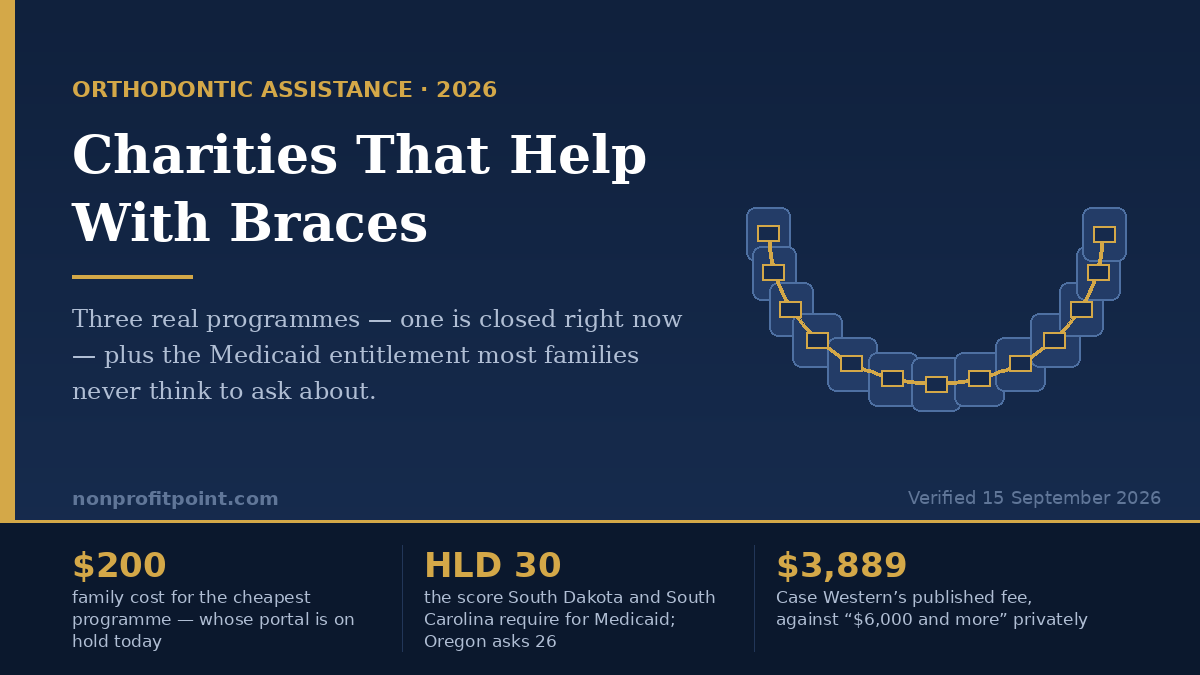
Three charities in the United States run programmes that put braces on a child’s teeth for a fraction of what an orthodontist charges. One of them is not accepting applications at the moment. Another can have you waiting three years or more depending on where you live. The third asks for a school report.
And none of them is the biggest route. The largest source of free orthodontic treatment for children in America is not a charity at all — it is Medicaid, which is legally obliged to cover medically necessary orthodontics for enrolled children under 21, and which most families never think to ask about because they assume braces are cosmetic and therefore excluded.
This guide covers all of it: the three charitable programmes and exactly what each costs and requires, how the Medicaid entitlement actually works and why a state’s scoring form decides your case, the six dental school clinics that publish reduced fees, the well-known organisations that are not braces charities no matter how often they appear on lists, and the ways to pay down whatever is left. Every figure, fee, age limit and eligibility rule below was read off the organisation’s own website or a federal primary source on 15 September 2026. Where a figure is not published, this page says so.
Start here: the three moves that matter most
1. If your child is on Medicaid and under 21, ask for an orthodontic evaluation before you do anything else. Medicaid.gov lists “medically necessary orthodontic services” among required children’s dental benefits under EPSDT. It is an entitlement, not a grant you compete for. What decides it is a scoring form your state uses, not your income.
2. Check application status before you pay a fee. The AAO Foundation’s Gifted Smiles programme — the old Donated Orthodontic Services — currently states that its “application portal and process have been temporarily placed on hold.” Two of the three charitable programmes charge a non-refundable fee up front.
3. Call your nearest dental school before you accept a private quote. Case Western publishes braces at $3,889 against “typical orthodontist fees of $6,000 and more.” Rutgers publishes $3,000–$3,300 for adolescents. UTHealth Houston says its graduate clinics run “about two-thirds the cost” of private practice.
1. The three charitable braces programmes
AAO Foundation Gifted Smiles — the cheapest, and currently on hold
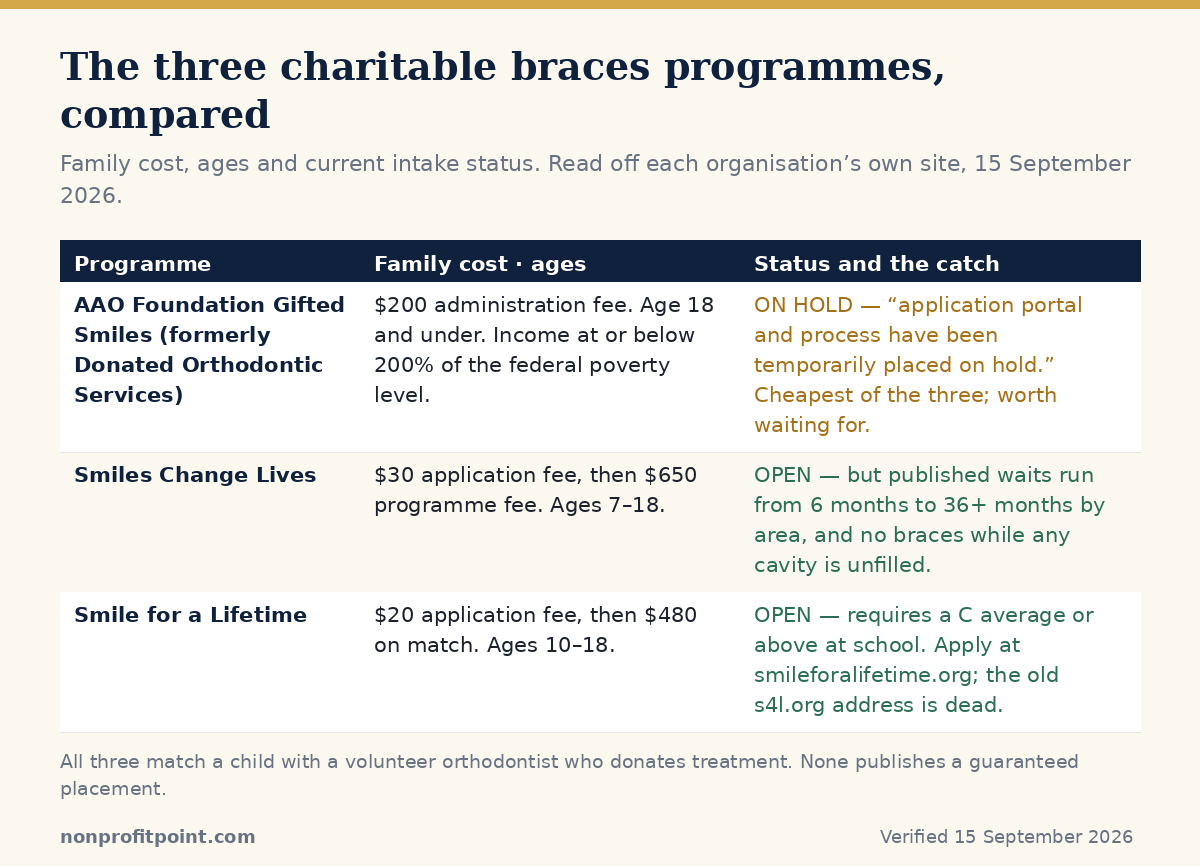
Start with the name, because this is where most articles go wrong. The American Association of Orthodontists Foundation states it plainly: “Gifted Smiles, formerly Donated Orthodontic Services (DOS) program.” If you find a page telling you to apply to “Donated Orthodontic Services,” it is out of date. An orphaned AAO page still carries the old name and advertises application windows from 2023. Ignore it.
The current status, in the Foundation’s own words: “The Gifted Smiles application portal and process have been temporarily placed on hold. Our goal is to have the application portal open again this spring.” So this is a programme to watch and prepare for rather than apply to today.
What it costs when it is open: $200. “Family cost is only $200 (administration fees).” That is the lowest family contribution of the three programmes by a wide margin, which is a large part of why it is worth waiting for.
Who qualifies. The published criteria: the child is 18 or younger; total family income is at or below 200% of the federal poverty level; the child receives regular dental care and has good oral hygiene; the child is not currently in orthodontic treatment or between phases; and the child has not had previous orthodontic treatment. Treatment is provided nationwide.
| Household size | 48 contiguous states | Alaska | Hawaii |
|---|---|---|---|
| 2 | $42,300 | $52,860 | $48,640 |
| 3 | $53,300 | $66,620 | $61,300 |
| 4 | $64,300 | $80,380 | $73,960 |
| 5 | $75,300 | $94,140 | $86,620 |
| 6 | $86,300 | $107,900 | $99,280 |
| 7 | $97,300 | $121,660 | $111,940 |
| 8 | $108,300 | $135,420 | $124,600 |
Note the discrepancy in that caption, because it is the kind of thing that costs a family an application. The consumer-facing AAO page still shows a two-person limit of $40,880, an earlier year’s poverty figure; the Foundation’s own page shows $42,300. If you are near the line, the Foundation’s table is the one to go by.
Scale is modest and honest: the Foundation describes treating “over 1,000 children” in more than a decade, with “patients… waiting to be matched with a volunteer orthodontist.” Programme contact: Tabitha Smith, 314-292-6582.
Smiles Change Lives — open now, with a wait you need to check first
Smiles Change Lives is accepting applications, and its eight-step online form is live. It is the best-known of the three and the one with the most published detail.
Ages 7 to 18, with a warning the organisation prints itself: “if you are 17 or older when you apply, please be aware that your chances of placement with a treatment provider are greatly decreased.”
The cost: a $30 non-refundable application fee, then a $650 programme fee that “must be paid in full within 30 days of notification.” Dental insurance cannot be used against it — “Dental insurance plays no part in the SCL treatment program.”
The dental gate that stops most applicants. “You cannot be approved for the SCL program or get braces while you have unfilled cavities.” Your child also needs regular brushing and flossing and scheduled dental check-ups, and a moderate to severe clinical need for braces. If there is untreated decay, deal with that first — and if paying for that is the obstacle, a dental school clinic or a federally qualified health centre is usually the cheapest route to it.
The wait is the part to research before you pay the $30. Smiles Change Lives publishes a wait-time map — last updated January 2026 — with bands of roughly six months or less, 12 to 24 months, 36+ months, “no SCL providers within 100 miles,” and states and provinces with no providers at all. The organisation’s own instruction: “If you live in rural area, or your city is not listed, please email info@smileschangelives.org for an approximate wait time before submitting an application.” It also cautions that “the orthodontic provider in your area may not have availability to treat additional patients at this time.” Do that email first. A non-refundable fee against a 36-month wait is a different decision from one against a six-month wait.
What you will need: a federal income tax return or an SSI award letter, plus photographs. Decisions take around three weeks. Income limits vary by state and, in some states, by city, and are assessed on taxable income — the organisation publishes them as images on its financial qualifications page rather than as text, so check them there directly rather than trusting a figure quoted elsewhere. Treatment plans average 20 to 36 months.
Smile for a Lifetime — the one with a GPA requirement
First, the link correction. The address most articles give for this organisation, s4l.org, no longer resolves — a connection to it fails outright. The live site is smileforalifetime.org.
Ages 10 to 18. A $20 non-refundable application fee, then a $480 final payment once you are matched with an orthodontist. After that: “Once you are matched with an orthodontist, treatment is completely FREE.” At $500 all-in it sits between Gifted Smiles and Smiles Change Lives on cost.
The unusual requirement: the applicant “must be enrolled in school with a C average or above GPA.” No other programme in this field asks for that. Also required: not currently wearing braces or a retainer; “good” dental hygiene practices; a social impediment or moderate to severe need for braces; and family income meeting the organisation’s financial guidelines, which are not published as figures on the application page. You have 30 days after submitting to provide all documentation.
One thing to expect and one thing we could not confirm. The organisation is candid that matching is not guaranteed in advance: after you apply, “our team begins the process of locating a volunteer orthodontist in your local area,” and it “does not confirm provider availability beforehand.” Separately, this organisation has historically operated through local orthodontist-run chapters, and many individual practices still advertise their own Smile for a Lifetime chapter pages. The national site now describes a single centralised application rather than chapter-by-chapter cycles. We could not establish today whether that is a restructure or two parallel routes, so the safe advice is to apply through smileforalifetime.org and also ask any local orthodontist advertising a chapter whether they take applications directly. The organisation is registered as Smile For A Lifetime Inc, a 501(c)(3), EIN 26-3471255.
2. Medicaid: the biggest route, and the one families skip
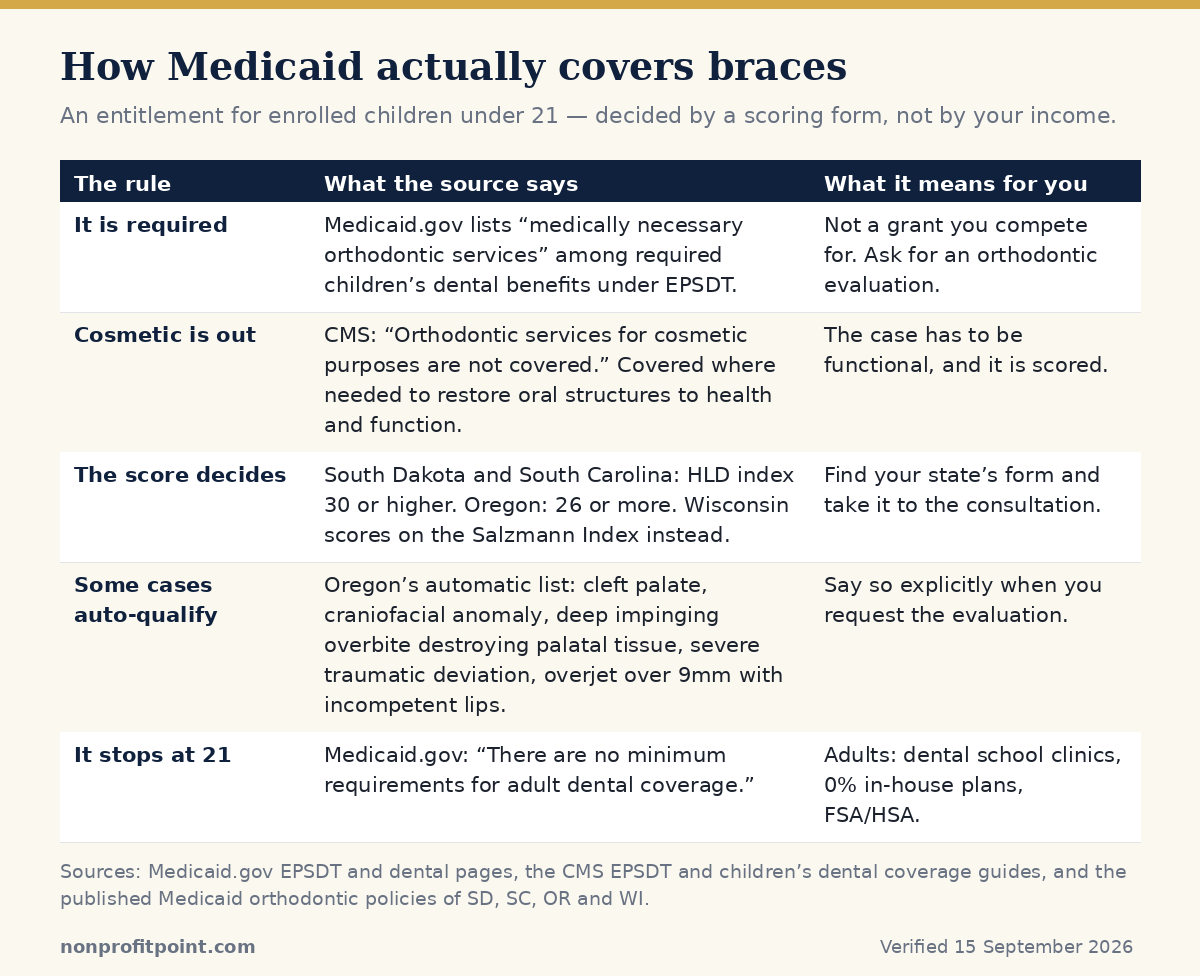
The federal rule. Medicaid.gov’s page on Early and Periodic Screening, Diagnostic and Treatment lists “medically necessary orthodontic services” among required dental benefits. EPSDT “provides comprehensive and preventive health care services for children under age 21 who are enrolled in Medicaid,” and states must furnish all coverable, appropriate and medically necessary services needed to “correct and ameliorate” health conditions. Dental care is required “for relief of pain, infection, restoration of teeth, maintenance of dental health.”
This is not a grant you compete for and it is not discretionary. If your child is enrolled and under 21 and the case meets the state’s medical necessity standard, coverage follows.
The limit, in CMS’s own words: “Orthodontic services for cosmetic purposes are not covered.” What is covered is orthodontics “to the extent necessary to prevent disease, promote oral health, and restore oral structures to health and function,” and CMS’s children’s dental guide names the standard: “Orthodontic treatment when medically necessary to correct handicapping and other malocclusions.” Determinations are made case by case, and “ameliorate” means to improve or maintain the child’s health in the best condition possible.
How “medically necessary” is actually decided: a scoring form
In practice your child’s bite is scored on an index — most commonly the Handicapping Labio-Lingual Deviations index, the HLD — and the score is compared against a threshold your state sets. The threshold is not the same everywhere, and that is the single most important thing to understand about Medicaid orthodontics.
- South Dakota: treatment is medically necessary at “a score of 30 or higher on the Handicapping Labio-Lingual Deviations Form (HLD Index),” with the recipient under 21 when treatment begins.
- South Carolina: requires “a documented score of 30 or more,” ages 0–20, and allows the comprehensive orthodontic codes “once per lifetime, per patient,” with treatment completing before 21.
- Oregon: a lower bar — “Conditions in this section must total 26 or more to qualify for treatment.”
- Wisconsin does not use the HLD at all; its Medicaid programme scores on the Salzmann Index, with instructions revised in October 2025.
Some conditions qualify automatically. Oregon publishes a list that bypasses scoring entirely: cleft palate deformity; craniofacial anomaly; deep impinging overbite where lower incisors are destroying the soft tissue of the palate; crossbite of individual anterior teeth with clinical attachment loss and gingival recession; severe traumatic deviation; and overjet greater than 9mm with incompetent lips, or reverse overjet greater than 3.5mm with chewing and speech difficulties. Other states publish comparable lists. If any of those describes your child, say so explicitly when you request the evaluation.
What to do with this. Search for your own state’s HLD or Salzmann form — most publish it as a PDF on the Medicaid or dental-benefits page — and take it to the orthodontic consultation. A provider who knows the form is scoring against the threshold from the first appointment. A denial is appealable, and a denial based on a borderline score is worth a second opinion from a different orthodontist.
CHIP and adults: be realistic
CHIP. Dental coverage in separate CHIP programmes must include services “necessary to prevent disease and promote oral health, restore oral structures to health and function, and treat emergency conditions.” That is the same functional language that drives medical necessity decisions — but orthodontics is not named in the CHIP dental standard, and no federal dollar cap is published. Whether CHIP covers braces in your state is a question for your state programme, not one this page can answer for you.
Adults. Medicaid.gov is blunt: “States have flexibility to determine what dental benefits are provided to adult Medicaid enrollees. There are no minimum requirements for adult dental coverage.” The EPSDT entitlement stops at 21. If you are an adult seeking braces, no federal guarantee exists anywhere in the country, and the realistic routes are the dental school clinics and payment structures below.
3. Dental school clinics: the most reliable discount in the country
Orthodontic residents treat patients under faculty supervision, appointments run longer, and treatment costs substantially less. Six clinics with published terms:
| School | What it publishes | Phone |
|---|---|---|
| Case Western Reserve | Braces at $3,889, “a savings from typical orthodontist fees of $6,000 and more.” Ages 10–26; about 200 new patients a year | 216-368-8665 |
| Rutgers School of Dental Medicine | $3,000–$3,300 adolescents, $3,600–$3,800 adults. Excludes extractions and periodontal or orthognathic surgery; breakage and missed-appointment fees may apply | 973-972-4242 |
| UTHealth Houston | Advanced education clinic fees “average about two-thirds the cost” of private practice. Full fee payable before treatment is scheduled | 713-486-4190 |
| Tufts | “Significantly lower than… most private practices,” with 0% interest payment plans, a family discount for two or more children, and a reduced rate for paying up front. Treats all ages; early intervention from age 8 | 617-636-6887 |
| University of Washington | Reduced fees (no figure published); screenings are free. Accepts Apple Health for patients qualifying with severe problems. Requires age 7+, a cleaning in the last six months, residence in greater Seattle, good hygiene and an existing general or pediatric dentist | 206-543-5787 |
| Columbia College of Dental Medicine | Fees “very competitive” (no figure published); payment plans available; accepts New York State Medicaid and Medicaid Managed Care; children and adults | 212-305-6100 |
Two practical notes. Waiting lists and screening requirements are normal, so call early rather than when the situation is urgent. And a school that accepts Medicaid, as Columbia does, can be the cheapest route of all for a child who scores above the threshold.
4. The organisations that are not braces charities
These four appear constantly on “charities that help with braces” lists. None of them will get a typical child braces, and knowing that saves wasted applications.
Dental Lifeline Network — Donated Dental Services. A real and valuable programme, but not this one. To qualify you must be 65 or older, permanently disabled, or require medically necessary dental care — it is an adult programme. It states “we do not provide cosmetic dental care,” its stated goal is that patients end up “pain-free and able to eat properly,” and it warns it cannot offer emergency treatment because of waiting-list volume. It does not publish an explicit orthodontic exclusion, so the accurate statement is that braces fall outside its scope rather than that they are named as excluded. Patients may use it only once.
Smile Train. A cleft lip and palate organisation that empowers “local medical professionals in 75+ countries to provide 100%-free cleft surgery and other forms of essential cleft care.” Orthodontics does appear in its model — “Children with clefts need more than just surgery. They may also need nutritional support, dental care, orthodontic treatment, speech therapy, and more” — but as a component of cleft care delivered through international partners, not as a US braces programme.
Operation Smile. Also cleft lip and palate. Its published comprehensive cleft care is surgical repair, speech therapy, nutritional support and post-operative care. Orthodontics is not listed among its services on its own pages, and its published emphasis is international.
Shriners Children’s — a genuine exception, but only for cleft and craniofacial patients. Shriners states it directly for cleft palate: “Children with cleft palate usually require a two phase treatment plan. Phase one involves a palate expander before any bone grafts that may be needed in the child’s jaw area. Phase two typically is traditional braces when patients are teenagers.” It also notes that around 25% of children with cleft lip or palate will need jaw surgery in their late teens. If your child has a cleft or craniofacial condition, this is a serious route worth pursuing. Shriners does not publish cost or ability-to-pay terms online and notes that services vary by location, so call the nearest location and ask.
5. What braces actually cost — and why most quoted figures are unsourced
Here is something worth knowing before you read any other article on this subject. The American Association of Orthodontists publishes no cost figures at all. Its own consumer page on the cost of braces says only that “Treatment costs are influenced by factors such as the type, complexity, and duration of the orthodontic treatment.” No range, no average, no numbers. So every “the AAO says braces cost $X” claim you encounter is attributing a figure to a body that has not published one.
What can be sourced comes from clinics that publish their own fees. Case Western puts its own treatment at $3,889 and describes typical private orthodontist fees as “$6,000 and more.” Rutgers publishes $3,000–$3,300 for adolescents and $3,600–$3,800 for adults. UTHealth Houston describes its clinic fees as running about two-thirds of private-practice fees. Triangulating those puts a typical private-practice comprehensive case somewhere in the region of $4,500 to $6,000 and up, with school clinics at roughly $3,000–$3,900. That is a defensible read of published numbers rather than an invented average, and it is the honest way to frame it.
On metal braces versus clear aligners, no primary source publishing a reliable split could be found, so this page does not offer one.
6. Paying for the part nobody covers
Dental insurance: check the lifetime maximum, not the annual one
Orthodontic benefits work differently from the rest of your dental plan. Delta Dental of New Jersey’s consumer material describes a typical structure: an “orthodontia benefit provides 50% coinsurance up to a $1,500 lifetime maximum,” paid against the group’s orthodontic payment schedule until treatment ends or the lifetime maximum is reached. It also notes that “orthodontia for minor tooth movement is not covered.”
Run the arithmetic before you count on it. A $1,500 lifetime cap against a $5,000 case leaves the family carrying most of the bill. The AAO’s guidance is to ask specifically about “any lifetime maximums or age limits” — age limits being the second trap, since many plans stop orthodontic coverage at 19. Your own plan’s terms are what govern; the figures above are one insurer’s published example, not a universal rule.
In-house payment plans
The AAO notes that “many orthodontic practices offer in-house payment plans, allowing patients to spread the cost of treatment over several months or years,” and that “these plans often come with low or no interest and can be tailored to fit your budget.” That is standard practice and it is negotiable, which families often do not realise. Tufts publishes an actual rate — payment plans at 0% interest — which gives you a reasonable benchmark to ask a private practice to match.
FSA and HSA: braces are explicitly qualifying
This is the most reliable discount available to a working family, and it is written into IRS Publication 502: “Treatment to alleviate dental disease includes services of a dentist for procedures such as X-rays, fillings, braces, extractions, dentures, and other dental ailments.” Braces are named.
The usual cosmetic caveat applies — the IRS generally excludes “any procedure that is directed at improving the patient’s appearance and doesn’t meaningfully promote the proper function of the body” — with an explicit exception where the work is “necessary to improve a deformity arising from, or directly related to, a congenital abnormality, a personal injury resulting from an accident or trauma, or a disfiguring disease.”
For 2026 the health FSA salary-reduction limit is $3,400, with a maximum carryover of $680 where the plan permits carryover, under Revenue Procedure 2025-32. Paying with pre-tax dollars is effectively a discount equal to your marginal tax rate, and if treatment spans two plan years you can use two years of contributions against it.
7. Before you pay anyone: two warnings
Application fees
Every legitimate programme verified for this guide charges a small, clearly disclosed fee: Gifted Smiles $200 in administration fees, Smiles Change Lives $30 plus $650, Smile for a Lifetime $20 plus $480. A programme demanding a large payment before any orthodontist has been matched to your child is out of line with what every real programme publishes. You can check any organisation’s status through the IRS Tax Exempt Organization Search, which covers determination letters, Form 990 filings and the automatic revocation list.
Two honest cautions about the legitimate programmes themselves: the Smiles Change Lives fee is non-refundable and its published waits run past three years in some areas, and the Gifted Smiles portal is closed today. Confirm intake status before you pay anything.
Mail-order aligners
The AAO’s consumer alert on direct-to-consumer orthodontics is specific: “there is more to creating a healthy, beautiful smile than moving the visible portions of your teeth,” and “orthodontic treatment involves the movement of biological material, which if not done correctly could lead to potentially irreversible and expensive damage.” Its concern is companies that do not involve in-person evaluation or in-person supervision, and it publishes thirteen questions to ask — among them whether diagnostic records and x-rays are taken before treatment, whether there are any in-person visits, whether you can identify and research the specific dentist or orthodontist, who detects and handles problems mid-treatment, whether local help is available in an emergency, and what rights you have if injured.
In a 2023 submission to the FDA the AAO wrote that “providing orthodontic treatment through a mail-order format may fall within the gaps of proper regulatory supervision, potentially posing significant risks to patient health and safety,” and reported that 77% of its surveyed members had seen patients needing retreatment after trying mail-order orthodontics first.
One correction, in fairness. That was a submission to an FDA request for information — it is the profession’s position, not a regulatory finding. No FDA safety communication, warning letter or recall on direct-to-consumer aligners could be located. Articles that describe the FDA as having acted or warned are overstating it. The AAO’s concerns stand on their own; they do not need to be dressed up as federal action.
Frequently asked questions
What charities actually pay for braces in the United States?
Three: the AAO Foundation’s Gifted Smiles programme (formerly Donated Orthodontic Services), Smiles Change Lives, and Smile for a Lifetime. Each matches a child with a volunteer orthodontist who donates treatment, and each charges the family a modest fee — $200 for Gifted Smiles, $30 plus $650 for Smiles Change Lives, and $20 plus $480 for Smile for a Lifetime. As of 15 September 2026, Gifted Smiles has its application portal temporarily on hold; the other two are open. Most other organisations named on “charities that help with braces” lists are cleft-care or adult dental programmes that do not provide general orthodontic treatment.
Does Medicaid cover braces?
Yes, for enrolled children under 21, when treatment is medically necessary. Medicaid.gov lists “medically necessary orthodontic services” among required children’s dental benefits under EPSDT, and CMS’s children’s dental guide covers “orthodontic treatment when medically necessary to correct handicapping and other malocclusions.” The limit is explicit: “Orthodontic services for cosmetic purposes are not covered.” Whether a case qualifies is decided by scoring the bite on an index — usually the HLD index — against a threshold your state sets. Adults have no federal guarantee; Medicaid.gov states there are “no minimum requirements for adult dental coverage.”
What score do you need for Medicaid to approve braces?
It depends on your state, which is why a blanket answer is wrong. South Dakota and South Carolina both require a score of 30 or higher on the Handicapping Labio-Lingual Deviations index. Oregon requires 26 or more. Wisconsin does not use the HLD at all and scores on the Salzmann Index instead. Some conditions qualify automatically regardless of score — Oregon’s automatic list includes cleft palate, craniofacial anomaly, deep impinging overbite destroying palatal soft tissue, severe traumatic deviation, and overjet greater than 9mm with incompetent lips. Find your own state’s form, usually published as a PDF on its Medicaid dental pages, and take it to the consultation.
How much do braces cost without insurance?
Be careful with quoted figures: the American Association of Orthodontists publishes no cost range at all, so any article attributing a dollar figure to the AAO is inventing the attribution. What is published comes from clinics. Case Western Reserve puts its own orthodontic treatment at $3,889 and describes typical private orthodontist fees as “$6,000 and more.” Rutgers publishes $3,000–$3,300 for adolescents and $3,600–$3,800 for adults. UTHealth Houston says its graduate clinic fees run about two-thirds of private practice. That puts private practice in the region of $4,500–$6,000 and up, and dental school clinics around $3,000–$3,900.
Is there an age limit for free braces programmes?
Yes, and it is tighter than most families expect. Gifted Smiles takes children 18 and under. Smiles Change Lives takes ages 7 to 18 but warns that “if you are 17 or older when you apply, your chances of placement with a treatment provider are greatly decreased.” Smile for a Lifetime takes ages 10 to 18. The Medicaid EPSDT entitlement runs to age 21, and some states require treatment to be completed before 21, not merely started. For adults, the realistic options are dental school clinics — Rutgers, Tufts and Columbia all treat adults — payment plans, and FSA or HSA dollars.
How long is the wait for Smiles Change Lives?
It depends heavily on where you live, and the organisation publishes a map showing it. The bands, last updated January 2026, are roughly six months or less, 12 to 24 months, 36 months or more, “no SCL providers within 100 miles,” and states and provinces with no providers at all. The organisation asks rural applicants and those whose city is not listed to email info@smileschangelives.org for an estimate before applying. Since the $30 application fee is non-refundable, sending that email first is worth the day it costs.
Will Smile Train or Operation Smile give my child braces?
No, unless your child has a cleft. Both are cleft lip and palate organisations. Smile Train works through local medical professionals in more than 75 countries and does include orthodontic treatment as a component of comprehensive cleft care, but it is cleft-linked care through international partners rather than a US braces programme. Operation Smile’s published comprehensive cleft care is surgery, speech therapy, nutritional support and post-operative care, with orthodontics not listed. If your child does have a cleft or craniofacial condition, Shriners Children’s is the more relevant route — it states that phase two of cleft palate treatment “typically is traditional braces when patients are teenagers.”
Can I use an FSA or HSA to pay for braces?
Yes. IRS Publication 502 names braces explicitly among dental procedures that count as deductible medical care, which is the same standard FSAs and HSAs use. For 2026, the health FSA salary-reduction limit is $3,400 with a maximum carryover of $680 where the plan allows it, under Revenue Procedure 2025-32. Because orthodontic treatment usually spans more than a year, you can often apply two plan years of contributions to the same case. Paying pre-tax is effectively a discount equal to your marginal tax rate, and it is the most reliable saving available to a working family that does not qualify for a charitable programme.
What is Donated Orthodontic Services and how do I apply?
That programme has been renamed. The AAO Foundation now calls it Gifted Smiles — its own page reads “Gifted Smiles, formerly Donated Orthodontic Services (DOS) program.” An older AAO page still carries the old name and advertises 2023 application windows; it is out of date and should be ignored. The current programme is nationwide, costs families $200 in administration fees, and requires the child to be 18 or under with family income at or below 200% of the federal poverty level. As of 15 September 2026 the Foundation states that the “application portal and process have been temporarily placed on hold,” with a stated goal of reopening in the spring.
Are mail-order clear aligners a safe way to save money on braces?
The orthodontic profession says no, and it is worth understanding exactly what that claim rests on. The AAO’s consumer alert warns that “orthodontic treatment involves the movement of biological material, which if not done correctly could lead to potentially irreversible and expensive damage,” and its concern is companies that skip in-person evaluation and supervision. In a 2023 submission to the FDA the AAO reported that 77% of surveyed members had seen patients needing retreatment after trying mail-order orthodontics. That said, this is the profession’s position rather than a regulatory finding — no FDA safety communication, warning letter or recall on direct-to-consumer aligners could be located, and articles saying the FDA has warned or acted are overstating the record.
How we verified this guide. Every programme, fee, age limit, income threshold and clinic price on this page was read off the organisation’s own website or a federal primary source on 15 September 2026. Medicaid material comes from Medicaid.gov’s EPSDT and dental pages and from CMS’s own EPSDT and children’s dental coverage guides; state scoring thresholds come from the published policy documents of South Dakota, South Carolina, Oregon and Wisconsin; tax material comes from IRS Publication 502 and Revenue Procedure 2025-32. Three corrections are printed here rather than quietly absorbed: Donated Orthodontic Services has been renamed Gifted Smiles and its portal is currently closed; the American Association of Orthodontists publishes no cost figures, so every price attributed to it elsewhere is unsourced; and the FDA has taken no action on direct-to-consumer aligners, the AAO merely filed comments in response to a request for information. Where a figure is not published — Smiles Change Lives’ income table, Smile for a Lifetime’s financial guidelines, Shriners’ cost terms, the metal-versus-aligner price split — we say it is not published rather than filling the gap. Four organisations commonly listed as braces charities are named here as not providing general orthodontic treatment. We are not promising a re-verification cadence we cannot guarantee; this page carries the date it was checked. Programme intake status changes without notice, so confirm before you pay any fee.