Charities That Help Seniors With Bills: 25 Real Programs (2026)

Editor’s Note — Verified September 2026. Every program on this page was checked in September 2026 against the operating agency’s own website — Medicare.gov, CMS, SSA, USDA, the FCC, HUD, USDA Rural Development, state agencies and each charity’s own pages — and the dollar figures below are the ones those agencies published for 2026. Where an agency has not yet released a 2026 or 2027 number, we say so instead of guessing. We also list the programs that no longer exist, because sending an older adult to a dead program wastes the one thing they have least of. Spotted something out of date or a broken link? Email team@nonprofitpoint.com and we’ll correct the record.
Roughly 9 million older adults are missing out on about $58 billion a year in benefits they already qualify for, according to the National Council on Aging’s analysis with the Urban Institute. That figure covers just three programs — SNAP, Supplemental Security Income and the Medicare Savings Programs. It does not count energy assistance, property tax relief, prescription funds or the local charity that would pay a shut-off notice if someone called and asked.
The money is not hard to find. It is hard to believe you qualify for. Most of the seniors who never apply were told once, years ago, that they made too much or owned too much — and the rule that disqualified them has since changed, or never applied to people over 60 in the first place.
This guide lists the programs that actually pay, with the 2026 income limits, the dollar amounts, the phone numbers and the application steps. It also opens with the programs that have shut down, because half the advice still circulating online sends older adults to funding that ran out years ago.
Start with these three. Everything else follows.
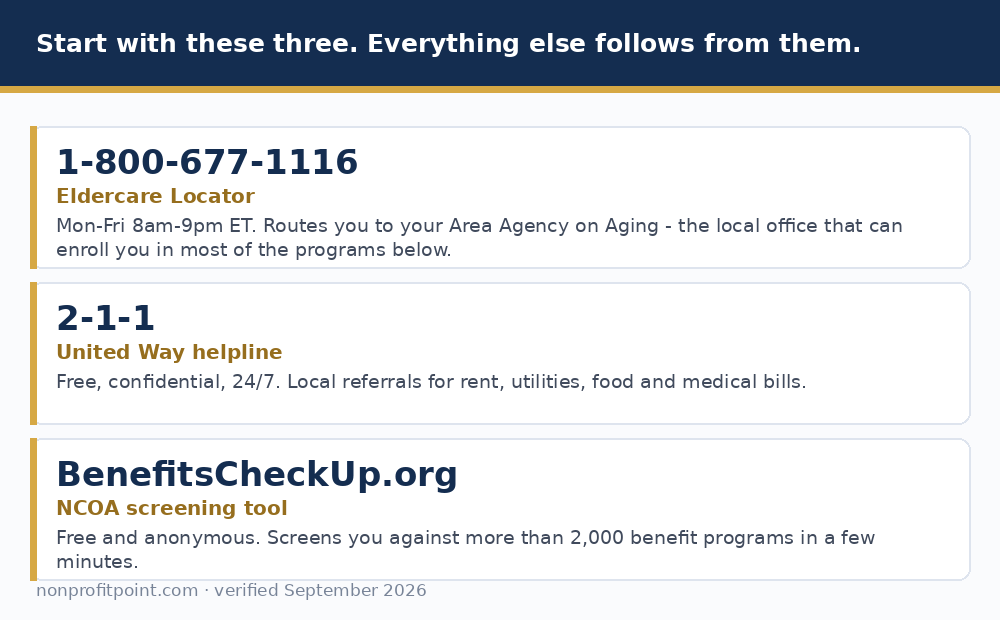
Nearly every program below is administered locally, which is why a national article can only take you so far. These three doors open the local ones.
- Eldercare Locator — 1-800-677-1116, Monday to Friday, 8:00 a.m. to 9:00 p.m. ET, or eldercare.acl.gov. Funded by the federal Administration for Community Living and run by USAging, it handles about 400,000 requests a year and connects you to your Area Agency on Aging — the local office that does benefits counselling, home-delivered meals, transport and, in many states, energy-assistance intake. There are more than 600 Area Agencies on Aging nationally.
- Dial 2-1-1 (or 211.org). Free, confidential, available 24/7, and the fastest route to whichever local church, community action agency or charity currently has money for utility and rent help. In 2025 the 211 network made more than 19 million referrals, of which 9.1 million were for housing, homelessness and utility bills.
- BenefitsCheckUp.org from the National Council on Aging. Free, anonymous, no documents needed to start. It screens you against more than 2,000 public and private benefit programs across all 50 states and DC. Start here before you fill in a single application — it will usually surface two or three programs you had never heard of.
First, the programs that no longer exist
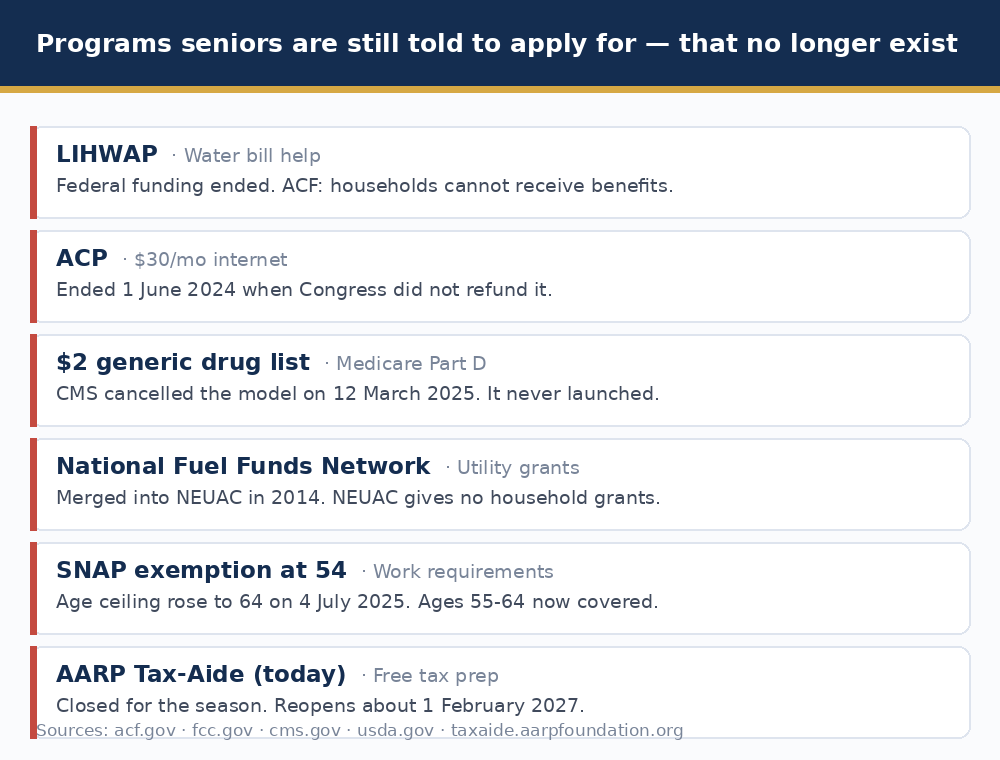
Every one of these is still being recommended in articles published this year. None of them will help you today.
- LIHWAP — the federal water bill program — is finished. The Administration for Children and Families states plainly on its own program page: “Funding is no longer available for LIHWAP. Households cannot receive LIHWAP benefits at this time.” It was a one-off pandemic-era appropriation, not a permanent block grant, and nothing federal replaced it. Real water help still exists — see the water section below — but it is utility-run and local.
- The Affordable Connectivity Program (ACP) ended on 1 June 2024. The FCC stopped taking new applications on 7 February 2024, April 2024 was the last month households got the full discount, and the FCC now says: “Due to a lack of additional funding from Congress, the ACP ran out of funding and, for now, the ACP discount is no longer available to households.” The $30/month internet benefit is gone. Lifeline is not — see below.
- The “$2 generic drug” Medicare model never launched. CMS announced on 12 March 2025 that the Medicare $2 Drug List Model would not be implemented. If an article promises you $2 generics under Part D, it is describing something that was cancelled before it started.
- The National Fuel Funds Network no longer exists as a grant-maker. It merged into NEUAC in 2014, and NEUAC is a membership and advocacy coalition — it does not give money to households. Applying there gets you nowhere.
- The SNAP work-requirement exemption at age 54 is gone. Under the One Big Beautiful Bill Act, effective 4 July 2025, USDA’s implementation memo confirms that “individuals aged 18 to 64 are now subject to the time limit, unless they meet another exception.” If you are between 55 and 64 this is the single most important change on this page — details in the SNAP section.
- AARP Foundation Tax-Aide is closed right now. Its own site currently reads: “AARP Foundation Tax-Aide service is closed for the 2026 tax season.” Service generally runs 1 February to 15 April. Note the date on your calendar rather than calling in September.
Medicare costs: the four programs that pay your premiums
The Medicare Savings Programs are run by state Medicaid offices and pay Medicare’s premiums and, at the top tier, its deductibles and coinsurance too. The standard 2026 monthly income and resource limits published by Medicare are below.
| Program (2026) | Income — single | Income — couple | Resources | What it pays |
|---|---|---|---|---|
| QMB | $1,350/mo | $1,824/mo | $9,950 / $14,910 | Part A and Part B premiums, deductibles, coinsurance and copayments |
| SLMB | $1,616/mo | $2,184/mo | $9,950 / $14,910 | Part B premium |
| QI | $1,816/mo | $2,455/mo | $9,950 / $14,910 | Part B premium |
| QDWI | $5,405/mo | $7,299/mo | $4,000 / $6,000 | Part A premium only |
Read this sentence before you decide you earn too much. Medicare.gov prints it under every one of those tables: “Income limits slightly higher in Alaska and Hawaii. You may qualify in other states for these programs even if your income or resources are higher than the federal limits listed.” Several states have raised their limits or dropped the asset test entirely. The federal chart is a floor, not a gate. Apply anyway.
The 2026 standard Part B premium is $202.90 a month with a $283 annual deductible, per the CMS fact sheet — so QMB or SLMB approval is worth about $2,435 a year in premiums alone, before any deductible or coinsurance savings. Apply through your state Medicaid office; Medicare.gov’s instruction is simply “These programs are run by your state. Contact your state to apply.”
If you have QMB, providers are breaking federal law when they bill you
This is the most under-used protection in Medicare. CMS states it directly: “Federal law prohibits Medicare providers and suppliers, including pharmacies, from billing individuals in the QMB group for Medicare cost sharing” and “Medicare beneficiaries enrolled in the QMB group have no legal obligation to pay Part A or Part B deductibles, coinsurance, or copayments for any Medicare-covered items and services.”
What to do if a bill arrives anyway, in order:
- Tell the provider you are in the QMB Program. If you have already paid, Medicare says “you have the right to a refund.”
- If they keep billing, call 1-800-MEDICARE (1-800-633-4227), TTY 1-877-486-2048.
- If it goes to a debt collector, file a complaint with the Consumer Financial Protection Bureau at consumerfinance.gov/complaint or 1-855-411-2372.
Extra Help: about $5,700 a year off your prescriptions
Extra Help, formally the Part D Low-Income Subsidy, wipes out the Part D deductible and caps what you pay per prescription. The Social Security Administration’s August 2026 publication puts the value at “about $5,700 per year.” The 2026 limits:
- Income: up to $23,940 a year for one person, $32,460 for a married couple living together. Those are exactly 150% of the 2026 federal poverty guidelines ($15,960 and $21,640 for the 48 contiguous states).
- Resources: $18,090 single, $36,100 married — but note the detail almost nobody explains: those are the limits if you tell Social Security you expect to use some savings for burial expenses. Without that notification the limits are $16,590 and $33,100. Mention burial expenses on the form.
- What you pay: the deductible is $0 in every Extra Help category. Copays run up to $5.10 generic / $12.65 brand in 2026, and lower — $1.60 and $4.90 — for full dual-eligibles at or below 100% of poverty. Above the annual out-of-pocket threshold, you pay nothing.
- The partial subsidy is gone, in your favour. Under the Inflation Reduction Act, since 1 January 2024 everyone up to 150% of poverty who meets the resource test gets the full subsidy. If you were told years ago you only qualified for partial help, re-apply.
Apply free at ssa.gov/extrahelp or call 1-800-772-1213 (TTY 1-800-325-0778), weekdays 8 a.m. to 7 p.m. There is no charge and no reason to pay anyone to file it for you.
The 2027 numbers you are actually shopping against this autumn
Medicare Open Enrollment runs 15 October to 7 December every year, and coverage chosen in it starts 1 January. If you are in a Medicare Advantage plan there is a second window, 1 January to 31 March, to switch plans or go back to Original Medicare. Medicare’s own guidance calls the autumn window “the one time of year when everyone with Medicare can make changes to their health and drug plans for next year” — and tells you to read the plan’s change notice that arrives around 1 October.
Two Part D numbers matter when you compare plans this autumn, and they are not the same for the two years:
| Part D standard parameter | 2026 | 2027 |
|---|---|---|
| Annual out-of-pocket cap | $2,100 | $2,400 |
| Maximum deductible | $615 | $700 |
| Extra Help copay, 100–150% FPL | $5.10 / $12.65 | $5.80 / $14.40 |
Insulin is capped separately: a one-month supply of each covered insulin product costs no more than $35, with no deductible. Note that Part B covers insulin only when it is used with a Part B-covered insulin pump — pens and disposable pumps fall under Part D.
The 2027 Part B premium is announced by CMS each November and had not been published when this guide went up. Any 2027 Part B figure you see quoted today is a projection, not a CMS number.
Free, unbiased help choosing: SHIP
Every state has a State Health Insurance Assistance Program, federally funded by the Administration for Community Living, which gives “local, in-depth, and objective insurance counseling and assistance” at no cost. A SHIP counsellor earns no commission and sells nothing — unlike most people who will phone you in October. Find yours at shiphelp.org or call 877-839-2675, which routes you to your local SHIP rather than counselling you directly. 1-800-MEDICARE will also connect you.
Ask a SHIP counsellor before you accept any “give-back” offer. The Part B premium reduction some Medicare Advantage plans advertise is real, but it is a plan benefit funded from rebate dollars — not a government program and not something you can apply for on its own. Taking it means accepting that plan’s network, prior-authorisation rules and drug formulary, and in most states it can cost you the right to buy a Medigap policy later. That trade-off deserves an hour with someone who has no commission riding on the answer.
PACE: everything covered, usually for nothing, if you qualify
The Program of All-Inclusive Care for the Elderly is the best-value benefit in this entire guide for the people who qualify, and it is badly under-known. You must be at least 55, live in a PACE organisation’s service area, need a nursing-home level of care as certified by your state, and be able to live safely in the community with PACE’s help.
If you have Medicaid you pay no monthly premium for PACE. And for every participant, regardless of Medicaid: “You won’t have a deductible, copayment, or co-insurance for any drug, service, or care your PACE team approves.” If you have Medicare but not Medicaid you pay a monthly premium for the long-term-care portion plus one for Part D drugs.
The catch is geography. As of April 2026 the National PACE Association counted 202 programs across 33 states and DC, serving about 93,615 people. Check Medicare.gov/pace or call 1-800-MEDICARE to see whether one covers your address.
Heat, power and the winter shut-off calendar
LIHEAP — and the senior priority window most people miss
The Low Income Home Energy Assistance Program is the largest single source of utility help in the country, roughly $4 billion in federal money for the 2026 fiscal year. It does more than most people realise: the Administration for Children and Families describes it as helping “with home heating bills, preventing energy shutoffs, reconnecting services, making homes more energy efficient, and repairing or replacing heating equipment.” Cooling counts too, which matters in July as much as January.
Here is the part worth acting on now. Several states open applications early for households with someone aged 60 or over, weeks before everyone else. Two states have published their 2026–2027 dates:
- Illinois: priority households may apply from 1 October 2026; everyone else from 1 November. The state defines the priority group as “Older adults (age 60 and older), individuals with a disability, households with at least one child age 5 years and under, households that are disconnected from their utilities/energy vendors, have a disconnect date within 7 days or have less than 25% in their propane tank.”
- Iowa: the Iowa Utilities Commission says the season runs 1 November to 30 April “with early applications accepted during October for households with at least one resident who is 60 or older or has a disability.”
- Pennsylvania has no age-priority window but has published firm 2026–2027 dates and amounts: the season “opens Monday, November 2, 2026, and will continue through Friday, April 23, 2027,” with cash grants of $200 to $1,000 and crisis grants up to $1,000.
Whether your state runs a senior window is a question worth asking in September rather than December, because LIHEAP money is first-come, first-served and the crisis funds go first. Two cautions: season dates slip — Pennsylvania’s 2025–26 season was pushed to December by a federal shutdown — and LIHEAP funding was again proposed for elimination in the federal budget request for the 2027 fiscal year, as it was the year before. Congress has restored it each time, but do not assume the calendar.
How to apply: find your state office through the ACF state and territory contact listing at acf.gov, or call the National Energy Assistance Referral line on 1-866-674-6327, weekdays 9:00 a.m. to 7:00 p.m. ET. Your Area Agency on Aging can often take the application or tell you exactly who does in your county.
Weatherization: seniors have priority by federal regulation
The Department of Energy’s Weatherization Assistance Program pays for insulation, air sealing, heating system repair or replacement and safety fixes. It is free to the household. And unusually, the priority is not agency policy that can be reinterpreted — it is written into federal regulation. 10 CFR § 440.16(b) directs states to give priority to “(1) Elderly persons; (2) Persons with disabilities; (3) Families with children; (4) High residential energy users; and (5) Households with a high energy burden.” Older adults are first on that list.
DOE reports average annual household energy savings of about $372, and its most recent published figure for the average cost of the work is $4,695 per home (from DOE’s June 2022 fact sheet — it has not published a newer per-unit number). The program weatherises roughly 32,000 homes a year and has served over 7.2 million families since 1976. Households at or below 200% of the poverty guidelines, or receiving SSI, generally qualify. Find your state administrator through energy.gov. Waiting lists are normal; get on one now rather than in the cold.
Dollar Energy Fund — the best single utility referral in the country
Operating since 1983, Dollar Energy Fund helps households “maintain or restore basic gas, water, wastewater and electric service” across 18 states: Arkansas, California, Connecticut, Hawaii, Illinois, Indiana, Louisiana, Maryland, Massachusetts, Nebraska, New Mexico, Ohio, Pennsylvania, Tennessee, Texas, Virginia, Washington and West Virginia. It gives a decision within two business days if you are eligible. Call 1-888-282-6816 or apply at dollarenergy.org.
Amounts are set per utility programme rather than nationally. Three real, currently published examples for the programme year running to 30 September 2026: Ohio utility assistance pays “$300 per utility ($600 maximum if a grant is received for both gas and electric service)” for households between 175% and 250% of the poverty guidelines; Pittsburgh’s water hardship programme pays “$450 for water and $450 for wastewater” at or below 200%; and Pennsylvania American Water’s H2O Help to Others gives up to $500 at or below 250%. Water and sewer are the one utility where a permanent income-based rate usually beats a one-off grant, and the cities that run one are listed in charities that help with water bills.
HeatShare, Operation Round Up and what they really do
Two programmes are routinely described as national when they are not.
- Salvation Army HeatShare is a divisional programme, not a national one. In the Northern Division (Minnesota) it is offered at most Salvation Army centres, serves roughly 7,800 households a year with an average grant of about $400 from a budget near $1.2 million, and names “low-income seniors” first among those it serves; applicants generally must have been denied county assistance first. Minnesota hotline: 1-800-842-7279. Outside those divisions, contact your local Salvation Army corps for general utility help rather than asking for HeatShare by name.
- Operation Round Up is not one programme either. Each electric cooperative runs its own, with its own board and rules, funded by rounding members’ bills up to the next dollar — typically about $6 per meter per year. Grants tend to go to emergencies, scholarships and community projects rather than routine bill payment. Ask your own co-op whether bill assistance is eligible before you count on it.
Winter shut-off protection: the dates, by state
Most states restrict disconnection in cold months. The protection is usually conditional — on entering a payment plan, or on having applied for energy assistance — which is exactly the detail people miss.
| State | Protected period | The condition that catches people out |
|---|---|---|
| Minnesota (Cold Weather Rule) | 1 Oct – 30 Apr | You must make and keep an agreed payment plan. Does not cover delivered fuels — oil, propane or wood. |
| Wisconsin | 1 Nov – 15 Apr | Applies to service used for home heating. |
| Pennsylvania | 1 Dec – 31 Mar | Statewide winter moratorium on termination. |
| Indiana | 1 Dec – 15 Mar | Protection applies to customers eligible for and who have applied for the Energy Assistance Program. Applying is the trigger. |
| Georgia | 15 Nov – 15 Mar | Temperature-triggered: no disconnection when the forecast is below 32°F for the 24 hours from 8:00 a.m. on the disconnection date. |
A note on a claim you will see elsewhere: we could not verify a general age-65 exemption from disconnection in any of the five states above. Georgia does have a genuine senior benefit, but it is a discount rather than a shut-off shield — Georgia Power, Atlanta Gas Light and Liberty Utilities offer discounts to customers 65 or older under an income test (200% of the poverty guidelines for electric), with Liberty waiving part of the monthly customer charge. Ask your own utility whether it offers a senior rate; many do and almost none advertise it.
Water bills after LIHWAP
With the federal programme gone, water help is now utility-run and municipal. Three routes that genuinely work:
- H2O Help to Others, run by American Water subsidiaries and administered by Dollar Energy Fund. Pennsylvania American Water gives up to $500 in grants at or below 250% of the poverty guidelines; apply through Dollar Energy on 1-888-282-6816.
- Aqua’s Customer Assistance Program is a tiered discount rather than a grant — at the lowest income tier it removes 100% of fixed charges and 85% of volumetric charges, with tiers running from at or below 50% of the poverty guidelines up to 200%. Aqua also runs a hardship fund, Helping Hand, on 877-987-2782; it does not publish a grant maximum.
- Municipal senior discounts, which are the most overlooked of all. Philadelphia, for example, gives a 25% discount on water and sewer to residents who are “at least 65 years old” with total household income of $42,100 or less — apply at cap.phila.gov or on (215) 685-6300. Most large cities have an equivalent. Search your water utility’s site for “senior discount” or ask on the phone; it is rarely on the bill insert.
Phone and internet
Lifeline survived the ACP’s collapse and is still running. It gives a service discount of up to $9.25 a month, or up to $34.25 on qualifying Tribal lands, on phone or broadband. You qualify at or below 135% of the federal poverty guidelines, or automatically if you receive SNAP, Medicaid, SSI, Federal Public Housing Assistance, or a Veterans Pension or Survivors Benefit — the last two being the doors most older adults walk through. It is one benefit per household, and it is a discount, not a free phone guarantee. Apply at lifelinesupport.org.
For home internet, Xfinity Internet Essentials currently lists $14.95 a month for up to 75 Mbps, or $29.95 for up to 100 Mbps, for households on Medicaid, SNAP, housing assistance or the National School Lunch Program. Note that these offers qualify you on income-based programmes, not on age — there is no major-ISP “senior discount” as such, whatever the marketing suggests. Check the pricing on xfinity.com rather than the old Internet Essentials landing page, which still references a benefit that no longer exists.
Food: the SNAP rules that only apply to people over 60
More older adults are wrongly disqualified from SNAP than from any other programme on this page, and it is almost always for one of three reasons that do not actually apply to them.
- The gross income test does not apply to you. USDA states it plainly: “A household with an elderly or disabled person only has to meet the net income limit.” “Elderly” means 60 or older. Everyone else is screened on gross income first — you are not. If someone quoted you the 130% figure and stopped there, they applied the wrong test.
- Your asset limit is higher. For the year running to 30 September 2026, households with a member aged 60+ or disabled may hold $4,500 in countable resources, against $3,000 for everyone else. Retirement accounts and your home are generally not countable.
- Your medical bills come off your income. Members 60+ or disabled may deduct out-of-pocket medical costs above $35 a month — and the definition is broad: “doctor bills, prescription drugs and other over-the-counter medication when approved by a doctor; dentures, inpatient and outpatient hospital expenses; and nursing care,” plus transport to appointments, attendant care and health insurance premiums. Special diets do not count. This single deduction is what pulls thousands of seniors under the net income limit each year.
Twenty-five states use a Standard Medical Deduction, a flat figure that saves you itemising: Alabama, Arizona, Arkansas, California, Colorado, Georgia, Idaho, Illinois, Iowa, Kansas, Kentucky, Louisiana, Massachusetts, Michigan, Missouri, New Hampshire, North Dakota, Oregon, Rhode Island, South Carolina, South Dakota, Texas, Vermont, Virginia and Wyoming. You may still claim actual expenses if they come to more.
Twenty-five states also run the Elderly Simplified Application Project — Alabama, Arizona, Arkansas, California, Connecticut, DC, Florida, Georgia, Illinois, Indiana, Kentucky, Louisiana, Maryland, Massachusetts, Mississippi, New Mexico, New York, Ohio, Pennsylvania, Rhode Island, South Carolina, Texas, Vermont, Virginia and Washington. ESAP “streamlines the application and certification process by simplifying the verification process, providing 36-month certifications, and waiving the recertification interview,” for households with no earned income where every adult is 60+ or disabled. Three years between renewals, no interview. Ask for it by name. (Both state lists reflect states’ October 2024 elections — confirm with your own state office.)
For the year to 30 September 2026 in the 48 contiguous states, the maximum monthly allotment is $298 for one person and $546 for two; the minimum benefit is $24. The net monthly income limits are $1,305 and $1,763. A $24 monthly benefit is worth applying for on its own terms: in many states SNAP enrolment is the key that unlocks Lifeline, utility discounts and free tax help without a second means test.
If you are 55 to 64, read this before you apply
The One Big Beautiful Bill Act changed SNAP’s work requirements, effective 4 July 2025. USDA’s implementation memorandum states that “individuals aged 18 to 64 are now subject to the time limit, unless they meet another exception” — where the ceiling used to be 54. Three exemptions were also removed: for people experiencing homelessness, for veterans, and for young adults who aged out of foster care. The dependent-child exemption was narrowed to children under 14.
In practice: if you are between 55 and 64, not yet on Medicare, and not working, you may now face a three-month time limit unless you meet another exception — most commonly being unable to work because of a physical or mental limitation. That exception is not automatic. Raise it at the interview and bring documentation. Note also that USDA’s own consumer-facing work-requirements page is still showing the old “18–54” language; the signed implementation memo is the operative document.
Three food programmes just for people over 60
- Commodity Supplemental Food Program (CSFP) — a monthly USDA food box for people 60 or older at or below 150% of the poverty guidelines: for 2026 that is $23,940 a year ($1,995 a month) for one person and $32,460 for two. The box contains milk, cheese, juice, cereal, rice, pasta, peanut butter, dry beans, canned meat or fish, and canned fruit and vegetables. It operates in all 50 states, DC, Puerto Rico and through seven tribal organisations. It is caseload-capped — about 732,000 slots nationally — so waiting lists are normal. Apply through your state agency.
- Senior Farmers’ Market Nutrition Program (SFMNP) — coupons for locally grown fruit, vegetables, honey and herbs at farmers’ markets, roadside stands and CSAs, for people 60+ at or below 185% of the poverty guidelines. Federal benefits run from $20 to $50 per year under 7 CFR 249.8, though some states top that up with their own money. It operates in 57 states and territories.
- Meals on Wheels — there is no single national organisation; roughly 5,000 community programmes each set their own rules. On cost, the national body says: “Meals may be free, have a suggested donation or be paid for on a sliding scale, based on your location, income and need.” Be aware of the honest picture on waiting lists: one in three providers has one, nearly 48,000 seniors are waiting nationally, and the average wait is more than four months — some more than two years. Get on the list early. Search by ZIP at mealsonwheelsamerica.org.
Prescription costs beyond Medicare
For the full picture, including the four national copay charities, their 2026 income limits and the manufacturer programs that supply medication free, see our guide to charities that help with prescription costs.
Once Extra Help is in place, charitable copay funds cover what is left. The landscape changed materially this year, so check the name before you apply.
- TotalAssist (Patient Advocate Foundation) — the PAN Foundation and Patient Advocate Foundation merged effective 1 July 2026, and their combined charitable assistance programme is TotalAssist, covering nearly 150 disease-specific funds. It pays medication costs, copays, coinsurance, deductibles, health insurance premiums and same-day office visit charges. Apply at totalassist.org or call 866-512-3861, weekdays 8:30 a.m. to 5:30 p.m. ET. Funds open and close as money runs out; the screener needs no documents, and you can sign up for FundFinder alerts to be told when a closed fund reopens. Income limits are set per fund, not globally — do not assume you are over.
- HealthWell Foundation — disease-specific funds marked open, re-enrolment or closed. Income up to 500% of the federal poverty level. You must have some form of health insurance to qualify. Call (800) 675-8416, weekdays 9 a.m. to 5 p.m. ET, or apply at healthwellfoundation.org.
- Good Days — income at or below 500% of the poverty level; you must have insurance covering at least 50% of the cost of treatment, a valid Social Security number, and a covered diagnosis with the programme accepting enrolments. Assistance runs for the calendar year or until funds are exhausted, and it will not reimburse medication bought before approval. Call 877-968-7233 or apply at mygooddays.org.
- NeedyMeds — a nonprofit clearinghouse with free information on over 30,000 programmes, plus a free drug discount card that saves up to 80% on prescriptions, over-the-counter medicines approved by a doctor, medical supplies and even pet prescriptions. No registration, no age or income restriction, accepted at more than 65,000 pharmacies. Helpline 800-503-6897, needymeds.org.
- Manufacturer patient assistance programmes — nearly every large drug maker runs one giving free or reduced-cost brand-name medication below an income threshold. One question decides it for a Medicare enrollee: ask whether the programme accepts people enrolled in Part D, because many historically exclude them while operating a separate Medicare track. NeedyMeds indexes them by drug.
Two directory sites deserve a caveat rather than a recommendation. RxAssist is still online but is now operated by a commercial company rather than its original hospital sponsor, and we could not establish when its drug database was last updated — use it to cross-check, not as a primary referral. RxHope loads, but its security certificate chain is broken and many browsers will throw a warning; we are not linking it.
Housing, home repairs and property taxes
USDA Section 504: a $10,000 grant if you are 62 or over
USDA Rural Development’s Single Family Housing Repair Loans and Grants is the most concrete money on this page for an older homeowner, and its terms are published verbatim:
- “Maximum loan is $40,000” at a fixed 1% interest rate over 20 years, for repairs and modernisation. There is no age requirement for the loan.
- “Maximum grant is $10,000” — and for grants you must “be age 62 or older and have a household income that does not exceed the very low limit.” Grants are for removing health and safety hazards.
- Loan and grant can be combined, up to $50,000.
- The catch to know before you sign: “Grants must be repaid if the property is sold in less than 3 years.”
- The home must be in an eligible rural area — which covers far more of the country than most people assume. Check your address on the USDA eligibility map.
HUD also funds an Older Adults Home Modification Program for grab bars, ramps and fall-prevention work, currently $64 million nationally. One thing to understand: HUD funds organisations, not individuals. You cannot apply to HUD. Ask your Area Agency on Aging which local nonprofit or housing authority holds the grant in your county.
Section 202 housing, and the truth about waiting lists
HUD’s Section 202 Supportive Housing for the Elderly funds subsidised rental housing where, under 24 CFR § 891.205, an eligible household is one “composed of one or more persons at least one of whom is 62 years of age or more at the time of initial occupancy” and meets very-low-income limits. Rent is generally calculated at 30% of adjusted income under HUD’s standard rules.
Be realistic about timing. The most recent national analysis of HUD data found that 53% of Housing Choice Voucher waiting lists were closed to new applicants, nearly two-thirds of those closed for at least a year; that only about one in four eligible households receives rental assistance at all; and that families who did get a voucher had waited close to two and a half years. State averages ranged from nine months to five years, and some large agencies exceeded eight. That data is from 2020 and was published in 2021 — it is the most recent national dataset available, and there is no reason to think waits have shortened. Apply to several housing authorities at once, and treat it as a long-term move rather than a solution to this month’s bill.
Property tax relief, which is where the largest annual sums are
For an older homeowner, a state property tax programme is often worth more per year than every charity on this page combined — and it renews annually. Five real examples with current thresholds:
| State programme | Age | Income limit | What you get |
|---|---|---|---|
| Pennsylvania Property Tax/Rent Rebate | 65+ (or widowed 50+, or disabled 18+) | $48,110 household | Up to $1,000, or $1,500 with the supplement. Deadline 31 December 2026 for 2025 rebates. |
| New Jersey Senior Freeze | 65+ on 31 Dec 2025, or on SSDI | $168,268 (2024) and $172,475 (2025) | Reimburses property tax increases above your base year |
| New York Enhanced STAR | 65+ (one owner) | $110,750 for 2026; $113,550 for 2027 | Larger school tax exemption than Basic STAR |
| Illinois Senior Assessment Freeze | 65+ | $75,000 for 2026 (payable 2027) | Freezes assessed value; plus a homestead exemption of $8,000 in Cook and contiguous counties, $5,000 elsewhere |
| Texas age-65 homestead | 65+ | None for the exemption | $140,000 school district homestead exemption plus an additional $60,000 for those 65+ or disabled, after the 2025 constitutional amendments, and a school tax ceiling that stops school taxes rising while you own and live in the home |
One warning on Texas: the Comptroller’s own age-65 FAQ page is out of date and still shows the pre-2025 figures. Use the exemptions page and the November 2025 propositions. And if your state is not listed, check anyway — almost every state has a homestead exemption, circuit breaker or deferral for older homeowners. AARP Foundation Property Tax-Aide is a free service that checks whether you qualify: my.aarpfoundation.org/property-taxes. Note the URL — the older ptaconsumers address now redirects.
Income, work and free tax help
If the return itself is the obstacle, the full map of free filing help is here: free tax preparation programs covers who qualifies for VITA, TCE and AARP Foundation Tax-Aide, what to bring to an appointment, and the tax year 2026 credit amounts.
- SCSEP — the Senior Community Service Employment Program. A paid training programme, not a volunteer scheme. The Department of Labor sets eligibility at 55 or older, unemployed, with family income no more than 125% of the poverty guidelines. Participants work an average of 20 hours a week at a community organisation and are paid “the highest of federal, state or local minimum wage.” Priority goes to veterans, people over 65, people with disabilities, those with limited English, rural residents and people experiencing homelessness. AARP Foundation is one national grantee — 1-800-775-6776 — or find any local provider through CareerOneStop on 1-877-872-5627.
- Back to Work 50+ is free coaching for workers over 50, but it is no longer national — AARP Foundation currently lists just four active locations (Atlanta, Palm Bay, Slidell and Miami). Sign-up line 1-855-850-2525.
- Free tax preparation. The IRS Tax Counselling for the Elderly programme “offers free tax help, particularly for those who are 60 years of age and older, specializing in questions about pensions and retirement-related issues unique to seniors”; VITA serves people generally making $69,000 or less, people with disabilities and limited-English speakers. Call 800-906-9887. Most TCE sites are run by AARP Foundation Tax-Aide, which is free, requires no AARP membership, focuses on taxpayers over 50, and runs roughly 1 February to 15 April — 1-888-227-7669. One link to avoid: the old irs.treasury.gov/freetaxprep address is dead and now redirects to the IRS homepage, though plenty of articles still print it.
The four national charities — and what they can honestly promise
Each of these is a federation of locally controlled offices. Amounts, income limits, how often you can apply and whether a given office has any money left this month all vary by location. There is no national dollar figure for any of them, and any article that quotes one is inventing it.
- The Salvation Army provides rent and mortgage help and “critical utility assistance to ensure that no one goes without heat in the coldest winters, air conditioning in the brutal summers, or fresh water,” and names among those it serves anyone who is “a senior living on a fixed income.” There is no national intake line; use the location finder and call the corps nearest you.
- Society of St. Vincent de Paul works through parish-based conferences: you call, and volunteers visit in pairs to assess and then help with rent, utilities, food, clothing and other emergencies. Nationally it delivers more than $1.7 billion in aid to over 5 million people a year through 81,000 volunteers in more than 4,000 conferences. Note the domain change — the national site is now ssvpusa.org. There is no national helpline; reach a conference through your local Catholic parish or via 211.
- Catholic Charities is made up of 170 diocesan agencies, each independent. Emergency financial assistance is usually one-time. Services are given “regardless of their faith or background” — there is no religious test and you do not need to be Catholic. Find your agency through the CCUSA locator.
- 211 / United Way — covered at the top of this guide, and still the fastest way to find which local fund is open today.
What to have in front of you before you call
Almost every application on this page asks for the same things. Assembling them once turns a two-week process into an afternoon.
- Photo ID and Social Security numbers for everyone in the household
- Proof of age — birth certificate, passport or driver’s licence — because most of these programmes turn on 60, 62 or 65
- Your Social Security or SSI award letter, and any pension or annuity statements
- Last two or three months of bank statements (for the resource tests)
- The actual bill or shut-off notice you need help with, plus one recent paid bill from the same utility showing the account number
- Your lease or mortgage statement and a recent property tax bill
- Out-of-pocket medical receipts and insurance premium statements from the last three months — these are what unlock the SNAP medical deduction
- Your Medicare card and any Medicaid or plan cards
Two habits that make a real difference. First, apply before the crisis where you can: LIHEAP crisis funds, CSFP slots and Meals on Wheels places are finite, and the senior priority windows in October exist precisely so you do not have to compete in January. Second, when an office says no, ask what it says no to — a denial for one funding stream at a community action agency very often sits next to another stream the same caseworker administers, and they will not always volunteer it.
Frequently asked questions
What is the fastest way for a senior to get help with a shut-off notice?
Call 2-1-1 first, because they know which local fund has money today, then call the utility itself and ask for its hardship programme and for a payment arrangement in the same call — entering an arrangement is what triggers shut-off protection in several states. In parallel, apply for LIHEAP crisis assistance through your state office or the National Energy Assistance Referral line on 1-866-674-6327. If you are in one of Dollar Energy Fund’s 18 states, apply there too on 1-888-282-6816; it decides within two business days.
I was told I earn too much for SNAP. Is that right if I am over 60?
Very possibly not. Households with a member aged 60 or older only have to meet the net income limit, not the gross one, and out-of-pocket medical costs above $35 a month come off your income before that test is applied. Your asset limit is $4,500 rather than $3,000. If you were screened on gross income alone, you were screened on the wrong test — re-apply and specifically raise the medical expense deduction.
Which programme pays my Medicare Part B premium?
Any of the first three Medicare Savings Programs — QMB, SLMB or QI. In 2026 the standard Part B premium is $202.90 a month, so approval is worth roughly $2,435 a year, and QMB additionally covers deductibles, coinsurance and copayments. Apply through your state Medicaid office. Do not disqualify yourself on the federal chart: Medicare states you may still qualify in many states with higher income or resources than the federal limits shown.
Is there still a federal programme that helps with water bills?
No. The Low Income Household Water Assistance Program has ended — the Administration for Children and Families says funding is no longer available and households cannot receive benefits — and nothing federal replaced it. Water help now comes from utility-run funds such as H2O Help to Others and Dollar Energy Fund’s water programmes, from municipal senior discounts like Philadelphia’s 25% reduction for residents 65 and over, and from local charities reached through 211.
Do I have to be a US citizen, or a member of a particular faith, to get help?
Faith-based charities on this page do not apply a religious test — Catholic Charities states it serves people “regardless of their faith or background,” and the Salvation Army and St. Vincent de Paul operate the same way. Federal benefit programmes such as SNAP, Medicare Savings Programs and LIHEAP do have citizenship or qualified-immigrant rules that vary by programme; ask your local office rather than assuming, and note that a household can sometimes qualify on behalf of eligible members even when others are not eligible.
How much is Extra Help actually worth, and does it cost anything to apply?
The Social Security Administration estimates Extra Help is worth about $5,700 a year. Applying is free, at ssa.gov/extrahelp or on 1-800-772-1213 — never pay anyone to file it. In 2026 you can qualify with income up to $23,940 for one person or $32,460 for a couple, and resources up to $18,090 or $36,100 if you tell Social Security you expect to use some savings for burial expenses. If you were told years ago that you only qualified for partial help, apply again: the partial subsidy was eliminated in 2024 and everyone who meets the test now gets the full benefit.
Are there grants for home repairs if I am an older homeowner?
Yes. USDA Rural Development’s Section 504 programme gives grants of up to $10,000 to homeowners aged 62 or older with very low income to remove health and safety hazards, alongside 1% loans of up to $40,000 at any age, combinable up to $50,000. The grant must be repaid if you sell the home within three years. The Department of Energy’s Weatherization Assistance Program covers insulation and heating repairs free, and federal regulation puts elderly households first in line. For accessibility work such as grab bars and ramps, ask your Area Agency on Aging which local organisation holds HUD’s Older Adults Home Modification grant.
I am 58 and out of work. Do SNAP work requirements apply to me now?
Probably yes, and this is new. Since 4 July 2025 the SNAP time limit applies to adults aged 18 to 64 rather than 18 to 54, and the exemptions for veterans, people experiencing homelessness and former foster youth were removed. You may still be exempt if you are unable to work because of a physical or mental limitation, if you care for a child under 14, or under several other exceptions — but none of it is automatic. Raise it at your interview and bring medical documentation. SCSEP, which pays at least minimum wage for about 20 hours a week from age 55, is also worth asking about in the same conversation.
Paying a specific bill? Start with the guide for that bill.
Each of these covers eligibility, dollar amounts and application steps in far more depth than a single section here can: charities that help with medical bills, prescription assistance programs, help with heating bills, utility bill assistance, charities that help pay property taxes and charities that help with rent.
Related help
- Respite care and family caregiver grants — the Older Americans Act programme that funds respite with no means test, plus the VA and Medicaid routes.
- Get help paying for … — the full index of assistance guides on this site, grouped by what you need
- Charities that help with hearing aids and charities that help with eyeglasses — two costs Medicare does not cover
- Charities that help with dental bills — including the Dental Lifeline Network programme for people 65 and over
- Charities that help with food and charities that help with home repairs
- Charities that help with funeral costs — and how to plan for them before they arrive
- Free financial assistance organizations — the wider national list
This guide is general information, not financial, legal or medical advice. Programme rules, income limits and funding change frequently and vary by state and county — confirm details with the agency or organisation before you rely on them.
If the bills are a care bill. When an older adult’s income no longer covers residential care, the money comes from different places entirely — Medicaid home and community-based waivers, state SSI supplements for residential care, VA Aid and Attendance and benevolent care funds at nonprofit communities. See charities that help with assisted living costs for the 2026 figures.
Seniors aged 65 and over who receive Supplemental Security Income qualify for the cheapest tier of Spectrum’s low-income internet plan. See charities that help with internet bills for that route and the other verified 2026 programmes.