Charities That Help With Winter Coats: 13 Real Ways to Get a Free Coat (2026)

Here is the single most useful thing to know about free winter coats, and almost no article tells you: the two biggest coat charities in America will not give you a coat if you ask them directly. Operation Warm’s own application page says it “is unable to provide coats and shoes to individuals” — it supplies brand-new coats to schools, Head Starts, and nonprofits, which then hand them to kids. One Warm Coat, which moved nearly 500,000 coats last season, states just as plainly that it “does not distribute coats directly to individuals.” Neither fact makes these bad programs — they’re excellent — but it means the standard listicle advice (“apply to Operation Warm!”) sends cold families to a door that doesn’t open.
The real system has two lanes. Lane one is referral: the big inventories (Operation Warm, Cradles to Crayons, Baby2Baby) flow through schools, shelters, and caseworkers — so the fastest question isn’t “where do I apply?” but “who near me is already a partner?” Lane two is direct: Salvation Army corps distributions and store vouchers, rescue-mission clothing rooms, Buy Nothing groups, and a handful of programs — like Detroit’s Empowerment Plan — that quietly accept requests from individuals. This guide maps both lanes: 13 real ways to get a free winter coat, with exactly how each one works, verified against each program’s own materials in August 2026 — plus the season’s timing calendar, the state clothing allowances that pay for coats in cash, and the scams to walk past.
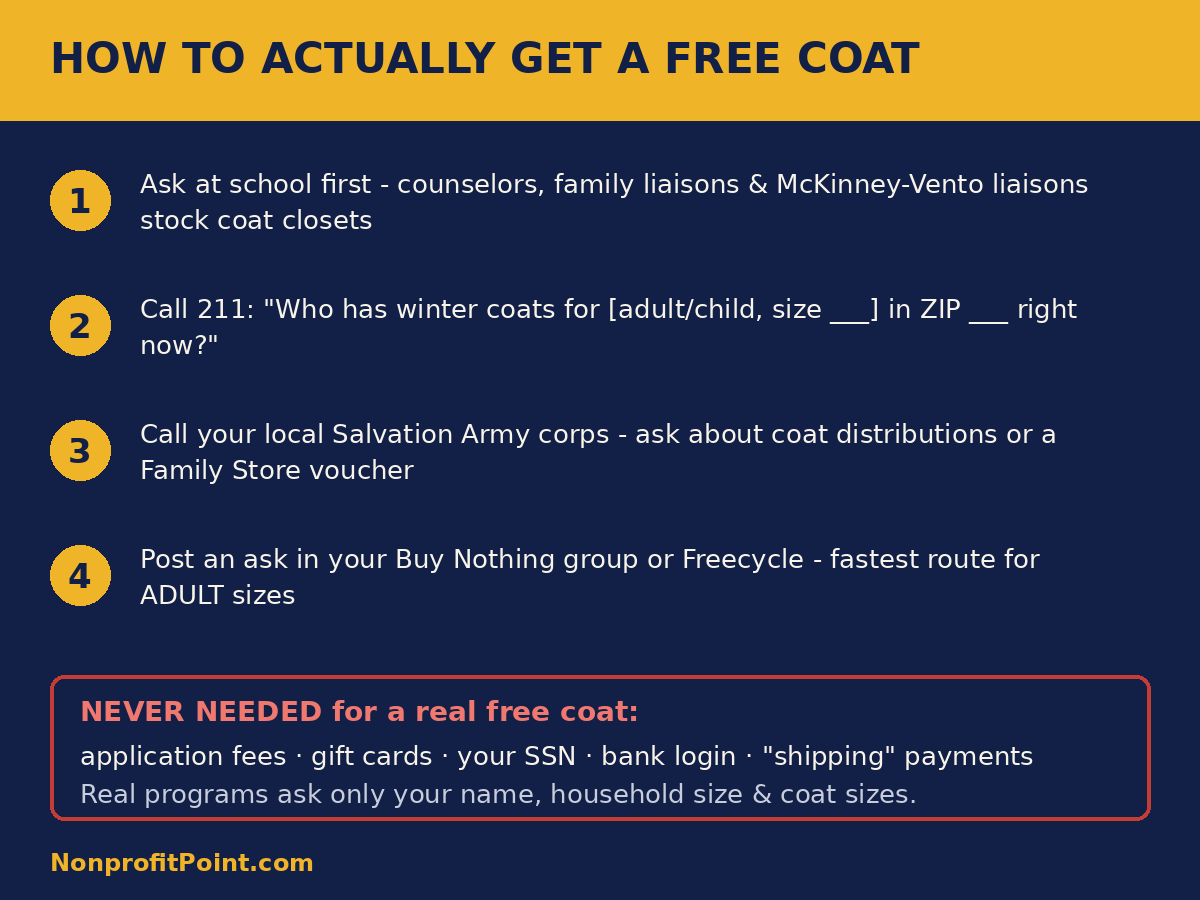
🟪 Start here: three asks. If it’s for a child, ask the school counselor or family liaison first — schools sit at the center of the coat-referral system. Then dial 2-1-1 and ask which coat programs in your ZIP code are taking requests right now. Third, call your local Salvation Army corps about coat distributions or a Family Store voucher. For clothing beyond coats, see our guide to free clothing programs, and for every assistance guide in one place, our Get Help Paying For… directory.
How free coat programs actually work (read this first)
Coat charity in the U.S. is a supply chain, not a storefront. Manufacturers and drives collect or produce coats in October and November; partner agencies — schools, shelters, churches, human-service nonprofits — place orders or pick up inventory; families get coats at the partner, usually in a 6–10 week window from mid-October to January. Three consequences follow. First, the person who can get your child a coat is often already in your life: a teacher, a caseworker, a shelter staffer. Second, timing is everything — distributions are first-come, first-served nearly everywhere, and the best programs run out (New York Cares warns its own partner sites are “not guaranteed to have coats at any given time”). Third, adult coats are the system’s gap: most charity inventory is children’s sizes, which is why the direct lane — Salvation Army vouchers, rescue missions, Buy Nothing — matters most for grown-ups.
13 real ways to get a free winter coat (2026)
1. The Salvation Army — distributions and Family Store vouchers
The Salvation Army has no single national coat program — and that’s the point: your local corps does, as funds and donations allow. Two verified models show what to expect. In Rochester, MN, the annual “More Than a Coat” distribution ran October 15–16, 2025 with one online registration per household and assigned time slots — families with children one day, single adults the next (help line 507-288-3663). In Milwaukee, the corps runs Material Assistance: thrift-store vouchers for essential clothing, “limited each month,” requested by phoning the corps serving your ZIP code. The Twin Cities’ Coats for Kids program hands out coats walk-in at any Worship & Service Center for infants through age 18 (call ahead for sizes, 1-800-SAL-ARMY). The script that works everywhere: call your corps, ask “do you have a coat distribution this fall, or clothing vouchers for the Family Store?” — and register the day registration opens.
2. St. Vincent de Paul — the parish conference route
The Society of St. Vincent de Paul’s 4,000+ parish-based conferences provide clothing among their core aid — often as thrift-store vouchers redeemable at SVdP stores, arranged after volunteers call you back (Cincinnati’s council, a good model, runs an address-based lookup and help line at 513-421-0602). There’s no national application; find your conference through the ssvpusa.org locator or by calling the nearest Catholic parish. Conferences are small and personal — which means they can also say yes to the adjacent need (a utility bill, groceries) in the same visit; see our guides to utility bill help and food assistance.
3. Cradles to Crayons — Boston, Chicago, Philadelphia (birth to 12)
Cradles to Crayons packs winter coats into its year-round essentials packages for children birth through age 12 in Boston, Chicago, and Philadelphia — at serious scale (Chicago’s “Gear Up for Winter” campaign targets 50,000 coats plus 25,000 winter outfit packs). Families can’t order directly: the Boston family-assistance page says to “ask your social worker or case manager if they can place an order for you” or to contact one of its listed Service Partners. If you’re in one of the three metros and connected to any agency at all — WIC office, shelter, school social worker — you’re one referral away from a full winter package rather than just a coat.
4. Operation Warm — brand-new coats, through your school
Operation Warm manufactures brand-new coats and shoes for children pre-K through 5th grade and moves them exclusively through partner organizations — schools, Head Starts, Boys & Girls Clubs, shelters (1-800-730-WARM). Applications for the April 2026–March 2027 cycle are rolling, org-only, and require an EIN. The family move: ask whether your child’s school already partners — and if not, forward the wish-list application to the counselor or PTA in the spring. Schools that apply in spring and summer get coats in the fall; it is genuinely a “plant in April, harvest in November” program.
5. One Warm Coat — the drive network and its locator map
One Warm Coat is the country’s coat-drive engine: volunteers run local drives, and collected coats flow to its nonprofit partner network — nearly 500,000 coats in the 2025-26 season. For a family, the useful asset is its Nonprofit Locator Map (searchable by state, city, or ZIP at onewarmcoat.org), which lists the local agencies that actually hand out the coats. One Warm Coat itself is upfront that it “cannot guarantee that a local nonprofit will have coats available” — so treat the map as a call list, not a promise, and phone before you go.
6. Knights of Columbus Coats for Kids — ask a council or parish
Knights of Columbus councils have given away more than 1.5 million new children’s coats, purchased at cost and distributed at local events, schools, and parishes, typically in late fall. There’s no application anywhere — distribution is council-by-council. The route: call the nearest Catholic parish and ask whether its KofC council runs Coats for Kids and when this year’s distribution lands (the national office at 203-752-4000 can help you find a council). One caution for searchers: “Coats for Kids” is a name used by many unrelated local programs — the old coats4kids.org domain now belongs to a Portland, Oregon metro project — so anchor on your local council or a named local charity, not the generic phrase.
7. Your school’s hidden coat system — counselors and McKinney-Vento liaisons
Schools are the quiet center of the children’s coat supply chain: counselors and family liaisons keep clothing closets, receive Operation Warm inventory, and know which local drives serve their families. And if your family is doubled-up, in a motel, or otherwise without stable housing, federal law gives you a named ally: every school district must appoint a McKinney-Vento homeless-education liaison, whose job includes connecting families to services — coat funds and closets very much included. Call the district office and ask for “the McKinney-Vento liaison” — the definition covers families sharing housing due to economic hardship, which is far broader than most parents assume. Our school clothes guide covers the rest of the school-clothing system.
8. 211 — the call that maps your ZIP code
United Way’s 2-1-1 line (free, confidential, 24/7 in most regions) indexes clothing-assistance programs the way no national article can — local closets, church drives, agency vouchers — and its specialists know what’s stocked this week. Use a specific script: “I’m looking for winter coat or clothing help for [an adult / a child, size ___] in ZIP ___ — which programs are currently taking requests, and do any require a referral?” Ask for two or three options — coat supplies burn out fast, and the backup number is the one that usually delivers.
9. Buy Nothing and Freecycle — the fastest lane for adult sizes
For adults — the sizes charity inventory rarely covers — the gift economy is often same-week: the Buy Nothing Project (14M+ members across 8,000+ neighborhood groups, plus its app) lets you post an “Ask” for a coat in your size, and Freecycle (12.2M members, 5,000+ town groups) takes “Wanted” posts. No income test, no paperwork, no referral — just neighbors with spare coats. Post early in the season, name your size plainly, and offer to pick up.
10. Rescue missions — walk-in clothing rooms
City rescue missions distribute donated coats through day-service or “community care” hours. The Bowery Mission in New York — which moved 25,000 articles of clothing last year — runs clothing and showers at 227 Bowery on a first-come basis (women Mondays, men Wednesday–Friday; arrive early, no ID needed for services). Your city’s mission almost certainly has an equivalent; call and ask for “clothing room hours.” If you need more than a coat tonight, start with our emergency shelter guide.
11. The Empowerment Plan — the coat that’s also a sleeping bag (individuals CAN ask)
Detroit’s Empowerment Plan manufactures the EMPWR coat — a waterproof winter coat that converts into a sleeping bag, sewn by staff hired out of homeless shelters. Most articles describe it as partner-only; its current Request-a-Coat form says otherwise: “If you are interested in ordering coats for someone in need in your community or you yourself are in need, fill out the form.” Coats are sponsored at $150 each and flow heavily through shelters, so it’s not instant — but for people sleeping rough, it is one of the few national programs an individual can petition directly.
12. Goodwill — the honest answer
Goodwill sells donated clothing to fund its job programs — walking in and asking for a free coat is not how it works, whatever the roundup sites imply. What does exist, region by region, is a voucher program routed through partner agencies: Goodwill of Greater Washington, for example, honors “Good Samaritan” clothing vouchers (about $25 of clothing) that a caseworker or partner agency submits for a client. So the ask isn’t at Goodwill’s counter — it’s to your caseworker: “can you request a Goodwill clothing voucher for me?” Where no voucher program exists, Goodwill’s $7 coat is still often the cheapest warm option — but that’s a purchase, and this article is about free.
13. Coats4Vets — free new coats for veterans
Veterans have a dedicated lane: Coats4Vets, run by the Massachusetts Military Support Foundation with Ocean State Job Lot’s backing, distributes free new coats to veterans and active-duty members through its Empowerment Centers — and its site invites veterans who still need a coat to call 617-378-3974. (Operation Homefront, often listed for “military winter help,” runs holiday meals, a toy drive, and Critical Financial Assistance grants — valuable, and a CFA grant can cover clothing, but it is not a coat program.) Veterans’ families should also work every lane above; the veteran ID often moves you up a distribution list.
Coat drives worth knowing in the big metros
New York: New York Cares’ annual Coat Drive — 52,732 coats through 200+ partner nonprofits and schools last drive — relaunches in October 2026; recipients pick up at partner sites with no ID or voucher required (last season the Coalition for the Homeless site at St. Bartholomew’s ran late November through January, 4–6 p.m.). Chicago: the Bears’ coat drive collects at Jewel-Osco stores each winter with distribution through the Salvation Army — the number that matters is the Salvation Army holiday hotline, 773-353-8607 — and Cradles to Crayons’ Gear Up for Winter covers the under-12s. Denver: Coats for Colorado has collected 2 million+ coats since 1982, professionally cleaned free by Dependable Cleaners; the drive runs October 1–November 30 and distributes through ~120 partner agencies (find yours via 211 Colorado). Boston/New England: Anton’s Cleaners’ Coats for Kids and Families — 1.3 million coats over 30 years, cleaned and given through 100+ partner agencies — has already published its 2026 date: collection resumes October 5, 2026 at 200 locations. Philadelphia: NBC10’s Bundle Up campaign with Cradles to Crayons ran December through late February last season across PA/NJ/DE. Detroit: the Empowerment Plan (section 11) is the standout.
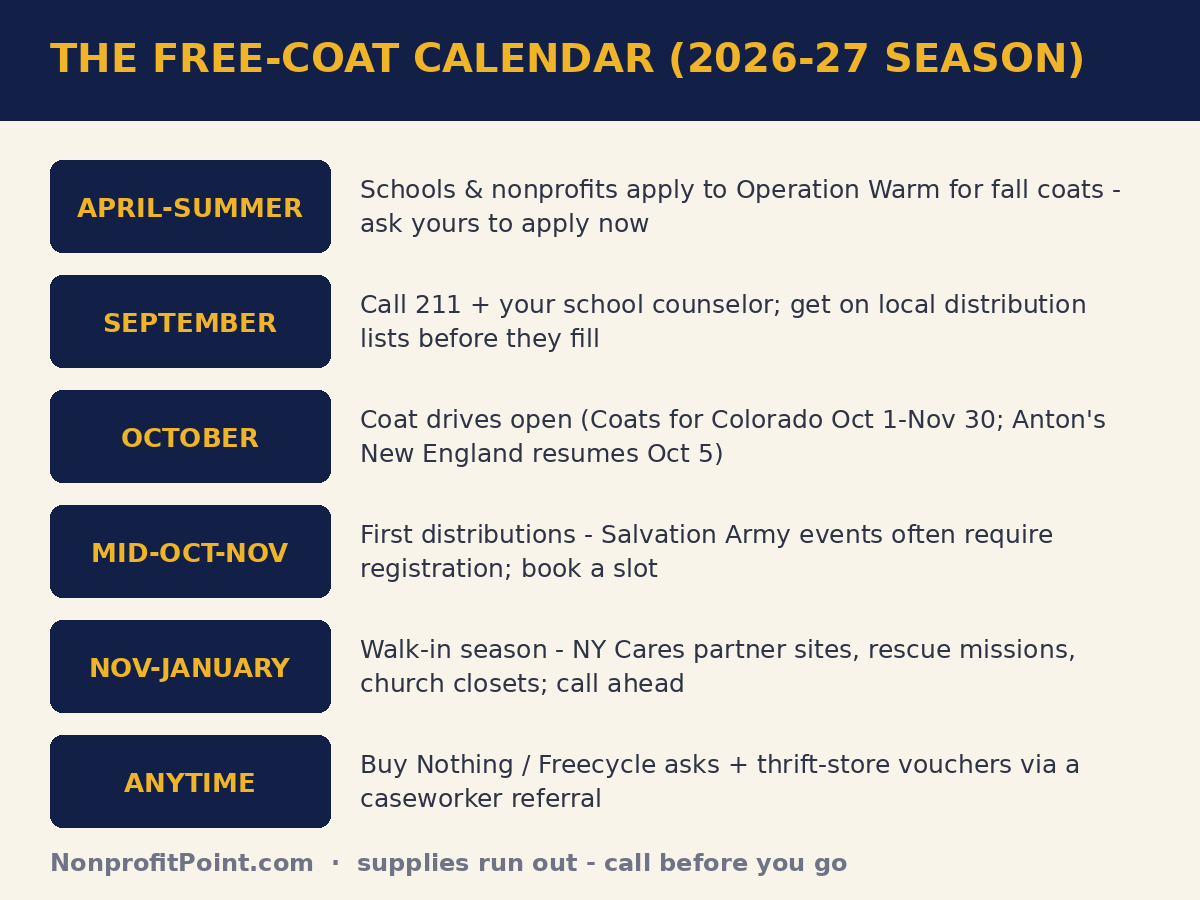
When to ask: the season’s real calendar
Coat charity runs on a hard calendar, and the punishment for missing it is a cold January. Collection opens in October (Coats for Colorado October 1; Anton’s October 5; New York Cares and the Bears drive late October). Distribution clusters mid-October through January — and the registered events fill first: Rochester’s Salvation Army distribution assigned time slots in mid-October, and Portland’s kidsneedcoats project orders in early November to distribute before Thanksgiving. The cautionary tale for “I’ll do it later”: West Virginia’s school clothing allowance — $200 per child that can buy a coat — opened July 7, 2026 and closed early on July 27, 2026 because funds ran out. The operating rule across every program in this guide: ask in September, register in October, walk in by November — and always call ahead, because first-come, first-served is the industry standard.
The cash lanes: state clothing allowances (and what LIHEAP isn’t)
Two honest adjacencies. First, some states pay clothing money outright to low-income families, which beats any coat line: Massachusetts’ TAFDC September Clothing Allowance pays $500 per eligible child automatically in late August/early September, and West Virginia’s School Clothing Allowance loads $200 per child onto an EBT card for school clothing including coats (apply in July at wvPATH.wv.gov — and see above about it closing early). Check whether your state’s TANF program carries a clothing supplement; many don’t, and no, we won’t pretend New York has one — its Temporary Assistance covers emergency needs case-by-case only. Second, LIHEAP does not buy coats, despite appearing in half the “free winter clothes” roundups on the internet — it pays heating bills and energy crises. It’s the right program for a different cold problem; our utility bills guide covers it properly.
Coat scams: the tells
Fake “free coat giveaway” posts spike every November, and they follow the patterns the FTC and Meta have documented: impersonation of a known charity, manufactured urgency, and — the giveaway — a request to pay something (a “shipping fee,” a gift card) or to fill out a “survey” harvesting your address, income, and debts. The real thing never works that way. Real programs charge nothing, ever. Real registration asks for your name, household size, and coat sizes — the Rochester model — not your SSN, not a bank login. Real drives trace to a named nonprofit, school, church, or Salvation Army corps with a working phone number, and you can verify any charity free on the IRS Tax-Exempt Organization Search or Candid. When in doubt, don’t DM the Facebook page — call 211 and ask whether the program is real. Report fakes at ReportFraud.ftc.gov.
🎁 Have coats to give instead? You’re the supply chain: drop clean coats at a One Warm Coat drive (or start one), sponsor a brand-new coat through Operation Warm, or — in New England — hand them to any Anton’s Cleaners location from October 5. Our guides to the best charities for clothing donations and the best charities to donate to in 2026 rank the options.
Related help for staying warm this winter:
- Free clothing programs for struggling families — the full clothing system beyond coats
- Charities that help with school clothes — the school-year companion guide
- Help with utility bills — LIHEAP and the charities that stop heat shut-offs
- Christmas assistance and Thanksgiving help — the season’s other lifelines
- Charities that help with food — free up grocery money for winter bills
- Get Help Paying For… — our full directory of every assistance guide
Frequently asked questions
Does Operation Warm give free coats directly to families?
No — and its application page says so explicitly: it “is unable to provide coats and shoes to individuals.” Operation Warm supplies brand-new coats (pre-K through 5th grade) to schools, Head Starts, and nonprofits, which distribute them to children they serve. The family route is to ask your child’s school or program whether it partners with Operation Warm — or to ask the counselor to submit the free organizational application, which is open on a rolling basis for each winter cycle.
Where can I get a free winter coat near me right now?
Make three calls: your child’s school counselor (for kids), 2-1-1 with your ZIP code and sizes, and your local Salvation Army corps (ask about distributions or Family Store vouchers). Then check One Warm Coat’s nonprofit locator map for partner agencies near you and call before visiting — supplies aren’t guaranteed. For adult sizes, post an ask in your neighborhood Buy Nothing group or Freecycle; it’s routinely the fastest route.
Can adults get free winter coats, or is everything for kids?
Most charity coat inventory is children’s sizes, but adults have real lanes: Salvation Army Family Store vouchers and corps distributions (Rochester’s annual event serves single adults on its second day), rescue-mission clothing rooms, St. Vincent de Paul conference vouchers, New York Cares partner sites (no ID required), Buy Nothing and Freecycle asks, and — for people sleeping outside — the Empowerment Plan’s coat/sleeping-bag, which individuals can request directly. Veterans can call Coats4Vets at 617-378-3974.
When do winter coat giveaways start?
Drives collect in October (Coats for Colorado runs October 1–November 30; Anton’s New England collection resumes October 5, 2026; New York Cares launches in October), and distributions cluster from mid-October through January. Registered events fill first — Salvation Army distributions increasingly use online registration with time slots — so ask in September, register the day sign-ups open, and have 211 give you two backups, because nearly everything is first-come, first-served.
Does Goodwill give away free coats?
Not over the counter — Goodwill sells donated clothing to fund its job-training mission. Some regional Goodwills run voucher programs through partner agencies (Goodwill of Greater Washington’s agency-submitted vouchers are worth about $25 of clothing), so the correct ask is to your caseworker or a partner agency, not at the register. If no voucher program exists in your region, the free-coat lanes are the Salvation Army, St. Vincent de Paul, local drives, and Buy Nothing.
Is there a free winter coat program for veterans?
Yes. Coats4Vets, run by the Massachusetts Military Support Foundation and sponsored by Ocean State Job Lot, gives free new coats to veterans and active-duty members through its Empowerment Centers — veterans still needing a coat are invited to call 617-378-3974. Operation Homefront’s winter offerings are holiday meals, a toy drive, and Critical Financial Assistance grants (which can cover clothing needs) rather than coats. Any veteran ID also tends to move you up local distribution lists — say so when you register.
About this guide. Compiled and fact-checked by the Nonprofit Point editorial team, which researches financial-assistance and charity-vetting resources for U.S. households. Every program model, phone number, and date above — including Operation Warm’s and One Warm Coat’s individuals policies, the Empowerment Plan’s individual-request form, Anton’s October 5, 2026 collection date, and West Virginia’s early July 27, 2026 closure — was verified against each organization’s own materials in August 2026. Coat supplies are seasonal and finite; always confirm availability by phone or through 2-1-1 before traveling. Nonprofit Point is an independent resource and is not affiliated with the organizations listed.