Charities That Help With Adoption Costs: 13 Real Programs (2026)

Search for help paying for an adoption and you will be handed the same six or seven organizations, over and over, by articles that never checked whether they still exist. The Micah Fund is on nearly every list. Its domain now forwards to a Japanese investment company’s blog, and there is no organization by that name in the IRS Business Master File at all. God’s Grace Adoption Ministry is on nearly every list. Both of its domains are gone — and one of them, ggam.org, was picked up by somebody else within the last few months and now resolves to an unrelated Russian-language utility site, while search engines still rank its old application page. Parenthood for Me does not resolve at all; its domain has no DNS record and the organization never filed a single Form 990. The JSC Foundation says it plainly on its own homepage: “JSC is no longer accepting applications.”
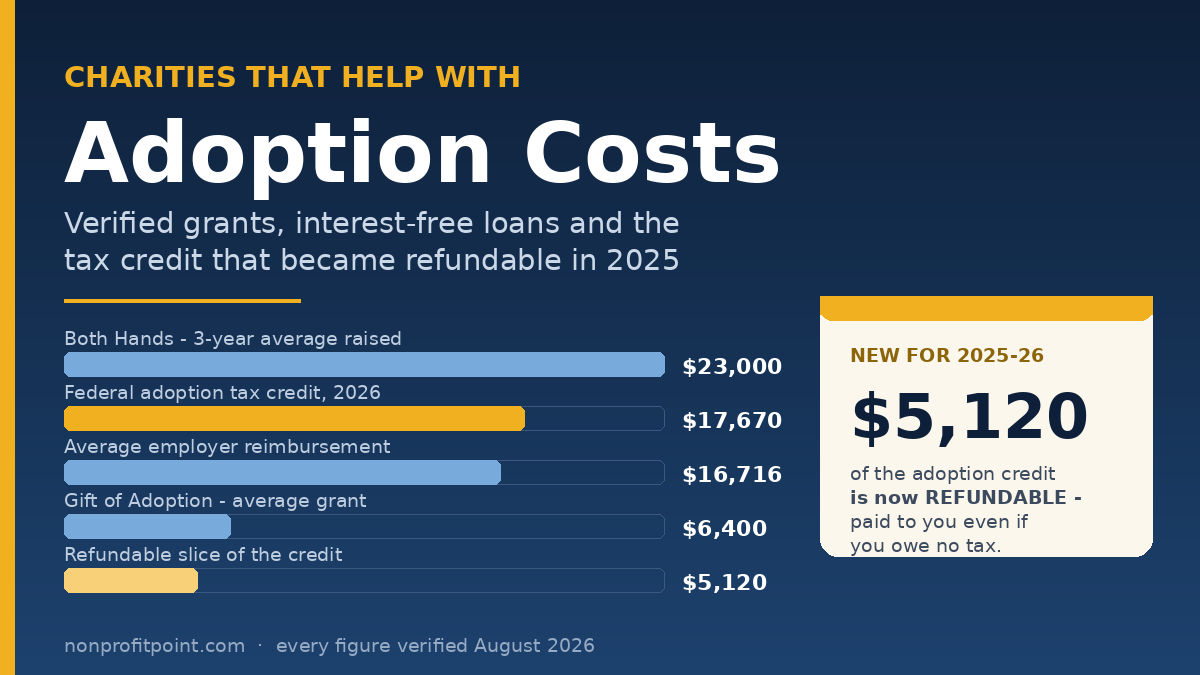
Meanwhile the largest change to adoption funding in a generation has barely reached these articles. Since tax year 2025, part of the federal adoption tax credit is refundable. For decades the standard advice was that the credit was worthless to families with little tax liability. That advice is now backwards. The IRS states it directly: “Beginning in tax year 2025, a portion of the Adoption Credit is refundable up to $5,000 per qualifying child.” For 2026 that refundable slice rises to $5,120 and the total credit to $17,670. Lower-income adoptive families are precisely the group that gained.
This guide covers the grant programs that are genuinely open right now — with their real amounts, their real fees, their real deadlines and, where they exist, their real religious and marital requirements stated up front rather than buried. It also covers the money most families never apply for because nobody told them it was there: the refundable credit, employer reimbursement averaging $16,716, military reimbursement, and the foster-care adoption subsidy with the one timing rule that families lose thousands by missing. Everything below was read on the organization’s own website or an official federal source in August 2026.
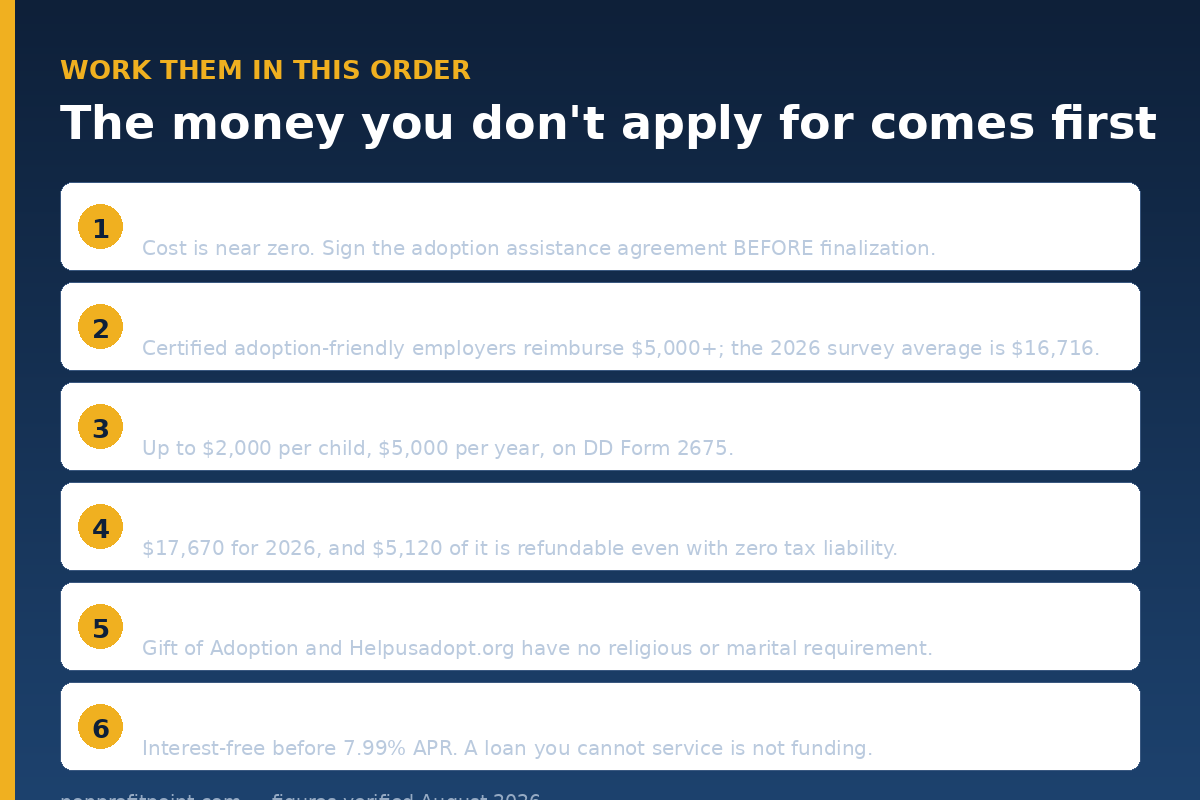
💰 Work these in order — the money you don’t apply for comes first. 1. If you are adopting from foster care, your cost is close to zero and the grants below are largely beside the point — but the adoption assistance agreement must be signed before finalization, or you likely lose it permanently. 2. Check whether your employer has an adoption benefit before you fundraise a dollar. 3. If you are active duty, file DD Form 2675. 4. Claim the federal credit — it is $17,670 for 2026 and $5,120 of it comes back as cash even if you owe no tax. 5. Only then work the grant list. 6. Loans last, and interest-free ones before commercial ones.
Start with the money you do not have to apply for
1. The federal adoption tax credit — and the part that is now cash
This is the largest single source of adoption money in the United States, and it is not a charity or a competition you can be rejected from. If you have qualified adoption expenses, you claim it. For tax year 2026, the maximum credit is $17,670 per child, according to the IRS’s own inflation-adjustment procedure. It begins to phase out at a modified adjusted gross income of $265,080 and disappears entirely at $305,080. For tax year 2025 the figures were $17,280, phasing out between $259,190 and $299,190.
The change that matters: up to $5,000 of the credit became refundable for tax year 2025, rising to $5,120 for 2026 because the refundable portion is indexed to inflation. Refundable means the Treasury sends it to you as a refund even if your tax liability is zero. The non-refundable remainder carries forward for a maximum of five years, after which anything left is forfeited.
Two traps sit inside that. First, a carryforward can never become refundable — the IRS is explicit: “any nonrefundable amount carried forward can’t be used to calculate a refundable portion for future tax years,” and any credit carried forward from 2024 stays permanently non-refundable. Second, the refundable portion is not a one-time bonus in the year you finalize. The IRS says you may claim it “each year you have qualified adoption expenses, up to $5,000,” subject to the per-child ceiling.
If you adopt a child the state determines to have special needs, you may claim the full credit even if you paid no qualified adoption expenses at all. That is the most under-used provision in this entire subject, and it applies to the overwhelming majority of foster-care adoptions. New for tax year 2025, Indian tribal governments now have the same authority as states to make that special-needs determination — a route that did not exist before and that no consumer article we found mentions.
You claim all of this on Form 8839, Qualified Adoption Expenses, attached to your return; the refundable portion lands on Form 1040 line 30. Timing differs by adoption type, and the domestic rule has two prongs that are easy to get wrong. For a domestic adoption, the IRS says to claim expenses in the year you incur or pay them if the adoption is finalized, but the year after you incur or pay them if the adoption is still in progress and not final. The compensating advantage is that with a domestic adoption you can claim even if the adoption never becomes final. For a foreign adoption you can claim nothing at all until the adoption is final. Note before you go looking: as of late July 2026 the IRS’s own consumer-facing adoption credit page and Topic 607 still show only tax year 2025 figures. The 2026 numbers live in Revenue Procedure 2025-32.
2. Your employer — the most-skipped money in adoption
The Dave Thomas Foundation for Adoption has run its Adoption-Friendly Workplace survey for twenty years. Its 2026 findings, published June 8, 2026, are worth reading before you fundraise a single dollar: participating employers offer an average of $16,716 in financial reimbursement for adoption costs, up 6% from 2025, plus an average of 8.9 weeks of paid leave for adoptive parents. To be certified, an employer must offer at least $5,000 in reimbursement and six weeks of paid leave. 103 employers qualified as Certified Adoption-Friendly Workplaces in 2026. At the top, Ferring Pharmaceuticals and NVIDIA tied, both offering unlimited financial reimbursement plus 20 weeks of paid leave.
You can look up participating employers on the Foundation’s Adoption-Friendly Workplace survey results page. One warning: the Foundation’s own June 2026 press release prints the URL davethomasfoundation.org/AFW twice, and that address returns a 404. Use the survey-results link instead.
Two caveats we will state plainly rather than gloss over. Those averages describe employers who chose to enter the survey, not American employers generally. And we could not find any current, primary-sourced figure for what share of US employers offer adoption benefits — SHRM gates its adoption data behind a paid tool in both its 2025 and 2026 benefits surveys, and the widely-quoted “52% of employers” figure comes from a 2013 SHRM article citing an Aon Hewitt survey of large employers only. Do not trust that number; ask your own HR department.
Separately, employer adoption assistance has its own tax treatment. Under Internal Revenue Code §137 you can exclude up to $17,670 of employer-provided adoption benefits from your 2026 income, with the same phase-out band as the credit. You can use both the exclusion and the credit — but not for the same expenses, and the exclusion must be claimed first.
3. Military families: $2,000 per child, $5,000 per year
Under 10 U.S.C. §1052, service members can be reimbursed for qualifying adoption expenses up to $2,000 per adopted child and no more than $5,000 in any calendar year. Eligibility covers active-duty personnel and Reserve or National Guard members called to active duty for 180 or more consecutive days. You file DD Form 2675 with DFAS, and the claim must be submitted no later than two years after the adoption is finalized. Reimbursement is paid only after finalization, and the statute expressly excludes travel costs; the implementing instruction also excludes clothing, and sets out the foreign-adoption filing window, so read it alongside the statute.
Worth knowing before you budget around it: those caps were set when the program was created by Public Law 102-190 in December 1991, and the statute’s amendment history shows subsection (e) has never been touched. The $2,000 has lost most of its purchasing power in thirty-five years. Details on Military OneSource.
4. Adopting from foster care: near-zero cost, and one deadline that costs families everything
The federal government’s own position is that “adopting a child from the child welfare system is virtually free of cost.” Beyond that, eligible children come with adoption assistance — an ongoing monthly subsidy and Medicaid or equivalent coverage that continues after finalization, generally until the child reaches the age of majority, and in some states to age 21.
Three details decide how much your family receives, and articles routinely get all three wrong.
The amount is negotiated, not assigned. The Children’s Bureau’s own factsheet says so: “you can negotiate the terms of the financial assistance, which must not exceed the amount that the child would have received while in foster care.” If you are handed a figure and told it is the rate, that is not the whole truth.
The agreement must be signed before or at finalization. This is the single most consequential sentence in the subject: “With rare exceptions, it is highly unusual to obtain an adoption subsidy after an adoption has been finalized if the adoption assistance agreement was not in effect at the time that the adoption was finalized.” Families who finalize first and ask later routinely lose a subsidy worth tens of thousands of dollars over a childhood. Do not sign a final decree without a signed adoption assistance agreement in hand.
You can renegotiate later. If a medical, developmental or mental-health need surfaces after finalization, federal law permits the agreement to be reopened. Eligibility and Medicaid travel with the child across state lines, though the specific Medicaid services change.
There is also a one-time reimbursement for nonrecurring adoption expenses — court costs, attorney fees and similar. You will see “$2,000” quoted everywhere as a federal entitlement. It is not one. The statute contains no dollar figure at all; the $2,000 appears in regulation, at 45 CFR 1356.41(f)(1), as a ceiling on the federal 50% match of the agency’s expenditure per adoptive placement. States may — and do — set lower maximums: Washington State publishes $1,500 per child. What is genuinely guaranteed is that there is no means test for it, that siblings each get their own separate cap, and that claims must be filed within two years of the final decree with the agreement signed at or before it.
Adoption grants with no religious or marital requirement
This is a heavily faith-based funding landscape. Several of the largest programs require a pastor’s letter or a signed statement of faith, and two require that applicants be married. We list those separately and quote their requirements, because discovering them on page four of an application wastes your week. These three have none.
Gift of Adoption Fund — $1,000 to $15,000, average $6,400
The largest grant-maker in the category and the most explicit about non-discrimination. Its application page describes it as “the largest provider of adoption assistance grants without regard to marital status, race, sexual orientation, religion, or age,” and its separate non-discrimination policy commits to treating all applicants and grant families equitably “without regard to race, color, national origin, ancestry” and the other protected characteristics.
Amount: “Adoption assistance grants range from $1,000 to $15,000 while the average grant award is $6,400.” Fee: $50, non-refundable, which entitles you to submit your case for review up to three times; the application stays valid for 18 months. Deadline: none — “Families are invited to apply anytime after completing their home study and before finalization,” and the selection committee reviews monthly. Eligibility: any US citizen with an approved home study, from a Hague-accredited agency for international adoptions or a licensed social worker for domestic. There is no fixed income limit, but the committee looks for identifiable financial need. In practice the committee will not usually review your file until a match or referral has been accepted and placement is expected within six months.
Apply at giftofadoption.org/apply-for-a-grant. Two notes: the URL most articles link, giftofadoption.org/grants/, returns a 404. And the organization’s own “Who Should Apply” page still shows an outdated range of “$1,000 to $7,500” with a $3,500 average. The FAQ and application pages carry the current figures; the higher numbers are the right ones.
Helpusadopt.org — grants of up to $30,000
The largest single grant in this guide, and equally explicit: Helpusadopt.org “helps couples and individuals (regardless of race, religion, gender, ethnicity, marital status or sexual orientation) with the cost of their adoptions by awarding grants of up to $30,000.” Singles are eligible. Same-sex couples are eligible.
Grants are paid directly to your licensed adoption agency or lawyer rather than to you, for outstanding or future expenses, and are intended for applicants with financial need. There are six application cycles in 2026, each with a fixed deadline and award date: January 3 (awarded February 28), March 7 (April 30), May 2 (June 30), July 7 (August 31), September 5 (October 31) and November 7 (December 31). As of this writing the next deadline is September 5, 2026. Apply at helpusadopt.org/apply. There is no application fee — the organization states so directly in its FAQ. One restriction to plan around: adoption funds from this grant may not be used to cover travel costs.
A Child Waits Foundation — grants up to $8,000, plus international loans
A Child Waits awards “grants of up to $8,000” and also offers low-interest loans for international adoption. Eligibility is open to “US or Canadian Citizens” and is stated “without regard to race, age, ethnicity, religion, gender, marital status, sexual orientation or disability,” with a completed home study required. It has removed its application fee outright: “We no longer charge an application fee.” You can apply at any time of year through achildwaits.org.
One thing that affects your odds rather than your eligibility: A Child Waits’ most recent available IRS filing, for fiscal year 2023, shows revenue of $80,009 against expenses of $805,747, with net assets falling from roughly $2.61 million in 2021 to $1.31 million in 2023. Its application forms are live and the program has not stopped — but a fund spending ten times what it raises is drawing down a balance sheet, and presenting that as equivalent to a growing fund would be dishonest. Apply, and apply elsewhere in parallel.
Faith-based grants — and exactly what they require
These programs are legitimate, well-funded and give real money. They also have requirements that will end your application immediately if you do not meet them, so here they are first.
Show Hope — grants generally between $8,000 and $12,000
Show Hope is the largest of the faith-based grant-makers, with revenue above $10 million in its most recent filing. Its adoption aid grants “generally fall within the range of $8,000 and $12,000 each.” Applications require a completed and approved home study and a licensed, 501(c)(3) child-placing agency; both domestic and international adoptions qualify, with Hague accreditation required for international. The current cycle is “open through September 30, 2026,” and the organization runs quarterly deadlines of January 5, March 31, June 30 and September 30. Apply through showhope.org.
An honesty note: Show Hope publishes a Statement of Faith under its About section, but its adoption-aid pages do not state a faith requirement for applicants. We are not going to tell you there is one, and we are not going to tell you there is not. Ask them directly before you invest time in the application.
Lifesong for Orphans — matching grants and interest-free loans
Lifesong offers “dollar-for-dollar adoption matching grants” alongside “interest-free loans through covenant agreements,” for domestic and international adoptions, and applying is “completely free.” The requirement to know about: a letter showing support from your church, plus a completed home study, applied for before placement. Lifesong does not publish its grant or loan amounts or any deadlines, so you will have to ask. Apply at lifesong.org/adoption/apply.
Katelyn’s Fund — up to $3,000, with the narrowest eligibility here
Grants “may be up to $3,000, contingent on available resources,” paid to your agency. The eligibility rule, in the organization’s own words, is “two-parent married, heterosexual, Christian families professing their belief in Jesus Christ as the only Lord and Savior,” and “parents must complete their statement of faith on the application.” If you are single, LGBTQ+ or not Christian, this program is closed to you, and you should know that before you start rather than after. Domestic applications are due within 45 days of placement; international applications at least 90 days before travel. Application here.
Sacred Selections — full or partial grants, very narrow membership requirement
Sacred Selections has funded 588 adoptions since 2006 and does something unusual: a full grant “covers all agency and attorney fees,” with applicants choosing between a full grant, a partial grant and self-funding. The family remains responsible for home study, travel and post-placement visits, plus fees due after placement — typically $20,000 to $25,000 by the organization’s own estimate.
The eligibility bar is the narrowest in this guide. Applicants must be “active members in good standing of a conservative, non-instrumental, non-institutional church of Christ as shown by letters of reference and discussions with local church leadership.” The application is structured for married couples, with “Husband’s Name” and “Wife’s Name” fields and separate signature lines. Demonstrated financial need is required. We found no application fee and no deadline stated anywhere in the thirteen-page application, but we would confirm both by phone before relying on it. Details at sacredselections.org.
Brittany’s Hope — international special-needs only, and you cannot apply directly
Brittany’s Hope funds adoptions of children with designated special needs from countries other than the United States, and your placing agency must be one of its affiliates. That last point matters: families cannot apply directly — the grant runs through the agency. The organization publishes no grant amount, no fee and no deadline anywhere public. If your agency is an affiliate, ask them; if it is not, this is not a route for you. Inquiry form here.
Interest-free and low-interest adoption loans
A loan is not a grant, and several widely-circulated lists file these under “adoption grants,” which is how families end up surprised by a repayment schedule. Here is what each of them actually is.
ABBA Fund — interest-free loans, Christian families
Explicitly a loan, not a grant, and interest-free. Amounts “average in the $6,000–$8,000 range” and are capped at “no more than 1/3 of the overall cost” of the adoption. The program describes itself as “Adoption Assistance for Christian Families,” and states: “If you are uncomfortable with covenanting with God for this assistance, we respectfully ask you not to apply.” Approval takes six to eight weeks. See abbafund.org. Note that the application page blocks automated requests, so open it in a normal browser.
Pathways for Little Feet — 0% loans, church involvement required
Pathways has lent $4.5 million in interest-free loans for 750+ children, at “100% Interest-free — No interest or hidden fees – ever.” The requirements are specific: current active involvement in a church, agreement with the organization’s faith statement, a letter of recommendation from a pastor, an approved home study, work with a licensed adoption agency, and a credit score of 600 or above. There are no income restrictions. One geographic exclusion applies: Pathways is “unable to provide financial support to those working with adoption agencies in Utah.”
The organization does not publish a maximum loan amount — the $10,000 that appears on its comparison table is an illustration, not a cap — so ask. And ignore the $2,000 matching-grant popup that is still displayed site-wide: it applied to families approved in June and July and that window has closed. Apply here.
America’s Christian Credit Union — a commercial loan, priced accordingly
This is a genuine bank product, not charity, and it should be your last stop rather than your first. ACCU has funded over $50 million in adoption loans since 2009. You can “borrow up to $50,000” with “fixed interest rates as low as 7.99% APR” and terms up to 84 months, plus a $75 loan funding fee. Minimums scale with term: $500 for terms up to 60 months, $15,000 for 61–72 months, $25,000 for 73–84 months. Their own worked example: a $20,000 loan over 60 months at 7.99% APR runs about $391 a month. A separate adoption line of credit runs 9.49% to 16.49% APR. The advertised rate assumes excellent credit and an automatic-payment discount; most applicants will not receive it. Funds go directly to the agency. You must establish credit-union membership before funding. Terms at americaschristiancu.com.
Fundraising platforms that are not predatory
AdoptTogether — tax-deductible crowdfunding, 5% cost
AdoptTogether says it has helped over 5,000 families raise more than $40 million. Creating a profile is free — “AdoptTogether is free for everyone to use” — and the economics are stated plainly: “A 5% transaction cost is deducted from all donations. This covers costs incurred for processing donations.” Because it operates as a project of the Hoping Hearts Foundation (EIN 27-1966036), donations are tax-deductible for your donors, which a personal crowdfunding page cannot offer. The board reviews grant requests monthly, with cheques 7–14 days after review. Funds can cover “homestudy fees, agency fees, attorney or court fees, travel expenses.” No religious or marital requirement is stated. Details here.
Both Hands — an average of over $23,000, and they take nothing
The highest average dollar figure in this entire guide, and the least known. The model is a one-day service project: you assemble a team of ten or more people who spend a day repairing a widow’s home — “landscaping, cleaning, decluttering and painting” — while the team raises support for your adoption.
Both Hands states that projects “raised an average of over $23,000 the past three years,” footnoting that this is the average of every adoption fundraising project completed in 2023, 2024 and 2025, and adding that “families are not guaranteed to raise the average.” They are currently offering $3,000 matching grants to families completing a project by December 31, 2026, plus a $1,000 supply grant. And on fees: “We don’t take a penny out of the funds raised for adoption or orphan care projects for ourselves.” If a donor declines to cover processing fees, Both Hands covers them.
The framing is openly Christian — the site speaks to “Christian families across the country” and cites James 1:27 throughout — but no religious eligibility bar is stated anywhere, and we are not going to invent one. What it does require is organizational effort and a team. How it works.
The graveyard: programs still on every list that no longer exist
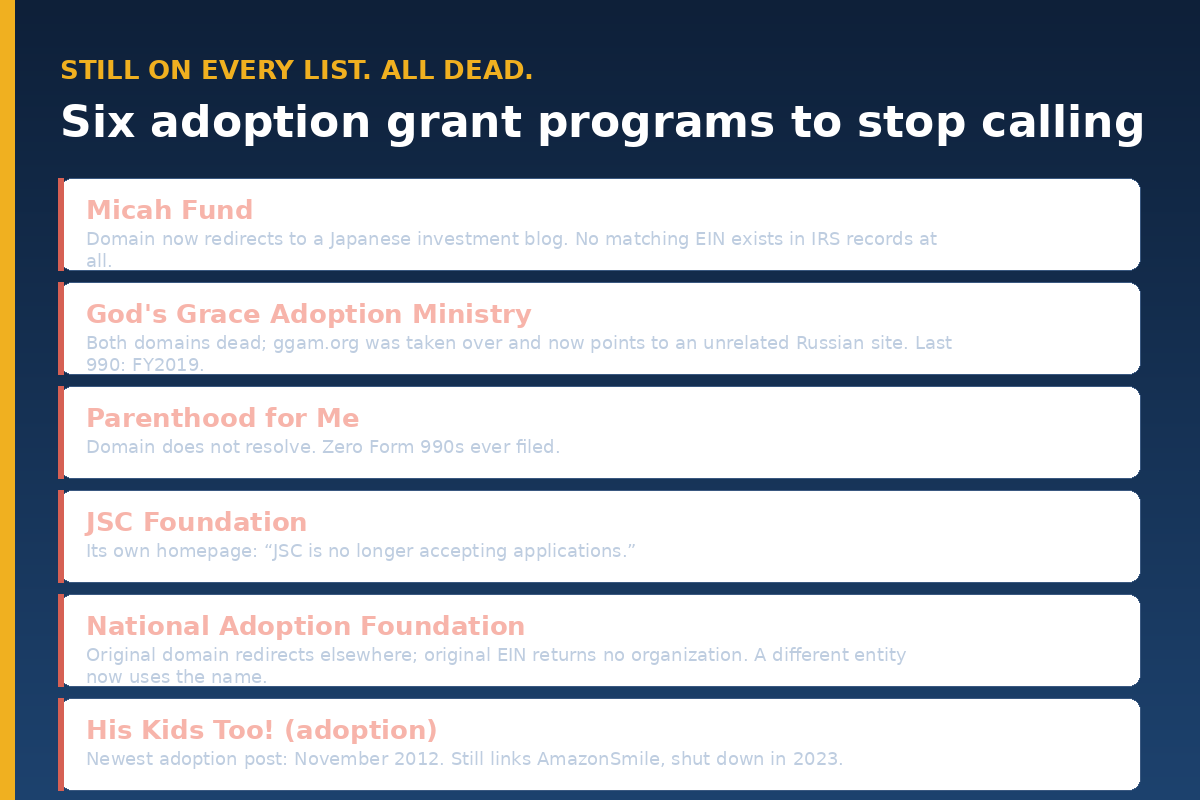
The Micah Fund. The domain no longer hosts the charity. Checked twice on the day of publication, it served first a chain of redirect JavaScript and then a parked landing page reading “This domain may be for sale” — either way, no adoption content and nothing to apply to. More conclusively: searching the IRS Business Master File for “Micah Fund” and “The Micah Fund” returns zero results. We could not confirm it was ever registered as a 501(c)(3) under that name. Its last genuine archived snapshot is from August 2025.
God’s Grace Adoption Ministry. Its original domain, godsgrace.org, returns a 404 from a domain-forwarding service with no site behind it. Its successor domain, ggam.org, has been lost: it now redirects to an unrelated Russian-language site, and the TLS certificate confirms it belongs to that other operator. The archive shows ggam.org was still the ministry’s site as recently as March 2026, so this takeover is recent and search results have not caught up. The organization’s last IRS filing under EIN 77-0488466 was fiscal 2019, showing $14,692 in revenue against $38,525 in expenses. Do not enter your details on that domain.
Parenthood for Me. The domain does not resolve — there is no DNS record at all. Under EIN 26-4261911 there are no Form 990 filings on record, and the entity is frozen at a 2019 tax period with zero assets and zero income. In fairness to the record: an organization under $50,000 in gross receipts files a Form 990-N e-postcard rather than a full return, which can produce an empty filing history, so read this alongside the dead domain rather than on its own.
The JSC Foundation. Not a mystery — it says so itself. Its site is now a single wind-down page reading “JSC is no longer accepting applications.” Its filings show the collapse: revenue fell from $1.58 million in fiscal 2021 to $528,942 in fiscal 2023, against $1,046,847 in expenses.
The “National Adoption Foundation.” This one needs care, because a live site currently uses the name. The historic National Adoption Foundation’s domain, nafadopt.org, now redirects to a site that has nothing to do with adoption or charity at all — a video-streaming domain carrying adult categories. Do not follow that link. Its EIN, 06-1327015, returns “organization not found” in IRS data, and no entity by that exact name appears in the IRS file. The nearest match, National Adoptive Foundation Inc of Bethel, Connecticut, is a different EIN with a single filing on record for 2016. The site that ranks today, fundyouradoption.org, operates from a different state than the original, states that its founder is deceased, heavily cross-promotes a bank loan product, and advertises grants of only “$500 to $2,000.” We could not match it to any 990 filing. It may be entirely legitimate; we simply cannot verify it, and it is not the organization the older articles are pointing you to.
His Kids Too! The site is live and the charity exists, but its adoption program is dormant. The newest post in its adoption category is dated November 8, 2012. The homepage still links AmazonSmile, which Amazon shut down in February 2023. Its current work is Ukraine relief, and it publishes no grant amount. Its mechanism was never a grant in the usual sense — it held donor-designated funds on a family’s behalf, minus payment processing fees.
The pattern generalises: a charity list is only as good as the date somebody last checked it. If an article recommending adoption grants does not say when each organization was verified, assume it never was. The same problem runs through charity recommendations generally, which is why we maintain a guide to the worst-performing charities and how to check any organization yourself.
What adoption actually costs — and why the “official” number is nine years old
You will see a federal-looking range quoted with great confidence: $30,000 to $60,000 for a private domestic adoption, $25,000 to $45,000 for an independent one, $20,000 to $50,000 internationally. Those figures come from the Child Welfare Information Gateway’s factsheet Planning for Adoption: Knowing the Costs and Resources, published June 2022 — which sounds current until you read its own footnotes.
Every one of those ranges is footnoted, in part, to the same source: a magazine reader survey. The factsheet says the private-agency range “was determined using estimates from the Adoptive Families Magazine article, ‘Adoption Cost & Timing in 2016-2017’” alongside two agency websites, and the independent and intercountry ranges cite that same article alongside their own additional sources. That survey covered adoptions finalized in 2016 and 2017 and was published in February 2018. No newer edition exists. The “federal” cost of adoption in 2026 is, in substance, a nine-year-old consumer-magazine survey that was never inflation-adjusted — and the federal FAQ still routes families to it.
For intercountry adoption there is a far better number, and almost nobody uses it. The State Department collects fee data from accredited adoption service providers and publishes it annually. In its FY2025 report, providers “reported charging between $17,500 and $75,750 for adoption services from Convention countries, with a median charge of $45,974,” plus a further $3,250 to $44,795 for country-specific services. That is materially above the $20,000–$50,000 range still being repeated, and it is current, first-party and specific.
Context you should have before choosing an international route: the volume has collapsed. Total intercountry adoptions to the United States were 1,172 in FY2024 and 973 in FY2025. Several major sending countries are closed. China ended intercountry adoption effective August 28, 2024 — the State Department states that adoptions from China “are not possible, with very limited exceptions.” Russia has banned adoption by US citizens since 2013. Ethiopia effectively ended adoption by non-citizens in 2018. The State Department’s FY2025 report also identifies blanket prohibitions in the Democratic Republic of the Congo and Latvia, and notes that Nepal, Ukraine, Cuba and Belarus are not currently placing children with US families. Any article still listing China as a program option was written before September 2024.
One more line item to expect rather than be surprised by: accredited providers are charged a monitoring and oversight fee by the accrediting entity, and the State Department has said plainly that it “anticipates that most ASPs will pass the M & O fee along to adoptive families on a per case basis.” Ask your provider whether its quoted fees include it.
State adoption tax credits — and four that articles get wrong
Several states stack a credit or deduction on top of the federal one. Below is every state we could verify directly on that state’s own revenue department materials. We have deliberately left out states we could not confirm first-party — an incomplete list you can trust beats a complete one you cannot.
| State | Benefit | Refundable? | Notes |
|---|---|---|---|
| Alabama | $2,000 per child (in-state private or DHR foster); $1,000 out-of-state | Yes | Plus a separate deduction for medical and legal expenses; agency fees are not deductible |
| California | 50% of costs, max $2,500 per child per year | No; excess carries forward | Child must have been in the custody of a California agency or political subdivision |
| Georgia | $6,000 per child per year for five years, then $2,000 per year to age 18 | No; cannot be carried forward | Qualified foster children only |
| Illinois | $2,000, rising to $5,000 if the child is at least one year old and an Illinois resident when expenses are paid | No | Claimed on Schedule 1299-C |
| Indiana | 20% of the federal credit, or $2,500 per child, whichever is less | No | Indiana has incorporated the new federal refundable limitation |
| Iowa | First $5,000 of unreimbursed expenses per child placed in Iowa | Yes | No income limit at all |
| Kansas | 100% of the federal credit, plus $1,500 for special-needs or DCF-custody adoptions | No; carries forward | Was 25% through 2023 — most articles still say 25% |
| Missouri | $10,616 for 2025 ($10,318 for 2024), CPI-indexed | Yes | Applies “regardless of whether such child is a special needs child” |
| Oklahoma | 10% of qualified nonrecurring expenses, capped at $2,000 (single) or $4,000 (joint) per year | Not stated as refundable | Restructured from a deduction to a credit for 2023 onward |
| Utah | Up to $3,500 for an adoption finalized in the tax year | Yes below an AGI line, otherwise no | Refundable under $55,000 joint / $27,500 single; disqualified if you claimed the same expenses federally |
| West Virginia | $5,000 one-time, may be spread over three years | Not stated as refundable | Nonfamily adoptions only — not stepparent adoptions |
| Wisconsin | $15,000 per child subtraction from income (not a credit) | n/a — deduction | Raised from $5,000 for tax year 2025 |
| Ohio | REPEALED | — | “Not available for adoptions finalized after December 31, 2022” — still listed as live in most roundups. Adoptions finalized on or after January 1, 2023 may instead qualify for an adoption grant through Ohio Job and Family Services |
Four of those rows exist because the commonly-published version is wrong. Ohio’s credit is repealed, and every list still carrying it is sending families to claim something that does not exist. Kansas quadrupled from 25% to 100% of the federal credit. Wisconsin tripled from $5,000 to $15,000. And Oklahoma converted a deduction into a much smaller credit, which is a downgrade families need to plan around rather than discover in April.
States we deliberately omitted, because we could not verify them on the state’s own materials: Arkansas, New Mexico, Mississippi, Michigan, Minnesota, South Carolina, North Dakota, Kentucky, Montana and Maryland. Several are widely listed elsewhere. Check with your own state revenue department rather than a list.
Three things that stack, that almost nobody mentions
The FAFSA rule that is worth more than most grants. A child who was in foster care at any time at or after age 13 is an independent student for federal financial aid purposes — permanently, and regardless of being adopted afterwards. Parental income is never counted. Over four years of college that is frequently worth more than every adoption grant in this article combined. It is also routinely misstated as age 16; the criterion is 13.
Adoption assistance does not wreck your housing benefit. Families receiving Section 8 or living in public housing often fear that accepting an adoption subsidy will raise their reported income and cost them their home. Federal regulation at 24 CFR 5.609 excludes from annual income “adoption assistance payments for a child in excess of the amount of the deduction for a dependent,” and separately excludes payments received for the care of foster children. The threshold is the dependent deduction in 24 CFR 5.611 — a figure HUD adjusts annually for inflation, so do not use the $480 base figure you will see quoted.
FMLA covers adoption. Employers with 50 or more employees must grant up to 12 weeks of unpaid leave to employees on the adoption of a child, and both parents are eligible.
And one thing that does not stack, because it is one of the most persistent myths in this subject: you cannot pay adoption fees from an HSA, a health FSA, an HRA or a Dependent Care FSA. Those accounts are limited to expenses that meet the IRS medical-expense standard, and IRS Publication 502 handles adoption by pointing readers away to Form 8839 instead. A Dependent Care FSA covers care that lets you work — Publication 503 states that expenses for care “don’t include amounts you pay for food, lodging, clothing, education, and entertainment,” and adoption fees appear nowhere as a qualifying expense. What people are half-remembering is the separate §137 employer adoption assistance program, which can sit inside a cafeteria plan but is not an FSA. What you can reimburse from an HSA or FSA is the child’s medical care, including care paid for before the adoption was final, if the child qualified as your dependent when the services were provided.
Before you pay anyone: two warnings
Adoption intermediaries are not licensed agencies, and the FTC is watching them. In September 2024 the Federal Trade Commission sent letters to 31 adoption intermediaries warning them against “misleading consumers with respect to placement rates and placement times, suppressing negative reviews, or engaging in other unfair or deceptive practices.” The FTC describes these entities — “sometimes called adoption advertisers, facilitators, consultants, matchmakers, or brokers” — as middlemen charging fees “often in the tens of thousands of dollars” who “are not licensed adoption agencies.” One named practice: an intermediary advertising itself as an “adoption agency” in paid search ads. Violations of the Consumer Review Fairness Act can carry civil penalties of more than $50,000 per violation. The Commission issued a follow-up report to Congress on June 4, 2026. The FTC did not release the names of the 31 recipients, so no list of them exists — the defence is to verify a provider’s license yourself with your state, not to look for a blacklist.
Facilitators are illegal in more places than the standard reference says. Nearly every article on this subject cites a federal summary stating that only Delaware, Kansas and Maine strictly prohibit facilitators. That document is stamped “state statutes current through July 2020,” and its original federal URL now 404s. It therefore misses the biggest change in the field: California banned adoption facilitators outright. California’s Department of Social Services states that AB 120 repealed the state’s Adoption Facilitator Program, that registered facilitators had to cease operation by December 31, 2023, and that “as of January 1, 2024, a person or entity operating or providing adoption facilitator services in California is prohibited,” with unlicensed placement a misdemeanor. California was historically the largest facilitator market in the country — it was the only state that maintained a facilitator registry. Any guide telling you facilitators are legal in California is more than two years out of date.
What we could not verify, and are not going to guess
A short list, because pretending to certainty you do not have is how families end up wasting weeks. We could not obtain grant amounts, fees or deadlines for Lifesong or Brittany’s Hope — neither publishes them. We could not confirm whether Show Hope’s Statement of Faith binds applicants. We could not find a published maximum loan amount for Pathways for Little Feet. We could not verify a current figure for the share of US employers offering adoption benefits from any primary source. We could not confirm the base USCIS filing fee for Forms I-800A and I-600A, because the fee schedule blocks automated retrieval — check uscis.gov/g-1055 directly. And on God’s Grace Adoption Ministry and Parenthood for Me: the filing gaps are strong evidence of dormancy, but they are not proof that either organization’s tax-exempt status was revoked, and we are not going to claim it was.
Related help from Nonprofit Point
- The best adoption charities to donate to — for the other side of this: giving to adoption causes rather than applying to them
- Charities that help with baby supplies — diapers, formula and equipment once the child is home
- Grants for single mothers — several of which apply to single adoptive parents
- Charities that help with medical bills — for the medical costs adoption assistance does not reach
- Charities that help with rent and help with utility bills — if adoption costs have squeezed the rest of the budget
- Get help paying for … — our full directory of financial-assistance guides
Frequently asked questions
Is the adoption tax credit refundable in 2026?
Partly, yes — and this changed recently enough that most articles still say no. Up to $5,120 per qualifying child is refundable for tax year 2026, up from $5,000 for tax year 2025, because the refundable portion is indexed to inflation. The total credit for 2026 is $17,670. Refundable means you receive that portion as a refund even if you owe no federal income tax. The remaining, non-refundable portion carries forward for up to five years, but a carryforward can never later be converted into a refund.
Which adoption grants have no religious requirement?
Three of the largest. Gift of Adoption Fund awards grants of $1,000 to $15,000, average $6,400, explicitly without regard to religion, marital status, sexual orientation or gender identity, for a $50 application fee and with no deadline. Helpusadopt.org awards up to $30,000, explicitly to couples and individuals regardless of religion, marital status or sexual orientation, on six fixed deadlines a year. A Child Waits Foundation awards up to $8,000 with no application fee and the same non-discrimination language. By contrast, Katelyn’s Fund requires married heterosexual Christian applicants with a statement of faith, Sacred Selections requires membership in a conservative non-institutional church of Christ, and Pathways for Little Feet requires active church involvement and a pastor’s letter.
How much does it cost to adopt a child in 2026?
It depends entirely on the route, and the commonly quoted figures are older than they look. Adoption from US foster care is described by the federal government as “virtually free of cost.” For private domestic adoption, the figures you will see — $30,000 to $60,000 for agency adoption, $25,000 to $45,000 for independent adoption — come from a federal factsheet published in 2022 whose own footnotes trace every range to a magazine reader survey of adoptions finalized in 2016 and 2017. No newer government figure exists. For intercountry adoption there is current data: the State Department’s FY2025 report says providers charged between $17,500 and $75,750 for Convention-country adoption services, with a median of $45,974, plus $3,250 to $44,795 in country-specific fees.
What is the biggest mistake families make with foster care adoption subsidies?
Finalizing the adoption before the adoption assistance agreement is signed. The federal guidance is unambiguous: “With rare exceptions, it is highly unusual to obtain an adoption subsidy after an adoption has been finalized if the adoption assistance agreement was not in effect at the time that the adoption was finalized.” A subsidy can run monthly until the child reaches majority, and in some states to 21, so missing that signature can cost a family tens of thousands of dollars with no route back. The second-biggest mistake is treating the offered amount as fixed — it is negotiated, capped only at what the child would have received in foster care.
Can I use my FSA or HSA to pay adoption fees?
No. Health savings accounts, health FSAs and HRAs are limited to expenses meeting the IRS medical-expense definition, and IRS Publication 502 explicitly redirects adoption expenses to Form 8839 instead. A Dependent Care FSA covers care that enables you to work, not adoption fees. What people usually have in mind is a separate Section 137 employer adoption assistance program, which can sit inside a cafeteria plan but is not an FSA and carries its own exclusion of up to $17,670 for 2026. You can, however, use an HSA or FSA for the child’s medical care, including expenses paid before the adoption was final if the child qualified as your dependent at the time.
Does my employer offer adoption benefits?
Check before you fundraise, because this is often the largest single cheque available to you. Among employers participating in the Dave Thomas Foundation for Adoption’s 2026 survey, the average financial reimbursement is $16,716, alongside an average of 8.9 weeks of paid leave; certification requires at least $5,000 and six weeks. Ferring Pharmaceuticals and NVIDIA tied at the top in 2026, both offering unlimited reimbursement and 20 weeks of paid leave. You can search participating employers on the Foundation’s survey-results page — but note the shortcut URL printed in the Foundation’s own press release returns a 404. There is no reliable current figure for what share of US employers offer these benefits, so ask your HR department directly rather than relying on published percentages.
Are there adoption grants that are actually loans?
Yes, and this is routinely miscategorised. ABBA Fund provides interest-free loans averaging $6,000 to $8,000, capped at a third of the adoption’s total cost, for Christian families. Pathways for Little Feet provides 0% interest loans and requires active church involvement, a pastor’s recommendation and a credit score of 600 or above, and cannot fund families working with agencies in Utah. Lifesong for Orphans offers both matching grants and interest-free loans. A Child Waits offers grants plus low-interest loans for international adoption. America’s Christian Credit Union is a straightforward commercial lender: up to $50,000, rates from 7.99% APR, a $75 funding fee, and a line-of-credit option at 9.49% to 16.49% APR.
Which adoption grant organizations should I stop calling?
Six that appear on current lists and cannot help you. The Micah Fund — domain flipped to an unrelated commercial blog, and no organization by that name exists in the IRS Business Master File. God’s Grace Adoption Ministry — both domains dead, one of them taken over by an unrelated foreign site, last IRS filing fiscal 2019. Parenthood for Me — domain does not resolve, no Form 990 ever filed. The JSC Foundation — its own homepage states it is no longer accepting applications. The historic National Adoption Foundation — original domain redirects elsewhere and its EIN returns no organization; a different, unverifiable entity now uses the name. His Kids Too! — the charity exists but its newest adoption content is from November 2012.
About this guide. Compiled and fact-checked by the Nonprofit Point editorial team, which researches financial-assistance and charity-vetting resources for U.S. households. Every grant amount, application fee, deadline and eligibility rule above was read on the organization’s own website in August 2026, and every tax, military and child-welfare figure on an official federal source: Revenue Procedure 2025-32 for the 2026 adoption credit and employer exclusion, IRS Topic 607 and the Instructions for Form 8839 for tax year 2025, 26 U.S.C. §23 for the refundable portion and carryforward rule, 10 U.S.C. §1052 and Military OneSource for military reimbursement, 45 CFR 1356.41 for nonrecurring adoption expenses, the Children’s Bureau factsheet on adoption assistance for the subsidy rules, the State Department’s FY2025 Annual Report on Intercountry Adoption for international fees and country closures, 24 CFR 5.609 for the HUD income exclusion, the 2026–27 Federal Student Aid Handbook for the foster-care independence rule, the FTC’s September 2024 enforcement announcement, and the California Department of Social Services for the facilitator ban. Nonprofit status and filing history were checked against IRS Form 990 data. Where an organization does not publish a figure, we say so rather than estimating, and the section above lists what we could not verify. Programs in this category close and change hands quickly — confirm current terms by phone before paying any application fee. Nonprofit Point is an independent resource, is not affiliated with any organization listed, and does not provide tax or legal advice; consult a tax professional about your own return.
Considering fertility treatment alongside adoption? Several foundations fund both from a single application — the Tinina Q. Cade Foundation awards up to $10,000 per family toward “costs of domestic adoption and medical fertility treatment,” and Gift of Parenthood funds adoption, surrogacy and IVF up to $20,000. Our guide to IVF grants and fertility treatment financial assistance lists 14 verified programmes with award amounts, income limits and deadlines.