Charities That Help With Hearing Aids: 12 Real Programs (2026)

Almost every article you will find on this subject opens by telling you to apply to the Starkey Hearing Foundation’s Hear Now program. The Starkey Hearing Foundation has not run Hear Now since 2021. Its own site says so: it stopped accepting hearing aid donations in April 2021, its work is now international, and it redirects Americans asking for help to Starkey Cares — a corporate program of Starkey the manufacturer, not the foundation. Five years on, the wrong instruction is still the first line of nearly every list.
That is the shape of this whole category. It is full of dead organizations that nobody removed. AUDIENT, the alliance most often listed second, no longer exists: its domain serves nothing, its partner EarQ now redirects to a for-profit buying group, and no IRS-registered nonprofit under its name remains. The Lions Hearing Aid Recycling Program survives only on an archived page — Lions International now routes every donated aid to a different charity and tells individuals to call a local club. The Gift of Hearing Foundation last filed a tax return for 2017. Ears for Years serves children overseas and its newest page is dated 2014. Songs for Sound changed its name and does not supply devices at all. Even the application link most sites give for the Hearing Aid Project — hearingaiddonations.org/apply — is a 404.
Here is what is actually true in August 2026. A prescription pair of hearing aids commonly runs $1,300 to $4,000 or more once you include testing, fitting, warranty and follow-up care, according to the Hearing Industries Association’s own financial-assistance guide. Original Medicare pays none of it — medicare.gov states flatly that “Medicare doesn’t cover hearing aids or exams for fitting hearing aids.” Only 32 states cover hearing aids for adults under Medicaid, according to a 2025 study in Health Affairs. And yet the two best routes in the country cost nothing and $550 respectively, and neither is a charity.
This guide covers the programs that are genuinely taking applications right now — with their real application fees, their real income limits, and their real waiting conditions — followed by the public routes that beat every charity on this list, the cheapest verified ways to buy, and a plain graveyard of the programs you should stop calling. Everything below was verified on each organization’s own website in August 2026.
📞 Start here, in this order. 1. If you are a veteran enrolled in VA health care, stop reading and call your VA medical center’s audiology clinic — hearing aids, repairs and batteries are free, and audiology is one of the few VA services you can book without a primary-care referral. 2. If your child is on Medicaid, hearing aids are mandatory coverage in every state under EPSDT — that is federal law, not a state option. 3. If you are an adult on Medicaid, check your own state: 32 states cover adult hearing aids and 18 do not. 4. Only then work the charity list — most have fees between $200 and $300, and the free one has a waiting condition.
The charities that are actually taking applications
1. Starkey Cares — Hear Now (the real one)
This is the program people mean when they say “Hear Now,” and it now lives with Starkey the manufacturer rather than the foundation. You receive new Starkey hearing aids, not refurbished ones — the company describes it as offering “our most advanced hearing technology at a significantly reduced cost.”
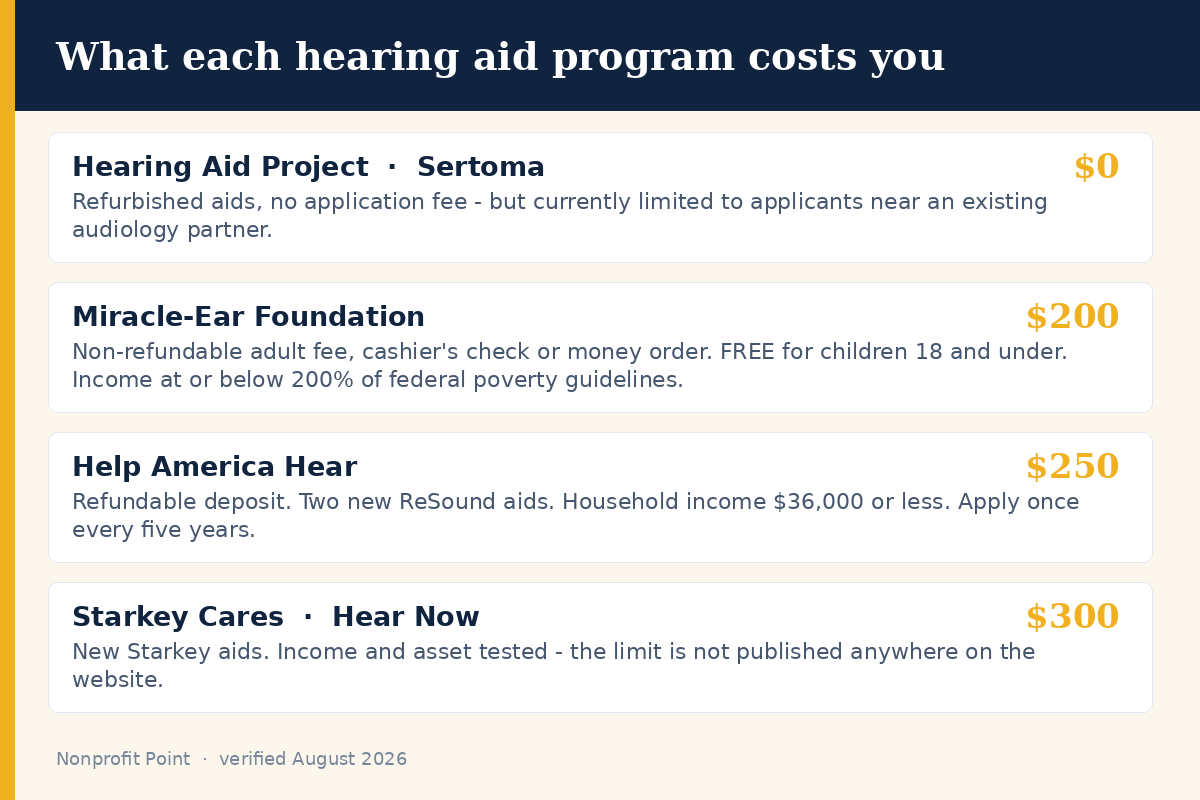
Cost to you: a $300 application fee. Eligibility is income- and asset-tested, and here is a detail worth knowing before you spend an afternoon on paperwork: Starkey does not publish its income limit anywhere on its website. Its own program sheet says only “if your household income is below the current limit” and points to a QR code. You will be asked for three months of bank statements for every adult in the household or a Form 1040, plus statements for any IRA, 401(k), savings, annuity, CD, stock or living trust. That asset test is unusually broad; a modest retirement account can disqualify you.
Apply online at app.starkeycares.org or by phone on (855) 686-2202. Email starkeycares@starkey.com.
2. Miracle-Ear Foundation — Gift of Sound
The best-documented of the manufacturer foundations, and the only one that publishes a hard income line. Household income must be at or below 200% of the federal poverty guidelines, and you must be a resident or citizen of the United States or Puerto Rico. You receive new hearing aids and services at no cost, with the first pair of earmolds included for adults and all earmolds included for children.
Cost to you: a $200 non-refundable application fee for adults 19 and over, paid by cashier’s check or money order — and nothing at all for children 18 and under. That children’s waiver is the single most useful fact in this section and it is buried on the eligibility page.
The foundation also requires that you have been denied all other financing options and exhausted other resources, meaning insurance, Medicaid, the VA, vocational rehabilitation and other charities. Children need an audiogram and physician medical clearance within six months; adults may waive medical clearance by signature. Processing takes up to four weeks for a complete application. Start by contacting a local Miracle-Ear store for a free hearing evaluation, then apply online or on paper. Phone 800-234-5422.
3. Help America Hear
Formerly the Foundation for Sight & Sound, this is the program with the clearest published income test in the entire category: household income of $36,000 or less per year before taxes. You receive two new prescription ReSound hearing aids, custom earmolds and one year of limited service, with three to five follow-up visits from your provider.
Cost to you: a $250 refundable deposit, applied to fitting fees if your provider charges them and refunded if the provider donates services. You separately pay for the hearing evaluation, medical clearance, batteries, accessories and any extended loss-and-damage warranty. Applicants may apply once every five years, and the organization describes the program as a last resort.
Two cautions. The organization’s older downloadable application, still sitting on its server, shows a superseded fee structure of $300, $600 and $1,000 by income band, along with asset caps. Use the $250 figure from the current site. And set your expectations against its size: this is a small charity, with reported revenue of roughly $286,000 in its most recent filing year. Review and approval take two to three weeks, but the full process including provider matching can take two to six months. Phone 888-580-8886.
4. The Hearing Aid Project (Hearing Charities of America / Sertoma)
The only genuinely free option on this list — no application fee at all — providing refurbished hearing aids and accessories to qualifying individuals. The aid bank is housed with the Department of Hearing and Speech at the University of Kansas Medical Center.
Eligibility is a hearing loss diagnosed and documented by a licensed audiologist with a recommendation for hearing aids, plus either low income with no health insurance, or low income with insurance that provides zero hearing-aid coverage. There is no published dollar figure. One explicit exclusion: they will not cover your insurance deductible.
The catch is geography, and it is stated on their own page: because of an overwhelming number of applications, they are currently accepting applications only from people located within a reasonable distance of an existing audiology partner. Treat this as a waitlisted program with a location test rather than an open national one. The live application page is hearingaiddonations.org/get-an-aid/ — the /apply/ URL that most articles link is a 404. Phone 816-895-2410, email hap@sertoma.org.
5. TPA Hearing Trust — cash, not devices
The Travelers Protective Association’s hearing trust is different in kind from everything above: it writes a cheque rather than fitting a device, which means it can cover the parts other programs will not, including specialized treatment, note-takers, interpreters and education. Grants generally range from $100 to $1,600 and there is no application fee.
Two myths to clear. You do not need to be a TPA member — membership is one route in, not a requirement. And there is no published numeric income limit, though every applicant must submit a recent Form 1040; the trust explicitly states that W-2s and pay stubs will not be accepted as proof of income. Recipients may receive aid once a year.
Applications are reviewed monthly, trustees consider everything on file as of the last day of each quarter, decisions follow within 30 days, and cheques go out after the first of the following month. Plan on a quarter, not a fortnight. The application form was revised in March 2026, making it the freshest document of any organization in this guide. Mail to TPA Hearing Trust, 2041 Exchange Drive, St. Charles, MO 63303, or email trustsecretary@tpahq.org. Phone 1-877-872-2638. Since 1975 the trust reports allocating more than $2.4 million to roughly 6,100 recipients.
6. The HIKE Fund — children only
A volunteer-run fund providing hearing devices to children from newborn to age 20 across the United States and Canada, where parents cannot meet the cost. It covers more than hearing aids: FM systems, closed-caption converters, tactile units, alerting systems and specialized sports equipment. There is no fee to the family and no published income limit; need is verified by a prescription from an audiologist or physician. Its own stated capacity is roughly 100 children a year, so apply early and apply elsewhere in parallel.
7. AG Bell Association financial aid — for families with young children
AG Bell makes cash awards to families of children with bilateral hearing loss who are using listening and spoken language. Over the past three years, Parent–Infant awards have ranged from $300 to $2,000. The clinical threshold is specific: unaided pure-tone average of 55 dB or greater in the better-hearing ear, with documented moderately-severe to profound bilateral loss. The child and family must live in the United States, its territories, or Canada. There is no application fee and no published income limit. One honest caveat: the awards are described as covering “auditory support services, speech-language therapy, technology, pre-school fees/tuition,” and “technology” is not defined as hearing aids in so many words — confirm with AG Bell before counting on it for a device.
8. Ear Community — bone-conduction devices
A narrow but genuinely useful door for people with microtia and atresia. Ear Community takes applications for bone-conduction hearing devices from people who have been denied by their insurance plan or cannot afford to purchase one, and separately runs Pax’s Ear Fund for surgery-related travel costs. Eligibility criteria and timelines are not published — apply and ask.
The public routes that beat every charity on this page
The VA: free hearing aids, and not only for service-connected loss
If you are a veteran, this is the answer. The VA states plainly that “there is no cost for hearing aids from the VA,” and that the hearing aids, the repairs and the future batteries are all free for as long as you maintain VA eligibility for care. You are fitted with premium devices from multiple manufacturers, not a single budget line.
The eligibility rule people get wrong is that hearing loss must be service-connected. It need not be. Federal regulation 38 CFR § 17.149 lists eight qualifying categories, and only the first involves a compensable service-connected disability. The others cover former prisoners of war; Purple Heart recipients; those receiving benefits under 38 U.S.C. 1151; those receiving increased pension for aid and attendance or being permanently housebound; those whose hearing impairment resulted from another condition VA is treating, or from its treatment; those with significant functional or cognitive impairment; and those whose hearing loss is severe enough that aids are necessary for them to participate in their own medical treatment.
VA’s plain-language fact sheet puts it more simply — “any Veteran eligible to receive healthcare may receive hearing aids” — but the regulation is the governing rule, so read the eight categories rather than assuming automatic entitlement. The process is short: enrol in VA health care in person, online with VA Form 10-10EZ, or by mail, then book directly with a VA Audiology and Speech Pathology clinic. Audiology is one of the few VA services that does not require a primary-care referral. Reorder batteries with VA Form 2346 or on 303-273-6200.
Medicaid: mandatory for children, a coin flip for adults
For anyone under 21 enrolled in Medicaid, hearing aids are not a state option. Under Early and Periodic Screening, Diagnostic and Treatment, states are required to furnish all medically necessary services to correct or ameliorate a condition, and Medicaid’s own guidance names the example directly: vision and hearing services include “screening, diagnosis and treatment for defects in vision and hearing such as hearing aids.” That is a federal mandate in every state.
For adults, it is a lottery by geography. A 2025 study in Health Affairs identified 32 states with Medicaid hearing-aid coverage for adults as of December 31, 2023, with substantial variation in the policy details — some cap it at one aid per ear every three years, some charge copays. Do not rely on the widely-circulated state-by-state table from KFF for current numbers; its most recent data is from 2018. Call your own state Medicaid agency.
CHIP is a separate question with a less generous answer. Hearing services are not a mandatory benefit in a separate CHIP program; only states running Medicaid-expansion CHIP must apply EPSDT. Ask your state which model it uses.
State vocational rehabilitation — real, but not universal
Every state runs a vocational rehabilitation agency that can fund equipment when a disability is a barrier to employment, and hearing aids sometimes qualify. The blanket claim that every state VR agency buys hearing aids is false, and here is the evidence.
Texas is the clearest yes: the Texas Workforce Commission’s own vocational rehabilitation materials say VR can “help buy hearing aids, wheelchairs, prosthetics, braces or other medical devices,” and that a hearing impairment affecting your ability to prepare for, obtain, maintain or advance in employment may make you eligible. Start at 512-936-6400.
New York is a documented no at the rehabilitation-technology level: ACCES-VR policy classifies “prosthetic and orthotic devices, wheelchairs, hearing aids, etc.” as restoration services rather than rehabilitation technology, on the reasoning that they are available by prescription or through Medicaid and private insurance. ACCES-VR does not charge for services, but applies an economic needs assessment at 300% of the federal poverty level, with TANF, SSI and SSDI recipients exempt. Intake is 1-800-222-5627.
California and Florida sit in between: both publish deaf and hard-of-hearing services covering audiologic and hearing-aid assessments and assistive listening devices, without naming hearing aids as a purchased item. Both also operate an order-of-selection waiting list. Apply anyway — but apply somewhere else at the same time.
Two public routes nobody mentions
State assistive technology programs. The federal Assistive Technology Act funds one program in every state and territory — 56 grantees in total — and each is required to run device loan, device demonstration, device reutilization and alternative financing activities. In plain terms: you can borrow equipment to try it before spending money, buy reused equipment at reduced cost, or access a low-interest loan. Find yours through the AT3 Center directory at at3center.net/stateprogram. Washington’s program, for example, lends devices for a 21-day period for a nominal fee.
State telecommunications equipment distribution programs. Many states give amplified and captioned telephones away outright. Florida’s is the model: FTRI provides amplified phones, cell phone amplifiers, captioned phones and visual alert ringers with no application fee, no monthly cost and no income requirement, to any permanent Florida resident aged three or older with certified hearing loss. California’s equivalent runs through the CPUC on 1-800-806-1191; Texas issues vouchers through its Specialized Telecommunications Assistance Program, though the voucher may not cover the full device price and processing takes roughly six months.
If you are buying: the cheapest verified routes
University audiology clinics — the best value in the country
This is the most underused option in hearing care. The University of Washington’s Hearing Aid Assistance Program publishes exact numbers: a $100 non-refundable administrative fee, then $250 for one hearing aid or $550 for two, plus $80 per earmold where needed, with a six-month repair warranty. That is a professionally fitted binaural set for $650 all-in, against a Costco floor of $1,599.99 and a private-practice range that starts around $1,300 per device. Eligibility is a documented hearing loss and low income; people on Medicaid do not qualify because that programme is meant to cover them. Contact the UW Speech and Hearing Clinic on 206-543-5440.
Most university audiology programs run something comparable, though few publish prices. The University of Minnesota operates a sliding fee scale reviewed annually, requiring verified income documentation — call 612-624-3322 for a confidential ability-to-pay conversation. Gallaudet University’s Hearing and Speech Center fits devices from Phonak, ReSound, Oticon, Widex, Starkey, Unitron and Signia with trials of up to three devices, three years of follow-up care included with purchase, and a walk-in clinic several times a week, on (202) 250-2119. Search “audiology clinic” plus your nearest university and ask two questions: do you have a sliding scale, and do you have a hearing aid assistance fund.
Warehouse clubs and direct-to-consumer
Costco’s Hearing Aid Center is the most-recommended budget route in America and the recommendation has quietly gone stale. Kirkland Signature hearing aids are not listed on Costco’s hearing aid page today. The four products currently shown, each priced for two aids plus a charger, are Philips HearLink 9050 at $1,599.99, Rexton Reach at $1,599.99, Sonite Rise at $1,599.99 and Jabra Enhance Pro 30 at $1,699.99, with prices varying by state. Hearing tests and service appointments are free, purchases are FSA and HSA eligible, and membership is required.
Sam’s Club hearing centers are still open, contrary to a rumour that circulates every year — club-level pages show staffed hours and phone numbers. Its published range runs from Sharper Image rechargeable aids at $99.99 and an OTC version at $129.99, up to Jabra Enhance Select 50R at $999, and members receive free lifetime adjustments and cleanings.
Direct-to-consumer, Jabra Enhance sells its Enhance Select line at $1,195, $1,695 and $1,995 per pair with a 100-day risk-free trial, a three-year warranty and three years of audiology support included. At the bottom of the market, Audien prices pairs from $98 for the Atom ONE up to $689 for the ION Pro 2, with a 45-day trial.
What over-the-counter really means
The FDA created the over-the-counter hearing aid category with a rule that took effect on October 17, 2022, allowing adults to buy hearing aids in a store or online without seeing an ENT or an audiologist. Read the boundary carefully, because it is where most bad advice lives: OTC aids are “intended for use by people 18 years of age and older to help with perceived mild to moderate hearing loss.” Children, severe or profound loss, and single-sided deafness all fall outside OTC and need the prescription route.
One more caution. Two of the best-known OTC brands are gone. Eargo and Lexie — including the Bose-powered Lexie models — are both winding down US operations under their shared parent, LXE Hearing. Eargo’s own notice says customer service and warranty claims will be handled only “through at least September 15th.” Existing devices keep working; there is no new purchase route and no assurance of future support. Any 2026 article recommending either is wrong.
What the manufacturers will not do
Apart from Starkey Cares, none of the major hearing aid manufacturers runs a patient assistance or financing program of its own. Phonak’s cost page points to providers who “offer hearing aid payment plans.” Widex declines the question outright: “the only person who can give you an exact cost for hearing aids is your local hearing professional.” Oticon publishes government-services information only. Signia and ReSound publish nothing consumer-facing. Financing in this industry is a dispenser-level offering, not a manufacturer benefit — treat any article claiming otherwise with suspicion.
The graveyard: programs to stop calling
This is the section no other list writes, and it is the one that will save you the most time. Every organization below still appears on first-page results for hearing aid assistance. None of them will help you today.
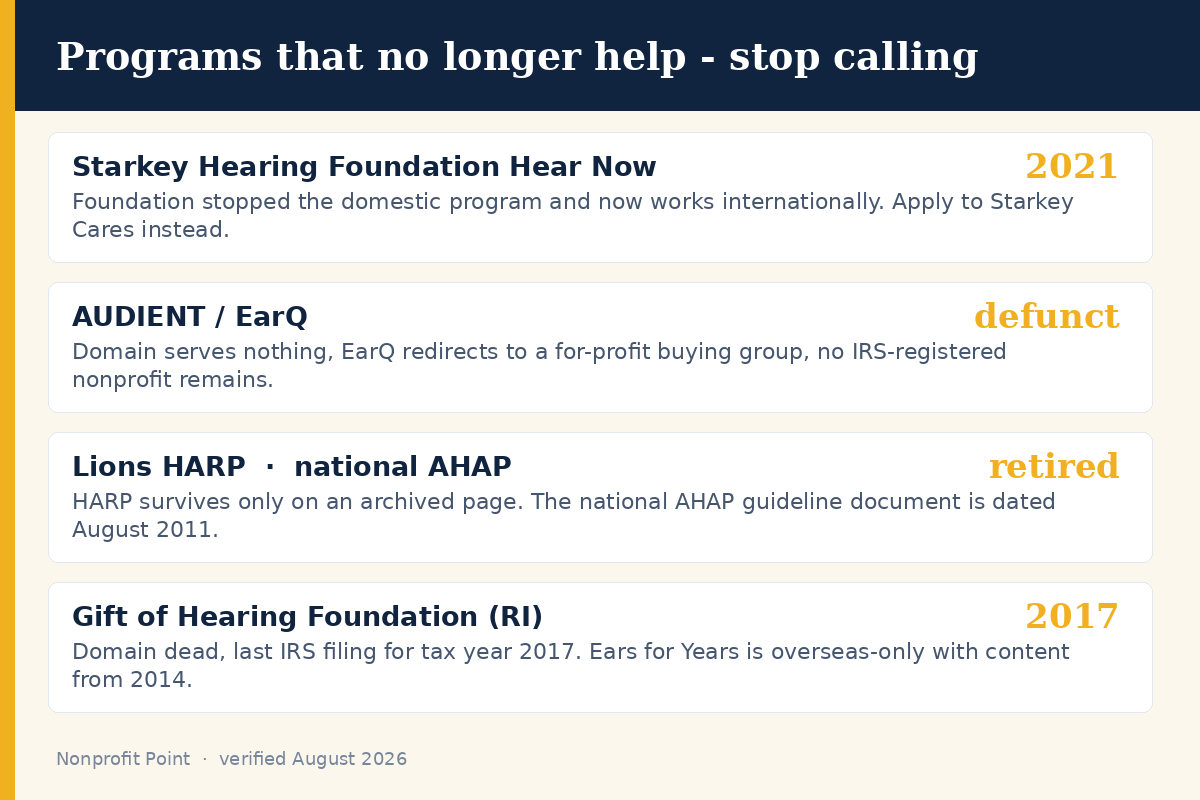
- Starkey Hearing Foundation — no longer runs Hear Now. Its own FAQ: “while our foundation no longer provides this service, I would recommend you reach out to the Starkey Cares program.” It stopped accepting hearing aid donations in April 2021 and its work is now international. Apply to Starkey Cares instead.
- AUDIENT / EarQ — defunct. audientalliance.org serves no content, earq.com redirects permanently to a for-profit buying group, and no IRS-registered nonprofit under the alliance’s name exists. The Northwest Lions Foundation, which once hosted it, no longer mentions it anywhere.
- Lions HARP as a national program — retired. Lions International’s current recycling page carries no HARP branding and routes donated aids to Hearing Charities of America. Its own instruction is that “the best way for an individual to receive eyeglasses or hearing aids assistance from Lions International is to get in contact with a local Lions club.” You cannot apply centrally. Local clubs do help — ad hoc, on their own terms.
- Lions Affordable Hearing Aid Project — the national version is dead. The only source document is an LCIF guideline dated August 2011, no longer hosted on the Lions site, and ordering was always club-only. A separate, live program of the same name is run by the Lions Hearing Conservation Society of New York State and provides Oticon devices — but only in New York, and only through a local club.
- Gift of Hearing Foundation (Rhode Island) — defunct. Domain dead, last IRS filing for tax year 2017. A similarly named Canadian charity does exist and runs overseas missions; it is not a US assistance program.
- Ears for Years — dormant and not US-serving. Its mission is solar-powered hearing aids for children in developing countries, and the newest dated content on the site is from 2014.
- Songs for Sound — renamed, and it does not supply devices. It is now the LexCare Hearing Foundation, and its programs are free hearing screenings and care-team navigation, not hearing aids.
- Oticon Hearing Foundation — not a patient assistance program. Its domain redirects to Oticon, and its grantmaking goes to professional and academic causes. There is no individual application path.
- Let Them Hear Foundation — a four-page brochure site. No application form, no eligibility criteria, no intake process anywhere, and roughly $67,000 in annual revenue. Contact it directly before relying on it.
- Hearing Loss Association of America — not a device provider. HLAA is a genuinely valuable advocacy and support organization with chapters nationwide, but its own financial-assistance page is a referral list. It funds nothing.
- Northwest Lions Foundation — regional, and individuals cannot apply. It provides aids only to patients sponsored by a Lions club in Washington or Idaho, and states it cannot accept applications from anyone other than such a club. Its page also lists a patient copay figure that appears to contain a typographical error; confirm any cost by phone before relying on it.
- EARS Inc. is an Australian not-for-profit working in low and middle income countries. It is a real organization doing real work, and it has nothing to do with US assistance.
Related help from Nonprofit Point
- Charities that help with medical bills — the funds that cover the audiology visit, the medical clearance and everything a hearing aid grant will not.
- Charities that help with eyeglasses — the closest parallel category, and several of the same organizations run both.
- Charities that help with medical equipment — loan closets and reuse programs, which is exactly how state assistive technology programs work.
- Charities that help with prescriptions — patient assistance programs, useful if hearing loss sits alongside another treated condition.
- Housing assistance for disabled veterans — if the VA route above applies to you, so may this one.
- Charities that give money to individuals — unrestricted cash funds, for the costs no device program covers.
Frequently asked questions
Does Medicare cover hearing aids?
No. Medicare.gov states plainly that Medicare does not cover hearing aids or the exams for fitting them, and that you pay all costs for those non-covered services. Some Medicare Advantage plans offer a hearing benefit as an extra, and by one KFF analysis most Advantage enrollees have access to one, but the depth of that benefit varies enormously and Medicare directs you to your own plan to confirm. If you are on Original Medicare, budget as though there is no coverage, because there is none.
Is the Starkey Hearing Foundation still running Hear Now?
No, and this is the most common error in this category. The Starkey Hearing Foundation stopped accepting hearing aid donations in April 2021 and now works internationally. Its own FAQ redirects Americans to Starkey Cares, which is a program of Starkey the manufacturer rather than the foundation. Starkey Cares provides new Starkey hearing aids for a $300 application fee, is income and asset tested, and is applied for at app.starkeycares.org or on (855) 686-2202. The income limit is not published on the website.
Which hearing aid charity is actually free?
The Hearing Aid Project run by Hearing Charities of America charges no application fee and provides refurbished hearing aids to qualifying people. The condition is geographic rather than financial: because of application volume, it is currently accepting applications only from people within a reasonable distance of one of its existing audiology partners. The TPA Hearing Trust also has no fee and makes cash grants generally ranging from $100 to $1,600, but reviews applications quarterly. Every other program on this list charges between $200 and $300.
Can I get free hearing aids from the VA if my hearing loss is not service-connected?
Often yes. Federal regulation 38 CFR 17.149 lists eight qualifying categories and only the first requires a compensable service-connected disability. The others include former prisoners of war, Purple Heart recipients, veterans receiving increased pension for aid and attendance or being permanently housebound, and veterans whose hearing loss resulted from another condition the VA is treating. There is no cost for the aids, the repairs or the batteries. Enrol in VA health care, then book directly with a VA audiology clinic. You do not need a primary care referral.
Does Medicaid pay for hearing aids?
For anyone under 21 it is mandatory in every state under Early and Periodic Screening, Diagnostic and Treatment, which requires states to furnish medically necessary services to correct or ameliorate a condition and names hearing aids as an example. For adults it depends entirely on the state: a 2025 Health Affairs study identified 32 states with adult hearing aid coverage as of the end of 2023, with wide variation in limits and copays. Do not use the widely-shared KFF state table for current numbers, because its most recent data is from 2018.
What is the cheapest way to get properly fitted hearing aids?
A university audiology clinic, if there is one within reach. The University of Washington publishes its figures: a $100 administrative fee plus $250 for one aid or $550 for two, with earmolds at $80 each and a six-month repair warranty. That is roughly $650 for a fitted binaural set. The nearest commercial equivalent is Costco at $1,599.99 for a pair including a charger, and private practice typically starts well above that. Most university programs run sliding scales without publishing prices, so call and ask specifically about a hearing aid assistance fund.
Are over-the-counter hearing aids worth it?
For the right person, yes. The FDA category took effect on October 17, 2022 and is defined for adults 18 and over with perceived mild to moderate hearing loss. Verified prices run from about $99.99 for Sharper Image models at Sam’s Club, through Audien from $98 a pair, up to Jabra Enhance at $1,195 to $1,995. If your loss is severe or profound, if it is in one ear only, or if the user is a child, OTC is the wrong category and you need a prescription fitting. Note also that Eargo and Lexie, including the Bose-powered models, are winding down US operations and are no longer a purchase route.
How long do these applications take?
Longer than most people expect, which is why parallel applications matter. Miracle-Ear Foundation says up to four weeks for a complete application. Help America Hear takes two to three weeks to review and approve but two to six months for the whole process including provider matching. The TPA Hearing Trust reviews quarterly, decides within 30 days of that review, and mails cheques after the first of the following month. Texas’s telecommunications equipment program takes about six months. Apply to several at once; none of these programs penalise you for it.
About this guide. Compiled and fact-checked by the Nonprofit Point editorial team, which researches financial-assistance and charity-vetting resources for U.S. households. Every application fee, income limit, price and phone number above was read on the organization’s own website or on an official federal source in August 2026 — including the Starkey Cares $300 fee, the Miracle-Ear Foundation’s 200% federal poverty guideline test and its children’s fee waiver, Help America Hear’s $36,000 income line, the TPA Hearing Trust application revised March 2026, the University of Washington HAAP price list, the Costco and Sam’s Club published prices, medicare.gov’s hearing aid coverage statement, 38 CFR 17.149, Medicaid’s EPSDT guidance, and the FDA’s over-the-counter hearing aid rule. Where an organization does not publish a figure — Starkey’s income limit, the Hearing Aid Project’s income test, Ear Community’s criteria — we say so rather than estimating. The 32-state Medicaid figure is from Arnold et al., Health Affairs 44(12):1522–29 (2025), measured as of December 31, 2023. Program status changes quickly in this category; confirm by phone before paying any application fee. Nonprofit Point is an independent resource and is not affiliated with the organizations listed.