Charities That Help With Rent in New Jersey: 40+ Real Programs (2026)

Start with the correction that will save a New Jersey renter the most wasted time this year, because it comes from the state’s own housing agency. The Department of Community Affairs still runs a page for CVERAP, New Jersey’s COVID Emergency Rental Assistance Program, telling renters they can submit “a pre-application for future funds.” That page has not been touched since December 2021, it states plainly that the program is “closed as funding has been fully obligated,” and the portal it links to — njdca.onlinepha.com — no longer exists. Load it today and it redirects straight back to the DCA homepage. The action the state is still advertising is impossible to take.
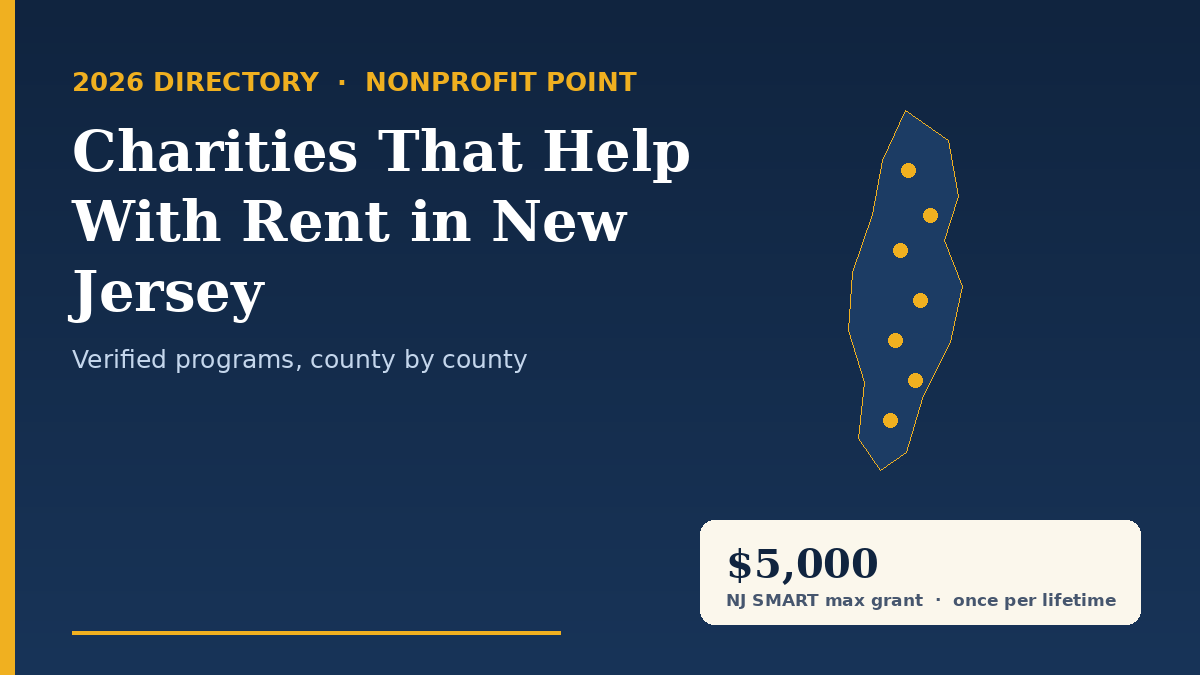
The second correction is about the charity most New Jersey rent lists still name first. NJ SHARES is now SHARES Nation Inc. Type njshares.org and you are redirected to sharesnation.org. The rent grant survived the rebrand and it is the single largest one-shot rent grant a New Jersey household can apply for — up to $5,000 — but the rules tightened in a way nobody has written up. The 2026 program guidelines, revised August 6, 2026, describe NJ SMART as “a once in a lifetime grant opportunity.” Earlier guidelines allowed one grant per calendar year. If you used NJ SMART in 2023, you cannot use it again.
The third thing is not a correction, it is the most valuable fact on this page, and almost no competing article carries it. New Jersey funds a program called Comprehensive Eviction Defense and Diversion (CEDD) that gives low-income tenants a free eviction lawyer plus a navigator whose job is to find them rental assistance, and the DCA states flatly that “CEDD is available in every county throughout NJ.” The state publishes the provider and phone number for each county. By DCA’s own count, 86% of households that received intensive CEDD support stayed in their housing or were permanently relocated, against a backdrop of more than 112,000 eviction filings in New Jersey in 2024.
This guide lists the real sources of rent help in New Jersey for 2026 — four statewide doors, the county welfare office that administers the state’s emergency housing money, verified nonprofits in thirteen counties, and a plain list of the programs that are closed or that never paid rent in the first place. Every phone number below was read on the organization’s own website or on an official New Jersey state or county page in August 2026.
📞 Start here: three calls, in this order. First, call the CEDD provider for your county from the table below — it is the only door that brings a lawyer and a rental-assistance navigator at the same time, and it is free. Second, apply to NJ SMART at apply.sharesnation.org or 1-866-657-4273 for the $5,000 arrears grant. Third, dial 2-1-1 (or 1-877-652-1148, or text your ZIP code to 898-211) — NJ 211 answers 24 hours a day and indexes more than 6,300 programs, though it refers rather than pays. If you already have a court date, call the CEDD number today, not after the hearing.
The four statewide doors
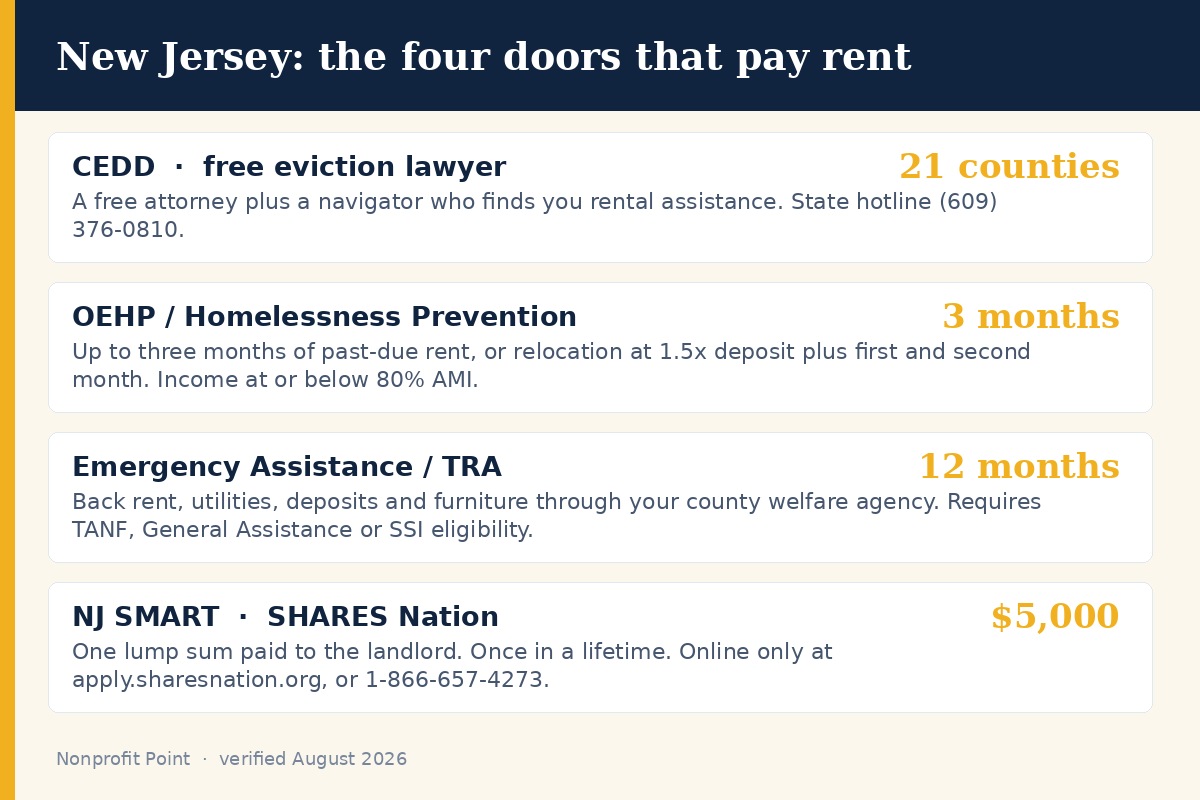
New Jersey does not have one big rent fund. It has four separate systems, each with a different front door, and applying to only one is the most common mistake renters make. Two of them are open to anyone under an income limit; one requires you to be on or eligible for cash assistance; one is a charity grant. They do not talk to each other, and applying to all four in the same week is not double-dipping — it is the correct strategy.
1. Comprehensive Eviction Defense and Diversion (CEDD) — a free lawyer in all 21 counties
CEDD is run by the DCA’s Office of Eviction Prevention, and it is the most under-published resource in the state. The office describes it as providing “free quality legal advice or representation… to eligible low-income NJ tenants facing or threatened with eviction,” and pairs each tenant with a resource navigator who connects them to rental assistance and relocation support. There is no statewide income test published; eligibility is described only as “low-income.”
Two things make this worth calling before anything else. New Jersey has no statewide right to counsel — the 2021 law that created the Eviction Prevention Program, P.L.2021 c.188, contains no right-to-counsel provision, so a lawyer is not something a judge will simply hand you. And CEDD staff are the people who know which of the funds below still has money this month. The DCA hotline is (609) 376-0810; the email is evictionprevention@dca.nj.gov.
| County | CEDD provider | Phone |
|---|---|---|
| Atlantic, Cape May | Jewish Family Services | 609-822-1108 |
| Bergen, Hudson, Middlesex | Garden State Home | 732-532-6865 ext. 902 |
| Burlington, Monmouth, Ocean | Community Affairs and Resource Center | 732-774-3282 |
| Camden | Center for Family Services | 877-922-2377 |
| Cumberland, Gloucester, Salem | Jewish Family Services | 609-822-1108 |
| Essex | United Community Corporation | 973-642-0181 |
| Hunterdon, Warren | Family Promise of Warren County | 908-453-2194 |
| Mercer | Catholic Charities, Diocese of Trenton | 609-394-8847 ext. 2527 |
| Morris, Somerset, Sussex | Bridgeway | 877-692-5664 |
| Passaic | Catholic Family and Community Services | 973-279-7100 ext. 2055 |
| Union | Elizabeth Coalition to House the Homeless | 908-355-2060 |
2. OEHP and the Homelessness Prevention Program — up to three months of back rent
This is where the state’s actual rent money sits, and it changed shape in 2026. On May 18, 2026, DCA awarded more than $7 million in Omnibus Eviction & Homelessness Prevention (OEHP) grants to twelve nonprofits across New Jersey, with a grant term running February 1, 2026 through March 31, 2027. OEHP folds in the older Homelessness Prevention Program, and the money is spent by those nonprofits, not by the state directly.
What it pays is specific. The Homelessness Prevention component provides up to three months of assistance toward past-due rent, including court, legal and late fees. If staying put is not realistic, it will instead fund relocation — a security deposit of up to 1.5 times the monthly rent, plus first and second month’s rent. You get back rent or relocation, not both. Separately, OEHP carries a flexible fund capped at $5,000 per household that can cover utility arrears, shutoff prevention, emergency repairs that make a unit habitable, transportation, and short hotel or motel stays.
Eligibility is household income at or below 80% of area median income, with flexibility for survivors of domestic violence and people with disabilities. To show the scale of that limit: in the Trenton metro area the 2025 figures used in the program guidelines are $72,000 for one person, $82,200 for two, $92,400 for three and $102,600 for four. The classic HPP route also requires court papers — a summons or warrant of removal — no older than six months, three months of tenancy without arrears, and a credible ability to pay going forward.
You apply through the funded nonprofit in your county, most of which are the same organizations listed in the CEDD table and the county sections below. The state’s own housing office line is (609) 376-0811 and OHP@dca.nj.gov. One warning: DCA’s dedicated HPP page at nj.gov/dca/dhcr/offices/hpp.shtml returns a 404, and two different county contact PDFs on nj.gov name different agencies for the same counties. Neither is dated. Use the CEDD table above or call 211 rather than trusting either PDF.
3. Emergency Assistance and Temporary Rental Assistance through your county welfare agency
Emergency Assistance (EA) is the state’s deepest housing benefit and the one with the narrowest door. It exists to “prevent homelessness by paying for back rent, back mortgage or back utilities as well as shelters, motels or Temporary Rental Assistance,” and it also covers moving expenses, security deposits, utility deposits and furniture. Temporary Rental Assistance (TRA) can provide ongoing housing support for up to twelve months in the lifetime of a case, with two six-month extensions possible for TANF households and one for General Assistance.
The catch is the gateway: you must be eligible for WorkFirst New Jersey — TANF or General Assistance — or receiving SSI. Resources must be $2,000 or less. You must show a shutoff notice, proof of imminent eviction or foreclosure, or homelessness “through no fault of your own,” and recipients are expected to contribute 30% of household income toward housing costs. Apply online at mynjhelps.gov, pre-screen at njhelps.gov, or go in person to your county office below.
4. NJ SMART from SHARES Nation — the $5,000 grant
NJ SMART pays up to $5,000 as a one-time lump sum directly to your landlord for overdue rent. There is a second use most applicants miss: in place of an arrears grant, NJ SMART will fund a security deposit and first month’s rent up to $5,000, provided you apply within 90 days of moving in.
To qualify you must live in New Jersey with the property as your primary residence, be in a temporary financial crisis such as a job loss or illness, be at least one month in arrears, and have gross monthly income at or below 80% of the state median. The 2026 monthly caps are $6,233 for one person, $7,121 for two, $8,013 for three, $8,900 for four, $9,613 for five, $10,325 for six, $11,038 for seven and $11,750 for eight.
Two rules to plan around. It is now described as a once-in-a-lifetime grant. And paper applications are no longer accepted — every 2026 application goes through the online portal at apply.sharesnation.org, in person at the Trenton office, or through one of 250-plus partner sites. Documents are due within ten business days and processing runs about five to seven days after a complete file. Phone 609-883-1626 or 1-866-657-4273. The organization’s own site currently warns that “call volume is very high.”
Your county welfare agency: the exact office, address and phone
Every EA and TRA application goes through a county office, and half of them are not called “Board of Social Services” — a detail most rent lists get wrong, which sends people to the wrong switchboard. These names, addresses and numbers are published by the New Jersey Department of Human Services.
| County | Office | Address | Phone |
|---|---|---|---|
| Atlantic | Department of Family and Community Development | 1333 Atlantic Ave, Atlantic City 08401 | (609) 348-3001 |
| Bergen | Bergen County Board of Social Services | 218 Route 17 North, Rochelle Park 07662 | (201) 368-4200 |
| Burlington | Burlington County Board of Social Services | 795 Woodlane Rd, Mount Holly 08060 | (609) 261-1000 |
| Camden | Camden County Board of Social Services | 101 Woodcrest Rd, Suite 161, Cherry Hill 08003 | (856) 225-8800 |
| Essex | Division of Family Assistance and Benefits | 320 University Ave, 2nd Floor, Newark 07102 | (973) 395-8000 |
| Hudson | Department of Family Services, Welfare Division | 257 Cornelison Ave, Jersey City 07302 | (201) 420-3000 |
| Mercer | Mercer County Board of Social Services | 200 Woolverton St, Trenton 08650 | (609) 989-4320 |
| Middlesex | Middlesex County Board of Social Services | 181 How Lane, New Brunswick 08903 | (732) 745-3500 |
| Monmouth | Monmouth County Division of Social Services | 3000 Kozloski Rd, Freehold 07728 | (732) 431-6000 |
| Morris | Morris County Office of Temporary Assistance | 340 W. Hanover Ave, Morristown 07963 | (973) 326-7800 |
| Ocean | Ocean County Board of Social Services | 1005 Hooper Ave, Toms River 08753 | (732) 349-1500 |
| Passaic | Passaic County Board of Social Services | 80 Hamilton St, Paterson 07505 | (973) 881-0100 |
| Union | Union County Division of Social Services | 342 Westminster Ave, Elizabeth 07208 | (908) 558-2288 |
Verified rent help, county by county
Bergen County
Bergen publishes the freshest county-level document in the state: a 2026 Emergency Services Brochure dated January 2026, which lists nine separate homelessness-prevention doors with what each one pays. Its own header is the honest caveat — “all assistance based on availability of funds.”
- Bergen County Board of Social Services, 218 Route 17 N, Rochelle Park — (201) 368-4317 for the housing line. Security deposits, rent and utilities for households eligible for or receiving TANF, GA or SSI. Monday to Friday 8:00–4:30, open until 8pm Tuesdays.
- Bergen County Housing, Health and Human Services Center, 120 South River St, Hackensack — (201) 336-6490. Security deposits and rent arrears. Appointment required.
- Center for Food Action, 192 W. Demarest Ave, Englewood — (201) 569-1804. Security deposits, rent and utilities. Monday to Friday 9–5, Tuesdays to 7.
- Greater Bergen Community Action, Homeless Prevention, 294 Union St, Hackensack — (201) 488-5100 ext. 7041 or 7166. Security deposits and rent, by appointment only.
- Jewish Family Service, 1485 Teaneck Rd, Teaneck — (201) 837-9090. Rent and utilities.
- Social Service Association of Ridgewood and Vicinity, 6 Station Plaza, Ridgewood — (201) 444-2980. Residents of Ridgewood, Waldwick, Glen Rock, Ho-Ho-Kus, Midland Park and Wyckoff only.
- CarePlus NJ Kinship Program — (201) 398-9110 ext. 5645. For grandparents and relatives raising children.
- NJ Buddies, 149 Hudson St, Hackensack — (201) 489-2900. For people living with HIV/AIDS.
- Bergen County’s United Way Compassion Fund — apply through 2-1-1 only.
One thing to skip: Bergen County’s Emergency Rental Assistance Program pages are dead. bergencountynj.gov/erap/ returns a 404 and the alternate ERAP page loads with no program content at all.
Essex County (Newark, East Orange, Irvington)
Essex has something no other New Jersey county has: a city-funded right to counsel. Newark’s Office of Tenant Legal Services provides free legal representation to Newark tenants facing eviction whose gross income is at or below 200% of the federal poverty level, with an exception for infirm applicants over 60. It is at 920 Mayor Kenneth A. Gibson Blvd, Room 110, and the number is 973-877-9424. Every applicant is screened before services begin, and intake runs through an online form on weekdays.
- United Community Corporation, 332 S 8th St, Newark — 973-642-0181. Runs a rental assistance program, eviction prevention and utility assistance, and holds both the Essex CEDD contract and a $1,140,647 OEHP award, the second largest in the state.
- Family Promise of Essex County, 60 S. Fullerton Ave, Suite 205, Montclair — (973) 746-1400. Pays rental arrears and past-due utilities, or first month’s rent and a security deposit when a move is necessary. Read their warning carefully: the online assessment form “is not an application for services” — an intake worker contacts you afterwards, first come, first served.
- Catholic Charities, Archdiocese of Newark — St. Rocco’s Prevention Program, 368 South 7th St, Newark — (973) 286-4175. For Essex residents at risk of eviction or behind on Public Service bills.
- Bridges Outreach, Project Connect Newark, 35 Halsey St — 973-723-2307. Rental and utility arrears payments based on funding availability. Walk-in 8:30am–noon, appointments 1–3pm, Monday to Thursday.
Hudson County (Jersey City, Bayonne, Union City)
Hudson’s best-documented door is in Bayonne. The Bayonne Economic Opportunity Foundation at 555 Kennedy Boulevard, 201-437-7222, provides rental assistance and housing counseling across the whole of Hudson County, funded through state homelessness-prevention grants. It is the only organization in this guide that publishes its document checklist up front: photo identification, Social Security numbers for every family member, rent receipts, and proof of income. Bring all four and you will not lose a week. Hours are Monday to Thursday 8:30–4:00 and Friday 8:30–3:00.
Catholic Charities of the Archdiocese of Newark runs Parish Access Centers serving Hudson and Bergen — main line (800) 227-7413, Union City (201) 325-4813 — providing emergency assistance to families in economic crisis. Its Another Chance program at 619 Grove St, Jersey City, (201) 656-7201, provides temporary housing help specifically for people released from correctional facilities. Free HUD-certified housing counseling for Hudson, Bergen, Essex and Union runs on (973) 266-7942.
Union County (Elizabeth, Plainfield)
Union is the strongest county in the state for a renter who has already been turned down by the welfare office.
- The Elizabeth Coalition to House the Homeless, 118 Division St, Elizabeth — (908) 355-2060. Back rent assistance for tenants facing eviction and first month’s rent for those moving in, plus utilities, furniture and groceries. Holds the Union CEDD contract and a $357,213 OEHP award, so a single call reaches both the lawyer and the money.
- PROCEED, Inc., 1126 Dickinson St, Elizabeth — 908-351-7727 ext. 235. Four distinct payment types: rent to landlords, security deposits, rental arrears, and first month’s rent. Its stated target is unusual and worth reading twice — working families who are rent-burdened, living paycheck to paycheck, and not eligible for government subsidies. That is precisely the household the county welfare office turns away. Services are free; recipients are strongly encouraged to attend monthly financial literacy classes.
- Bridges Outreach, Project Connect Summit, 120 Morris Ave — 908-273-0176, appointments only.
Mercer County (Trenton)
Arm In Arm — formerly the Crisis Ministry of Mercer County — publishes the most precise eligibility rules of any rent charity in New Jersey, and one figure nobody else prints: assistance is available only once in a calendar year and no more than twice in five years. It delivers the state’s three-month HPP arrears assistance and requires that your hardship trace to a qualifying event: a medical disability or emergency, a loss or delay in benefits, a natural or man-made disaster, or a substantial change in household composition. Intake is online in English or Spanish, or by phone on 609-396-9355 ext. 11, Monday to Thursday 9:00 to 3:30, with a response within 72 business hours. Their own caveat is worth quoting: “completing the intake process does not guarantee assistance.”
Catholic Charities, Diocese of Trenton at 132 N Warren St, 609-394-8847, runs homelessness prevention covering rent, mortgage and utilities, plus rapid re-housing that carries three to six months of financial assistance. Its Returning Citizens to Community Program (extension 2500) serves people released from a facility within the past year who are employed or employable.
Camden County
The county’s designated prevention agency is the Camden County Council on Economic Opportunity, 538 Broadway, Camden — (856) 964-6887, preventionservices@cccoeo.com. It pays rental or relocation assistance and works back rent, mortgage and utility bills to stop evictions. Its eligibility test has two halves worth knowing before you call: you must meet income guidelines and demonstrate that you can sustain payments on your own once the assistance ends.
Camden County’s own homelessness services page also lists Center for Family Services on 877-922-2377 (its eviction-prevention inbox, ccphousing@centerffs.org, serves Camden city residents only), Catholic Charities on 856-342-4100 for back rent and utilities, Senior Citizens United Community Services on 856-456-1121, and Volunteers of America Delaware Valley on 856-854-4660 for shelter.
Middlesex County
The strongest option is Catholic Charities, Diocese of Metuchen at the Edison Family Service Center, 26 Safran Ave — 732-738-1323. Its Homeless Prevention and Rapid Re-Housing program covers rental arrears, short-term rental assistance, security deposits, and utility deposits and arrears, for households struggling with rent or holding a court-ordered eviction notice.
PRAB’s Housing Coalition of Central Jersey, 754 Route 18, Suite 202, East Brunswick — (732) 832-7535 ext. 154 — is a navigation and mediation service rather than a cash grant. It helps complete subsidized-housing applications, locates financial resources for rent and deposits, and represents tenants in landlord-tenant mediation.
Do not call PRAHD for rent. The Puerto Rican Association for Human Development in Perth Amboy states on its own website: “We do not currently have funding for rental or utility assistance.” The state’s HPP contact PDF still lists PRAHD as Middlesex County’s designated agency. The state list is out of date; the organization is not hiding anything.
Monmouth County
Interfaith Neighbors in Asbury Park runs the county’s rental and mortgage assistance program, covering rent arrears, mortgage payments and security deposits. Call 732-775-0525 ext. 198, 8:30am to 4:30pm Monday to Thursday; the Launch Center at 1201 Springwood Avenue, Unit 105, is staffed 9–4 weekdays. Acceptance follows an intake assessment and application, and a determination is typically made within seven to ten days — the fastest published turnaround of any rent charity in this guide. The organization says it assists more than 300 families a year and screens hundreds of applicants a month.
Ocean County (Toms River, Lakewood)
Catholic Charities, Diocese of Trenton at 725 Mantoloking Road, Brick — 732-363-5322 — is the main door, with homelessness prevention covering rent and utilities and rapid re-housing carrying three to six months of financial assistance funded through HUD and county money.
Skip O.C.E.A.N., Inc. for rent. It appears on nearly every “rent help in Ocean County” list, and its own website contains no rental assistance and no eviction prevention anywhere. What it actually runs is first-time homebuyer assistance — a $25,000 deferred loan forgiven after six years — senior housing, mortgage and credit counseling, and LIHEAP energy assistance, which is genuinely useful on (732) 244-9041. Just not rent.
Passaic County (Paterson, Passaic, Clifton)
Passaic is concentrated in one place, but it is a strong one. Catholic Family and Community Services at 435 Main Street, Paterson — (973) 279-7100 ext. 2015 — runs Community Emergency Support, providing case management, housing search and placement, and short- and medium-term financial assistance for Passaic County residents at imminent risk of homelessness. It holds both the Passaic CEDD contract and a $396,221 OEHP award. The organization asks that you call for a confidential appointment to determine eligibility rather than walking in.
Burlington County
Burlington Community Action Partnership at the Dickens Community Service Center, One Van Sciver Parkway, Willingboro — (609) 835-4329 ext. 4026 — provides back rent and mortgage payment assistance plus relocation assistance for low and moderate income households. Note that the state’s HPP PDF lists this organization under a slightly different name and a different phone number; use the number the organization publishes itself. Catholic Charities, Diocese of Trenton at 460 Veterans Drive, Burlington — 856-764-6940 — covers rent, mortgage and utilities, and flags its own emergency sheltering as limited.
Atlantic County (Atlantic City)
Atlantic Homeless Alliance at Jewish Family Service is the coordinated entry point for the county and holds both the CEDD and OEHP contracts — a $578,346 award. It is inside the Atlantic County Office Building at 1333 Atlantic Avenue, first floor, and the number is 609-343-2282. Hours are 8:30am to 2:00pm. Its eligibility test has exactly two conditions: you are an Atlantic County resident, and you are experiencing or at immediate risk of homelessness. Staff run a coordinated assessment and build an individual housing stability plan covering eviction defence, housing navigation and rental assistance.
Morris County
Morris is the thinnest county in this guide and one page there is actively misleading. The county’s own New Jersey Rental Assistance page still describes COVID-era eviction protections covering March 2020 to August 2021 and points readers to a renter form that closed years ago. Ignore it. The two live doors are the Morris County Office of Temporary Assistance on (973) 326-7800, which asks that you apply online or call rather than visiting, and the CEDD provider Bridgeway on 877-692-5664.
What is closed, and what never paid rent
Half the value of a list like this is the half that saves you a phone call. These are the New Jersey programs still being recommended online that will not help you today.
- CVERAP / federal emergency rental assistance — closed. DCA’s own page says it is “closed as funding has been fully obligated.” The page was last modified in December 2021 and the “pre-application for future funds” portal it links to no longer resolves.
- State Rental Assistance Program waiting list — closed. SRAP is a long-term subsidy, not emergency money, and its pre-application window last opened January 13–31, 2025. Roughly 6,000 households are selected by lottery. No 2026 opening has been announced.
- DCA statewide Section 8 Housing Choice Voucher waiting list — closed since February 3, 2023, when 20,000 applicants were selected. Preferences run veterans first, then homeless applicants, people with disabilities, survivors of domestic violence and local residents. Watch the DCA site rather than any third-party alert service.
- United Way of Northern New Jersey ALICE Recovery Fund — closed. In its own words, it is “not accepting additional applications at this time” because demand exceeded available funding.
- Housing authority emergency cash funds — mostly a myth. New Jersey public housing authorities run Section 8 and public housing; they do not hand out emergency rent grants. The only verified city-run tenant program in the state is Newark’s Office of Tenant Legal Services, and what it gives you is a lawyer, not a cheque.
- NJ 211 does not pay rent. It is a referral service indexing more than 6,300 programs, staffed 24 hours a day on 2-1-1 or 1-877-652-1148, with text service on 898-211. Use it to find a door, not to fund one.
Protect the rest of the budget while you work the rent problem
Most New Jersey renters who lose an apartment lose it to the total, not to the rent line alone. Four state programs move real money out of the other columns.
LIHEAP and USF. Both run on a 60% state median income test. For the current program year the annual limits are $50,005 for one person, $65,392 for two, $80,778 for three, $96,165 for four, $111,551 for five and $126,937 for six. The detail that matters for renters is in the state’s own FAQ: your household qualifies if it is responsible for heating or cooling costs “either directly or included in the rent.” Heat-included tenants are eligible and almost never apply. LIHEAP intake is closed right now and reopens October 1, 2026; USF runs year-round with a monthly credit the Board of Public Utilities describes as ranging from $20 to $200. Apply at energyassistance.nj.gov or call 1-800-510-3102.
Shutoff moratoria. New Jersey’s Winter Termination Program runs November 15 to March 15 and covers electric, gas, water and sewer. The Summer Termination Program runs June 15 to August 31 for residential electric, water and sewer. Both protect LIHEAP, TANF, SSI, PAAD, General Assistance, USF, Lifeline and LIHWAP recipients — and, critically, anyone “unable to pay their utility bills because of circumstances beyond their control,” including unemployment, illness, medical expense or a death in the family. That last category is self-certified. Contact your utility directly, or the BPU on 1-800-624-0241.
SHARES Nation’s smaller utility grants. Alongside NJ SMART, the organization publishes fixed caps by utility type: up to $700 per utility for natural gas or electric on some funds, up to $500 for electric under the Atlantic City Electric Customer Relief Fund, up to $500 for water under the NJ American Water H2O program, and a tiered 15–60% discount on water and wastewater under the Universal Affordability Discount. It also administers the Board of Public Utilities PAGE program, which reaches households from $39,900 for one person up to $139,300 for eight. Apply for USF first; PAGE is designed to sit on top.
ANCHOR. Not rent assistance, but it is cash and most renters do not claim it. Renters receive $450, and renters aged 65 and over receive $700, provided income did not exceed $150,000 and you occupied a New Jersey rental as your principal residence on October 1, 2025. The deadline is November 2, 2026 and payments begin rolling from September 15. File at propertytaxreliefapp.nj.gov; most eligible renters are filed automatically.
The New Jersey eviction clock, in plain numbers
Knowing the timeline is what turns a panic into a plan, and the numbers below come from the Judiciary’s own tenant information forms.
A warrant of removal cannot be issued less than three business days after a judgment for possession is entered. Once you are served with that warrant, you must leave within three business days, and the landlord can ask a Special Civil Part Officer to execute it three business days after service. Only that officer can remove you — a landlord who changes the locks is acting illegally.
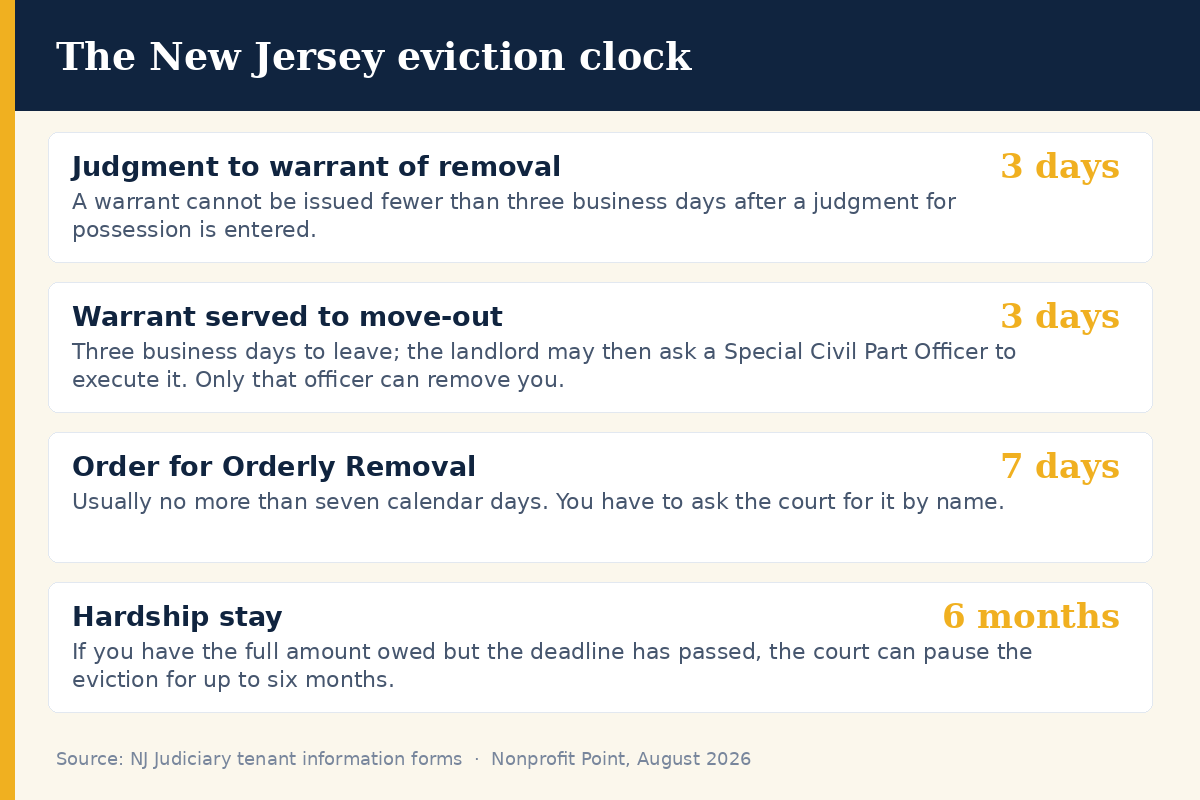
Two forms of relief sit inside that window and both are worth asking for by name. You can request an Order for Orderly Removal, which usually buys no more than seven calendar days. And if you have all the money but the deadline has already passed, you can request a hardship stay, which can stop the eviction for up to six months. Court staff are also directed to give both parties a list of agencies that may help with rent, shelter or legal services — ask for it at the window. The Legal Services of New Jersey hotline, printed on the court’s own form, is 1-888-576-5529, with online intake at lsnjlawhotline.org.
One structural fact to plan around: New Jersey does not have a statewide right to counsel. The 2021 law that created the Eviction Prevention Program set income tiers reaching up to 120% of area median income but created no right to a lawyer. Jersey City has a municipal ordinance and Newark has OTLS; everywhere else, the free lawyer comes through CEDD, and only if you call.
Neighbouring states run on different rules and different agencies. If your search crosses a border, we keep the same verified format for rent help in New York and rent help in Pennsylvania.
Related help from Nonprofit Point
- Charities that pay rent directly — the national programs behind every state list, including the ones that wire money to a landlord the same week.
- Charities that help with security deposits — useful if NJ SMART’s move-in option or an OEHP relocation grant is the realistic path.
- Charities that help with utilities — what to do between LIHEAP closing and the October 1 reopening.
- Charities that help with emergency shelter — if the warrant has already been served.
- Charities that give money to individuals — direct cash-assistance funds that are not tied to a specific bill.
- Grants for single mothers — overlapping eligibility with most of the programs above.
Frequently asked questions
Is there still emergency rental assistance in New Jersey in 2026?
Yes, but not the pandemic-era kind. CVERAP, the federal COVID Emergency Rental Assistance program, is closed and its application portal no longer resolves. What replaced it in 2026 is the Omnibus Eviction and Homelessness Prevention grant, which put more than $7 million into twelve nonprofits for a term running February 1, 2026 to March 31, 2027. It pays up to three months of past-due rent, or relocation costs of up to one and a half months’ security deposit plus first and second month’s rent, plus a flexible fund capped at $5,000 per household. You apply through the funded nonprofit in your county, not to the state.
How much will NJ SMART pay and can I apply twice?
Up to $5,000, paid as a single lump sum directly to your landlord, mortgage company or tax collector. The 2026 guidelines describe it as a once-in-a-lifetime grant, which is a change from earlier rules that allowed one grant per calendar year. You must be at least one month in arrears, live in New Jersey with the property as your primary residence, be in a temporary financial crisis, and have gross monthly income within the caps, which run from $6,233 for one person to $11,750 for eight. There is a second use worth knowing: instead of arrears, NJ SMART will fund a security deposit and first month’s rent up to $5,000 if you apply within 90 days of moving in.
Can I get a free lawyer for an eviction in New Jersey?
In most cases yes, through Comprehensive Eviction Defense and Diversion, which the Department of Community Affairs says is available in every county. It provides both a free attorney and a navigator who connects you to rental assistance. New Jersey has no statewide right to counsel, so nobody will offer it to you automatically. Call the CEDD provider for your county, or the state office on (609) 376-0810. Legal Services of New Jersey also runs a statewide hotline on 1-888-576-5529. Newark tenants at or below 200% of the federal poverty level have a separate city program, the Office of Tenant Legal Services, on 973-877-9424.
What is Emergency Assistance and who actually qualifies?
Emergency Assistance is New Jersey’s deepest housing benefit, covering back rent, back mortgage, back utilities, shelter, motels, moving expenses, security deposits and furniture, plus Temporary Rental Assistance for up to twelve months in the lifetime of a case. It is administered by your county welfare agency. The gateway is narrow: you must be eligible for WorkFirst New Jersey, meaning TANF or General Assistance, or be receiving SSI, and your resources must be $2,000 or less. Recipients contribute 30% of household income toward housing costs. Apply at mynjhelps.gov or in person at the county office.
How long do I have after an eviction judgment in New Jersey?
A warrant of removal cannot be issued fewer than three business days after judgment. Once served with the warrant you have three business days to leave, and the landlord can then ask a Special Civil Part Officer to execute it. Only that officer can remove you. You can ask the court for an Order for Orderly Removal, usually up to seven calendar days, and if you have the full amount owed you can request a hardship stay that can pause the eviction for up to six months. Ask for both by name.
Does the county welfare office pay rent if I am working?
Usually not, because Emergency Assistance requires eligibility for cash assistance or SSI. That gap is why PROCEED, Inc. in Elizabeth is worth knowing about: it specifically targets working families who are rent-burdened, living paycheck to paycheck, and not eligible for government subsidies, on 908-351-7727 ext. 235. NJ SMART also has no cash-assistance requirement, only an income cap. And the OEHP and HPP route reaches to 80% of area median income, which in the Trenton metro is $102,600 for a family of four.
Which New Jersey organizations should I not bother calling for rent?
Three that appear on most lists. PRAHD in Perth Amboy states on its own website that it does not currently have funding for rental or utility assistance, even though the state’s contact PDF still lists it for Middlesex County. O.C.E.A.N., Inc. in Toms River runs homebuyer assistance and LIHEAP, not rent or eviction prevention. And the United Way of Northern New Jersey ALICE Recovery Fund has closed to new applications. Bergen County’s emergency rental assistance web pages are also dead; use the county’s 2026 Emergency Services brochure contacts instead.
About this guide. Compiled and fact-checked by the Nonprofit Point editorial team, which researches financial-assistance and charity-vetting resources for U.S. households. Every program status, dollar figure and phone number above — including the OEHP awards announced May 18, 2026, the NJ SMART guidelines revised August 6, 2026, the CEDD county provider table, the county welfare agency directory published by the Department of Human Services, the SRAP and Housing Choice Voucher waiting-list closures, the LIHEAP October 1, 2026 reopening, and the eviction timelines on the Judiciary’s own tenant forms — was verified against official state, county and organizational sources in August 2026. Where an organization does not publish a dollar amount or income limit, we say so rather than estimating. Funds open and close quickly; confirm availability by phone before traveling to an office. Nonprofit Point is an independent resource and is not affiliated with the agencies listed.