Best Peer-to-Peer Fundraising Software in 2026: What Each Platform Actually Costs

Peer-to-peer fundraising is the one channel where your supporters do the asking — a walk-a-thon team, a birthday page, a dozen board members each hitting up their own network. It is also the channel where software pricing is at its most opaque. Two of the biggest names in the category will not publish a single number, one charges a higher percentage when a supporter runs the page than when you do, and one advertises a free plan that does not include peer-to-peer at all.
This guide compares the best peer-to-peer fundraising software for nonprofits on the only basis that survives a board meeting: what each platform actually costs, in the vendor’s own published words. Every fee and quote below was pulled from the vendors’ own websites on 22 August 2026 — not from a listicle or a review aggregator. Where a vendor publishes nothing, this guide says so rather than estimating.
The short version
- Givebutter and Zeffy are the only genuinely $0 options for peer-to-peer, and both fund themselves by asking your donors for a voluntary tip at checkout.
- Donorbox charges 3.95% on supporter-run peer-to-peer pages and 2.95% on organisation-run ones on its free plan — a distinction it publishes but never defines.
- Funraise’s free tier does not include peer-to-peer. The feature sits on the quote-only Premium plan.
- GoFundMe cannot run nonprofit team fundraising at all. Its help centre states that charity representative accounts “will not be able to add co-organizers at this time.” The cheap 2.2% + $0.30 charity rate buys one page, not a campaign.
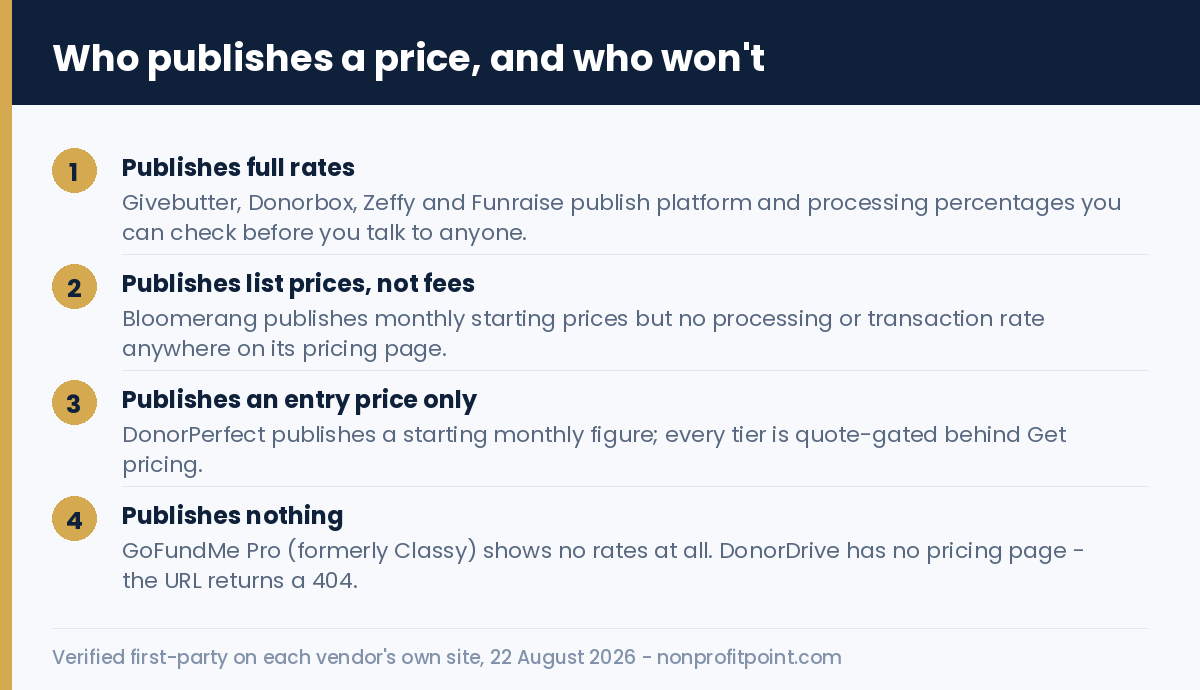
- GoFundMe Pro (formerly Classy) and DonorDrive publish no rates whatsoever. DonorDrive does not have a pricing page — the URL returns a 404.
- Nobody publishes an American Express rate. Donorbox is the only vendor that even flags the exclusion.
Peer-to-peer platform fees at a glance (August 2026)
| Platform | Recurring cost | Platform fee on P2P | Payment processing |
|---|---|---|---|
| Givebutter (tips on) | $0 | 0% | 0% — covered by optional donor tips |
| Givebutter (tips off) | $0 | 3% flat | 2.9% + 30¢ cards / 1.9% + 30¢ ACH |
| Zeffy | $0 | 0% | 0% — funded by optional donor contributions |
| Donorbox Standard | $0 | 3.95% supporter pages / 2.95% org pages | Stripe 2.2% + 30¢; ACH 0.8% (capped at $5) |
| Donorbox Pro | $150/mo | 2% supporter pages / 1.75% org pages | Same processor rates |
| Funraise (Premium only) | Not published | 0–3% | 2.9% + 60¢ |
| Bloomerang Fundraising | From $40/mo + CRM from $125/mo, billed annually | Not published | Not published |
| DonorPerfect | From $99/mo, tiers quote-only | Not published | Card $0.30/txn; e-check 0.75% + $0.35 |
| GoFundMe Pro (ex-Classy) | Not published | Not published | Not published |
| DonorDrive | Not published | Not published | Not published |
Five of the ten rows above contain the words “not published” — the single most useful finding here: half the peer-to-peer market will not tell you what it costs until you have spoken to a salesperson.
The fee math on a real campaign
Percentages are abstract. Here is one campaign priced on every platform that publishes enough to be priced: $50,000 raised across 625 card gifts averaging $80 — a typical mid-size walk-a-thon. These are nonprofit-side costs assuming donors do not cover fees: the pessimistic case, and the one to budget against.
| Platform | Cost to the nonprofit | Effective rate |
|---|---|---|
| Givebutter (tips on) / Zeffy | $0 | 0% |
| GoFundMe certified charity (single page — not P2P) | $1,287.50 | 2.58% |
| Donorbox Pro, supporter pages (3-month campaign) | $2,737.50 | 5.47% |
| Donorbox Standard, org pages | $2,762.50 | 5.53% |
| Givebutter with tips off | $3,137.50 | 6.28% |
| Donorbox Standard, supporter pages | $3,262.50 | 6.53% |
| Funraise Premium (fees only) | $1,825 – $3,325 plus an unpublished subscription | 3.65% – 6.65%+ |
Three things fall out of that table. First, the gap between the cheapest and most expensive published option on the same campaign is more than $3,200 — roughly the cost of a part-time development assistant for a month. Second, the difference between Donorbox’s supporter rate and its organisation rate alone is $500 on this campaign, and almost nobody evaluating the platform knows the two rates are different. Third, Donorbox Pro’s $150/month only pays for itself above roughly $7,700 a month in supporter-driven volume; below that, the free Standard plan is cheaper despite the higher percentage.
The five numbers to get in writing before you sign
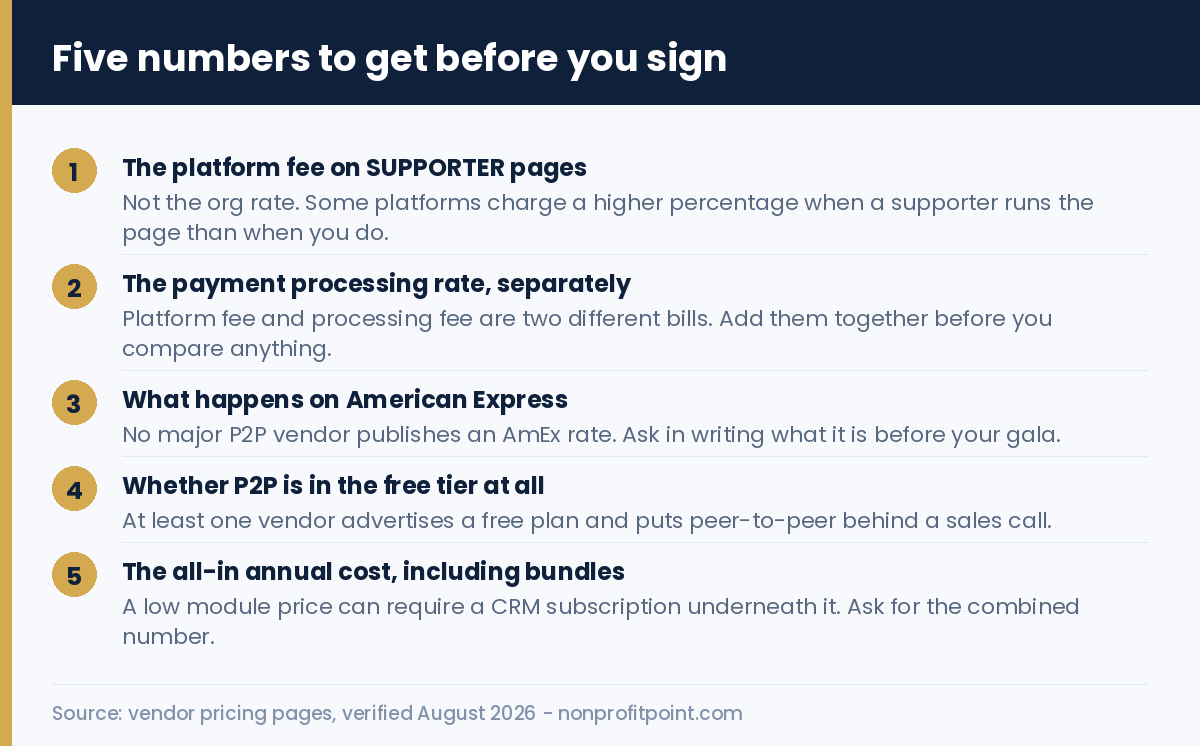
Every one of these came out of reading the vendors’ own pages side by side. Each is a place where a published headline and a published detail disagree.
Platform by platform
Givebutter — the strongest free option, if you are comfortable with tips
Givebutter’s peer-to-peer product is not a paid add-on. Its own feature page states plainly: “Like all of Givebutter’s fundraising tools, peer-to-peer fundraising is completely free.” Team pages are included alongside individual pages — “In addition to individual peer-to-peer fundraising pages, you can also take advantage of user-friendly team fundraising features to raise money for your cause.”
The pricing model has one condition attached, and Givebutter states it in the same sentence as the headline: “0% platform fees across all campaign types when tips are enabled. If you disable tips, a flat 3% platform fee applies.” With tips off you also pick up standard processing at 2.9% + 30¢ on cards and 1.9% + 30¢ on ACH. In other words, turning tips off costs you roughly 6.3 points on a card campaign — which is why almost every Givebutter user leaves them on.
Givebutter says 92% of donors cover fees when tips are enabled, and absorbs whatever donors do not; tips are removable at checkout. Its paid tier — Givebutter Plus at $29, $79 or $129 per month, billed annually at $348, $948 and $1,548 — buys CRM capacity and marketing features, not peer-to-peer access.
Check current terms: Givebutter pricing
Zeffy — genuinely zero, including on what your fundraisers raise
Zeffy is the only platform here that charges nothing at any layer. Its peer-to-peer page answers the obvious question directly: “Yes, including on what your fundraisers raise. No platform fee, no transaction fee, no credit card fee and no percentage of anyone’s total.” Campaign structure is flexible — “Creating a team, joining a team and fundraising solo are three separate switches, so you can run a campaign that’s teams only, individuals only, or open to all of it.”
The cost is moved entirely onto your donors. Zeffy is “funded by optional contributions donors can add at checkout,” and roughly two in three donors add one. Donors can set the contribution to $0 using a dropdown at checkout, and the nonprofit still receives the full gift.
One disclosure gap is worth knowing before you commit a flagship campaign to it. Zeffy’s own help centre says the suggested contribution wording and amounts “cannot be customized,” and that the suggested percentage “fluctuates based on the transaction amount—the larger the donation, the lower the percentage.” You cannot see or control what your donors are asked for at your own checkout. On a $25 walk-a-thon gift that is trivial; on a $5,000 board gift it is a conversation to have first. Payouts run weekly on Mondays by default, or monthly on the first Monday.
Check current terms: Zeffy peer-to-peer
Donorbox — the two-rate structure nobody talks about
Donorbox includes peer-to-peer on all three plans, including the free Standard plan. But its fee table splits peer-to-peer into two products at two different rates. On Standard: “2.95% fee for Donation Forms, Fundraising Pages, QuickDonate™, Peer-to-Peer: Org, Crowdfunding Pages” and, separately, “3.95% fee for Event Ticketing, Memberships, Peer-to-Peer: Supporters.” Pro runs 1.75% and 2%; Premium runs 1.6% and 2%.
Donorbox does not define anywhere on that page what separates “Peer-to-Peer: Org” from “Peer-to-Peer: Supporters.” The natural reading is that pages your organisation creates bill at the lower rate and pages your supporters create bill at the higher one — which is to say, the more successful your peer-to-peer programme is at recruiting fundraisers, the higher your blended rate climbs. Get this defined in writing before you build a campaign around it.
There is a second, sharper problem. Donorbox’s own pricing FAQ says of the Standard plan: “You’ll only be charged a small platform fee of 2.95% for every transaction.” The fee table on the same page sets supporter-driven peer-to-peer at 3.95%. Both statements are published by Donorbox, on one page, and they cannot both be true for a peer-to-peer campaign.
Processing is separate and reasonable: Stripe at 2.2% + 30¢ for US nonprofits, ACH at 0.8% capped at $5. American Express is excluded from the published rate — “Except American Express cards” — and no replacement rate is given. Pro is $150/month; Premium is quote-only. If you want the longer view on Donorbox as a whole, we cover it in our Donorbox review.
Check current terms: Donorbox peer-to-peer
Funraise — publishes its rates, then puts peer-to-peer behind a sales call
Funraise is the most transparent vendor here on fees and the least useful on access. It publishes both numbers most vendors hide: platform fees of “5%” on the free tier and “0-3%” on Premium, with processing at “2.9% + 60¢” on both. It states that “~90% of donors cover fees” and estimates real-world total payment costs at “2.5%” free / “0.8%” Premium.
The catch is placement. Funraise’s free plan is real — “$0/month,” self-serve signup, and pitched at “organizations raising under $1 million annually” — but peer-to-peer fundraising is listed only under Premium, alongside onboarding and a dedicated success manager. Premium pricing is not published; the page routes to “Talk with Sales.” So the honest summary is: Funraise’s fee transparency does not extend to the product in this comparison.
One practical note if you are checking their site: funraise.com now redirects to funraise.org, and funraise.com/pricing returns a 404. There is no notice of the change anywhere on the site. Verified first-hand on 22 August 2026.
Bloomerang Fundraising (formerly Qgiv) — a real bundle floor
Bloomerang’s peer-to-peer capability is the acquired Qgiv platform, rebranded. Bloomerang’s own product page reads “Bloomerang Fundraising (formerly Qgiv) is an intuitive suite of nonprofit fundraising tools,” and qgiv.com now carries a sitewide banner: “Qgiv is now Bloomerang Fundraising!” The feature set is strong and includes “Individual & team registration & fundraising pages,” flexible registration, personal dashboards and gamification — this is genuine event-grade peer-to-peer, not a donation form with a share button.
Pricing is where the care is needed. Bloomerang publishes “Starting at: $40 /month, billed annually*” for Bloomerang Fundraising, with the footnote “*Must be purchased as part of bundle with Bloomerang CRM,” which itself starts at “$125 /month, billed annually.” The published floor is therefore $165/month billed annually — about $1,980 a year — before you have processed a single donation, and Bloomerang never states that combined figure itself. No payment processing or transaction rate appears anywhere on the pricing page. There is no free tier and no published trial.
DonorPerfect — it exists, but it is called something else
If you search DonorPerfect’s plan matrix for “peer-to-peer” you will not find it. The line item is “Crowdfunding,” and it is available on the Plus and Pro tiers only, not on Core. Its own factsheet describes the supporter flow accurately: supporters “fundraise on your behalf by creating fundraising pages with their own story, photo, and video.” True event-style peer-to-peer is delivered through a third-party integration with Raisin rather than natively.
DonorPerfect publishes an entry price — “Fundraising suites for any size nonprofit starting at $99/month” — then gates every tier behind “Get pricing.” It does publish processing detail in a first-party PDF: card transactions at $0.30 each with no monthly account fee, e-check at 0.75% plus $0.35, “NO minimums & inactivity fees,” “NO contracts or cancellation penalty,” and a one-time $0.30 per-record vault charge. The card percentage sits in a two-column table in that PDF that does not extract unambiguously, so we are not publishing it — ask for it in writing.
GoFundMe Pro (formerly Classy) — no published pricing at all
Classy no longer exists as an independent property. As of today, classy.org returns a 302 redirect to pro.gofundme.com, and classy.org/pricing lands on pro.gofundme.com/c/pricing/. The rebrand is stated on the vendor’s own pricing FAQ: “Classy is now GoFundMe Pro. We’re 100% dedicated to nonprofits, now with the power of GoFundMe and its community of 190 million.”
The peer-to-peer product is real and enterprise-grade — “Activate supporters to amplify your mission and fundraise on your behalf.” The pricing page is not. Two tiers are shown: Essentials, “Designed for nonprofits with annual revenue under $1 million,” with “Zero subscription fees and no setup costs” but a “Request access” button rather than a signup; and a Custom plan for organisations above $1 million. No platform fee, no processing rate, no setup fee, no minimum and no “starting at” figure appears anywhere. The only qualifier published is “*Additional costs may apply based on fees and add-ons.”
DonorDrive — no pricing page exists
DonorDrive builds serious peer-to-peer software — its livestream and DIY fundraising products run some of the largest US endurance and gaming campaigns — and publishes no pricing whatsoever. donordrive.com/pricing returns a 404, there is no Pricing item in the navigation or footer, and the only published route is “Schedule a Demo.” DonorDrive was acquired by Bonterra, announced in its own newsroom, though the site still carries no Bonterra branding.
GoFundMe itself — the cheapest published rate, and not peer-to-peer
This is the most common and most expensive mistake in the category, so it is worth being blunt. GoFundMe’s certified-charity rate is genuinely the lowest published number in this article: “One transaction fee—that’s it — 2.2% + $0.30,” with “No fee to create a fundraiser” and tips from donors that are “never required.” A personal fundraiser runs 2.9% + $0.30. Recurring donations carry a 5% fee paid by the donor.
But GoFundMe cannot run a nonprofit peer-to-peer campaign. Its own team-fundraising help article states: “Charity representative accounts will not be able to add co-organizers at this time.” You can have one charity page. You cannot have fifty supporter pages rolling up to a campaign total with a leaderboard. GoFundMe’s pricing page flags the split itself — “GoFundMe Pro pricing and fees differ” — and GoFundMe Pro is the quote-only product described above. If a comparison article puts GoFundMe’s 2.2% next to Givebutter’s 0% as though they are the same kind of tool, it has not checked.
What changed in this market in the last two years
Three of the eight platforms here have been absorbed by a larger company, and two gave up their own domains in the process. Classy is now GoFundMe Pro and classy.org redirects away. Qgiv is now Bloomerang Fundraising and qgiv.com/pricing redirects to bloomerang.com/pricing. Funraise moved from funraise.com to funraise.org with no announcement. DonorDrive was acquired by Bonterra but still presents as standalone.
The practical consequence is that any peer-to-peer comparison written before mid-2025 is now sending readers to redirects and dead pricing pages. If a guide tells you to “check classy.org for pricing,” its numbers should not be trusted either. Re-verify every rate on the vendor’s live page before you sign — including the ones here, which carry a date for exactly that reason.
How to choose in ten minutes
You are a small nonprofit running one or two peer-to-peer campaigns a year. Start with Givebutter or Zeffy. Both are $0 to you, both include real team pages, and neither requires a sales call. Choose Givebutter if you also want an events and CRM layer in the same tool; choose Zeffy if you want absolute zero and are comfortable that you cannot see what donors are asked to contribute.
You already run donation forms on Donorbox and just want to add supporter pages. Stay put, but budget at 3.95% rather than the 2.95% you are used to, and get the org-versus-supporter definition in writing before you launch.
You run a signature event — a ride, a walk, a gala with team registration. This is where Bloomerang Fundraising, GoFundMe Pro and DonorDrive earn their money: registration flows, tiered teams, gamification, livestream integrations. Expect a procurement process, and expect only Bloomerang to give you a number before the call.
You are comparing on price alone and someone has put GoFundMe on the shortlist. Take it off. It is cheap because it is a single fundraiser page, not a peer-to-peer platform.
Whichever way you go, the platform is the smaller half of the problem. Peer-to-peer lives or dies on how well you brief and support your fundraisers; the software just counts the money. Our guides to fundraising ideas for nonprofits and how to ask for donations cover the part that moves the total, and managing recurring fundraising covers what to do with the donors a campaign brings you.
What we deliberately did not publish
A comparison is only as trustworthy as the claims it refuses to make. Five were left out on purpose.
No GoFundMe Pro transaction rate: a percentage range circulates widely but appears nowhere on GoFundMe Pro’s own pricing page. No American Express rate for any platform, because no vendor here publishes one. No DonorPerfect card processing percentage, because its own PDF renders as an ambiguous two-column table and we would be guessing which figure maps to which card type. No Givebutter default tip percentage — a 10% figure appears in one illustrative help-centre example, but Givebutter nowhere states it is the pre-selected default. And no Facebook or Instagram fundraisers: Meta’s help centre is closed to automated verification and we could not confirm its current US fee terms first-hand, so rather than repeat what other articles claim, we left it out.
Frequently Asked Questions
What is the cheapest peer-to-peer fundraising software?
Givebutter with tips enabled and Zeffy both cost the nonprofit $0 — no subscription, no platform fee and no processing fee — because optional donor tips fund the platforms. Among percentage-fee platforms, Donorbox Standard is the mainstream benchmark at 2.95% on organisation-run pages and 3.95% on supporter-run pages, plus Stripe processing at 2.2% + 30¢.
Does Donorbox charge more for peer-to-peer than for regular donations?
Yes, for supporter-run pages. Donorbox’s published fee table lists “Peer-to-Peer: Org” with donation forms at 2.95% on the Standard plan, and “Peer-to-Peer: Supporters” with event ticketing and memberships at 3.95%. Donorbox does not define the difference between the two on its pricing page, so confirm which rate applies to your campaign before you launch.
Is Givebutter’s peer-to-peer fundraising really free?
Yes, when optional donor tips are enabled: Givebutter charges 0% platform and 0% processing, and covers any processing costs donors do not. Its feature page states that “peer-to-peer fundraising is completely free.” If you disable tips, a flat 3% platform fee applies plus standard processing of 2.9% + 30¢ on cards and 1.9% + 30¢ on ACH.
Can you do peer-to-peer fundraising on GoFundMe?
Not as a nonprofit. GoFundMe’s own help centre states that “Charity representative accounts will not be able to add co-organizers at this time,” so a certified charity fundraiser cannot become a multi-fundraiser campaign. GoFundMe’s charity rate of 2.2% + $0.30 applies to a single fundraiser page. Team-based peer-to-peer sits in GoFundMe Pro, formerly Classy, which publishes no pricing.
Does Funraise include peer-to-peer on its free plan?
No. Funraise’s free plan is genuine at $0/month with published fees of 5% platform plus 2.9% + 60¢ processing, but peer-to-peer fundraising is listed only on the Premium tier, whose subscription price is not published. Funraise also now operates at funraise.org; funraise.com redirects and funraise.com/pricing returns a 404.
How much does Bloomerang peer-to-peer cost?
Bloomerang publishes Bloomerang Fundraising, the former Qgiv platform that carries peer-to-peer, at “Starting at: $40 /month, billed annually” with the footnote that it “must be purchased as part of bundle with Bloomerang CRM,” which starts at $125/month billed annually. That is a published floor of $165/month, or about $1,980 a year. No payment processing or transaction rate is published on the pricing page.
Why do so many peer-to-peer platforms hide their pricing?
Enterprise peer-to-peer is usually sold as a bundle of software, implementation and support, priced against the size of the campaign rather than a rate card — which is why GoFundMe Pro and DonorDrive route everything through a demo. That is a legitimate model, but it has a cost to you: you cannot shortlist on price, and you cannot compare two quotes without normalising them yourself. Ask every quote-only vendor for the platform fee, the processing rate, the subscription, the implementation charge and the contract term as five separate numbers.
Running the campaign over SMS instead of email? Peer-to-peer and text giving are priced completely differently, and the A2P 10DLC compliance layer only applies to one of them. Compare text-to-give platforms and what they actually cost in 2026.
Related Guides
- Best Donation Platforms for Nonprofits: Real Fees Compared
- Best CRM for Nonprofits: Honest Reviews
- Donorbox Review
- Crowdfunding for Charity: Best Platforms and Tips
- Fundraising Ideas for Nonprofits
- Virtual Fundraiser Ideas
- Best Nonprofit Auction Software: What 13 Platforms Actually Cost
Written & reviewed by Atdhe Trepca, founder of Happy Productions and a nonprofit strategist. Every fee, plan price and quotation in this comparison was verified against the vendor’s own website on 22 August 2026; redirects and 404s were confirmed first-hand on the same date. Where a vendor publishes no figure, this article says so rather than estimating. Platform pricing changes frequently — confirm current rates on each vendor’s pricing page before you commit. Some links on this page may become affiliate links; that never changes our rankings or the fees we report.