
9 Worst Veteran Charities to Donate to in 2026 | Avoid them

📝 Editor’s Note (Updated 6 October 2026): Reviewed again on 6 October 2026. We ran a link-health check across all 37 outbound sources on this page: every regulator action, court record and watchdog page still resolves, with one exception — the Charity Navigator profile for United American Patriots now returns a 404, so that citation has been replaced with the ProPublica Nonprofit Explorer record and the rating is now presented as historical. The list itself was last re-verified in full on August 27, 2026 by cross-referencing current Charity Navigator scores, CharityWatch letter grades, Candid / GuideStar Form 990 filings, and BBB Wise Giving Alliance accreditation status. Re-audited on 10 September 2026 against the IRS Automatic Revocation of Exemption list, Form 990 filings, current watchdog ratings and regulator case records; that audit corrected eight items, which are marked inline as corrections rather than changed silently. We are not promising a re-verification cadence we cannot guarantee — this page carries the date it was checked. If you see a rating that has shifted or a charity that has improved, email team@nonprofitpoint.com with your source and we will update the record and credit you.
Read the entries, not just the ranking. This list mixes three different situations and they are not equivalent. Some organisations here are currently rated F by CharityWatch for spending most of what they raise on overhead. Some have been shut down — exemption revoked, or barred by a regulator — and appear so you recognise the name. And one, Wounded Warrior Project, is included for a scandal it has since recovered from: it now holds 4 stars and a 99% score from Charity Navigator, with a perfect Accountability & Finance rating on its FY2024 filing. Where a charity has fixed the problem, this page says so.
Before you redirect your donation: the organizations flagged below are ones we’d steer donors away from based on the ratings agencies listed above. To find a higher-rated veteran-serving alternative, start with Charity Navigator’s veterans category (filter to 4-star orgs), then read our companion guide on the worst charities to donate to overall for context beyond veteran-specific orgs.
As a society, we must support and honor the men and women who have served our country in the military. One way to do this is by donating to charitable organizations assisting veterans. However, not all veterans charities are created equal. Unfortunately, some nonprofit organizations do not use donations most effectively or ethically.
In this blog post, we will highlight some of the worst veteran charities to donate to inform you and help you make more informed decisions about where to direct your generosity.
It is important to note that the purpose of this post is not to criticize or disparage veterans or the work that many organizations do to support them but rather to raise awareness about where donations may not have the intended impact. Our goal is to empower you, the donor, with the information you need to ensure that your contributions make a real difference in the lives of veterans.
These are the 9 Worst Veteran Charities to Donate to in 2026:
Note: This list is made with social media research examples of people sharing their opinions, news articles & opinions and alerts from Charity Navigator (Top website for Nonprofit Intelligence.

None of the organizations on this page has been described as a scam by any source we cite. What one donor considers an unacceptable overhead ratio, another may accept. We are trying to share information and present factual truths.

If you think any charities should not be a part of this list, feel free to contact us at nonprofitpoint@gmail.com & we will take it down after a review. Our goal is not to hurt anyone's sentiment but to just share information on what's happening so that the donors won't be affected.
- 1. Wounded Warrior Project (WWP)
- 2. Vietnam Veterans of San Diego
- 3. AMVETS National Service Foundation
- 4. AdoptAPlatoon Soldier Support Effort (AdoptaPlatoon)
- 5. Disabled Veterans National Foundation (DVNF)
- 6. Veterans Relief Network
- 7. United American Patriots (UAP)
- 8. Purple Heart Foundation
- 9. Paralyzed Veterans of America (PVA)
- ✅ Best Veteran Charities to Donate to Instead
- Final Thoughts
1. Wounded Warrior Project (WWP)
Wounded Warrior Project is on this page for its history, not for its current numbers, and you deserve both halves of that. The 2016 New York Times investigation into lavish spending was accurate and led to the removal of its chief executive and chief operating officer. In the decade since, WWP has rebuilt its ratings: Charity Navigator gives it 4 stars and a 99% overall score on its FY2024 filing, with a perfect 100% on Accountability & Finance — among the strongest scores of any organization discussed on this page. The record below is what happened and why the name still carries weight; judge the charity today on the FY2024 numbers, not on 2014.
Let’s look at why you should not donate to Wounded Warrior Project (WWP).
- They spend on lavish retreats heavily. Overall, any veteran charity should reinvest the money into the cause, but for WWP its totally different.
- NYTimes has reported the following:-
- In 2014, after 10 years of rapid growth, the Wounded Warrior Project flew its roughly 500 employees to Colorado Springs for an “all hands” meeting at the five-star Broadmoor hotel. Source
- It has spent millions a year on travel, dinners, hotels and conferences that often seemed more lavish than appropriate, more than four dozen current and former employees said in interviews – reported the New York Times.
- The CEO and COO were removed by the board following the investigation.
Update (August 2026): since the 2016 scandal and the leadership overhaul that followed, Wounded Warrior Project has rebuilt its independent ratings – it currently holds a 4-star, 99% score on Charity Navigator. We keep WWP on this list for its history and scale of past waste, but donors weighing it today should consider its current ratings alongside that record.
Some social media angry comments:
One of the Reddit user, shared this story regarding WWP CEO.

Another Reddit user, shared an insight on their spending.
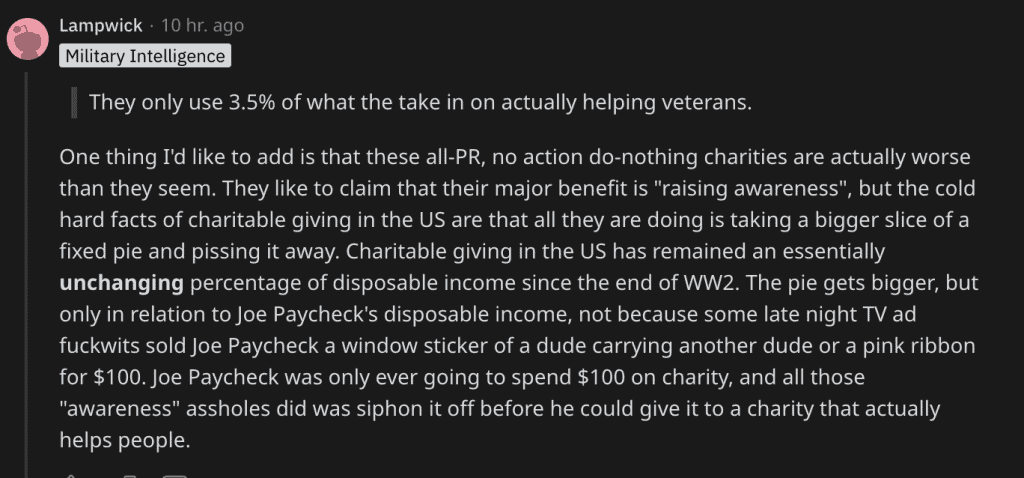
That is the historical record. Weighed against it, WWP’s current Charity Navigator score of 99% on FY2024 is a genuine turnaround, and a donor who cares about present-day governance and financial reporting has a defensible case for giving. A donor who weighs the 2014–2015 conduct more heavily has an equally defensible case for giving elsewhere. Both are reasonable; we would not tell you the numbers say otherwise.
2. Vietnam Veterans of San Diego
This particular charity has a low concern on Charity Navigator ratings.
Multiple reports and news suggest that their campus has drug abuse.
One of the article stated: Staff and residents say Veterans Village has deteriorated over the past few years as leadership has prioritized filling beds over providing high quality care, admitted too many clients during a severe staffing shortage and failed to establish enough oversight to keep the campus drug-free.
It has also started enrolling non-veterans which many of the people consider a shift in focus too. Staff members say that they don’t even feel safe in the Vietnam Veterans Village campus.
In yet another report, when the investigation was going on, an employee was fired after speaking to reporters. We are reporting what iNewsource reported; we are not in a position to characterise the termination legally.
Since the Charity Navigator rating has since recovered to 3 stars (76%, with a 100% Accountability & Finance score, and the earlier donor advisory removed), we keep this charity listed on the strength of the 2022 inewsource investigations into conditions on its campus – weigh both signals before donating.
🔍 Donor due-diligence beyond veteran charities: if you’re vetting one organization, you’re probably going to vet more. The same red flags — low program-ratio, watchdog downgrades, opaque 990s — show up across other charity verticals. A few companion guides our team re-verifies quarterly:
- Worst animal charities to avoid — the animal-welfare sector has its own set of poorly-rated orgs; we cross-reference Charity Navigator, CharityWatch, BBB, and Candid for each.
- Charities with the lowest overhead ratios — if program-ratio matters to you (it should), here’s the inverse list: orgs where the highest share of each dollar reaches beneficiaries.
- The worst charities to donate to (overall) — our master watch-list across every vertical, with the specific watchdog ratings that flagged each one.
3. AMVETS National Service Foundation
AMVETs is a 501c3 veterans charity operating nationally.
Their mission is to provide support to veterans through service programs as well as providing community and youth-oriented programs designed to promote unity and patriotism.
However, it has got an F rating from Charity Watch.
CharityWatch still grades AMVETS National Service Foundation an F. On its most recent review, covering the fiscal year ended August 31, 2023, 27% of spending reached programs and 73% went to overhead.
For scale: CharityWatch’s Top-Rated charities spend $25 or less to raise each $100 and put 75% or more of their budget into programmes. AMVETS National Service Foundation meets neither test. (A cost-to-raise-$100 figure previously printed here has been removed on 10 September 2026: CharityWatch publishes that detail only to members, and we could not retrieve it from any public source.)
The two major watchdogs disagree sharply here, and you should know it. Charity Navigator gives AMVETS National Service Foundation 4 stars and a 95% score on its FY2024 filing, scoring mainly governance and financial-reporting practices. CharityWatch grades it F because it measures something different — how much of each dollar reaches programs once joint-cost and direct-mail allocations are stripped out. If program efficiency is what you care about, weigh the CharityWatch figure.
The BBB Wise Giving Alliance currently lists AMVETS National Service Foundation as “Did Not Disclose” — the charity did not supply the information the Alliance requested, so it has not been evaluated against the 20 Standards for Charity Accountability. An earlier local-news investigation reported that it failed five of those standards. Quoted here.
In that same WSOC-TV investigation, broadcast on July 8, 2014, Tom Bartholomy, president of the Better Business Bureau of Southern Piedmont, told the station that AMVETS NSF sells donors’ personal information. We have not been able to verify that independently, and we are reporting it as what one source said on the record more than a decade ago rather than as an established finding.
Note also that annual reports are not consistently available, which matters because almost every charity of this size does publish one covering all the numbers, expenses, donations, etc.
Overall, looking at the history and some irregular practices, we recommend avoiding donating to AMVETs.
4. AdoptAPlatoon Soldier Support Effort (AdoptaPlatoon)
AdoptaPlatoon is an “F” rated veteran charity as stated by CharityWatch.
It has a mission of providing deployed military service members with quality of life and morale-lifting packages.
AdoptaPlatoon reported making $8.3 million in grants to individuals on its 2014 filing, then reported $0.00 in grants for 2015, 2016 and 2017. CharityWatch flagged that swing and said the charity “may have been masking payments to professional fundraisers and/or burying its in-house fundraising expenses within its program grants” — which is why it withheld a letter grade for the 2012 to 2016 rating years.
The current figure is worse, not better. CharityWatch reports 14% of spending reached programs in the fiscal year ended December 31, 2024, down from 24% two years earlier. Charity Navigator, using the charity’s own expense allocations, calculated 80.8% program spending for fiscal 2022, and currently rates AdoptAPlatoon 3 stars at 88% on its fiscal 2024 filing — the gap between the two raters is the joint-cost allocation CharityWatch strips out. Both numbers belong on the page.
You can read the full article by CharityWatch here, where they have detailed everything and recommended adopting better accountability practices.
Some other notes by Charity Watch:-
- Approximately 95% of Adoptaplatoon’s revenue is derived from the fundraising efforts of a professional fundraising company.
- Adoptaplatoon is in dispute with its direct mail service provider concerning mailing costs.
- Adoptaplatoon reported Paycheck Protection (PPP) Loan proceeds of $88,125.
We would certainly recommend avoiding this charity from donating.
5. Disabled Veterans National Foundation (DVNF)
DVNF is a veterans charity that provides critically needed support to disabled and at-risk veterans who leave the military wounded—physically.
But they have been rated “F” by Charity Watch for these statistics.
Per CharityWatch’s November 2025 review, roughly 93% of spending goes to overhead, with just 7% reaching program services that actually help veterans.
93% overhead for a veteran charity is a great deal too much. The 7% figure covers the fiscal year ended September 30, 2024. (A cost-to-raise-$100 figure previously printed here has been removed on 10 September 2026 — CharityWatch publishes that detail to members only and we could not retrieve it from a public source.) (An earlier version of this page gave $90, which was the fiscal-2019 figure, and attributed $25.5 million in direct-mail payments to a named vendor; the article we cited does not support that figure or that vendor, so we have removed it. The vendors identified in that article are Quadriga Art, $14.7 million, and Brickmill Marketing, $1.4 million.)
Charity Watch also reported, “According to DVNF’s 2008 audit, only $127,421 or less than 1% of DVNF’s $16.3 million budget could have been spent on grants or aid to individuals. Except for this amount and a $40,000 unrestricted grant to a related party, all the rest of DVNF’s reported program expenses of $4.5 million were direct mail related.”
We list this charity as the worst veteran charity to donate to and recommend avoiding donating here.
6. Veterans Relief Network
Veterans Relief Network is a 501c3 veterans charity to assist U.S. military veterans and their families.
They also have an F rating by Charity Watch.
Per CharityWatch’s November 2025 review, roughly 93% goes to overhead, and just 7% is spent on program expenses for military veterans.
Note the date on that rating: it covers the fiscal year ended December 31, 2022. Two more recent Form 990s are now on file, and they tell the same story from the primary source rather than the watchdog: for the fiscal year ended December 31, 2023, Veterans Relief Network reported $896,539 in professional fundraising fees against $1,317,737 in total functional expenses on $1,301,100 of revenue — 68 cents of every dollar spent went to professional fundraisers. Source: ProPublica Nonprofit Explorer. (A cost-to-raise-$100 figure previously printed here, and a claim that CharityWatch had carried it unchanged across three annual lists, were removed on 10 September 2026: the 2025 list carries no cost-to-raise figures at all, so it cannot have carried one unchanged.)
The BBB (Better Business Bureau) has also urged caution to donors when they found out their fundraising consultant, Precision Performance Marketing (PPM) of Kirkwood, has used sweepstakes mailings to help several national charities raise millions of dollars on behalf of causes ranging from childhood cancer to autism.
Records show that most of those contributions have gone to pay the costs of fundraising rather than to assist people in need.
You can read the entire report by BBB here, alerting the donors regarding the same.
7. United American Patriots (UAP)
⚠️ Updated August 25, 2026 — two developments that change this entry. First, the IRS automatically revoked United American Patriots’ federal tax-exempt status effective May 15, 2026, posting the revocation on August 11, 2026 (EIN 41-2172043). The organization does not appear on the IRS reinstatement list, which means donations to it are not tax-deductible. Second, on August 27, 2025 the Pennsylvania Secretary of the Commonwealth issued a cease and desist order (Case No. 25-98-005322) barring UAP from soliciting contributions in Pennsylvania, finding it was not registered with the state and had failed to submit requested documentation — expressly requiring it to stop “all internet solicitation via a ‘donate button’ on a website.” Its own website, uap.org, no longer loads.
The organization has said it generates public awareness, funds legal representation and provides reintegration support for service members, to preserve their rights and defend the defenders.
Correction (August 27, 2026): an earlier version of this page said CharityWatch currently rates UAP “F” with 37% program spending. That is out of date and we have removed it. CharityWatch currently assigns UAP a “?” rating, stating it “is unable to provide a rating for United American Patriots based on its fiscal year ended 12/31/2024 at this time due to an inability to obtain its audited financial statements and IRS tax Form 990.” CharityWatch adds that its “most recent letter grade rating of United American Patriots was a ‘D’… based on our analysis of its fiscal 2021 financial information” — 54% of spending on programs, and $83 to raise every $100. The 37% figure came from CharityWatch’s review of fiscal year 2019 and should not be read as current.
Charity Navigator previously gave them a 2-star rating and a score of 67%, based on the fiscal 2022 filing, which is the last Form 990 the organisation filed; none has been filed since. Checked again on 6 October 2026: that Charity Navigator profile no longer resolves — the rating page for EIN 41-2172043 returns a 404 — so the score above should be read as a historical rating rather than a current one. The underlying filing history is still public in the ProPublica Nonprofit Explorer record for United American Patriots, which is the citation we now point readers to. The harder facts are elsewhere: the IRS automatically revoked United American Patriots’ tax-exempt status effective May 15, 2026, posting the revocation on August 11, 2026, and the organisation does not appear on the IRS reinstatement list. Pennsylvania’s Department of State issued a cease and desist order on August 27, 2025 (Case No. 25-98-005322) covering “all internet solicitation via a ‘donate button’ on a website.” And its domains are gone: uap.org does not load, and unitedamericanpatriots.org now redirects to a domain-for-sale parking page.
8. Purple Heart Foundation
Their mission as stated on their website is: To enhance the quality of life of Purple Heart recipients and other honorably discharged veterans and their families.
Charity Watch has given them an “F” rating, whereas Charity Navigator currently rates them 2 stars with a 68% score – an improvement from the zero-star, 40% rating they held when we first flagged them, but still among the weakest scores of any major veteran charity. CharityWatch still grades them F. On the fiscal year ended June 30, 2024, 17% of spending reached programs and 83% went to overhead. That is an improvement on the 7% CharityWatch found four years earlier, for the fiscal year ended June 30, 2020, but it remains far below CharityWatch’s 75% Top-Rated threshold.
When the consolidated audit came out in 2020, we found the following statement, “For each of the preceding 5 years, the Organization has generated net losses ranging from $950,000 to 7.6 million dollars. The current year’s loss of approximately 414,000 dollars further reduced net assets to a deficit of approximately $1.1 million on June 30, 2020.”
We recommend avoiding this charity for now.
9. Paralyzed Veterans of America (PVA)
Paralyzed Veterans of America (PVA) is a 501c3 tax-exempt nonprofit, that is a steadfast advocate for paralyzed and disabled Veterans and all people living with disabilities.
In earlier BBB Wise Giving Alliance (Give.org) evaluations, PVA failed several Standards for Charity Accountability (including oversight of operations, board policy on effectiveness, and annual-report disclosure). As of 2026, Give.org lists PVA’s report status as “Did Not Disclose” – the charity did not provide the information the Alliance requested for evaluation, which is itself a transparency red flag.
PVA spent $95 million on average, with $56 million paying for a direct-mail campaign to get money and support for its public education program, according to tax filings, quoted by Public Integrity.
CharityWatch grades Paralyzed Veterans of America an F. On its most recent review, covering the fiscal year ended June 30, 2023, 34% of spending reached programs and 66% went to overhead — up slightly from the 31% recorded two years earlier, but still far under CharityWatch’s 75% Top-Rated threshold.
CharityWatch’s current F-rated veterans list (November 2025) also includes:
- Help Heal Veterans, formerly Help Hospitalized Veterans — 24% of spending on programs, fiscal year ended July 31, 2023
- Mutts With a Mission — 7%, fiscal year ended December 31, 2022
- Homes for Veterans — 15%, fiscal year ended September 30, 2023
- Native American Veterans Assistance — 24%, fiscal year ended December 31, 2023
- Veterans of Foreign Wars — 46%, fiscal year ended August 31, 2024
Corrected August 2026. Four organizations named in earlier versions of this list — Vietnam Veterans of America, Operation Finally Home, HonorBound Foundation and For The Troops — no longer appear on CharityWatch’s F list, and we have removed them. Healing Heroes Network is gone for a different reason: it no longer exists.
New in 2026: an active enforcement action against Healing for Heroes (New York)
On August 12, 2026, New York Attorney General Letitia James commenced a special proceeding by Verified Petition in the Supreme Court of the State of New York, County of Erie, against Healing for Heroes – A Disabled Veteran’s Retreat and Wooded Oasis, Inc. (EIN 99-2546948, Bemus Point, NY) and two of its officers, board president Thomas L. Nelsen and board secretary-treasurer Jennifer S. Milchanoski-Nelsen. These are allegations. The proceeding is pending, no answer has been filed, and no court has found any of them true.
The Attorney General’s office alleges that the charity solicited donations promising that 100% would fund retreats for disabled veterans, and that:
- “Only four retreats were held in 2024 and 2025, which were exclusively attended by Healing for Heroes board members and their family and friends.”
- “Around this time the Nelsens began renting the property on Airbnb promising customers that 100 percent of the rental funds would go to the charity. They rented the property on at least 32 occasions and deposited $33,312.16 into their personal account.”
- The charity “has received at least $93,091.88 in monetary donations between March 20, 2024 through September 19, 2025,” and the Attorney General’s announcement states that almost half of the nearly $100,000 donated went to utilities, maintenance and renovations on the property, and to board members’ personal expenses including meals, shopping and vehicle repairs. The itemised figures in this list come from the Verified Petition rather than from the press release, which gives only the rounded total.
One detail is worth stating precisely, because early coverage got it wrong: the 30-acre property was never donated to the charity. The petition states it was purchased on December 19, 2022 by the Nelsens personally with a $241,500 VA-guaranteed mortgage, and that “Healing for Heroes does not own the Property and has no interest in” it. The Attorney General seeks dissolution of the charity, distribution of its assets to organizations serving disabled veterans, a bar on the two officers soliciting or holding leadership positions at any New York charity, damages and statutory penalties.
The organization’s IRS exemption remains intact and it is not on the IRS automatic-revocation list. It has never filed a full Form 990; it files only the 990-N e-Postcard, and the Attorney General alleges the 2025 e-Postcard’s under-$50,000 gross receipts declaration is inaccurate. Read the Attorney General’s announcement.
We are not listing Healing for Heroes among the nine charities above, because those entries rest on published financial ratings while this one rests on unproven allegations. It is here because a donor researching veteran charities in 2026 should know the case exists.
A different organisation with a confusingly similar name: Healing Heroes Network, Inc.
Not to be confused with Healing for Heroes above. Healing Heroes Network, Inc. was a separate Florida organisation, unrelated to the New York charity described in the previous section. On January 12, 2021 Healing Heroes Network agreed to pay $95,000 and to permanently cease soliciting donations, in a settlement with eleven state attorneys general led by Washington and joined by Florida, Ohio, Oregon, Illinois, Maryland, Minnesota, Missouri, New Mexico, California and Virginia. Washington’s announcement states that the organisation “spent less than one percent of individuals’ donations on veterans’ medical care.” Under the settlement, three former directors — Stacey J. Spiegel, Allan M. Spiegel and Neal A. Spiegel — were banned for five years from overseeing, managing or soliciting charitable contributions for any nonprofit, and the organisation agreed to pay $400,000 in monetary relief if it violated any settlement term. The case formed part of Operation Donate with Honor, the nationwide effort against veterans’ fundraising fraud coordinated by the Federal Trade Commission and the National Association of State Charities Officials, though the FTC itself was not a party to this settlement. Healing Heroes Network is defunct; its last Form 990 covers 2017. Sources: Washington Attorney General and California Attorney General.
Correction, 10 September 2026: until today this paragraph ran immediately after the Healing for Heroes section with no named subject, so that the pronoun attached to Healing for Heroes — an operating New York charity facing allegations that are still unproven — and stated that it had already settled and been shut down. That was wrong. The settlement described here belongs to Healing Heroes Network, Inc., a different and now-defunct organisation. We apologise for the error.
Here are some tips for you when you look to donate to a veteran charity. These tips will help you make an even more informed decision.
- Research the charity: Look up the charity on websites such as Charity Navigator or GuideStar, which provide information on a charity’s financial health and accountability.
- Check the charity’s website: Look for information on how it uses donations, its programs, and how they help veterans.
- Don’t give to telemarketers: Many fraudulent veterans charities use telemarketing to solicit donations, so be wary of unsolicited phone calls.
- Be wary of high-pressure tactics: Legitimate charities will not pressure you to donate on the spot.
- Be cautious of charities with similar names: Some fraudulent charities will use names similar to well-known and reputable organizations.
- Donate directly to the charity: Avoid giving donations through third-party fundraisers, which may keep a large portion of the donation for themselves.
- Consider supporting veterans through other means: such as volunteering or providing services to veterans directly.
- Always check that the charity is registered and approved by the state attorney general office or the charity commission.
- Look for transparency: Legitimate charities will typically provide detailed information about their programs, finances, and impact on their website.
- Check for accreditation: Charities accredited by organizations such as the BBB Wise Giving Alliance or the Charity Navigator have met high standards for financial health, accountability, and transparency.
- Avoid charities that make unrealistic claims: Be wary of charities that make grandiose promises about the impact they will have, or that claim to provide services that seem too good to be true.
Best Veteran Charities to Donate to Instead (2026)
Knowing which veteran charities to avoid is only half the job. If you want your gift to actually reach a veteran, give to organizations that an independent watchdog has vetted and that publish how they spend. Every group below was named to CharityWatch’s Top-Rated Veterans & Military list. To earn that label a charity generally spends 75% or more of its budget on programs and spends $25 or less to raise every $100 in donations — the opposite of the high-overhead groups above. CharityWatch updates its grades through the year, so click any name to confirm it is still Top-Rated before you give.
Fisher House Foundation
Fisher House builds comfortable homes on the grounds of military and VA medical centers so families can stay free of charge while a loved one is treated — a concrete benefit that saves military families millions in lodging costs each year. It is a long-standing fixture on CharityWatch’s Top-Rated list. Check its current rating →
Semper Fi & America’s Fund
The Fund provides one-on-one case management and lifetime support to critically wounded, ill, and injured service members, veterans, and military families across every branch of the Armed Forces. It has held a CharityWatch “A+” grade for more than a decade — one of the most consistent records in the sector. Check its current rating →
Gary Sinise Foundation
Founded by the actor and veterans’ advocate, the foundation serves veterans, first responders, and their families. Its R.I.S.E. program builds specially adapted smart homes for severely wounded heroes, alongside mental-wellness and family-support work. It appears on CharityWatch’s Top-Rated Veterans & Military list. Check its current rating →
Homes For Our Troops
This organization builds and donates specially adapted, mortgage-free homes to the most severely injured post-9/11 veterans, restoring independence to those with life-changing injuries. It is a CharityWatch Top-Rated charity with a strong program-spending ratio. Check its current rating →
Intrepid Fallen Heroes Fund
IFHF builds advanced treatment centers for service members and veterans living with traumatic brain injury and post-traumatic stress, including the network of “Intrepid Spirit” centers. It is named to CharityWatch’s Top-Rated list. Check its current rating →
K9s For Warriors
K9s For Warriors pairs rescue dogs trained as service dogs with veterans living with PTSD, traumatic brain injury, or military sexual trauma — meeting the veteran-suicide crisis with a concrete, evidence-informed program. It is not currently named to CharityWatch’s Top-Rated Veterans & Military list (corrected August 2026) — check its Charity Navigator rating before you give. See CharityWatch’s current Top-Rated list →
How to Confirm a Veteran Charity Is Legitimate (in 60 Seconds)
Before giving to any veteran charity — including the ones above — run this three-step check:
- Check an independent watchdog. Look the charity up on CharityWatch or Charity Navigator. Be cautious of groups that spend less than 65% of their budget on programs.
- Confirm tax-exempt status. Search the charity in the IRS Tax-Exempt Organization Search to verify it is a registered 501(c)(3) and that your gift is deductible.
- Read the real financials. Look up the charity’s Form 990 to see how much actually reaches veterans versus fundraising and executive pay.
Related Articles You Should Read
If you’re researching which charities to trust (and which to avoid), these guides will help you make better decisions:
- 10 Worst Charities to Donate To in 2026 — Our complete guide to charities you should avoid across all categories.
- Charities With the Lowest Overhead Costs — Find organizations that put the most money toward their mission.
- Wounded Warrior Project Scandal Explained — A deep dive into one of the biggest veteran charity controversies.
- Best Charities That Help the Elderly — Reputable organizations that actually make a difference for seniors.
- Charities That Give Money to Individuals — Legitimate organizations that provide direct financial assistance.
Final Thoughts
In conclusion, it is important to be diligent when choosing which veterans’ charity to donate. By researching the charity, checking the charity’s website, being cautious of high-pressure tactics, looking for transparency, and avoiding charities that make unrealistic claims, you can help ensure that your donation goes to a legitimate and effective organization that truly supports veterans.
Remember, there are many reputable and effective veterans charities, so take the time to find one that aligns with your values and supports the causes you care about. By donating to a charity that truly makes a difference in the lives of veterans, you can make a real and meaningful impact on the lives of those who have served our country.
Related Resources
Looking for more help? Check out these related guides:
➤ Get Help Paying For… (all financial assistance guides)
Related: Worst Homeless Charities to Avoid | Worst Cancer Charities | Worst Children’s Charities
Related Resources
Looking for more ways to help? Check out our guides on veteran transportation assistance, worst animal charities, financial assistance programs.
Related help for veterans and their families:
- Housing assistance for disabled veterans — the programs that actually pay, with eligibility and application steps
- Charities that help with rent — if the bill in front of you is rent rather than a donation decision
- Charities that help with medical bills — including the veteran-specific routes most lists miss
- Charities that help with utility bills — direct-pay programs, by utility and by state
- Charities that give money to individuals — cash-assistance and micro-grant programs
- Get Help Paying For… — our full index of financial-assistance guides
Frequently Asked Questions About Veteran Charities
Which veteran charities should I avoid?
Research organizations like Charity Navigator and Give.org before donating. Look for charities with low ratings, high administrative costs, or those that have faced fraud allegations. Organizations with less than 70% of donations going to programs should be avoided. Always verify their 501(c)(3) status and financial disclosures.
How do I know if a veteran charity is legitimate?
Check the charity status on Charity Navigator, CharityWatch, or the IRS Tax Exempt Organization Search. Look for a published annual report, clear financial statements, and transparent information about program spending. Legitimate charities should have at least 75% of donations going directly to programs. Verify contact information and read third-party reviews from other donors.
What percentage of donations actually help veterans?
The percentage varies significantly by organization. Top-rated veteran charities typically allocate 75-90% of donations to actual programs, with the remainder covering administration and fundraising. Charities such as Veterans Community Project and Fisher House Foundation carry high program-expense ratios and appear on CharityWatch’s Top-Rated Veterans and Military list. Always check individual charity ratings on Charity Navigator for specific percentages.
What are the best veteran charities to donate to instead?
The most consistently top-rated veteran charities include Fisher House Foundation, Semper Fi and America’s Fund, the Gary Sinise Foundation, Homes For Our Troops, Intrepid Fallen Heroes Fund, and Veterans Community Project, all of which appear on CharityWatch’s Top-Rated Veterans and Military list. Avoid the high-overhead groups covered above (including Wounded Warrior Project and AMVETS). Always confirm a charity’s current rating on CharityWatch or Charity Navigator before you give.
How can I report a fraudulent veteran charity?
Report suspected fraud to the Federal Trade Commission (FTC) at ReportFraud.ftc.gov, your state Attorney General office, or the IRS at irs.gov/report. You can also file a complaint with Charity Navigator or contact the Better Business Bureau. Provide specific details about the fraudulent activity and any documentation you have.
Related help
If you came here because a veteran in your family needs help
- Charities that help with cremation costs — the VA burial allowance and what it actually pays toward a veteran cremation
- Charities that help with funeral costs — broader funeral assistance, including burial
- Charities that help with medical bills — for veterans carrying medical debt
- Charities that help seniors with bills — programmes for older veterans on a fixed income
- Charities that help with rent — direct-pay rent assistance