Free Tax Preparation Programs: Where to Get Free Help With Your 2026 Tax Return

Reviewed 21 October 2026. Every figure below comes from the IRS, Treasury or the organisation that runs the programme, and every dollar amount for tax year 2026 is taken from Revenue Procedure 2025-32. This page explains who qualifies for free filing help and how to get it. It is not tax advice, and it does not tell you what to put on a return.
Roughly 70% of American households can have their tax return prepared and filed for nothing, by someone the IRS has trained and certified, and most of them pay for it instead. The programmes are not new, not obscure and not charity in the embarrassing sense. They are federal grant programmes with a volunteer workforce, and in a normal season they sit half empty while people down the road pay $150 to a storefront preparer for the same return.
There is one change this year that matters more than anything else on this page: IRS Direct File no longer exists. If you used it, or if you read a guide that recommends it, that route is closed. What follows is what is actually open for the return you will file in early 2027, who qualifies for each route, and the four credits that account for most of the money people leave behind.
First, the route that closed: Direct File is gone
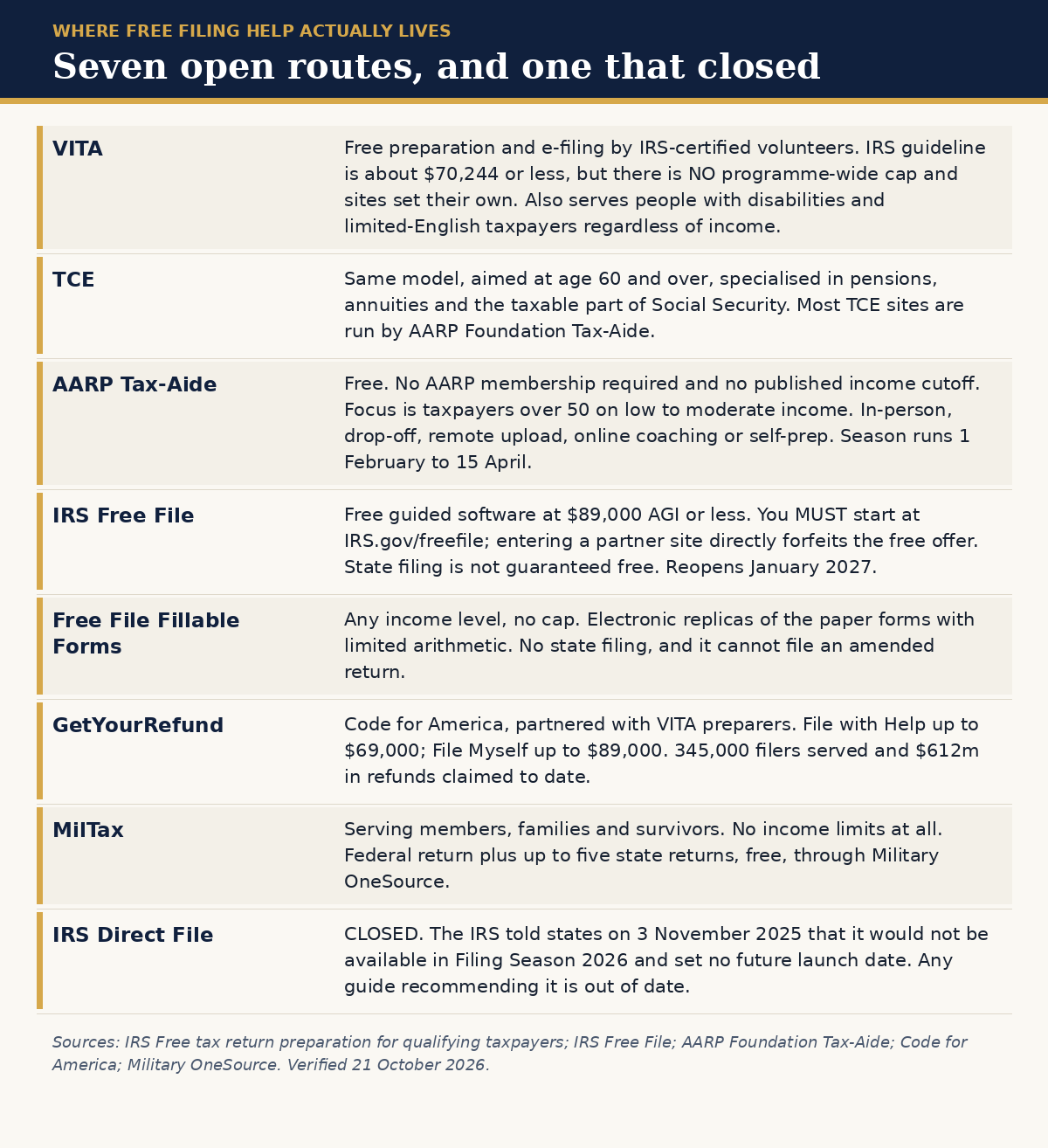
Direct File was the IRS’s own free filing tool, built in-house, where you filed straight with the government instead of through a software company. It ran as a pilot in 2024 and expanded in 2025. It is finished.
On 3 November 2025 an IRS official emailed the state tax offices that had partnered on the tool. The wording was flat: “IRS Direct File will not be available in Filing Season 2026. No launch date has been set for the future.” Treasury Secretary Scott Bessent defended the decision publicly the same week, saying “I think that we have better alternatives” and “It wasn’t used very much, and we think that the private sector can do a better job.”
The usage numbers behind that: about 141,000 returns were accepted through Direct File in the 2024 pilot and nearly 300,000 in the 2025 season, against roughly 30 million people who were eligible to use it. It cost over $40 million a year to run.
Two practical consequences. First, if a guide published before late 2025 tells you to use Direct File, that guide is stale and you should distrust the rest of it too. Second, the old VITA site locator link that is still circulating is also dead. For years the locator lived at irs.treasury.gov/freetaxprep/. That address now redirects to the IRS homepage and does not find you a site. The working locator is at freetaxassistance.for.irs.gov, or you can call 800-906-9887.
VITA: the one most people qualify for and almost nobody uses
The Volunteer Income Tax Assistance programme is the backbone of free filing in the United States. The IRS trains and certifies volunteers, grants money to community organisations to host them, and those organisations prepare and electronically file your return at no charge. Sites run out of libraries, community colleges, churches, United Way offices, housing authorities and food banks.
The eligibility line as the IRS states it: VITA serves people who “generally make about $70,244 or less.” That figure is deliberately odd-looking because it is pinned to the top of the earned income credit range rather than being a round number somebody chose.
Two things about that number are worth knowing, because they cut in opposite directions and both of them get misreported.
There is no programme-wide income limit. The IRS sets a guideline, not a cap. Individual sites set their own thresholds, and plenty of them serve people above the guideline, particularly outside the February rush. If you are at $75,000 or $80,000 with a simple return, you have not been ruled out by the IRS. You have to ask the site.
Income is not the only door in. The same programme explicitly serves people with disabilities and taxpayers with limited English, independent of the income guideline. A site with a Spanish, Mandarin, Haitian Creole or Somali speaker on the rota is doing exactly what the grant pays it to do.
What VITA will not do is everything. Volunteers are certified to a scope, and complex returns sit outside it: rental property in several states, a business with inventory or employees, farm income, cancelled debt in some forms, bankruptcy. If your return is genuinely complicated, the site will tell you early rather than halfway through. That is the system working, not a brush-off.
The locator is refreshed regularly from February through April, which tells you something about the rhythm: outside those months a lot of sites are not listed because they are not open. Appointments at good sites in a mid-sized city are gone by early February. The sensible move is to find your site in January and book then.
TCE and AARP Foundation Tax-Aide: the over-60 route, and what the age rule actually is
Tax Counselling for the Elderly is VITA’s sibling programme, aimed at people 60 and older, and specialised in the things that only show up on an older person’s return: pension distributions, annuities, the taxable portion of Social Security, required minimum distributions.
Here is the part that surprises people. A majority of TCE sites are run by the AARP Foundation’s Tax-Aide programme, and Tax-Aide’s own rules are looser than the TCE name suggests. Tax-Aide is free. It has no AARP membership requirement. It publishes no income cutoff. It describes its focus as taxpayers over 50 with low to moderate income, and focus is not the same as a rule. If you are 44 and broke and your local free site is a Tax-Aide site, go and ask.
Tax-Aide also offers more ways in than a single appointment desk, and the options vary by location:
- In-person service – the traditional sit-down appointment.
- Drop-off service – you leave your documents, a volunteer prepares the return, you come back to review and sign.
- No site visit required – you upload your documents and never go in.
- Online coaching – you prepare your own return with a volunteer talking you through it.
- Facilitated self-assistance and self-preparation – free software, with help on hand if you get stuck.
The season runs, in the Foundation’s own words, “generally from February 1 to April 15.” Find a site through the AARP Tax-Aide locator or call 888-227-7669 between January and April.
IRS Free File: free software up to $89,000, and the mistake that costs people the discount
If you would rather do it yourself, IRS Free File is a partnership between the IRS and commercial tax software companies. Guided software is free for filers with $89,000 adjusted gross income or less. That threshold applies to your whole household return, not per person.
Now the part that matters more than the threshold, and it is the single most expensive mistake in this whole area:
You have to enter through the IRS. Start at IRS.gov/freefile and follow the link to a partner from there. The IRS warns, in plain language on its own page, that going directly to a partner’s commercial website will not give you Free File. You will land in the paid product with the same logo and the same forms, and somewhere around the state return or the credit you actually needed, it will ask for money. Every year a large number of people who qualified for free filing pay for it because they typed the company name into a search engine instead of starting at IRS.gov.
Two further limits to know before you commit. Partners set their own additional criteria on top of the IRS threshold, so some will bounce you for age, state or form type even under $89,000 – the IRS tool asks you a few questions and matches you. And state returns are not guaranteed free. Some partners include free state preparation and filing; others charge for it. Check before you start entering numbers, because switching providers halfway is miserable.
Free File closes after the filing deadline and reopens for the new season. The IRS page currently says it has closed and to check back in January 2027.
Free File Fillable Forms: no income limit at all, and no hand-holding either
Separate product, commonly confused with the above. Free File Fillable Forms is available for any income level. There is no cap, because there is no software doing the thinking. You type your figures into electronic replicas of the paper forms, it does limited arithmetic, and it files.
Use it if you know what goes where and you earn too much for guided Free File. Do not use it as your first ever return. Two hard limits: it does not support state filing, and it cannot prepare or file an amended return.
GetYourRefund: the nonprofit that will do it for you online
GetYourRefund is run by Code for America, a nonprofit, in partnership with IRS-certified VITA preparers. It is the route for people who qualify for VITA but cannot get to a site, or cannot get an appointment, or work hours that do not overlap with a library’s.
Two tiers, with different limits:
- File with Help – up to $69,000 income. You upload documents and an IRS-certified preparer does the return for you, free.
- File Myself – up to $89,000 income. Free online software with preparer support available when you need it.
It also runs its own VITA site locator for people who do want to go in person, on the same $69,000 line.
The scale is not trivial. Across six seasons the service has helped 345,000 people file, claiming more than $612 million in refunds and saving filers close to $39 million in preparation fees. The 2026 season was its seventh. Start at getyourrefund.org.
MilTax: no income limit, five state returns, and nobody checks your pay grade
If anyone in the household is serving, has recently served, or is a surviving family member, MilTax is almost certainly the best option on this page and it is the one people in that position most often miss.
MilTax runs through Military OneSource and was built specifically around the things that wreck a military return: combat pay, multiple permanent changes of station inside one tax year, a spouse earning in a different state from the one you are domiciled in. Two facts carry it: there are no income limits, and it files a federal return plus up to five state returns free. Find it at Military OneSource.
What to bring, and the one missing card that sends people home
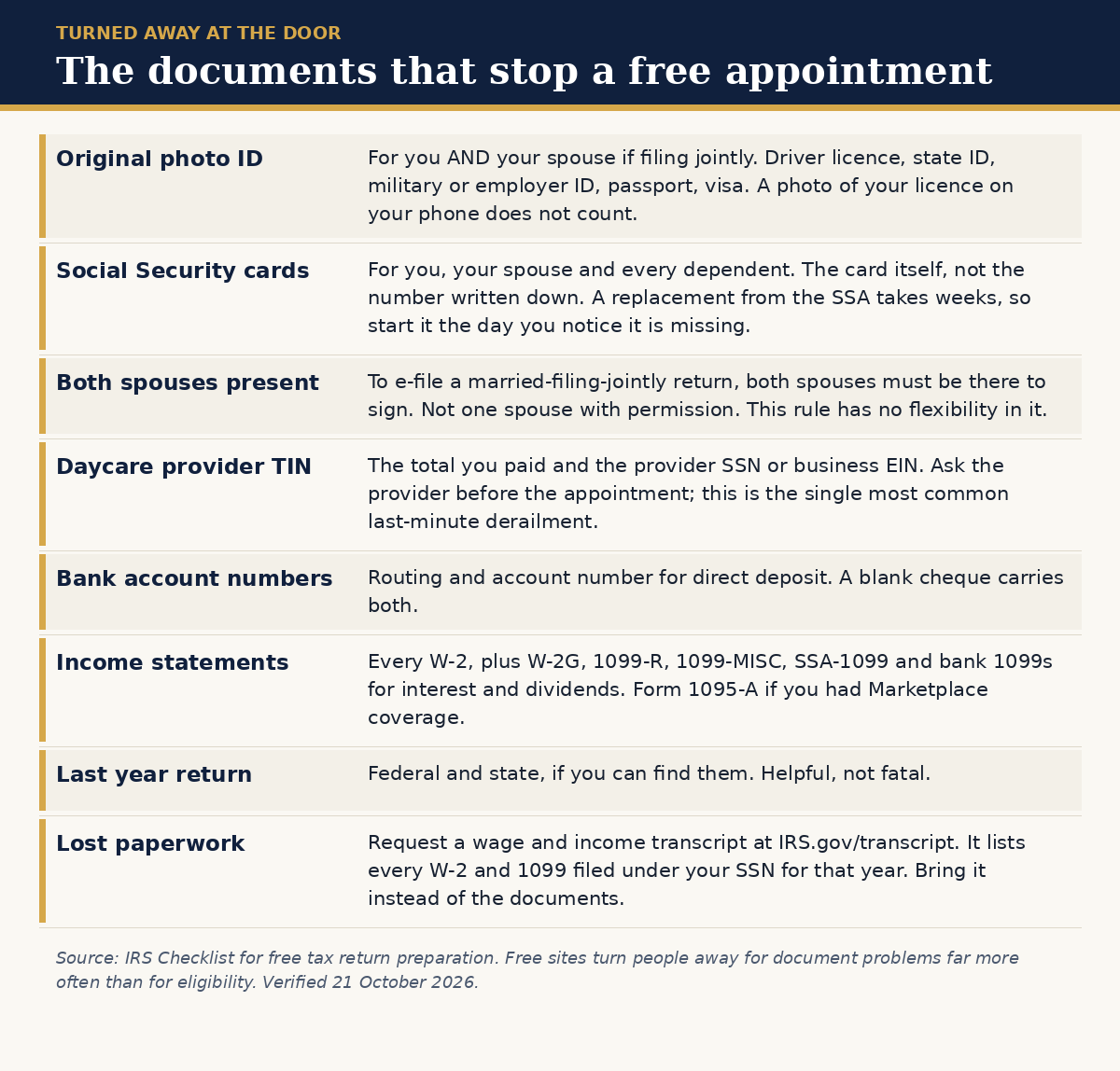
Free sites turn people away every single day for document problems, not eligibility problems. The volunteer cannot bend these rules; the certification they signed does not let them. The IRS publishes the checklist, and the two items at the top of it are the ones that cause the trouble.
Original photo identification for you and, if you are filing jointly, your spouse. A valid US driver’s licence, state ID, military ID, employer or school ID, passport, visa or national ID. A photograph of your licence on your phone is not original identification.
Social Security cards for you, your spouse and every dependent on the return. Not the number written down. The card. If a card is lost, request a replacement from the Social Security Administration before your appointment, because that is a multi-week errand and the site cannot work around it. If you file with an ITIN rather than an SSN, bring the ITIN notice, and proof of foreign status if you are applying for one.
Then the rest:
- Birth dates for everyone on the return.
- Wage and earning statements from every employer: Form W-2, and W-2G, 1099-R or 1099-MISC where they apply.
- Form SSA-1099 if you receive Social Security benefits.
- Interest and dividend statements from banks, the 1099 series.
- A copy of last year’s federal and state returns if you can find them.
- Bank routing and account numbers for direct deposit. A blank cheque is the easiest way to carry them.
- Total paid to a daycare provider, and that provider’s tax identifying number – their SSN or business EIN. Ask the provider for it before you go; this one derails appointments constantly.
- Form 1095-A if you had Marketplace health coverage, and a Health Insurance Exemption Certificate if you were issued one.
- IRS and state income transcripts if you have them.
One rule with no flexibility in it at all: to file a married filing jointly return electronically, both spouses must be present to sign. Not one spouse with permission. Not a phone call. Both people, in the room. If that is impossible, say so when you book and ask what the site can do, because some offer a drop-off process that handles it differently.
The earned income credit: the real tax year 2026 numbers
The earned income tax credit is the largest cash transfer in the American tax code aimed at working people on low pay, and it is refundable, which is the word that matters. A refundable credit pays out even when you owe no tax at all. If your tax bill is zero and your credit is $4,427, the Treasury sends you $4,427.
Which is why the single most common EITC mistake is not filing. If you earned too little to be required to file a return, and you qualify for the credit, the only way to get the money is to file anyway. Nobody mails it to you.
These are the tax year 2026 figures, from Revenue Procedure 2025-32. This is the return you file in early 2027.
| Qualifying children | Maximum credit | Earned income amount | Phase-out starts (joint) | Credit gone at (joint) | Credit gone at (all other statuses) |
|---|---|---|---|---|---|
| None | $664 | $8,680 | $18,140 | $26,820 | $19,540 |
| One | $4,427 | $13,020 | $31,160 | $58,863 | $51,593 |
| Two | $7,316 | $18,290 | $31,160 | $65,899 | $58,629 |
| Three or more | $8,231 | $18,290 | $31,160 | $70,244 | $62,974 |
Read the table this way. The earned income amount is where the credit reaches its maximum – earn that much and you get the full figure. Below it the credit climbs with every dollar you earn. Above the phase-out threshold it shrinks, and at the completed phase-out figure it is gone. Note how much wider the joint columns are: a married couple filing together keeps the credit several thousand dollars of income further up than a single filer with the same children.
Three eligibility rules catch people out:
The age rule for workers with no children. To claim EITC without a qualifying child you must be at least 25 and under 65 at the end of the year. A 23-year-old on $19,000 gets nothing. A 24-year-old with one child does. On a joint return only one spouse has to meet the age test.
The investment income ceiling. If your investment income exceeds $12,200 in 2026, the credit is disallowed outright, however low your wages were. This is the rule that disqualifies people who sold something.
The Social Security number timing rule. You, your spouse and each qualifying child need an SSN valid for employment, and it must have been issued on or before the due date of the return, including extensions. A number that arrives later does not retroactively qualify you for that year. An SSN issued only to receive a federally funded benefit, which does not authorise work, does not count.
The child tax credit, the refundable part, and the $500 almost nobody claims
The child tax credit is worth up to $2,200 per qualifying child. The child must be under 17 at the end of the tax year, which is the cliff that catches families every year: the credit is not reduced for a 17-year-old, it disappears. You get the full amount if your income is not more than $200,000, or $400,000 filing jointly.
Most of that credit is non-refundable, meaning it can erase tax you owe but will not pay out beyond it. The part that does pay out is the Additional Child Tax Credit, refundable up to $1,700 per child for 2026. To reach it you need at least $2,500 of earned income. As with the EITC, you must have a Social Security number valid for employment, for yourself and for each child, issued by the return’s due date including extensions.
Then the one that gets left on the table. The Credit for Other Dependents is worth $500 for each dependent who does not qualify for the child tax credit. A 17 or 18-year-old still at home. A college student you support. A disabled adult child. An elderly parent living with you. Crucially, this credit accepts a dependent with an SSN, an ITIN or an ATIN, where the child tax credit demands a work-valid SSN. Families who assumed they got nothing once a child turned 17 have frequently been entitled to $500 a year and never claimed it.
If you contributed to an IRA or a workplace retirement plan on a modest income, ask the preparer about the Saver’s Credit as well. It is worth 50%, 20% or 10% of up to $2,000 of contributions, $4,000 on a joint return, so a maximum of $1,000 or $2,000. It is claimed on Form 8880 and the income bands move every year, so check the current table rather than a figure from an old article.
The state credits: 28 states, the District of Columbia and New York City
Qualifying for the federal EITC often makes you eligible for a second credit from your state, usually calculated as a percentage of the federal one, and in most places you claim it by ticking a box on your state return. Free preparers handle this routinely. Software sometimes does not surface it unless you look.
The IRS maintains the list. It currently names 28 states, the District of Columbia and New York City, and it marks which are refundable:
Refundable – California, Colorado, Connecticut, District of Columbia, Hawaii, Illinois, Indiana, Iowa, Kansas, Louisiana, Maine, Maryland, Massachusetts, Michigan, Minnesota, Montana, Nebraska, New Jersey, New Mexico, New York, New York City, Oklahoma, Oregon, Rhode Island, Vermont, Virginia and Wisconsin.
Not refundable – Delaware, Ohio and South Carolina. In those three the credit can reduce state tax you owe but will not generate a payment.
New York City residents should note they are on that list separately from New York State, which means a qualifying New York City family can be claiming three earned income credits: federal, state and city.
When the money actually arrives, and why February feels broken
If you claim the EITC or the Additional Child Tax Credit, your refund is held. Not delayed by a backlog – held, deliberately, by statute. The IRS states it plainly: “By law, we can’t issue EITC or ACTC refunds before mid-February.”
Two details people get wrong about this hold, and they cause a lot of unnecessary panic:
It holds the entire refund, not just the credit. Your withholding, your other credits, all of it waits. Filing on 20 January does not get you the non-credit portion early.
Nothing has gone wrong. The hold exists to give the IRS time to match returns against employer records and catch fraudulent claims. Every EITC filer in the country is in the same queue.
The dates the IRS publishes for an early filer with a clean return: Where’s My Refund should show an updated status by 21 February, and you can expect the refund by 2 March if you filed online, chose direct deposit and the return raised no issues. Some people see it a few days sooner. Add time for your bank, which may not post deposits at weekends or on holidays.
The practical point: do not borrow against this money. Refund anticipation products are sold hardest to exactly the people whose refunds are held longest, and the fee buys you about two weeks.
The refunds that expire: three years, then the money is gone
This is the section to read twice if you have not filed for a while, because there is real money in it and a hard deadline on it.
If you did not file a return for a past year and you were owed a refund, that refund is still claimable – but not forever. The IRS rule: “If you are due a refund for withholding or estimated taxes, you must file your return to claim it within 3 years of the return due date.” The same three-year window applies to refundable credits including the earned income credit.
After three years it is not a debt the Treasury owes you. It is gone, permanently, and no hardship appeal reopens it.
So if you worked a job that withheld tax, earned too little to be required to file, and never filed, you very likely have an unclaimed refund sitting in one or more of the last three tax years – and if you had children in those years, potentially several thousand dollars of EITC on top of the withholding.
VITA sites prepare prior-year returns. Not all of them, and not always in the March crush, but many will, and the ones attached to community organisations often prefer to: a three-year back-filing is the single highest-value thing a volunteer can do in an hour. Ask when you book, and ask specifically, because “do you do taxes” and “do you do prior-year returns” get different answers.
If you cannot find the old paperwork, you do not need it. Request a wage and income transcript from the IRS at IRS.gov/transcript; it lists every W-2 and 1099 reported under your Social Security number for that year. Bring the transcript to the site instead of the documents.
If the IRS is already disputing something: Low Income Taxpayer Clinics
VITA and Tax-Aide prepare returns. They do not fight the IRS on your behalf. If you have a notice, an audit, a proposed assessment or a collection action, the programme you want is a Low Income Taxpayer Clinic, and it is a different thing entirely.
LITCs are independent organisations, funded by IRS grants but not run by the IRS, and they represent low-income taxpayers in disputes – before the IRS and in court. Audits, appeals, collection matters, innocent spouse claims. Services are free or for a small fee. Eligibility turns on income below a published threshold, and the amount in dispute is usually under $50,000.
They also do outreach for taxpayers who speak English as a second language, and Publication 4134 lists which languages each clinic covers. Find a clinic through the Taxpayer Advocate Service, or call 800-829-3676 to request Publication 4134 by post.
Worth knowing the clinics exist before you need one. People sign payment agreements they cannot afford because nobody told them free representation was available.
How to work this in one week
The whole thing fits into a few hours spread over a week, and the order matters because one step gates the next.
Day 1 – find your site. Run the VITA/TCE locator and the AARP Tax-Aide locator on your postcode. List three sites, not one. Note which are Tax-Aide, because those are the ones with drop-off and remote options.
Day 1, same sitting – book. Appointments at the good sites are gone by early February. If every site near you is full, go to getyourrefund.org, which has no appointment queue.
Day 2 – the two documents that stop everything. Find the original photo ID and the Social Security cards for everyone on the return. If a card is missing, start the SSA replacement today, because it takes weeks and nothing else can proceed without it.
Day 3 – the awkward phone calls. Ring your daycare provider for their tax identifying number. Ring any former employer who has not sent a W-2. Both take five minutes now and cost you an appointment later.
Day 4 – assemble. Everything from the checklist above in one envelope, plus a blank cheque for the routing and account numbers. Last year’s return if you can find it.
Day 5 – the back years. Work out whether you failed to file in any of the last three tax years. If you did, pull a wage and income transcript for each and add them to the envelope. Tell the site when you arrive that you have prior-year returns to do, so they allocate the time.
At the appointment – ask three questions out loud. Does my state have an earned income credit and am I claiming it. Do I have any dependent who does not qualify for the child tax credit but might qualify for the $500 credit for other dependents. Did I contribute to a retirement account this year. All three are commonly missed, and all three are one sentence from the person who already has your return open.
Sources
- IRS, Free tax return preparation for qualifying taxpayers – the $70,244 VITA guideline, the TCE age-60 threshold, the AARP Foundation share of TCE sites, and the locator addresses and phone numbers.
- IRS Revenue Procedure 2025-32 (PDF) – every tax year 2026 earned income credit figure in the table above, section 4.06, plus the $12,200 investment income limit and the $1,700 refundable child tax credit amount at section 4.05.
- IRS, Child Tax Credit – the $2,200 credit, the under-17 age limit, the $200,000 and $400,000 thresholds, the $2,500 earned income floor for the refundable portion, and the $500 Credit for Other Dependents including its SSN, ITIN and ATIN rule.
- IRS, Who qualifies for the Earned Income Tax Credit – the age 25 to 65 rule for filers with no qualifying child and the Social Security number timing rule.
- IRS, States and local governments with Earned Income Tax Credit – the full list of 28 states, the District of Columbia and New York City, and which credits are refundable.
- IRS Free File – the $89,000 adjusted gross income threshold, the warning that entering through a partner’s own site forfeits Free File, the January 2027 reopening, and the Free File Fillable Forms limits on state and amended returns.
- IRS, Checklist for free tax return preparation – the document list, the original-photo-ID requirement and the rule that both spouses must be present to sign a joint electronic return.
- IRS, When to expect your refund if you claimed the EITC or ACTC – the statutory mid-February hold, that it covers the entire refund, and the 21 February and 2 March dates.
- IRS Tax Topic 153 – the three-year deadline for claiming a refund on an unfiled return.
- AARP Foundation Tax-Aide – that the service is free with no membership requirement and no published income cutoff, its focus on taxpayers over 50, the six service formats, and the 1 February to 15 April season.
- Code for America, GetYourRefund opens for the 2026 filing season – the $69,000 and $89,000 tiers and the 345,000 filers, $612 million in refunds and $39 million in fees saved.
- Military OneSource, MilTax and IRS, Military personnel filing options – that MilTax has no income limits and covers a federal return plus up to five state returns.
- IRS, Low Income Taxpayer Clinics – what LITCs represent clients on, the free-or-small-fee basis, the under-$50,000 dispute guideline and Publication 4134.
- Federal News Network and Money – the 3 November 2025 IRS notification to states that Direct File “will not be available in Filing Season 2026”, the Treasury Secretary’s comments, and the 141,000 and 300,000 usage figures.
Related help
- Charities that give money to individuals – where direct cash help comes from when a refund is months away.
- Charities that help seniors with bills – the Medicare, utility and food programmes that sit alongside free tax help for people over 60.
- Charities and grants for grandparents raising grandchildren – kinship care, TANF child-only grants and the credits that follow the child.
- Respite care and family caregiver grants – what actually pays when you are caring for an adult relative.
- Charities that help low-income families – the broader assistance map, by need.
- Free financial assistance organisations – national organisations that give direct financial help.
Frequently asked questions
Does VITA really cost nothing
Yes. VITA preparation and electronic filing are free. The programme is funded by IRS grants to community organisations and staffed by IRS-certified volunteers, so there is no fee, no percentage of your refund and nothing to pay at the end. Any site asking for a payment or a cut of your refund is not a VITA site.
Is there a hard income limit for VITA
No. The IRS publishes a guideline of about 70,244 dollars or less, but it states that there is no programme-wide income limit and that individual sites set their own thresholds. If you are somewhat above the guideline with a simple return, ask the site rather than assuming you are excluded. Income is also not the only route in: VITA explicitly serves people with disabilities and taxpayers with limited English regardless of the income guideline.
Can I use AARP Foundation Tax-Aide if I am under 50 and not an AARP member
Very likely yes. Tax-Aide is free, requires no AARP membership and publishes no income cutoff. It describes its focus as taxpayers over 50 with low to moderate income, but focus is not a rule, and most Tax-Aide sites are also IRS Tax Counselling for the Elderly sites serving the wider public. Ask the site directly.
Is IRS Direct File coming back
There is no sign of it. On 3 November 2025 the IRS told state tax offices that Direct File would not be available in Filing Season 2026 and that no launch date had been set for the future. Treasury has defended ending it. Treat any guide that still recommends Direct File as out of date.
What happens if I go straight to a tax software company instead of starting at IRS.gov
You lose the free offer. The IRS warns that going directly to a partner company website will not give you IRS Free File. You end up in that company paid product, which looks identical, and you are asked for money partway through. You must enter through IRS.gov and follow the link to a partner from there.
Can I claim the earned income credit if I have no children
Yes, but the amount is small and there is an age rule. For tax year 2026 the maximum credit with no qualifying children is 664 dollars, and you must be at least 25 and under 65 at the end of the year. On a joint return only one spouse has to meet the age test.
Why is my refund held until mid February
Because the law requires it. The IRS cannot issue refunds on returns claiming the earned income credit or the additional child tax credit before mid February, and the hold covers your entire refund rather than just the credit. It is an anti-fraud matching window, not a problem with your return. For an early online filer with direct deposit and no issues the IRS expects the refund by 2 March.
Can I still get a refund for a year I never filed
Usually yes, if you act inside three years. The IRS rule is that a refund for withholding or estimated taxes must be claimed by filing within 3 years of the return due date, and the same window applies to the earned income credit. After that the money is gone permanently. Many VITA sites prepare prior-year returns, and if you cannot find the old paperwork you can request a wage and income transcript from the IRS instead.