Employer Matching Gift Programs in 2026: 17 Confirmed Caps and the December 31 Trap

In 1954 the GE Foundation invented an idea that has since moved billions of dollars to charity: it offered to write a second cheque every time an employee wrote one. GE says donations and matching through the programme have exceeded $1.5 billion since it began.
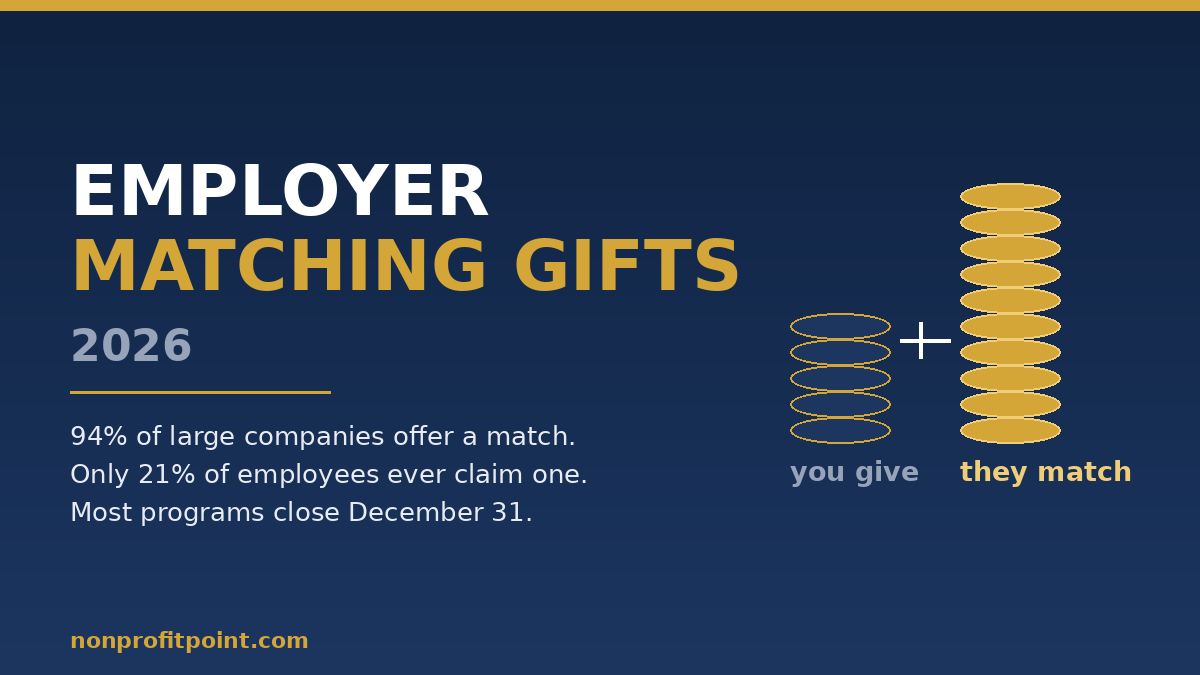
Seventy-two years later, almost every large American employer copies it. According to CECP’s Giving in Numbers research released in August 2026, covering 2025 data, 94% of companies offer at least one matching-gift programme. And according to the same research, average employee participation is 21%.
That gap is the whole story. Roughly four out of five people who could have their donation doubled never ask. If you are reading this in October, you have somewhere between 11 and 15 weeks to be one of the people who does, because most of these programmes close on December 31 and the money is not waiting for you indefinitely.
This guide gives you the verified numbers. Every cap, ratio and deadline below was confirmed on the company’s own website or benefits documentation in October 2026. Where a widely quoted figure could not be confirmed, we say so plainly rather than repeating it.
How an employer match actually works
The single most important mechanical fact is this: the donor starts the process, not the charity. The American Cancer Society puts it directly on its matching gifts page: requesting a matching gift “must be initiated by the donor.” Nonprofits cannot see that your employer offers a match. If you never file the request, nothing happens, and the charity never knows it lost the money.
The sequence is near identical everywhere. GE’s published guidelines describe it this way:
- You donate to the charity first. The corporate system, as GE puts it, “is for registration and reporting only.” You are not giving through your employer; you are reporting a gift you already made.
- You register the gift in your employer’s giving portal, logging in with your company credentials and entering the organisation, amount, type and date.
- The charity confirms it received the gift.
- The company foundation approves and pays, usually in a batch alongside everyone else’s matches.
Caterpillar runs a five-step version: search its eligible-charity database, donate at least $25, submit the request in the portal, wait for the nonprofit to verify the amount, and the Foundation then processes a 1:1 match on a quarterly review cycle.
Most large employers route this through one of two platforms. Benevity handles Microsoft, CarMax, Starbucks, Workday and Micron, among many others. CyberGrants handles GE and ExxonMobil. If your employer uses Benevity, the nonprofit you support needs a Benevity Cause Profile and a completed annual self-certification, which then auto-enrols it in every programme it qualifies for.
One genuinely useful detail that almost no guide mentions: Home Depot lets associates register a match by phone on 1-855-384-2982, not just online. If a portal is defeating you, ask whether a phone route exists.
The deadline trap
This is the part that costs people money, and it is the reason to deal with it in October rather than the week between Christmas and New Year.
There are three distinct patterns in use, and no industry norm:
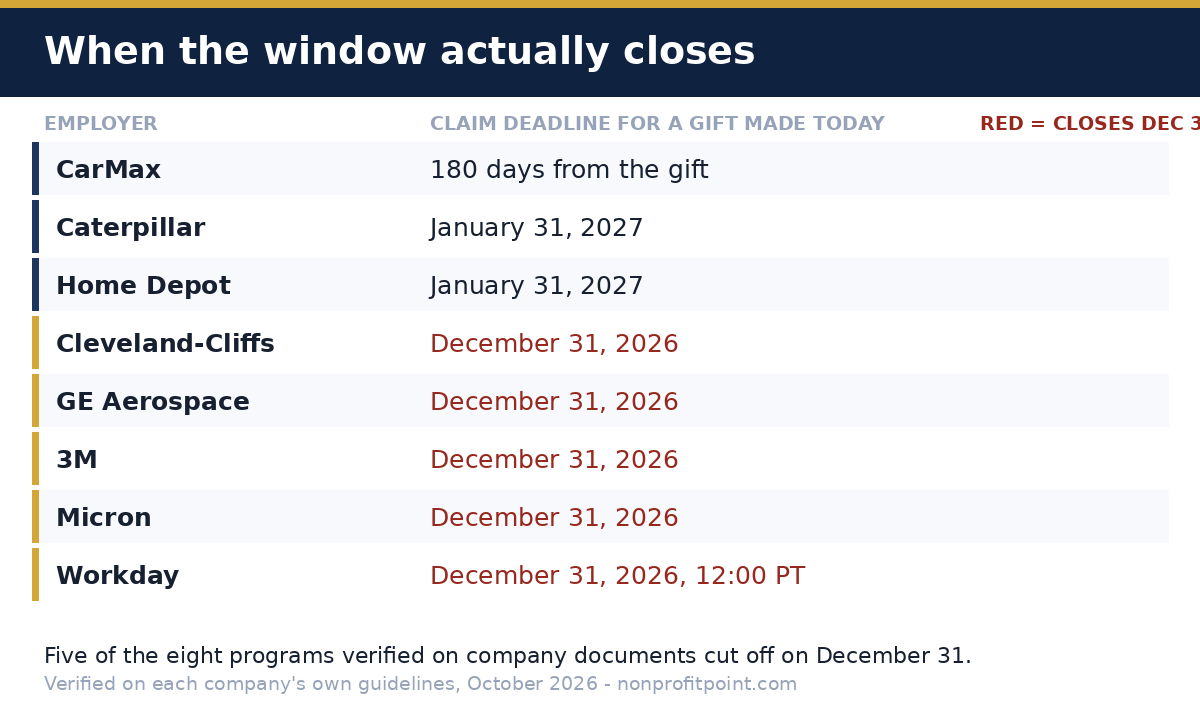
Pattern A, hard calendar-year-end. The gift and the claim must both land in the same year. GE Foundation guidelines state that gifts made in a given year “must be registered by December 31” of that year. 3M is blunter still: donors must submit documentation by December 31, and 3M “will not match prior-year donations.” Cleveland-Cliffs, Micron and Workday use the same cutoff. Workday goes further and sets the exact minute, 12:00 p.m. Pacific on December 31.
Pattern B, a grace period into January. Home Depot allows registration “by January 31 of the year after the gift was made.” Caterpillar allows until January 31, with the nonprofit required to approve by February 15.
Pattern C, a rolling window. CarMax matches gifts up to 180 days from the donation date. Workday’s FAQ separately allows submission up to 90 days after the gift, which interacts awkwardly with its December 31 cap cutoff: a gift made on December 20 has a 90-day window on paper but only 11 days to count against that year’s allowance.
Of the eight programmes we could verify on company documents, five cut off on December 31. If you see a guide claiming most employers allow until the following March or April, treat it with suspicion. We found no primary evidence for that pattern anywhere.
There is a second, harsher deadline nobody talks about, covered further down: the money itself can run out.
What large employers actually match
Below are the figures we could confirm on primary sources. A “confirmed” figure was found on the company’s own website, benefits portal or published programme guidelines. Where the source document is old enough that terms may have moved, we flag it.
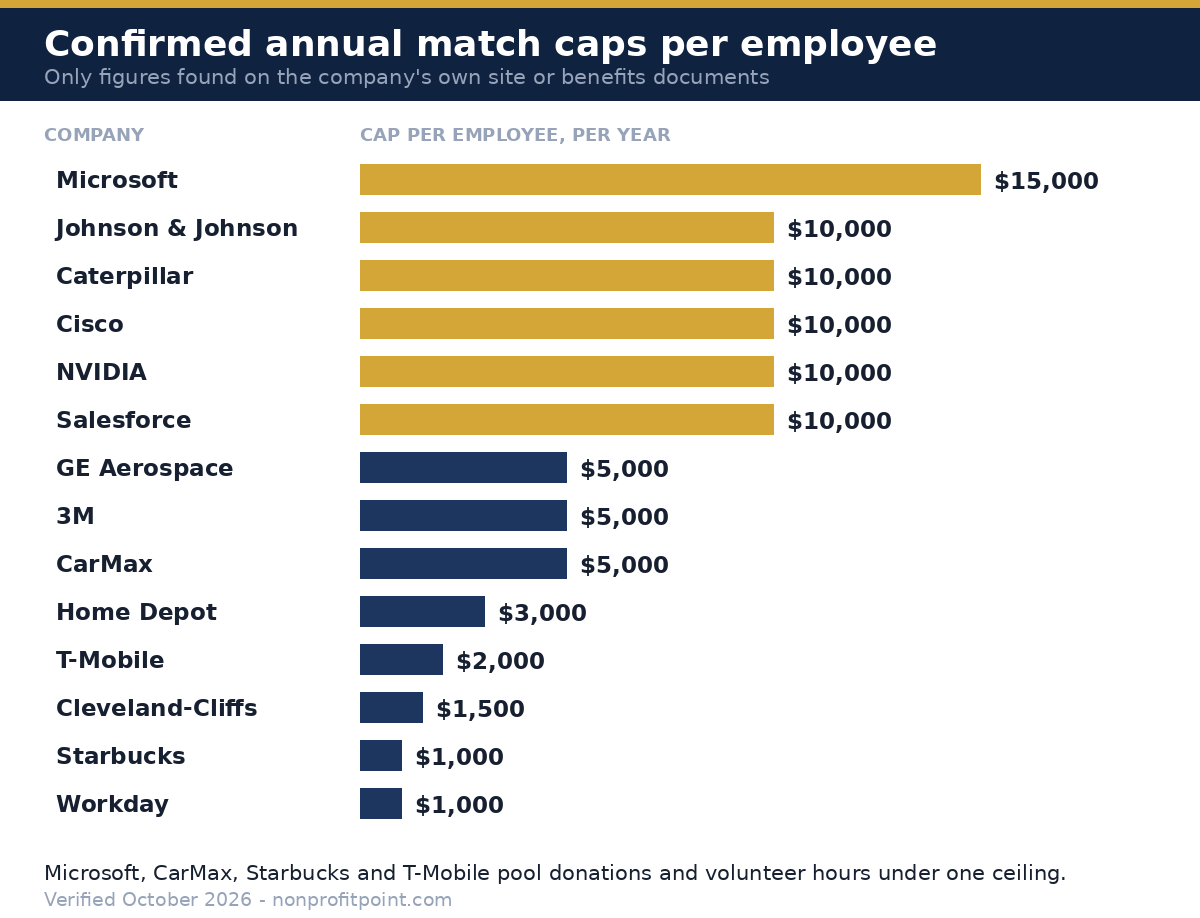
Confirmed programmes
- Microsoft — 1:1, up to $15,000 per eligible employee per calendar year, combining cash donations and volunteer time valued at $25 per hour.
- Johnson & Johnson — 2:1 for employees, 1:1 for retirees, up to $10,000 a year. One of the few true 2:1 programmes we could verify.
- Caterpillar — 1:1 up to $10,000 for employees. Note the change: the retiree cap drops from $10,000 to $5,000 effective April 1, 2026. Full-time and part-time staff, US retirees and board members are all eligible; China and Kazakhstan are excluded.
- Cisco — up to $10,000 per employee per calendar year, with volunteer time counted at $10 per hour. Ratio not published.
- NVIDIA — up to $10,000 a year. Ratio not published.
- Salesforce — up to $10,000 in matching gifts annually, plus seven paid volunteer days. Ratio not published. This was the freshest page in our whole sample, last modified August 2026.
- GE Aerospace Foundation — 1:1 up to $5,000 per calendar year, $25 minimum, employees and current directors. Note that GE Foundation was relaunched as the GE Aerospace Foundation in 2024 and said it would continue the matching programme; post-split terms have not been republished.
- 3M — 1:1 for employees, 0.5:1 for retirees within five years of retirement, 1:1 for directors, $5,000 cap. This is specifically the college and university match.
- CarMax — 1:1 up to $5,000, volunteer hours at $15. Unusually, the cap covers the associate and eligible family: spouse or domestic partner and children 26 and under.
- Home Depot — 1:1, $25 to $3,000 per charity per calendar year, part-time and full-time associates both eligible.
- T-Mobile — $2,000 per employee per year across donations and volunteer hours. Source is the 2021 corporate responsibility report, so verify before relying on it.
- Cleveland-Cliffs — up to $1,500 a year, and the most restrictive we found: active full-time employees and directors only, with part-time, seasonal, per-diem, temporary, retired and contract workers plus interns, spouses and domestic partners all explicitly excluded.
- Charles Schwab — $1,000 a year, plus an additional $1,000 for employees who serve on a nonprofit board.
- Starbucks — $1,000 per fiscal year across volunteer hours and donations, $5 minimum. You must be an active partner both when you give and when the request is processed.
- Workday — 1:1, $1,000 per calendar year, $10 minimum. Crisis-response gifts are capped separately and do not count against the limit.
- Micron — dollar-for-dollar, within the calendar year of the gift. Cap not published.
- Boeing — dollar-for-dollar on eligible donations. Cap not published.
Figures you will see quoted that we could not confirm
Two of the most-cited “generous employer” numbers on the internet rest on very old documents:
- Goldman Sachs, $20,000. This traces to a press release dated November 21, 2007, which itself described the increase as subject to board approval. We found nothing newer on goldmansachs.com. Treat the current figure as unknown.
- Disney, $15,000. This traces to a company article dated September 7, 2012. Current terms are not published.
- ExxonMobil, 3:1 for education. ExxonMobil’s own programme guidelines PDF is blocked to automated access, so we could not verify the famous 3:1 educational match. Company press material confirms the programme exists and includes retirees, but states no ratio.
And a long list of household names publish nothing usable at all: Google, Apple, Verizon, Dell, Netflix, Gap, Nike, Target, Kroger, PepsiCo, Coca-Cola, Procter & Gamble, American Express, Adobe, Intel and IBM. Several, including Verizon, Boeing, Dell and General Mills, name the programme on their website and give no numbers whatsoever. Apple’s newsroom confirms it matches “every hour an employee volunteers, or dollar they donate” without stating a ratio or a cap.
Of roughly 35 major employers checked, usable figures were public for about 17. That is why “check with your employer” is not a cop-out. For more than half of large American employers, it is the only reliable method.
The $4 billion number has no source
If you have read anything about matching gifts, you have read that $4 billion to $7 billion in matching funds goes unclaimed every year. It appears in fundraising decks, nonprofit newsletters and hundreds of articles.
We went looking for the original study. There is not one.
The figure is published by Double the Donation, a matching-gift software vendor, with no inline citation, no methodology and no year attached. America’s Charities repeats it and cites Double the Donation. WorkplaceGiving.org repeats it and cites Double the Donation, while also disclosing that its statistics page is curated “in partnership with Double the Donation.” Double the Donation’s own 2014 article uses the same range with no source. Wikipedia’s article on employer matching programmes carries no unclaimed-funds figure at all, and its only matching-gift footnote points back to the same vendor.
The same applies to the companion statistic, that 78% of donors do not know whether their employer matches. That traces to a Double the Donation blog post published August 25, 2014, attributed only to unnamed “recent studies.” Even if it was measured once, it is at least twelve years old.
Neither number is necessarily wrong. But a vendor’s uncited estimate has been laundered into an industry fact, and you should know that before you repeat it.
There is a defensible version of the same point. CECP’s Giving in Numbers research, 2025 data, published August 2026, is named, dated and methodologically transparent: 94% of companies offer at least one matching-gift programme, and average employee participation is 21%. Nearly every large company offers a match; roughly four in five eligible employees never use it. That is the honest story, and it does not need an invented dollar figure.
Five things the internet gets wrong about matching gifts
1. The matching pool is finite, and it is first come first served
Companies cap the total programme budget, not just the amount per employee. Benevity’s donor help states that a match is available only “if there are still matching funds remaining,” and that a match displayed to you as an estimate can disappear if other donations finalise at the same moment. Every article that frames a match as an entitlement you can claim at leisure in late December has this backwards. Claiming in January is strictly safer than claiming in December.
2. A bigger ratio does not raise more money
The best evidence on this comes from a large field experiment by Dean Karlan and John List, published in the American Economic Review in 2007, covering more than 50,000 prior donors. Offering a match raised revenue per solicitation by 19% and the probability of giving by 22%. But 2:1 and 3:1 ratios produced no additional effect over 1:1. The existence of a match moves people. Its size does not. So the hunt for an unusually generous employer matters less than simply filing the claim.
3. You cannot deduct the matched amount
You deduct the contribution you made. The company that provided the match takes any tax benefit attached to it, even though the combined gift is often recorded in your name on the charity’s receipt. If you are planning your deduction, see our guide to the charitable tax deduction in 2026 for what actually counts.
4. The charity does not receive the full amount
Where a giving platform processes the gift, an administrative fee comes off first. CarMax states outright that the match “is subject to a processing fee, which reduces the amount the nonprofit receives.” Published fee figures are not always consistent even within a single platform’s own documentation, so treat any specific percentage you see with care.
5. Caps often pool donations and volunteer hours together
Microsoft, CarMax, Starbucks and T-Mobile all count cash and volunteer-hour matching under a single ceiling. At Microsoft’s $25 per hour, 600 volunteer hours would exhaust the entire $15,000 benefit on their own. Lists that present these as pure donation caps overstate what is available to match your cash gift.
A sixth, smaller trap: Home Depot’s $3,000 limit is per charity, not only per year, which produces a different result than the headline number suggests if you give to several organisations.
Programmes are getting less generous, not more
The prevailing tone of coverage in this category is that corporate matching is booming. The 2026 data says otherwise. CECP found that matching gifts fell from 11.2% to 9.8% of total corporate cash contributions across a matched set of companies, and that median employee contributions declined 14%. Caterpillar’s halving of its retiree cap in April 2026 is a concrete example on a company’s own website.
Bank of America offers the long view: it eliminated its retiree match, previously up to $5,000, in 2009, citing the downturn and a growing employee count. Programmes do end.
How to find out whether your employer matches
- Use the lookup tool on the charity’s own website. Hundreds of nonprofits embed a free employer search. You type your employer’s name and get that company’s specific rules. The American Cancer Society and NPR both run one. It is free to the donor, needs no login and no email, and the nonprofit pays for it.
- Go to your employer’s giving portal directly. If your company uses Benevity, the address is usually your company name followed by .benevity.org. Access is through your normal work sign-on.
- Check the benefits site, not the CSR site. This is the single most useful tip in this article. Corporate social responsibility pages describe programmes in warm language and withhold the numbers. Employee benefits sites publish the actual rules. Home Depot’s real terms are on mythdhr.com; Starbucks’ are on starbucksbenefits.com; Workday’s are on benefits.workday.com.
- Ask HR or the community giving team. Both the American Cancer Society and NPR direct donors to do exactly this when a lookup comes up empty, and for the majority of large employers that publish nothing, this is the only route.
- Have your charity’s details ready. You will typically need the EIN, legal name and headquarters address. Good nonprofits publish these on a matching gifts page; the American Cancer Society, for instance, lists EIN 13-1788491 along with a dedicated matching gifts email address.
The practical Q4 checklist
- Find out today whether your employer matches, using step 1 or 3 above. It takes under five minutes.
- Write down your cap and your deadline. Assume December 31 unless you have confirmed otherwise.
- Check whether volunteer hours share the cap. If they do, decide how to split it.
- Make the donation, then file the match request the same day. The pool is finite and the claim is what triggers the money.
- Give the charity the heads-up so it can confirm quickly. Some programmes require nonprofit approval within weeks of your submission.
- If you are over 70 and giving from an IRA, read our guide to qualified charitable distributions first, as the mechanics and deadlines are different.
If you are still choosing where to give, our list of the best charities to donate to in 2026 is vetted on financials rather than marketing, and our guide to year-end charitable giving deadlines covers every other cutoff that lands in December.
Frequently asked questions
Who has to submit the matching gift request, me or the charity?
You do. The donor always starts the process. The American Cancer Society states that requesting a match must be initiated by the donor. The charity only confirms afterwards that your gift arrived, and your employer pays the match to the charity directly.
What is the deadline to claim a match for a donation I made this year?
It depends entirely on your employer, and there is no industry standard. Of eight programs verified on company documents in October 2026, five cut off on December 31 of the year you gave. Caterpillar and Home Depot allow until January 31 of the following year. CarMax allows 180 days from the gift date.
Is there a minimum donation to qualify for a match?
Usually yes, and it is usually small. Confirmed minimums include 5 dollars at Starbucks, 10 dollars at Workday, and 25 dollars at Home Depot, Caterpillar, 3M and the GE Foundation. Gifts under the minimum are simply not eligible rather than partially matched.
Can I still get a match if I work part time?
Sometimes. Home Depot, Caterpillar and 3M all explicitly include part-time staff in their published guidelines. Workday includes part-timers only if they receive full Workday benefits, and excludes contractors outright. Cleveland-Cliffs excludes part-time, seasonal, temporary and contract workers.
Do retirees get an employer match on their donations?
At some companies, usually at a reduced rate. Johnson and Johnson matches retirees 1 to 1 against 2 to 1 for current employees. 3M matches retirees at half rate and only within five years of retirement. Caterpillar cut its retiree cap to 5,000 dollars effective April 1, 2026. Cleveland-Cliffs excludes retirees entirely.
Does my employer match my spouse donations too?
Rarely, and almost no large employer says so publicly. CarMax is the clearest confirmed example, extending its 5,000 dollar cap to a spouse or domestic partner and to children aged 26 and under. Cleveland-Cliffs explicitly excludes spouses and domestic partners. Most companies do not address the question at all.
Can I deduct the amount my employer matched on my tax return?
No. You deduct only the contribution you made yourself. The company that provided the match receives any available tax benefit for it, even though the combined donation is often recorded in your name on the charity receipt. IRS Publication 526 covers contributions you make and does not treat an employer match as yours.
Does the charity receive the full matched amount?
Usually not quite. Where a corporate giving platform processes the gift, an administrative or processing fee comes off first. CarMax states plainly that the matching gift is subject to a processing fee which reduces the amount the nonprofit receives. Published fee percentages vary and are not always consistent.
How long does it take for the charity to get the matched money?
Typically weeks to months, because almost every program pays on a batch schedule rather than per gift. Benevity sends one pooled payment per cause in the month following the donation. Home Depot and CarMax pay monthly. Caterpillar reviews match requests only once a quarter.
Can my employer run out of matching funds before I claim?
Yes, and very few donors know it. Companies cap the total budget for the programme, not just the per-employee amount, so a match is available only while matching funds remain. A match shown to you as an estimate can disappear if other donations finalise first. Claiming early in the year is safer than waiting for December.
Related help
More on giving, deductions and getting help with costs:
- Year-End Charitable Giving Deadlines 2026 — every December cutoff in one place, including payroll, stock and cheque timing.
- Charitable Tax Deduction 2026 — what changed this year and what you can actually claim.
- Qualified Charitable Distributions in 2026 — the IRA route, and the limit that applies.
- 15 Best Charities to Donate To in 2026 — vetted on financials, not marketing.
- Get Help Paying For… — our full directory of financial assistance guides, if you are the one who needs help rather than the one giving it.
Every cap, ratio and deadline in this article was verified on the employer’s own website, benefits portal or published programme guidelines in October 2026. Figures we could not confirm on a primary source are labelled as such rather than repeated from third-party databases. Programme terms change without notice; confirm with your employer before relying on a number here.