Top 5 Political Fundraising Tools for Grassroots Campaigns

Editor’s Note — Updated April 2026. Our team reviews nonprofit and fundraising guides quarterly, cross-referencing program details against Charity Navigator, CharityWatch, GuideStar/Candid, and BBB Give.org — and we publish program or naming updates within 7 days of verified changes. Spotted an outdated name or broken link? Email team@nonprofitpoint.com and we’ll correct the record.
Politics can be a grueling uphill battle. From organizing meetings with constituents to attending rallies and fairs, fundraising for a grassroots campaign is no easy feat.
Evaluating donation-form tools for a campaign or 501(c)(4)? Donorbox is the most commonly-picked option for small-to-mid political orgs that need a reliable online form without a monthly subscription. Full breakdown: Donorbox Review (2026): Pricing, Pros, Cons.
Political fundraising tools are essential for running a successful grassroots campaign. Whether you’re organizing community meetings, rallying at local events, or managing campaign donations, these tools streamline your fundraising efforts. In today’s digital age, building relationships and securing contributions online is easier than ever, if you’re using the right platforms.
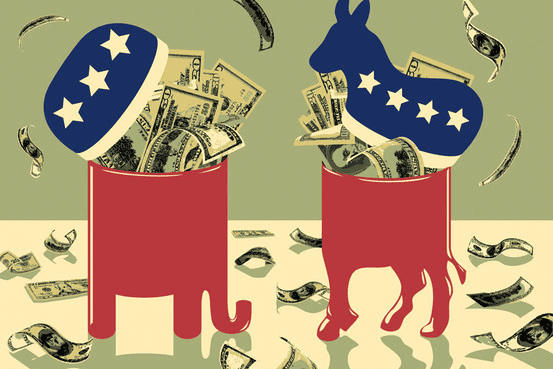
With these 5 political fundraising tools, you’ll be well on your way to running a successful grassroots campaign.
1. GiveWP
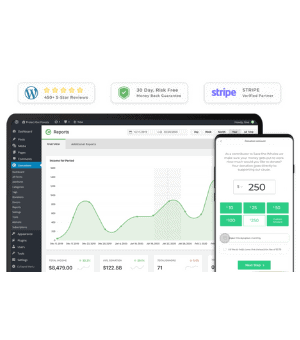
If you’ve ever wondered how political action committees raise big money, GiveWP is for you. The easiest way to collect online donations, this WordPress plugin shows you exactly how your potential donors feel. You can set up statistics for your campaign and track how many people have viewed your page, as well as look into the percentage breakdown of each donation.
GiveWP is specifically built for WordPress sites. Also considered one of the best WordPress donation plugins. With more than 100k+ users using GiveWP for online fundraising, for political fundraisers, it’s a no-brainer solution.
Pricing: You don’t pay fees on your donation, unlike the other platforms. Just pay a nominal platform fee annually and you will be good to go.
Accept Online Donations within minutes.
4 Reasons you should get GiveWP:
- No Fees on Donations
- Easy to set up on your WordPress Website
- Customizable donation forms
- Powerful donor management
2. Indiegogo
Indiegogo is a crowdfunding platform that has been making the headlines lately. But the platform has been around for 10 years, and is one of the most effective ways to get your campaign up and running. Most importantly, it’s easy to use. Start a campaign, set a goal, and share your story. Then, sit back and wait for the donations to roll in.
With an all-in funding fee of just 5% plus 30 cents, it’s one of the most affordable ways to get your message out there. Plus, there are no monthly fees, and no hidden costs.
Once your campaign is finished, make sure to check out the Indiegogo’s Guide to Success. It has 100+ helpful tips for crowdfunders of all kinds.
3. Donorbox
Donorbox is one of the most widely used political fundraising platform in the world. With more than 50,000+ nonprofits showing faith as their preferred online solution, many political organisations have joined in and raised millions of dollars for their political campaigns.
With wide features such as crowdfunding, peer-to-peer, text to give, QR codes, one can easily setup a political fundraising campaign within minutes without any technical know-how.
The best part about Donorbox is its fees. They charge 1.5% fees from the received donations. It is one of the most lowest and affordable political fundraising tool right now. If you compare this with GiveWP, we would recommend Donorbox only because of the features available. The team behind Donorbox is rapidly developing a suite of donation tools to maximize the experience for donors and make it seamless.
Hence, a no-brainer solution for any political organization to sign up.
Donorbox
Start fundraising in 15 minutes (absolutely free)
- Easy to the setup donation page
- Lowest fees of just 1.5% on donations
- Can start fundraising in just 15 minutes
- No technical experience is needed
- Hassle-free donation experience
4. Crowdpac
Crowdpac is a newer platform, and one of the most engaging political fundraising tools available. Not only can you create and manage your own campaign, but you can also get involved in other people’s campaigns.
Become a “crowdfunder” and help out your favorite candidates and causes. It’s a great way to get some campaign experience under your belt, and it’s free to sign up. Get involved with other campaigns, offer technical advice and make some friends along the way.
Once your campaign is over, head on over to the Crowdpac User Dashboard to see the donations you’ve received, as well as the analytics for your campaign. It’s a great way to see what worked, and what could be improved for the next time around.
5. GoFundMe
If you’re looking for a quick and easy way to start collecting donations, try setting up a GoFundMe campaign. All you have to do is write a simple, heartfelt plea on the topic you want to raise money for, select a funding goal, and hit “publish.” From there, you’ll start receiving donations from around the country. You can set up a GoFundMe campaign for just about any cause, and you don’t even have to be a United States citizen.
However, while GoFundMe is a quick and easy way to start a campaign, it’s not always the best option. Many people complain that GoFundMe just trims the edges off of legitimate campaigns, making them look more organized than they are. That might be a good thing if you want to inflate your fundraising numbers, but it can be problematic if you want to receive donations with a specific amount of money.
At the end of the day, no matter which political fundraising tool you choose, the most important factor is to have a good campaign. If you’re willing to put in the effort, you can collect donations through any crowdfunding platform—even if you don’t end up using it.
That’s why it’s more important than ever to have a great campaign. Your fundraising efforts should be focused on reaching your funding goal as quickly as possible while also appealing to your audience. The more your supporters like you, the more they’ll donate.
Our Pick for Political Fundraising Tool: Donorbox
Donorbox
Start fundraising in 15 minutes (absolutely free)
- Easy to the setup donation page
- Lowest fees of just 1.5% on donations
- Can start fundraising in just 15 minutes
- No technical experience is needed
- Hassle-free donation experience
Bottom line
Don’t let the small size of your campaign get in the way of making it big. These top-notch political fundraising tools will help you connect with your constituents and solicit donations from all over the country. Put them to use and you won’t be disappointed with the results.
Every campaign is different, and no two fundraising efforts will be the same. That’s why it’s important to experiment and use multiple fundraising tools. Find the ones that work best for you, and make sure to keep track of the results.
Once you’ve got your platform preferences down, you’ll find that fundraising is a lot less stressful. You’ll be able to focus on telling your story, rather than wondering how you’re going to raise the funds.
Disclaimer: This post may contain affiliate links and we might earn a small commission on qualifying purchases at no additional cost to you. This helps us run this website and share more such valuable posts.
Best Political Fundraising Tools — Platform Selection FAQs
What separates a political fundraising tool that actually scales from one that just collects donations?
High-performing political fundraising platforms share five operational traits that distinguish them from generic donation widgets, and the gap shows up in measurable end-of-cycle revenue. (1) FEC-compliant donor data capture — employer, occupation, address, and citizenship attestation collected on every gift over $200 with field validation that flags incomplete records before the donor exits. (2) Recurring-donor onboarding flow that converts 18–28 percent of one-time donors into monthly sustainers within the first 60 days — the single biggest predictor of cycle revenue is recurring-conversion rate because sustainers retire roughly 65–80 percent of acquisition cost over a 12-month window. (3) ActBlue/WinRed/NGP VAN integration as native rather than bolt-on — campaigns that move donor data manually between platforms lose 8–14 percent of donations to attribution and timing errors. (4) Mobile-first donation forms that complete in under 90 seconds with Apple Pay and Google Pay enabled — mobile conversion rates on optimized forms run 3.4–5.2 percent vs. 1.1–1.8 percent on desktop-first responsive forms. (5) Real-time donor pipeline visibility for the candidate, campaign manager, and finance director with same-day reconciliation rather than weekly batches. Avoid: platforms billed as “all-in-one” without FEC field validation, tools that charge percentage fees above 3.95 percent + $0.30 per transaction, and any system that doesn’t export to standard NGP/ActBlue CSV formats.
How should a federal vs. state vs. local political campaign choose its fundraising tool stack?
Tool selection diverges meaningfully across the three campaign tiers because contribution limits, disclosure thresholds, and donor-acquisition channels operate under different rule sets. (1) Federal campaigns (House, Senate, presidential) overwhelmingly anchor on ActBlue (Democratic) or WinRed (Republican) as the donor-acquisition layer, NGP VAN or i360 as the donor database, and Anedot/Numero or comparable as the secondary processor for ActBlue/WinRed-restricted donors — this stack handles FEC quarterly reporting natively and covers 95+ percent of compliant federal fundraising. (2) State campaigns (governor, state senate, attorney general) use a hybrid stack — ActBlue/WinRed for low-dollar acquisition, but state-disclosure-rule-compliant platforms like RaiseRight, Anedot, or campaign-finance-specialist providers handle state-PAC reporting because state rules vary widely and federal-focused platforms miss state-specific disclosure fields. (3) Local campaigns (mayor, school board, city council) typically operate on simpler stacks — Anedot, DonorsTrust’s campaign tools, or even Stripe + a campaign-finance-aware bookkeeper — because volume is lower and the FEC layer doesn’t apply. Federal-style infrastructure on a $35,000 city-council race wastes money on overhead. (4) PACs and super-PACs operate on dedicated infrastructure (BloomTrac, Encompass, or NGP VAN’s PAC modules) because the disclosure and contribution-limit logic is fundamentally different from candidate committees. Match tier to platform, never inherit a federal-style stack onto a local race. Avoid: running federal races on consumer payment processors like Stripe-direct, mixing state and federal donor data without committee-segregation discipline, and assuming ActBlue or WinRed alone covers all compliance requirements.
How do effective political campaigns combine ActBlue/WinRed with email, SMS, and CRM tools to drive recurring revenue?
End-of-cycle revenue is overwhelmingly determined by how tightly the donation platform integrates with the email-and-SMS acquisition layer and the CRM-and-data layer, not by which donation platform the campaign picks. (1) Email tools that natively integrate with ActBlue or WinRed donor records (NGP VAN, EveryAction, Action Network, Mailchimp with ActBlue webhook, or Iterable in higher-budget operations) let the campaign tag donors by gift size, recency, and frequency and trigger lifecycle flows automatically — campaigns that operate this integration well convert 22–38 percent of first-time small-dollar donors into sustainers, compared to 8–12 percent on disconnected stacks. (2) SMS tools (Hustle, Strike, Spoke, or RumbleUp) generate the highest dollar-per-impression of any channel for political fundraising in the final 14 days of the cycle — campaigns that don’t have SMS infrastructure in place by 90 days before Election Day leave 8–15 percent of total revenue on the table. (3) CRM-and-data layer (NGP VAN, i360, ActionKit) holds the donor history that powers the segmentation — without it the campaign blasts the same ask cadence to the $5 first-time donor and the $2,800 max-out donor, which suppresses both. (4) The bottleneck is rarely the donation platform itself — ActBlue and WinRed both convert at industry-leading rates — it’s the upstream and downstream integrations that determine whether the platform’s capability becomes revenue. Avoid: running email and SMS as disconnected silos, treating CRM as an afterthought, and relying on ActBlue or WinRed’s default templates without customizing the suggested-amount and recurring-conversion modules.
What are the most common political fundraising tool selection mistakes that cost campaigns 10–25 percent in revenue?
Five recurring failure patterns destroy political fundraising ROI and each is measurable against published cycle benchmark data. (1) Picking the platform last — campaigns that select fundraising infrastructure after staffing the field team and the digital team consistently overpay on transaction fees and waste 30–60 days re-keying donor data; the platform decision should anchor the operations plan from day one. (2) Treating ActBlue or WinRed as a complete solution — both are excellent donor-acquisition layers but neither replaces a CRM, an email tool, an SMS tool, or a compliance bookkeeper; campaigns that fail to budget for the supporting stack underperform on recurring-conversion by 40–60 percent. (3) Overpaying on percentage fees — any platform charging above 4 percent + $0.30 per transaction on volume above $50,000/month is overcharging by sector norms; the right scrutiny on fee structure typically saves 0.5–1.5 percent of total revenue, which translates to $25,000–$150,000 on a competitive House campaign. (4) Skipping FEC validation on the donation form itself — campaigns that catch incomplete employer/occupation fields at the FEC-filing stage rather than at the donation stage waste 4–9 percent of staff hours on remediation; build validation into the form. (5) Inheriting the prior cycle’s stack without auditing it — donor expectations, mobile conversion rates, and SMS-deliverability rules all shifted between 2022 and 2024 and again between 2024 and 2026; a stack that worked in the last cycle is probably leaving 8–18 percent on the table this cycle. Avoid: anchoring decisions on what a peer campaign uses without auditing the fit, optimizing the platform without optimizing the upstream and downstream stack, and treating tool selection as an IT decision rather than a revenue decision.