Scalp Cooling Costs and Insurance Coverage in 2026: What Medicare, Four States and HairToStay Will Pay

For ten years scalp cooling sat in the worst possible place in American health care: a device the FDA had cleared, that oncologists recommended, that no insurer would pay for. Patients were quoted two thousand dollars in cash, on top of a cancer diagnosis, and told the answer was no before they asked.
That changed on 1 January 2026, and it changed in two separate ways at once. Medicare now has permanent billing codes for mechanical scalp cooling with published payment rates attached. And a handful of states now require commercial insurers to cover it. Neither change means your bill is zero. Both change what you should say when you call.
This page is about the money. It covers what scalp cooling costs out of pocket right now, what the new codes actually do, which states have mandates and who those mandates leave out, and the two charities that write cheques. If you are past that decision and looking at a wig instead, we cover charities that help with wigs separately, including the insurance language that works there.
The one thing that changed on 1 January 2026
Until the end of 2025, scalp cooling was billed, when it was billed at all, under two temporary Category III CPT codes: 0662T and 0663T. Category III codes are the medical coding equivalent of a learner plate. They exist to collect data on emerging services, they carry no assigned payment rate, and payers are free to ignore them. Most did.
Effective 1 January 2026, 0662T and 0663T were deleted and replaced with three permanent Category I codes. The change is recorded in Medicare billing and coding article A59371, published by the Palmetto GBA contractor and revised on that date for the 2026 annual code update. The article complements local coverage determination L39573 and sits under national coverage determination 110.6.
The language in the article is specific and worth quoting, because it is the sentence your billing office needs: Medicare, it says, is establishing limited coverage for CPT codes 97007, 97008 and 97009. The article then lists 484 ICD-10 diagnosis codes that support medical necessity, every one of them in the malignant neoplasm range from C00.0 to C7B.8. It also carries the standard warning that correct use of a diagnosis code does not by itself assure coverage.
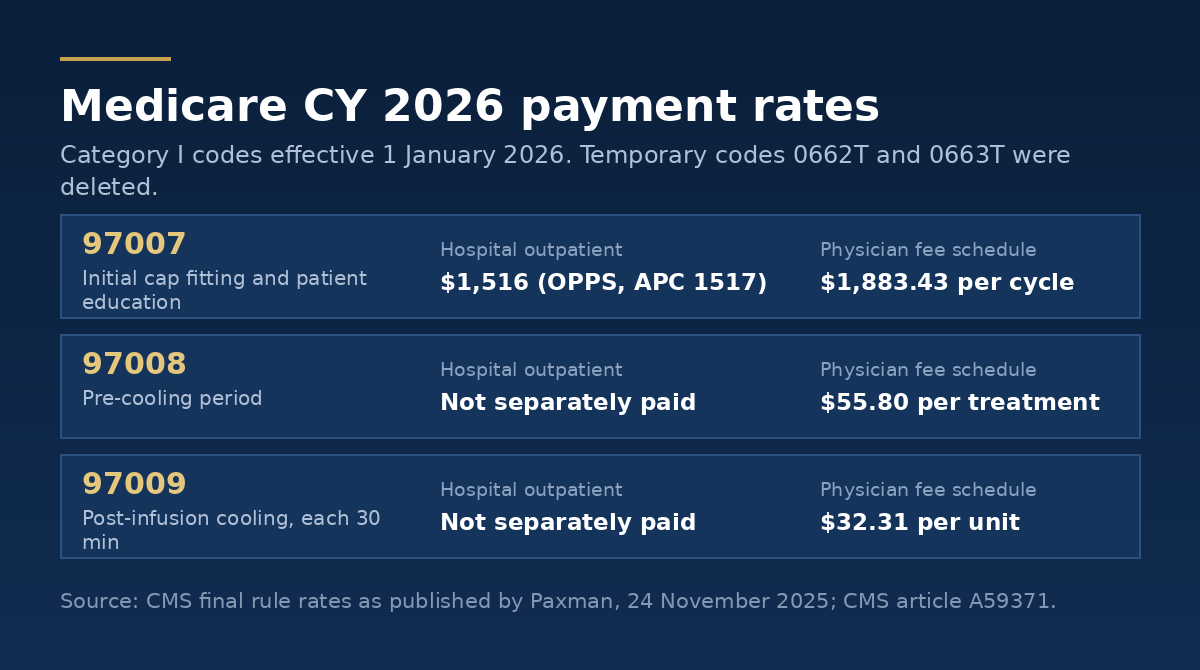
Paxman, one of the two machine manufacturers, announced the finalised Medicare rates on 24 November 2025. Under the hospital outpatient system, 97007 was assigned to ambulatory payment classification 1517 at 1,516 dollars. Under the physician fee schedule the same code pays 1,883.43 dollars per patient per treatment cycle, with 97008 at 55.80 dollars per treatment and 97009 at 32.31 dollars per 30 minute unit. Paxman describes the three codes as initial cap fitting and patient education, the pre-cooling period, and post-infusion cooling per each 30 minute period.
Two cautions, because this is the part people misread. First, those are the manufacturer’s published figures for the CMS final rule, not a quote for your treatment. Second, and more important: a payment rate is not a coverage guarantee. Medicare has established limited coverage, which means coverage under stated conditions, in a contractor jurisdiction, for listed diagnoses. Palmetto GBA’s jurisdictions are Alabama, Georgia and Tennessee, plus South Carolina, Virginia, West Virginia and North Carolina. If you are treated elsewhere, your contractor may have reached a different conclusion, and you need to ask rather than assume.
What it still costs out of pocket
Nothing in the coding change stops a cancer centre from charging you cash today, and most still do. The two machine systems price differently, and both prices are published by the treatment centres rather than hidden behind a quote request.
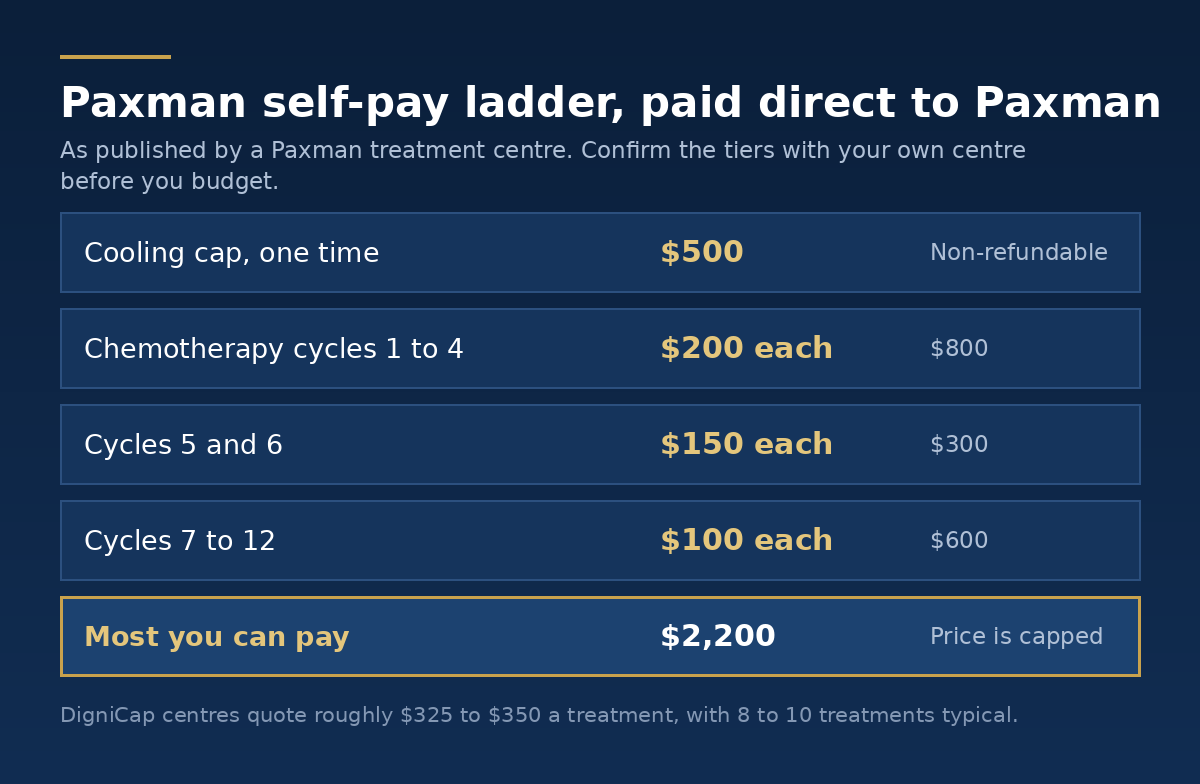
Paxman uses a declining ladder. A Paxman treatment practice publishes it as 500 dollars for the cooling cap itself, then 200 dollars for each of chemotherapy cycles one to four, 150 dollars for cycles five and six, and 100 dollars for cycles seven to twelve. The practice states plainly that you will never pay more than 2,200 dollars, because the price is capped. The arithmetic confirms it: 500 plus 800 plus 300 plus 600 is exactly 2,200.
Payments go directly to Paxman, not to the cancer centre, which is why the centre administering your treatment often cannot answer billing questions about it. The cap itself is non-refundable. Unused cooling credits are refundable once your treating physician completes an enrolment form, so if your chemotherapy regimen is cut short, ask for that form rather than writing the money off.
One warning about those tiers. A second Paxman centre publishes a different split, charging 150 dollars for cycles five through eight and 100 dollars for cycles nine through twelve, which totals 2,300 dollars and exceeds Paxman’s own stated cap. Centre pages drift out of date. Get the ladder in writing from the centre that will actually treat you, and if the total runs past 2,200 dollars, ask why.
DigniCap prices by the treatment rather than by the ladder. The Heartland Cancer Foundation, which funds DigniCap patients, states that treatments typically cost about 325 to 350 dollars each and that patients usually need eight to ten of them. That is roughly 2,600 to 3,500 dollars, higher than the Paxman cap. The National Cancer Institute’s own estimate, published in 2017 and now dated, put the average total at 1,500 to 3,000 dollars depending on cycle count.
Penguin Cold Caps and Cooler Heads both publish pricing pages that our checks could not open from here. We are not going to print a number for either one that we did not read off their own page. Ask them directly, and ask whether the quoted figure is a rental, a purchase, or a per-cycle fee, because the three are not comparable.
The states that now require coverage
Four states have moved, and they did not move the same way. The differences matter more than the headline count.
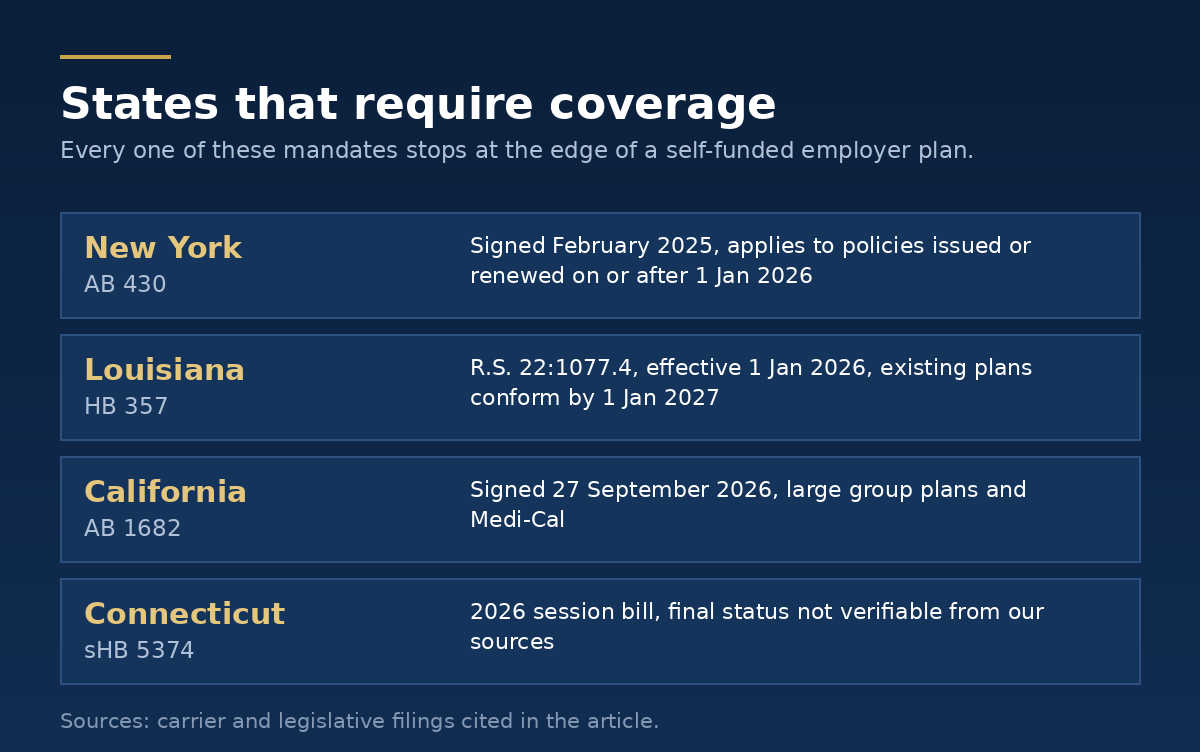
New York passed Assembly Bill 430, signed by Governor Kathy Hochul in February 2025, amending section 3221 of the state insurance law for large group policies and the parallel section for individual policies. It applies to policies issued, renewed, modified, altered or amended in New York on or after 1 January 2026. New York defines large group as employers with 101 or more employees. The statute defines a scalp cooling system as any device used to cool the human scalp to prevent or reduce hair loss during cancer chemotherapy treatment, and requires coverage wherever the policy covers chemotherapy. There is no dollar cap, but coverage may be subject to the policy’s ordinary deductibles, coinsurance and copayments.
Louisiana went further than anyone else and almost nobody has noticed. House Bill 357 of the 2025 regular session enacted R.S. 22:1077.4, titled required coverage for integrative cancer treatments. It covers acupuncture, cryotherapy and scalp cooling systems together, where they are used alongside medical cancer treatment and recommended by nationally recognised cancer treatment guidelines. Its device definition adds two requirements the New York definition does not carry: the device must be designed and intended for repeated use, and primarily and customarily used for a medical purpose. There is no dollar cap. Coverage may be subject to deductibles, coinsurance, copayments and prior authorisation. The act took effect on 1 January 2026 for new policies, and existing policies must conform at renewal and no later than 1 January 2027. Acupuncture, separately, may be limited to fifteen visits a plan year unless guidelines and your physician call for more.
California enacted Assembly Bill 1682, signed by Governor Gavin Newsom on 27 September 2026, reaching large group commercial insurance and Medi-Cal, the state Medicaid programme, and defining covered devices as those cleared by the FDA. Our source for the California detail is a manufacturer press release rather than the enrolled bill, so treat the specifics as provisional and check the legislature’s own text before you rely on them.
Connecticut has a bill, substitute House Bill 5374 of the 2026 session, with an Office of Legislative Research analysis dated 30 March 2026. Several press releases describe Connecticut as having enacted coverage. We could not open the General Assembly’s own files to confirm the final status, so we are not going to tell you it is law. If you are in Connecticut, check cga.ct.gov for HB 5374 before you make a plan around it.
Now the part that will apply to more readers than all four mandates combined. Every state mandate stops at the edge of a self-funded employer plan. Self-funded and level-funded group health plans are governed by federal ERISA law and no state insurance mandate reaches them. Roughly two thirds of Americans with employer coverage are in one. A fully insured group policy issued in another state does not pick up the New York mandate either, even if it covers New York employees. Before you count on a mandate, ask your human resources department one question: is our medical plan fully insured or self-funded. If the answer is self-funded, the mandate is irrelevant to you and the charity route below is your route.
At federal level, the Access to Scalp Cooling Therapy Act was introduced in the 118th Congress as H.R. 8128. It did not become law.
HairToStay: the national subsidy, and the deadlines that lose people the money
HairToStay is the one national nonprofit that subsidises scalp cooling, and its terms are precise enough to plan around. They are also strict enough that patients forfeit money every month by missing them.
The subsidy covers 80 percent of your paid invoices up to a maximum of 1,000 dollars. Donor-targeted funds, which are earmarked for particular medical centres, regions or demographics, typically raise that ceiling to 1,500 dollars. Against a 2,200 dollar Paxman cap, a full standard subsidy takes your real cost to about 1,200 dollars.
To qualify you must be a chemotherapy patient diagnosed with a solid tumour cancer, a full-time United States resident treated at a United States facility, with household income at or below 400 percent of the federal poverty level. Donor-targeted funds run from 400 to 600 percent. For 2026 the income maximum rises by 5,680 dollars for each additional household member in the 48 contiguous states, 7,100 dollars in Alaska and 6,530 dollars in Hawaii. You must be using a system from one of four qualified suppliers: Dignitana, Paxman, Penguin Cold Caps or Cooler Heads.
Blood cancer patients are not eligible. HairToStay states that scalp cooling is not recommended for haematological cancers. This is the single most common reason an application is refused, and it is knowable in advance.
The timing rules are where the money goes missing:
- Costs incurred before your application is approved are not subsidised. Apply before your first chemotherapy session, not after.
- Submit your first treatment invoice within eight weeks of approval or the subsidy is inactivated.
- If it is inactivated you must reapply and pay a 25 dollar application fee.
- Each individual invoice must go in within four weeks of its invoice date.
- The full subsidy must be used within six months of approval. Anything left is gone.
- One subsidy per patient. There is no second bite.
Decisions are usually communicated within a week of a completed application, though the organisation’s own FAQ describes email responses in one to two business days. Apply at hairtostay.org, or call 800-270-1897. The enquiries address is info@hairtostay.org.
The second fund almost nobody lists
The Heartland Cancer Foundation runs a DigniCap Scholarship that works differently from a reimbursement subsidy. Rather than paying a percentage, it issues four discount codes worth 250 dollars each, totalling 1,000 dollars, to be used across four treatments. You pay the remaining balance on each of those four. Against treatments at 325 to 350 dollars, that is most of the cost of four sessions.
The foundation lists five DigniCap treatment locations in Nebraska, in Lincoln and Omaha. Its public page does not state whether applicants must be Nebraska residents and does not publish an income threshold, and we could not read the linked eligibility page, so ask before you assume you are out. The same application form also opens the door to help with housing, fuel, car payments and utilities, which is worth knowing if the cooling bill is not the only one on the table.
If neither fund reaches you, the next stop is the general cancer assistance network rather than another scalp cooling programme. We maintain a current map of charities that help cancer patients with living costs, and a separate guide to charities that help with medical bills for the hospital balances that arrive alongside everything else.
Does it work, and what the numbers actually say
This matters to the money question, because you are deciding whether to spend two thousand dollars on an outcome that is not guaranteed. The honest answer is that scalp cooling works often, not always.
The DigniCap system was first cleared by the FDA in 2015 for breast cancer patients, and the clearance was expanded in 2017 to adults with any solid tumour receiving chemotherapy associated with hair loss. Paxman was cleared in 2017 for breast cancer and expanded to all solid tumours in 2018.
In the study supporting DigniCap’s expanded clearance, of 226 patients, 146 – 65 percent – had no hair loss or only mild hair loss. Sixty-three, 28 percent, chose a wig anyway. In the earlier JAMA study of 122 early-stage breast cancer patients, of the 101 who were cooled, five had no hair loss at all and 62 had less than 50 percent loss, while all 16 patients in the control group lost more than half their hair. The Paxman randomised trial produced a similar shape: all 47 controls lost more than half, while among cooled patients five had no loss and 43 had less than 50 percent.
Dr Dawn Hershman, quoted by the National Cancer Institute, put it plainly: scalp cooling is not 100 percent effective. Roughly a quarter to a third of patients who cool will still want a wig. Budget for the possibility rather than being surprised by it.
The tax route, and its limits
Scalp cooling you pay for yourself is a medical expense. Under IRS Publication 502 rules, unreimbursed medical expenses are deductible to the extent they exceed 7.5 percent of adjusted gross income, and only if you itemise. Publication 502 does not name scalp cooling specifically, which means you are relying on the general medical device and treatment category rather than a listed item, so keep the physician’s recommendation with the invoices.
Be realistic about the size of this. Two thousand dollars of cooling against a 60,000 dollar income clears the 7.5 percent floor only if you have other medical spending in the same year, which during cancer treatment you almost certainly do. Add it to the pile rather than treating it as a standalone deduction. Note also that any amount HairToStay reimburses is not yours to deduct.
Build the packet once
Everything above resolves into one sequence, and the order is not arbitrary. Doing step four before step two is how people lose the subsidy.
- Ask your oncologist before your first infusion whether scalp cooling is appropriate for your regimen and your diagnosis. Solid tumour only, and the timing has to work with your first cycle.
- Apply to HairToStay now, before any cooling bill is incurred. Nothing before approval is subsidised. This is the step with the hardest deadline and the least flexibility.
- Ask human resources whether your plan is fully insured or self-funded. One sentence, and it decides whether any state mandate applies to you at all.
- If you are fully insured in New York, Louisiana or California, ask your carrier in writing to confirm coverage under the state mandate, and ask whether prior authorisation is required. Louisiana expressly permits prior authorisation, so do not let a request for it read as a denial.
- Give your billing office the code numbers. 97007, 97008 and 97009, Category I as of 1 January 2026, replacing the deleted 0662T and 0663T. A billing office still looking for 0662T will come back empty and report it as not covered.
- Get the self-pay ladder in writing from your own centre and check the total against Paxman’s 2,200 dollar cap.
- Keep every invoice and submit each one within four weeks of its date. Scan them the day they arrive.
Related help
- Charities that help with wigs – for when cooling is not an option or not enough, including the cranial prosthesis billing language.
- Charities that help with medical bills – the hospital balances that arrive alongside the cooling quote.
- Charities that help cancer patients – rent, utilities and living costs during treatment.
- Charities that help with transportation – rides to chemotherapy, including the longer appointments cooling adds.
- Charities for alopecia – for hair loss that is not chemotherapy related.
- Free financial assistance organizations – the wider map when the cooling bill is not the only one.
Frequently asked questions
Does insurance cover scalp cooling in 2026?
Sometimes, and it depends on three things in this order. First, whether your plan is fully insured or self-funded: no state mandate reaches a self-funded employer plan, and about two thirds of people with employer coverage are in one. Second, whether your state has a mandate. New York, Louisiana and California have enacted coverage requirements, and Connecticut has a 2026 bill whose final status we could not confirm. Third, whether your billing office is using the right codes. Mechanical scalp cooling moved to permanent Category I CPT codes 97007, 97008 and 97009 on 1 January 2026, replacing the deleted temporary codes 0662T and 0663T.
How much does scalp cooling cost out of pocket?
Paxman publishes a capped ladder: 500 dollars for the cooling cap, 200 dollars each for chemotherapy cycles one to four, 150 dollars for cycles five and six, and 100 dollars for cycles seven to twelve, with a stated maximum of 2,200 dollars. Payments go directly to Paxman rather than to the cancer centre. DigniCap prices by the treatment, at roughly 325 to 350 dollars each with eight to ten treatments typical, which puts the total around 2,600 to 3,500 dollars. The National Cancer Institute put the average at 1,500 to 3,000 dollars, but that estimate dates from 2017.
What are CPT codes 97007, 97008 and 97009?
They are the permanent Category I CPT codes for mechanical scalp cooling, effective 1 January 2026. Paxman describes them as initial cap fitting and patient education, the pre-cooling period, and post-infusion cooling per each 30 minute period. They replace temporary Category III codes 0662T and 0663T, which were deleted in the same update. Give these numbers to your billing office: a billing office still searching for 0662T will find nothing and report the service as not covered.
Does Medicare pay for scalp cooling?
Medicare billing and coding article A59371, revised 1 January 2026, states that Medicare is establishing limited coverage for CPT codes 97007, 97008 and 97009, and lists 484 malignant neoplasm diagnosis codes that support medical necessity. Paxman reported the finalised 2026 rates as 1,516 dollars for 97007 under the hospital outpatient system in payment classification 1517, and 1,883.43 dollars per patient per treatment cycle under the physician fee schedule, with 55.80 dollars per treatment for 97008 and 32.31 dollars per 30 minute unit for 97009. Limited coverage means coverage under stated conditions, and the article in question comes from the Palmetto GBA contractor, so confirm the position of the contractor covering your own state.
Which states require insurance to cover scalp cooling?
New York Assembly Bill 430 was signed in February 2025 and applies to policies issued, renewed, modified, altered or amended on or after 1 January 2026. Louisiana House Bill 357 enacted R.S. 22:1077.4, effective 1 January 2026 for new policies with existing policies conforming at renewal and no later than 1 January 2027. California Assembly Bill 1682 was signed on 27 September 2026 and reaches large group commercial plans and Medi-Cal. Connecticut has substitute House Bill 5374 from the 2026 session, and we could not verify its final status. None of these mandates reaches a self-funded employer plan.
Who pays for scalp cooling if my insurance will not?
HairToStay is the national subsidy. It covers 80 percent of paid invoices up to 1,000 dollars, or up to about 1,500 dollars through donor-targeted funds, for solid tumour chemotherapy patients at or below 400 percent of the federal poverty level who are using a Dignitana, Paxman, Penguin Cold Caps or Cooler Heads system. Apply before your first session, because costs incurred before approval are not subsidised. The Heartland Cancer Foundation separately runs a DigniCap Scholarship issuing four discount codes of 250 dollars each, 1,000 dollars in total, across four treatments.
Why are blood cancer patients not eligible for the HairToStay subsidy?
HairToStay restricts the subsidy to patients diagnosed with a solid tumour cancer and states that scalp cooling is not recommended for haematological cancers. This is the most common avoidable reason an application is refused, and it is knowable before you apply. The FDA clearances for both DigniCap and Paxman are likewise written for solid tumours.
Does scalp cooling actually work?
Often, not always. In the study supporting the expanded DigniCap clearance, 146 of 226 patients, 65 percent, had no hair loss or only mild hair loss, while 63 of them, 28 percent, chose a wig anyway. In the earlier JAMA study, of 101 cooled patients five had no hair loss and 62 had less than 50 percent loss, against all 16 controls losing more than half. In the Paxman randomised trial, all 47 controls lost more than half, while among cooled patients five had no loss and 43 had less than 50 percent. Dr Dawn Hershman, quoted by the National Cancer Institute, said that scalp cooling is not 100 percent effective.